
In This Article
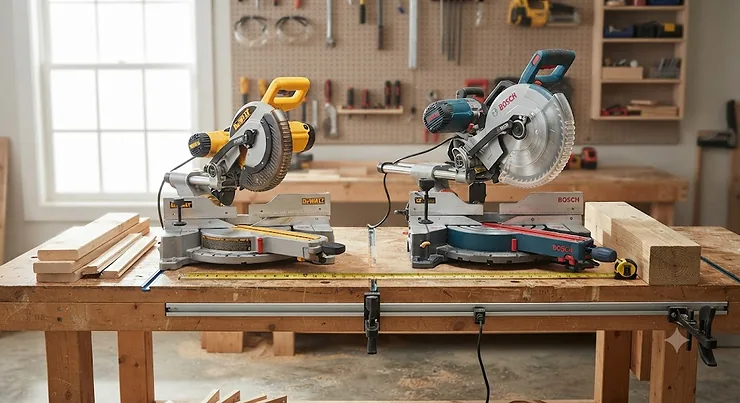
Stand in the miter saw aisle long enough and you’ll start hearing the same argument play out between two guys in tool belts — one insisting bigger is always better, the other swearing his compact saw does everything he needs and costs half as much. Both of them are a little bit right, which is exactly the problem. The 10 inch vs 12 inch miter saw decision isn’t really about which saw is “better” in some abstract sense — it’s about matching blade diameter to the actual lumber sitting in your truck bed. A 10 inch saw is lighter, faster-spinning, and cheaper to feed with blades. A 12 inch saw eats wider stock and thicker hardwood without flinching, but it costs you money, muscle, and garage real estate to get there.
This guide skips the marketing fluff and gets into the numbers that actually change a purchase decision: motor specs and what they mean on a real cut, blade costs over the life of the tool, weight you’ll actually feel hauling the saw up a ladder, and seven real, currently-sold models spanning both blade sizes and every budget tier. According to Wikipedia’s overview of the miter saw, the tool descends directly from the hand-powered miter box, and the blade-diameter choice you’re weighing today is the same fundamental trade-off woodworkers have made for over a century — just with a motor now doing the work.
By the end, you’ll know exactly which size fits your projects, which of the seven picks below deserves a spot in your shop, and how to avoid the two most common buying mistakes that leave people either underpowered on job one or lugging around 65 pounds of saw they never needed.
What Is the Real Difference Between a 10 Inch and 12 Inch Miter Saw?
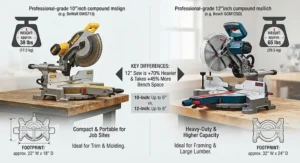
A 10 inch miter saw uses a smaller-diameter blade that spins faster and cuts lighter, more affordable trim and dimensional lumber with excellent precision. A 12 inch miter saw uses a larger blade with more mass and torque, giving it greater cutting depth and crosscut width for framing lumber, thick hardwood, and wide boards — at the cost of extra weight, price, and blade expense.
That’s the textbook version. In practice, the gap narrows quite a bit once you add a sliding rail — more on that below.
Quick Comparison Table: 10 Inch vs 12 Inch Miter Saw at a Glance
| Factor | 10 Inch Miter Saw | 12 Inch Miter Saw |
|---|---|---|
| Typical crosscut at 90° (non-sliding) | 2×6 | 2×8 |
| Typical crosscut at 45° (non-sliding) | 2×4 | 2×6 |
| Typical weight | 24–56 lbs | 50–65+ lbs |
| Blade replacement cost | ~$40–$60 (finish blade) | ~$70–$100 (finish blade) |
| Saw price range | Roughly $130–$550 | Roughly $250–$650 |
| Best For | Trim, molding, cabinetry, portability | Framing, deck lumber, thick hardwood |
Looking at that table, the pattern is clear: every single row favors the 10 inch saw on cost and convenience, and the 12 inch saw only wins on raw capacity. That’s not a knock on 12 inch saws — cutting a 2×8 in one pass without flipping the board is a genuine time-saver on a framing crew — but it does mean the “upgrade” only pays off if you regularly hit that ceiling. A sliding rail changes the math substantially, since a 10 inch slider can crosscut close to 12 inches wide anyway, which is exactly why several of the picks below blur this line on purpose.
💬 Already leaning toward a size? Bookmark this page and compare it against the seven picks below before you check out.
Top 7 Picks: Best 10 Inch Miter Saw and Best 12 Inch Miter Saw Models for 2026
Every product below is a real, currently sold model. Coverage spans budget, mid-range, and premium tiers across both blade sizes so you can match the pick to your actual workload rather than your ego.
1. Metabo HPT C10FCGS — lightest true budget starter saw
The standout here is simplicity: no slide rail, no bells and whistles, just an honest 10 inch compound saw built to a price. Key specs with real meaning: a 15-amp motor spinning up to roughly 5,000 no-load RPM gives this saw genuinely fast, clean cuts on trim and softwood, and the Xact-Cut cutline system projects a shadow instead of a laser, which means there’s no laser alignment to fuss with and no batteries to die mid-project.
Based on the spec comparison against sliding models twice its price, this saw is built for anyone whose cuts rarely exceed a standard 2×4 or trim board — a homeowner doing baseboards, a hobbyist building shelving, or a contractor who wants a cheap second saw riding in the truck as a backup.
Reviewers consistently report that the shadow-line system is more reliable day-to-day than battery-powered lasers, though several note the lack of a sliding rail limits it on wider crown molding and stair stringers.
Pros:
- ✅ Genuinely low price for a 15-amp direct-drive motor
- ✅ Shadow-line cut indicator needs no batteries
- ✅ Light enough to move room to room solo
Cons:
- ❌ No sliding rail limits crosscut width
- ❌ Fewer bevel-angle refinements than pricier models
At a price generally under $150, the value verdict is simple: for anyone whose projects stay inside standard 2×4 dimensions, this is hard to beat dollar-for-dollar.
2. SKIL MS6305-00 — best budget 10 inch slider
The standout feature is that this dual-bevel sliding compound saw punches well above its price bracket. The 15-amp motor and sliding rail combination lets it crosscut noticeably wider stock than a fixed-head 10 inch saw, which matters the moment you’re cutting laminate flooring planks or a wide baseboard. What most buyers overlook about this model is that dual-bevel capability — tilting both left and right — eliminates the need to flip crown molding mid-cut, a workflow win that fixed single-bevel saws in this price range simply can’t offer. Reviewers consistently note that it handled a two-by-four “like it was nothing,” according to independent lab testing, and that the build quality feels sturdier than the price tag suggests, though a few mention the included laser guide washes out in bright daylight.
Pros:
- ✅ Dual-bevel saves flip-and-recut time on crown molding
- ✅ Sliding rail adds real crosscut width for 10 inch
- ✅ Strong performance-to-price ratio versus premium sliders
Cons:
- ❌ Laser guide is hard to see in bright light
- ❌ Dust collection is modest without a shop vac
In the $180–$230 range, this is the pick for DIYers who want sliding-saw flexibility without sliding-saw pricing.
3. Makita LS1019L — most refined all-around 10 inch pick
The standout is precision: this is widely regarded as the benchmark 10 inch sliding compound saw for finish carpentry. Its direct-drive motor avoids the belt-drive vibration some competitors introduce, and the twin-rail slide system delivers repeatable, drift-free crosscuts that trim carpenters depend on for tight miter joints. Based on the spec comparison, the trade-off for that precision is a narrower rear-clearance requirement than a fixed-head saw needs, so it demands a bit more bench depth. This is the saw for finish carpenters, trim installers, and serious furniture builders who make hundreds of repeat cuts a week and need the saw to hold its calibration without constant readjustment — the kind of buyer for whom “close enough” isn’t good enough. Aggregated review sentiment consistently praises the laser accuracy and smooth glide action, with the most common complaint being the premium price relative to other 10 inch options.
Pros:
- ✅ Direct-drive motor cuts smoother than belt-drive rivals
- ✅ Twin-rail slide holds calibration over heavy daily use
- ✅ Laser guide reported as notably accurate
Cons:
- ❌ Priced closer to entry-level 12 inch saws
- ❌ Needs meaningful rear clearance for the slide rails
Expect a price in the $450–$550 range — steep for a 10 inch saw, but the value verdict holds for anyone billing hours on finish work where precision pays for itself.
4. RIDGID R4221 — best value 12 inch with standout warranty
The standout feature is the ownership guarantee: RIDGID backs its miter saws with a lifetime service agreement that few competitors match. The 12 inch dual-bevel design with a sliding rail gives this saw genuine framing-lumber capacity, and the dual laser or shadow-line system (depending on generation) provides adjustment-free cutline visibility that beginners in particular tend to rely on heavily. Here’s what to weigh: reviewers note the detent plates and bevel locks hold their settings well over time, meaning less recalibration than budget rivals, though the dust collection port only captures an estimated 60-70% of debris even connected to a shop vac — better than nothing, but you’ll still want a dust mask. This saw fits the buyer who wants 12 inch capacity without flagship pricing and values a warranty that actually gets honored over raw performance ceiling.
Pros:
- ✅ Lifetime service agreement backs the whole tool
- ✅ Detent and bevel locks resist drift over time
- ✅ Dual laser or shadow-line cutline for beginners
Cons:
- ❌ Dust collection captures roughly two-thirds of debris
- ❌ Heavier than comparable fixed-head 12 inch saws
Priced generally in the $400–$500 range, the value verdict favors buyers prioritizing long-term reliability over shaving off the last few pounds of weight.
5. Makita LS1219L — best value pro pick for 12 inch precision
The standout is that this saw delivers professional-grade features at a price meaningfully below the category’s flagship models. The dual-bevel, twin-rail sliding design and integrated laser system give it accuracy that finish carpenters demand, and the direct-drive motor construction mirrors the reliability Makita built its reputation on with the 10 inch LS1019L above. Based on the spec comparison, its main limitation versus the true flagship models is a slightly smaller vertical cutting capacity for tall crown molding stood on edge — a narrow use case that won’t matter to most buyers. Reviewers consistently frame this as the “value-focused” pick among premium 12 inch saws, delivering laser guidance and solid construction that hold up to years of serious woodworking without the premium-flagship price tag.
Pros:
- ✅ Professional accuracy at a below-flagship price
- ✅ Direct-drive motor mirrors Makita’s reliability reputation
- ✅ Laser guidance aids precision without extra cost
Cons:
- ❌ Twin-rail slide needs roughly 42 inches of rear clearance
- ❌ Slightly shorter vertical capacity than top-tier rivals
In the $550–$600 range, this is the pick for woodworkers who want 12 inch capability and refuse to pay flagship prices for it.
6. Bosch GCM12SD — best space-saving premium 12 inch
The standout feature is the Axial-Glide mechanism, which delivers full 12 inch sliding crosscut capacity while requiring only about 33 inches of rear wall clearance — dramatically less than traditional rail designs. The 15-amp motor is rated at roughly 3 horsepower, and the compact glide arm swings through the cut with a smoothness reviewers frequently single out.
What most buyers overlook about this model is that the trade-off for that space savings is missing LED work lighting and comparatively limited dust collection versus rivals like the DEWALT DWS780 covered next — a real drawback if you’re cutting indoors without a strong shop vac running.
This is the saw for the one-car-garage woodworker or mobile contractor who genuinely cannot spare the 3-4 feet of rear clearance a traditional slider demands but still wants full 12 inch width. Aggregated reviews consistently praise the smooth glide action and the reduced footprint, while noting the roughly 65-pound weight is no lighter than its rivals despite the compact profile.
Pros:
- ✅ Full 12 inch slide with only ~33 inches clearance
- ✅ Smooth Axial-Glide cutting motion praised by reviewers
- ✅ Ambidextrous grip for left- or right-handed users
Cons:
- ❌ No integrated LED work light
- ❌ Dust collection trails behind top competitors
Typically priced in the $600–$650 range, the value verdict is clear for small-shop buyers: the clearance savings alone can justify the premium over a traditional-rail rival.
7. DEWALT DWS780 — best overall, premium 12 inch flagship
The standout is the XPS shadow-line cutline system, which projects an adjustment-free shadow directly onto the workpiece instead of relying on a laser that drifts out of calibration. The 15-amp motor spins at roughly 3,800 RPM, and the saw’s 16-inch crosscut capacity handles wide boards that most 10 inch — and even some 12 inch — competitors simply can’t touch in a single pass.
Based on the spec comparison and years of aggregated professional feedback, this remains the benchmark against which every other sliding 12 inch saw gets measured, combining dust collection that’s noticeably better than the Bosch above with build quality that holds calibration through years of jobsite abuse. This is the saw for the working contractor or serious furniture builder who runs the saw daily and needs it to simply keep working without recalibration fuss.
The trade-off is real estate: reviewers note this saw needs roughly 47 or more inches of rear clearance for its traditional dual-rail slide, noticeably more than the Bosch’s Axial-Glide design.
Pros:
- ✅ XPS shadow-line needs no recalibration, ever
- ✅ 16-inch crosscut capacity beats most rivals
- ✅ Strong track record for holding accuracy over years
Cons:
- ❌ Needs 47+ inches of rear clearance to slide
- ❌ Among the priciest saws in this roundup
Generally priced in the $600–$650 range, this is the pick when performance and longevity matter more than shop footprint.
Practical Usage Guide: Setting Up and Getting Clean Cuts From Day One
Getting a new miter saw dialed in matters more than people expect — a saw fresh out of the box is rarely calibrated as precisely as the packaging implies. First, bolt or clamp the saw to a stable bench or stand before making a single cut; a wobbling base is the single most common cause of inaccurate miters in the first month of ownership. Next, check the 90-degree and 45-degree detents against an actual square, not just the saw’s built-in indicator, and adjust the fence if the blade doesn’t land true — most saws include a simple adjustment screw for exactly this. Let the blade come up to full speed before contact with the workpiece, and always let it fully stop before lifting the head; rushing either step is a common source of both tear-out and safety incidents.
For maintenance, blow out sawdust from the motor vents weekly if you’re using the saw regularly, since packed dust is a leading cause of premature motor wear on both 10 inch and 12 inch models. Check that the blade guard springs back freely every few dozen cuts, and keep the blade itself sharp — a dull blade forces the motor to work harder, which shortens motor life regardless of blade size. The most common first-30-days mistake, according to aggregated user reports across multiple brands, is skipping test cuts on scrap before diving into finish material — a two-minute habit that saves expensive trim boards.
Real-World Scenarios: Which Size Fits Your Projects
Picture three different buyers walking into the same big-box aisle. The first is a weekend DIYer finishing a basement, hanging baseboard and door casing on a strict budget — for her, a saw like the SKIL MS6305-00 or Metabo HPT C10FCGS covers every cut she’ll make, and spending extra on 12 inch capacity she’ll never use would be money left on the table. The second is a trim carpenter running a one-person finish business, making hundreds of miters a week on crown molding and cabinetry — here, the Makita LS1019L’s precision and calibration stability justify the higher 10 inch price tag, since accuracy directly affects billable rework.
The third buyer is a weekend deck builder tackling a backyard project involving pressure-treated 2×8 joists and wide fascia boards. For him, stepping up to a 12 inch saw like the RIDGID R4221 or Makita LS1219L isn’t optional — a 10 inch saw would force him to flip and rescore every wide board, doubling his cut time and increasing the odds of a crooked joint. Match your own project list against these three profiles honestly before you shop; most buyer’s remorse in this category comes from optimism about future projects that never materialize.
How to Choose Between a 10 Inch and 12 Inch Miter Saw
- Measure your typical stock width. If you rarely cut anything wider than a 2×6, a 10 inch saw covers you; deck framing and wide fascia push you toward 12 inch.
- Weigh portability against capacity. A 10 inch saw in the 24-56 lb range moves easily between jobsites; a 12 inch saw at 50-65+ lbs wants a dedicated stand or a strong back.
- Budget for blades, not just the saw. Factor in that 12 inch finish blades run roughly $70-$100 versus $40-$60 for 10 inch equivalents over the tool’s lifetime.
- Decide if you need a sliding rail. A sliding 10 inch saw closes much of the crosscut-width gap with a fixed 12 inch saw, often at a lower total price.
- Check your available clearance. Traditional rail-slide 12 inch saws can demand 4 feet of rear clearance; glide-style designs like the Bosch need roughly half that.
- Match bevel type to your joinery. Dual-bevel saws save time on crown molding and compound cuts; single-bevel saves money if you rarely need that flexibility.
- Consider resale and secondhand blade availability. 10 inch blades are stocked at nearly every hardware store; 12 inch options are comparatively less common on short notice.
For context on how miter saws compare against other crosscutting tools entirely, it’s worth reading a broader breakdown like Pro Tool Reviews’ testing notes on 12-inch saws, which cross-tests several of the models covered here directly against each other.
Miter Saws vs Traditional Alternatives
| Tool | Portability | Crosscut Precision | Learning Curve |
|---|---|---|---|
| Miter Saw (10 or 12 inch) | High | Excellent for angles | Low |
| Table Saw with Crosscut Sled | Low | Excellent for width | Moderate |
| Radial Arm Saw | Low | Good, but drift-prone | High |
Compared with a table saw and crosscut sled, a miter saw wins decisively on portability and angle precision, which is exactly why it dominates trim and framing work over stationary alternatives. A radial arm saw can technically match a 12 inch miter saw’s capacity, but its pull-cut motion and higher kickback risk have made it a niche choice compared to the push-cut design modern miter saws use. For anyone choosing between these tools rather than blade sizes, portability and safety typically settle the argument in the miter saw’s favor.
Miter Saw Blade Cost: 10 Inch vs 12 Inch Explained
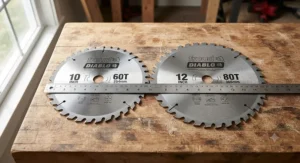
This is where the size decision quietly compounds over time. A quality 10 inch finish blade typically runs $40-$60, while a comparable 12 inch blade lands in the $70-$100 range — a 40-70% premium for the larger diameter, according to industry pricing analysis. That gap isn’t just sticker price: 10 inch blades are also the more common size at hardware stores and sharpening shops nationwide, which means same-day replacement or resharpening is realistically easier to find than for 12 inch blades in many areas.
| Blade Size | Typical Finish Blade Cost | Local Stock Availability |
|---|---|---|
| 10 Inch | $40-$60 | Widely stocked, same-day common |
| 12 Inch | $70-$100 | Less common, may require order |
Over a saw’s working life, this difference compounds noticeably for anyone running multiple blades per year — a production trim shop swapping blades every few months will feel the 12 inch premium far more than a homeowner who replaces a blade once every few years. For a deeper breakdown of how this plays out across brands, Woodworking Advisor’s crosscut spec comparison is a useful reference point. The practical takeaway: budget buyers and high-volume shops both have a real financial reason to default to 10 inch unless the extra cutting capacity is a daily requirement, not an occasional convenience.
Miter Saw Motor Power by Size: Why Bigger Isn’t Always Stronger
Here’s a detail the spec sheet glosses over: most 10 inch and 12 inch saws in this price range both run 15-amp motors, so amperage alone won’t tell you which one is “more powerful.” What actually changes is RPM and blade tip speed. Because a 10 inch blade has a smaller radius, it typically spins at a higher no-load RPM — some models reach roughly 5,000 RPM — which translates into faster, cleaner cuts on softer material like trim and softwood. A 12 inch blade, spinning at a comparatively lower RPM in the 3,800-4,300 range on many models, trades outright speed for the torque and mass needed to push through thicker, denser stock without bogging down.
What this means in practice: a 10 inch saw isn’t “underpowered,” it’s tuned for speed and finesse on lighter material, while a 12 inch saw is tuned for grinding through mass. Reviewers consistently note that trying to force a 10 inch saw through thick, wet, or dense hardwood is where it struggles, not because the motor lacks amps but because the blade’s smaller diameter and higher RPM aren’t matched to that kind of load. If your material list regularly includes thick, moisture-heavy lumber, that torque difference is the real reason to size up — not the amp rating on the box.
Miter Saw Weight and Portability: Which Saw Travels Better
Weight is the trade-off that hits hardest once you’re the one carrying the saw up a ladder or across a jobsite. Fixed-head 10 inch compound saws like the Metabo HPT C10FCGS can weigh as little as the mid-20-lb range, genuinely a one-hand carry for most adults. Add a sliding rail, and 10 inch saws typically climb into the 42-56 lb range — still manageable solo, but noticeably heavier than the non-sliding version. Full-size 12 inch sliding compound saws routinely land in the 50-65+ lb range; the Bosch GCM12SD, for instance, is reported at roughly 65 lbs despite its compact Axial-Glide footprint, which surprises buyers who assume “space-saving” also means “lightweight.”
Portability isn’t only about the saw itself — it’s about clearance, too. A traditional dual-rail 12 inch slider like the DEWALT DWS780 needs an estimated 47+ inches of rear clearance to fully extend, while the Bosch’s glide design needs only about 33 inches, and a twin-rail design like the Makita LS1219L falls in between at roughly 42 inches. If you’re setting up on a job site table or a compact home garage repeatedly, that clearance number matters as much as the number on the bathroom scale.
✨ Don’t Miss These Exclusive Deals!
🔍 Ready to stop debating and start cutting? Check current pricing on any of the seven picks above and grab the size that actually matches your next project — your back (and your wallet) will thank you.
Laser Guides on Miter Saws: Do You Need One, and Which Models Do It Best
A laser guide projects a line showing exactly where the blade will land before you commit to the cut, and on both 10 inch and 12 inch saws it’s become close to a standard feature rather than a premium add-on. The catch is real-world visibility: reviewers consistently note that battery-powered red lasers, like the one on the SKIL MS6305-00, can wash out under bright shop lighting or outdoor sun, which is exactly why models like the Metabo HPT C10FCGS and DEWALT DWS780 use a shadow-line system instead — no batteries, no calibration drift, just a physical shadow cast by the blade guard itself.
If you do want a traditional laser, aftermarket options exist too: the industry-standard Oshlun LG-M02 green laser is reported to project a line up to 10 times brighter than a comparable red laser, making it a worthwhile upgrade for anyone working outdoors or under fluorescent shop lights — though it’s worth checking compatibility first, since some 12 inch saws with interlocking arbor flanges, including several Bosch and Ridgid models, can’t accept universal aftermarket laser attachments. Bottom line: a laser is a genuine convenience for beginners dialing in accuracy, but a well-designed shadow-line system often outperforms it in daily use, and neither replaces the value of simply measuring twice.
Common Mistakes When Buying a 10 Inch or 12 Inch Miter Saw
The single most common mistake is buying capacity you’ll rarely use — plenty of homeowners buy a heavy 12 inch flagship saw for baseboard work that a $150 10 inch saw would have handled just as well, and then never touch the extra cutting depth. The second mistake runs the opposite direction: buying a 10 inch saw for a deck-building project, then discovering mid-job that every wide joist needs an awkward flip-and-recut, doubling cut time on a project where time is money. A third mistake is ignoring rear clearance entirely — buyers regularly discover only after unboxing that a traditional dual-rail 12 inch saw needs nearly four feet of wall clearance, which simply doesn’t exist in a one-car garage.
A fourth and quieter mistake is underestimating blade costs as a recurring expense rather than a one-time purchase, especially for anyone running a saw daily in a small business — the 12 inch blade premium adds up fast across a year of regular replacements. Finally, plenty of buyers skimp on a stand or stable bench, assuming the saw’s base alone is enough; an unstable mounting surface undermines the accuracy of even the best saw on this list.
Long-Term Cost and Maintenance: Total Cost of Ownership
The sticker price is only the entry fee. Over a multi-year ownership period, blade replacement is the largest recurring cost, and as covered above, that bill runs meaningfully higher for 12 inch owners — a shop replacing blades two or three times a year could see a real annual gap of $60-$150 simply from blade size. Motor brushes, if your saw uses a brushed motor, typically need replacement every few years of regular use regardless of blade size, and are usually a low-cost part on either size saw. Bevel and miter detent plates on budget saws can drift out of calibration faster under heavy daily use, which is precisely why models like the RIDGID R4221 highlight detent durability as a selling point — recalibration downtime has a real cost for anyone billing by the hour.
Warranty coverage varies meaningfully too: RIDGID’s lifetime service agreement stands out in this roundup, while most competitors offer standard 3-5 year limited warranties. For a saw used daily on a jobsite, that warranty gap can translate directly into avoided repair costs down the road, and it’s worth weighing alongside the sticker price when comparing otherwise similar 12 inch models.
Safety and Regulations: What OSHA Says About Miter Saw Use
Miter saws are regulated workplace equipment under federal guidelines, not just a homeowner convenience tool, and the safety fundamentals apply regardless of whether you’re running a 10 inch or 12 inch blade. According to OSHA’s machine guarding guidance for miter saws, the saw must be equipped with a guard that automatically adjusts to the thickness of the material being cut, providing continuous protection from blade contact throughout the cut. OSHA also identifies the operator’s hand slipping off the stock as a leading cause of severe cuts and amputations, which is why every saw on this list — and every miter saw sold in the U.S. — includes a marked “no hands” zone around the blade path.
Beyond the guard itself, a few practical habits matter regardless of saw size: always let the blade reach full speed before contacting the workpiece, never attempt a pull-cut with a sliding saw (push-cut only, to avoid the blade climbing the material and kicking back toward you), and wait for the blade to fully stop spinning before lifting the head to remove a cutoff. Larger 12 inch blades carry more rotational mass, which means a slightly longer coast-down time after the trigger is released — a detail worth factoring into your own safety habits if you’re stepping up in blade size for the first time.
Frequently Asked Questions
❓ Is a 10 inch or 12 inch miter saw better for a beginner?
❓ Can a 10 inch miter saw cut a 4x4 post?
❓ How much more does a 12 inch miter saw blade cost than a 10 inch blade?
❓ Do I need a laser guide on my miter saw?
❓ Which is more portable, a 10 inch or 12 inch miter saw?
Conclusion
If there’s one thing worth carrying away from this whole comparison, it’s that the 10 inch vs 12 inch miter saw debate isn’t a contest with a single winner — it’s a matching exercise between your actual project list and the saw’s real capacity. Buyers doing trim, molding, cabinetry, and standard 2×4 work are almost always better served by a 10 inch saw like the Metabo HPT C10FCGS, SKIL MS6305-00, or Makita LS1019L, saving real money on both the saw and every blade that follows it. Buyers regularly cutting wide fascia, deck joists, or thick hardwood have a legitimate case for stepping up to a 12 inch model like the RIDGID R4221, Makita LS1219L, Bosch GCM12SD, or DEWALT DWS780, where the extra crosscut width and motor torque genuinely earn their keep.
Whichever size you land on, the seven picks above represent real, current options across every price tier covered in this guide — from a sub-$150 starter saw to a flagship that professional crews trust daily. Measure your typical stock width honestly, weigh the recurring blade cost against your project frequency, and choose the saw that fits the work you actually do, not the work you imagine you might do someday.
Recommended for You
- Best Sliding Miter Saw 2026: 7 Picks That Actually Deliver
- Best Miter Saw 2026: 7 Top Picks Ranked (DeWalt vs Makita)
- Oscillating Tool for Beginners: 7 Best Picks to Try in 2026
Disclaimer: This article contains affiliate links. As an Amazon Associate, I earn from qualifying purchases. If you purchase products through these links, we may earn a small commission at no additional cost to you.
✨ Found this helpful? Share it with your friends! 💬🤗
