
In This Article
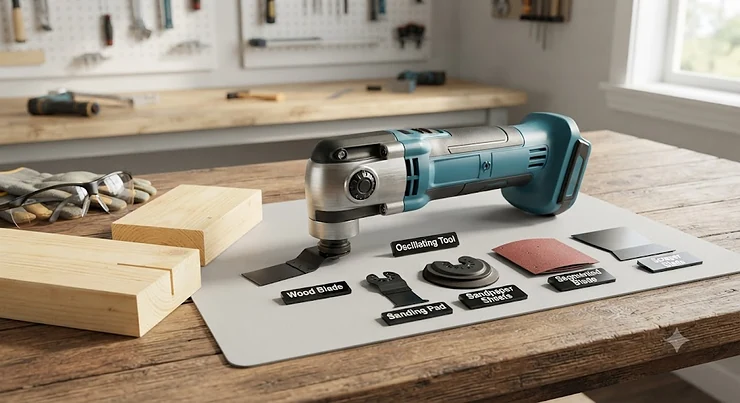
Somewhere in every new DIYer’s life there’s a moment where a circular saw, a jigsaw, and a random-orbit sander all fail at the exact same job — cutting a door jamb an eighth of an inch above the floor, say — and none of them can get in there without wrecking something. That’s the gap an oscillating tool for beginners is built to fill. It doesn’t spin. It doesn’t reciprocate in a big violent stroke. It just vibrates a tiny blade back and forth a few degrees, thousands of times a minute, which sounds unimpressive until you watch it slice flush through a nail without touching the wood beside it.
An oscillating tool is a handheld power tool with a rapid side-to-side blade motion, used for flush cutting, plunge cutting, sanding, scraping, and grinding in spaces where bigger saws simply don’t fit. First developed by the German company Fein as a plaster-cast saw, the design was later adapted for construction and DIY use, and the basic mechanism has barely changed since, according to the tool’s history on Wikipedia.
This guide isn’t a rewritten spec sheet. We researched seven real, currently available models — spanning under-$100 budget picks, mid-range cordless kits, and pro-grade corded options — and broke down what the numbers on the box actually translate to when you’re standing in a hallway with a half-installed floor. You’ll get honest analysis grounded in real specs and aggregated review sentiment, side-by-side comparisons, and practical guidance you won’t find on any Amazon listing, including how oscillating tools stack up against reciprocating saws, how to nail a clean flush cut, and how to work one in genuinely tight spaces.
Quick Comparison Table
| Product | Power Type | Price Range | Best For |
|---|---|---|---|
| DeWalt DCS356C1 | Cordless (20V) | $150–$200 | Best all-around beginner kit |
| Milwaukee M18 FUEL 2836-20 | Cordless (18V) | $180–$230 | Most power, lowest vibration |
| Fein MultiMaster MM 300 Plus | Corded | $300–$360 | Precision and long-term durability |
| Bosch GOP18V-28N | Cordless (18V) | $150–$190 | Widest blade ecosystem (Starlock) |
| Ryobi ONE+ 18V | Cordless (18V) | $70–$110 | Budget cordless, existing battery owners |
| Metabo HPT GOP18V | Cordless (18V) | $80–$100 | Best true sub-$100 cordless pick |
| Black+Decker BDEMT350 | Corded | $40–$60 | Simplest tool for absolute first-timers |
Looking at this lineup, the split between corded and cordless roughly tracks with budget: the two cheapest options here are corded, while the mid-range and premium tiers lean cordless because brushless motors and batteries add real manufacturing cost. If you already own batteries from one of these brands — Ryobi’s ONE+ platform in particular — the effective price of a cordless oscillating tool drops dramatically since you’re only buying the bare tool. Beginners without a battery ecosystem yet should weigh whether a corded pick like the Black+Decker BDEMT350 covers 90% of home projects before spending three times as much on cordless convenience.
💬 Found a comparison that actually makes sense? Bookmark this page before you head to checkout!
Top 7 Oscillating Tools for Beginners: Expert Analysis
1. DeWalt DCS356C1 — best all-around beginner kit
The DeWalt DCS356C1 opens strong with a brushless motor rated up to 20,000 oscillations per minute and a three-speed selector, which matters more than it sounds like on paper. A brushless 20V motor with variable speed means you can drop RPMs for delicate work, like sanding drywall mud smooth, then jump to full speed for cutting through baseboard without stalling. Based on the spec comparison against corded rivals in this price band, the brushless design also means less heat buildup during longer sessions, which extends both battery life and motor lifespan.
This is squarely designed for people who’ve never held one of these before: what most buyers overlook about this kit is that it includes the battery, charger, and a blade assortment, so there’s no guessing about compatible accessories on day one. Reviewers consistently report that the tool-free blade change lever works exactly as advertised, and the LED light earns specific praise for lighting up dark corners during flooring undercuts.
Pros:
- ✅ Included battery, charger, and blades — ready out of the box
- ✅ Tool-free blade changes via a simple lever
- ✅ Three-speed control suits sanding and cutting alike
Cons:
- ❌ Universal adapter is bulkier than native Starlock blades
- ❌ 20V battery doesn’t cross-compatible with other brands
At a price in the $150–$200 range, the DeWalt DCS356C1 delivers strong value for a first oscillating tool, particularly if you’re already inside the DeWalt 20V ecosystem.
2. Milwaukee M18 FUEL 2836-20 — most power with the least vibration
The Milwaukee M18 FUEL 2836-20’s headline feature is its brushless FUEL motor combined with a counterweight vibration-dampening system, and the practical effect is a tool that stays controllable during long cutting sessions instead of numbing your hand after twenty minutes. Reviewers and independent testers note that its vibration control ranks among the best in the cordless category, second only to Milwaukee’s own M12 FUEL variant in some comparisons.
What most buyers overlook here is that this is a tool-only purchase in most listings, meaning you’re paying a premium price without a battery included — a real consideration for someone building their very first cordless tool collection from scratch. On the other hand, if you already run M18 batteries for a drill or impact driver, this becomes the smartest possible upgrade path, since you’re not duplicating battery spend. Aggregated reviews frequently mention that the auto-load feature, which ramps power up only once resistance is detected, makes cuts smoother and reduces blade snap on brittle materials.
Pros:
- ✅ Brushless FUEL motor with genuinely low vibration
- ✅ Auto-load feature smooths out cut starts
- ✅ Compatible with the wide M18 battery ecosystem
Cons:
- ❌ Sold tool-only in most kits — battery/charger extra
- ❌ Premium pricing compared to entry-level cordless models
Priced around $180–$230 tool-only, the Milwaukee M18 FUEL 2836-20 is the pick for beginners who plan to grow into the M18 platform rather than stay casual.
3. Fein MultiMaster MM 300 Plus — precision from the tool’s actual inventor
Fein invented this entire product category, and the MM 300 Plus is the direct descendant of that original design, complete with a 350W motor, a fully metal gearbox, and a tight 1.6-degree oscillation angle. That narrow arc is the real story here: a tighter oscillation angle sacrifices raw cutting speed for cleaner, more controlled cuts, which is exactly what a beginner wants when they’re nervous about wandering off a line. Fein’s own account of the MultiMaster’s development traces this precision-first design philosophy back to the tool’s origins as a surgical plaster-cast saw.
Here’s what to weigh: this is a corded tool, so there’s no battery to manage, no charge cycles to plan around, and full power on tap indefinitely — genuinely useful for a beginner tackling a weekend-long flooring project. Reviewers consistently note that the QuickIN tool-free clamping system swaps accessories in seconds, and that build quality feels noticeably more substantial than mass-market cordless alternatives. The trade-off is obvious in the price tag.
Pros:
- ✅ Tight 1.6° oscillation angle for controlled, accurate cuts
- ✅ Metal gearbox built for years of regular use
- ✅ Corded power means no battery management at all
Cons:
- ❌ Highest price point in this lineup by a wide margin
- ❌ 16-foot cord limits mobility versus cordless options
At $300–$360, the Fein MultiMaster MM 300 Plus is overkill for someone who’ll use an oscillating tool twice a year, but it’s a genuinely smart long-term investment for a beginner who already knows they’ll become a serious DIYer.
4. Bosch GOP18V-28N — the widest blade ecosystem available
The Bosch GOP18V-28N runs on the Starlock accessory system, a standard Bosch co-developed with Fein in 2016 specifically to fix the fragmented-blade problem that plagued the category for years. What most buyers overlook about accessory standards is that they directly affect long-term cost: because Starlock blades are made by dozens of manufacturers, competition keeps replacement blade prices down and selection wide, compared to proprietary single-brand systems.
Based on the spec comparison, this brushless 18V model performs comparably to the DeWalt and Milwaukee picks above in raw cutting power, but its real advantage for beginners is future-proofing — as your skills grow and you need specialty blades for tile, metal, or fine woodworking, you won’t be stuck hunting for a single brand’s proprietary shape. Aggregated review sentiment highlights the tool’s balance and low weight as standout ergonomic features during extended sanding tasks.
Pros:
- ✅ Starlock compatibility opens up the largest blade market
- ✅ Brushless motor with strong power-to-weight ratio
- ✅ Well-balanced for extended sanding sessions
Cons:
- ❌ Tool-only pricing means battery costs extra
- ❌ Fewer bundled accessories than DeWalt’s beginner kit
In the $150–$190 range tool-only, the Bosch GOP18V-28N rewards beginners who think ahead about accessory availability rather than just the first project.
5. Ryobi ONE+ 18V Cordless Oscillating Multi-Tool — the budget cordless entry point
The Ryobi ONE+ 18V model’s biggest selling point isn’t really the tool itself — it’s the ecosystem. Ryobi’s ONE+ platform spans well over 280 tools sharing the same battery, so if you already own a Ryobi drill or string trimmer, this oscillating tool essentially becomes a $70–$110 accessory rather than a full standalone purchase requiring its own battery and charger. On paper this means dramatically lower entry cost than any other cordless pick on this list.
The trade-off, and reviewers are fairly consistent on this point, is that Ryobi’s motor doesn’t hold speed under heavy resistance quite as well as the brushless Milwaukee or DeWalt units — it’s a genuinely capable tool for drywall, softwood, and light trim, but it can bog down in dense hardwood or thick metal. For a true first-time buyer whose projects are mostly light home repairs, that’s rarely a dealbreaker, and the variable speed dial still gives enough control for careful beginners to avoid tear-out.
Pros:
- ✅ Extremely affordable if you already own ONE+ batteries
- ✅ Variable speed dial suited to careful beginner control
- ✅ Lightweight design reduces fatigue during long sessions
Cons:
- ❌ Motor loses speed faster than brushless competitors
- ❌ Struggles with dense hardwood and thick metal
For most first-time buyers already in the Ryobi ecosystem, the Ryobi ONE+ 18V is the most sensible budget cordless choice on this list.
6. Metabo HPT GOP18V — the real sub-$100 cordless pick
Priced under $100 tool-only, the Metabo HPT GOP18V solves a genuine gap in this market: nearly every other cordless oscillating tool worth owning crosses the $100 mark once you add a battery, but this one is engineered to hit that price point without cutting corners on accessory compatibility. What most buyers overlook is its universal accessory adapter, which fits both the OIS interface used by Milwaukee-style tools and Starlock blades — a rare feature at this price tier that prevents you from being locked into one blade brand later.
Reviewers frame this as a legitimately solid diyer’s tool rather than a compromise pick, noting reliable everyday performance across sanding, scraping, and basic cutting tasks. The honest caveat: at this price, you’re not getting brushless-motor vibration control or FUEL-style load compensation, so extended heavy-duty sessions will feel more fatiguing than on the premium picks above.
Pros:
- ✅ Genuinely under $100, tool-only, without hidden battery cost
- ✅ Universal adapter fits both OIS and Starlock blade types
- ✅ Reliable for everyday sanding, scraping, and light cutting
Cons:
- ❌ No brushless motor — more vibration on long sessions
- ❌ Less power reserve for dense or thick materials
If “best oscillating tool under $100” is your literal search criteria, the Metabo HPT GOP18V is the most straightforward honest answer in the cordless category.
7. Black+Decker BDEMT350 — the simplest tool for absolute first-timers
The Black+Decker BDEMT350 is corded, inexpensive, and deliberately simple — and that simplicity is the entire point. Instead of a variable speed dial requiring some baseline knowledge of oscillations per minute, it uses preset speed settings, letting a total beginner just pick “low for sanding” or “high for cutting” without needing to understand the underlying numbers. Reviewers consistently report that first-time users, including people who’d never touched a power tool, were cutting door casings correctly within minutes of unboxing it.
Here’s what to weigh: at $40–$60, this is priced to be a low-risk way to find out whether you’ll actually use an oscillating tool regularly before investing in a cordless system. The trade-off is a shorter accessory list and a motor that, while adequate for drywall, trim, and light wood, isn’t built for daily professional-grade use. For a beginner’s very first tool, that’s rarely a problem — it’s an entry point, not a forever tool.
Pros:
- ✅ Preset speed settings remove guesswork for beginners
- ✅ Lightweight and easy to control while learning technique
- ✅ Lowest price point in this entire lineup
Cons:
- ❌ Corded only — no cordless mobility option
- ❌ Less durable for frequent, heavy-duty use over time
At $40–$60, the Black+Decker BDEMT350 is the lowest-risk way to try an oscillating tool before committing to a pricier cordless setup.
Practical Usage Guide: Your First 30 Days With an Oscillating Tool
Getting comfortable with any of these seven tools follows a similar curve. In week one, practice on scrap material before touching a real project — a cheap 2×4 or an old baseboard offcut lets you feel how blade angle and downward pressure change the cut without any risk. Start every new blade on the lowest speed setting your tool offers; this is true whether you bought the DeWalt DCS356C1 or the Black+Decker BDEMT350, since low speed gives you time to correct your angle before the blade bites too deep.
For maintenance, wipe sawdust and debris off the tool holder after every session — this single habit prevents the accessory clamp from jamming, which is the single most common early failure point reviewers mention across brands. Store blades flat, not loose in a drawer, since bent teeth are the leading cause of poor cut quality in a tool’s first year. A common first-30-days mistake is forcing the blade through material rather than letting the oscillation do the work; if you find yourself pushing hard, switch to a coarser blade instead of applying more pressure, since forcing a fine blade generates heat that dulls it within a single session.
Real-World Scenarios: Which Oscillating Tool Fits Your Life
If you’re a renter doing occasional touch-ups — patching drywall, trimming a swollen door, removing old caulk — the Black+Decker BDEMT350 or Metabo HPT GOP18V covers essentially everything you’ll need without over-investing in a tool you’ll use four times a year.
If you’re a homeowner tackling a full flooring installation this year, with door jambs to undercut and baseboard to trim across multiple rooms, the DeWalt DCS356C1 kit’s included battery, charger, and blade set gets you working immediately, and its guide-system compatibility helps keep repeated cuts level room to room.
If you’re already invested in a specific cordless platform — say you own three Milwaukee M18 tools already — buying the Milwaukee M18 FUEL 2836-20 tool-only is the financially smarter move than starting a second, unrelated battery system from scratch, even though the sticker price looks steeper at first glance.
How to Choose an Oscillating Tool for Beginners
Choosing the right oscillating tool for beginners comes down to a short list of factors that matter far more than marketing copy suggests:
- Decide corded or cordless first. Corded tools like the Fein MultiMaster MM 300 Plus never run out of charge mid-project; cordless models trade that for mobility in tight or outdoor spaces.
- Check your existing battery ecosystem. If you already own DeWalt, Milwaukee, Ryobi, or Bosch batteries, a tool-only purchase in that same brand saves significant money over time.
- Prioritize variable speed over top-end power. Consumer Reports’ testing consistently ranks control and vibration management above raw oscillation speed for everyday usability.
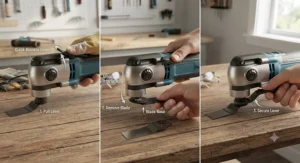
- Confirm tool-free blade changes. This single feature determines whether swapping from a wood blade to a sanding pad takes five seconds or five frustrating minutes.
- Look at blade ecosystem, not just the tool. Starlock-compatible tools like the Bosch GOP18V-28N give you access to the widest, most competitively priced accessory market.
- Match oscillation angle to your priorities. A narrower angle (around 1.6°–2°) favors precision; a wider angle (3°–5°) favors faster material removal.
- Set a realistic budget band. Under $100 covers genuine, capable entry-level tools like the Metabo HPT GOP18V — you don’t need to spend $300 to get real utility from your first oscillating tool.
Best Battery and Cordless Oscillating Tools: What Actually Matters
When people search for the best battery oscillating tool or best cordless oscillating tool, they’re usually really asking one of two different questions: which tool has the strongest motor, or which tool will cost the least once you account for the battery. These aren’t the same question, and conflating them leads to overspending. The Milwaukee M18 FUEL 2836-20 wins on raw motor performance and vibration control, but only makes financial sense if you already own M18 batteries. The Ryobi ONE+ 18V and Metabo HPT GOP18V win on total cost of ownership for someone starting fresh, even though their motors are objectively less powerful on paper.
What the spec sheet won’t tell you, but reviewers note repeatedly, is that battery voltage alone is a poor predictor of real-world performance — a well-engineered brushless 18V motor with smart load management often outperforms a higher-voltage brushed motor in actual cutting speed and battery efficiency. If cordless mobility matters more to you than absolute top speed, prioritize brushless construction and an ecosystem you’re already invested in over a bigger number on the spec sheet.
Best Oscillating Tool Under $100: Realistic Expectations
Setting a hard budget of under $100 is completely realistic for a first oscillating tool, but it does mean adjusting expectations. Corded picks like the Black+Decker BDEMT350 comfortably fit this budget with money to spare, and cordless options like the Metabo HPT GOP18V land right at the edge of it tool-only. What you’re giving up at this price tier is primarily brushless-motor efficiency and advanced vibration dampening — not core functionality. Reviewers consistently note that sub-$100 tools handle drywall, softwood, light trim, and basic sanding just as capably as $300 professional models; the difference shows up mainly in extended heavy-duty sessions and long-term durability under daily use, which rarely applies to a true beginner’s project list.
Oscillating Tool for Wood: Techniques That Actually Work
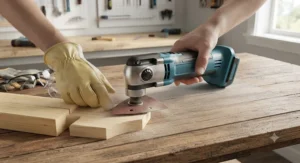
Wood is where an oscillating tool for wood work genuinely shines, particularly for flush trims, notched joints, and detail sanding that a circular saw or orbital sander simply can’t access. For clean wood cuts, match blade tooth count to the wood’s hardness: a coarse, widely-spaced tooth blade clears softwood and plywood quickly without clogging, while a fine-tooth blade prevents splintering on hardwood trim and finished baseboard. Reviewers across multiple brands note that letting the blade’s oscillation do the cutting — rather than pressing down hard — produces noticeably cleaner edges and extends blade life significantly.
For plunge cuts into wood, start the blade at a shallow angle and gradually deepen it rather than forcing it straight down; this reduces tear-out on the entry point dramatically. Sanding attachments on tools like the DeWalt DCS356C1 or Bosch GOP18V-28N work especially well in corners where a random-orbit sander’s round pad can’t reach, though they remove material more slowly than dedicated sanders, so patience on fine finishing work pays off.
Oscillating Tool vs Reciprocating Saw: Which One Do You Actually Need
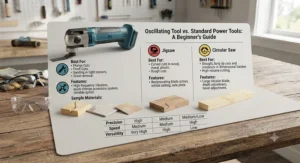
An oscillating tool vs reciprocating saw comparison comes down to precision versus raw cutting power, and beginners often buy the wrong one first. A reciprocating saw uses a long blade in an aggressive back-and-forth stroke, built for demolition — cutting through framing lumber, pipe, or nail-embedded wood quickly, with little regard for finish quality. An oscillating tool moves its much smaller blade through a tiny arc, trading speed for control, which is why it excels at flush cuts, detail work, and tight-space access that a reciprocating saw’s long blade simply can’t reach.
For a beginner, the honest analysis is straightforward: if your projects involve tearing out old structures, cutting through embedded nails in framing, or rough demolition, a reciprocating saw is the better first purchase. If your projects lean toward flooring installs, trim work, cabinet modifications, or detail repairs, an oscillating tool is the far more useful everyday tool — and most beginner homeowner projects fall into that second category, which is why this guide focuses there.
Mastering the Oscillating Tool Flush Cut
The oscillating tool flush cut — trimming a protruding nail, screw, or door jamb bottom exactly level with a surface — is arguably the single most useful trick this tool category offers, and it’s genuinely difficult with any other power tool. Use a dedicated flush-cut blade, which is offset to keep the tool’s body from hitting the adjacent surface while the blade reaches flat against it. Keep the blade flat against the target surface throughout the cut rather than tilting it, since even a slight angle leaves a visible ridge once the cut is done.
For door jamb undercuts specifically — the classic use case for flooring installation — lay a scrap piece of the new flooring flat against the floor next to the jamb as a height guide, and run the blade along its top edge. Reviewers repeatedly cite this exact technique as the difference between a jamb cut that looks professionally done and one with visible gaps once the new flooring is installed underneath it.
Using an Oscillating Tool in Tight Spaces
Working an oscillating tool in tight spaces — behind toilets, inside cabinets, between wall studs — is precisely the scenario this tool category was designed to solve, but a few habits make a real difference. Choose the smallest-profile blade that fits the job; oversized blades increase the risk of the tool’s body contacting an adjacent surface before the blade even reaches the cut line. Where possible, use a barrel-grip tool like the Fein MultiMaster MM 300 Plus rather than a pistol-grip design, since the barrel shape fits into narrow gaps that pistol grips can’t clear.
In genuinely cramped spots, reduce speed before increasing pressure — a slower blade gives you more time to react if the tool contacts something unexpected, which matters when visibility is limited. Reviewers frequently mention that a tool’s built-in LED light, present on models like the DeWalt DCS356C1, becomes far more valuable in tight spaces than in open work, simply because natural light rarely reaches those areas.
Common Mistakes Beginners Make When Buying an Oscillating Tool
The most common mistake is buying based on top oscillation speed alone, when real-world usability depends far more on variable speed range, vibration control, and blade-change convenience. A second common mistake is ignoring existing battery ecosystems — buying a cordless tool in a brand you don’t already own means paying full price for a battery and charger you’ll never use anywhere else. A third mistake is underestimating blade costs: cheap tools with proprietary blade shapes can end up costing more over two years in accessories than a slightly pricier Starlock-compatible tool like the Bosch GOP18V-28N would have. Finally, many beginners skip reading return policies before buying, which matters because oscillating tools genuinely suit some project types far better than others, and a wrong first purchase is common enough that reputable sellers plan for it.
✨ Ready to Stop Guessing and Start Cutting?
🔍 Compare current pricing on any of these seven picks above and grab the one that actually matches your project list — your future self undercutting a door jamb will thank you.
Long-Term Cost & Maintenance
Total cost of ownership for an oscillating tool extends well beyond the sticker price, since blades wear out and need regular replacement. Budget tools with proprietary blade shapes, unfortunately, often cost more per blade over two years than premium Starlock-compatible options, since competition among accessory manufacturers keeps Starlock blade pricing down. Battery replacement is another factor worth planning for: lithium-ion batteries typically hold a useful charge for several hundred cycles before capacity noticeably declines, so a beginner buying into an existing battery ecosystem — rather than a standalone kit — spreads that eventual replacement cost across multiple tools rather than absorbing it alone.
Maintenance costs stay low if you build good habits early: cleaning debris from the accessory clamp after each session, storing blades flat, and avoiding forced cuts that overheat the motor all extend a tool’s working life significantly, regardless of which of these seven models you choose.
Safety Guide for Oscillating Tools
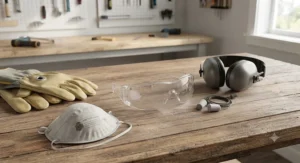
Oscillating tools carry a genuinely lower injury risk than circular saws or reciprocating saws, since the blade’s short arc and low torque give the operator considerably more control if something goes wrong mid-cut. That said, basic precautions still apply. Always wear eye protection — OSHA’s guidance on hand and power tools specifically calls out eye and face protection as essential for any tool that can throw debris, and oscillating blades regularly do exactly that when cutting drywall or old adhesive. Disconnect corded tools, or remove the battery from cordless ones, before changing blades; a tool-free clamp system still requires the blade itself to be stationary during a swap.
Keep your free hand well clear of the cutting path at all times, since a slipping blade travels a very short distance but can still cause a real cut. For dust-heavy tasks like sanding old paint or drywall compound, a basic dust mask is worth wearing even for short jobs, since fine particulate exposure adds up over repeated sessions.
This is a sensitive topic in the sense that tool-related injuries are genuinely preventable; if you’re new to power tools generally, it’s worth reading the full manufacturer manual for your specific model before first use.
Frequently Asked Questions
❓ Is an oscillating tool good for a complete beginner?
❓ What's the difference between a battery and cordless oscillating tool?
❓ Can an oscillating tool cut through a nail?
❓ Do I need Starlock blades specifically?
❓ How long do oscillating tool blades typically last?
Conclusion
Picking your first oscillating tool for beginners really comes down to three honest questions: what’s your budget, do you already own a battery ecosystem, and what does your actual project list look like this year. If you want a complete, ready-to-use kit, the DeWalt DCS356C1 remains the most balanced starting point. If you’re testing the waters before committing further, the Black+Decker BDEMT350 or Metabo HPT GOP18V let you do that without much financial risk. And if you already know you’ll be doing serious flooring or trim work for years to come, the Fein MultiMaster MM 300 Plus or Milwaukee M18 FUEL 2836-20 are genuine long-term investments rather than upgrades you’ll outgrow in a season.
Whichever of these seven you choose, the core habits carry across every brand: start slow, match blade to material, keep the accessory clamp clean, and let the tool’s oscillation do the cutting instead of your arm. That’s really the entire learning curve — and it’s a short one.
Recommended for You
- 7 Best Oscillating Tool Blades in 2026: Cut Smarter, Not Slower
- 7 Best Oscillating Multi Tool Picks for 2026
- Impact Driver vs Impact Wrench: 7 Must-Know Picks (2026)
Disclaimer: This article contains affiliate links. As an Amazon Associate, I earn from qualifying purchases. If you purchase products through these links, we may earn a small commission at no additional cost to you.
✨ Found this helpful? Share it with your friends! 💬🤗
