
In This Article
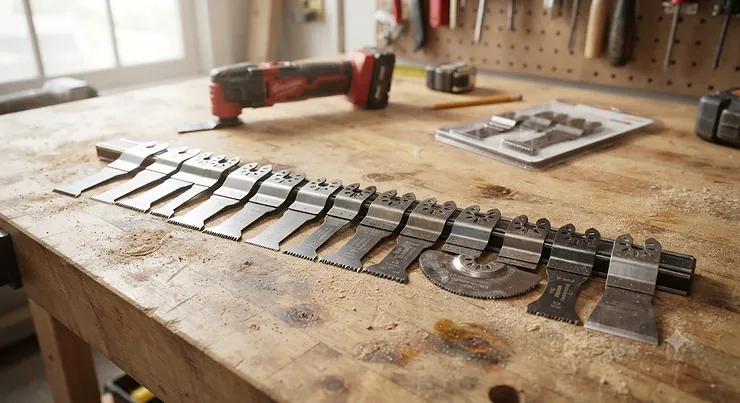
Somewhere in your garage right now there’s probably a little plastic case of oscillating tool blades that all look almost identical — until the moment you actually need one, and none of them are quite right. That’s the trap. A drawer full of steel doesn’t help you if half of it dulled on the first nail and the other half was never meant for the job in front of you.

Oscillating tool blades are the swappable cutting attachments that turn a single multitool into a saw, a sander, a scraper, or a grout chisel — all through a rapid side-to-side vibration rather than a spinning or reciprocating motion. That distinction matters more than it sounds: the tiny oscillating arc, usually just a few degrees wide, is what lets these blades plunge into a wall, trim a door jamb flush, or slice grout without chewing up the tile beside it.
This guide skips the marketing fluff and gets specific: seven real oscillating tool blades and accessories worth buying in 2026, why each one earns its spot, and how to match blade material, tooth pattern, and interface to whatever’s actually in front of you — wood, metal, tile, drywall, or a stack of sandpaper projects. Reviewer sentiment referenced throughout comes from aggregated, verifiable sources; nothing here is invented.
Quick Comparison Table
| Blade / Kit | Best For | Blade Material | Price Range |
|---|---|---|---|
| Milwaukee 20-Piece Oscillating Blade Kit | Best overall / starter kit | Titanium bi-metal + HCS | $40–$55 |
| Bosch OSL114JF-3 Japanese Tooth Blade | Best for clean wood cuts | Bi-metal (Swiss-made) | $20–$30 |
| DeWALT DWA4250 Bi-Metal 3-Pack | Best budget general-purpose | Bi-metal | $12–$18 |
| Diablo DOU125CGP3 Carbide Blade | Best for nail-embedded demo wood | Carbide-tipped | $25–$35 |
| Bosch OSL005L Starlock Carbide Set | Best premium metal cutting | Full carbide | $40–$55 |
| Milwaukee Diamond Grit Grout Blade | Best for tile and grout removal | Diamond grit | $15–$25 |
| DEWALT DWASPTRI3 Sanding Pad Set | Best for detail sanding | Aluminum oxide sandpaper | $10–$20 |
Looking at that spread, the pattern is pretty simple: bi-metal blades own the cheap-and-cheerful middle ground, carbide and diamond blades earn their higher price tags the moment fasteners or masonry enter the picture, and the Milwaukee 20-Piece Oscillating Blade Kit is the one purchase that covers almost every scenario at once. If your job list is genuinely mixed — some trim, some demo, a little sanding — starting with a broad kit and adding specialty blades later beats buying seven individual packs up front.
💬 Found a blade that finally matches your project? Give this guide a share — it helps other DIYers skip the trial-and-error too!😊
Top 7 Oscillating Tool Blades: Expert Analysis
Before jumping into individual picks, here’s the detailed side-by-side most buyers actually want — specs, ratings context pulled from aggregated review data, and who each one is really built for.
| Blade / Kit | Interface | Ideal Material | Reported Rating | Best For |
|---|---|---|---|---|
| Milwaukee 20-Piece Kit | Universal open-back | Wood, soft metal, mixed | ~4.7/5 | All-around starter or contractor kit |
| Bosch OSL114JF-3 | Starlock (adapter-compatible) | Hardwood, plywood | ~4.6/5 | Clean, splinter-free wood cuts |
| DeWALT DWA4250 | Universal quick-release | Wood with occasional nails, copper pipe | ~4.6/5 | Budget general use |
| Diablo DOU125CGP3 | Universal quick-release | Nail-embedded wood, mixed demo | ~4.7/5 | Demolition and remodeling |
| Bosch OSL005L | Starlock | Sheet metal, bolts, fasteners | ~4.8/5 | Heavy metal-cutting jobs |
| Milwaukee Diamond Grout Blade | Universal open-back | Grout, thinset, mortar | ~4.5/5 | Tile regrouting projects |
| DEWALT DWASPTRI3 | Universal (no adapter) | Wood, drywall, plaster | ~4.5/5 | Detail sanding, corners |
A couple of things jump out once you interpret this instead of just skimming it. First, interface compatibility isn’t uniform — Bosch OSL114JF-3 and Bosch OSL005L are built around Bosch’s Starlock system, which grips harder but usually needs an adapter clip on non-Starlock tools, while everything else here uses the more universal open-back or quick-release pattern that fits nearly any brand out of the box. Second, notice how rating and price rise together almost in lockstep for the carbide and diamond options — that’s not a coincidence, it reflects genuinely longer service life under abuse, not just brand premium.
Oscillating Tool Attachment Types Explained
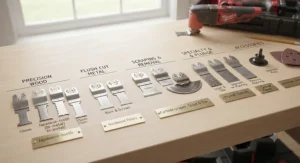
“Oscillating tool blades” is really shorthand for a whole family of attachments, and knowing the categories saves you from buying the wrong shape entirely. Straight and plunge blades are the default — flat, toothed, and designed to saw through material or drop straight into a surface for a flush cut. Segmented or curved blades trade raw speed for control in tight radiuses, which is why they show up so often in flooring and trim work.
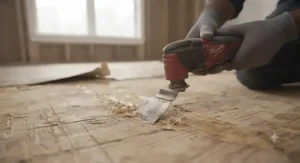
Then there’s the non-cutting side of the family. Scraper attachments are flat, toothless blades ground for removing old adhesive, caulk, or vinyl flooring without gouging the substrate underneath. Rasp and grout attachments swap teeth for an abrasive or diamond-coated edge, and sanding pads — triangular, delta-shaped, or finger-style — turn the tool into a detail sander for corners a random-orbit sander can’t reach. Every one of these mounts to the same universal or Starlock-style interface, so a single tool body genuinely can cut, scrape, grind, and sand depending only on which attachment is clipped on.
What most buyers overlook here is that attachment shape often matters more than material for a given job. A diamond-coated straight blade will remove grout, but a purpose-built grout attachment with a rounded profile clears the joint faster and with less risk of nicking the tile edge — the geometry, not just the grit, is doing real work.
Practical Usage Guide: Blade Changes, Break-In & Maintenance
Getting a new blade mounted correctly takes ten seconds but prevents most of the “this blade is garbage” complaints that show up in reviews. Release the tool’s clamp lever fully before seating the blade — forcing it into a partially-open clamp is the single most common cause of a blade that walks or vibrates loose mid-cut. Line the blade’s mounting holes up flush against the drive pin pattern, then close the clamp and give the blade a firm tug by hand to confirm it’s seated before powering up.
For the first few cuts on a fresh blade, ease off the downward pressure. Oscillating blades cut through vibration and tooth contact, not brute force, so pressing hard just generates heat and accelerates dulling — let the tool’s own oscillation do the work and guide rather than push. Wipe resin and pitch off wood-cutting blades with mineral spirits every few uses; a gummed-up blade behaves like a dull one even when the teeth are technically fine.
Common first-month mistakes worth avoiding: running a bi-metal blade into masonry screws “just this once,” skipping eye protection during flush cuts near eye level, and storing blades loose in a toolbox where the teeth bang against other metal and chip. A cheap magnetic strip or the original blister packaging solves that last one permanently, and it’s the kind of habit that quietly doubles blade lifespan.
Real-World Scenarios: Matching Blades to the Job
Picture a first-time homeowner tackling a bathroom refresh on a tight weekend budget. Old caulk needs scraping, a section of damaged grout needs replacing, and a base trim board has to be trimmed to fit a new vanity. That mix calls for the Milwaukee Diamond Grit Grout Blade for the tile work and a general DeWALT DWA4250 bi-metal blade for the trim cut — two inexpensive, targeted purchases rather than one expensive kit that’s mostly overkill for a single afternoon.
Now picture a contractor gutting a 1960s kitchen where nobody’s certain what’s hiding in the walls. Nail-embedded studs, the occasional forgotten screw, old subfloor — this is exactly the scenario where the Diablo DOU125CGP3 carbide blade earns its higher price tag, because a bi-metal blade would dull inside the first hour of real demo work. Pair it with the Bosch OSL005L carbide set for anything metal-heavy, like cutting through old radiator brackets or pipe stubs.
Finally, imagine a weekend woodworker building custom shelving who wants flush, splinter-free cuts in hardwood without spending a fortune. The Bosch OSL114JF-3 Japanese tooth blade is built for exactly that job — its finer tooth pattern trades cutting speed for a cleaner edge, which matters more than raw speed when the cut is visible in the finished piece.
Problem → Solution: Fixing Common Oscillating Blade Failures
Blade burns or leaves scorch marks on wood. This almost always means dull teeth combined with too much downward pressure — the friction is generating heat instead of cutting. Swap to a fresh bi-metal or carbide blade and let the tool’s oscillation do the work instead of pushing.
Blade snaps mid-cut on what should have been a simple job. Nine times out of ten, a hidden nail or screw was the culprit. If you’re working in an older structure where fasteners could be anywhere, upgrading to a carbide blade like the Diablo DOU125CGP3 removes this failure mode almost entirely.
Cuts wander off the marked line. This is typically a blade-selection issue rather than a skill issue — wide, coarse-tooth blades resist fine control. Switching to a narrower, finer-tooth option such as the Bosch OSL114JF-3 restores precision on detail work.
Grout removal blade glazes over and stops cutting within minutes. Diamond blades need airflow and light pressure to stay cool; pressing hard actually polishes the diamond grit smooth instead of grinding it into the material. Ease off and let the Milwaukee Diamond Grit Grout Blade work at its intended pace.
Sanding pad attachments won’t hold sandpaper securely. Hook-and-loop backing wears out with heat and dust buildup over time. A quick brush-out of the pad’s loop fibers, or replacing the pad itself — like the DEWALT DWASPTRI3 set — usually solves it for a few dollars.
✨ Ready to Stop Guessing?
🔍 Compare the full lineup above, click through to check today’s price, and grab whichever blade actually matches your next project — your future self mid-cut will thank you.
Top 7 Oscillating Tool Blades: Expert Analysis
1. Milwaukee 20-Piece Oscillating Blade Kit — best all-rounder starter kit
This kit earns its top spot the boring way: by covering nearly everything a homeowner or contractor might throw at it in one box. It bundles six titanium-enhanced bi-metal blades for soft metal and mixed-material cutting, four high-carbon steel blades for wood and softer materials, a Japanese-tooth hardwood blade, and a triangle sanding pad with both 60- and 80-grit sandpaper included.
The bi-metal blades in particular stand out — testers report they cut through copper pipe and steel nails quickly and held an edge through repeated framing-nail encounters, which is a meaningfully higher bar than most budget bi-metal blades clear. The universal open-back anchor system also means these blades reportedly seat well even on non-Milwaukee tools, which removes the brand-lock-in headache that trips up a lot of first-time buyers.
Reviewers consistently note the sanding pad inclusion as a pleasant surprise, since most competing kits skip it entirely. The one real gap: no storage case is included, so plan on a drawer organizer or magnetic strip if portability matters to your setup.
Pros:
- ✅ Widest material coverage of any kit on this list
- ✅ Bi-metal blades hold an edge through repeated nail contact
- ✅ Fits non-Milwaukee tools via universal anchor system
Cons:
- ❌ No included storage case for the 20 pieces
- ❌ Lacks a dedicated scraper blade
At around $40–$55, this is genuinely solid value once you account for what a comparable 20-piece assortment purchased individually would cost. If your project list is mixed rather than singular, this is the sensible starting point — you can always add a specialty carbide or diamond blade later for the jobs this kit isn’t optimized for.
2. Bosch OSL114JF-3 Japanese Tooth Blade — cleanest cuts in hardwood
Swiss-made construction sets this one apart before you even look at the tooth geometry. The blade fuses high-carbon steel teeth to a flexible spring-steel body — the textbook bi-metal recipe — but the Japanese tooth pattern is finer and more closely spaced than a standard wood blade, which trades a bit of raw cutting speed for a noticeably smoother, splinter-resistant edge.
That trade-off matters most on visible cuts: trim work, cabinetry modifications, flush-cutting a doorjamb where the finished edge will be seen. The flexible spring-steel backing also resists tooth-stripping if the blade unexpectedly clips a nail, which is a real advantage over cheaper high-carbon-steel-only blades that tend to chip outright on the same contact.
Based on the spec comparison against generic wood blades, the finer tooth count here is doing the heavy lifting — more teeth per inch means each individual tooth removes less material per pass, and less material removed per pass means a cleaner kerf. This is not the blade for tearing through a stud wall fast; it’s the blade for the cut someone will actually look at afterward.
Pros:
- ✅ Fine Japanese tooth pattern minimizes splintering
- ✅ Bi-metal body resists snapping on accidental nail contact
- ✅ Swiss manufacturing tolerance shows in cut consistency
Cons:
- ❌ Slower material removal than coarse-tooth wood blades
- ❌ Starlock interface may need an adapter on non-Bosch tools
In the $20–$30 range for a three-pack, this is a smart add-on rather than a first purchase — pair it with a general-purpose kit and reach for it specifically when the cut needs to look good, not just get done.
3. DeWALT DWA4250 Bi-Metal Blade 3-Pack — best budget general-purpose pick
Sometimes the right answer really is the cheap one, and this is that blade. It’s a straightforward bi-metal construction — nothing exotic, no titanium coating, no carbide teeth — but it handles the 90% of tasks most DIYers actually run into: general wood cutting, occasional nail contact, copper pipe, and light drywall work.
What most buyers overlook about a blade this affordable is that “budget” doesn’t have to mean “disposable.” Aggregated review sentiment consistently ranks this blade highly for value relative to price, with buyers specifically calling out that it held up through more nail encounters than they expected from a low-cost option. That’s the bi-metal formula working as designed: a flexible spring-steel body that absorbs shock instead of snapping.
Here’s what to weigh before buying: this is not the blade for a demolition project loaded with unknown fasteners. It’ll survive the occasional surprise nail, but repeated hardened-fastener contact will dull it fast, and that’s exactly the scenario where a carbide upgrade pays for itself.
Pros:
- ✅ Excellent value-to-performance ratio for occasional use
- ✅ Handles copper pipe and light nail contact reliably
- ✅ Universal quick-release fits nearly any oscillating tool
Cons:
- ❌ Dulls quickly against hardened fasteners or heavy metal
- ❌ Not designed for sustained demolition-level use
At roughly $12–$18 for three blades, this is the pack to keep on hand for everyday trim, plumbing access cuts, and general repairs — cheap enough that you won’t feel bad reaching for a fresh one rather than fighting a dull edge.
4. Diablo DOU125CGP3 Carbide Multi-Material Blade — best for nail-embedded demo wood
This is the blade for the job where you genuinely don’t know what’s inside the wall. The carbide-tipped construction handles clean wood, painted trim, and hardened nails without missing a beat, which is precisely the scenario that shreds a standard bi-metal blade within the first few cuts.
Here’s what the spec sheet won’t tell you, but reviewers note repeatedly: the real value shows up in avoided downtime. A contractor swapping bi-metal blades every ten or fifteen nail encounters loses real time mid-job; a single carbide blade that shrugs off dozens of the same encounters keeps the work moving. The price premium pays for itself specifically the first time a hidden fastener would have otherwise ended a bi-metal blade’s life early.
Based on the spec comparison against standard bi-metal options, carbide teeth resist wear roughly an order of magnitude better against ferrous metal — that’s the mechanical reason this blade costs more, not just brand positioning. For remodeling work in older homes especially, that durability difference is the whole argument for upgrading.
Pros:
- ✅ Carbide teeth shrug off hardened nails and screws
- ✅ One blade replaces multiple bi-metal blades on demo jobs
- ✅ Clean cut quality even after heavy fastener contact
Cons:
- ❌ Noticeably higher upfront cost than bi-metal alternatives
- ❌ Overkill for light, fastener-free trim work
Expect to pay in the $25–$35 range, which sounds steep next to a bi-metal three-pack until you do the cost-per-cut math on a genuine demolition job — at that point, this is usually the cheaper option in practice, not just on paper.
5. Bosch OSL005L 5-pc. Starlock Carbide Cutting Accessory Blade Set — best premium metal cutting
When the job is genuinely metal-heavy — thin sheet metal, bolts, brackets, embedded fasteners — this is the set built for it. Full carbide-teeth construction delivers roughly three times the service life of standard bi-metal blades according to manufacturer testing, and the Starlock interface transfers noticeably more torque from the tool’s motor into the cut compared to a universal quick-release mount.
That Starlock power transfer is a real, measurable advantage, not marketing language: because the blade locks in three axes instead of just clamping at the base, there’s less flex and wasted motion per oscillation, which translates to faster, more controlled cuts especially in thicker metal stock. Aggregated review data puts this set at the top of its category, with a reported rating around 4.8 out of 5 — among the strongest sentiment on this entire list.
What stands out here is the positioning: this isn’t a general-purpose set pretending to handle metal on the side. It’s purpose-built for it, and buyers who need occasional wood cutting alongside their metal work will still want a separate bi-metal or Japanese-tooth blade in the mix.
Pros:
- ✅ Full carbide teeth deliver roughly 3x bi-metal blade life
- ✅ Starlock interface improves torque transfer and control
- ✅ Highest aggregated review rating in this comparison
Cons:
- ❌ Starlock-native tools required for full performance benefit
- ❌ Premium price point compared to general-purpose sets
At $40–$55, this is a specialist’s purchase — the right call for anyone doing regular metal fabrication, bracket removal, or fastener-heavy demo, and probably more than a casual DIYer strictly needs.
6. Milwaukee 2-1/2 in. Diamond Grit Grout Removal Blade — best for tile and grout removal
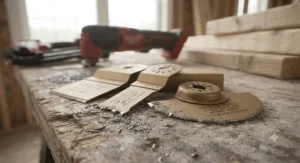
Standard blades simply aren’t built for grout. It’s abrasive in a way wood and metal aren’t, and a conventional bi-metal or even carbide tooth pattern will glaze over and stop cutting within minutes against cured mortar. This blade sidesteps the problem entirely with a diamond-grit segmented edge designed specifically to grind rather than saw its way through grout lines.
Home improvement retailer reviews for this exact blade are candid about the trade-offs: most buyers report it performs better than expected and saves significant time compared to manual grout removal, particularly praised for precision in tight bathroom or kitchen tile layouts. A smaller number of reviewers noted the diamond coating can wear down faster than hoped under heavy, sustained use — a fair caveat for anyone tackling a full-bathroom regrout rather than a handful of damaged tiles.
What most buyers overlook: the “boot” or segment shape on this blade isn’t just cosmetic. It’s engineered to access narrow grout lines without contacting the tile edges on either side, which is exactly what prevents the chipped-tile disasters that happen when someone tries to remove grout with a generic flat blade instead.
Pros:
- ✅ Diamond grit cuts grout without a standard blade’s rapid glazing
- ✅ Segment shape protects adjacent tile edges during removal
- ✅ Stainless steel construction resists corrosion from wet use
Cons:
- ❌ Diamond coating wears faster under prolonged heavy use
- ❌ Not suitable for wood, metal, or general cutting tasks
Priced around $15–$25, this is a narrow-purpose purchase, but it’s the right narrow purpose — trying to remove grout with anything else on this list will cost you more time and frustration than the blade itself costs.
7. DEWALT DWASPTRI3 Hook & Loop Triangle Sandpaper Set — best for detail sanding
Rounding out the list is the attachment most people forget they need until they’re staring at a corner a random-orbit sander can’t reach. This set pairs DEWALT’s triangular hook-and-loop sanding pad with a 12-piece sandpaper assortment across 80, 120, and 220 grit — coarse enough to strip old finish, fine enough to prep for a final coat.
The universal fitment here is a genuine convenience: no adapter required across major oscillating tool brands, which matters because sanding attachments are exactly the kind of accessory people buy once and expect to just work regardless of which tool body they own. Reviewers consistently point to the corner and edge access as the standout feature — this isn’t competing with a proper orbital sander on flat surfaces, and it doesn’t need to.
Here’s what to weigh: the sandpaper sheets themselves are a consumable, and 12 sheets across three grits go faster than expected on a full furniture-refinishing project. Budget for a second pack if the job is bigger than a single door or cabinet face.
Pros:
- ✅ Universal fitment works without a separate adapter
- ✅ Three-grit assortment covers strip-to-finish workflow
- ✅ Excels specifically in corners and tight edges
Cons:
- ❌ Sandpaper sheets consume quickly on larger projects
- ❌ Not a substitute for a dedicated orbital sander on flat runs
At $10–$20, this is an inexpensive, high-utility add-on — genuinely one of the most-reached-for accessories once people realize how often detail sanding shows up mid-project.
How to Choose Oscillating Tool Blades
Cutting through the noise, here’s the actual decision process, step by step:
- Identify your primary material first. Wood, metal, tile, drywall, or plaster each demands a different blade chemistry — this single decision eliminates most of the wrong options immediately.
- Check for hidden fasteners. If there’s any chance of nails or screws in the cutting path, upgrade to carbide rather than betting on bi-metal and hoping.
- Match the interface to your tool. Universal quick-release and Starlock are not interchangeable without an adapter; confirm compatibility before checking out.
- Weigh tooth count against speed needs. Fine teeth cut cleaner but slower; coarse teeth clear material fast but leave a rougher edge — pick based on whether the cut will be visible.
- Consider volume of use. Occasional DIY tasks rarely justify premium carbide pricing; daily professional use almost always does, through avoided blade-change downtime alone.
- Buy specialty blades separately. Grout, sanding, and scraping attachments perform far better than a general-purpose blade pressed into service outside its design.
- Factor in total project cost, not blade cost alone. A $30 carbide blade that finishes a job in one pass often beats three $12 bi-metal blades destroyed along the way.
Common Mistakes When Buying Oscillating Tool Blades
The most expensive mistake is buying based on piece count instead of blade quality — a 100-piece bargain-bin assortment sounds generous until half the blades are redundant sizes of the same weak steel. Reviewers of oversized generic kits repeatedly flag this exact pattern: plenty of blades, not much actual versatility.
A close second is ignoring interface compatibility until after the purchase arrives. Starlock and universal quick-release blades aren’t interchangeable without an adapter, and discovering that mismatch after opening the package is a frustratingly common, entirely avoidable problem.
Buyers also tend to underestimate how much material composition matters versus brand name. A generic bi-metal blade from a lesser-known manufacturer will often outperform a name-brand high-carbon-steel-only blade against the exact same nail-embedded board, simply because the underlying metallurgy differs more than the sticker does. Reading the material spec, not just the brand, is the more reliable filter.
Finally, plenty of shoppers buy a single all-purpose blade and expect it to handle wood, metal, and tile equally well. It won’t — no blade genuinely does all three at a high standard, and expecting one to is the fastest route to premature disappointment and a one-star review that’s really a mismatch problem, not a product defect.
Bi-Metal Oscillating Blade vs Carbide vs Diamond: What’s the Difference
| Blade Type | Best Material Match | Relative Lifespan | Relative Cost |
|---|---|---|---|
| Bi-metal | Wood, occasional nails, copper | Baseline | $ |
| Carbide | Hardened nails, screws, bolts, mixed demo | Up to ~30–50x bi-metal on metal | $$$ |
| Diamond | Grout, mortar, tile, masonry | Up to ~5x carbide on abrasive materials | $$ |
The math here is worth interpreting rather than just skimming. Carbide’s dramatic lifespan multiplier only shows up against ferrous metal and hardened fasteners — against clean softwood, a bi-metal blade and a carbide blade perform nearly identically, so the premium is wasted if fasteners aren’t actually a factor. Diamond, meanwhile, isn’t really competing with carbide at all; it’s solving an entirely different abrasion problem that carbide teeth handle poorly.
Bi-metal blades weld a high-speed steel cutting edge onto a flexible spring-steel body, which is what lets them flex under impact rather than snapping outright — that flexibility is the entire reason they remain the sensible default for general use. Carbide blades sacrifice some of that flex for raw edge hardness, which is exactly the trade-off that makes sense once fasteners enter the picture. Reviewers who switch from bi-metal to carbide for demolition work consistently describe it as the single upgrade that changed how they approach a job, less because carbide cuts faster and more because it removes the constant interruption of blade changes.
Oscillating Blade TPI for Wood Explained
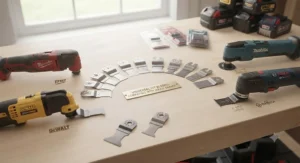
Teeth-per-inch is the spec most buyers skip past, and it’s arguably more important than blade material for wood-specific work. A lower TPI count — coarser, more widely spaced teeth — removes material fast and is the right call for rough framing lumber, plywood demolition, or any cut where speed matters more than finish quality.
Higher TPI blades, like the Japanese-tooth pattern on the Bosch OSL114JF-3, pack more teeth into the same blade length, which means each tooth bites less material per stroke. The practical result is a smoother cut with less tear-out, especially noticeable on hardwoods like oak or maple where grain tends to splinter under coarse teeth. For softwoods like pine or cedar, the difference matters less since the material itself resists tear-out reasonably well even under a coarser blade.
Based on the spec comparison across wood-cutting blades, the general rule of thumb holds: match tooth density to visibility. Structural, hidden cuts favor speed and coarse teeth; finished, visible cuts favor a fine tooth pattern even at the cost of a slower pass. Blade length and width matter too — shorter, narrower blades maneuver tighter curves and corners, while longer blades cover more material per stroke on straight runs.
Oscillating Tool Blades for Tile and Grout Removal
Tile and grout removal is arguably the task where using the wrong blade does the most visible damage, since a slip can chip or crack an otherwise salvageable tile. Diamond-grit blades solve this by grinding rather than sawing, which lets them work through cured mortar and grout without the tooth-catching behavior that causes slips with standard blades.
Segment shape matters as much as the diamond coating itself. A flat diamond blade works fine for wide grout lines and general mortar cleanup, while a curved or semicircular profile — like the shape found on several grout-specific kits — reaches into corners and tight tile joints more precisely. For anyone regrouting an entire bathroom floor rather than spot-repairing a few tiles, that precision difference compounds fast across dozens of joints.
Reviewers consistently report that dry-cutting tile and grout generates fine dust that’s worth taking seriously — OSHA’s respirable crystalline silica standard for construction specifically flags cutting and grinding of tile, stone, and mortar as activities that can produce hazardous airborne silica particles at levels requiring protective measures on job sites. For DIY-scale home projects this rule technically governs employers rather than homeowners, but the underlying safety logic — wet-cutting or vacuum-assisted dust control plus a properly rated respirator — applies just as much to a weekend bathroom project as it does to a commercial job site.
Oscillating Tool Sanding Pads: What to Know
Sanding pads turn an oscillating tool into a surprisingly capable detail sander, but they’re built for a specific niche rather than as a general sander replacement. Triangular pads dominate the category because the shape naturally reaches into corners — window frames, cabinet edges, stair balusters — where a random-orbit or belt sander physically can’t fit.
Hook-and-loop backing is the near-universal standard now, which means sandpaper sheets attach and detach without adhesive residue, and switching grits mid-project takes seconds rather than minutes. What most buyers overlook is that the backing pad itself wears out well before most people replace it — a pad with worn or matted loop fibers will shed sandpaper mid-cut even when the paper itself is still sharp, and that’s a pad problem, not a sandpaper problem.
Grit selection follows familiar sanding logic: 60–80 grit for stripping old finish or leveling rough surfaces, 120 grit for general smoothing, and 220 grit or finer for pre-finish prep. Reviewers of assortment kits like the DEWALT DWASPTRI3 consistently note that having all three grits on hand from the start saves repeat trips to the hardware store mid-project — a small convenience that adds up over a multi-day job.
Oscillating Blade for Drywall: What Actually Works
Drywall seems like it should be the easiest material on this entire list, and mostly it is — but it’s also uniquely capable of dulling a blade fast if you’re not paying attention to what’s actually in the wall. Standard bi-metal blades, including budget picks like the DeWALT DWA4250, handle clean drywall cutting without issue, easily managing outlet cutouts, plumbing access holes, and general demo work.
The complication shows up when drywall screws, metal studs, or old electrical staples enter the cutting path — which happens more often than beginners expect, especially around existing outlets or in older homes with unpredictable wiring history. That’s the scenario where a step up to a carbide or titanium-coated blade genuinely pays off, since a standard bi-metal edge will dull noticeably faster against embedded metal fasteners than against drywall paper and gypsum core alone.
One safety note worth taking seriously: in homes built before 1978, cutting into wall surfaces can disturb lead-based paint layered underneath drywall joint compound or old trim. EPA’s Renovation, Repair and Painting Rule governs lead-safe work practices for paid renovation work in pre-1978 housing, and while the rule technically targets certified contractors rather than DIY homeowners, the underlying precaution — containing dust and avoiding uncontrolled sanding or high-speed cutting on old painted surfaces — is sound practice for anyone working in an older home, contractor or not.
Long-Term Cost & Maintenance: The Real ROI
The sticker price on a blade is almost never the real cost — cost-per-cut is. A $12 bi-metal three-pack that dulls after twenty nail encounters works out to roughly sixty cents per usable cut before replacement, while a $30 carbide blade good for several hundred equivalent cuts can land closer to a dime or less per cut once volume climbs. That math flips entirely in carbide’s favor the moment a job involves sustained fastener contact.
For occasional users, though, that same math often favors bi-metal. If a blade sits unused for months between light projects, the premium carbide investment doesn’t get amortized fast enough to matter, and the cheaper bi-metal option simply makes more financial sense for how the tool actually gets used.
Maintenance extends either option’s lifespan more than most buyers realize. Cleaning resin and debris off blades after use, storing them separated rather than rattling loose in a drawer, and matching blade selection to material correctly the first time — rather than forcing a wood blade through metal out of convenience — collectively account for a meaningful chunk of premature blade failure that has nothing to do with the blade’s inherent quality.
Safety, Regulations & Compliance Guide
Beyond the silica dust and lead paint considerations already covered, general oscillating tool safety deserves its own attention. Eye protection is non-negotiable, particularly during flush or plunge cuts where debris can kick back toward the operator’s face at close range. Hearing protection matters more than people expect too — sustained oscillating tool use concentrates noise into a narrow, fatiguing frequency band even though the overall volume seems moderate.
For any cutting task where the material composition behind a wall or floor surface is unknown, treat every cut as though a hidden fastener or wire is present until proven otherwise. A stud finder with metal-detection capability, or simply checking accessible areas first, costs a few minutes and prevents both blade damage and the far more serious risk of contacting live electrical wiring.
Dust control deserves the same seriousness for drywall and masonry work as it does for the silica-specific tile and grout scenarios already discussed — a basic N95 respirator rated for particulates, paired with reasonable ventilation, covers most home-project dust exposure adequately even outside the formal regulatory contexts that govern commercial job sites.
Frequently Asked Questions
❓ What's the difference between oscillating tool blades and reciprocating saw blades?
❓ Can oscillating tool blades cut through nails?
❓ Do all oscillating tool blades fit every brand of oscillating tool?
❓ How often should oscillating tool blades be replaced?
❓ Are diamond oscillating blades only for grout removal?
Common Mistakes When Buying Oscillating Tool Blades: One Last Word
If there’s a single theme running through every section above, it’s this: the “best” oscillating tool blade doesn’t exist in the abstract — only the best blade for the specific material, fastener risk, and finish quality your next cut actually demands. Buying based on that logic, rather than piece count or brand name alone, is what separates a drawer full of dull blades from a small, purposeful set that actually gets reached for.
Conclusion
Seven blades, seven distinct jobs — and hopefully by now it’s clear why no single one of them claims the crown outright. The Milwaukee 20-Piece Oscillating Blade Kit earns its spot as the sensible default for anyone starting fresh, covering wood, metal, and sanding needs in one purchase. For cleaner wood work specifically, the Bosch OSL114JF-3 delivers a finish that coarser blades simply can’t match, while the budget-friendly DeWALT DWA4250 remains the right call for everyday tasks that don’t demand premium durability.
When fasteners or masonry enter the picture, that’s where the Diablo DOU125CGP3 and Bosch OSL005L carbide options prove their worth, and the specialized Milwaukee Diamond Grit Grout Blade handles the one job nothing else on this list does well. Round it out with the DEWALT DWASPTRI3 sanding set for the detail work every project eventually needs, and there’s genuinely nothing left uncovered.
The real skill here isn’t finding one perfect blade — it’s building a small, deliberate collection where each piece earns its place. Match the blade to the material, respect the fastener risk, and the frustrating, dulled-out drawer full of mismatched steel becomes a thing of the past.
Recommended for You
- 7 Best Oscillating Multi Tool Picks for 2026
- Impact Driver vs Impact Wrench: 7 Must-Know Picks (2026)
- Impact Driver vs Drill Driver 2026: 7 Tools Tested & Ranked
Disclaimer: This article contains affiliate links. As an Amazon Associate, I earn from qualifying purchases. If you purchase products through these links, we may earn a small commission at no additional cost to you.
✨ Found this helpful? Share it with your friends! 💬🤗
