
In This Article
Stand in the tool aisle long enough and you’ll hear the same argument on repeat: impact driver vs drill driver, which one do you actually need? It sounds like a trivial question until you’re the one holding a stripped screw head and a project that’s suddenly running two hours behind schedule. Here’s the short version — these two tools look like siblings but behave like distant cousins with very different personalities. One hammers rotational force in short, punchy bursts. The other spins smoothly and predictably, built for control rather than brute strength.
This guide breaks the impact driver vs drill driver decision into something you can actually use. We researched specs, torque numbers, and real owner feedback across seven current tools — from a $60 homeowner pick to a $220 professional-grade beast — and layered in the mechanical “why” behind each recommendation. You’ll walk away knowing exactly when to reach for the hammering tool and when the smooth spinner is the smarter call, plus which specific models are worth your money in 2026.
An impact driver essentially takes the guts of a standard drill and bolts on a spring-loaded mechanism that unleashes short rotational shocks the instant resistance builds past what the motor can push through smoothly. That hammering action is the entire reason the tool exists, and it’s what separates it from a plain drill driver in every meaningful way. For readers who want the deeper engineering history behind both hand-operated and powered impact tools, Wikipedia’s overview of impact driver mechanics is a solid starting point.
Quick Comparison Table
Before diving into all seven tools, here’s the fast answer for anyone in a hurry.
| Tool | Type | Torque | Best For | Price Range |
|---|---|---|---|---|
| Milwaukee M18 FUEL 2853-20 | Impact Driver | Highest in class | Daily professional use | $180-$220 range |
| DeWalt DCF887B 20V MAX XR | Impact Driver | ~1,825 in-lbs | Best overall value | $100-$140 range |
| Makita XDT16Z 18V LXT | Impact Driver | High RPM, moderate torque | Tight spaces, finish work | $130-$170 range |
| Ryobi PBLID01K 18V ONE+ HP | Impact Driver | ~1,800 in-lbs | Budget-conscious DIYers | Under $90 |
| DeWalt DCD805B 20V MAX XR | Drill Driver | ~565 in-lbs | Compact precision drilling | $130-$160 range |
| Makita XFD131 18V LXT | Drill Driver | Moderate, efficient | Comfort during long sessions | $150-$190 range |
| DeWalt DCD771C2 20V MAX | Drill Driver | Entry-level | First-time buyers | $90-$120 range |
Looking at this table, the pattern is obvious: impact drivers cluster around higher torque figures because that hammering action multiplies rotational force in short bursts, while drill drivers trade raw torque for smoother, more controllable rotation. If your projects involve driving long fasteners into dense lumber, the top four rows deserve your attention. If precision drilling, cabinet hardware, or delicate bit work is more your speed, the bottom three rows are where the real value lives.
💬 Already have a favorite platform? Skip ahead to your battery ecosystem and compare the exact torque numbers below!😊
Top 7 Impact Drivers & Drill Drivers: Expert Analysis
We picked these seven specifically to cover both sides of the impact driver vs drill driver debate — four impact drivers and three drill drivers — spanning budget, mid-range, and professional tiers so there’s a realistic option no matter your project list or your wallet.
1. Milwaukee M18 FUEL 2853-20 — highest torque and smart drive control
The standout feature here is straightforward: raw power. Industry testing consistently places this model at the top of the torque charts for its class, and it pairs that output with Milwaukee’s REDLINK PLUS intelligence system, which actively watches temperature and current draw so the tool and battery don’t overheat under sustained load. That protection isn’t just marketing language — it’s a real safeguard on long fastening runs where cheaper tools tend to stumble.
Milwaukee’s DRIVE CONTROL system lets you toggle between several speed and torque settings, so you’re not stuck choosing between “too aggressive for trim work” and “too weak for structural screws.” You dial in the right amount of hammering action for the job in front of you instead of fighting the tool’s default setting. Based on the spec sheet alone, that flexibility is what separates a genuinely versatile impact driver from one that’s simply strong in a single gear.
Reviewers consistently note that the M18 FUEL line holds up under daily commercial abuse better than most competitors, and the M18 battery ecosystem is one of the largest in the professional tool world — a real consideration if you’re planning to build out a full kit over time. On paper, this is the tool contractors reach for when a single missed fastener means a callback.
Pros:
- ✅ Highest torque output of any model in this roundup
- ✅ Four-mode DRIVE CONTROL adapts to delicate or heavy-duty work
- ✅ REDLINK PLUS protects motor and battery under sustained load
Cons:
- ❌ Premium price tag compared to every other pick here
- ❌ Overkill torque for light homeowner tasks like hanging shelves
At around $180-$220 for the bare tool, the Milwaukee M18 FUEL 2853-20 isn’t a casual purchase, but for anyone running fasteners eight hours a day, the value math works out fast — fewer stripped screws, fewer stalled motors, and a tool that outlasts cheaper alternatives by years.
2. DeWalt DCF887B 20V MAX XR — best all-around value pick
This impact driver produces roughly 1,825 in-lbs of torque and spins up to about 3,250 RPM, enough muscle for deck building, framing, and general fastening tasks. That torque figure sits shockingly close to the Milwaukee flagship despite a noticeably lower price, which is exactly why this model shows up on nearly every “best value” list you’ll find in 2026.
What most buyers overlook about this tool is the three-speed setting, which functions almost like a built-in clutch substitute — dial it down for delicate work like assembling furniture hardware, then crank it up for lag bolts without switching tools entirely. Based on the spec comparison against the Ryobi and Milwaukee, the DCF887B sits squarely in the sweet spot: enough torque for professional-grade tasks without professional-grade pricing.
This model has been a job-site staple for years, and the current version keeps that reputation intact according to most current reviews. Aggregated review sentiment across major retailers consistently praises the tool’s durability under daily use, with the most common complaint centering on a dimmer work light compared to pricier competitors — a minor gripe against an otherwise dependable performer.
Pros:
- ✅ Torque nearly matches premium models at a fraction of the cost
- ✅ Three-speed settings act like a built-in control clutch
- ✅ Wide availability within the massive DeWalt 20V MAX ecosystem
Cons:
- ❌ LED work light less bright than Milwaukee’s premium models
- ❌ Bare tool only — battery and charger sold separately
Priced in the $100-$140 range for the bare tool, the DeWalt DCF887B 20V MAX XR delivers the best torque-per-dollar ratio in this entire lineup, making it the pick we’d recommend to most DIYers weighing impact driver vs drill driver options for the first time.
3. Makita XDT16Z 18V LXT — best compact impact driver for tight spaces
If you’ve ever wedged your knuckles between wall studs trying to drive a screw at an awkward angle, you already understand why size matters as much as torque. The Makita XDT16Z is consistently rated the most compact and lightweight driver in this comparison, which makes it the clear answer when someone specifically searches for the best compact impact driver for finish carpentry or electrical rough-in work.
The XDT16 spins at up to roughly 3,600 RPM, the highest of any standard 18V impact driver on the market, and it features Auto-Stop mode — a system that automatically halts the hammering action the instant a screw seats flush. That’s a genuinely clever solution to a problem every finish carpenter has fought with for decades. What most buyers overlook about Auto-Stop is that it isn’t just a convenience feature; it directly prevents the kind of over-driving that cracks trim or strips cabinet hardware.
Makita’s LXT platform is generally regarded as the choice for finish carpenters and woodworkers who prioritize precision over raw torque, and reviewers on that ecosystem consistently mention long-term reliability as a selling point over flashier competitors. If you’re already invested in Makita batteries, this is an easy addition; if not, it’s still worth evaluating against the DeWalt on ergonomics alone.
Pros:
- ✅ Smallest, lightest body among all impact drivers tested here
- ✅ Auto-Stop mode prevents over-driving screws in finish work
- ✅ Highest RPM of any standard 18V impact driver
Cons:
- ❌ Lower peak torque than the Milwaukee or DeWalt options
- ❌ LXT batteries add a third ecosystem if you’re not already invested
At roughly $130-$170 for the bare tool, the Makita XDT16Z 18V LXT earns its spot as the best compact impact driver in this lineup — the trade-off in raw torque is a fair price for control and comfort during long finish-carpentry sessions.
4. Ryobi PBLID01K 18V ONE+ HP — best budget brushless impact driver
Not everyone needs professional-grade torque, and Ryobi built an entire reputation around that reality. This model delivers around 1,800 in-lbs of torque — competitive with far pricier options — at a fraction of the price, making it a strong choice for homeowners and occasional users who don’t need professional-grade durability. That torque figure alone is genuinely impressive for the price bracket; it wasn’t long ago that budget impact drivers meant brushed motors and mediocre performance.
Ryobi’s real pitch is unbeatable affordability paired with a massive battery platform, and that battery point matters more than it sounds. The ONE+ ecosystem spans hundreds of tools, from string trimmers to shop vacuums, so a single battery investment stretches across your entire garage rather than just one driver.
Here’s what the spec sheet won’t tell you, but forum sentiment suggests: duty cycle is the real limiting factor. This tool handles weekend projects and occasional structural fastening without complaint, but reviewers note it isn’t built for eight-hour daily commercial use the way the Milwaukee or DeWalt professional lines are. That’s a fair trade for the price, not a flaw — just a matter of matching the tool to realistic usage.
Pros:
- ✅ Torque competitive with tools costing three times as much
- ✅ Massive ONE+ battery ecosystem across hundreds of tools
- ✅ Genuinely brushless motor at a budget-tool price point
Cons:
- ❌ Not rated for heavy daily commercial-duty cycles
- ❌ Build materials feel noticeably lighter-duty than pro-tier options
Landing under $90 for most kit configurations, the Ryobi PBLID01K 18V ONE+ HP is the smart starting point for anyone still deciding where they land on impact driver vs drill driver and doesn’t want to overspend before they know their real usage pattern.
5. DeWalt DCD805B 20V MAX XR — most compact professional-grade drill driver
Switching gears to drill drivers, this is where precision starts to matter more than punch. The DCD805B packs a brushless motor into a chassis just over six inches front-to-back, one of the shortest head lengths in its class, which makes it genuinely useful in tight spaces like cabinet interiors and between wall studs. That compact head length is the entire selling point here — a few inches sounds trivial until you’re drilling pilot holes inside a finished cabinet box.
Under load, the DCD805B produces up to roughly 565 in-lbs of torque and spins at around 2,000 RPM in high gear, numbers that sound modest next to the impact drivers above — and that’s intentional. Drill drivers trade torque ceiling for smoother, more predictable rotation, which is exactly what you want when a metal spade bit is one careless squeeze away from splitting a hardwood board.
Independent testers frequently describe the DCD805B as their safest overall recommendation for the widest range of users, balancing power, portability, build quality, and price better than most competitors in its class. Aggregated owner sentiment backs that up, with the compact head design earning consistent praise from electricians and cabinet installers working in confined spaces.
Pros:
- ✅ Shortest head length among premium compact drill drivers
- ✅ Brushless motor delivers strong torque-to-weight efficiency
- ✅ Balanced power and portability suited to daily pro use
Cons:
- ❌ Bare tool pricing means battery costs add up fast
- ❌ Less raw stopping power than heavy-duty hammer drill models
Priced around $130-$160 for the bare tool, the DeWalt DCD805B 20V MAX XR is the drill driver we’d point professionals toward when the impact driver vs drill driver decision comes down to which tool fits inside a tight cabinet frame.
6. Makita XFD131 18V LXT — smoothest runtime for all-day comfort
Comfort during extended use is an underrated spec that never shows up on a listing page, but it’s the difference between finishing a project fresh and finishing it with an aching wrist. The XFD131 uses an electronically controlled brushless motor that optimizes battery energy use, delivering meaningfully longer runtime per charge than earlier Makita models — a real upgrade for anyone drilling dozens of holes across a full workday.
Forum users who’ve invested in the Makita 18V LXT ecosystem consistently praise the platform’s reliability, and Makita backs this tool with a three-year warranty covering the tool, battery, and charger. That warranty length matters more than it seems on paper — it signals confidence in long-term motor durability, not just a marketing checkbox.
What most buyers overlook about efficiency-focused drill drivers like this one is that the runtime gains compound over a project’s life: fewer battery swaps mean fewer interruptions, and fewer interruptions mean a project that actually wraps up on schedule. Reviewers who compared it side-by-side with heavier hitters noted the trade-off is a slightly lower peak torque ceiling — acceptable for cabinetry, furniture assembly, and general remodeling, less ideal for structural framing.
Pros:
- ✅ Meaningfully longer runtime per charge than prior Makita models
- ✅ Three-year warranty on tool, battery, and charger
- ✅ Ergonomic design reduces wrist fatigue over long sessions
Cons:
- ❌ Lower peak torque than dedicated heavy-duty drill models
- ❌ LED light placement sometimes casts shadows over the work area
At around $150-$190 for a standard kit, the Makita XFD131 18V LXT rewards buyers who value comfort and battery efficiency over chasing the biggest torque number on the spec sheet.
7. DeWalt DCD771C2 20V MAX — best starter drill driver kit
Every list needs an honest entry point, and this is it. For occasional projects around the house without breaking the budget, this kit is a smart choice — you get DeWalt quality with battery, charger, and case included in a single box rather than a pile of “sold separately” add-ons.
The brushed motor, rather than brushless, means more wear over time and slightly less efficiency compared to premium models, which is the honest trade-off here. For someone assembling flat-pack furniture, hanging shelves, or handling occasional home-improvement projects a few times a year, that trade-off is barely noticeable. For daily professional use, it’s a real limitation worth acknowledging rather than glossing over.
Reviewers position this kit as the natural upgrade path away from a basic corded drill for first-time cordless-tool buyers, and aggregated feedback consistently frames it as dependable rather than exciting — which, for a first tool, is exactly the right kind of unexciting. For daily professional use, most reviewers suggest stepping up to a brushless model or a heavier-duty platform down the road instead.
Pros:
- ✅ Complete kit includes battery, charger, and carrying case
- ✅ Lowest price point of any drill driver in this roundup
- ✅ Backed by DeWalt’s wide dealer and service network
Cons:
- ❌ Brushed motor wears faster than brushless alternatives
- ❌ Not intended for heavy daily professional duty cycles
Typically priced in the $90-$120 range for the full kit, the DeWalt DCD771C2 20V MAX is the tool we’d hand to a first-time buyer who isn’t ready to commit to a premium platform yet.
Practical Usage Guide: First 30 Days With a New Driver
Getting a new tool out of the box is the easy part — using it correctly from day one prevents most of the common complaints that show up in one-star reviews. Start by charging the included battery fully before first use, even if it arrives with a partial charge; lithium-ion cells perform more consistently after that initial full cycle. Next, insert a bit and test the clutch or speed settings on scrap material before touching your actual project — this single step prevents the vast majority of stripped screws and over-driven fasteners in the first week of ownership.
For maintenance, wipe down the chuck or bit holder after dusty jobs, since accumulated debris is the number-one cause of bits slipping loose mid-task. Every 3-6 months of regular use, inspect the battery contacts for corrosion or buildup, and store batteries at roughly 40-80% charge if the tool will sit unused for more than a month — leaving lithium-ion packs fully charged in storage measurably shortens their lifespan. The most common first-month mistake we see is buyers cranking an impact driver to its highest torque setting for every task; instead, start low and step up only when a fastener resists, which extends both bit life and battery efficiency considerably.
✨ Ready to build out your kit? Explore matching battery and charger combo packs to keep every tool running without downtime!
When to Use Impact Driver vs Drill: The Real-World Decision
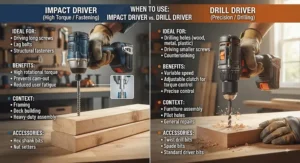
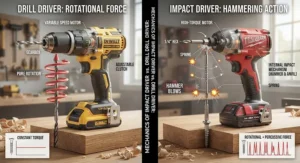
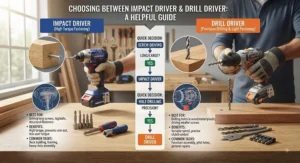
This is the question that started the whole impact driver vs drill driver conversation, so let’s answer it directly: reach for an impact driver whenever you’re driving long screws, structural fasteners, or lag bolts into dense material, especially where a standard drill would bog down or strip the bit. An impact driver is generally the better tool for tightening bolts too, though it delivers less torque than a full impact wrench and accepts smaller bits — meaning it fills the gap between a delicate drill and a heavy-duty wrench.
Reach for a drill driver instead when precision matters more than raw force — drilling clean pilot holes, driving delicate screws into trim or cabinetry, or using accessories like hole saws and paddle bits that need smooth, controllable rotation rather than percussive hammering. The hammering action that makes impact drivers so good at stubborn fasteners is the exact same trait that makes them a poor choice for precision drilling; that jarring motion walks a drill bit off-center almost every time.
| Feature | Impact Driver | Drill Driver |
|---|---|---|
| Best For | Milwaukee M18 FUEL 2853-20, DeWalt DCF887B | DeWalt DCD805B, Makita XFD131 |
| Torque Delivery | Percussive bursts | Smooth, continuous |
| Ideal Tasks | Lag bolts, decking, framing | Pilot holes, cabinetry, delicate screws |
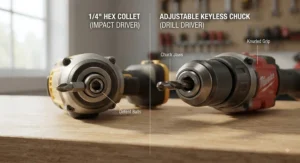
| Bit Compatibility | 1/4″ hex, torsion bits preferred | Keyless chuck, wide bit range |
| Learning Curve | Steeper — easy to over-drive | Gentler — clutch settings help |
The table above makes the split obvious once you see it laid out: impact drivers dominate the “force” column while drill drivers dominate the “control” column, and almost every buying decision comes down to which column matters more for your typical project list. Most serious DIYers eventually own both, using the drill driver for 70% of routine tasks and reaching for the impact driver only when a fastener fights back.
How the Impact Driver Cam Mechanism Actually Works
Understanding the impact driver cam mechanism explains almost everything about why these tools behave so differently from a standard drill. The original manual version of the tool used a heavy outer sleeve wrapped around an inner core connected by a curved spline; striking the sleeve with a hammer forced the spline to convert that blow into rotational torque at the core, translating the sleeve’s rotational inertia into a burst of turning force. Powered versions replicate that same physics electronically instead of relying on a hammer blow from the user.
Inside a cordless impact driver, a spring-loaded hammer and anvil system engages and disengages dozens of times per second once resistance builds. The motor spins a hammer that repeatedly strikes an anvil connected to the bit — each strike adds rotational force without adding continuous strain on the motor itself. This is a different animal from the hammer mechanism inside a hammer drill, which delivers a straight-line, forward-and-back blow rather than a rotational one — a distinction that trips up a lot of first-time buyers browsing spec sheets.
What most buyers overlook about this cam mechanism is that it’s precisely what prevents cam-out — the frustrating slip where a bit pops out of a screw head under pressure. The striking blow drives the bit forward into the screw at the same moment it twists, which reduces or eliminates cam-out and is especially beneficial for Phillips-head screws, which are notoriously prone to slipping. That’s the mechanical reason impact drivers feel almost magnetically locked onto a screw head compared to a standard drill fighting to stay seated.
Torsion Bit vs Standard Bit: Why It Actually Matters
If you’ve ever snapped a bit clean in half mid-project, the torsion bit vs standard bit distinction is the explanation you were missing. Standard driver bits are solid steel from tip to shank, which sounds sturdier on paper but actually transmits every ounce of an impact driver’s percussive force directly through a single rigid point — exactly the kind of stress that causes sudden, clean snaps under repeated hammering.
Torsion bits include a narrower flex zone machined into the shank that absorbs the torque spikes that would otherwise snap an ordinary bit, while precision-machined tips help reduce the annoying cam-out slipping that strips screw heads. Think of it like the difference between a rigid steel rod and a torsion bar in a car’s suspension: the flex zone briefly twists and releases rather than transmitting shock in one instant burst, which is exactly the engineering an impact driver’s hammering action demands.
Manufacturer and independent testing both point toward torsion-style bits engineered specifically for impact use lasting dramatically longer than standard bits under identical conditions, and real-world owner reports back that up consistently. The practical takeaway: standard bits are fine in a drill driver, where rotation is smooth and continuous, but pairing them with an impact driver is a false economy — you’ll replace them constantly and risk a snapped bit flying loose mid-task.
Building the Right Impact Driver Bit Set
A great impact driver is only as good as the impact driver bit set you’re feeding it, and this is one area where spending a little more up front saves real money over a project’s lifespan. An impact driver without the right bits is a bit like buying a sports car and never getting past first gear — the tool’s torque ceiling is wasted if the bit snaps before you reach it.
Look for sets specifically rated for impact use rather than generic multi-bit kits, since regular bits will shatter under repeated hammering rather than gradually wear down. Reviewers consistently point to two tiers worth considering: a budget-friendly starter set that covers roughly 90% of typical projects for around $20, and a premium torsion-engineered set for anyone who finds themselves stripping bits regularly or needs professional-grade durability.
Here’s what the spec sheet won’t tell you: bit length matters almost as much as bit hardness. A 2-inch bit works fine for open access, but confined spaces — inside cabinets, between studs — practically demand a 1-inch or magnetic stubby bit to avoid gouging surrounding material. If your work regularly involves bolts and hex fasteners rather than screws, adding a dedicated nut driver set to your impact driver bit set rounds out the kit nicely without duplicating bits you already own.

Real-World Scenarios: Matching the Tool to Your Project
The weekend furniture builder. If you’re assembling flat-pack furniture, hanging shelves, and tackling the occasional home-improvement project a few times a year, the Ryobi PBLID01K paired with a basic drill driver like the DeWalt DCD771C2 covers nearly everything without a huge upfront investment. This buyer rarely drives fasteners longer than 2 inches and values a light, low-torque setting more than raw power.
The remodeling DIYer. Someone building a deck, replacing subfloor, or hanging cabinetry needs more headroom. The DeWalt DCF887B handles structural fasteners with room to spare, while the DeWalt DCD805B takes over for precision drilling in tight cabinet corners — a combination that balances cost and capability without tipping into professional-grade pricing.
The daily contractor. For anyone running fasteners eight hours a day across multiple job sites, duty cycle and battery ecosystem depth outweigh almost every other consideration. The Milwaukee M18 FUEL 2853-20 absorbs sustained abuse that would wear out a homeowner-grade tool within months, and pairing it with the Makita XFD131 for finish work gives a contractor both raw torque and refined control in a single toolbox.
Fixing Impact Driver Screw Stripping (Problem → Solution Guide)
Impact driver screw stripping is easily the most common complaint we found across aggregated reviews, and almost every case traces back to one of a handful of fixable causes.
Problem: Cam-out on Phillips screws. Solution — switch to a torsion bit with a precision-machined tip; the flex zone reduces the cam-out slipping that strips screw heads, far more effectively than a worn standard bit.
Problem: Over-driving past flush. Solution — drop down a speed or torque setting before the final quarter-turn, or choose a model like the Makita XDT16Z with Auto-Stop, which halts hammering the instant a screw seats.
Problem: Worn or mismatched bit tips. Solution — retire bits showing visible rounding at the tip; a worn tip transmits force unevenly and chews out the screw head almost instantly under impact force.
Problem: Wrong bit size for the screw head. Solution — always match bit size exactly rather than “close enough”; a slightly undersized Phillips or square bit is one of the fastest ways to round out a screw head on the very first strike.
Problem: Pilot hole too small or missing entirely. Solution — in hardwood or dense engineered lumber, drill a proper pilot hole first; forcing a screw without one multiplies resistance and dramatically increases stripping risk regardless of which driver you’re using.
Common Mistakes When Buying an Impact Driver or Drill Driver
The single biggest mistake buyers make is choosing based on torque numbers alone, without considering duty cycle or ergonomics. A tool with class-leading torque that’s too heavy for overhead work all day isn’t actually the better purchase for every buyer — comfort compounds across a full workday in a way spec sheets never capture.
The second mistake is ignoring battery ecosystem lock-in. Once you’re invested in a platform, every future battery-powered tool purchase gets cheaper because you’re not buying a new battery and charger every time, so picking a driver in isolation without considering the rest of your eventual toolkit often costs more in the long run than the sticker price suggests.
A third common misstep: assuming bare-tool pricing is the full cost. Battery packs and chargers frequently cost as much as the tool itself, so comparing a bare-tool price against a full kit price is comparing apples to oranges. Finally, plenty of buyers skip impact-rated bits entirely and wonder why their brand-new driver keeps stripping screws — the tool was never the problem in those cases.
Long-Term Cost & Maintenance: What Ownership Really Costs
The sticker price on any of these seven tools is just the entry fee. Batteries degrade over roughly 300-500 charge cycles depending on care, and a replacement battery for a major platform typically runs $60-$120 depending on amp-hour rating — a cost worth factoring in before committing to a brand purely on bare-tool price. Buying tool-only makes the most sense if you already have batteries in that platform, while a full kit is the smarter move if you’re starting fresh, since kits typically bundle a battery and charger at a lower combined price than buying separately.
Maintenance costs stay low across every tool in this lineup — brushless motors, which all seven models except the DeWalt DCD771C2 use, have no brushes to replace and generally outlast brushed alternatives by a wide margin. The real recurring cost is consumables: impact-rated bits, drill bits, and the occasional battery replacement every few years of regular use. Factoring in a realistic bit and battery replacement budget over a five-year span, the gap between a $90 budget kit and a $200 professional tool narrows considerably once you account for how much longer the premium tool’s components tend to last under equivalent use.
For a deeper look at how these platforms stack up on power, runtime, and charging speed across dozens of lab-tested models, Consumer Reports’ cordless drill and impact driver ratings are a genuinely useful second opinion before committing to a platform long-term.
Safety, Regulations & Compliance Guide
Power tools carry real hazards regardless of price point, and a few baseline habits prevent the overwhelming majority of injuries. Always wear eye protection when using any cordless power tool, and review the operator’s manual before use to confirm whether the specific tool requires additional protective equipment like hearing protection or a dust mask. Inspect all cordless power tools, accessories, and battery packs for damage before each use, and remove anything damaged from service immediately rather than risking a mid-project failure.
For anyone using these tools professionally, OSHA maintains specific standards covering hand and power tools across general industry, maritime, and construction settings, and the agency’s hand and power tools safety guidance is worth bookmarking if tools are part of your daily job rather than an occasional weekend task. Keep hair, loose clothing, and jewelry away from any spinning bit or chuck, and always disconnect or lock out the trigger before changing bits or accessories — a habit that costs three seconds and prevents a meaningful share of hand injuries reported industry-wide.
Frequently Asked Questions
❓ Is an impact driver stronger than a drill driver?
❓ Can I use a drill bit in an impact driver?
❓ Do I need both an impact driver and a drill driver?
❓ Why does my impact driver keep stripping screws?
❓ What torque do I need for deck building?
Conclusion
The impact driver vs drill driver debate isn’t really about which tool is objectively better — it’s about matching mechanical strengths to the job in front of you. Impact drivers earn their keep on structural fasteners, lag bolts, and anything a standard drill would strip or stall on, while drill drivers win on precision, control, and the kind of delicate work where a hammering motion does more harm than good.
Across the seven tools we broke down, the DeWalt DCF887B stands out as the smartest single purchase for buyers who want serious torque without professional-grade pricing, the Milwaukee M18 FUEL 2853-20 remains the benchmark for daily commercial use, and the Makita XDT16Z earns its reputation as the best compact impact driver for anyone working in tight quarters. On the drill driver side, the DeWalt DCD805B and Makita XFD131 both reward buyers who prioritize control and comfort over maximum torque, while the DeWalt DCD771C2 remains a sensible, affordable entry point for first-time cordless tool owners.
Whichever side of the impact driver vs drill driver question you land on, the real answer for most home workshops and job sites is “eventually both” — and now you know exactly which model earns that spot in your toolbox first.
✨ Don’t Miss These Exclusive Deals!
🔍 Take your next project further with the picks above. Click through to check current pricing and availability, and build a toolkit that won’t let you down on the jobs that matter most!
Recommended for You
- Best Impact Driver 2026: 7 Top Picks Tested & Compared
- Angle Grinder Disc Types Explained: 7 Must-Know Picks (2026)
- Angle Grinder vs Die Grinder: 7 Real Picks Compared (2026)
Disclaimer: This article contains affiliate links. As an Amazon Associate, I earn from qualifying purchases. If you purchase products through these links, we may earn a small commission at no additional cost to you.
✨ Found this helpful? Share it with your friends! 💬🤗
