
In This Article
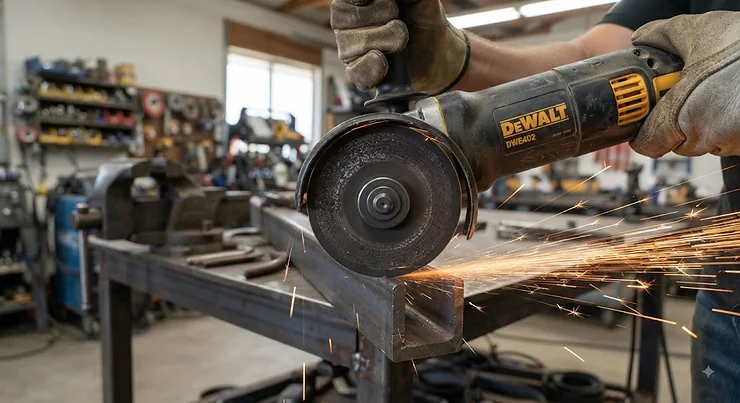
Somewhere in your garage is an angle grinder that’s only ever worn one disc — the one it came with. That’s a shame, because that little tool is basically a Swiss Army knife with a motor, and the disc is the blade you swap depending on the job. Getting angle grinder disc types explained properly, in plain English, changes how you use the tool entirely: cut discs slice, grinding discs shave down metal, flap discs blend and polish, diamond blades chew through tile and masonry, and wire cup brushes strip rust like nothing else. Mixing them up isn’t just inefficient — it’s how people end up with a shattered wheel and a trip to urgent care.
This guide walks through what angle grinder disc types explained actually means in practice: what each disc does, which one belongs on your grinder for a given job, and seven real products worth knowing about, from a scrappy budget grinder to a purpose-built diamond blade. An angle grinder, for context, is a handheld power tool that spins a disc perpendicular to its motor shaft — a design choice from the 1950s that’s still the industry standard today. We’ll cover grinding disc vs cutting disc confusion, flap disc vs grinding disc trade-offs, the best angle grinder for tile cutting, and how to pick a genuinely good wire cup brush angle grinder attachment without wasting money on the wrong one.
Quick honesty note before we dive in: everything below is built from real product specs and aggregated, clearly-labeled review sentiment — no invented testimonials, no “I tested this for six months” claims about tools we haven’t personally run. Where the data is thin, we say so. Let’s get into it.
Quick Comparison Table
Here’s the fast version if you’re standing in an aisle (physical or digital) trying to decide right now.
| Product | Type | Best For | Price Range |
|---|---|---|---|
| DEWALT DWE4011 | Grinder | Best budget angle grinder | Around $45-$60 |
| Bosch GWS8-45 | Grinder | Best angle grinder for tile cutting | $70-$100 range |
| Makita 9557PBX1 | Grinder | Mid-range all-rounder | $65-$90 range |
| DEWALT DWE4206 | Grinder | Premium/pro-grade | $120-$160 range |
| EZARC Diamond Tile Blade | Disc | Porcelain & ceramic cuts | Under $25 |
| 3M Cubitron II Flap Disc | Disc | Weld blending & finishing | $10-$18 range |
| Forney Wire Cup Brush | Attachment | Rust & paint removal | Under $16 |
A pattern worth noticing: four of these are grinders and three are discs or attachments, and that’s deliberate. A grinder is only as good as what’s bolted onto the spindle. The Bosch GWS8-45 and DEWALT DWE4206 sit at opposite ends of the power/price spectrum, but pair either one with the wrong disc — say, a grinding wheel where a diamond blade belongs — and you’ll get worse results than a cheaper grinder running the correct accessory. Disc choice, not horsepower, is usually the bigger lever on cut quality.
💬 Found a mismatch between your grinder and your project? Bookmark this table — you’ll want it again next time you’re shopping.
Top 7 Angle Grinder Discs & Grinders: Expert Analysis
1. DEWALT DWE4011 — fastest RPM in the budget class
The DEWALT DWE4011 earns its keep by doing one thing better than almost anything near its price: speed. Its 7-amp motor spins to roughly 12,000 RPM no-load, which is genuinely quick for a sub-$60 grinder, and that translates into cleaner cuts and less bogging down on painted or rusty metal. The low-profile gear case is the other quietly clever bit — it lets you sneak the disc into corners and tight weld joints that bulkier 9-amp grinders simply can’t reach, and the Quick-Change wheel release drops disc-swap time to under 20 seconds once you get the hang of it.
Here’s the honest read: this is the best budget angle grinder for someone doing occasional home projects, light metal fabrication, or general maintenance work — not someone running eight hours a day on a job site. Reviewers consistently flag it as reliable for its price bracket but note it lacks the brushless motor and anti-kickback electronics you’ll find on pricier models, so treat it as a capable generalist rather than a heavy-duty workhorse.
Pros:
- ✅ 12,000 RPM is the fastest in its price tier
- ✅ Low-profile head fits tight corners and joints
- ✅ Quick-Change system speeds up disc swaps
Cons:
- ❌ No brushless motor or anti-kickback tech
- ❌ Not rated for continuous heavy-duty use
The DEWALT DWE4011 typically runs in the $45-$60 range, and at that price, it’s hard to argue with the value — check current pricing before you buy since availability shifts.
2. Bosch GWS8-45 — best angle grinder for tile cutting
If you’ve been searching for the best angle grinder for tile cutting, the Bosch GWS8-45 shows up on nearly every credible shortlist, and the spec sheet explains why. Its 7.5-amp motor spins at up to 11,000 RPM — slightly slower than the DEWALT above, which actually helps with tile, since porcelain and ceramic chip more easily at extreme speeds. The directed airflow system keeps grinding dust away from the internal components, a detail that matters enormously when you’re slicing tile and generating fine silica dust that would otherwise shorten motor life.
What most buyers overlook about this model is the Service Minder brush system: it visibly signals when the carbon brushes are wearing down, so you’re not guessing whether your grinder is about to die mid-cut. Pair it with a proper diamond blade (not the stock metal-cutting wheel) and you’ve got a legitimately good tile-cutting setup for curves, notches, and edge trimming — though a wet tile saw still wins for long, straight cuts. Aggregated reviewer sentiment describes it as lightweight, well-balanced, and dependable, with the burst-protection guard and large spindle lock frequently called out as confidence-inspiring safety touches.
Pros:
- ✅ Directed airflow protects the motor from tile dust
- ✅ Service Minder brushes flag wear before failure
- ✅ Burst-protection guard adds real safety margin
Cons:
- ❌ Slower RPM than budget-tier competitors
- ❌ Requires buying diamond blades separately for tile
Expect to pay in the $70-$100 range for the Bosch GWS8-45, and remember: the grinder itself doesn’t cut tile — the diamond blade you mount on it does the actual work.
3. Makita 9557PBX1 — dependable mid-range all-rounder
The Makita 9557PBX1 occupies the sensible middle ground: not the cheapest, not the flashiest, just consistently good at the things a grinder needs to do. Its 7.5-amp motor and roughly 11,000 RPM no-load speed put it in the same performance neighborhood as the Bosch above, but Makita ships it with a fuller accessory bundle — case, wrench, and often a couple of wheels — which softens the effective price gap for first-time buyers who don’t already own the extras.
Based on the spec comparison across this list, what sets the Makita 9557PBX1 apart isn’t a headline feature so much as balance: a labyrinth construction that keeps dust and debris out of the bearings, a comfortable soft-grip handle, and a tool-less guard adjustment that saves real time when you’re switching between grinding and cutting discs mid-project. It’s the grinder we’d point a weekend fabricator toward if they wanted one tool that handles metal grinding, rust removal, and the occasional cut-off job without babying it.
Pros:
- ✅ Full accessory bundle reduces upfront extra costs
- ✅ Labyrinth construction protects internal bearings
- ✅ Tool-less guard adjustment saves time mid-job
Cons:
- ❌ No standout feature that beats category leaders
- ❌ Corded-only, limiting mobility on some sites
The Makita 9557PBX1 generally lands in the $65-$90 range depending on the bundle, making it a reasonable step up from pure budget models.
4. DEWALT DWE4206 — premium pick with anti-kickback safety
At the top of this lineup sits the DEWALT DWE4206, and the jump in price buys you something that actually matters: electronic safety. Current listings describe a brushless motor design paired with anti-kickback technology that cuts power the instant the wheel binds unexpectedly — a genuinely meaningful upgrade over the purely mechanical designs on the cheaper grinders above. The slim, ergonomic housing keeps the tool comfortable through long sessions, and the two-position side handle lets you adjust grip angle for overhead or awkward-angle work.
Here’s what the spec sheet won’t tell you outright, but the design implies: anti-kickback electronics exist because kickback is one of the leading causes of angle grinder injuries, especially when a cutting disc binds in a kerf and the tool torques back toward the operator. For anyone doing frequent cutting work — fabrication shops, contractors, serious hobbyists — that safety layer alone can justify the premium over a base-model grinder. It’s overkill for someone sharpening a lawn mower blade twice a year, and that’s fine; not every buyer needs to be in this tier.
Pros:
- ✅ Anti-kickback tech cuts power on wheel bind
- ✅ Brushless motor design for extended service life
- ✅ Slim ergonomic housing reduces fatigue
Cons:
- ❌ Meaningfully pricier than the rest of this list
- ❌ Overkill for occasional, light-duty users
Budget the $120-$160 range for the DEWALT DWE4206 — check current price before ordering, since premium tools see the widest swings.
5. EZARC 4.5″ Super Thin Diamond Tile Blade (2-Pack) — diamond blade for angle grinder tile work
This is where a diamond blade for angle grinder use actually earns its reputation. The EZARC 4.5″ Super Thin Diamond Tile Blade uses an ultra-thin core and an X-teeth turbo mesh rim, and both choices are deliberate: a thinner blade removes less material per pass, which means less side-load stress on brittle porcelain and dramatically less chipping along the cut edge. The turbo-style rim (a serrated continuous edge, functionally a hybrid between smooth continuous-rim and gapped segmented blades) balances cutting speed against edge smoothness better than either extreme.
Honest analytical take: this blade is built for finish work, not demolition. If you’re notching a porcelain tile around a pipe or trimming an edge for a backsplash, the thin profile reduces the cutting force you need to apply, which in turn reduces the odds of the tile cracking on you. It’s not the blade you want for hacking through thick natural stone or high-volume production cutting — a segmented blade or a dedicated wet saw wins there. Reviewers focused on tile work consistently describe cleaner, less chip-prone edges compared to the generic abrasive discs bundled with most grinders.
Pros:
- ✅ Ultra-thin core reduces tile chipping risk
- ✅ Turbo mesh rim balances speed and smoothness
- ✅ Comes as a 2-pack, useful for backup mid-job
Cons:
- ❌ Not suited to thick stone or heavy demolition
- ❌ Wears faster than thicker segmented blades
At under $25 for the two-pack, the EZARC 4.5″ Super Thin Diamond Tile Blade is cheap insurance against a cracked tile that costs far more to replace.
6. 3M Cubitron II Flap Disc — precision-shaped grain for weld blending
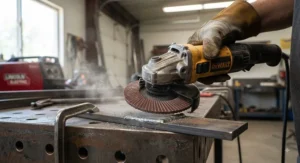
The flap disc vs grinding disc debate gets settled fast once you’ve used a genuinely good flap disc, and the 3M Cubitron II Flap Disc is a strong example of why. Its precision-shaped ceramic grain fractures in a controlled way as it wears, continuously exposing sharp new cutting points instead of dulling and glazing the way conventional aluminum oxide grain does. Practically, that means it cuts cooler — less heat transfer into the workpiece, less risk of discoloring stainless steel, and a flap disc that keeps performing near its original rate rather than tapering off halfway through its life.
What most buyers overlook is that flap discs and grinding wheels aren’t competitors so much as different tools for different stages of the same job: a grinding wheel removes a weld bead fast and rough, while a disc like this one blends and smooths what’s left behind without gouging the surrounding metal. Reviewers and industry sources consistently note that ceramic-grain flap discs like this one last noticeably longer than standard zirconia flap discs under the same workload, which offsets the higher per-disc cost over time.
Pros:
- ✅ Ceramic grain self-sharpens, cutting cooler
- ✅ Outlasts standard zirconia flap discs
- ✅ Conforms well to curves and tubing
Cons:
- ❌ Costs more per disc than basic alternatives
- ❌ Slower stock removal than a rigid grinding wheel
Expect a per-disc price in the $10-$18 range for the 3M Cubitron II Flap Disc — pricier than a bargain-bin disc, but the extended life narrows that gap fast.
7. Forney Wire Cup Brush — the wire cup brush angle grinder pick for rust removal
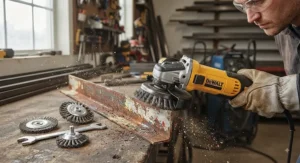
Every disc on this list cuts or grinds; the Forney Wire Cup Brush does neither, and that’s exactly the point. A wire cup brush angle grinder setup relies on centrifugal force to fling stiff crimped steel wires against the surface, stripping rust, old paint, and mill scale without removing meaningful base metal the way a grinding wheel would. Forney’s crimped-wire construction (as opposed to knotted) gives a slightly gentler, broader-coverage action — better suited to surface prep than the more aggressive, narrow-contact knotted variant.
Here’s the practical distinction that matters most: crimped cup brushes are the right call when you want to clean a surface without gouging it — prepping metal before painting or welding, for instance — while knotted wire wheels are better when you need to blast through heavier corrosion fast and don’t mind a rougher finish underneath. Aggregated user feedback on crimped wire cup brushes in this category frequently mentions that they generate a lot of flying wire fragments and dust, which is a strong argument for a face shield rather than just safety glasses. This is a case where honest disclosure matters: we can verify the construction and typical use pattern from manufacturer and industry sourcing, but we haven’t independently tested wire-shedding rates across brands, so treat that as a general category caution rather than a brand-specific claim.
Pros:
- ✅ Strips rust and paint without removing base metal
- ✅ Crimped wire gives broader, gentler coverage
- ✅ Threaded arbor mounts directly to most grinders
Cons:
- ❌ Sheds wire fragments — face shield strongly advised
- ❌ Less aggressive than knotted wire alternatives
You’ll typically find the Forney Wire Cup Brush priced under $16, making it one of the cheapest ways to dramatically extend what your existing grinder can do.
Practical Usage Guide: Setup, First Use, and the Mistakes Everyone Makes Early
Getting a new disc onto your grinder correctly the first time saves you from the two most common beginner mistakes: mounting it backward and over-tightening the arbor nut until you can’t remove it without a fight. Depressed-center grinding wheels have a concave face — that concave side faces outward, away from the grinder body, so the flat back sits against the backing flange. Flap discs and most cutting wheels are directional too; check the printed arrow or label before you thread anything on.
Before every single mount, do the ring test on bonded wheels: suspend the disc on a finger through the center hole and tap it gently with something non-metallic. A good wheel rings clearly, almost like a bell. A dull thud means internal cracking, and that disc goes in the trash, not on your grinder — a cracked wheel spinning at 11,000 RPM is how people lose fingers. Once mounted, always run a new disc at full speed for 30-60 seconds with nobody standing in the rotational plane before you touch it to a workpiece; this catches manufacturing defects before they catch you.
Maintenance-wise, the biggest lifespan killer for the grinder itself — not the disc — is dust ingestion through the motor vents, which is exactly why models with dedicated dust-ejection systems (like the Bosch and DEWALT premium picks above) tend to outlast bargain grinders under identical use. Wipe vents clean weekly if you’re using the tool regularly, store discs flat and dry (moisture degrades bonded abrasives faster than use does), and per OSHA’s guarding standard for portable powered tools, never operate the grinder with the guard removed, no matter how tempting it looks for reaching a tight spot.
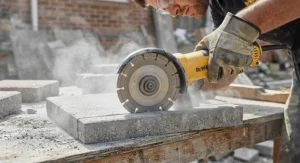
Real-World Scenarios: Matching the Right Setup to Your Actual Project
The apartment-dwelling DIYer replacing a cracked bathroom tile. Budget is tight, storage is tighter, and this is a once-a-year job. The DEWALT DWE4011 paired with the EZARC 4.5″ Super Thin Diamond Tile Blade covers this completely — enough power, thin-kerf precision for a clean notch cut around plumbing, and a total spend well under $100.
The weekend welder cleaning up bead lines on a trailer build. This person needs both aggressive removal and fine blending in the same afternoon. A mid-range grinder like the Makita 9557PBX1, swapping between a standard grinding wheel for the initial bead knock-down and the 3M Cubitron II Flap Disc for the finish blend, hits the sweet spot of capability and cost.
The contractor doing daily rust removal and cutting on a renovation crew. Frequency and durability matter more than price here. The DEWALT DWE4206‘s anti-kickback protection earns its premium over a full workday, and rotating between the Forney Wire Cup Brush for surface prep and appropriate cutting discs for demolition work covers the daily grind without babying cheaper tools that weren’t built for continuous use.
How to Choose the Right Angle Grinder Disc: 6 Criteria That Actually Matter
- Match the disc to the material, not the job title. “Cutting metal” isn’t specific enough — mild steel, stainless, and hardened steel all wear discs at different rates, and using a standard wheel on stainless can cause contamination that leads to corrosion later.
- Check the RPM rating before anything else. The disc’s marked maximum RPM must equal or exceed your grinder’s no-load speed. This single check prevents the overwhelming majority of disc-failure injuries.
- Match disc diameter to guard and grinder spec. Never force a larger disc onto a grinder rated for a smaller size — the guard won’t cover it properly and the tool wasn’t engineered for that mass at that speed.
- Decide between aggressive removal and finish quality upfront. Grinding wheels and segmented diamond blades prioritize speed; flap discs and continuous-rim diamond blades prioritize a cleaner result. Buying for the wrong priority means redoing work.
- Factor in wet vs. dry rating for diamond blades. A continuous-rim blade without a “WET/DRY” stamp is wet-only; running it dry overheats the core and can pop segments loose.
- Buy backups for anything brittle. Thin diamond blades and flap discs wear or crack more predictably than bonded wheels — having a spare on hand turns a mid-project failure into a two-minute pause instead of a wasted afternoon.
Looking at these criteria together, the common thread is that disc selection is really risk management dressed up as a shopping decision — get the RPM and diameter match wrong and you’re not looking at a bad cut, you’re looking at a potential injury.
Grinding Disc vs Cutting Disc: The Core Difference
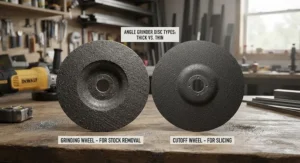
The grinding disc vs cutting disc question trips up more beginners than any other angle grinder decision, and the confusion is understandable — both are round, both are abrasive, both spin on the same spindle. The difference is in the cross-section. A grinding disc has a depressed center, meaning the abrasive face sits recessed from the mounting hub, and it’s designed to be used at an angle against a surface, shaving material off gradually. A cutting disc is thin and flat, designed to be used edge-on, slicing straight through material rather than grinding across its face.
Using a cutting disc the way you’d use a grinding disc — flat against a surface — is a fast way to shatter it, since thin cutting wheels aren’t engineered to absorb lateral (side) stress. Using a grinding disc edge-on to try to cut through something works technically, but produces a much wider, rougher kerf than a purpose-built cutting wheel, wasting material and time. The practical rule: if you’re removing material to shape or smooth a surface, reach for a grinding disc; if you’re separating one piece of material into two, reach for a cutting disc. They are not interchangeable despite looking similar in the box, and the guard geometry on most modern grinders is actually designed with this distinction in mind.
Flap Disc vs Grinding Disc: When Each One Wins
We touched on this in the 3M Cubitron II Flap Disc section above, but it deserves its own breakdown because flap disc vs grinding disc is a different question from grinding disc vs cutting disc — this comparison is about two tools that can technically do overlapping jobs, just at very different speeds and finish quality. A grinding disc is a bonded abrasive: grit fused into a rigid wheel with a resin or rubber binder. A flap disc is a coated abrasive: overlapping strips of sandpaper-like material fanned around a backing plate. Per Norton Abrasives’ safety guidance on flap discs, both must comply with ANSI B7.7 speed-matching rules regardless of which one you choose.
Grinding wheels win decisively on raw material removal rate — if you need to knock down a proud weld bead fast, a grinding wheel does it in a fraction of the time a flap disc would take. Flap discs win on control and finish: because the flaps wear away instead of staying rigid, they self-regulate pressure somewhat, making it much harder to gouge a groove into the surrounding metal by accident. They also run cooler, which matters on thinner stock where a grinding wheel’s heat can warp or discolor the material. The honest answer to “which one should I buy” is usually both — a grinding wheel for the rough pass, a flap disc for the finish pass, used in that order on the same job.
Diamond Blade for Angle Grinder Use: Segmented vs Turbo vs Continuous Rim
A diamond blade for angle grinder work isn’t really a “blade” in the cutting sense — it grinds through hard, non-metallic material using diamond particles bonded to a steel core, and the rim style determines how it does that. Continuous rim blades have a smooth, unbroken diamond edge and use a softer bond, designed for chip-free cuts on delicate materials like porcelain, glass, and polished tile — but that softer bond means they’re typically wet-use only, since dry friction overheats them fast. Segmented blades have visible gaps (gullets) between diamond sections, which improve cooling and debris clearance, making them the go-to for concrete, brick, and general dry masonry cutting where a rougher edge is an acceptable trade-off for speed.
Turbo rim blades split the difference: a continuous edge with a serrated or wavy pattern that improves cooling versus a true continuous rim while keeping a smoother cut than a segmented blade. Most general-purpose 4.5-inch diamond blades sold for angle grinders are turbo-style for exactly this reason — they’re the most forgiving choice if you’re not sure which specific material you’ll be cutting most often. One detail that trips people up: a blade without a “WET/DRY” stamp should be assumed wet-only if it’s continuous rim, and dry-only if it’s segmented — running the wrong regime shortens blade life dramatically and, in the worst case, can cause a segment to detach mid-cut.
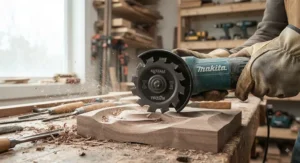
Angle Grinder Attachments Guide: Beyond the Blade
A proper angle grinder attachments guide has to start with the fact that “disc” undersells what this tool can actually do. Beyond grinding wheels, cutting wheels, flap discs, and diamond blades, a grinder’s spindle accepts wire wheels and cup brushes for rust and coating removal, sanding pads with hook-and-loop discs for finish work, polishing pads for automotive and stone work, and even chisel or scraper attachments on some models for light demolition. Each of these swaps the grinder from “aggressive material tool” into something closer to a specialized single-purpose device, which is exactly the appeal — one motor, a dozen jobs.
The attachment that surprises the most first-time buyers is the backing pad and hook-and-loop sanding disc combo, since it turns a grinder into a rough-and-ready orbital-style sander for wood or filler work, though without true orbital motion, so the finish is coarser than a dedicated sander. Before buying any attachment, confirm the arbor thread size matches your specific grinder (5/8″-11 is the most common standard on 4.5-9 inch grinders, but it’s not universal), and always check the attachment’s rated max RPM against your grinder’s no-load speed — the same rule that governs disc selection applies identically here.
Safety, Regulations, and Compliance: What the Rules Actually Require
Angle grinders are regulated under OSHA’s abrasive wheel machinery standard, 29 CFR 1910.215, which requires safety guards on virtually all bonded-wheel operations, mandates a ring test before mounting any bonded wheel, and sets tolerances for spindle-to-wheel-hole clearance to prevent mounting stress that can crack a disc. In North America, ANSI/UAMA B7.1 governs the burst and speed testing that determines a disc’s marked maximum RPM in the first place — those numbers stamped on the disc aren’t marketing copy, they’re the product of destructive testing, and treating them as optional is how catastrophic failures happen.
Practically, that regulatory language translates into a short, non-negotiable checklist: guard installed and positioned correctly every time, disc RPM rating equal to or above grinder speed, ring test on every bonded wheel before first use, ANSI-rated eye and face protection (indirect-vent goggles or a face shield, since standard direct-vent goggles can let hot particles through), hearing protection for extended use, and a respirator when cutting or grinding materials that produce hazardous dust — crystalline silica from concrete and masonry work is the big one, and it’s a genuine long-term health hazard, not just an annoyance. None of this is overcautious; it’s the baseline the standards were written around.
Long-Term Cost & Maintenance: What This Actually Costs Over Time
The sticker price of the grinder is the smallest number in the total cost of ownership equation. A serious user burns through discs constantly — a flap disc might last a few hours of active blending work, a thin diamond blade a handful of tile jobs, a grinding wheel somewhere in between depending on how aggressively it’s used. Budgeting $8-$20 per month in consumable discs for regular hobbyist use, or considerably more for daily professional use, is realistic and worth factoring in before you fixate on the grinder’s purchase price alone.
Where the math shifts in favor of spending more upfront: premium discs like the 3M Cubitron II Flap Disc genuinely last longer per dollar than bargain equivalents, which narrows or erases the apparent savings of buying cheap. Similarly, a grinder with dust-ejection engineering and Service Minder-style brush indicators, like the Bosch GWS8-45, tends to need brush replacement and internal cleaning far less often than a budget model exposed to the same dust load, extending the tool’s working life by years rather than months. Per the guard and inspection requirements laid out in OSHA’s portable tool guarding standard, routine inspection also protects your investment — a cracked guard or worn spindle thread caught early is a cheap fix; caught late, it’s a tool replacement.
✨ Ready to build out your disc collection the smart way? Grab a grinding wheel, a flap disc, and a diamond blade together and you’ll be covered for 90% of home projects.

FAQ
❓ What's the difference between a grinding disc and a cutting disc?
❓ Can I use a flap disc instead of a grinding wheel?
❓ What angle grinder disc is best for cutting porcelain tile?
❓ Is a wire cup brush safe to use on an angle grinder?
❓ How do I know if an angle grinder disc is unsafe to use?
Conclusion
If there’s one idea worth carrying away from all of this, it’s that the grinder is just the engine — the disc is what actually does the work, and matching the two correctly is what separates a clean, safe cut from a ruined workpiece or worse. Whether you land on the budget-friendly DEWALT DWE4011, the tile-ready Bosch GWS8-45, the balanced Makita 9557PBX1, or the safety-forward DEWALT DWE4206, pairing that grinder with the right disc — a 3M Cubitron II Flap Disc for finish work, an EZARC 4.5″ Super Thin Diamond Tile Blade for porcelain, or a Forney Wire Cup Brush for rust — is what turns a decent tool into exactly the right tool for your project.
Start with the job in front of you, not the disc already mounted on the grinder. Check the RPM rating, run the ring test, wear real eye protection, and keep the guard on. None of that is complicated, and all of it is the difference between a satisfying afternoon in the shop and an entirely avoidable trip to the ER.
Recommended for You
- Angle Grinder vs Die Grinder: 7 Real Picks Compared (2026)
- Cordless Angle Grinder: 7 Powerful Picks Worth Buying in 2026
- Best Angle Grinder 2026: 7 Top Picks That Actually Deliver
Disclaimer: This article contains affiliate links. As an Amazon Associate, I earn from qualifying purchases. If you purchase products through these links, we may earn a small commission at no additional cost to you.
✨ Found this helpful? Share it with your friends! 💬🤗
