
In This Article
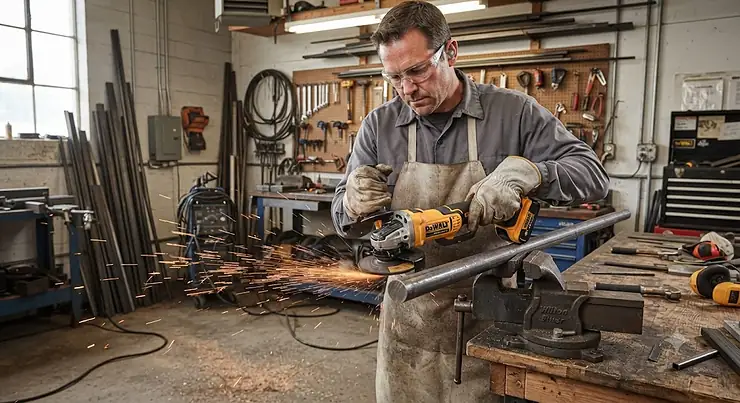
If you’ve ever stood in the tool aisle staring at a wall of angle grinders, you already know the problem: they all look the same. Yellow one, red one, blue one, green one — same disc, same guard, same vague promise of “power.” But the best angle grinder for your project isn’t the one with the loudest branding. It’s the one whose amps, switch type, and guard design actually match what you’re about to cut, grind, or strip. This guide skips the marketing copy and gets into the real specs — amps versus watts, paddle switches versus trigger switches, guard styles, and seven genuine products worth your money.
We researched real listings, manufacturer spec sheets, and aggregated review sentiment across DeWalt, Makita, Milwaukee, Bosch, Metabo, Black+Decker, and WEN to put together a buying guide grounded in facts, not affiliate fluff. Whether you’re chasing rust off a trailer hitch or slicing rebar on a jobsite, there’s a angle grinder below sized to the job — and we’ll tell you exactly why.
What Is an Angle Grinder?
An angle grinder is a handheld power tool that spins an abrasive disc — typically 4.5 to 9 inches — at high RPM to cut, grind, polish, or strip material. It runs on corded electric power, battery power, or compressed air, and swapping the disc changes the job entirely: a cutoff wheel slices metal, a flap disc smooths welds, a wire wheel strips rust. It’s arguably the single most versatile tool in a metalworker’s or contractor’s kit.
Quick Comparison Table
| Product | Power Source | Motor | Weight | Best For |
|---|---|---|---|---|
| DeWalt DWE402 | Corded | 11 Amp | 4.9 lbs | Best all-around value for DIY and pros |
| Makita GA4542C | Corded | 12 Amp | 5.4 lbs | Lowest vibration for long sessions |
| Milwaukee 2880-20 | Cordless (18V) | Brushless | 5.3 lbs (bare) | Best cordless for jobsite mobility |
| Bosch GWS13-50VSP | Corded | 13 Amp | 5.1 lbs | Best variable-speed control |
| Metabo WEV15-125 | Corded | 13.5 Amp | 4.9 lbs | Best kickback protection |
| Black+Decker BDEG400 | Corded | 6.5 Amp | 4.8 lbs | Best budget pick for occasional use |
| WEN 94475 | Corded | 7.5 Amp | 4.6 lbs | Best cheap grinder with included accessories |
Looking at this table, the split is pretty clean: DeWalt DWE402, Makita GA4542C, Bosch GWS13-50VSP, and Metabo WEV15-125 occupy the serious-use corded tier where amperage and vibration control matter most, while Black+Decker BDEG400 and WEN 94475 serve buyers who need a grinder twice a year, not twice a day. The Milwaukee 2880-20 is the outlier — it trades a few amps of raw power for the freedom of no cord, which matters a lot more than the spec sheet suggests once you’re up a ladder or under a truck.
💬 Found a favorite already? Tap its name above to check today’s price on Amazon!
Top 7 Angle Grinders: Expert Analysis
1. DeWalt DWE402 — best power-to-weight ratio under $100
The DeWalt DWE402 earns its reputation the boring way: it just works, every time, without drama. That reliability is the standout feature here, and it’s why this model shows up on more contractor trucks than almost anything else in this list.
The 11-amp motor spins at up to 11,000 RPM, which is plenty for cutting angle iron, grinding welds flat, or knocking rust off a trailer frame. What the spec sheet won’t tell you is how much that 11-amp figure matters in practice — it’s enough headroom that the disc doesn’t bog down under moderate pressure, which is exactly where cheaper 6-amp grinders start to stall and burn out their motors. The paddle switch (more on that distinction later) means the tool only runs while you’re actively gripping it, a genuine safety advantage over slide-switch designs.
Based on the spec comparison against similarly priced tools, the DeWalt DWE402 is the pick for a DIYer who wants one grinder that can also handle occasional pro-grade work, or a tradesperson who wants a reliable backup without spending premium money. Reviewers consistently report years of daily use without failure, and multiple sources note the dust ejection system genuinely extends motor life compared to older DeWalt models it replaced.
Pros:
- ✅ 11-amp motor handles metal cutting without bogging down
- ✅ Paddle switch shuts off automatically when released
- ✅ Oversized brushes rated for roughly double the brush life
Cons:
- ❌ No variable speed dial for delicate finishing work
- ❌ Stock guard requires a tool to reposition
Expect to pay in the $50-$70 range for the DeWalt DWE402, and at that price it’s genuinely hard to beat for value — check current price and availability before you buy, since angle grinder pricing shifts often.
2. Makita GA4542C — lowest vibration for extended grinding sessions
The Makita GA4542C leads with something most grinders ignore entirely: comfort over a full workday. Makita’s SJS II (Super Joint System II) mechanism is the standout feature, and it’s a genuinely clever piece of engineering rather than a marketing buzzword.
Here’s what that spec means in practice: the SJS II uses a leaf spring and cam gear drive that absorbs shock when the wheel binds, which does two things — it protects the gear train from damage, and it noticeably cuts down the vibration transmitted into your hand and wrist. Paired with a 12-amp motor and a variable speed range of 2,800-11,000 RPM, this is the grinder Makita built for people who are on the tool for hours, not minutes. The electronic controller also adds soft-start and current-limiting protection, which matters if you’re running it off a long extension cord where voltage drop is a real concern.
Based on the spec comparison, the Makita GA4542C is the strongest pick for auto body work, shipyard maintenance, or any job involving sustained grinding rather than quick cuts — exactly the use cases Makita lists in its own product documentation. Aggregated reviewer sentiment across multiple retailers consistently praises the low-vibration feel and smooth start-up, with fewer complaints about hand fatigue than competing 12-amp models.
Pros:
- ✅ Variable speed dial from 2,800 to 11,000 RPM
- ✅ SJS II vibration dampening reduces hand fatigue
- ✅ Labyrinth construction seals out dust and debris
Cons:
- ❌ Heavier than the DeWalt at 5.4 lbs
- ❌ Premium price compared to base-model 12-amp grinders
Pricing typically lands in the $130-$160 range for the Makita GA4542C — a jump over budget models, but the vibration control alone justifies it for anyone grinding daily.
3. Milwaukee 2880-20 — best cordless grinder for jobsite mobility
The Milwaukee 2880-20 solves the one problem no corded grinder can: the cord itself. No more hunting for an outlet, no more tripping hazards, no more running extension cords across a roof. That’s the standout feature, and Milwaukee backs it with genuine performance rather than a watered-down cordless compromise.
The POWERSTATE brushless motor spins the 4.5″/5″ disc at 8,500 RPM — slightly below the top corded models, but Milwaukee’s own engineering notes claim up to 2x the runtime and 10x the motor life versus their prior cordless grinder generation, thanks to the brushless design eliminating carbon brush wear entirely. On paper, this means less maintenance over the tool’s life, which matters if you’re running it daily on a jobsite. The paddle switch with no-lock function is the same safety-first design philosophy DeWalt and Bosch use on their corded models, so you’re not sacrificing the auto-shutoff behavior just because there’s no cord.
What most buyers overlook about cordless grinders is the total cost of ownership: this is sold as a bare tool, meaning the M18 battery and charger are a separate purchase unless you already own Milwaukee’s M18 platform. If you do, this becomes one of the smartest additions to your kit; if you’re starting from zero, budget accordingly. Reviewers who already owned M18 batteries consistently report being surprised by how close the cutting speed feels to a corded unit for anything short of continuous industrial use.
Pros:
- ✅ No cord — ideal for ladders, roofs, and tight crawlspaces
- ✅ Brushless motor rated for far longer service life
- ✅ Compatible with the wide Milwaukee M18 battery ecosystem
Cons:
- ❌ Sold bare — battery and charger cost extra
- ❌ Runtime limited by battery capacity on sustained cuts
The bare tool typically runs in the $180-$220 range, with a battery-inclusive kit pushing well past $300 — a real investment, but one that pays off fast for anyone already on the M18 platform.
4. Bosch GWS13-50VSP — best variable-speed control for mixed materials
The Bosch GWS13-50VSP is built around one idea: match the tool’s speed to the material, every single time. That adjustability is the standout feature, and it’s what separates a grinder that can finesse stainless steel from one that just brute-forces every job at max RPM.
A 13-amp motor delivers up to 11,500 no-load RPM at the top end, with a variable-speed dial that drops all the way down to 2,800 RPM for delicate work. What that range means practically: you can run full speed for aggressive metal cutting, then dial down for polishing or working stainless without discoloring it from excess heat — something a fixed-speed grinder simply can’t do. Bosch also builds in an acceleration sensor that detects sudden rotational spikes (the kind that happen right before a kickback) and cuts power automatically, plus restart protection so the tool won’t fire back up unexpectedly after a power interruption.
Based on the spec comparison, this is the grinder for someone who works across multiple materials — steel one day, stainless the next, maybe stone prep after that — rather than a single repetitive task. Reviewers who’ve run it alongside fixed-speed competitors consistently highlight the vibration-control side handle as a genuine comfort upgrade during long sessions, not just a marketing checkbox.
Pros:
- ✅ True variable speed from 2,800 to 11,500 RPM
- ✅ Acceleration sensor helps limit kickback severity
- ✅ Tool-less guard adjustment speeds up disc changes
Cons:
- ❌ Among the pricier corded options in this roundup
- ❌ Some users report the dial detents feel imprecise at low speeds
Expect a price in the $110-$140 range for the Bosch GWS13-50VSP — a fair ask for a grinder that genuinely adapts to the job instead of forcing the job to adapt to it.
5. Metabo WEV15-125 — best kickback protection in a corded grinder
The Metabo WEV15-125 puts safety engineering front and center, and its S-Automatic Safety Slip Clutch is the standout feature that separates it from nearly everything else on this list.
Here’s what that means in real terms: if the disc binds — say, it pinches in a cut or catches an edge — the clutch mechanically slips rather than transferring that sudden rotational force straight into your wrists. That’s the exact moment most grinder kickback injuries happen, and Metabo built a physical safeguard for it rather than relying on electronics alone. The 13.5-amp LongLife motor claims up to 50% more torque than standard motors in its class, and a variable speed range (published between roughly 2,800 and 9,600-11,000 RPM depending on model variant) lets you dial it back for stainless steel prep, where excess heat and speed cause discoloration.
On paper, this reads like a premium safety-focused grinder built in Germany for buyers who prioritize long-term durability over rock-bottom price — and that’s exactly how Metabo positions it. What most buyers overlook is that the electronics package also includes overload protection and soft start, meaning the motor is less likely to burn out from repeated hard starts, a common failure mode in cheaper grinders run hard day after day.
Pros:
- ✅ S-Automatic slip clutch reduces kickback severity
- ✅ 13.5-amp LongLife motor with high overload capacity
- ✅ Tool-free guard repositioning for fast cut-to-grind changes
Cons:
- ❌ One of the more expensive corded options here
- ❌ Overkill for occasional, light-duty home use
Pricing generally sits in the $140-$180 range for the Metabo WEV15-125, positioning it as a premium buy — but for anyone grinding professionally, the built-in kickback protection is worth the premium alone.
6. Black+Decker BDEG400 — best budget grinder for occasional DIY use
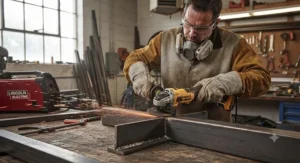
The Black+Decker BDEG400 is the grinder to buy if you need to fix a fence gate twice a year, not run a fabrication shop. Its low price is the honest standout feature here, and it delivers reasonable performance for exactly that kind of intermittent use.
The 6.5-amp motor spins at up to 10,000 RPM, which handles light rust removal, small metal cuts, and occasional sharpening without issue. What that spec means in practice: it’s noticeably less powerful than the 11-13 amp models above, so pushing it into sustained heavy cutting will bog the motor down faster and shorten its lifespan. A metal gear case and three-position side handle are genuine upgrades over the cheapest disposable grinders on the market, giving it a sturdier feel than the price suggests.
Aggregated review sentiment here is mixed and worth being upfront about: many buyers report solid performance for light use and praise the comfortable grip, while a meaningful number of reviews flag switch failures and one report of a workshop fire tied to an electrical fault after extended use. That split sentiment tracks with what you’d expect from a budget tool — most units perform fine for occasional work, but the margin for reliability under heavy or sustained use is thinner than on the pro-grade models above.
Pros:
- ✅ Lowest price point of any corded grinder in this list
- ✅ Metal gear case adds durability at this price tier
- ✅ Lightweight at 4.8 lbs for easy handling
Cons:
- ❌ Reviewers report occasional switch and motor failures
- ❌ Underpowered for sustained heavy-duty cutting
The Black+Decker BDEG400 typically sells in the $25-$35 range, making it a reasonable entry point — just don’t expect it to survive daily professional use the way the pricier models will.
7. WEN 94475 — best cheap grinder with included accessories
The WEN 94475 rounds out the budget tier with a straightforward pitch: more amps than the Black+Decker, plus a bundle of discs and a carrying case, all at a genuinely low price. That bundled value is the standout feature.
A 7.5-amp motor gives it a modest edge over most sub-$40 competitors, and it ships with three discs and a storage case — meaning you’re not making a second purchase just to start using it. What that means in practice: for someone assembling a first home tool kit, the WEN 94475 removes the “wait, I need discs too” frustration that trips up first-time buyers of bare-bones budget grinders. It won’t match the RPM stability or vibration control of the Makita or Bosch above, but for basic rust removal, small cuts, and occasional grinding, it’s a genuinely competent entry-level tool.
Reviewers consistently note it as a solid value pick relative to similarly priced no-name alternatives, with the included case and discs cited repeatedly as a meaningful convenience rather than a throwaway bonus. As with any budget-tier grinder, don’t expect the motor to hold up to daily professional abuse — this is a homeowner’s tool, not a contractor’s primary grinder.
Pros:
- ✅ Includes three discs and a carrying case out of the box
- ✅ 7.5-amp motor outperforms most similarly priced rivals
- ✅ Compact and lightweight for easy one-handed control
Cons:
- ❌ Not built for sustained daily professional use
- ❌ Fewer safety electronics than the pro-tier models above
Priced around $25-$35, the WEN 94475 is arguably the best “starter kit” pick on this list simply because it removes the extra-purchase friction that trips up first-time buyers.
Practical Usage Guide: Your First 30 Days With a New Grinder
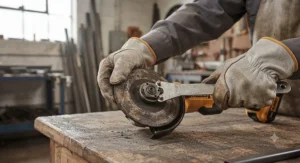
Getting a new angle grinder set up right prevents most of the early failures reviewers complain about. Start by mounting the guard before you ever touch the power switch — running any grinder without the guard is how flying disc fragments end up in someone’s forearm, and it’s explicitly against the design intent of every model on this list. Check the disc’s rated RPM against your grinder’s max RPM before mounting anything; a disc rated below your tool’s top speed can shatter under load.
For the first few uses, run the tool for a few seconds before touching it to material — this is a basic “spin test” that catches wobble or an improperly seated disc before it becomes a problem mid-cut. Keep the side handle installed at all times; it’s tempting to remove it for tight spaces, but that handle is your main leverage point if the disc catches and the tool torques in your hand.
Maintenance-wise, blow out the vents with compressed air every few uses if you’re working in dusty environments — the labyrinth seals on models like the Makita GA4542C help, but they’re not a substitute for basic upkeep. Inspect carbon brushes (on corded and brushed models) every few months of regular use; a grinder that starts sparking heavily at the vents or losing power under load is usually telling you the brushes need replacing. On cordless units like the Milwaukee 2880-20, store batteries at partial charge rather than fully depleted if the tool will sit unused for weeks, which preserves long-term battery capacity.
Real-World Scenarios: Which Grinder Fits Your Situation
Picture three different buyers. First, there’s a weekend DIYer restoring an old truck bed in a driveway, using the grinder maybe once a month for rust removal and the occasional bracket cut — for that use case, the Black+Decker BDEG400 or WEN 94475 covers the job without wasting money on capability that will sit idle 95% of the time.
Second, there’s a metal fabricator running a small home shop, welding brackets and gates several days a week — this buyer needs the vibration control and sustained-use durability of the Makita GA4542C or the kickback protection of the Metabo WEV15-125, because an 8-hour day on a budget grinder is exactly how carbon brushes burn out early.
Third, there’s a roofing or framing contractor who’s constantly moving between ladders, attics, and job sites without a nearby outlet — for that buyer, the cord is the actual enemy, not the amperage, and the Milwaukee 2880-20 solves a mobility problem no corded grinder can touch, assuming they’re already invested in (or willing to invest in) the M18 battery platform.
✨ Not sure which category you fall into? Scroll back up to the comparison table and match your use case to the “Best For” column.
Amps vs. Watts: What Angle Grinder Power Ratings Actually Mean
Amps and watts both describe how much electrical power a corded grinder’s motor draws, but they’re not interchangeable, and manufacturers use both depending on the market. In the U.S., angle grinders are almost always rated in amps — the DeWalt DWE402 at 11 amps or the Metabo WEV15-125 at 13.5 amps, for example — while European-spec tools often list watts instead, since that’s the standard on that side of the Atlantic.
The rough conversion is watts equals amps multiplied by voltage, so an 11-amp tool on standard 120V US household current works out to roughly 1,320 watts. What this means in practice: don’t panic if you see a grinder advertised at “1,010W” and assume it’s weaker than an “11-amp” competitor — run the math and you’ll often find they’re in the same power class. Where amps actually matter more than the raw number suggests is under sustained load; a motor with more amp headroom bogs down less when you’re pushing hard through thick steel, which is exactly the real-world difference reviewers notice between a 6.5-amp budget grinder and a 12-13 amp professional model.
Paddle Switch vs. Trigger Switch: Which Is Actually Safer?
This is one of the most misunderstood specs on any grinder listing, and it genuinely affects both safety and comfort. A paddle switch — used on the DeWalt DWE402, Milwaukee 2880-20, and Bosch GWS13-50VSP — requires continuous hand pressure to keep the tool running. Let go, and the disc stops. That’s a deliberate safety design: if the tool is dropped or kicks back hard enough to jar your grip loose, it shuts off automatically rather than continuing to spin unattended.
A slide or trigger-style switch, by contrast, locks the tool in the “on” position once flipped, which frees both hands for extended grinding without maintaining constant pressure — less fatiguing over a long session, but riskier if the tool is dropped or the operator loses control, since it keeps spinning until manually switched off. Some slide-switch grinders add electronic braking or auto-stop features to offset that risk, but as a pure safety mechanism, paddle switches remain the preferred configuration for general jobsite work. If your priority is safety margin over raw convenience, favor a paddle-switch model; if you’re doing long, controlled production grinding at a bench, a slide switch may genuinely reduce hand fatigue.
Angle Grinder Guard Types Explained
Every grinder in this roundup ships with a wheel guard, but not all guards serve the same function, and choosing the wrong disc-and-guard combination is a common and dangerous mistake. Standard grinding guards cover roughly the top half of the wheel and are designed for surface grinding, where the disc contacts material at a shallow angle. Cutting guards — sometimes called Type 1 guards — enclose more of the wheel’s circumference and are built specifically for cutoff wheels, which fracture differently than grinding discs when they bind.
Tool-free guards, found on the Bosch GWS13-50VSP and Metabo WEV15-125, let you reposition the guard in seconds without a wrench, which matters more than it sounds like the first time you’re switching from grinding to cutting mid-job. Whatever guard type you’re running, never remove it entirely to “make the tool easier to handle” — that guard is engineered to deflect fragments away from the operator if a wheel fractures, and grinding without one is one of the most preventable causes of serious jobsite injuries.
How to Choose an Angle Grinder
- Match disc size to your work. A 4.5-inch grinder handles most home and light-pro tasks; step up to 5-6 inches only if you’re regularly working thicker stock or larger welds.
- Prioritize amps over marketing language. For corded models, 10+ amps is the threshold where sustained cutting stops bogging the motor down.
- Decide corded versus cordless honestly. If you’re always near an outlet, corded delivers more sustained power per dollar; if mobility matters more, accept the cordless tradeoff.
- Check the switch type against your use case. Paddle switches favor safety for general work; slide switches favor comfort for long production runs.
- Look for tool-free guard adjustment if you switch disc types often. It saves real time across a workday.
- Weigh the tool before buying if possible. A half-pound difference matters a lot after two hours of overhead grinding.
- Factor in the ecosystem for cordless models. A bare cordless tool is only a bargain if you already own compatible batteries.
Common Mistakes When Buying an Angle Grinder
The most common mistake is buying based on price alone and ending up with a motor that can’t sustain real work — the Black+Decker BDEG400 and WEN 94475 are honest, capable budget tools, but buying an even cheaper no-name unit below their amperage class is where reviewers report the most switch and motor failures. The second mistake is ignoring switch type entirely; plenty of buyers don’t realize their new grinder has a slide switch until it’s already spinning in a way they didn’t expect.
A third mistake is skipping disc compatibility research — mounting a grinding disc rated for lower RPM than your tool’s maximum is a genuine safety hazard, not just a performance issue. Finally, buyers often underestimate the total cost of a cordless system, focusing on the bare-tool price of something like the Milwaukee 2880-20 without budgeting for the battery and charger that make it actually usable.
What to Expect: Real-World Performance
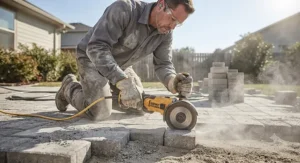
Specs on a box rarely translate directly to feel in your hand. In practice, an 11-13 amp corded grinder like the DeWalt DWE402 or Bosch GWS13-50VSP cuts through 1/8-inch steel angle iron in a few seconds per pass, with the disc barely slowing under moderate pressure. Push a 6.5-amp budget grinder through the same material, and you’ll notice the RPM sag audibly — not dangerous, just slower, and harder on the motor over time.
Vibration is the other variable specs undersell. The Makita GA4542C‘s SJS II system genuinely reduces the buzzing fatigue that builds up in your forearm after twenty or thirty minutes of continuous grinding, which is the kind of difference you only notice by comparison, not by reading a spec sheet. And cordless power, as delivered by the Milwaukee 2880-20, feels close to corded for short-to-medium bursts but tapers off noticeably on long, continuous cuts as the battery works to keep voltage stable under load.
Angle Grinders for Different Skill Levels
Beginners are best served by a mid-power corded model with a paddle switch — the DeWalt DWE402 hits that sweet spot, since it’s forgiving, widely reviewed, and simple enough that there’s no learning curve around variable speed dials. Intermediate DIYers who’ve outgrown a single-purpose grinder benefit from variable speed, which is where the Bosch GWS13-50VSP earns its keep — it adapts to steel, stainless, and stone prep without needing a second tool.
Professionals running daily hours on the tool should prioritize vibration control and durability over price, which points toward the Makita GA4542C or Metabo WEV15-125, both of which are engineered specifically around sustained-use comfort and motor longevity. And tradespeople who move constantly between job sites without reliable outlet access are the exact audience the Milwaukee 2880-20 was designed for — that use case alone often justifies the higher upfront cordless investment.
Long-Term Cost and Maintenance
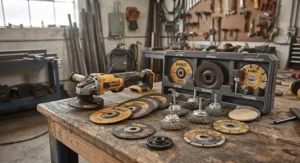
The sticker price is only part of the real cost of owning an angle grinder. Discs are consumable — a household running occasional projects might go through a handful of cutoff wheels a year, while a fabrication shop can burn through dozens monthly, and disc cost adds up faster than most buyers expect regardless of which grinder body they’re using. Corded models like the DeWalt DWE402 and Makita GA4542C have effectively unlimited “runtime” cost, since electricity is cheap, but they do eventually need carbon brush replacement — a low-cost repair that extends the tool’s life significantly if caught early.
Cordless ownership, exemplified by the Milwaukee 2880-20, shifts the cost structure: no brush replacement thanks to the brushless motor, but batteries degrade over years of charge cycles and eventually need replacing at a real cost, often $80-$150 depending on capacity. Budget models like the Black+Decker BDEG400 and WEN 94475 have the lowest upfront cost but, per aggregated review sentiment, the shortest expected lifespan under heavy use — meaning a contractor buying three of these over five years may spend more in total than buying one Metabo WEV15-125 upfront and maintaining it properly.
Features That Actually Matter (And Those That Don’t)
Genuinely useful features worth paying for: variable speed control, tool-free guard adjustment, a metal gear case, and — critically — a kickback mitigation system like Metabo’s slip clutch or Bosch’s acceleration sensor. These directly affect either safety or the range of jobs the tool can competently handle.
Features that sound impressive but matter less than marketing suggests: extremely high top-end RPM figures beyond what’s typical for the disc size (most 4.5-inch discs are rated well below what some grinders claim as a max speed, making the extra headroom largely irrelevant), and cosmetic details like colored housings or “ergonomic” grip textures that don’t meaningfully change how the tool performs. If you’re choosing between two similarly priced grinders and one leads with RPM bragging rights while the other leads with safety electronics, the safety features are the better investment for daily use.
Safety and Regulations Guide
Angle grinder safety isn’t optional guidance — it’s governed by specific OSHA standards that apply to any job site in the U.S. Under OSHA’s guarding regulations for portable powered tools, safety guards on right-angle grinders must have a maximum exposure angle of 180 degrees and must be positioned between the operator and the wheel at all times — removing or misadjusting a guard is a direct violation of that standard, not just a bad habit.
Beyond guarding, always wear eye protection and consider a face shield for cutting operations, since disc fragments and sparks travel fast and unpredictably. Inspect every disc before mounting it — a cracked or damaged wheel should give a clear metallic ring when tapped, and anything that sounds dull or dead should be discarded immediately rather than risking it. For anyone wanting the full regulatory detail, the Wikipedia entry on angle grinders offers a solid overview of wheel types, disc classifications, and general operating principles worth reviewing before your first use.
Frequently Asked Questions
❓ What size angle grinder do I need for home use?
❓ Is a cordless angle grinder as powerful as a corded one?
❓ How many amps is good for an angle grinder?
❓ What's the difference between grinding and cutting discs?
❓ Do I need a paddle switch or is a slide switch fine?
Conclusion
There’s no single “best” angle grinder — there’s only the best one for what you’re actually doing. For most DIYers and general contractors, the DeWalt DWE402 hits the widest sweet spot of power, price, and reliability. If vibration and comfort matter more because you’re on the tool for hours, the Makita GA4542C‘s SJS II system is worth the upgrade. Need to cut the cord entirely? The Milwaukee 2880-20 delivers real cordless performance, provided you’re ready for the M18 battery investment. And if kickback protection is non-negotiable for your work, the Metabo WEV15-125‘s slip clutch is genuinely unique in this lineup.
Whichever you choose, match the tool to the guard, the disc, and the job — that’s what actually determines whether an angle grinder is “the best,” not the badge on the side.
✨ Ready to Grind Smarter, Not Harder?
🔍 Compare today’s prices on all seven picks above before you decide. Click through on any bolded product name to check current availability — the right grinder makes every project faster, safer, and a lot less frustrating.
Recommended for You
- Circular Saw for Beginners: 7 Real Picks Worth Buying in 2026
- Worm Drive vs Sidewinder Circular Saw: 7 Top Picks (2026)
- Best Cordless Circular Saw 2026: 7 Powerful Picks You’ll Love
Disclaimer: This article contains affiliate links. As an Amazon Associate, I earn from qualifying purchases. If you purchase products through these links, we may earn a small commission at no additional cost to you.
✨ Found this helpful? Share it with your friends! 💬🤗
