
In This Article
Picture the moment. Oil’s drained, the fairing is off, and the one fastener standing between you and a finished job is a size you don’t own. A decent socket set for motorcycle maintenance prevents that scene, and it’s the smartest first purchase any rider can make.
So what is it, exactly? A socket set for motorcycle maintenance is a ratchet-driven collection of metric sockets, extensions and adapters sized for bike fasteners, usually 3/8-inch drive covering roughly 8-19 mm. It speeds up tightening and loosening, reaches recessed bolts, and pairs with a torque wrench for accurate final tightening.
Most advice online treats a motorcycle like a small car. It isn’t. Bikes pack aluminum threads, tight frame clearances and fasteners you can barely see. Motorcycle News, for one, points to a 3/8in drive set as the likely go-to, with a 1/4in set for smaller or tighter fittings. That’s the starting logic behind every pick below.
Here’s the honest part. I haven’t hand-tested these kits, so none of what follows is invented “workshop experience.” The analysis comes from real spec sheets, retailer data and the reviewer sentiment I could verify. Where review data is thin, I say so. You’ll also see where a motorcycle mechanic socket kit differs from a generic car set, and why a metric socket set for motorcycles beats a mixed-bag toolbox.
Quick Comparison: Socket Set for Motorcycle Maintenance at a Glance
| Set | Drive | Metric Coverage | Price Range* | Best For |
|---|---|---|---|---|
| Craftsman 10-Piece | 3/8 in. | Compact 6-point metric selection | Budget tier | Under-seat emergency kit |
| EPAuto 40-Piece | 1/4 and 3/8 in. | Metric + SAE, 72-tooth ratchet | Well under $100 | First-time DIYers |
| DEWALT 108-Piece | 1/4 and 3/8 in. | Metric 4-11 mm on the 1/4 in. drive, plus 3/8 in. sockets | $70-$145 | Small-fastener work |
| Tekton 44-Piece | 3/8 in. | 6-24 mm standard and deep | Low-to-mid $100s | All-metric home garage |
| GearWrench 80550 | 3/8 in. | 6-19 mm standard and deep + SAE | $100-$150 | Tight frames, stubby ratchet |
| Milwaukee 48-22-9008 | 3/8 in. | 6-19 mm standard and deep + SAE | $130-$215 | Long-term daily-driver set |
| Sunex 3329 | 3/8 in. | 8-22 mm, 14 standard + 14 deep | $130-$175 | Add-on set (no ratchet) |
*Prices vary by retailer and change often; check current price.
Looking at the table, EPAuto 40-Piece and Craftsman 10-Piece are the entry points, while Milwaukee 48-22-9008 and GearWrench 80550 sit in the buy-once tier. Sunex 3329 is a different animal because it ships without a ratchet, so it works best layered onto a handle you already own. If you only want one answer, the middle of the table is where most riders land.
💬 Just one click — help others make better buying decisions too!😊
Top 7 Socket Sets for Motorcycle Maintenance: Expert Analysis
Seven real kits, budget to premium. Each gets spec translation, a who-it’s-for verdict, and aggregated review themes, clearly labeled as such.
1. Craftsman 10-Piece 3/8″ Metric Set — smallest footprint on this list
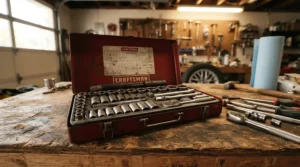
The standout here is size. Ten pieces in a slim case means this set can ride under a seat or in a tank bag without a second thought, which makes it the purest compact socket set for bikes in the lineup.
It’s a 3/8-inch drive with six-point sockets. Six-point matters because the walls grip the flats of a fastener rather than the corners, so you round fewer soft bolt heads. Ten pieces can’t cover every size from 6 to 19 mm, though. Compare the listed sizes against the fasteners your motorcycle service manual calls out before you commit.
Based on the spec comparison, this is a roadside and garage-corner kit, not a primary set. Reviewers on a retailer listing described using it on a Honda motorcycle and liked how many common sizes it covers. Another buyer suggested cushion tape to quiet case rattle. A third felt the brand isn’t what it once was.
Pros:
- ✅ Genuinely pocketable for under-seat storage
- ✅ Six-point sockets grip flats, not corners
- ✅ Lowest cost of entry on this list
Cons:
- ❌ Limited size range for a full service
- ❌ Short handle struggles on stubborn bolts
Price: the cheapest entry here; check current price. Verdict: buy it as the set that lives on the bike, not the one you service the bike with.
2. EPAuto 40-Piece 1/4″ & 3/8″ Set — most sockets per dollar for beginners
The standout is the value-per-piece math. It pairs 1/4-inch and 3/8-inch drives with a 72-tooth reversible ratchet, which gives roughly a 5-degree swing arc between clicks. That’s useful in tight frame corners.
Sockets are chrome vanadium steel with a chrome finish, and listings state Taiwan manufacturing. It includes both metric and SAE, so some pieces will sit idle on a Japanese bike. Still, the metric side covers the basics of oil changes, battery swaps and brake-lever hardware.
If you’re deciding whether to start doing your own wrenching, this is the low-risk bet. Reviewers frequently call it good value with a case that keeps everything organized. Complaints cluster around etched size markings that are hard to read in dim light. One buyer said the 3/8-to-1/4 adapter wouldn’t hold a small socket securely. An independent review of a larger EPAuto kit concluded the tools aren’t bad for the money, though they’re not pro-grade.
Pros:
- ✅ Metric and SAE in a single, tidy case
- ✅ Fine-tooth ratchet for cramped access
- ✅ Low financial risk for first-timers
Cons:
- ❌ Etched markings can be tough to read
- ❌ Adapter reportedly loose with small sockets
Price: well under $100 at the time of research; check current price. Verdict: strong starter value, upgrade the ratchet later if you outgrow it.
3. DEWALT 108-Piece Mechanics Set (DWMT73801) — tiny 1/4-inch sockets for small fasteners
The standout is the 1/4-inch drive socket range, which includes metric 4, 5, 6, 7, 8, 9, 10 and 11 mm sockets. Small sockets like these are what make carb-bowl, sensor and trim-panel hardware workable without improvisation.
Here’s a spec the box won’t spell out: a breakdown from one reviewer shows roughly 47 of those 108 pieces are actual sockets. The rest are bits, hex keys, nut drivers, extensions and ratchets. That’s still a healthy mix, with two quick-release 72-tooth ratchets, and DEWALT’s DirectTorque design aims to reduce rounding.
For a rider who wants one box that also handles non-bike chores, this works. Reviewers praise the overall quality for the money, and one specifically bought it for a Ninja 400. The recurring complaint is the tray: pulling one piece can loosen others. DEWALT’s product page lists a one-year limited warranty, shorter than some competitors offer.
Pros:
- ✅ Metric 4-11 mm sockets on the 1/4 in. drive
- ✅ Two quick-release ratchets included
- ✅ Doubles as a general household kit
Cons:
- ❌ About half the piece count is bits and keys
- ❌ Tray holds pieces loosely, per reviewers
Price: roughly $70-$145 depending on retailer; check current price. Verdict: great value if you want one case for everything. Confirm the 3/8-inch metric sizes in the exact listing before ordering.
4. Tekton 44-Piece 3/8″ 6-Point Set (SKT13201) — no skipped metric sizes from 6 to 24 mm
The standout is the complete metric run. It covers 6-24 mm in both standard and deep lengths with no gaps, plus a 90-tooth quick-release ratchet (4-degree swing), universal joint, magnetic hex-bit holder, extensions and storage rails.
“No skipped sizes” sounds like marketing until you hit an odd 12 or 14 mm bolt mid-job and the set you own doesn’t have it. The deep sockets help on long studs, and the rail system keeps the whole thing visible at a glance. The 6-24 mm range runs past what many bikes need, so the largest sizes will earn their keep mostly on car or tractor duty. At around 9 pounds, it’s a garage set rather than a travel kit.
I couldn’t verify a deep review pool for this exact kit. Reviews of closely related Tekton metric socket sets show consistent praise for six-point fit, full size coverage and price-to-quality. One buyer wished a breaker bar came in the package.
Pros:
- ✅ Complete 6-24 mm run, standard and deep
- ✅ 90-tooth ratchet with short swing arc
- ✅ Rails keep every socket visible
Cons:
- ❌ Heavy for anything but garage use
- ❌ Upper sizes are overkill on most bikes
Price: low-to-mid $100s; check current price. Verdict: the cleanest all-metric home-garage set here.
5. GearWrench 80550 57-Piece 3/8″ Set — stubby ratchet for cramped frames
The standout is the second ratchet. Alongside a full-polish teardrop ratchet you get a stubby one, and on a motorcycle that second handle often decides whether a job takes five minutes or an hour with the wrong tool.
The set includes 6-19 mm metric sockets in standard and deep lengths, plus 1/4-1 inch SAE, 3 and 6 inch extensions and a universal joint. GearWrench designs the sockets with off-corner loading to reduce fastener rounding, and the manufacturer lists a lifetime warranty. Distributor listings give Taiwan as the origin.
Based on the spec comparison, it’s a close sibling of Milwaukee 48-22-9008, trading four-flat sockets for the extra stubby ratchet. I couldn’t verify a large pool of consumer reviews for this exact kit. A deal-thread commenter noted that sockets hit diminishing returns fast for non-professionals, which is a fair warning about buying more kit than you’ll use.
Pros:
- ✅ Stubby ratchet reaches where standard heads can’t
- ✅ Off-corner loading helps protect fastener heads
- ✅ Lifetime manufacturer warranty
Cons:
- ❌ SAE half is dead weight on Japanese bikes
- ❌ Priced above comparable-sized budget sets
Price: roughly $100-$150 depending on retailer; check current price. Verdict: worth it if frame clearance is your main frustration.
6. Milwaukee 48-22-9008 56-Piece 3/8″ Set — four-flat sockets that won’t roll off the bench
The standout is the socket shape. Four parallel flats on each socket deter rolling, and they make the sockets wrench-ready, so you can grab one with an open-end wrench when a ratchet won’t fit.
The set packs 27 standard and 25 deep sockets in SAE and metric (metric runs 6-19 mm), a 90-tooth ratchet with a 4-degree arc, 3 and 6 inch extensions, a universal swivel and a removable tray. Milwaukee lists a lifetime guarantee. Stamped markings sit on the flats, which helps when the garage light is poor.
Based on the spec sheet, this is the “buy once” pick for riders who wrench often. Reviewers consistently praise the ratchet’s positive-locking feel and the sockets that stay put on a bench. They also like readable numbers and the fact that the tray fits shallow toolbox drawers. I found no recurring defect themes in the sources I checked, though the premium price is the obvious catch.
Pros:
- ✅ Four-flat design stops sockets rolling away
- ✅ 90-tooth ratchet with 4-degree swing
- ✅ Lifetime guarantee and removable tray
Cons:
- ❌ Premium price versus similar piece counts
- ❌ SAE sockets pad the count on metric bikes
Price: roughly $130-$215 across retailers; check current price. Verdict: the best long-haul value if you wrench monthly.
7. Sunex 3329 29-Piece 3/8″ Metric Master Impact Set — deep and shallow sockets up to 22 mm
The standout is the metric-only depth. It holds 14 standard and 14 deep six-point sockets from 8 to 22 mm, plus a universal joint, in chromium-molybdenum alloy steel with a black-oxide finish and radius-corner design to grip fastener walls.
There’s no ratchet in the box. That’s a feature if you already own a favorite handle and just want robust sockets, and a trap if you assumed it was a complete kit. The case measures about 14.2 by 8.7 by 1.9 inches and weighs roughly 7 to 8 pounds, so it belongs on a bench, not a bike.
The review pool for this exact set is thin: the retailer listing I found showed a single five-star review. Reviewers of Sunex’s larger 3580 master set praise its swivel sockets and the quality for the price, though one called it a lot of money. Treat that as directional, not conclusive.
Pros:
- ✅ Full 8-22 mm metric in both depths
- ✅ Chrome-moly construction for tough jobs
- ✅ Universal joint adds access options
Cons:
- ❌ No ratchet included
- ❌ Bulky and heavy for portable use
Price: roughly $130-$175; check current price. Verdict: a smart add-on for someone who already owns a ratchet and wants deeper metric coverage.
✨ Don’t Miss These Exclusive Deals!
🔍 Ready to take your wrenching to the next level? Compare these seven kits, tap any highlighted product name to check current pricing and availability, and pick the one that fits your garage. 🔧 Your bike deserves the right tool for every bolt!
Your First 30 Days With a Motorcycle Mechanic Socket Kit
Most stripped bolts happen in the first month, when habits are still forming. A few small routines prevent nearly all of them.
Week one: learn the kit. Lay everything out and sort sockets by size. Hand-thread a nut onto a bolt and test-fit each socket you’ll use most. A snug, wobble-free fit tells you the right size faster than guessing.
Week two: master leverage. Use a long handle or breaker bar to crack stubborn fasteners loose, then switch to the ratchet to spin them off. Extensions are convenient, but they can fool you into over-tightening small bolts because you lose feel. Always start threads by hand to avoid cross-threading aluminum.
Week three: add a torque wrench. The ratchet is for speed, not final tightening. A torque wrench is the tool that actually matches the numbers in your manual, and the logic is the same as any torque wrench used in mechanical work.
Week four: maintain. Wipe sockets dry after rides, return each to its slot, and check the case latch. A set that lives in a wet saddlebag will rust faster than one stored in a dry drawer.
Common first-month mistakes: using SAE sockets on metric bolts, because the slightly-too-loose fit rounds heads; skipping a manual check on tightening specs; and treating a bit adapter like a socket. Build the habit now and you’ll own a set that lasts a decade.
Real-World Scenarios: Matching a Set to Your Riding Life
Three profiles, three budgets.
The commuter with a small balcony garage. Say you ride a 400 cc bike 8 miles a day and do oil changes in a parking space. Craftsman 10-Piece rides under the seat for roadside fixes, and EPAuto 40-Piece handles the weekend oil change at home. Total spend stays modest, and you rarely wrench more than once a month.
The weekend wrench on a 600-1000 cc bike. You swap chains, bleed brakes and do your own valve-cover jobs. Small fasteners matter here, so DEWALT 108-Piece with its 1/4-inch metric sockets covers cover bolts and sensors. If you prefer a metric-only layout, Tekton 44-Piece removes the SAE clutter and gives you the gap-free run.
The restorer with three bikes. You’ll be in the garage weekly, often with frames and swingarms in the way. Milwaukee 48-22-9008 earns its price through daily use, GearWrench 80550 adds the stubby-ratchet access, and Sunex 3329 fills in depth when a bolt sits recessed. Frequency of use justifies spending more.
These scenarios share one lesson: match the kit to how often your hands are actually on the bike, not to the piece count on the box.
How to Choose a Socket Set for Motorcycle Maintenance
- Start with the drive size. A 3/8-inch drive is the sweet spot for most bike work. Add a 1/4-inch set for small, tight or low-torque fasteners.
- Prefer six-point sockets. Twelve-point sockets slip on faster but round soft heads more easily. For motorcycle work, six-point grip is the safer trade.
- Count sockets, not pieces. A 108-piece box can be about half bits and keys. Check the actual socket list.
- Cover at least 8-19 mm. That’s the minimum spread AMCN recommends for a bike set, and your service manual will confirm the rest.
- Look for both standard and deep sockets. Deep sockets reach studs and recessed bolts; standard ones fit tight spaces.
- Add swivel and extension options. A universal joint and two extensions solve most access headaches.
- Check the ratchet and warranty. A finer-tooth ratchet needs less swing room, and a lifetime guarantee tells you how much the maker trusts the steel.
Metric Socket Set for Motorcycles: Why It Beats a Mixed Toolbox
Japanese motorcycles are built around metric fasteners. Rider magazine notes that nuts and bolts on Hondas, Yamahas, Suzukis and Kawasakis mate perfectly with metric wrenches, and that’s the plain reason to choose a metric socket set for motorcycles over an inch-heavy generalist kit.
Why does mixing sizes cause damage? A socket that’s a fraction too big for a metric bolt can feel almost right, but it grips corners instead of flats. Aluminum and soft steel heads round off quickly, and once a head is rounded, a five-minute job becomes a drill-out. Sets like Tekton 44-Piece and Sunex 3329 go all-metric for that reason, while GearWrench 80550 and Milwaukee 48-22-9008 hedge with inch sizes for American-built machines.
The takeaway is practical. If your bike is Japanese or European, buy metric, keep inch sizes physically separate, and never “make do” with a nearly-fitting socket. If you own an American cruiser or ride vintage machinery, check the manual first, because some of those bikes mix fractional and metric hardware.
Compact Socket Set for Bikes: What to Carry on the Road
A compact socket set for bikes has one job: get you home. It doesn’t need 100 pieces; it needs the right 12.
Think in terms of failure points. Levers, mirrors, battery terminals, loose bodywork and chain adjusters account for most roadside tinkering. A small 3/8-inch ratchet, a short extension and sockets in the 8-14 mm range will cover a surprising share of those jobs on many bikes. Confirm against your own motorcycle service manual, since sizes vary by model.
Craftsman 10-Piece is the lightest way to carry that capability, and EPAuto 40-Piece is the better pick if you have room in a top case. Skip the case-heavy kits for travel. Weight and bulk are the real enemies once you’re packing a bike.
A smart touch: wrap the sockets in a rag or foam strip so they don’t rattle against metal on long rides, and add a small adjustable wrench and a pair of pliers. Together, that’s a modest but real emergency kit.
Motorcycle Mechanic Socket Kit: Scaling From Starter to Pro
A motorcycle mechanic socket kit isn’t about size, it’s about stages. Here’s a simple growth path.
Stage one: the starter. A budget metric set like EPAuto 40-Piece handles oil, filters, batteries and basic bolt-ons. Spend little and learn what you actually use.
Stage two: the committed DIYer. You’ve done a few services and want faster, smoother work. Upgrading to Tekton 44-Piece or GearWrench 80550 gets you better ratchets, a wider metric spread and deeper sockets.
Stage three: the near-pro. When you’re stripping engines, replacing sprockets or rebuilding forks, pair Milwaukee 48-22-9008 with Sunex 3329 for extra depth and swivel options. Add a torque wrench, a breaker bar and a proper JIS screwdriver.
What most buyers overlook: tools at this level aren’t about brute strength. They’re about repeatable fit. A precise, six-point socket that seats fully, a ratchet with a short swing arc and a torque wrench you trust will save you more headaches than any extra piece count.

Sprocket Bolts: Torque, Tab Washers and Access
Sprocket bolts are where a socket set earns its respect. They carry real load, they’re often secured with thread-locking compound or locking tabs, and they sit behind a chain guard in a space where a full-size ratchet may not turn.
First, check what your bike uses. Some front sprockets use a tab washer to lock the nut or bolt in place. AMCN suggests using a small chisel or a ground-down flat piece of steel to bend the tab open, rather than ruining a good screwdriver. Good advice, and an easy habit to adopt.
Second, plan the access. A stubby ratchet like the one in GearWrench 80550 or a short extension from Milwaukee 48-22-9008 often makes the difference. A universal joint helps when the bolt sits at an angle.
Third, torque matters. Your motorcycle service manual lists the tightening value for each fastener, and a torque wrench turns that number into a result. Work in a cross pattern on rear sprockets, and re-check the tightness after your first ride. Loose sprocket bolts are not a nuisance, they’re a safety problem.
Engine Cover Screws: When the Socket Set Meets the JIS Problem
Engine cover screws are the great exception in any socket guide, because many of them aren’t hex at all. On older Japanese bikes, they’re cross-head screws that look like Phillips but aren’t.
They follow the Japanese Industrial Standard, and JIS screws are usually marked with a dot or small “x” beside the cross. The key difference: a Phillips head is designed to release at a certain torque, while a JIS fastener grips tighter. According to Wikipedia’s screw drive list, a Phillips driver won’t seat fully in a JIS screw and will damage it if forced, while a correct JIS driver engages a Phillips head without damage.
Where does the socket set fit in? Many modern bikes have swapped JIS screws for hex heads, so a 3/8-inch socket does the job. For the cross-head screws that remain, use a proper JIS driver, and Rider notes that Motion Pro sells a T-handle kit with #1, #2 and #3 JIS bits. Hobbyist forums sometimes recommend swapping to hex-head bolts, but they also advise a gentle touch or a torque wrench, because hex heads won’t cam out to warn you. Match the tool to the head, and engine cover screws stop being a frustration.
Your Motorcycle Service Manual: The Tool Every Socket Set Needs
A socket set tells you how to turn something. A motorcycle service manual tells you what to turn and how hard.
It’s worth understanding the difference. The owner’s manual covers basic care, while the service manual (often called a workshop manual) carries the detail: exact tightening values for each fastener, fastener sizes, tightening sequences and exploded diagrams. Both are tied to your specific model and year, so a generic manual is a gamble.
Why does this matter for buying? Because the manual tells you which sockets you actually need. Flip to the torque table, note the head sizes and compare against the kit you’re considering. If the table is full of 10, 12 and 14 mm heads, a set that covers 8-19 mm is plenty. If you see unusual sizes or Torx fasteners, you’ll know to add bits.
It also pays off on small jobs. Even an oil change benefits from the exact drain-plug torque and the correct oil quantity. Pair the manual with a torque wrench, and a decent socket set becomes a repeatable, safe way to maintain your machine rather than a pile of guesswork.
Socket Set vs Combination Wrenches and Multi-Tools
Is a socket set really better than the wrenches in the OEM kit under your seat? Usually, yes, for anything beyond roadside fixes.
| Tool Type | Speed | Access | Risk to Fasteners | Best For |
|---|---|---|---|---|
| Socket set (6-point) | High | Good with extensions | Low | Routine service |
| Combination wrenches | Medium | Excellent in tight spots | Low-medium | Backup and cramped jobs |
| OEM or multi-tool kit | Low | Limited | Higher | Emergency roadside use |
The table makes the logic plain. A socket set wins on speed and fastener protection, and combination wrenches win when a ratchet head won’t fit. Per AMCN, you can get most jobs done with combination spanners and a socket set, so the pairing is the real answer. OEM multi-tools are emergency gear, not a maintenance plan.
Long-Term Cost & Maintenance
Cheap tools can cost more in the long run, and expensive ones can pay back quickly.
| Set | Approx. Price Range | Value Logic | Best For |
|---|---|---|---|
| EPAuto 40-Piece | Well under $100 | Low entry cost, upgrade later | Beginners |
| DEWALT 108-Piece | $70-$145 | One case, many chores | Mixed household use |
| Milwaukee 48-22-9008 | $130-$215 | Lifetime guarantee, daily use | Frequent wrenching |
Looking at the numbers, EPAuto 40-Piece is the cheapest way to find out if you enjoy the work. DEWALT 108-Piece spreads its cost across household tasks, while Milwaukee 48-22-9008 costs more upfront but pairs with a lifetime guarantee. If you’ll use the set a few times a year, the cheaper kit wins; if it’s weekly, premium wins.
Maintenance costs almost nothing: wipe the sockets dry, store them in a dry spot, and replace any worn piece before it rounds a bolt. A dollar spent on a replacement socket beats ten spent on a drilled-out head.
Frequently Asked Questions
❓ Is a 3/8 inch drive socket set enough for motorcycle maintenance?
❓ Can I use a car socket set on my motorcycle?
❓ How many sockets do I need in a metric socket set for motorcycles?
❓ Should I buy a socket set or a motorcycle-specific tool kit?
❓ Do I need a torque wrench with my socket set?
Conclusion: Choose the Set That Matches Your Garage
A good socket set for motorcycle maintenance isn’t about the biggest case. It’s about fit, access and the confidence to tighten a bolt correctly. Start with the basics: 3/8-inch drive, six-point sockets and a metric range that matches the numbers in your motorcycle service manual.
If you’re just starting out, EPAuto 40-Piece or DEWALT 108-Piece will get you going. For a metric-only home garage, Tekton 44-Piece is the tidy choice. If you wrench often, Milwaukee 48-22-9008 and GearWrench 80550 reward the extra spend, and Sunex 3329 adds depth where you need it. Keep Craftsman 10-Piece under the seat as your roadside insurance.
Remember the bigger picture too. Sprocket bolts need torque and a cross pattern, and engine cover screws need the right driver rather than brute force. Do those things well and a modest kit performs like a professional one.
Recommended for You
- Metric Socket Set For European Cars: 7 Best Picks Ranked (2026)
- Impact Socket Set For Power Tools: 7 Best Picks In 2026
- Socket Set For Automotive Mechanics: 7 Best Picks In 2026
Disclaimer: This article contains affiliate links. As an Amazon Associate, I earn from qualifying purchases. If you purchase products through these links, we may earn a small commission at no additional cost to you.
✨ Found this helpful? Share it with your friends! 💬🤗
