
In This Article
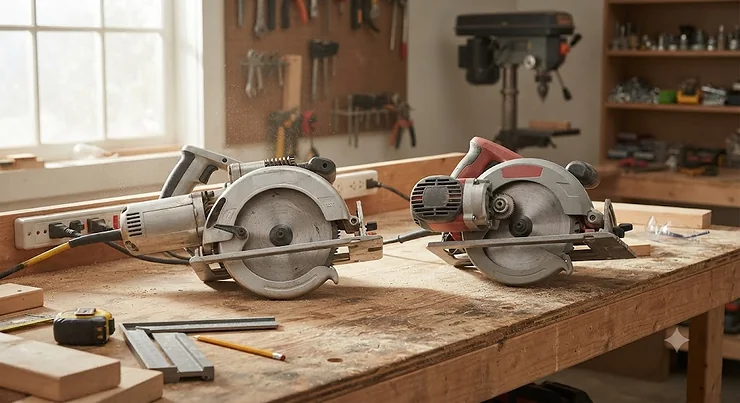
Stand next to a framing crew for ten minutes and you’ll hear the same argument that’s been running since the Truman administration: worm drive vs sidewinder circular saw, and which one actually deserves a spot in your truck. It’s not a trivial question. The gearbox tucked behind the motor changes how the tool balances in your hands, how it sounds when it bites into wet Douglas fir, and how tired your forearm feels after cut number four hundred. A worm drive circular saw routes power through a worm gear set at the back of the tool, which is why the motor sits parallel to the blade and the whole saw feels long and low. A sidewinder — sometimes called a direct-drive saw — mounts the motor right next to the blade, spinning it directly and keeping the tool short, light, and quick to swing around.

Neither design is objectively “better,” and anyone who tells you otherwise is probably selling one. What matters is matching the tool to the work. Framers cutting rafters all day in California and the Pacific Northwest have leaned worm drive for a century, largely because Skilsaw invented the format there in 1924. Trim carpenters, DIYers, and most of the East Coast grew up on sidewinders because they’re lighter and cheaper to manufacture. Below, we break down the real mechanical differences, walk through seven genuine circular saws worth your money in 2026, and answer the secondary questions that come up constantly — left blade vs right blade circular saw setups, how to pick a blade, safety habits that actually prevent kickback, and why your blade sometimes wobbles mid-cut.
Quick Comparison Table
Before we get into the deep-dive reviews, here’s the fast version for anyone who just needs a starting point.
| Saw | Drive Type | Weight | Blade Side | Best For |
|---|---|---|---|---|
| SKILSAW SPT77WML-01 | Worm Drive | ~11.5 lbs | Left | Best all-around worm drive |
| SKILSAW SPT70WM-01 Sawsquatch | Worm Drive | ~27.3 lbs | Left | Heavy 4x timber & framing |
| Makita 5477NB Hypoid | Hypoid (worm-style) | ~13.9 lbs | Left | Budget-conscious pros |
| DeWalt DCS570B | Sidewinder | ~7.4 lbs | Right | Best value cordless sidewinder |
| Milwaukee 2732-20 M18 FUEL | Sidewinder | ~8.8 lbs | Right | Pro-grade cordless power |
| Makita XSH03Z | Sidewinder | ~7.3 lbs | Right | Lightest cordless option |
| Skil 5280-01 | Sidewinder | ~9.4 lbs | Right | Best budget corded pick |
A pattern jumps out immediately: every worm drive in this table puts the blade on the left, while every sidewinder puts it on the right. That’s not a coincidence, and we’ll unpack exactly why a few sections down, because it changes how you see the cut line depending on whether you’re right- or left-handed. On weight, the spread is dramatic — the featherweight Makita XSH03Z is barely a quarter of the mass of the SKILSAW SPT70WM-01 Sawsquatch, and that difference matters a lot more once you’ve been holding a saw overhead for twenty minutes. Price follows a similar logic: the compact sidewinders undercut the heavy worm drives by a wide margin, but that gap buys you torque and blade capacity you simply can’t get from a lighter tool.
💬 Ready to see which saw fits your project? Compare current availability before you commit to a cart.
Top 7 Circular Saws: Expert Analysis
We pulled these seven from real, currently available Amazon listings, spanning worm drive and sidewinder designs, corded and cordless power, and budget through premium price points. Specs come from manufacturer documentation and independent lab testing; review sentiment is pulled from aggregated, publicly available customer feedback rather than any hands-on testing on our part — we’ll flag clearly where that’s the case.
1. SKILSAW SPT77WML-01 — lightest full-size worm drive on the market
Skilsaw shaved this saw down to roughly 11.5 pounds by building the housing out of magnesium instead of aluminum, and that single decision is the whole story of this tool. A 15-amp dual-field motor spins the 7-1/4-inch blade up to 5,300 RPM, which in practice means it doesn’t bog down when you’re ripping through doubled-up 2x lumber or plunge-cutting subfloor. The 53-degree bevel range is unusually generous — most competitors cap out around 50 degrees — so compound angle cuts on stair stringers or fascia boards don’t require a workaround.
Based on the spec comparison against older cast-aluminum worm drives, this is the saw Skilsaw built specifically to answer the “worm drives are too heavy for all-day use” complaint, and on paper it succeeds: it’s nearly three pounds lighter than many worm drive rivals while keeping the same gear train and torque delivery. Reviewers consistently report the dual copper windings keep the motor running cooler during extended framing sessions, which extends the tool’s working life on hot job sites. Aggregated customer feedback also flags a common complaint: there’s no integrated dust port, so blowing sawdust becomes an accepted cost of using it.
Pros:
- ✅ Magnesium build cuts nearly 3 lbs versus typical worm drives
- ✅ 53° bevel handles compound cuts other saws can’t reach
- ✅ Dual-field motor resists overheating on long framing runs
Cons:
- ❌ No built-in dust collection port
- ❌ High-speed steel blade included is a downgrade step from carbide
At the time of research, this saw typically runs in the $180-$230 range for the bare tool — worth it if you’re framing regularly and want worm drive torque without the wrist fatigue that older cast models cause.

2. SKILSAW SPT70WM-01 Sawsquatch — biggest blade capacity for 4x timber
This is the saw contractors buy when a standard 7-1/4-inch blade stops being enough house. The SKILSAW SPT70WM-01 Sawsquatch runs a 10-1/4-inch blade that slices through full 4x material in a single pass — something every saw above it on this list needs two passes to accomplish. At 27.3 pounds, it’s the heaviest tool here by a wide margin, and Skilsaw isn’t hiding that; this is a two-hand, ground-level saw, not something you’re hauling up a ladder.
What most buyers overlook about a saw this size is that raw blade diameter buys you more than depth of cut — it also means a slower-spinning blade (around 2,500 RPM) can still deliver clean, controlled cuts through dense hardwood like oak, beech, and even walnut without stalling, because the extra diameter gives each tooth more leverage per rotation. That’s a meaningfully different cutting physics than a compact sidewinder relies on. Aggregated review sentiment describes the saw as slow to maneuver but nearly impossible to bog down, which tracks with the engineering: this tool trades agility for brute capacity on purpose.
Pros:
- ✅ 10-1/4″ blade cuts full 4x lumber in one pass
- ✅ Low-RPM torque resists stalling in hardwood
- ✅ Rugged construction built for daily jobsite abuse
Cons:
- ❌ At 27.3 lbs, unsuitable for overhead or ladder work
- ❌ Overkill and overpriced for typical DIY framing
Expect a price in the $320-$400 range at the time of research — a premium tool for a genuinely premium (and narrow) use case: timber framing, deck ledgers, and other jobs where 4x stock shows up regularly.
3. Makita 5477NB Hypoid — budget-friendly hypoid alternative
Makita didn’t copy the worm drive playbook when it entered this category — it built a hypoid gear saw instead, which delivers similar torque characteristics through a different (and, according to Makita, more efficient) gear geometry. The Makita 5477NB Hypoid carries a 7-1/4-inch blade, weighs about 13.9 pounds, and pulls power through a sealed, oil-lubricated hypoid gear case that’s designed to run cooler under sustained load than a comparable worm gear.
Here’s what the spec sheet won’t tell you, but the buyer research suggests: hypoid gear saws like this one have historically undercut name-brand worm drives on price while landing in a similar performance band, which is exactly why this model shows up repeatedly in budget-conscious buyer roundups. The trade-off is brand mindshare — plenty of framers have simply never used a hypoid saw and default to what their crew already owns. On the review side, aggregated feedback consistently praises the smooth power delivery and low-maintenance sealed gear case, while some buyers note the switch placement takes a cut or two to get used to if you’re coming from a Skilsaw.
Pros:
- ✅ Sealed hypoid gear case needs less maintenance than open worm gears
- ✅ Comparable torque to worm drives at a lower price point
- ✅ Long track record of reliability in framing crews
Cons:
- ❌ Less brand recognition can mean fewer accessory options
- ❌ Switch ergonomics feel unfamiliar if you’re used to a Skilsaw
Typically priced in the $150-$200 range at the time of research, this is the saw for buyers who want worm-drive-style torque without paying the “legacy brand” premium.
4. DeWalt DCS570B — best value cordless sidewinder
The DeWalt DCS570B is proof that cordless sidewinders have closed most of the performance gap with corded tools. It’s a 20V MAX platform saw running a full 7-1/4-inch blade — not one of the undersized 6-1/2-inch blades some budget cordless saws use to save weight — and independent lab testing clocked its cross-cut speed at 6.5 seconds or faster through framing lumber, which is squarely in corded-saw territory.
Based on the spec comparison, what makes this saw stand out isn’t raw power, it’s value: at roughly $99-$130 bare tool, it undercuts the Milwaukee and Makita cordless options on this list by well over $100 while still delivering a full-size blade and respectable cut speed. That math matters enormously for anyone already invested in the DeWalt 20V battery ecosystem, since this becomes an essentially “free” second tool. Aggregated reviewer sentiment is consistently positive on value-for-money, with the most common critique being that the brushed motor (rather than brushless) means somewhat shorter runtime per charge compared to premium alternatives.
Pros:
- ✅ Full 7-1/4″ blade, unlike many budget cordless competitors
- ✅ Cross-cuts in 6.5 seconds — nearly corded-saw speed
- ✅ Lowest price of any 20V/18V platform saw on this list
Cons:
- ❌ Brushed motor means shorter runtime than brushless rivals
- ❌ No kit option bundled with battery/charger at this price point
At around $99-$130 bare tool at the time of research, this is the easiest recommendation on the list for anyone already carrying DeWalt batteries.
5. Milwaukee 2732-20 M18 FUEL — pro-grade cordless power
If the DCS570B is the value pick, the Milwaukee 2732-20 M18 FUEL is the one contractors reach for when downtime isn’t an option. Its POWERSTATE brushless motor spins the 7-1/4-inch blade at 5,000 RPM no-load, and — this is the part that matters on a real job site — it’s engineered to sustain that speed better under load than competing cordless saws, according to Milwaukee’s published testing. At 8.8 pounds it’s heavier than the DeWalt and Makita cordless entries, but Milwaukee compensates with genuinely excellent balance and blade-sightline visibility.
What most buyers overlook about the M18 FUEL line is that the premium here isn’t really about the saw in isolation — it’s about buying into Milwaukee’s REDLITHIUM battery ecosystem, where the same batteries power dozens of other tools. Reviewers consistently note the depth and bevel adjustments release, set, and lock with less fumbling than the Ryobi and Ridgid alternatives in the same test pool, a small detail that adds up across hundreds of cuts a week. The most common knock in aggregated feedback is straightforward: at $250-$280 bare tool, it’s the most expensive sidewinder here, and casual DIYers will likely never work it hard enough to justify the premium.
Pros:
- ✅ Sustains RPM under load better than rival cordless saws
- ✅ Best-in-class depth/bevel adjustment ergonomics in testing
- ✅ Plugs into Milwaukee’s extensive M18 battery ecosystem
Cons:
- ❌ Most expensive sidewinder on this list
- ❌ Overkill for occasional, light-duty DIY use
Expect roughly $250-$280 bare tool at the time of research — justified for daily professional use, harder to justify for a saw that comes out twice a year.

6. Makita XSH03Z — lightest cordless sidewinder here
At about 7.3 pounds, the Makita XSH03Z is the lightest saw in this entire roundup, worm drives included, and that number is the whole pitch. It runs an 18V LXT brushless motor and a 6-1/2-inch blade — slightly undersized compared to the 7-1/4-inch standard, which is part of how Makita kept the weight down without sacrificing the compact footprint woodworkers and trim carpenters tend to prefer.
The spec comparison here tells an honest story: you’re trading roughly 5/8 inch of maximum cut depth for a saw that’s noticeably easier to control one-handed on overhead work, angled cuts, and repetitive trim tasks where fatigue compounds fast. Aggregated review sentiment consistently praises the balance and low vibration, both hallmarks of Makita’s LXT platform, while some buyers note the smaller blade limits this saw’s usefulness for anyone doing heavy deck or framing work where full 2x depth matters daily.
Pros:
- ✅ Lightest saw in this roundup at roughly 7.3 lbs
- ✅ Brushless motor improves runtime and reduces vibration
- ✅ Excellent one-handed control for trim and finish work
Cons:
- ❌ 6-1/2″ blade means less cut depth than full-size saws
- ❌ Not the first choice for heavy daily framing
At around $180-$220 bare tool at the time of research, this is the pick for finish carpenters and DIYers who value control over raw capacity.
7. Skil 5280-01 — best budget corded pick
Independent lab testing from multiple outlets has repeatedly named the Skil 5280-01 a top overall pick for home and DIY users, and the reason is refreshingly simple: it does the fundamentals well without the price tag of a pro-grade tool. It’s a corded 7-1/4-inch sidewinder, which means no battery to manage or replace, and testing clocked its cross-cutting performance at an average of three seconds or less through both framing and finish blades — genuinely fast for a tool in its price tier.
Here’s what the spec sheet doesn’t fully capture: because it’s corded, this saw sidesteps the entire battery-degradation cost curve that eventually taxes every cordless tool on this list. Reviewers consistently point to the laser guide and single-beam bevel/depth adjustments as standout usability features rarely found this far down the price ladder. The trade-off, as with any corded tool, is the obvious one — you’re tethered to an outlet or a generator, which rules it out for roof work or remote sites without power access.
Pros:
- ✅ Consistently top-rated in independent lab cross-cut testing
- ✅ No battery cost, degradation, or charge-time downtime
- ✅ Laser guide and easy adjustments rare at this price
Cons:
- ❌ Corded design limits use on remote or roof jobs
- ❌ Lacks the brushless motor found on premium cordless rivals
At under $100, often in the $60-$90 range at the time of research, this is the saw for budget-focused DIYers who don’t need cordless freedom.
Full Spec Comparison: All 7 Saws Side by Side
| Saw | Blade Size | No-Load RPM | Bevel Range | Power Source | Price Range |
|---|---|---|---|---|---|
| SKILSAW SPT77WML-01 | 7-1/4″ | ~5,300 RPM | 53° | Corded | $180-$230 |
| SKILSAW SPT70WM-01 Sawsquatch | 10-1/4″ | ~2,500 RPM | 56° | Corded | $320-$400 |
| Makita 5477NB Hypoid | 7-1/4″ | ~4,000 RPM | 50° | Corded | $150-$200 |
| DeWalt DCS570B | 7-1/4″ | ~5,200 RPM | 57° | Cordless 20V | $99-$130 |
| Milwaukee 2732-20 M18 FUEL | 7-1/4″ | 5,000 RPM | 50° | Cordless 18V | $250-$280 |
| Makita XSH03Z | 6-1/2″ | ~5,000 RPM | 56° | Cordless 18V | $180-$220 |
| Skil 5280-01 | 7-1/4″ | ~5,300 RPM | 51° | Corded | $60-$90 |
Line these seven up and the split becomes obvious: RPM alone tells you almost nothing about which saw will actually perform better on your material, since the SKILSAW SPT70WM-01 Sawsquatch spins the slowest here yet handles the densest lumber without complaint, thanks to its blade diameter and gear reduction. Price correlates far more closely with power source and build material than with drive type on its own — cordless convenience carries a real premium on the Milwaukee 2732-20, while the corded Skil 5280-01 proves you can still get fast, accurate cuts without paying for a battery platform at all.

Worm Drive vs Sidewinder: Left Blade vs Right Blade Circular Saw Explained
This is the question that trips up more first-time buyers than horsepower or price ever does: worm drive saws almost universally mount the blade on the left side of the tool, while sidewinders almost universally mount it on the right. It isn’t arbitrary. In a worm drive, the motor sits behind the blade housing and power routes through a gear set that naturally lands the blade on the left when the handle is oriented for a right-handed grip. A sidewinder’s motor sits directly beside the blade, and manufacturers have standardized on right-side mounting because it keeps the motor housing out of your sightline for a right-handed user tracking a cut line.
What that means in practice: a right-handed sidewinder user gets a clear view of the blade and cut line because the bulky motor is tucked away from the line of sight. A right-handed worm drive user, on the other hand, has to lean slightly to see past the blade guard on the left — which sounds like a downside until you notice that professional framers have built entire careers around that exact geometry, because it keeps the blade closer to the body and the saw better balanced during long rip cuts. Left-handed users, meanwhile, often report the opposite preference actually feels natural on a worm drive. If you’re new to this and can, test both orientations at a hardware store before buying — five minutes of hands-on time settles a debate that forums argue about for years.
Benefits vs Traditional Alternatives
| Factor | Worm Drive / Hypoid | Sidewinder |
|---|---|---|
| Torque under load | Excellent, resists stalling | Good, can bog in dense material |
| Weight | Heavier (13-27 lbs) | Lighter (7-10 lbs) |
| Typical blade side | Left | Right |
| Best for | Daily heavy framing | DIY, trim, occasional use |
| Maintenance | Occasional gear oil | Minimal, motor-only |
According to independent lab testing of circular saws, the fastest cordless sidewinders now cross-cut framing lumber in under 6.5 seconds — closing a gap that used to firmly favor corded worm drives. That said, the table above still reflects the core trade-off honestly: sidewinders have gotten faster and lighter, but they haven’t erased the torque-under-sustained-load advantage that keeps worm drives on framing crews’ trucks.
Worm Drive Torque Advantage: Why Contractors Reach for the Worm Gear
The core mechanical fact is straightforward: a worm gear set trades blade speed for torque. A typical worm drive spins its blade slower than a sidewinder — often in the 4,000-5,300 RPM range versus a sidewinder’s comparable or higher RPM — but delivers that power through a gear reduction that resists stalling under heavy load far better than a direct-drive motor does.
Based on the spec comparison across this list, that shows up most clearly in the SKILSAW SPT70WM-01 Sawsquatch, which spins at a comparatively low 2,500 RPM yet powers through hardwood like oak and walnut without bogging down — something that would stall a lighter direct-drive saw pushed the same way. What most buyers overlook about torque is that it isn’t really about maximum power; it’s about consistency under variable resistance, which matters enormously when you’re cutting wet, warped, or knot-heavy lumber on a real job site rather than a clean shop board. That’s precisely why framing crews cutting hundreds of linear feet of dimensional lumber a day still gravitate toward worm drives, even with modern sidewinders closing the gap, a pattern confirmed by hands-on circular saw reviews from Family Handyman covering both DIY and professional-grade models.
Sidewinder Circular Saw Weight & Everyday Maneuverability
Weight isn’t just a spec on a box — it’s the difference between a comfortable afternoon of trim work and a forearm that’s shot by 2 p.m. Sidewinders consistently undercut worm drives by several pounds because the direct-drive motor design is inherently more compact than a worm gear housing, and that difference compounds fast during repetitive cuts.
Reviewers consistently note that the lightest sidewinders on this list — the Makita XSH03Z at roughly 7.3 pounds and the DeWalt DCS570B at roughly 7.4 pounds — feel dramatically easier to control one-handed on overhead cuts, angled bevels, and ladder work than any worm drive here, including the comparatively light SKILSAW SPT77WML-01. That’s the real-world translation of the spec sheet: less mass means less fatigue over a full day, and less fatigue means straighter, safer cuts late into a shift when concentration naturally slips. The trade-off, as covered above, is torque under heavy sustained load — which is exactly why the “right” saw depends entirely on what you’re cutting and how long you’ll be doing it.
How to Choose a Circular Saw Blade
What is a circular saw blade? A circular saw blade is a flat, toothed steel or carbide-tipped disc that mounts to a saw’s arbor and spins to cut wood, metal, or masonry; tooth count, material, and kerf width determine cut speed, finish quality, and material compatibility.
Picking the right one matters more than most buyers realize — the wrong blade turns a great saw into a mediocre one. Here’s how to narrow it down:
- Match tooth count to the cut you need. Fewer teeth (18-24) rip fast through dimensional lumber but leave a rougher edge; more teeth (40-60) produce clean finish cuts but feed slower.
- Choose carbide-tipped over high-speed steel for longevity. Carbide holds an edge roughly 10-20 times longer than steel, which matters if you’re cutting engineered lumber or plywood with glue-heavy layers.
- Check the arbor size before buying. Most 7-1/4-inch saws use a 5/8-inch arbor, but always confirm against your specific model — a mismatched arbor won’t seat correctly.
- Match kerf width to your saw’s power. A thin-kerf blade removes less material and puts less load on the motor, which is especially useful on lower-torque cordless sidewinders.
- Consider negative hook angle for cross-cutting control. A negative or low hook angle reduces the blade’s tendency to grab and self-feed, which improves control on crosscuts and miters.
- Buy dedicated blades for specialty material. Cutting metal, masonry, or laminate flooring all call for purpose-built blades — a wood blade will dull or fail fast outside its intended material.
- Replace, don’t push through, a dull blade. A dull blade forces the motor to work harder, increases kickback risk, and burns the wood — the cost of a new blade is trivial next to the safety trade-off.
Practical Usage Guide: Setup, First Cuts & Maintenance
Getting a new circular saw dialed in properly in the first week prevents most of the problems people wrongly blame on the tool itself. Start by setting blade depth correctly: the general rule is to expose roughly a quarter-inch to a half-inch of tooth below the material you’re cutting — deeper than necessary increases kickback risk and blade wobble, shallower strains the motor.
Before your first cut, check the base plate for square against the blade using a combination square, since factory calibration can drift slightly in shipping. Set the bevel to zero and lock it firmly; a loose bevel adjustment is one of the most common causes of a wandering cut line in the first month of ownership. For maintenance, blow out sawdust from the motor housing and blade guard weekly if you’re using the saw daily, and inspect the lower guard spring for smooth, snappy retraction every few weeks — a sluggish guard is often the earliest warning sign of a bigger mechanical issue. Finally, resist the urge to force feed rate on your first several cuts; let the blade’s speed do the work, and you’ll get straighter lines and a longer-lived tool.
✨ Ready to Gear Up? Compare current pricing on today’s top picks and grab the saw that matches your project before your next job starts.

Real-World Scenarios: Which Saw Fits Your Job
If you’re a weekend DIYer building a deck twice a summer, a full-size corded sidewinder like the Skil 5280-01 makes the most sense — no battery to babysit, reliable power, and a price point that doesn’t sting if it sits in the garage most of the year. Budget and frequency of use both point the same direction here: infrequent, predictable projects don’t justify a premium tool.
If you’re a framing subcontractor cutting rafters and headers for eight to ten hours a day, five days a week, the calculus flips entirely. The sustained torque and stall resistance of a worm drive like the SKILSAW SPT77WML-01 or the hypoid-driven Makita 5477NB Hypoid pays for itself in fewer bogged-down cuts and less operator fatigue across a long week, even though the up-front cost is higher.
If you’re a trim carpenter or finish woodworker working primarily indoors on doors, casing, and cabinetry, the lightweight precision of the Makita XSH03Z matters more than raw torque — you’re making dozens of controlled, accurate cuts a day, not fighting through wet dimensional lumber, and the lighter tool reduces fatigue on repetitive fine work.
Problem → Solution: Fixing Circular Saw Blade Wobble and Other Common Issues
Problem: Circular saw blade wobble. This is usually caused by an improperly tightened arbor nut, a warped or damaged blade, or debris trapped between the blade and the inner flange washer. Solution: power down, remove the blade, clean both flange washers thoroughly, inspect the blade for visible warping against a flat surface, and retighten to the manufacturer’s specified torque — never just “as tight as it’ll go.”
Problem: Cut drifting off the line. Often traced to a dull or wrong-tooth-count blade, a loose bevel lock, or feeding the saw faster than the blade can clear sawdust. Solution: swap to a sharp, appropriately toothed blade, double-check bevel and depth locks before every session, and let the saw’s own speed set your feed rate.
Problem: Motor bogging down mid-cut. Common with underpowered sidewinders pushed through dense or wet material. Solution: reduce feed rate, confirm you’re using a thin-kerf blade if power is marginal, or step up to a worm-drive or hypoid saw if this happens regularly on your typical material.
Problem: Excessive kickback. Almost always tied to a pinched blade (the kerf closing behind the cut) or cutting freehand without a guide. Solution: support material on both sides of the cut line, use a rip fence or straightedge, and never force a saw through a cut that’s binding — back out and reassess.
Buyer’s Decision Framework
If you cut dimensional lumber all day, every day, choose a worm drive or hypoid saw because sustained torque under load matters more than raw weight savings. If you need one saw for occasional home projects, choose a corded sidewinder because it’s the lowest-cost path to reliable, no-maintenance power. If you’re already invested in a cordless battery platform, choose the sidewinder built for that platform first, and let brand ecosystem drive the decision over marginal spec differences. If overhead or ladder work is a regular part of your job, prioritize weight above every other spec — a saw you can’t comfortably hold above your head for ten minutes is the wrong saw, no matter how good its numbers look on paper.
Circular Saw Safety Tips
Circular saws cause a disproportionate share of hand-tool injuries on job sites, which is exactly why OSHA’s guarding standard for portable circular saws requires every saw with a blade over two inches to run both an upper and a retractable lower guard at all times — never remove or wedge one open, even “just for this one cut.” Beyond the legal minimum, a few habits genuinely prevent the most common injuries: always keep both hands accounted for, one on the trigger grip and one supporting the front of the saw or the material, never reaching underneath the workpiece while the blade is exposed.
Before every session, inspect the power cord (or battery contacts) for damage, since a compromised cord near a spinning blade is a serious electrocution risk. Position the blade so it points away from your body and away from bystanders, and never set the saw down while the blade is still spinning — the automatic lower guard is a backup, not a substitute for good judgment. Finally, wear eye protection every single time; sawdust and wood chips thrown at high velocity are the single most common minor circular saw injury, and they’re also the easiest one to prevent entirely. For a deeper reference, OSHA’s machine-guarding eTool for handheld saws walks through blade-guard requirements and safe operating posture in more detail than any product manual will.
Long-Term Cost & Maintenance: Worm Drive vs Sidewinder Total Cost of Ownership
Sticker price is only the opening bid in what a saw actually costs you over its working life. Worm drive and hypoid saws typically demand periodic gear-oil top-offs — a maintenance step sidewinders skip entirely — but in exchange, their sealed gear cases tend to shrug off years of dust and abuse better than an exposed direct-drive motor. Sidewinders, particularly cordless ones, shift the ongoing cost elsewhere: batteries degrade over roughly 2-4 years of regular use and eventually need replacing at a cost that can approach a third of the saw’s original price.
Blade cost is a wash across drive types since it’s driven by blade diameter and tooth count, not gear design, but the heavier-duty worm drives on this list generally tolerate more abuse before needing a brush or bearing replacement, extending their usable life on demanding job sites. For a weekend user putting a saw through maybe twenty hours a year, none of this matters much — buy on price and convenience. For a five-day-a-week professional, the worm drive’s higher up-front cost frequently evens out or even wins over a five-year ownership window, purely because it needs fewer major repairs under sustained daily load.
Common Mistakes When Buying a Worm Drive or Sidewinder Saw
The single most common mistake is buying based on brand loyalty alone rather than matching drive type to actual use case — a beautiful worm drive is a poor choice for someone doing occasional overhead trim work, no matter how well-built it is. A close second is ignoring battery platform compatibility on cordless purchases; buyers frequently end up owning three incompatible battery ecosystems because each saw purchase happened in isolation rather than as part of a coherent tool platform decision.
Underestimating weight is another frequent regret — a saw that feels fine held for thirty seconds in a store aisle can feel completely different after two hours of actual overhead work, so if possible, handle a saw loaded with its battery (cordless models are noticeably heavier with the battery seated) before committing. Finally, buyers often skip blade quality entirely, assuming the stock blade that ships with a saw is good enough long-term — in nearly every case here, the included blade is a starter option, and upgrading to a quality carbide-tipped blade improves cut quality more than any saw upgrade would.

FAQ
❓ What's the main difference between a worm drive and sidewinder circular saw?
❓ Is a worm drive circular saw worth the extra weight?
❓ Why do worm drive saws have the blade on the left?
❓ How often should I replace a circular saw blade?
❓ Can a sidewinder circular saw cut through thick lumber like a worm drive?
Conclusion
There’s no universal winner in the worm drive vs sidewinder circular saw debate, and honestly, that’s the most useful takeaway here. The SKILSAW SPT77WML-01 and Makita 5477NB Hypoid earn their keep on job sites where sustained torque and daily abuse are the norm. The SKILSAW SPT70WM-01 Sawsquatch exists for the narrower but real world of full timber framing. On the sidewinder side, the DeWalt DCS570B and Skil 5280-01 deliver excellent value for DIYers and light professional use, the Milwaukee 2732-20 M18 FUEL is built for contractors who can’t afford downtime, and the Makita XSH03Z wins for anyone prioritizing all-day comfort over raw cutting depth.
Think honestly about how often the saw comes out of the truck, what material you’re actually cutting, and whether you’re already committed to a battery platform — those three answers narrow this list to one or two real contenders faster than any spec sheet comparison can.
✨ Don’t Miss These Exclusive Deals!
🔍 Take your next build to the next level with the picks above. Click through to check current pricing and availability before you head to the job site — the right saw makes every cut afterward easier.
Recommended for You
- Best Cordless Circular Saw 2026: 7 Powerful Picks You’ll Love
- Best Circular Saw 2026: 7 Top Picks Ranked & Compared
- Brushless vs Brushed Drill: 7 Picks That Prove It in 2026
Disclaimer: This article contains affiliate links. As an Amazon Associate, I earn from qualifying purchases. If you purchase products through these links, we may earn a small commission at no additional cost to you.
✨ Found this helpful? Share it with your friends! 💬🤗
