
In This Article
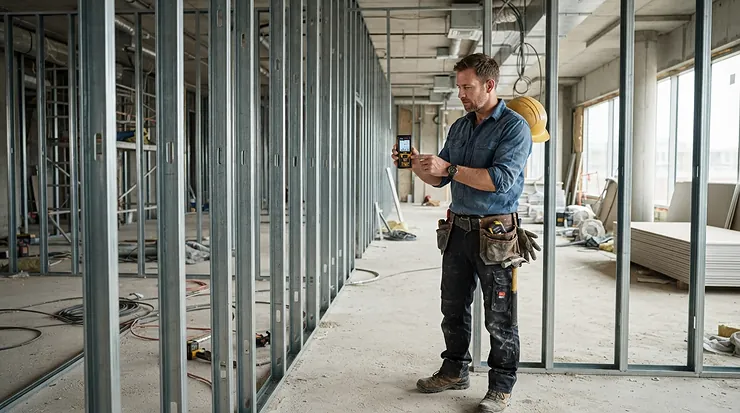
A laser measure for contractors is a handheld distance tool that fires a visible laser at a surface, times the return pulse, and shows the result in feet and inches. Built tougher than hobby units, it adds dust and splash resistance, area and volume math, onboard memory, and often Bluetooth for beaming numbers straight to your phone.

Picture a two-story foyer, a 40-foot ceiling run, or a driveway-to-eave shot. The old way involves a ladder, a patient helper, and a quiet prayer that the tape doesn’t sag. The new way is one button and about a second. That’s the whole pitch for a professional laser distance measure, and in 2026 the category has grown up: sharper displays, green beams you can actually see outdoors, and apps that turn raw numbers into sketches and estimates.
Here’s the catch. The spec sheet on the box is a sales document. Range, accuracy, and “jobsite ready” mean wildly different things from one model to the next. The gap between a bargain gadget and a contractor grade laser measure stays invisible until the day it costs you a miscut or a lost afternoon. Standards help, which is why the ISO 16331-1 standard for handheld laser distance meters exists: it lets buyers compare range and accuracy claims on testable terms.
This guide skips the fluff. You’ll get seven real models, what their specs mean on an actual job, where reviewers say each one frustrates, and how to match a jobsite laser measuring tool to your trade. We’ll also cover Bluetooth measurement sync, jobsite estimating workflows, and laser measuring accuracy, so you can buy once and stop second-guessing. Prices below are ranges only, so check the current price before you buy.
Quick Comparison: Laser Measure for Contractors at a Glance
| Product | Range | Accuracy | Bluetooth | Price Range | Best For |
|---|---|---|---|---|---|
| Bosch GLM 50 C | 165 ft | ±1/16 in | Yes | Around $100-$150 | All-round remodeling and estimating |
| Leica DISTO D2 | 330 ft | ±1.5 mm (about 1/16 in) | Yes | Around $200-$250 | Pros who need CAD and app compatibility |
| Bosch GLM400CL | 400 ft | ±1/16 in | Yes | Roughly $210-$350 | Long outdoor shots |
| Bosch GLM165-25G | 165 ft | ±1/16 in | No | Roughly $90-$140 | Bright-light visibility on a budget |
| Hilti PD-I | 328 ft | About ±1/16 in | Yes | Check current price (premium tier) | Interior fit-out and finishing crews |
| Leica DISTO D1 | 130 ft | ±2 mm | Yes | Roughly $115-$225 | Pocket-size residential work |
| Stanley TLM165 | 165 ft | ±1.5 mm | Listed; confirm on the box | Check current price (budget-to-mid tier) | Value-focused crews |
Looking at the table, the Bosch GLM 50 C hits the best balance of features and cost for most crews. If you regularly shoot past 200 feet outdoors, the Bosch GLM400CL is the one that justifies its higher price. Notice that the Bosch GLM165-25G is the only unit here without Bluetooth, which matters more than it sounds if you build estimates from digital sketches.
💬 Just one click — help others make better buying decisions too!😊
Top 7 Picks: Laser Measure for Contractors, Analyzed
Every unit below is a real, currently listed model. I couldn’t verify hands-on testing for any of them, so what follows is analysis built on published specs and the review roundups I could actually find. Individual customer ratings were not verifiable, so I haven’t quoted any.
1. Bosch GLM 50 C — best all-round pick for most crews
The standout trick here is a color display plus Bluetooth at a price that won’t make you flinch.
On paper you get 165 ft of range and ±1/16 in accuracy with an IP54 rating. In practice, 165 feet swallows nearly every residential and light-commercial interior, so range will rarely be your bottleneck. IP54 means dust and splashes won’t kill it, but it isn’t a drop-it-in-the-bucket rating. Front, back, and pivot-pin reference points let you measure from a corner or an edge without mental math, which is where most tape-and-notepad errors are born.
Based on the spec comparison, this is the model I’d steer a remodeler toward first. It has enough features to speed up jobsite estimating without turning the menu into a hobby. It’s also light, roughly a fifth of a pound with batteries per one review listing, so it won’t drag your belt.
Reviewers in the roundups I could verify keep naming it a top pick for people who want phone integration without paying Leica money. The recurring caveat is that its Bluetooth handoff to pro-grade software feels less refined than Leica’s.
Pros:
- ✅ Color display reads clearly in dim rooms
- ✅ Bluetooth sync into Bosch’s app ecosystem
- ✅ Three reference points cut corner errors
Cons:
- ❌ AAA batteries only, no rechargeable pack
- ❌ Pro-software Bluetooth reportedly less polished than Leica’s
Price: around $100-$150, so check current price. Verdict: the strongest value per feature in this lineup.
2. Leica DISTO D2 — 330 ft reach with a CAD-friendly Bluetooth pedigree
“Disto” has become almost a generic word for laser meters, and this is the model that earned the shorthand.
You get 330 ft (100 m) of range, roughly ±1/16 in (1.5 mm) accuracy, Bluetooth 4.0, seven measuring modes, and a three-line illuminated display in a package around four ounces. That range is overkill for a kitchen but a relief inside a warehouse, a long corridor, or a big-box retrofit. The operating window of 14°F to 122°F also covers most real-world site weather.
The analytical case for the Leica DISTO D2 is software. One review roundup says that if you specifically need AutoCAD-style compatibility, Leica takes the prize. If your estimating chain runs through CAD or a Leica-compatible app, the Bluetooth handoff matters more than any display.
Roundups rank it right alongside the Bosch GLM 50 C, usually picking Leica for ergonomics and range and Bosch for the screen and app ecosystem. Reviewers also praise the Swiss-engineering feel, though that’s a subjective impression rather than a spec.
Pros:
- ✅ 330 ft range handles big interior spans
- ✅ Strong fit with CAD-oriented workflows
- ✅ Compact, light body fits a shirt pocket
Cons:
- ❌ Monochrome display lacks the Bosch screen’s punch
- ❌ Costs noticeably more than comparable Bosch units
Price: around $200-$250 range; check current price. Verdict: worth it if range or software compatibility drives your workflow, otherwise a luxury.
3. Bosch GLM400CL — camera targeting for long outdoor shots
When your target is 300 feet away in glare, the laser dot disappears, and a zoom camera is the cure.
This model reaches 400 ft at ±1/16 in, with IP54 protection and a rechargeable lithium-ion battery. Its 5-megapixel camera with adjustable zoom finds the dot on distant targets, and the unit stores the last 50 measurements plus over 600 images. In plain terms, you can photograph a fascia, tag the measurement, and sync it through Bosch’s MeasureOn app. Bosch also states the unit’s range and accuracy are certified under ISO 16331-1.
The analysis is straightforward: this is a specialist tool. For exterior takeoffs, siding, roofing, fencing, and site layout, the camera fixes the “where did the dot go?” problem. For interior work it’s an expensive solution to a problem you don’t have, and at around 0.46 lb it’s chunkier than the pocket units.
Roundups position it for contractors and builders who need long range with camera-assisted targeting. Some retailers also showed it on backorder, so availability is worth checking before you plan a purchase around it.
Pros:
- ✅ 400 ft range for yard and exterior work
- ✅ Zoom camera locates the dot in bright light
- ✅ Rechargeable lithium-ion battery
Cons:
- ❌ Heavier and bulkier than pocket models
- ❌ Overkill for interior-only estimating
Price: roughly $210-$350 depending on retailer; check current price. Verdict: great for outdoor-heavy trades, wasted on indoor-only crews.
4. Bosch GLM165-25G — green beam for bright sites, minus Bluetooth
The standout feature is a green laser dot that Bosch says is up to four times brighter than a standard red beam.
You get 165 ft at ±1/16 in, 11 measuring functions, and a stakeout accuracy of ±1/2 in. The IP65 rating is a notch above the IP54 units here, so it shrugs off dust and water jets better. Haptic feedback buzzes the tool to confirm a reading on loud sites, a small touch that matters when you can’t hear the beep over a compressor.
Here’s the trade-off, and it’s a real one: this model has no Bluetooth. If you want measurements flowing into a digital sketch, look elsewhere. If you mostly write numbers on lumber or a clipboard and your problem is seeing the dot in daylight, it’s a clean answer.
One roundup notes that indoor-only contractors could save money with a red-beam model instead. That makes sense, since the green advantage pays off mainly outdoors or in bright rooms. Reviewers praise its visibility and ruggedness, and the common complaint is the missing Bluetooth.
Pros:
- ✅ Bright green dot for outdoor visibility
- ✅ IP65 build handles dust and splashes
- ✅ Haptic confirmation on noisy sites
Cons:
- ❌ No Bluetooth or app syncing
- ❌ AA batteries, no rechargeable option
Price: roughly $90-$140; check current price. Verdict: smart for outdoor-leaning crews who don’t need digital sync.
5. Hilti PD-I — rugged interior workhorse with a tradesman’s service plan
Hilti built this for crews who treat tools as consumables, and it shows in the battery and service claims.
Hilti’s US brochure lists up to 328 ft of range, accuracy of ±1/16 in (±1 mm), and battery life of up to 5,000 measurements on AAA cells. Weight is about 0.4 lb. That battery number is the real story. Fewer battery swaps mean fewer “why is it dead?” moments mid-bid. Hilti also pairs the tool with partner apps like magicplan, imagemeter, Floor Plan Creator, and WinWorker, though Hilti notes it doesn’t guarantee compatibility with third-party software.
Practical detail: Hilti says its products ship with Bluetooth deactivated, so you’ll need to switch it on during setup. Durability ratings vary across Hilti’s regional documents (IP54 on some pages, IP65 on the US brochure), so confirm the sheet for the version you’re buying. Hilti’s US service program also includes calibration coverage, per a trade-press summary.
I couldn’t verify a deep pool of aggregated user reviews, so treat this as a spec-and-service pick rather than a crowd favorite. It targets interior applications, so outdoor-heavy crews should look elsewhere.
Pros:
- ✅ Up to 5,000 measurements per battery set
- ✅ Bluetooth tie-ins with several estimating apps
- ✅ Service plan includes calibration
Cons:
- ❌ Interior-focused, no outdoor viewfinder
- ❌ Third-party app compatibility isn’t guaranteed
Price: check current price (premium tier). Verdict: a good fit for crews that value service and uptime over the lowest sticker.
6. Leica DISTO D1 — pocket-size simplicity with Bluetooth
This one wins by doing less: two buttons, a 130 ft range, and nothing else to learn.
The specs are modest on purpose. Accuracy is ±2 mm (about 1/16 in), the body is IP54, and it weighs only 87 g with batteries. Bluetooth works with Leica’s sketch and plan apps, so numbers can still land on a floor plan. The range ceiling of 130 ft (40 m) is plenty for houses, apartments, and small commercial suites.
What the spec sheet won’t tell you, but the product positioning makes clear, is that it’s aimed at simple interior tasks like flooring, curtains, and light carpentry. If you need indirect (Pythagoras-style) calculations for heights, you’ll want a unit with more modes. If you need a backup meter that lives in a jacket pocket, this is it.
Reviewers and retailers consistently frame it as the entry point to the Leica family, praising accuracy and pocketability and noting it’s stripped back by design.
Pros:
- ✅ Ultra-light at 87 g, easy to carry
- ✅ Bluetooth to Leica’s sketch and plan apps
- ✅ Simple two-button operation, near-zero learning curve
Cons:
- ❌ 130 ft range limits larger commercial jobs
- ❌ Fewer measuring modes than the premium units
Price: roughly $115-$225 depending on retailer; check current price. Verdict: a solid second tool or a first purchase for light residential work.
7. Stanley TLM165 — budget-friendly with area and volume math
The hook is straightforward: area and volume calculations at a lower price tier than the premium brands.
The Stanley TLM165 offers a 165 ft (50 m) range and ±1.5 mm accuracy, which lines up with the 1/16 in class. It adds continuous measurement and automatic area and volume calculations, which is exactly what a quick job estimate needs. The package includes a wrist strap and pouch, and it runs on three AAA batteries.
One retailer listing describes Bluetooth functionality on this model. Other listings I found didn’t confirm it, so verify on the box before assuming app syncing. For a crew that mainly needs reliable numbers and quick area math, the Bluetooth question may be a bonus rather than a requirement.
I couldn’t find an aggregated review pool I’d trust for the current version, so I won’t characterize owner sentiment. Based on specs alone, it’s a sensible value pick, but the thinner verification means more homework on your end.
Pros:
- ✅ Area and volume math built in
- ✅ 165 ft range matches pricier units
- ✅ Wrist strap and pouch included
Cons:
- ❌ Bluetooth support unclear across listings
- ❌ Less proven review record than the Bosch and Leica units
Price: check current price (budget-to-mid tier). Verdict: promising value, but confirm features before buying.
Jobsite Fit Snapshot
| Product | Power Source | Display/Beam | Best For |
|---|---|---|---|
| Bosch GLM 50 C | 2 AAA | Color display, red beam | Remodelers building estimates |
| Leica DISTO D2 | 2 AAA | Illuminated 3-line display | CAD-linked workflows |
| Bosch GLM400CL | Rechargeable Li-ion | Color display, red beam, camera | Exterior takeoffs |
| Bosch GLM165-25G | 2 AA | Color display, green beam | Bright-light sites without app needs |
| Hilti PD-I | AAA | Backlit display, red beam | Interior fit-out crews |
| Leica DISTO D1 | 2 AAA | Illuminated display | Pocket backup meter |
| Stanley TLM165 | 3 AAA | Digital display | Budget-minded estimators |
Reading across, the power source splits the field more than you’d expect. The Bosch GLM400CL is the only rechargeable option, which is convenient until the battery dies on a day with no outlet. The AAA and AA units can be refueled at any gas station, which is its own kind of reliability.
✨ Don’t Miss These Exclusive Deals!
🔍 Take your jobsite measuring to the next level with these carefully selected tools. Click on any highlighted product name to check current pricing and availability. The right meter will help you build faster, cleaner estimates your clients will trust!
Bluetooth Measurement Sync: A Practical Setup Guide
Bluetooth measurement sync is the feature that turns a laser from a fast tape into an estimating system. Done right, it removes the single most error-prone step on a jobsite: copying a number from a screen onto paper.
Setup in five moves:
- Install the app first. Use Bosch’s MeasureOn, Leica’s DISTO apps, or a partner app like magicplan if you’re on a Hilti PD-I. Pair before you leave the shop, not in a client’s driveway.
- Switch Bluetooth on deliberately. The Hilti PD-I ships with it off, and leaving radios on drains AAA cells faster on any unit.
- Set your reference point. Front, back, or pivot pin. The Bosch GLM 50 C and Bosch GLM400CL let you choose, so match it to how you’re bracing the tool.
- Calibrate once. Measure a known distance, like a marked 20 feet, and confirm it matches.
- Name rooms as you go. Labels beat guessing later.
Common mistakes in the first 30 days: forgetting to confirm the reference point after changing batteries, measuring across glass or shiny surfaces, and trusting app sketches without a quick tape check on the first job. Spend a week verifying digital numbers against a tape, and you’ll know exactly how far to trust the system.
One honest caution: Bluetooth compatibility with third-party software varies. Hilti explicitly doesn’t guarantee it, and reviewers note Bosch’s handoff to pro-grade software trails Leica’s. Test your actual workflow before committing a crew.

Jobsite Estimating With a Laser Measure for Contractors: Three Real-World Scenarios
Jobsite estimating lives or dies on the quality of your first measurements. These three sample profiles show how to match tools to situations.
Scenario 1: The kitchen remodeler. A solo remodeler quotes six to eight interiors a week, mostly in rooms under 30 feet, and sends PDF estimates from a phone. The Bosch GLM 50 C fits: Bluetooth sync, a bright color screen for dim basements, and a price that stays comfortable for a one-person shop. Pairing it with a sketch app means every room becomes a digital drawing before the truck is out of the driveway.
Scenario 2: The exterior and fencing contractor. This crew measures yards, rooflines, and property edges at 150 to 350 feet in bright sun. The Bosch GLM400CL earns its price here, because the zoom camera finds the dot where a plain red beam would vanish. If budget is tighter and Bluetooth isn’t critical, the Bosch GLM165-25G is a sensible green-beam alternative for shorter outdoor shots.
Scenario 3: The commercial interior finisher. This team measures long corridors and ceiling heights across big-box and office spaces, and battery uptime matters across a ten-hour day. The Hilti PD-I with its battery claim, or the Leica DISTO D2 with 330 ft range and CAD compatibility, are both logical choices depending on whether you favor service plans or software.
The pattern: pick for your bottleneck. For remodelers it’s speed and sketches, for exterior crews it’s visibility, and for commercial crews it’s range and uptime.
Problem → Solution: Fixing Common Laser Measure Headaches
Even a great jobsite laser measuring tool hits snags. Here are the five that come up most, with practical fixes.
Problem 1: You can’t see the dot outdoors. Bright sun washes out a red beam. Solutions include a green-beam unit like the Bosch GLM165-25G, a camera model like the Bosch GLM400CL, or simply a target plate on distant surfaces.
Problem 2: Readings jump around. Glass, mirrors, and glossy tile bounce the beam unpredictably. Re-aim at a matte spot, or hold a piece of cardboard against the surface as a target.
Problem 3: Numbers get lost between site and office. This is exactly what Bluetooth sync solves. Units like the Leica DISTO D1 and Leica DISTO D2 push measurements into sketch and plan apps so there’s no transcription step.
Problem 4: A dead battery mid-bid. AAA and AA units like the Bosch GLM 50 C can be refueled anywhere. The rechargeable Bosch GLM400CL needs a charge plan. Keep a spare pair in your truck either way.
Problem 5: Measurements are consistently a hair off. Check your reference point first (front, back, or pivot), then verify against a known distance. Most “inaccurate” complaints trace back to the wrong reference point, not a bad tool.
How to Choose a Laser Measure for Contractors
Choosing a laser measure for contractors comes down to six decisions, in this order.
- Match range to your longest realistic shot. Add 20% as a buffer. Most interiors fit within 165 ft, while exterior work may need 300 ft or more.
- Decide where you work. Mostly inside? A red-beam unit works fine. Mostly outside? Think green beam or camera targeting.
- Decide whether you need Bluetooth. If you build digital estimates, yes. If you scribble on lumber, it’s optional.
- Check the durability rating. IP54 handles dust and splashes, while IP65 handles water jets better. Be skeptical of vague “jobsite tough” claims with no rating attached.
- Think about power. Rechargeable is tidy but fails without an outlet, while AAA and AA are universally available.
- Look for standards-based specs. Range and accuracy certified under ISO 16331-1 are more trustworthy than unqualified claims.
Treat these as a filter, not a ranking. The best model is the one whose weak points don’t overlap with your daily work.
Laser Measuring Accuracy: What ±1/16 Inch Really Means
Laser measuring accuracy is the spec everyone quotes and almost nobody interrogates. Here’s the catch: the stated number depends on conditions.
Leica’s explanation of the ISO standard notes that range and accuracy depend on light conditions and target reflectivity, which is why the standard defines testing under favorable and unfavorable conditions. Favorable means weak ambient light, a white painted wall, and room temperature. Unfavorable means bright sunshine and the full operating temperature range. You can read the details in Leica’s explanation of the ISO 16331-1 testing conditions.
Translated: a ±1/16 in claim is a best-case number. A hot, sunny exterior shot to a rough, dark surface won’t match a quiet indoor measurement to white drywall. That doesn’t make the tool bad, it just means you should expect slightly wider error outdoors.
For real-world use, treat ±1/16 in as plenty for framing, flooring, and estimating, and verify critical cuts with a second reading. Keep measurements consistent by using the same reference point and bracing the tool against a solid surface. A laser held loosely against a wobbly forearm introduces more error than the electronics ever will.
What Makes a Contractor Grade Laser Measure Different From a Hardware-Store Gadget
A contractor grade laser measure isn’t defined by marketing. It’s defined by tolerance for abuse, readability in bad conditions, and features that save steps.
Look for a durability rating, multiple reference points, memory for recent readings, and calculation modes like area, volume, and indirect measurement. Standards-based range and accuracy claims are also a good sign.
| Factor | Laser Measure | Traditional Tape |
|---|---|---|
| Speed | One-button readings | Needs extending, hooking, reading |
| One-person use | Yes | Often needs a helper |
| Long spans | 165 ft to 400 ft depending on model | Tape sag limits accuracy |
| Digital sync | Many models via Bluetooth | None |
| Reliability | Needs batteries, can struggle with glare | Always works |
| Best For | Estimating, layout, long runs | Marking cuts, short precise checks |
The honest read: neither tool replaces the other. A laser wins on speed, reach, and documentation, while a tape wins on simplicity and marking cuts. Keep both, and let the laser handle the long, awkward, and number-heavy work. The Bosch GLM 50 C and Leica DISTO D1 are both small enough to ride beside a tape without adding bulk.
Professional Laser Distance Measure: Features That Actually Matter (And Those That Don’t)
A professional laser distance measure is easy to oversell with features. Here’s the practical filter.
Features that matter:
- Reference points. Measuring from a corner without fiddling saves real time, and the Bosch GLM 50 C handles this well.
- Readability. Backlit displays and bright beams beat extra modes. The color screen on the Bosch GLM165-25G helps in dim rooms.
- Durability rating. A clear IP number beats adjectives.
- Memory or app sync. Stored readings prevent re-measuring.
- Laser class. Class 2 units are widely used on the jobsite. Hilti lists the Hilti PD-I as a 635 nm Class 2 laser, and UVA’s laser safety guidance explains that Class 2 visible lasers rely on the natural aversion response to bright light for eye protection.
Features that matter less:
- Enormous range you’ll never use. If your longest shot is 80 feet, paying for 400 is wasteful.
- Camera targeting for interior work. The Bosch GLM400CL‘s zoom camera shines outdoors but adds little in a basement.
- Extra modes you won’t remember. If it takes four button presses, you’ll go back to the tape.
The best professional laser distance measure is the one you’ll actually use without thinking.
Safety and Compliance: Laser Classes on the Jobsite
Handheld laser measures are low-power devices, but they’re still lasers, and the rules are worth knowing.
The FDA regulates laser products sold in the U.S. through its radiation-emitting products program. Its laser products and instruments page explains how laser products fall under federal performance standards. Class II (equivalent to IEC Class 2) products typically emit under 1 mW of visible light, and the Bosch GLM400CL is described as a Class II laser under 1 mW.
Practical rules for the crew:
- Never aim at anyone’s eyes. Class 2 relies on the blink reflex, which isn’t a license to stare into the beam.
- Watch reflective surfaces. Mirrors and shiny metal can redirect a beam toward people.
- Keep it away from kids and bystanders. It’s a measuring tool, not a toy.
- Don’t modify or open the unit. Repairs belong with the manufacturer.
If your employer or site has a laser safety policy, follow it. For larger Class 3B or Class 4 equipment, which isn’t what we’re covering here, additional controls apply.
Jobsite Laser Measuring Tool: Long-Term Cost, Value and Maintenance
The sticker price is only the start of what a jobsite laser measuring tool costs you over a few years.
| Product | Typical Price Range | Power | Value Verdict |
|---|---|---|---|
| Bosch GLM 50 C | Around $100-$150 | AAA | Best value overall |
| Leica DISTO D2 | Around $200-$250 | AAA | Premium range and software |
| Bosch GLM400CL | Roughly $210-$350 | Rechargeable Li-ion | Worth it for outdoor work |
| Bosch GLM165-25G | Roughly $90-$140 | AA | Good outdoor budget pick |
| Hilti PD-I | Check current price | AAA | Pays off with uptime and service |
| Leica DISTO D1 | Roughly $115-$225 | AAA | Cheap, simple backup |
| Stanley TLM165 | Check current price | AAA | Budget candidate, verify features |
Analysis: the cheapest meter isn’t always the cheapest to own. A unit that dies mid-bid or drifts out of accuracy costs more than the $50 you saved. Conversely, paying for 400 feet and a camera you never use is wasted money.
Maintenance basics:
- Wipe the lens with a soft cloth. Dust is a bigger accuracy killer than most people realize.
- Check against a known distance every few months and after any hard drop.
- Pull batteries if the tool will sit for weeks.
- Store in a pouch, not loose with screws and blades.
Hilti’s service program includes calibration coverage, which can matter for crews who need documented accuracy. For everyone else, a tape check on a known distance is a free and surprisingly effective audit.
FAQ
❓ How accurate is a laser measure for contractors outdoors?
❓ Do I need Bluetooth on a jobsite laser measuring tool?
❓ Is a green beam laser measure worth the extra money?
❓ How often should I check a professional laser distance measure?
❓ Can a laser measure replace a tape measure completely?
Conclusion
A good laser measure for contractors does three things: it saves time, it cuts errors, and it makes your estimates look sharper. The trick is matching the tool to your actual work rather than the longest spec sheet.
For most remodelers and general crews, the Bosch GLM 50 C is the smart default thanks to its color screen, Bluetooth, and sensible price. If long range or CAD workflows matter, the Leica DISTO D2 earns its premium. Outdoor-heavy trades should look hard at the Bosch GLM400CL or, without app needs, the Bosch GLM165-25G. Interior crews that value uptime and service should weigh the Hilti PD-I, while the Leica DISTO D1 makes a fine pocket backup and the Stanley TLM165 is a value candidate once you verify its feature list.
Whatever you choose, remember the bigger lessons. Treat laser measuring accuracy as a conditional spec, set your reference point deliberately, verify digital numbers against a tape during your first weeks, and follow basic laser safety. Do that, and a contractor grade laser measure will pay for itself in saved hours long before the batteries need changing.
✨ Don’t Miss These Exclusive Deals!
🔍 Ready to upgrade your jobsite measuring? Click on any highlighted product name above to check current pricing and availability. The right tool will help you build faster, bid smarter, and cut once instead of twice! 📏
Recommended for You
- Socket Set For Beginner DIYers: 7 Best Picks, Zero Regrets (2026)
- Husky Vs Craftsman Socket Set: 7 Smartest Buys In 2026
- Socket Set For Motorcycle Maintenance: 7 Best Picks, Ranked (2026)
Disclaimer: This article contains affiliate links. As an Amazon Associate, I earn from qualifying purchases. If you purchase products through these links, we may earn a small commission at no additional cost to you.
✨ Found this helpful? Share it with your friends! 💬🤗
