
In This Article
Picture a Saturday morning. The bike is upside down on a towel, and the one bolt you need to loosen is a 14 mm that nothing in your junk drawer fits. Forty minutes later you’re hunting for a hardware store that’s still open. A good socket set for beginner DIYers ends that scene for good.

The pitch is simple. Sockets click onto a ratchet, the ratchet clicks through tight corners, and fasteners that used to beat you give up in seconds. The catch is the shelf itself. Kits boast 200, 250, even 400 pieces, and a big number says almost nothing about whether a set suits a first-timer. Half those pieces can be bit-driver filler. The other half might be missing the one size you need on a Sunday afternoon.
This guide cuts through the noise. Below are seven real kits that are currently sold, each analyzed for what its specs mean in practice, what reviewers keep praising or complaining about, and who should buy it. We also cover SAE vs metric basics, ratchet handle types, how to set up a socket organizer tray, and what a starter socket set for home use should actually contain. Maybe you want an easy-to-use socket kit for furniture and bikes. Maybe you want a beginner socket set that can handle an oil change. Either way, you’ll know what to buy.
A note on method: this article synthesizes manufacturer specs, expert roundups, and aggregated customer-review themes. It does not claim personal hands-on testing. You’ll see price tiers rather than exact prices, because prices change constantly.
What Is a Socket Set for Beginner DIYers?
A socket set for beginner DIYers is a starter collection of interchangeable sockets, a ratchet handle, and a few extensions and accessories. It covers the common SAE (inch) and metric fastener sizes found around the home, on bikes, and under car hoods. It lets first-timers tighten and loosen nuts and bolts far faster than fixed wrenches allow.
The idea is older than most people assume. Wikipedia credits J.J. Richardson of Woodstock, Vermont, with the modern indexable socket wrench, patented in 1863. The design has barely changed since. A ratcheting mechanism lets you swing the handle back and forth without lifting the tool off the fastener. That saves enormous time and a surprising amount of knuckle skin.
Every beginner socket set is built from the same handful of parts:
- Sockets: the cup-shaped pieces that grip the fastener. They come in fractional inch and metric sizes, in shallow and deep versions.
- Ratchet: the handle with a reversing lever and a toothed internal mechanism.
- Extensions and adapters: bars that reach recessed bolts and let you mix drive sizes.
- Case or organizer: where everything lives so you can find it before you lose your patience.
Think of it as a small orchestra. The ratchet is the conductor, and the sockets are the section players. Every size has a chair, and an empty chair is how projects stall.
Quick Comparison: 7 Beginner Socket Set Picks at a Glance
Here’s the lineup before we go deep. Price tiers use symbols: $ is budget, $$ is mid-range, and $$$ is premium. Check current prices before you buy.
| Set | Drive Sizes | Pieces | Price Tier | Best For |
|---|---|---|---|---|
| Amazon Basics 201-Piece | 1/4″, 3/8″, 1/2″ | 201 | $ | First-timers wanting one case that does it all |
| DEKO 258-Piece | Check listing | 258 | $ | Light home repair on a tight budget |
| Crescent CTK180 | 1/4″, 3/8″ | 180 | $$ | Compact kits with fine-tooth ratchets |
| DEWALT DWMT73802 | 1/4″, 3/8″ | 142 | $$ | Buyers who value build quality over piece count |
| CRAFTSMAN 230-Piece | 1/4″, 3/8″, 1/2″ | 230 | $$ | New homeowners wanting three drive sizes |
| DEWALT DWMT81535 | 1/4″, 3/8″, 1/2″ | 247 | $$$ | “Buy it once” garage setups |
| GEARWRENCH 232-Piece | 1/4″, 3/8″ | 232 | $$$ | Beginners planning to grow into serious work |
The table shows a pattern the packaging hides. Piece count and usefulness are only loosely related. The Crescent CTK180 has the smallest number on the list, yet it brings fine-tooth ratchets and a defined size range. The DEKO 258-Piece has the biggest number, but bits and accessories do much of the heavy lifting. If you only skim one thing here, skim the Drive Sizes column. A 1/2-inch drive matters the day a stubborn lug nut or suspension bolt shows up.
Budget buyers should also note that the cheapest kit is not automatically the best value. A set that covers 90% of your jobs beats a larger set that covers 70%.
💬 Just one click — help others make better buying decisions too!😊
Top 7 Socket Set for Beginner DIYers: Expert Analysis
Every pick below follows the same logic: what the specs mean in real use, what aggregated reviews say, and who the kit suits. Each set has a different personality, so read the one that matches your projects.
1. Amazon Basics 201-Piece Mechanic’s Socket Tool Set — best coverage for a first toolbox
The headline here is breadth. Amazon Basics 201-Piece combines SAE and metric sizes across all three common drive sizes in a portable case, which is unusual at the budget end of the aisle.
The listing describes chrome-vanadium steel, the standard alloy for hand sockets. It matters because softer metal flares and rounds its corners over time. Three drives means the 1/4-inch ratchet handles a bike stem, the 3/8-inch handles most engine-bay fasteners, and the 1/2-inch steps in when leverage matters. That covers the whole spread of a beginner’s likely year.
Based on the spec comparison, this is the “I don’t know what projects are coming” kit. The caveat is the headline count. Bits and small accessories inflate it, so judge the set by its socket range rather than the 201.
On sentiment, one aggregated roundup reports roughly a 4.7-star average across more than 13,000 reviews. Reviewers there frame it as covering the most common repair scenarios at a price most people can swallow. Treat that as directional and confirm the current rating on the listing.
Pros:
- ✅ Three drive sizes in one case
- ✅ SAE and metric sockets included
- ✅ Chrome-vanadium steel construction
Cons:
- ❌ Headline count padded by small accessories
- ❌ Fewer premium refinements than pricier sets
Budget tier, so check current price. Verdict: strong value for a general-purpose first kit.
2. DEKO 258-Piece Mechanics Tool Kit on Wheels — most pieces per dollar for light-duty repairs
If a rolling case sounds silly for a toolkit, picture hauling a loaded box from the garage to the third-floor apartment. Then it makes sense. Bob Vila’s testing team named the DEKO 258-Piece its best bang for the buck.
On paper, 258 pieces sounds like a mechanic’s dream. In practice, a large share of that count is bits and accessories, so the real payoff is how much ground it covers cheaply. I couldn’t verify the exact drive-size breakdown from the sources I found. Confirm it on the listing before you buy.
The honest analysis is pretty simple. If home repair is one of many odd jobs you do, which means furniture, appliances, the occasional bike, this kit fits. Bob Vila’s own caveat is the important one: serious mechanics should look elsewhere because it lacks the breadth they need. For a beginner, that caveat may never bite.
Reviewer framing is consistent. Buyers describe it as a budget workhorse for casual use rather than a long-haul professional kit.
Pros:
- ✅ Very high piece count for the money
- ✅ Rolling case simplifies moving and storage
- ✅ Wide assortment for odd household jobs
Cons:
- ❌ Lacks depth for serious automotive work
- ❌ Piece count flattered by accessories
Budget tier, so check current price. Verdict: great value if your projects stay light.
3. Crescent CTK180 180-Piece Professional Tool Set — 72-tooth ratchets in a compact case
Fine-tooth ratchets rarely show up at this price tier, which is why the Crescent CTK180 stands out. Bob Vila’s roundup labeled it the best socket pick.
Its specs are unusually well documented. The set has 1/4- and 3/8-inch drives, a 5/32″ to 1″ and 4 mm to 24 mm size range, quick-release ratchets with 72 teeth, polished chrome alloy steel, a blow-mold case, and a limited lifetime warranty. Retailer listings also show pliers, an adjustable wrench, four screwdrivers, and a magnetic bit driver with 46 bits. The 72 teeth mean the handle needs only about a 5-degree swing to advance, versus 10 degrees on a 36-tooth ratchet. In a cramped spot behind a dryer panel, that difference is the whole game.
The trade-off is range. Without a 1/2-inch drive, very large fasteners are out of reach.
On sentiment, Home Depot reviewers describe it as comprehensive for home and auto use. One buyer noted that bigger sockets would require a 1/2-inch ratchet and wished for more wrenches. Availability varies, and at least one retailer lists the set as discontinued, so confirm stock before you commit.
Pros:
- ✅ 72-tooth quick-release ratchets
- ✅ Wide documented size range in two drives
- ✅ Limited lifetime warranty
Cons:
- ❌ No 1/2-inch drive for big fasteners
- ❌ Availability and pricing vary by retailer
Mid-range tier, though pricing swings widely, so check current price. Verdict: excellent for tight-space work.
4. DEWALT DWMT73802 142-Piece Mechanics Tool Set — sturdiest build in the mid-range
Sometimes fewer, better pieces beat a mountain of mediocre ones. DEWALT DWMT73802 is the proof. Bob Vila rated it 9.2/10 and named it best overall in its mechanic tool set roundup.
It pairs 1/4- and 3/8-inch drives, which covers the bulk of beginner jobs, from bikes to brake pads to a basic engine-bay fastener. The testers’ standout comment was build quality. Cheap sets often feel slightly off: loose ratchet gears, sloppy fits, finishes that chip. A set that feels solid builds confidence, and confidence is what a first-timer needs most.
Bob Vila also noted a few notable omissions, so this kit may not be the last one you buy. That’s fine. It’s a strong foundation.
Aggregated reviewer sentiment leans positive on organization and durability, with users saying tools stay put in the case when it’s opened and closed. Pricing fluctuates widely across retailers, so shop around.
Pros:
- ✅ Top-tier build quality for its class
- ✅ Well-organized case that holds pieces in place
- ✅ Strong reputation from a respected testing team
Cons:
- ❌ No 1/2-inch drive for larger fasteners
- ❌ A few notable omissions in the assortment
Roughly the $100-$225 range depending on retailer and promotions, so check current price. Verdict: premium feel without a premium shock.
5. CRAFTSMAN 230-Piece Mechanics Tool Set (VERSASTACK) — three drive sizes in a stackable box
Storage is half of owning a socket set, and CRAFTSMAN 230-Piece treats it that way. The VERSASTACK toolbox is built to stack with other modular tool boxes, which suits people who expect to keep buying.
The listing details SAE and metric sizes, 1/4-, 3/8-, and 1/2-inch drives, and short and long arm hex keys. Roundups also point to 6-point sockets and chrome-vanadium steel. The 6-point design matters for beginners because it grips the flats of a hex fastener rather than its corners. That makes rounding off a bolt less likely while you’re still learning how much force is enough.
The analytical take is this: three drives plus modular storage make it a tidy “grow into it” kit. The downside is that 230 pieces include plenty you won’t touch in year one.
Reviewer roundups frequently place this set among beginner favorites. I’d still check recent buyer comments for QC notes before ordering, since mass-market kits can vary between production runs.
Pros:
- ✅ Three drive sizes with SAE and metric
- ✅ VERSASTACK storage expands with your tools
- ✅ 6-point socket design protects fasteners
Cons:
- ❌ Stack-style box takes up bench space
- ❌ Many pieces unlikely to get used early
Mid-range tier, so check current price. Verdict: solid all-rounder for new homeowners.
6. DEWALT DWMT81535 247-Piece Mechanics Tool Set — the “buy it once” three-drive kit
This is the set for the person who hates shopping twice. DEWALT DWMT81535 earned Pro Tool Reviews’ nod as best overall mechanic tool set.
The specs look like a grown-up’s toolbox. Listings show three drive sizes, a 72-tooth ratchet, a lifetime warranty, and chrome-vanadium steel. Reviewers praised excellent build quality and the included set of box wrenches. One standout feature is a locking mechanism on the ratchets that keeps sockets from popping off under heavy force. That sounds minor until a socket launches into a dark engine bay.
Analytically, this is overkill for someone assembling bookshelves. For a beginner who knows they’ll tackle brakes, suspension, and weekend car maintenance, it removes the upgrade cycle.
Pro Tool Reviews listed the price at around $190 at the time of that review. Pricing moves, so check current price. Reviewer sentiment centers on durability and organization, with little complaint beyond cost.
Pros:
- ✅ Three drive sizes with 72-tooth ratchet
- ✅ Lifetime warranty on a durable steel build
- ✅ Ratchet lock helps keep sockets secure
Cons:
- ❌ Costs more than typical starter kits
- ❌ More pieces than a first-timer may use
Premium tier, so check current price. Verdict: great long-term value if your ambitions run beyond furniture.
7. GEARWRENCH 232-Piece Mechanics Tool Set (80949) — premium drawers and ratcheting wrenches
Think of this one as the set a beginner grows into. GEARWRENCH 232-Piece is labeled best professional in Pro Tool Reviews’ roundup, and it earns that title.
The contents go beyond sockets. The set includes ratcheting wrenches, standard and deep 6-point and 12-point sockets, a magnetic screwdriver handle, bits, and Allen keys, all in a three-drawer molded storage box. Ratcheting box-end wrenches are a quiet superpower: where a socket won’t fit, they still turn the fastener without repositioning each time.
The analysis comes down to ambition. If you want to learn real mechanical work and refuse to buy twice, this is a legitimate path. If you only tighten furniture hardware, you’re paying for capability you’ll never use.
Aggregated review themes: buyers describe it as well organized, easy to navigate, and a solid start-up set for a garage or vehicle kit. One reviewer summary notes that heavy-duty users may want supplementary sets.
Pros:
- ✅ Ratcheting wrenches included with sockets
- ✅ Three-drawer box keeps everything findable
- ✅ Excellent build quality in expert roundups
Cons:
- ❌ Premium cost for a first-timer
- ❌ No 1/2-inch drive; plastic storage chest
Premium tier, roughly in the mid-$300s at retailers I found, so check current price. Verdict: worth it only if you’ll use the depth.
Head-to-Head: How the Seven Kits Stack Up
Now that you’ve met the lineup, here’s how they compare on the dimensions that matter once the novelty fades.
| Set | Standout Strength | Main Trade-Off | Best For |
|---|---|---|---|
| Amazon Basics 201-Piece | Three drives, SAE and metric | Accessory-padded count | General first toolbox |
| DEKO 258-Piece | Piece count per dollar | Limited depth for serious work | Light household repairs |
| Crescent CTK180 | 72-tooth ratchets, documented range | No 1/2″ drive | Tight-space jobs |
| DEWALT DWMT73802 | Build quality | A few omissions | Quality-minded beginners |
| CRAFTSMAN 230-Piece | Three drives plus modular storage | Unused pieces early on | New homeowners |
| DEWALT DWMT81535 | Complete, durable, locking ratchets | Price | Long-term garage builds |
| GEARWRENCH 232-Piece | Ratcheting wrenches, drawers | Cost, no 1/2″ drive | Growth into real mechanics |
Reading across, the DEWALT DWMT73802 and Crescent CTK180 reward buyers who prize craftsmanship, while the Amazon Basics 201-Piece and DEKO 258-Piece reward buyers who prize coverage per dollar. The CRAFTSMAN 230-Piece sits in the sensible middle. If hill-climbing torque is your priority, the extra drive size on the DEWALT DWMT81535 justifies its higher cost. Budget buyers should note that the DEKO 258-Piece trades depth for its price.
How to Choose a Socket Set for Beginner DIYers
The best socket set for beginner DIYers is the one that covers your actual projects with solid 6-point sockets, both SAE and metric sizes, and a ratchet you can use comfortably. Here are seven steps to choose without second-guessing.
- List your likely projects first. Furniture and bikes live in the 1/4-inch and 3/8-inch world. Brakes and suspension want a 1/2-inch drive.
- Insist on both SAE and metric. Mixed fasteners are normal in modern households.
- Prefer 6-point sockets. They grip hex flats and reduce rounding, especially for beginners still learning torque feel.
- Count sockets, not pieces. Look for the size range, such as 5/32″ to 1″ and 4 mm to 24 mm, rather than the headline number.
- Check the ratchet. More teeth means a smaller swing arc, which helps in tight spaces.
- Judge the case. A case that keeps sizes visible and secure beats a bigger one that spills.
- Weigh the warranty. A lifetime warranty on hand tools is worth real money if the claims process is simple.
Two extra checks. Confirm deep sockets are included, since they handle long bolts and recessed fasteners. And decide whether you’ll ever use an impact wrench. If so, add dedicated impact sockets later, since impact-rated sockets are thicker-walled and built for that duty.
SAE vs Metric Basics: The Rule That Saves You From Stripped Bolts
Understanding SAE vs metric basics is the fastest way to stop stripping fasteners. SAE sockets are sized in inches and fractions, such as 1/2″ or 3/4″. Metric sockets are sized in millimeters, such as 10 mm or 19 mm. Neither is better. They’re two languages, and a beginner socket set should speak both.
Where do you meet each? American-made machinery and older U.S. vehicles lean SAE. Modern imports, bikes, electronics, and most appliances lean metric. Many modern U.S. vehicles mix both, which is why a lopsided kit frustrates people.
The history is tidier than the toolbox. NIST guidance on inch-pound and SI units explains that customary units are defined in terms of metric ones, which is why the inch is exactly 25.4 millimeters. The systems are mathematically linked, but their socket sizes rarely line up cleanly.
The “Close Enough” Trap
Some pairs are near matches. A 19 mm socket and a 3/4″ socket are within about 0.05 mm. That tempts people to swap them. Resist the habit. Sizes that are nearly right can slip and round corners, especially on stuck bolts. If a socket wobbles at all, it’s the wrong socket. The right size should seat snugly with almost no play.
Quick Identification Tricks
- Look for stamped markings on the socket. Many are hard-stamped and easy to read, which helps as you learn.
- Test-fit by hand before you attach the ratchet.
- When in doubt, try the metric size first on anything made in the last few decades, then fall back to SAE.
Ratchet Handle Types Explained
Understanding ratchet handle types turns a decent kit into a flexible one. The ratchet is the part your hand touches most, and its design affects speed, access, and torque.
Home Depot’s ratchet guide lays out the basics. The drive size determines which sockets fit. A 1/4-inch ratchet suits small sockets and precision work, the 3/8-inch is the versatile all-rounder, and the 1/2-inch handles larger nuts and bolts. A low-profile head helps in tight spaces.
Standard Fixed-Head Ratchets
These are what most beginner kits ship with. They’re sturdy and simple. The tooth count is the number to watch. A 72-tooth ratchet advances on a 5-degree swing, while a 36-tooth ratchet needs 10 degrees. In cramped quarters, the finer tooth pays off.
Flex-Head Ratchets
The head pivots, letting you reach fasteners at an angle. They help in awkward engine bays but can feel less solid under heavy load.
Stubby and Low-Profile Ratchets
Short handles fit where full-length ones can’t. Less leverage means you’re less likely to overtighten small fasteners, which is a quiet benefit for beginners.
Breaker Bars and Speed Handles
A breaker bar is a long, non-ratcheting handle for cracking loose stubborn fasteners. A speed handle spins sockets quickly after the break. Beginners don’t need either on day one, but a breaker bar becomes useful the first time a lug nut refuses to move.
Don’t forget the reversing lever. Always check which way the ratchet is set before you apply force, or you’ll tighten when you meant to loosen.
Easy-to-Use Socket Kit: Features That Actually Matter (And Those That Don’t)
An easy-to-use socket kit is defined by a handful of unglamorous features. Marketing loves flashy numbers. Your hands love clear markings and a case that behaves.
Features That Matter
- 6-point sockets. Better grip, less rounding. This is the biggest safety net for a beginner.
- Clear size markings. A reviewer roundup specifically highlighted size markings that stay legible as a beginner learns which socket fits what.
- Case organization. Sockets that snap into labeled slots let you spot a missing piece instantly.
- Deep sockets. They reach long bolts and recessed fasteners.
- A comfortable ratchet. If it hurts your palm in the store, imagine hour three under a car.
Features That Don’t
- Headline piece count. Bits and accessories pad it.
- Mirror polish. It looks great and does little for performance.
- Specialty sockets you can’t name. If a piece’s purpose isn’t obvious, you won’t use it.
One more distinction: chrome-plated sockets can crack under an impact wrench, while impact sockets are thicker-walled and work fine with a hand ratchet. If power tools are in your future, impact-rated sockets are a smart add-on. A good easy-to-use socket kit doesn’t force you to think about any of this on day one.
Setup Guide: Your First 30 Days With a Socket Organizer Tray
A beginner socket set earns its keep through habits, not just hardware. Here’s a 30-day plan that avoids the classic rookie mistakes.
Day 1: Inventory and Label
Open the case, lay everything out, and check each socket against the size chart. Note any missing pieces while the return window is open.
Week 1: Build a Socket Organizer Tray Routine
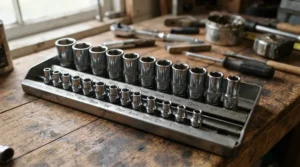
A socket organizer tray is a rail or tray that holds loose sockets in size order. Cases are fine for storage, but they’re a pain while you’re mid-project. Pull the sizes you need for a job, set them on a socket organizer tray in order, and return them after. A simple color or size-coded tray beats rummaging through a case. Keep SAE and metric on separate rails so you never confuse 13 mm with 1/2″.
Weeks 2-3: Practice on Low-Stakes Projects
Tighten furniture hardware, adjust a bike seat, or swap a cabinet pull. Learn the feel of “snug” before you graduate to anything that matters.
Week 4: First Maintenance Round
Wipe each socket and ratchet dry, check that the reversing lever moves cleanly, and store everything in a dry place. Rust starts in damp garages.
Common First-30-Day Mistakes
- Using a socket that’s slightly too big.
- Forgetting to check the ratchet direction.
- Adding extra leverage with a pipe before trying the proper tool.
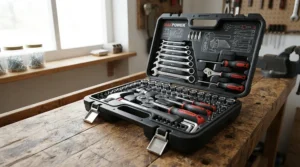
Starter Socket Set for Home Use: Three Real-World Scenarios
A starter socket set for home use looks different depending on who’s holding it. Here are three profiles with realistic budgets and frequency of use.
Scenario 1: The Apartment Renter With a Commuter Bike
You’re assembling furniture, adjusting a bike, and occasionally tightening an appliance panel. Budget is tight and storage is tighter. The Amazon Basics 201-Piece or DEKO 258-Piece fits, offering broad coverage in a case you can slide under a bed. Use frequency: a few times a month.
Scenario 2: The New Homeowner With One Car
Oil changes, brake pads, and the occasional weekend fix. You want fewer sizes missing and a case that stays organized. The DEWALT DWMT73802 or CRAFTSMAN 230-Piece balances build quality and range. If a stubborn lug nut is in your future, the CRAFTSMAN 230-Piece‘s 1/2-inch drive helps. Use frequency: every few weeks.
Scenario 3: The Learner Who Plans to Go Deeper
You expect to tackle suspension work, rebuild a lawn mower engine, or help friends with their cars. The DEWALT DWMT81535 or GEARWRENCH 232-Piece removes the upgrade cycle, and the ratcheting wrenches in the GEARWRENCH 232-Piece earn their keep when sockets can’t reach. Use frequency: weekly.
For tight-space tinkerers, the Crescent CTK180 is the sleeper pick. Its 72-tooth ratchets reward anyone working around cramped panels.
✨ Ready to Build Your First Toolbox?
🔍 Take your first DIY projects to the next level with these carefully selected socket sets. Click on any highlighted item to check current pricing and availability. These kits will help you create confident, stripped-bolt-free results your household will appreciate!
Common Mistakes When Buying a Beginner Socket Set
Most regrets trace back to a short list of errors. Avoid these and you’re ahead of most first-time buyers.
- Chasing the biggest number. A 400-piece box that lacks your sizes is worse than a 150-piece one that has them.
- Skipping SAE or metric. A kit that covers only one system leaves you stuck mid-project.
- Ignoring drive sizes. Without a 1/2-inch drive, large fasteners are out of reach. Without a 1/4-inch, small, delicate ones are a pain.
- Buying 12-point sockets for hex bolts. Twelve-point sockets are fine for specific jobs but are more likely to round fasteners under heavy torque. For most beginner work, 6-point wins.
- Overlooking the case. A flimsy case that dumps its contents is the fastest route to a lost 10 mm socket.
The pattern behind all five is the same: buyers shop for impressiveness rather than fit. Shopping by your real projects fixes most of this.
Complete Kit vs Buying Individual Pieces
Should you buy a complete kit or assemble your own from individual tools? For most beginners, a kit wins. Here’s why.
| Factor | Complete Kit | Individual Pieces | Best For |
|---|---|---|---|
| Upfront cost | Lower per tool | Higher per tool | Kit for beginners |
| Size coverage | Broad out of the box | Gaps until you fill them | Kit for unknown projects |
| Quality control | Uniform | Mix-and-match brands | Individual for experts |
| Storage | Built-in case | You supply it | Kit for simplicity |
| Upgrade path | Replace the weak pieces | Total flexibility | Individual for specialists |
The table points one direction. A kit gets you working immediately and keeps sizes organized, while individual pieces make sense once you know exactly what you’re missing. A smart hybrid is to start with a kit like the CRAFTSMAN 230-Piece, then add a single high-quality ratchet or breaker bar when a real project demands it. Beginners who buy piecemeal often end up with gaps and a drawer of mismatched tools.
Long-Term Cost, Maintenance, and Safety
Total cost of ownership is where the DEWALT DWMT81535 and GEARWRENCH 232-Piece justify their price tags. Buy a cheap set that fails in two years and you’ve paid twice. Buy once and the cost spreads across a decade. A lifetime warranty adds another layer, as long as the claim process is straightforward.
Maintenance is nearly free:
- Wipe sockets dry after use.
- Store in a dry spot, not a damp garage corner.
- Return every piece to its slot so missing sizes are obvious.
- Replace any socket that’s cracked, split, or visibly rounded inside.
Safety deserves a short, serious word. OSHA’s hand tool guidance was written for workplaces, but its logic applies at home. Its core advice is to keep tools in good condition, use the right tool for the job, and wear proper protective equipment such as safety glasses and gloves. The agency also warns that a wrench with sprung jaws can slip. The same applies to a worn socket that no longer grips squarely.
Use a breaker bar for stubborn fasteners rather than slipping a pipe over a ratchet, and never use a wrench as a hammer. Inspect each tool before a job. It takes ten seconds and prevents most injuries.
FAQ
❓ Is a 3/8-inch drive enough for a beginner socket set?
❓ Are 6-point or 12-point sockets better for beginners?
❓ How many pieces should a socket set for beginner DIYers include?
❓ Do I need impact sockets in a beginner socket set?
❓ How do I stop my socket set from rusting?
Conclusion
Choosing a socket set for beginner DIYers comes down to fit, not flash. Match the kit to your real projects, insist on both SAE and metric, favor 6-point sockets, and check the case before you check the piece count.
If you want the safest all-around start, the Amazon Basics 201-Piece and CRAFTSMAN 230-Piece cover the most ground with three drive sizes. If budget is the priority, the DEKO 258-Piece stretches farthest for light repairs. For tight-space work and fine-tooth ratchets, the Crescent CTK180 is a standout. If build quality is your north star, the DEWALT DWMT73802 delivers, and the DEWALT DWMT81535 and GEARWRENCH 232-Piece suit anyone who knows they’re growing into serious work.
Whichever you choose, set up a socket organizer tray, learn the feel of “snug,” and respect the basics from OSHA to the SAE vs metric rule. Your first stripped bolt is optional. Your first satisfying click is waiting.
Recommended for You
- Husky Vs Craftsman Socket Set: 7 Smartest Buys In 2026
- Socket Set For Motorcycle Maintenance: 7 Best Picks, Ranked (2026)
- Metric Socket Set For European Cars: 7 Best Picks Ranked (2026)
Disclaimer: This article contains affiliate links. As an Amazon Associate, I earn from qualifying purchases. If you purchase products through these links, we may earn a small commission at no additional cost to you.
✨ Found this helpful? Share it with your friends! 💬🤗
