
In This Article
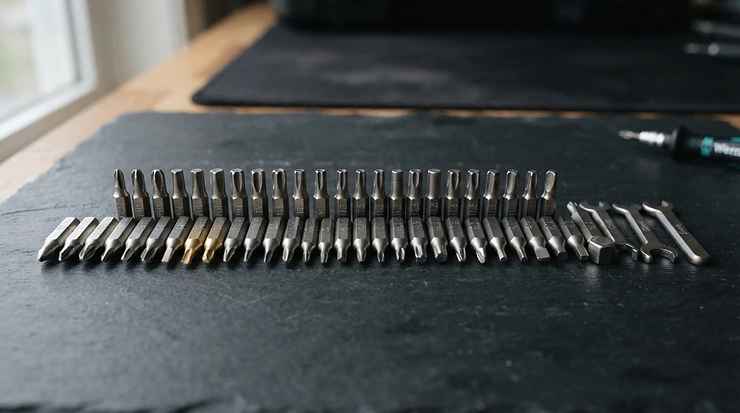
A screwdriver set for eyeglass repair is a compact collection of micro-sized drivers, usually flathead and Phillips tips between roughly 1.0 and 2.0 mm. It is built to tighten, remove and replace the tiny hinge, nose pad and lens screws that hold glasses together. Better kits add magnets, tweezers, spare screws and nose pads.
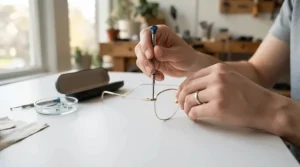
Here’s the thing about eyeglass screws: they are small enough to vanish into a carpet and stubborn enough to ruin your morning. Many are under two millimeters across, with shallow threads that loosen a little every time you push your frames up your nose. One day your temple arm wobbles. A week later, a lens pops out over the breakfast table. Then you’re squinting at a blurry screw hole with a butter knife in your hand, which is exactly how frames get scratched.
The fix is almost insultingly cheap. A decent precision screwdriver with the right tip size turns a 10-minute optician trip into a 90-second kitchen-table tune-up. This guide breaks down seven real kits, what their specs mean in practice, and which one suits your life. We also cover the sizes, tricks and mistakes that decide whether a repair holds or strips a thread for good.
One honest note before we start. This article is built on spec sheets, retailer listings and published roundups, not on hands-on bench testing. Where individual buyer reviews couldn’t be verified, I say so plainly. Prices appear as ranges only, because they change constantly.
Quick Comparison: 7 Screwdriver Sets for Eyeglass Repair at a Glance
Start here if you want the short list. The table sorts the seven kits by what’s actually in the box, which matters more than the marketing piece count.
| Product | Kit Type | Standout Contents | Price Range* | Best For |
|---|---|---|---|---|
| Kingsdun Eyeglass Repair Kit | All-in-one | 1,100 screws and nose pads, 6 drivers, curved tweezers | Budget (check current price) | Kingsdun suits households stocking up |
| VAPKER Glasses Repair Kit | All-in-one | 1,000 stainless screws, 6 magnetic drivers, tweezers | Budget (check current price) | VAPKER suits variety seekers |
| Hiketolight Magnetic Kit | Portable | Magnetic drivers, screws, nose pads, tweezers | Budget (check current price) | Hiketolight suits travel bags |
| MINGFIX Magnetic Kit | Starter | Magnetic bits, screws, pads, mini travel case | Under $10 | MINGFIX suits first-time fixers |
| YEEMO 188-Piece Kit | Screw and pad | 188 pieces, gold screws only | Budget (check current price) | YEEMO suits quick everyday fixes |
| HOTO 24-in-1 | Driver only | 24 S2 steel tips in a pen body | Roughly $15-$25 range | HOTO suits tool lovers |
| Craftsman 6-Piece Set | Jeweler’s driver set | 2 Phillips and 4 slotted sizes, hard case | Check current price | Craftsman suits frequent repairers |
*Price ranges reflect the time of research and may vary.
Looking at the comparison above, the all-in-one kits win on convenience because they bundle spare screws and pads. The two driver-only options, HOTO and Craftsman, win on feel and tip quality. The big gap is between “I have a repair kit” and “I have a tool I enjoy using.” If you only fix glasses once a year, a bundled kit like MINGFIX is plenty. If you repair family frames monthly, pairing a nicer driver with a small parts assortment beats any single box.
💬 Just one click — help others make better buying decisions too!😊
Top 7 Screwdriver Sets for Eyeglass Repair: Expert Analysis
Every pick below gets the same treatment. We look at what the specs mean, who the kit is for and what reviewers say, and we list the trade-offs. Review commentary comes from published roundups and retailer pages. It is aggregated and never invented.
1. Kingsdun Eyeglass Repair Kit — biggest spare-parts stockpile
The headline is volume. The listing advertises 1,100 screws and nose pads, plus six Phillips and flathead screwdrivers and a curved-tip tweezer. That is more spare hardware than most households will use in a decade.
On paper, the six drivers cover the common slotted and Phillips sizes, and the curved tweezer is the quiet hero. Eyeglass screws are tiny, and a curved tip lets you seat a screw into a hinge barrel without blocking your own view.
Based on the spec comparison, this kit suits people who repair glasses for a whole family, or who keep a drawer of spares for kids who sit on their frames. The sheer assortment also helps when you need a screw that merely resembles the original. The trade-off is sorting: a big bag of near-identical screws means a few minutes of matching under good light.
On reviews, one published roundup names it the overall best for versatility and a comprehensive tool lineup. I couldn’t verify individual buyer review text, so treat that as an editorial signal rather than a customer verdict.
Pros:
- ✅ Enormous spare screw and nose pad assortment
- ✅ Curved tweezer helps seat tiny screws
- ✅ Covers both Phillips and flathead tips
Cons:
- ❌ Sorting hundreds of screws takes patience
- ❌ Only six drivers, so less bit variety
Price: a budget buy; check current price. Value verdict: strong if you want one box that covers every household repair.
2. VAPKER Glasses Repair Kit — stainless steel screws in bulk
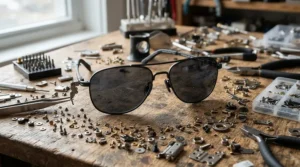
The VAPKER kit pairs 1,000 stainless steel screws with six magnetic precision screwdrivers and tweezers. Stainless matters because eyeglass screws live next to skin, sweat and sunscreen, all of which corrode cheap fasteners.
The magnetic tips are the practical upgrade. Anyone who has chased a 1.2 mm screw across a hardwood floor knows what a magnet saves you. Once the screw clings to the tip, you can aim it at the hinge instead of hoping.
My read of the specs: this is the kit for people who like having every size on hand. It also suits owners of metal frames, where matching a replacement screw’s finish makes the repair almost invisible. A roundup labels it the best versatile kit for its extensive, high-quality assortment of accessories.
As with the previous entry, I couldn’t verify individual buyer review text. The one cautionary note is that magnets only help if the bit fits the slot snugly, so test the fit before you apply torque.
Pros:
- ✅ Stainless steel screws resist everyday corrosion
- ✅ Magnetic tips stop screws from escaping
- ✅ Wide assortment suits most frame styles
Cons:
- ❌ Six drivers only, no interchangeable bits
- ❌ Bulk parts exceed what most people need
Price: a budget buy; check current price. Value verdict: a smart pick if parts variety is your priority.
3. Hiketolight Magnetic Eyeglass Repair Kit — built for the carry-on bag
Portability is the whole pitch here. The Hiketolight kit bundles magnetic screwdrivers, screws, nose pads and tweezers into a package aimed at travel and emergency fixes, and a published roundup calls it the best for on-the-go repairs.
That focus is useful. Glasses fail at the worst times: on a plane, at a wedding, halfway up a trail. A compact kit in a backpack side pocket turns a trip-ruining wobble into a two-minute fix.
Here’s what to weigh. Smaller kits carry fewer spares, so you won’t have the endless screw variety of the 1,000-piece boxes. But for an emergency, you rarely need variety. You need one screw that fits, a driver that grips and a tweezer to place it. This kit delivers that core trio in a smaller footprint.
It also suits sunglass owners who spend time outdoors, where hinge screws loosen from heat cycles and bumps. Individual buyer reviews weren’t verifiable in my research, so the editorial roundup is the only signal I can point to.
Pros:
- ✅ Compact format fits bags and glove boxes
- ✅ Magnetic drivers keep tiny screws secure
- ✅ Includes nose pads, screws and tweezers
Cons:
- ❌ Fewer spare parts than bulk kits
- ❌ Driver variety is limited for rare screw heads
Price: a budget buy; check current price. Value verdict: best when portability outranks parts volume.
4. MINGFIX Magnetic Eyeglass Repair Kit — the under-$10 starter
This is the entry ticket. The MINGFIX kit includes assorted screws, nose pads, magnetic bit tips, a small bit set, a tweezer and a mini travel case, all in the under $10 range at the time of research.
A published review summary praises the magnetic tips for making tiny screws easier to handle. It also frames the kit as a way to dodge optician fees for loose arms, missing screws and tired nose pads.
The same summary offers a smart caveat: the kit’s screws alone won’t stop loosening, so a thread-locking compound is recommended. That’s honest, and it lines up with the physics. Hinge screws loosen through vibration and repeated flexing, not because they were poor quality. We cover the fix later in this guide.
For beginners, this is a low-risk way to discover whether you enjoy tiny repairs. For serious tinkerers, it’s the kit you buy as a backup. The mini travel case keeps everything together, which is half the battle with small parts.
Pros:
- ✅ Very low cost for a complete starter set
- ✅ Magnetic bits simplify handling tiny screws
- ✅ Mini travel case keeps parts organized
Cons:
- ❌ Screws alone won’t prevent future loosening
- ❌ Modest parts supply versus bulk kits
Price: under $10. Value verdict: excellent entry-level value for light, occasional use.
5. YEEMO Eyeglass Repair Kit (188 Pieces) — everyday screw-and-pad fixer
The YEEMO kit contains 188 pieces focused on screws and nose pads. One roundup names it the best overall for everyday repair, but lists it as gold screws only.
That detail is more important than it sounds. Hinge screws are visible. If you own silver or black frames, a gold screw sitting in the hinge looks like a tiny pirate earring. On gold, rose-gold or tortoiseshell frames, it blends right in. So check your frame color before buying.
On the plus side, 188 pieces is a manageable assortment. It’s enough to cover typical hinge and nose pad needs without the sorting headaches of the 1,000-piece boxes. Think of it as the Goldilocks middle: more than a starter, far less than a hardware store.
I couldn’t verify individual customer reviews for this kit, so the roundup ranking is the only evidence I can cite. A mid-sized, color-limited kit makes sense only if your frames match its finish or you don’t mind visible mismatches.
Pros:
- ✅ Balanced parts count for everyday repairs
- ✅ Good fit for gold or warm-toned frames
- ✅ Easier to sort than mega-assortments
Cons:
- ❌ Gold-only screws clash with silver frames
- ❌ Smaller reserve for large families
Price: a budget buy; check current price. Value verdict: great for gold-toned frames, questionable otherwise.
6. HOTO 24-in-1 Precision Screwdriver — the pen-sized tool-nerd pick
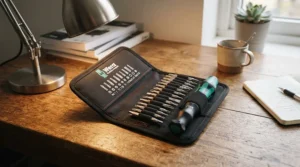
This one is a different animal. The HOTO is a pen-shaped driver holding 12 double-ended S2 steel bits, which gives you 24 tips in a pocket-size aluminum body. Listings cite a bit hardness of 60 HRC and a maximum of 2 Nm of torque.
S2 steel at 60 HRC means the tips resist deforming under load, so slots stay crisp instead of rounding off. The 2 Nm cap is low enough for tiny fasteners yet high enough for stubborn electronics screws. Tip sizes include SL1.5, SL2.0, PH000, PH00, PH0, PH1 plus hex and Torx, so it also handles watches and gadgets.
The catch is spelled out in a published roundup: it’s not a traditional repair kit. It lacks nose pads, ear grips and a screw assortment. It’s a premium tool, not a parts bin. Also note that the smallest flat bit is 1.5 mm, while some eyeglass screws take 1.0-1.4 mm blades. Check your own screw first.
One retailer listing showed a 4.7-star average from roughly 50 ratings at the time of research. Some reviews on other pages are labeled as incentivized, so weigh them accordingly. Reviewers generally mention solid build and compact convenience.
Pros:
- ✅ Hardened S2 steel tips resist rounding
- ✅ Magnetic bit storage inside the handle
- ✅ Doubles as an electronics and watch driver
Cons:
- ❌ No spare screws or nose pads included
- ❌ Smallest flat bit may be too big
Price: roughly $15-$25 range. Value verdict: superb tool quality, provided you buy spare parts elsewhere.
7. Craftsman 6-Piece Jeweler’s Precision Screwdriver Set (CMHT68012) — the proper jeweler’s set
If you like the idea of real jeweler’s screwdrivers rather than a bundled kit, this is the one. The Craftsman set includes two Phillips sizes (#0 and #1) and four slotted sizes (1.4, 2.0, 2.4 and 3.4 mm). It also has a free-spinning end cap, over-molded grips and a hard case with a compartment for screws.
The free-spinning cap is the feature that earns its keep. You press down with your palm, spin with your fingertips, and the driver stays seated in the slot. That means far less cam-out, which is what strips tiny screw heads.
The listing also shows a three-year limited warranty, a rare perk at this tool size. The honest limitation: its smallest slotted blade is 1.4 mm, which sits at the top of the typical 1.0-1.4 mm eyeglass range. Very small hinge screws may need a finer blade.
I couldn’t verify individual buyer reviews for this set, so its credibility rests on the brand’s specs and warranty. It suits repairers who want durable tools they’ll keep for years.
Pros:
- ✅ Free-spinning cap improves control and seating
- ✅ Hard case with screw compartment
- ✅ Three-year limited warranty
Cons:
- ❌ No spare screws or nose pads included
- ❌ Smallest blade may miss tiny screws
Price: check current price; this class of set usually sits in a modest mid-range. Value verdict: a long-term tool that rewards frequent repairers.
Spec Showdown: How the Seven Kits Really Differ
| Product | Tip Coverage | Spare Parts | Portability | Review Note |
|---|---|---|---|---|
| Kingsdun | Phillips and flathead | Very high | Medium | Roundup: top overall |
| VAPKER | Phillips and flathead, magnetic | Very high | Medium | Roundup: most versatile |
| Hiketolight | Magnetic precision set | Medium | High | Roundup: best on-the-go |
| MINGFIX | Magnetic bit set | Medium | High | Summary praises value |
| YEEMO | Driver plus parts | Medium | Medium | Roundup: everyday pick |
| HOTO | 24 tips, S2 steel | None | Very high | Strong retailer rating |
| Craftsman | 2 Phillips and 4 slotted | None | Medium | Warranty-backed |
Looking at the comparison above, the kits split into two families: parts-first and tool-first. The parts-first boxes win when you’re missing a screw. The tool-first picks win when the screw is stubborn, because a better driver prevents stripping in the first place. Beginners should lean parts-first, while tinkerers should add one quality driver on top.
How to Use a Screwdriver Set for Eyeglass Repair: Step-by-Step Guide
Owning the tools is half the job. This is the routine that keeps frames intact and screws put.
Set up like a surgeon, not a gambler. Work over a towel on a well-lit table, so a dropped screw bounces once instead of vanishing. Warby Parker’s at-home guide recommends a clean, well-lit workspace and a small repair kit before you start.
Match the blade to the slot. The tip should fill the slot with no wobble. A blade that’s too small chews the slot, and one that’s too large won’t seat at all.
Turn gently and stop at snug. Screws turn clockwise to tighten. Over-tightening is the classic mistake: it can strip threads or crack frames, and at lens-mounting screws it can crack the lens itself. Aim for snug, then stop.
Check twice. Test the arm’s swing. It should open and close smoothly without a gap or a sloppy wobble.
Make a 30-day habit. Screws loosen over weeks of micro-movements, so check hinges roughly monthly. For the first month after a repair, glance at the hinge every few days. If a screw keeps backing out, that’s your cue for thread lock rather than another tightening.
A few first-30-day mistakes to avoid:
- Using a driver that’s one size too big
- Tightening “one more quarter turn” for luck
- Leaving the screw loose in your pocket
✨ Don’t Miss These Top Picks!
🔍 Ready to stop squinting at wobbly hinges? Click any highlighted kit above to check current pricing and availability. A good screwdriver set for eyeglass repair pays for itself the first time you skip the optician trip! 🔧
Problem → Solution: 5 Common Eyeglass Screw Headaches
Most frame troubles come back to a short list of repeat offenders. Here’s how a screwdriver set for eyeglass repair solves each.
1. The arm wobbles. Hinge screws are the most common spot for looseness. Tighten gently with a snug-fitting flathead, like the 2.0 mm from the Craftsman set, or the SL2.0 tip on the HOTO.
2. The screw keeps backing out. Vibration wins this fight every time. Add a tiny dab of low-strength thread-locking compound, the type Wikipedia’s threadlocker entry describes as removable, and the screw stays put. Avoid permanent formulas on eyewear, since high-strength types can make the fastener nearly impossible to remove later. Check the label for plastic compatibility before using it near plastic frames.
3. A screw is missing. Reach for the spare stash. The Kingsdun and VAPKER kits carry the broadest assortments, so you can find a near match. Test-thread it by hand before you commit.
4. The screw head is stripped. Prevention is the best cure. A hardened bit like the HOTO‘s S2 tips grips better, and a free-spinning cap on the Craftsman keeps the driver seated. If it’s already stripped, stop and see an optician.
5. A nose pad is yellowed or loose. Replace it. The MINGFIX and Hiketolight kits include pads, so you can swap them with the tweezer and a screw. Fresh pads often fix slipping glasses faster than any adjustment.
Real-World Scenarios: Which Kit Fits Your Life?
Specs get abstract fast, so let’s put real people in the picture.
The commuter with a spare-parts problem. Imagine a college student riding eight miles daily with glasses in a backpack pocket. Every pothole rattles the hinges. Budget is tight, and the repair happens at a bus stop. A compact kit like Hiketolight or MINGFIX fits, because portability and magnetic tips matter more than a thousand spare screws.
The household fixer. Picture a parent with three kids, two sunglass wearers and one habitual frame-sitter. Repairs happen monthly, and nobody has the same frame. The Kingsdun or VAPKER kit makes sense, because the huge screw assortment is the real value when frames vary.
The hobbyist with delicate frames. Consider a retiree who also repairs watches and small electronics. They want one tool that’s a pleasure to hold, and they’re happy buying spares separately. A HOTO pen or a Craftsman set fits, since tip quality and control count more than parts count.
Here’s the cross-check each person should run: look at the actual screw before ordering. Match the tip first, the parts second and the case last.
How to Choose a Screwdriver Set for Eyeglass Repair
- Check the smallest blade size. Many eyeglass screws need a flat tip roughly 1.0-1.4 mm wide, according to one repair guide. A set starting at 1.5 mm may miss the tiniest screws.
- Look for magnetic tips. They keep screws on the driver, not on the floor.
- Decide parts-first or tool-first. Bundled kits supply spares, while driver sets supply control.
- Inspect the materials. Hardened steel tips resist rounding, and stainless screws resist corrosion.
- Confirm Phillips coverage. Some frames use Phillips heads, so pure flathead sets can fall short.
- Think storage. A labeled case or compartment prevents the “where did that screw go” scramble.
- Match screw color. Gold-only screws clash with silver frames.
If you want a second opinion, a short check with an eye care professional is always sensible. The American Optometric Association’s find-a-doctor tool helps you locate one.
What Belongs in an Eyeglass Repair Tool Set (and What’s Filler)
A good eyeglass repair tool set is smaller than the box suggests. Here’s the honest sort.
Essentials: two or three flathead blades, one or two Phillips tips, a curved tweezer, assorted screws and a few nose pads. That’s 90% of real repairs.
Nice to have: magnetic tips, a hard storage case and a cleaning cloth. They make the job pleasant, though they won’t make or break it.
Mostly filler: the 1,000-plus piece counts. Parts volume sounds impressive, but a few dozen well-matched screws solve nearly every problem. The rest becomes a drawer of orphaned hardware.
Overlooked but valuable: a thread-locking compound, a magnifier and a soft work surface. These aren’t in most boxes, yet they prevent the repairs that fail.
On paper, the bigger bundles look like better deals. In practice, an eyeglass repair tool set earns its keep by how well the driver fits and how easy the parts are to find. The MINGFIX and Hiketolight kits cover essentials in a smaller package, while Kingsdun and VAPKER push into surplus territory.
Mini Screwdriver Kit for Glasses vs. Jeweler’s Screwdrivers
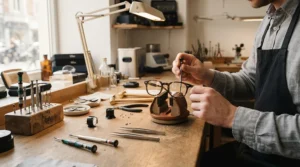
Both options work, but they solve different problems. A mini screwdriver kit for glasses bundles drivers with spares. Jeweler’s screwdrivers are standalone precision tools, built for control and repeated use.
| Factor | Mini Kit for Glasses | Jeweler’s Screwdrivers |
|---|---|---|
| Spare screws and pads | Usually included | Usually not |
| Tool feel and control | Adequate | Excellent |
| Durability | Moderate | High |
| Best For | MINGFIX, Kingsdun users | Craftsman, HOTO users |
Looking at the comparison above, the real difference is philosophy. A mini screwdriver kit for glasses solves “I need a screw and a driver right now.” Jeweler’s screwdrivers solve “I want a tool that won’t strip screws.” Most households benefit from both: a bundled kit for spares and one quality driver for the stubborn jobs. For reference, premium makers like Starrett build jeweler’s screwdrivers, like the Starrett 555 with blades from 0.6 to 2.5 mm, for watchmakers and opticians. That wide blade range fits tiny eyeglass screws better than most budget sets. Its price tier is far above a starter kit, so it’s overkill unless you repair daily.
Tiny Screwdrivers for Sunglasses: What’s Different?
Sunglasses behave differently from prescription frames, and that changes how you use tiny screwdrivers for sunglasses.
First, sunglasses take more abuse. They get tossed on dashboards, sat on at beaches and baked in hot cars, so heat cycles loosen hinges faster. Second, many sunglass frames use larger, chunkier hinge hardware than slim optical frames, so a 1.5-2.0 mm flathead often fits. Third, wraparound and sport styles can hide screws under rubber or trim, which makes a magnifier and a tweezer handy.
So tiny screwdrivers for sunglasses should include slightly larger blades than a pure optical kit. Both Craftsman (2.0 and 2.4 mm) and HOTO (SL2.0) cover that range, and bundled kits like VAPKER include multiple sizes.
Also remember lens-mounting screws on rimless or semi-rimless styles. Overtightening them can crack the lens, so stop at snug. If sunglass lenses are polarized, treat them gently and avoid chemical solvents near coatings. For anything fancy, a professional adjustment is cheap insurance.
Hinge Screw Replacement: What to Know Before You Swap
Hinge screw replacement is the single most common eyeglass repair, and the trickiest part isn’t the turning. It’s matching the screw.
Eyeglass screws come in dozens of sizes and thread types, and a wrong match can damage the hole or leave glasses unstable. So bring the old screw, if you still have it, and compare it against your spares side by side.
Here’s a quick method:
- Match the head type (flat or Phillips) and diameter first.
- Compare length against the hinge barrel.
- Hand-thread the replacement before using any driver.
- If it binds, back out and try a different size.
Bulk kits like Kingsdun, VAPKER and ESSSO (which lists 280 gold and silver screws) give you the matching pool. The YEEMO kit works if you can live with gold. Pair your chosen screw with a snug blade, and add low-strength thread lock if looseness keeps returning.
One warning: if a screw won’t thread or the hole is stripped, stop. A damaged hole often means a trip to the optician.
Magnifying Repair Kit: Do You Actually Need One?
A magnifying repair kit sounds like a gimmick until you’ve tried to find a 1.2 mm hinge screw hole at 6 p.m. under a kitchen light.
Magnification helps most with three jobs: threading a replacement screw into a barely visible hole, reading tiny slot shapes to pick the right tip, and spotting hairline cracks near hinges. Some bundled kits include a magnifier. One roundup lists the NIFUYOP kit with an organized case, a magnifier and 12 silicone nose pads, and notes the magnifier helps people repair frames without clear vision.
Honestly, there’s a paradox here. People who need glasses repaired often can’t see well without their glasses, so the magnifier gives you a way to work safely. If your eyesight is sharp, a good desk lamp may be enough. If not, a magnifying repair kit, or a separate clip-on or stand magnifier paired with something like the MINGFIX kit, solves the problem.
Don’t expect lab-grade optics. A basic magnifier is for orientation, not precision measurement.
Long-Term Cost & Value Analysis
Do the math, and a screwdriver set for eyeglass repair is among the cheapest tools you’ll ever own. A starter kit costs less than a single optician “adjustment” visit in many places. Some retailers have even started charging standard adjustment fees for glasses bought elsewhere.
| Option | Upfront Cost | Ongoing Cost | Best For |
|---|---|---|---|
| MINGFIX starter | Under $10 | Very low | Occasional fixes |
| Bulk kits (Kingsdun, VAPKER) | Budget range | Near zero (parts included) | Families |
| HOTO plus parts | Roughly $15-$25 range, plus parts | Low | Tool lovers |
| Craftsman set | Modest mid-range | Low | Frequent repairers |
Looking at the table above, cost per repair drops quickly. If a kit prevents even one pro visit, it has already paid off. The hidden cost is replacing a ruined frame after a stripped screw, which is why driver quality beats parts count over time. Maintenance is minimal: keep tips clean, store drivers in their case and replace bits that round off. Overall, cost-per-use favors the budget kits for casual users and the Craftsman or HOTO route for frequent repairers.
FAQ
❓ What tip size fits most eyeglass screws?
❓ Do eyeglass repair kits include spare screws and nose pads?
❓ How often should I check my hinge screws?
❓ Can magnetic screwdriver tips help with tiny screws?
❓ When should I skip DIY and see an optician?
Conclusion
A screwdriver set for eyeglass repair is the cheapest insurance policy in your drawer. It turns wobbly hinges, missing screws and tired nose pads from a minor emergency into a coffee-break fix.
Here’s the quick verdict. Pick MINGFIX or Hiketolight if you want a low-cost, portable starter. Choose Kingsdun or VAPKER if you want the biggest parts stash for a family. Grab YEEMO if your frames are gold-toned. And if you want tools you’ll love using, go with HOTO or Craftsman, then add a small assortment of spare screws.
Whatever you choose, remember the three habits that matter most: match the tip to the slot, stop at snug, and use a dab of low-strength thread lock when screws keep backing out. If a repair feels beyond DIY, an optician is always the right call.
✨ Ready to fix your frames for good? Check current pricing on the kits above and pick the one that fits your life!
Recommended for You
- Ratcheting Screwdriver Set For Tight Spaces: 7 Best Picks (2026)
- Precision Screwdriver Set For Electronics: 7 Best Picks 2026
- Craftsman Vs Husky Wrench Set: 7 Best Picks Compared (2026)
Disclaimer: This article contains affiliate links. As an Amazon Associate, I earn from qualifying purchases. If you purchase products through these links, we may earn a small commission at no additional cost to you.
✨ Found this helpful? Share it with your friends! 💬🤗
