
In This Article
Somewhere in every garage there’s a miter saw that promised more than it delivered — a blade that wandered off the pencil line, a fence that was never quite square, a motor that bogged down the second you fed it a piece of oak. A sliding miter saw is a woodworking tool that combines a rotating miter base, a tilting bevel head, and a rail or glide mechanism that lets the blade travel forward and back, so it can crosscut boards far wider than its blade diameter alone would allow. That extra travel is the whole point. A fixed-head 10-inch saw chokes on a 2×10; a sliding version shrugs it off. This guide exists because picking the best sliding miter saw shouldn’t require a engineering degree or a leap of faith on a product photo. We dug into real specifications, aggregated buyer feedback, and the kind of side-by-side comparisons that actually matter once the saw is bolted to a stand in your shop — the origins of the modern miter saw trace back to a tool family built for accurate, repeatable crosscuts at common angles, and understanding that lineage helps explain why the sliding variant became the trim carpenter’s default.

Below, you’ll find seven real, currently sold models spanning budget, mid-range, and premium tiers, along with the comparison tables, bevel-angle breakdowns, and rail-system analysis you need to stop guessing. Whether you’re chasing crown molding returns, stair stringers, or just a saw that won’t drift out of square after month two, there’s a specific pick here for you — not a generic “buy this” nudge.
Quick Comparison Table
| Saw | Best For | Blade Size | Bevel Type | Price Range |
|---|---|---|---|---|
| DEWALT DWS779 | Best overall value | 12″ | Single bevel | $320-$380 range |
| SKIL MS6305-00 | Best budget pick | 10″ | Dual bevel | $200-$260 range |
| Bosch GCM12SD | Best space-saving premium | 12″ | Dual bevel | $600-$700 range |
| Makita LS1019L | Best compact/lightweight | 10″ | Dual bevel | $550-$650 range |
| DEWALT DCS361B | Best cordless jobsite saw | 7-1/4″ | Single bevel | $200-$260 range |
Based on the spec comparison, the split here isn’t really “which is best” — it’s “best for what.” The DEWALT DWS779 earns its spot because it covers 90% of home-shop and trim-carpentry needs at a price that doesn’t sting, while the Bosch GCM12SD exists for the shop owner who’s tight on floor space and willing to pay for it. If your work happens on a jobsite with no outlet in sight, the DEWALT DCS361B‘s cordless format changes the calculation entirely — a 12-inch slider with more capacity is irrelevant if there’s no generator running.
💬 Found your category above? Scroll down for the full breakdown — or jump straight to the pick that matches your budget.
Top 7 Sliding Miter Saws: Expert Analysis
1. DEWALT DWS779 — best value 12-inch workhorse
The standout here is simple: a full-size 12-inch slider that doesn’t demand a premium-tier budget to own. Specs back that up — a 15-amp motor spins the blade to roughly 3,800 RPM, and the dual horizontal steel rails ride on linear ball bearings, which is the same basic mechanism found on saws costing twice as much. In practice, that motor speed matters because it’s fast enough to leave a clean edge in hardwood trim without bogging down mid-cut, something budget saws with underpowered motors can’t always claim.
Based on the spec comparison, this is the saw for the trim carpenter or serious DIYer who wants 12-inch crosscut capacity — enough for baseboard, door casing, and most crown molding — without paying for a laser or shadow-line system they may not need. It’s single bevel only, so if you’re cutting compound crown on both sides of a corner, you’ll be flipping stock, which is a real workflow difference worth weighing before you buy.
Reviewers consistently note that the miter detent stops feel confident and repeatable, and that the saw arrives close to factory-calibrated. A recurring complaint is that the stock blade is serviceable but not great — budget in an upgraded 60-tooth blade if fine trim work is the goal.
Pros:
- ✅ Full 12-inch crosscut capacity at a mid-range price
- ✅ Smooth, linear-bearing rail slide with minimal play
- ✅ Reliable, well-regarded 15-amp direct-feel motor
Cons:
- ❌ Single bevel only — no right-tilt for compound cuts
- ❌ No laser or LED shadow-line cutting guide included
At around $320-$380, the DEWALT DWS779 is hard to argue with if single bevel doesn’t bother your workflow — it’s the rare tool that’s genuinely mid-range in both price and compromise.

2. SKIL MS6305-00 — best budget dual-bevel pick
What jumps out immediately is the price-to-feature ratio: a dual-bevel sliding compound saw with an LED shadow-line cutting guide for meaningfully less than most competitors charge for single bevel alone. The 15-amp motor and dual-bevel stops at 0°, 33.9°, and 45° on both sides mean you can cut crown molding returns without flipping your workpiece — a feature usually reserved for pricier saws.
Based on the spec comparison, what most buyers overlook about this model is that dual bevel isn’t a luxury add-on here — it’s the headline reason to consider it over similarly priced single-bevel alternatives. The shadow-line system, which casts a dark line rather than a laser dot, tends to stay accurate without recalibration the way battery-powered lasers sometimes drift.
Aggregated reviewer sentiment is notably positive for a budget-tier tool: buyers report accuracy within a fraction of an inch on hardwood test cuts, and several note the saw “punches above its price.” A common complaint is that dust collection is mediocre without a shop vac attached, which tracks with most saws in this price bracket.
Pros:
- ✅ Dual bevel at a genuinely budget price point
- ✅ LED shadow-line cutline stays accurate without batteries drifting
- ✅ Reviewers report surprisingly clean cuts in hardwood
Cons:
- ❌ Dust collection is weak without a shop vac attached
- ❌ 10-inch blade caps crosscut capacity below 12-inch rivals
The SKIL MS6305-00 sits around $200-$260, and for a first miter saw or a second saw dedicated to trim, that’s genuinely tough to beat on value.
3. Makita LS1019L — lightest and most compact 10-inch slider
The compact forward-rail design is the headline feature — it needs almost no rear clearance, which means it can sit flush against a wall instead of eating a foot and a half of shop space behind it. At under 59 pounds, it’s also one of the lighter 12-inch-class saws you’ll find in a 10-inch footprint, thanks to its 12-5/8-inch horizontal crosscut capacity despite the smaller blade.
Here’s what to weigh: a direct-drive gearbox (no belt to wear out or replace) paired with a linear ball-bearing slide produces the kind of smooth, low-vibration cut that trim carpenters notice on long crown-molding runs. The built-in laser guide and integrated dust port add convenience without adding much bulk or weight.
Reviewers consistently praise the front-mounted bevel lock for how quickly it can be adjusted mid-project, and several highlight that this saw travels well between jobsites specifically because of its lighter build. A recurring critique is that the rail system can develop slight flex at full extension, which some woodworkers say makes it better suited to carpentry than fine furniture joinery.
Pros:
- ✅ Compact rail design needs almost no rear clearance
- ✅ Lightweight build makes jobsite transport genuinely easier
- ✅ Direct-drive gearbox with smooth linear-bearing slide
Cons:
- ❌ Slight rail flex reported at full slide extension
- ❌ 15-amp motor spins somewhat slower than some rivals
Priced around $550-$650, the Makita LS1019L is the pick for anyone whose shop space — or truck bed — is the real constraint, not the budget.
4. Bosch GCM12SD — best space-saving premium glide
The axial-glide system is what separates this saw from everything else on this list — instead of rails that extend backward when you pull the saw toward you, the glide arms stay tucked, meaning the saw can be pushed flush against a wall and still deliver full slide travel. Bosch’s own published specs list roughly 14 inches of horizontal cut capacity with a 6-1/2-inch vertical capacity against the fence, plus a 45-degree crown capacity nested against the fence.
Based on the spec comparison, this is the tool for a shop owner who values consistent long-term accuracy over raw price — the glide mechanism reportedly resists the wear and misalignment that eventually creeps into exposed-rail designs after years of dust exposure. The upfront bevel controls (lever and range selector both accessible from the front of the saw) also save real time for anyone making frequent bevel adjustments.
Reviewers repeatedly cite the detent stops — at 0°, 15°, 22.5°, 31.6°, and 45° on both miter and bevel — as remarkably repeatable even after years of daily use, which matters enormously when cutting dozens of identical crown-molding pieces in one sitting. A fair complaint that surfaces often: the glide arms are exposed and can collect dust and debris, requiring periodic wipe-downs to keep the slide buttery smooth.
Pros:
- ✅ Axial-glide needs zero rear clearance against a wall
- ✅ Detent stops stay repeatable even after years of use
- ✅ Upfront bevel controls speed up angle adjustments
Cons:
- ❌ Exposed glide arms need periodic cleaning
- ❌ Premium price compared to rail-based 12-inch rivals
At roughly $600-$700, the Bosch GCM12SD is a long-term investment more than a bargain, and reviewers who’ve owned one for years tend to say it was worth it.
5. DEWALT DWS780 — best overall for serious trim work
The XPS LED shadow-light system is the feature every reviewer mentions first — rather than a laser dot that requires calibration and batteries, it casts a crisp shadow line directly onto the cutline, which testers describe as “squaring up the cut perfectly every time.” Under that headline sits a genuinely capable 12-inch dual-bevel slider: a direct-drive motor (no belt to maintain), 0-48-degree bevel range in both directions, and roughly 15 inches of horizontal crosscut capacity at 90 degrees.
What most buyers overlook about this model is that dual bevel plus the direct-drive design means fewer moving parts to fail over the saw’s lifespan — belt-drive saws eventually need belt replacement, direct-drive units generally don’t. For a professional doing back-to-back crown-molding returns all day, not having to flip stock for opposite bevels saves real time, not just theoretical convenience.
Independent testers who evaluated a dozen or more miter saws side by side single this one out for arriving “perfectly calibrated right out of the box” — a detail that matters more than it sounds, since recalibrating a fence or bevel stop eats into the first afternoon of ownership on lesser saws. The main knock, consistently repeated, is that at nearly 60 pounds it’s not the saw you want to carry up three flights of stairs solo.
Pros:
- ✅ XPS shadow-line system nails cutline visibility every time
- ✅ Direct-drive motor skips belt maintenance entirely
- ✅ Testers report accurate calibration straight out of the box
Cons:
- ❌ Heavy at nearly 60 pounds — a two-person carry for many
- ❌ Premium price relative to single-bevel 12-inch alternatives
Sitting around $580-$650, the DEWALT DWS780 is the saw most professional testers land on when the question is simply “which one do I actually want in my own shop.”
6. Metabo HPT C12RSH2S — best value zero-clearance slider
This saw’s compact slide system is the reason it’s here: like the Bosch glide above, the saw head rides along fixed rails without needing rear clearance, cutting the saw’s footprint by up to a foot — but at a noticeably lower price than glide-style competitors. The 15-amp motor, laser marker system, and a tall pivoting fence (5-1/8 inches) that folds out of the way for bevel cuts round out a genuinely full-featured spec sheet.
Here’s what to weigh: the miter range runs 0-52 degrees and bevel runs 0-45 to 48 degrees depending on the exact revision, which covers essentially every common framing and trim angle you’ll encounter. The tool-less laser adjustment is a small but real convenience — no hex key required to nudge the cutline left or right of the mark.
Reviewers who bought this model specifically to save floor space report that the zero-clearance slide performs close to what pricier glide saws offer, and Metabo HPT’s five-year professional warranty gets mentioned often as a reason buyers trust the brand for a corded tool that’ll see daily use. A recurring critique is that the plastic dust port and bag combo is less effective than shop-vac-fed alternatives, and a few buyers note the laser needs occasional recalibration.
Pros:
- ✅ Zero-clearance slide saves up to a foot of shop space
- ✅ Backed by a five-year professional tool warranty
- ✅ Tool-less laser adjustment with no hex key needed
Cons:
- ❌ Stock dust bag underperforms without a shop vac
- ❌ Laser occasionally needs manual recalibration over time
Typically found in the $300-$430 range depending on retailer promotions, the Metabo HPT C12RSH2S is arguably the value pick for anyone who wants glide-style space savings without glide-style pricing.
7. DEWALT DCS361B — best cordless for jobsite mobility
No cord, full crosscut capability — that’s the pitch, and for a remodeler moving between rooms or floors without an outlet nearby, it’s a genuine game-changer rather than a gimmick. The brushless motor draws from 20V MAX battery packs and drives a 7-1/4-inch blade through a sliding rail system, with the XPS cutline system carried over from DEWALT’s corded lineup for the same shadow-line accuracy.
Based on the spec comparison, the tradeoff is capacity: a 7-1/4-inch blade simply can’t match a 10- or 12-inch slider for wide crown molding or deep dimensional lumber, so this is a saw built for trim, molding, and light framing rather than heavy structural work. At around 30 pounds, it’s noticeably lighter than most corded sliders, which matters when you’re the one hauling it up a ladder or through a job site all day.
Reviewers who’ve used it for remodel and punch-list work praise how close the cutting performance comes to a corded 10-inch saw, which is a meaningfully strong compliment for a cordless tool. The consistent caveat: runtime and cut count depend entirely on battery capacity, so buyers pairing it with smaller amp-hour packs report needing a spare battery on hand for a full day’s work.
Pros:
- ✅ Genuinely cordless without sacrificing much cut quality
- ✅ Lightweight at roughly 30 pounds for easy jobsite carry
- ✅ XPS shadow-line system carried over from corded models
Cons:
- ❌ Smaller 7-1/4-inch blade limits capacity vs. 10-12″ saws
- ❌ Runtime depends heavily on battery amp-hour rating
Sold bare-tool in the $200-$260 range (batteries and charger sold separately if you don’t already own DEWALT 20V gear), the DEWALT DCS361B earns its spot for anyone whose job doesn’t come with a nearby outlet.
Top 7 Products: Full Spec Comparison
| Saw | Blade | Motor | Bevel Range | Rail/Slide Type | Best For |
|---|---|---|---|---|---|
| DEWALT DWS779 | 12″ | 15A, ~3,800 RPM | Single, 0-48° | Dual steel rail | Value 12″ workhorse |
| SKIL MS6305-00 | 10″ | 15A | Dual, 0-45°/33.9°/45° | Dual rail | Budget dual-bevel |
| Makita LS1019L | 10″ | 15A | Dual, 0-48° | Compact forward rail | Compact/lightweight |
| Bosch GCM12SD | 12″ | 15A | Dual, 0-47° | Axial glide | Space-saving premium |
| DEWALT DWS780 | 12″ | 15A, direct drive | Dual, 0-48° | Dual steel rail | Overall best trim saw |
| Metabo HPT C12RSH2S | 12″ | 15A, ~4,000 RPM | Dual, 0-45°/48° | Compact zero-clearance | Value glide alternative |
| DEWALT DCS361B | 7-1/4″ | 20V MAX brushless | Single, 0-48° | Sliding rail | Cordless jobsite |
Looking at the table above, the pattern is clear: every saw in the 12-inch dual-bevel class costs meaningfully more than its single-bevel or 10-inch counterpart, and that premium buys you the ability to cut compound crown molding without flipping stock. If your projects rarely call for opposite-direction bevels, the DEWALT DWS779 or a cordless option like the DEWALT DCS361B delivers most of the practical capability at a fraction of the cost.
✨ Ready to stop comparing and start cutting? Check current availability on today’s top pick before prices shift.
Practical Usage Guide: Setup, Calibration, and the First 30 Days
A miter saw is only as accurate as its setup, and the first weekend with a new saw is where most accuracy problems either get solved or get baked in permanently. Start by squaring the fence to the table using a reliable square, not the factory bevel indicator — even saws that ship “calibrated” can be off by a degree or two, and that error compounds across every angled cut you make afterward. Next, check the 0-degree miter detent against a fresh test cut on scrap; if the cut isn’t square, most saws have a set-screw adjustment behind the miter scale specifically for this.
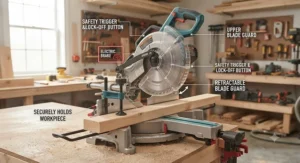
Dust collection deserves early attention too. The stock bags on most sliding miter saws — even premium ones — catch a fraction of what a shop vac connected through an adapter will capture, and airborne dust from repeated crosscuts adds up fast in an enclosed shop. Per OSHA’s machine-guarding requirements for miter saws, a blade guard is required to automatically adjust to the material’s thickness and provide continuous protection while cutting, so never zip-tie or wedge a guard open to “see the cut better” — recalibrate the laser or shadow line instead.
Common first-month mistakes: over-tightening the bevel lock (it strips over time), forcing wide stock through a slide that needs a light lubricant on the rails, and skipping blade upgrades — a quality 60-80 tooth blade transforms trim-cut quality more than almost any other single change you can make. Budget an hour for setup and calibration before your first real project; it pays for itself immediately.
Real-World Scenarios: Who Actually Needs Which Saw
Consider three buyer profiles that map cleanly onto the picks above. A weekend DIYer finishing a basement, working with a modest budget and mostly 90-degree crosscuts on baseboard and door casing, gets excellent value from the SKIL MS6305-00 — dual bevel for the occasional crown-molding corner, without paying for features that profile won’t use often.
A remodeling contractor moving between multiple jobsites weekly, prioritizing portability and battery-powered flexibility over raw capacity, is the exact use case the DEWALT DCS361B was built for — no generator, no extension cord tangle, no compromise on cut quality for trim-scale work. Meanwhile, a serious hobbyist or small trim-carpentry business doing daily crown molding, stair stringers, and wide dimensional lumber benefits most from either the DEWALT DWS780 or Bosch GCM12SD — the extra capacity and dual-bevel speed pay for themselves in reduced flip-and-recut time across a busy month.
If you’re somewhere between these profiles — say, a homeowner slowly building a permanent shop — the Metabo HPT C12RSH2S threads the needle: professional-grade capacity and a genuine five-year warranty, at a price that doesn’t require justifying the purchase to a spouse.
How to Choose a Sliding Miter Saw
Choosing the right saw comes down to seven concrete criteria, and working through them in order avoids the common trap of buying based on brand loyalty alone.
- Blade size first. A 10-inch slider typically crosscuts up to roughly 12-13 inches; a 12-inch slider can reach 15-16 inches. Measure your widest typical workpiece before shopping.
- Single vs. dual bevel. If you regularly cut crown molding or picture-frame corners in both directions, dual bevel saves real time by eliminating stock flips.
- Rail type and rear clearance. Traditional rails extend backward when pulled forward; glide and compact-rail designs (like Bosch’s or Makita’s) don’t, which matters in tight shops.
- Motor speed and amperage. Most quality saws run 15 amps; RPM in the 3,800-4,300 range handles hardwood cleanly without excessive tear-out.
- Cutline system. Shadow-line (LED) systems tend to stay accurate longer than battery-powered lasers, which can drift and need recalibration.
- Portability needs. If the saw travels between jobsites, weight and cordless capability outweigh raw capacity.
- Warranty and parts support. A five-year professional warranty (Metabo HPT, DEWALT) signals manufacturer confidence and protects a genuinely significant purchase.
Working through these in sequence — capacity, bevel, rail design, power, accuracy system, portability, warranty — tends to eliminate all but one or two realistic candidates for most buyers’ actual workflow.
Best 12 Inch Miter Saw: Why Blade Size Changes Everything
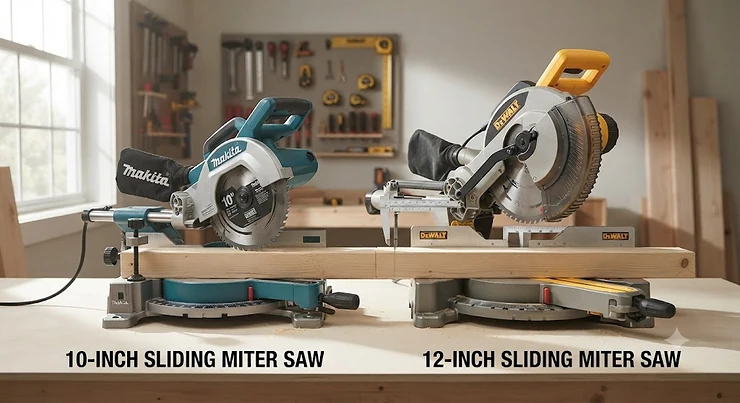
The jump from a 10-inch to a 12-inch blade sounds incremental on paper, but the practical difference is bigger than the two-inch gap suggests. A larger blade diameter means more usable crosscut width at both 90 degrees and common miter angles — generally, a 12-inch slider handles roughly 15-16 inches of horizontal capacity versus 12-13 inches for a 10-inch model, which is the difference between crosscutting a wide stair tread in one pass or needing to flip and rejoin it.
The tradeoff is weight, price, and blade cost — 12-inch blades run noticeably more than 10-inch equivalents, and the saws themselves are heavier to transport. Based on the spec comparison across our seven picks, the DEWALT DWS779, Bosch GCM12SD, DEWALT DWS780, and Metabo HPT C12RSH2S all represent the 12-inch tier, while the SKIL MS6305-00 and Makita LS1019L prove that a well-designed 10-inch slider still covers most trim and molding work without the extra bulk. If your projects regularly involve wide stock — stair parts, wide baseboard, or dimensional lumber — the 12-inch upgrade earns its keep; if you’re mostly doing standard trim, it’s often more saw than the job requires.
Compound Miter Saw vs Sliding: What’s Actually Different
These terms get used interchangeably, which causes real confusion at the point of purchase. A standard compound miter saw pivots and tilts — it can angle the blade left/right (miter) and tilt it (bevel) simultaneously, which is what makes a “compound” cut possible for crown molding and roof framing. What it can’t do is slide the blade forward and back, which caps its crosscut width at roughly the blade’s diameter minus a bit.
A sliding miter saw adds all of a compound saw’s miter and bevel capability, but the blade and motor assembly can also slide forward and back on a rail, letting it cut significantly wider stock than a fixed-head saw of the same blade size. For a deeper technical breakdown of how these categories differ mechanically, Yale University’s Environmental Health & Safety miter saw procedure offers a clear, plain-language classification of standard, compound, and sliding designs.
| Type | Cuts Bevels? | Slides for Width? | Typical Use Case |
|---|---|---|---|
| Standard miter saw | No | No | Basic 90° and simple angle crosscuts |
| Compound miter saw | Yes | No | Crown molding, roof framing on narrower stock |
| Sliding compound miter saw | Yes | Yes | Wide crown molding, stair treads, dimensional lumber |
The takeaway here is straightforward: if your stock regularly exceeds what a fixed-head saw’s blade diameter can handle, sliding isn’t a luxury feature — it’s the tool that actually does the job. Every saw featured in this guide, from the SKIL MS6305-00 to the DEWALT DWS780, falls into that third category for exactly this reason.
Double Bevel vs Single Bevel Miter Saw: Which Do You Need
Single-bevel saws tilt the blade in one direction only, typically left. To cut a mirror-image bevel — say, both sides of a crown molding corner — you have to flip the workpiece and remeasure, which introduces room for error and eats time on repetitive cuts. Dual-bevel saws tilt both directions, so you set the angle once and cut both orientations without touching the stock’s orientation.
Here’s what to weigh: dual bevel typically adds $50-$150 to a saw’s price at a given capacity tier, and for occasional users doing mostly 90-degree crosscuts, that premium may not pay for itself. But for anyone doing regular crown molding, picture framing, or repetitive angled cuts, the time saved by not flipping stock — and the reduced risk of a flipped-and-misaligned cut ruining an expensive piece of trim — usually justifies the extra cost quickly. Among our seven picks, the DEWALT DWS779 and DEWALT DCS361B are the single-bevel options; the remaining five are dual bevel, which reflects how the market has shifted toward dual bevel as the expected standard on anything above entry-level pricing.
Sliding Miter Saw Crosscut Capacity: Reading the Spec Sheet
Crosscut capacity numbers on a spec sheet always list several scenarios — 90-degree flat capacity, 45-degree miter capacity, and often a “nested” capacity for crown molding held vertically against the fence — and conflating them is a common buying mistake. A saw’s headline “15 inches” almost always refers to the best-case 90-degree flat cut; that same saw’s capacity drops noticeably once you introduce a miter angle, and drops again if you’re also adding a bevel for a true compound cut.
What most buyers overlook about this number is that real projects rarely stay at 90 degrees — baseboard returns, crown corners, and stair stringers all eat into that generous headline capacity fast. Reviewers testing several of these saws side by side note that the Bosch GCM12SD‘s axial-glide design and the Makita LS1019L‘s compact rail both maintain more of their rated capacity at compound angles than saws with simpler rail geometry, because the mechanism doesn’t lose travel distance to the slide hardware itself. Before buying based on a single capacity number, check the manufacturer’s spec sheet for capacity at 45-degree miter and at full bevel — not just the flat 90-degree figure used in marketing headlines.
Compound Bevel Angle Explained
A compound cut combines a miter angle (the horizontal rotation of the blade relative to the fence) and a bevel angle (the vertical tilt of the blade) in the same pass. Crown molding is the classic example: because crown sits at an angle against the wall and ceiling, cutting it flat on the saw table requires the blade to be simultaneously mitered and beveled to produce a joint that closes tightly in three dimensions.
Based on the spec comparison, the range of bevel angles matters more than most buyers initially assume — most saws in this guide offer 0-45 or 0-48 degrees per side, which covers standard crown profiles (typically cut at a 33.9-degree bevel and 31.6-degree miter for common spring angles), but a saw with a narrower bevel range can genuinely lock you out of certain steep-profile moldings. The detent stops at 33.9 and 31.6 degrees that show up repeatedly across these saws exist specifically because those are the calculated angles for standard 38/52-degree spring-angle crown molding — memorizing that pairing saves a genuine amount of setup time on every crown-molding project you tackle.
Miter Saw Rail System Comparison: Glide, Rail, and Zero-Clearance
Three distinct rail philosophies show up across this guide’s picks, and the differences are more than cosmetic. Traditional dual-rail systems — used on the DEWALT DWS779 and DEWALT DWS780 — extend backward as you pull the saw head toward you, which is simple, well-proven, and requires roughly a foot or more of rear clearance behind the saw. Axial-glide, Bosch’s proprietary design on the Bosch GCM12SD, uses a folding-arm mechanism that stays contained within the saw’s footprint, eliminating rear clearance entirely at a cost premium.
A third category — compact or zero-clearance rail, used on the Makita LS1019L and Metabo HPT C12RSH2S — achieves a similar space-saving result to glide systems but through a different fixed-rail geometry, typically at a lower price than true glide mechanisms. Reviewers consistently note that traditional rails are easier to clean and lubricate because the mechanism is fully exposed, while glide and compact systems trade that accessibility for a smaller shop footprint. If wall clearance behind your saw is under 12 inches, glide or compact-rail designs aren’t optional — they’re the only category that physically fits.
🔧 Explore Today’s Top-Rated Sliding Miter Saws — check current pricing and availability before you commit.
Safety and Regulations: What Federal Standards Actually Require
Miter saws are simple in concept but genuinely dangerous in operation, and the regulatory framework around them exists for good reason. Federal woodworking machinery requirements specify that machines must be constructed to run free from sensible vibration at full speed, with arbors and mandrels built for firm, secure bearing free from play — a helpful reminder that a saw shaking or wobbling at idle isn’t normal and shouldn’t be ignored. For a full technical read of the applicable rule, OSHA’s woodworking machinery standard lays out the construction, guarding, and maintenance requirements in detail.
Practically, this translates into a short list every buyer should follow regardless of which saw they choose: never defeat or wedge open the automatic blade guard, keep the blade sharp and properly tensioned (a dull blade is a genuine kickback risk, not just an inconvenience), wear ANSI-rated eye protection rather than everyday glasses, and unplug the saw fully before changing blades or clearing a jam. None of the seven saws in this guide ship without a guard system, but guard quality and how easily it can be inadvertently bypassed does vary, so it’s worth testing the guard’s return action before your first real cut.
Frequently Asked Questions
❓ What is the difference between a compound miter saw and a sliding one?
❓ Do I need a 12 inch or 10 inch sliding miter saw?
❓ Is dual bevel worth the extra cost on a sliding miter saw?
❓ How much crosscut capacity do I actually need?
❓ What's the best sliding miter saw for a beginner?
Conclusion
There’s no single best sliding miter saw for every shop — there’s a best sliding miter saw for your specific mix of budget, capacity needs, and shop space, and working through blade size, bevel type, and rail system in that order gets you there faster than chasing brand names. The DEWALT DWS779 remains the sensible default for most home shops and trim carpenters, the SKIL MS6305-00 proves dual bevel doesn’t require a big budget, and the Bosch GCM12SD or DEWALT DWS780 reward anyone doing this work daily enough to value the accuracy and space savings.
Whichever you choose, the calibration habits and safety practices covered above matter more over the saw’s lifetime than any single spec on the box. A well-calibrated $300 saw will consistently outperform a neglected $700 one, and that’s worth remembering before the next upgrade urge hits.
Recommended for You
- Best Miter Saw 2026: 7 Top Picks Ranked (DeWalt vs Makita)
- Oscillating Tool for Beginners: 7 Best Picks to Try in 2026
- 7 Best Oscillating Tool Blades in 2026: Cut Smarter, Not Slower
Disclaimer: This article contains affiliate links. As an Amazon Associate, I earn from qualifying purchases. If you purchase products through these links, we may earn a small commission at no additional cost to you.
✨ Found this helpful? Share it with your friends! 💬🤗
