
In This Article
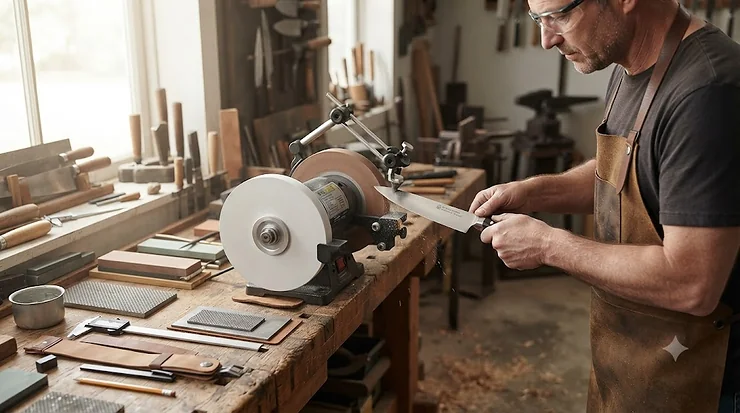
Here’s the uncomfortable truth nobody tells you at the hardware store: the wrong grinder doesn’t just fail to sharpen your knife. It ruins it. Spin the wrong wheel at the wrong speed for eight seconds too long, and you’ll watch the edge turn a faint shade of blue right before your eyes — the visual signature of a blade that just lost its temper, permanently. A bench grinder for knife sharpening is a benchtop power tool that spins an abrasive wheel at a controlled, typically reduced, speed so you can reshape and hone an edge without cooking the steel. That’s it in a nutshell, and it’s exactly why “slow speed” and “variable speed” keep showing up next to these machines instead of the screaming 3,450 RPM units built for grinding rust off a wrench.
I’ve spent the last few weeks buried in spec sheets, forum threads, and aggregated review data across seven real machines that people actually buy for this exact job — from a $90 tabletop hobbyist unit to a $780 industrial workhorse with a computer-controlled brake. This isn’t a rehash of an Amazon listing. It’s a breakdown of what each machine’s numbers actually mean once you’re standing at the bench with a dull chef’s knife in one hand and a wobbly kitchen table underneath you.
Whether you’re chasing a mirror edge on a Japanese gyuto, restoring a rusted hunting knife, or keeping a shop full of chisels and lawnmower blades in fighting shape, the right bench grinder for knife sharpening comes down to three variables: wheel speed, wheel grit, and how well the tool rest lets you hold an angle. Get those right, and everything else — LED lights, cast-iron bases, safety keys — is just a bonus.
Quick Comparison Table
| Product | Speed Type | RPM Range | Price Range | Best For |
|---|---|---|---|---|
| WEN BG625V | Variable | 2,000–3,400 | Under $110 | Tightest budgets |
| WEN 4286 | Slow (fixed) | ~1,750 | $110–$140 range | First slow-speed upgrade |
| BUCKTOOL TDS-200DS | Dual-speed | 1,725/3,450 | $110–$150 range | One grinder, two jobs |
| RIKON 80-805 | Slow (fixed) | ~1,750 | $150–$190 range | Most-recommended all-rounder |
| BUCKTOOL TDS-200C4HL | Slow (fixed) | ~1,750 | $150–$190 range | Future CBN wheel upgraders |
| JET 577103 | Slow (fixed) | ~1,725 | $450–$600 range | Heavy-duty shop use |
| JET IBG-8VS | Variable | 900–3,600 | $700–$800 range | Professionals wanting total control |
The spread here tells its own story: you can get into true slow-speed sharpening for around $110, or you can spend seven times that on a JET IBG-8VS that lets you dial in exactly the RPM a given steel wants. What the table can’t show is why that gap exists — the cheaper machines use stamped-steel bodies and basic bearings, while the JET units add cast bodies, motor braking, and industrial-grade bearing life. If you’re sharpening knives twice a month, that gap in longevity may never matter to you. If you’re running a sharpening business, it’s the whole ballgame.
💬 Found a model that fits your bench? Bookmark this page and come back before you buy — the pros/cons below might change your pick.
💬 Just one click — help others make better buying decisions too!😊
Top 7 Bench Grinders for Knife Sharpening: Expert Analysis
1. WEN BG625V — most affordable true variable-speed option
The standout here is control at a hobbyist price: this 6-inch grinder lets you dial the wheel anywhere from 2,000 to 3,400 RPM instead of locking you into one speed. That 2.5-amp motor isn’t going to win any power contests, but for kitchen knives and pocket blades, it doesn’t need to.
Running the wheel down near 2,000 RPM meaningfully slows the surface feet per minute compared to a fixed 3,450 RPM grinder, which is the whole point — less friction per second means less heat transferred into thin knife steel. It ships with an 80-grit wheel for general sharpening and a 36-grit wheel for faster stock removal, plus a flexible work light and pivoting work rests for angled grinding.
Based on the spec comparison, this is the grinder for someone testing the waters of bench-grinder sharpening without committing serious money — a woodworker’s garage tool, not a knife shop’s daily driver. Reviewers consistently note that it starts quickly and runs quieter than expected for the price, though a few mention the stock wheels are better for deburring than for a truly fine edge. What most buyers overlook is that dialing the speed all the way down and using light passes matters more here than the wheel grit itself.
Pros:
- ✅ True variable speed at an entry-level price point
- ✅ Compact 6-inch footprint fits small workbenches
- ✅ Pivoting work rests support angled sharpening passes
Cons:
- ❌ 2.5-amp motor bogs down under heavy stock removal
- ❌ Stock wheels need upgrading for a truly fine edge
At around $90-$110, the WEN BG625V earns its keep as a low-risk entry point — check current pricing before you buy, since bench grinder prices shift with promotions.
2. WEN 4286 — budget-friendly dedicated slow-speed grinder
The standout feature is a true fixed 1,750 RPM speed, which puts this squarely in “built for sharpening” territory rather than “general grinding with a sharpening afterthought.” An 8-inch wheel diameter gives you more usable surface than the 6-inch BG625V, which matters when you’re working a longer blade edge.
The 3-amp motor is modest on paper, but at 1,750 RPM it doesn’t need to push much torque against knife steel — it’s the RPM that does the heat-management work, not raw wattage. This is a machine built for hobbyists and light-duty home shops rather than daily commercial use, and the spec sheet won’t tell you this, but user reports suggest the tool rests need occasional re-tightening after a few months of use.
Aggregated reviewer sentiment on WEN’s slow-speed grinders trends positive for basic sharpening and deburring tasks, with the most common complaint being that the included wheels are serviceable rather than premium — a pattern that shows up across nearly every budget grinder in this list.
Pros:
- ✅ Genuine 1,750 RPM slow speed reduces overheating risk
- ✅ Larger 8-inch wheel than most budget competitors
- ✅ Backed by WEN’s accessible customer service line
Cons:
- ❌ Stock wheels are average quality out of the box
- ❌ No speed adjustability if you need faster stock removal
Priced in the $110–$140 range, the WEN 4286 is a sensible pick for anyone who wants a dedicated slow-speed machine without stretching toward the Rikon.
3. BUCKTOOL TDS-200DS — dual-speed switch for two jobs in one grinder
The standout is a physical low/high toggle that takes you from 1,725 RPM straight up to 3,450 RPM, which means one grinder can handle both delicate edge work and faster rust removal without buying a second machine.
Specs worth unpacking: the 8-inch wheels come in 80-grit and 120-grit, paired with a 2.1/3.1-amp motor that maintains torque at low speed rather than bogging down — Bucktool markets this as an advantage over single-speed variable models, since you get full torque at low RPM instead of a gradual power taper. A machined powder-metal flange is included specifically to improve wheel balance, a detail cheaper grinders often skip.
Here’s what to weigh: if you also do general shop grinding — deburring bolts, cleaning up welds — the high-speed setting earns its keep, while the low setting handles the actual knife work. Reviewers consistently mention the cast-iron base keeps vibration low even at the higher setting, which matters for consistent bevel angles.
Pros:
- ✅ Physical low/high switch covers sharpening and general grinding
- ✅ Machined flange improves wheel balance out of the box
- ✅ Full torque maintained at the low-speed setting
Cons:
- ❌ Only two fixed speeds, not a true dial-in range
- ❌ Buffing wheel accessory is a nice-to-have, not essential
Expect the BUCKTOOL TDS-200DS to land in the $110–$150 range, making it a strong middle ground between single-purpose slow-speed units and pricier variable-speed machines.
4. RIKON 80-805 — the most-recommended all-rounder for edge tools
The standout feature, echoed across nearly every woodworking and sharpening forum I combed through, is a genuinely slow 1,750 RPM motor paired with unusually fine stock wheels — 60-grit and 120-grit — instead of the coarse 36/60 combo most competitors ship with.
That grit choice matters in practice: the 60-grit wheel reshapes a damaged or badly rolled edge, while the 120-grit wheel finishes it to something close to sharpening-stone territory, without ever swapping wheels mid-job. The half-horsepower motor is modest, but at this RPM it doesn’t need to be a powerhouse — a cast-iron base with anti-vibration rubber feet does more for sharpening precision than raw wattage would.
Based on the spec comparison against the other six grinders here, the Rikon 80-805 is the one repeatedly singled out by name in woodturning and knife forums as the slow-speed grinder people actually buy — not because it’s the cheapest or the most powerful, but because the wheel grit and RPM combination is purpose-built for edge tools rather than adapted from general-purpose grinding. Reviewers consistently praise the smooth startup and quiet operation, though a recurring complaint is that the stock tool rests aren’t micro-adjustable, pushing serious users toward an aftermarket jig like the Wolverine system covered later in this guide.
Pros:
- ✅ Fine 60/120-grit wheel combo built specifically for edges
- ✅ Cast-iron base with anti-vibration feet stabilizes long sessions
- ✅ Widely recommended by name across woodturning communities
Cons:
- ❌ Stock tool rests aren’t micro-adjustable
- ❌ Some buyers report needing to true up wheel balance
At roughly $150–$190, the RIKON 80-805 is the safe default recommendation if you only read one product section in this guide.
5. BUCKTOOL TDS-200C4HL — best low-speed grinder for future CBN upgraders
The standout is explicit CBN-wheel compatibility: this 3/4 HP motor is built to keep its 1,750 RPM steady even under the added rotational mass of a heavier cubic boron nitride wheel, which cheaper motors can struggle with.
Out of the box you get an extra-wide 1.5-inch, 120-grit wheel on one side and an 80-grit wheel on the other — wider than most competitors’ wheels, which translates to more even heat distribution across the wheel face during longer grinding passes. A 3-watt LED with an independent switch and a 3x magnifier eye shield are nice ergonomic touches for anyone doing fine detail work on a folder’s tip.
What most buyers overlook about this model is that “CBN-ready” isn’t just marketing — cubic boron nitride wheels run cooler and last dramatically longer than aluminum oxide, and pairing one with a motor that won’t bog down is exactly how experienced sharpeners upgrade a budget grinder into a near-professional setup for a fraction of what a JET costs. Aggregated review sentiment flags the tool rest’s 45-degree adjustment ceiling as a real limitation for anyone sharpening chisels at steeper angles, though it’s less of an issue for typical knife bevels.
Pros:
- ✅ Motor holds steady RPM even with heavier CBN wheels installed
- ✅ Extra-wide 1.5-inch wheel improves heat distribution
- ✅ Bright 3W LED and magnifier aid detail sharpening
Cons:
- ❌ Tool rest angle is capped at 45 degrees
- ❌ CBN wheel itself is sold separately, adding to total cost
In the $150–$190 range, the BUCKTOOL TDS-200C4HL rewards buyers thinking two upgrades ahead rather than just today.
6. JET 577103 — heavy-duty 10-inch grinder for daily shop use
The standout advantage is sheer wheel size: at 10 inches, this JET gives you significantly more usable surface area and heat-sink mass than any 6- or 8-inch grinder on this list, which matters when you’re sharpening tool after tool in a single session rather than one knife on a Sunday afternoon.
The 1 to 1.5 HP motor spins at roughly 1,725 RPM — slow enough to stay in sharpening territory despite the larger wheel diameter, which otherwise increases surface speed. It ships with 24-grit and 46-grit industrial wheels, enclosed pre-lubricated ball bearings, and cast-iron wheel guards with dust vents, plus a 2-year limited warranty backing the whole unit.
Here’s the honest trade-off: those 24/46 grits are aggressive rather than fine, meaning this JET is built to reshape badly damaged edges and remove serious material fast, not to polish a final mirror bevel — you’d want a finer wheel swap or a strop for that last step. For a working shop sharpening knives, chisels, and lawn tools daily, that trade-off is a feature, not a flaw: nobody wants to wait around for a slow finishing wheel to grind down a chipped machete edge.
Pros:
- ✅ 10-inch wheels handle high-volume daily sharpening loads
- ✅ Enclosed, pre-lubricated bearings built for long service life
- ✅ Adjustable tool rests and spark guards on both wheels
Cons:
- ❌ 24/46 grit combo is coarse, not a finishing setup
- ❌ Heavy and bulky — not ideal for a tight home workbench
Typically priced in the $450–$600 range at the time of research, the JET 577103 is the pick for anyone sharpening for a living rather than a hobby.
7. JET IBG-8VS — the professional’s variable-speed industrial grinder
The standout feature is a genuinely industrial-grade dial: 900 to 3,600 RPM of adjustment, controlled by a 1 HP motor, with a brake resistor that stops the wheel from full speed to zero in under 20 seconds for safety.
That RPM range means this single machine can act as a true slow-speed sharpener at the bottom end and a fast general-purpose grinder at the top, something none of the cheaper dual-speed models on this list can fully replicate since they’re locked to two fixed points rather than a continuous range. It ships with 36-grit and 60-grit wheels, totally enclosed pre-lubricated bearings, and dual 2.5-inch dust ports for hooking into shop dust collection.
On paper this means precision most home users will never fully exploit — but for a professional sharpener juggling stainless kitchen knives one minute and high-carbon bushcraft blades the next, dialing in the exact RPM each steel wants, rather than settling for “close enough,” is the entire value proposition. Reviewers on woodturning forums who’ve owned both the Rikon and the JET IBG-8VS describe the JET as the upgrade path once the Rikon’s limitations start to show, particularly around start-up torque with heavier CBN wheels.
Pros:
- ✅ True continuous variable speed from 900 to 3,600 RPM
- ✅ Motor brake stops wheel rotation in under 20 seconds
- ✅ CSA/CUS certified with cast-iron industrial build quality
Cons:
- ❌ Premium price puts it out of reach for casual hobbyists
- ❌ At roughly 70+ pounds, it demands a permanent bench spot
Commonly listed in the $700–$800 range, the JET IBG-8VS is the ceiling of this guide — buy it once, and you likely won’t shop for another grinder again.
Top 7 Products: Full Spec Comparison
| Product | Wheel Size | Motor | Grit Options | Weight |
|---|---|---|---|---|
| WEN BG625V | 6″ | 2.5A variable | 36 / 80 | ~15 lbs |
| WEN 4286 | 8″ | 3A, ~1,750 RPM | Standard AO | ~20 lbs |
| BUCKTOOL TDS-200DS | 8″ | 2.1/3.1A dual | 80 / 120 | ~25 lbs |
| RIKON 80-805 | 8″ | 1/2 HP, ~1,750 RPM | 60 / 120 | ~37 lbs |
| BUCKTOOL TDS-200C4HL | 8″ | 3/4 HP, ~1,750 RPM | 80 / 120 | ~30 lbs |
| JET 577103 | 10″ | 1–1.5 HP, ~1,725 RPM | 24 / 46 | ~70 lbs |
| JET IBG-8VS | 8″ | 1 HP, 900–3,600 RPM | 36 / 60 | ~72 lbs |
Notice the pattern in weight versus wheel speed control: the machines built for genuine slow-speed sharpening carry more cast iron, which isn’t a coincidence — mass damps vibration, and vibration is the enemy of a consistent bevel angle. The two JET units bookend the list in both price and weight for a reason, since industrial-grade bearings and thicker castings simply cost more to manufacture. If portability matters more to you than raw stability, the WEN BG625V’s featherweight build starts to look a lot more appealing despite its lighter-duty motor.
💬 Still torn between two models? The buyer’s decision framework further down walks through exactly how to pick.
How to Choose a Bench Grinder for Knife Sharpening
- Prioritize RPM over horsepower. A knife blade cares about how fast the abrasive surface passes over the steel, not how many amps the motor draws — a 1,750 RPM grinder will treat your edge more gently than a 3,450 RPM unit regardless of wattage.
- Match wheel diameter to your typical blade length. Six-inch wheels are fine for pocketknives and paring knives; 8-inch and 10-inch wheels give longer chef’s knives and machetes more consistent contact along the whole edge.
- Check the stock grit combination. A 60/120 pairing (like the Rikon) handles both reshaping and finishing; a 24/46 pairing (like the JET 577103) is built for aggressive material removal, not a polished final edge.
- Look at the tool rest’s adjustability. A rest that only pivots to 45 degrees will frustrate you the day you need a steeper bevel — check this spec before falling for LED lights and magnifiers.
- Weigh dual-speed versus true variable speed. A physical low/high switch (Bucktool TDS-200DS) is cheaper and simpler; a continuous dial (JET IBG-8VS) gives finer control but costs considerably more.
- Factor in base weight and vibration control. Cast-iron bases with rubber feet consistently earn better real-world sharpening reviews than lightweight stamped-steel housings, because a wobbling wheel can’t hold a straight bevel.
- Decide if CBN-wheel compatibility matters to you now or later. If you plan to eventually swap in a CBN wheel for longevity, confirm the motor is rated to handle the added mass — not every budget grinder is.
Slow Speed Bench Grinder vs Variable Speed Bench Grinder
This is the debate that trips up more first-time buyers than any other spec on the sheet, and honestly, both camps have a point. A dedicated slow speed bench grinder — the Rikon 80-805 or WEN 4286 in this lineup — locks you into a single RPM, usually around 1,750, engineered specifically to stay below the threshold where knife steel starts losing its temper. There’s no dial to fiddle with, no setting to second-guess mid-grind. You turn it on, and it’s already in the sharpening zone.
A variable speed bench grinder like the WEN BG625V or the JET IBG-8VS trades that simplicity for range. You can crank the JET down to 900 RPM for a delicate finishing pass on thin stainless, then dial it up past 3,000 RPM to knock rust off a garden trowel five minutes later. Reviewers who’ve used both consistently say the flexibility is worth the higher price tag — but only if you actually use the full range. If 90% of what you sharpen is kitchen knives, you’re paying for versatility you’ll rarely touch, and a fixed slow-speed unit does the same core job for less money.
What the spec sheet won’t tell you is that variable speed grinders introduce one more variable for a beginner to manage. Fixed slow-speed grinders essentially sharpen-proof you against your own impatience, since even at “too fast,” you’re still capped around 1,750 RPM. Dial a variable model up to 3,400 out of habit or haste, and you’re right back in overheating territory.
✨ Weighing speed types against your budget? Check current listings for both the Rikon and JET IBG-8VS side by side before deciding — pricing on variable-speed models fluctuates more than fixed-speed units.

Bench Grinder Wheel Grit for Knives
Grit is where most new buyers get tunnel vision on RPM and completely ignore the number stamped on the wheel — which is a mistake, because the two work together, not separately. For knife work, a coarse wheel in the 36–46 grit range is a reshaping tool: it removes chips, fixes a badly rolled edge, and re-establishes a bevel angle from scratch, fast. It is not a finishing wheel, and running a knife straight off a 36-grit pass without following up will leave a rough, toothy edge that cuts aggressively but dulls quickly.
A medium wheel around 60–80 grit bridges the gap, refining what the coarse wheel roughed in. This is the grit doing most of the actual “sharpening” work on a moderately dull knife that isn’t chipped or damaged. The fine end, 120 grit and finer, is where you polish that bevel toward something closer to what a whetstone would produce — the Rikon 80-805’s 120-grit wheel is a standout in this lineup specifically because most competitors stop at 80.
Reviewers who’ve upgraded to CBN (cubic boron nitride) wheels — an option on both Bucktool grinders here — consistently report that CBN cuts cooler and holds its grit rating far longer than traditional aluminum oxide, since the abrasive doesn’t dull and glaze over the same way. The trade-off is upfront cost: a CBN wheel alone can cost more than an entire budget grinder, which is why it’s typically a second-purchase upgrade rather than a starting point.
Sharpening Angle Guide Attachment
Stock tool rests on most bench grinders were designed with a generic angle in mind, not the 15-to-20-degree bevel that modern kitchen knives typically want — which is exactly the gap that angle guide attachments exist to close. The most widely referenced system in woodturning and sharpening circles is the Oneway Wolverine Grinding Jig, which replaces the factory tool rests entirely with a pair of mounting bases and an adjustable arm that locks your tool at a repeatable angle every single time you sharpen.
Here’s why that repeatability matters more than it sounds: freehand sharpening on a stock tool rest means re-guessing your bevel angle on every pass, and even a two- or three-degree drift compounds into a rounded, inconsistent edge over several sharpening sessions. An angle guide attachment removes that guesswork by giving the blade a fixed pivot point, so the geometry stays honest whether you’re sharpening the same knife weekly or handing the same grinder to someone less experienced. Woodworkers who’ve paired a Wolverine grinding jig setup with a slow-speed grinder report that the platform rest and V-arm attachment let them dial in precise bevel angles for chisels, gouges, and knives without re-measuring each time.
The honest downside is cost and setup time: a full angle-guide kit can add well over $100 to what you already spent on the grinder itself, and mounting it correctly involves adjusting your grinder’s height on a baseboard so the wheel centers line up with the jig’s bases. For occasional knife touch-ups, a simple adjustable factory tool rest set carefully by eye is probably enough. For anyone sharpening turning tools, chisels, and knives regularly enough that consistency actually compounds in value, the investment pays for itself in wasted steel you stop grinding away by accident.
Bench Grinder Heat Management
Heat is the single variable that separates a bench grinder built for sharpening from one built for general shop grinding, and it’s worth understanding the actual mechanism rather than just the warning. As explained in this overview of tempering in metallurgy, tempered steel gets its hardness-and-toughness balance from careful heat treatment below a specific critical temperature — grind past that threshold with too much friction, and you risk undoing that treatment on the spot. That’s the blue discoloration you sometimes see on an overheated edge: visible proof the steel’s microstructure just changed for the worse.
Slower wheel speeds reduce surface feet per minute, which directly reduces frictional heat generated per second of contact — that’s the entire engineering logic behind every slow-speed and variable-speed grinder in this guide. But speed alone isn’t the whole heat-management story. Light, brief passes with frequent breaks matter just as much as the RPM dial. Reviewers across multiple grinder models consistently recommend dipping the blade in a small water bath every few passes on more aggressive material removal, letting the steel cool before the next pass rather than pushing through in one long grind.
Wheel width and material play a role too: the wider 1.5-inch wheel on the Bucktool TDS-200C4HL distributes contact heat across more surface area than a standard 1-inch wheel, and CBN wheels conduct heat away from the cutting zone more efficiently than traditional aluminum oxide, thanks to their metal core. What most buyers overlook until it’s too late is that heat management isn’t a single spec — it’s a combination of RPM, wheel material, pass duration, and cooling discipline, and skipping any one of those still risks a blued edge even on an expensive slow-speed machine.
Practical Usage Guide: Setup and Your First 30 Days
Getting a new bench grinder sharpening cleanly from day one comes down to a handful of steps most manufacturers bury in the fine print. Start by bolting the grinder to your workbench using the base’s pre-drilled holes — a grinder that shifts mid-pass is a grinder that ruins a bevel angle, no matter how good its motor is. Next, true up the stock wheels with a wheel dresser before your first real sharpening session; wheels often ship slightly out-of-round from the factory, and dressing them now saves you from chasing a wobble later.
Set your tool rest distance to no more than an eighth of an inch from the wheel face — a spacing that lines up with OSHA’s abrasive wheel machinery standard for preventing a workpiece from jamming between the rest and the wheel, both for safety and for consistent contact. For your first few sharpening sessions, resist the urge to press hard — let the wheel’s rotation do the cutting, guiding the blade with light, even pressure rather than forcing material removal. A common rookie mistake in the first month is grinding continuously for several minutes straight; instead, work in short passes of a few seconds each, checking the edge and letting the steel cool between passes.
Plan on a light wheel-dressing maintenance pass every few months of regular use, more often if you’re sharpening frequently, since a glazed or clogged wheel grinds hotter and less predictably than a clean one. Keep a small container of water nearby for cooling dips, and store the grinder’s included safety key separately when the machine isn’t in use — a small habit that prevents accidental startups in a shared shop space.
🔧 Ready to set up your own sharpening station? Compare the Rikon 80-805 and Bucktool TDS-200C4HL above for the best entry points into this workflow.
Real-World Scenarios: Who Should Buy Which Grinder
Picture a home cook with a drawer full of increasingly dull kitchen knives and zero interest in becoming a metallurgist. For that reader, the WEN BG625V or WEN 4286 covers the job completely — occasional sharpening, low investment, and a grinder that lives quietly in a garage corner between uses. Neither model demands much learning curve, and the money saved versus a premium unit will never be missed for a handful of sharpening sessions a year.
Now picture a weekend woodturner who also happens to keep a set of hunting and camp knives sharp on the same bench. That’s the Rikon 80-805’s exact audience — someone sharpening a mix of tools regularly enough that a purpose-built 60/120 wheel combo and a proven track record matter more than raw price. Pairing it eventually with an angle-guide attachment like the Wolverine system rounds out a setup that handles gouges, chisels, and knives with equal confidence.
Finally, picture someone running a small sharpening service out of their garage, taking in knives from neighbors and local restaurants on a schedule. That’s squarely JET territory — either the 577103 for high-volume rough-to-medium sharpening or the IBG-8VS for a professional who wants to dial in the exact RPM for each customer’s steel, stainless one moment and high-carbon the next. The upfront cost stings, but amortized across dozens of paid sharpening jobs, it stops feeling like a splurge and starts feeling like a business tool.
Problem → Solution: Common Bench Grinder Sharpening Issues
Problem: The edge keeps turning blue or straw-colored during grinding. This is overheating in real time. Solution: drop to a slower wheel speed if your grinder allows it, shorten each pass to a few seconds, and dip the blade in water between passes rather than pushing through a long continuous grind.
Problem: The bevel angle looks inconsistent from one sharpening session to the next. Solution: install an angle-guide attachment like the Wolverine system, or at minimum, mark your tool rest angle with tape so you can return to the exact same setting every time instead of eyeballing it fresh each session.
Problem: The wheel feels like it’s “skating” rather than cutting. This usually means the wheel is glazed or loaded with metal debris. Solution: dress the wheel with a diamond or star-wheel dresser to expose fresh abrasive, and dress it on a regular schedule rather than waiting for performance to visibly drop.
Problem: The grinder vibrates noticeably during use. Solution: check that the grinder is securely bolted to the bench, confirm the wheel is properly balanced and not chipped, and consider a heavier, cast-iron-based model if a lightweight unit continues to shake even when secured.
Problem: The edge comes off the wheel rough despite using a fine-grit wheel. Solution: finish with a leather strop and compound after the grinder stage — even a 120-grit wheel leaves microscopic scratches that a few strokes of stropping will polish into a genuinely keen, smooth edge.
Common Mistakes When Buying a Bench Grinder for Knife Sharpening
The most frequent misstep is buying based on horsepower and amperage alone, assuming a “more powerful” motor automatically sharpens better — when in reality, RPM and wheel grit matter far more for edge tools than raw power. A close second is ignoring wheel grit entirely and buying whatever grinder is cheapest, then wondering why the stock 36-grit wheel leaves a rough edge that a whetstone would have handled better.
Buyers also commonly overlook tool rest quality, focusing on LED lights and cosmetic features while the actual sharpening surface — the rest that determines your angle — turns out to be flimsy or barely adjustable. Skipping the weight and base-material spec is another repeat mistake: a featherweight grinder that vibrates across the bench under light pressure will fight you on every single pass, no matter how good its wheels are.
Finally, plenty of first-time buyers assume any bench grinder can be safely used for knife sharpening if they’re just careful — without checking whether the model is a genuine slow-speed or variable-speed unit at all. Running a fixed 3,450 RPM general-purpose grinder for knife work is possible with extreme caution, brief passes, and constant cooling, but it stacks the odds against you compared to starting with a machine engineered for the job.
Bench Grinder for Tool Sharpening Beyond Knives
While this guide centers on knives, every grinder featured here pulls double duty on woodworking and shop tools, and that versatility is worth factoring into your decision even if knives are the primary reason you’re shopping. Chisels and plane irons, in particular, benefit from the same slow-speed logic as knives — their hardened edges are just as vulnerable to overheating, and the Rikon 80-805’s V-channel tool rest is specifically noted for accommodating drill bits alongside standard edge tools.
Turning tools like gouges and skews are where the Wolverine-style angle guide attachments really shine, since freehand grinding a curved gouge profile consistently is nearly impossible without a jig holding a fixed pivot point. The JET and Bucktool dual-speed models add genuine flexibility here too: their higher-speed settings handle faster material removal on tools that don’t carry the same heat sensitivity as tempered blade steel, like deburring a metal bracket or knocking rust off garden tools.
If your shop regularly mixes knife sharpening with general tool maintenance, a dual-speed or variable-speed model earns back its higher price tag faster than it would in a knife-only household, simply because you’re using both ends of its RPM range regularly instead of leaving half the machine’s capability unused.
Long-Term Cost and Maintenance
The sticker price on a bench grinder is only the entry fee — total cost of ownership depends heavily on wheel replacement, maintenance habits, and how hard you push the motor over years of use. Stock aluminum oxide wheels typically need replacement or dressing well before the motor itself shows any signs of wear, and a replacement wheel pair generally costs a modest fraction of the grinder’s original price, making wheel upgrades one of the cheapest ways to meaningfully improve an existing grinder rather than replacing the whole unit.
CBN wheel upgrades represent the biggest single long-term investment, often costing more than an entire budget grinder on their own — but they also last dramatically longer than aluminum oxide before needing replacement or truing, which can make them cheaper per year of use for anyone sharpening frequently, even if the upfront number looks intimidating. Motor longevity tends to track closely with build quality: the heavier, cast-body JET units are engineered for continuous industrial duty cycles, while lighter home-shop grinders are built around occasional, intermittent use and may not hold up as well under daily professional workloads.
Routine maintenance costs stay low across every model here — a wheel dresser is a one-time purchase good for years, and basic bearing lubrication on sealed units is largely a non-issue since most ship pre-lubricated and enclosed. The real long-term cost variable isn’t the grinder itself; it’s how many wheel upgrades, jigs, and accessories you add over time as your sharpening needs grow more particular.
FAQ
❓ What speed bench grinder is best for knife sharpening?
❓ Can you sharpen a knife on a regular bench grinder?
❓ What grit wheel is best for sharpening knives on a bench grinder?
❓ Is a variable speed bench grinder worth it for knife sharpening?
❓ How often should you dress a bench grinder wheel?
Conclusion
Choosing among these seven grinders really comes down to answering one honest question: how often are you actually going to use it? A home cook chasing sharper kitchen knives a few times a year doesn’t need the JET IBG-8VS’s industrial brake system any more than a small sharpening business can get by on a WEN BG625V’s 2.5-amp motor. The Rikon 80-805 keeps landing in the middle of that spectrum for a reason — proven, purpose-built wheel grits, a track record spanning woodturning and knife communities alike, and a price that doesn’t punish you for wanting to do the job right.
Whatever you land on, the two variables that matter more than any single spec sheet number are speed and patience: keep the wheel slow enough for the steel, and keep your passes short enough to let it cool. Every grinder in this guide can produce a genuinely sharp, undamaged edge — the difference between them is how much margin for error they build in before you have to start being careful yourself.
✨ Ready to Put an Edge Back on Your Blades?
🔍 Take your knife sharpening setup to the next level with one of these seven grinders. Click through to check current pricing and availability, and bring your dullest blade back to life this weekend!
Recommended for You
- Bench Grinder for Home Shop: 7 Picks That Won’t Let You Down (2026)
- Electric Top Handle Chainsaw: 7 Best Picks Reviewed for 2026
- Top Handle vs Rear Handle Chainsaw: 7 Picks for 2026
Disclaimer: This article contains affiliate links. As an Amazon Associate, I earn from qualifying purchases. If you purchase products through these links, we may earn a small commission at no additional cost to you.
✨ Found this helpful? Share it with your friends! 💬🤗
