
In This Article
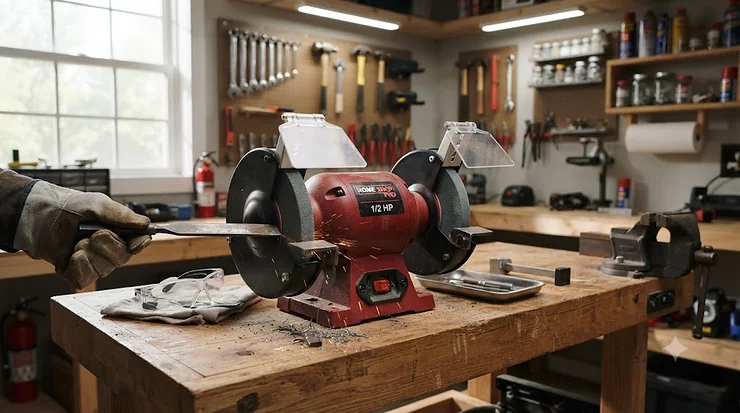
A bench grinder for home shop use is a stationary, dual-wheel power tool bolted to a workbench that spins abrasive wheels at high speed for sharpening, deburring, and shaping metal — most home models run a 1/4 to 1 HP motor and cost far less than most people expect. If you’ve ever tried to sharpen a chisel on a whetstone at 11 p.m. because you were too impatient to do it earlier, you already understand the appeal. This is the tool that turns “eh, it’s dull but it’ll do” into “wait, this actually cuts now.”
I’ve spent the last few weeks buried in spec sheets, forum threads, and the mechanics of how these machines actually drive abrasive wheels for tasks ranging from sharpening tool bits to roughly shaping metal before welding, and one thing became obvious fast: most buying guides either drown you in jargon or oversimplify to the point of uselessness. This one won’t. Whether you’re outfitting a one-car-garage workshop or replacing a grinder that finally gave up the ghost, you’ll walk away knowing exactly which of these seven real, currently-sold models fits your bench, your budget, and your actual grinding habits.
We’ll cover wheel size, motor power, RPM ratings, amperage, and the safety gear you genuinely need — not the stuff a listing throws in to look thorough. Let’s get into it.
Quick Comparison Table
| Model | Wheel Size | Motor | RPM | Best For |
|---|---|---|---|---|
| WEN BG4260 | 6-inch | 2.1 Amp | 3,450 | Absolute beginners on a tight budget |
| DEWALT DW756 | 6-inch | 5/8 HP | 3,450 | Reliable daily light-duty use |
| Delta 23-196 | 6-inch | 1/3 HP | 1,725 / 3,450 | Sharpening without scorching edges |
| WEN BG4280 | 8-inch | 5 Amp | 2,000–3,400 (variable) | One grinder that does it all |
| DEWALT DW758 | 8-inch | 3/4 HP | 3,600 | Most home shops, honestly |
| RIKON 80-805 | 8-inch | 1/2 HP | 1,725 (low speed) | Woodworking tool sharpening |
| JET IBG-8 | 8-inch | 1 HP | 3,600 | Buyers who never want to upgrade again |
A pattern jumps out immediately: wheel size and RPM don’t automatically scale together, and that trips up a lot of first-time buyers who assume “bigger wheel equals faster wheel.” It doesn’t — a low-speed 8-inch grinder can spin slower than a budget 6-inch model, which actually matters more than horsepower if your main job is keeping chisel edges cool. Notice, too, that amperage and horsepower aren’t interchangeable numbers on this table; they’re two different ways manufacturers describe motor strength, and we’ll untangle exactly why further down.
💬 Just one click — help others make better buying decisions too!😊
Top 7 Bench Grinders for Home Shop: Expert Analysis
Every one of these seven made the cut because it’s a real, currently available machine — not a hypothetical “ideal” grinder cobbled together from a marketing brochure. Prices shift constantly, so treat every figure below as a ballpark rather than gospel; always check the current listing before you buy.
1. WEN BG4260 — unbeatable price for a first shop grinder
The WEN BG4260 exists to answer one question: what’s the least you can spend and still get a grinder that won’t embarrass itself? Not much, as it turns out.
Its 2.1-amp motor spins 6-inch wheels at 3,450 RPM, and the whole unit weighs in around 16 pounds — light enough that you can shuffle it between a shelf and a workbench without throwing your back out. What that amperage number actually means in practice: this motor is built for short bursts of light sharpening, not for grinding down a rusted bolt head for ten straight minutes. Push it too hard for too long and it’ll bog down rather than power through, which is the tradeoff you accept at this price point.
Who should buy it? Anyone setting up a first home shop, apartment-dwellers with limited storage, or hobbyists who mostly touch up garden tools and kitchen knives a few times a month. Reviewers consistently note that the included flexible work light is a pleasant surprise at this price — it’s a feature usually reserved for pricier units, and it genuinely helps you see exactly where the wheel is contacting metal. Aggregated buyer feedback also points to the machine holding up fine for occasional use, though a few users mention it struggles once you lean into it with anything beefier than a mower blade or hand tool.
Pros:
- ✅ Genuinely low price point for a first grinder
- ✅ Includes a flexible work light most rivals skip
- ✅ Lightweight enough to store on a shelf
Cons:
- ❌ Motor bogs down under sustained heavy use
- ❌ Not built for daily metal-shop duty
Expect to pay somewhere in the $50-$70 range at the time of research — check current price before ordering, since these entry-level tools see frequent promotional swings.
2. DEWALT DW756 — cast-iron stability at a fair price
If the WEN BG4260 is the “will this even work” option, the DEWALT DW756 is the “I’d like this to still be running in ten years” option, and it costs accordingly more.
This 6-inch grinder runs on a 5/8 HP motor at 3,450 RPM and sits on a cast iron base that dramatically cuts down on the wobble you’d feel on a stamped-steel housing. That base matters more than it sounds like on paper — a grinder that vibrates across the bench while you’re trying to hold a chisel at a precise angle isn’t just annoying, it’s how you end up with an uneven bevel. Reviewers consistently point out that the DW756 arrives well-balanced out of the box, a detail that separates a grinder you trust from one you’re constantly second-guessing.
The 36- and 60-grit wheels included cover both aggressive material removal and lighter touch-up sharpening, and DEWALT backs the unit with a 3-year limited warranty plus a 1-year free service contract — a safety net that’s honestly rare in this price bracket. A handful of aggregated reviews mention the stock aluminum stand feels a little flimsy compared to the rest of the build, which is a fair critique on an otherwise solid machine.
Pros:
- ✅ Cast iron base minimizes vibration and wobble
- ✅ Strong 3-year warranty plus free service contract
- ✅ Ships well-balanced according to aggregated reviews
Cons:
- ❌ Stock stand feels less sturdy than the housing
- ❌ Single fixed speed limits sharpening finesse
Look for it in the $110-$140 range, with prices fluctuating around sales events.
3. Delta 23-196 — two-speed control for delicate edges
Here’s what most buyers overlook about single-speed grinders: a wheel spinning at 3,450 RPM generates heat fast, and heat is the enemy of a freshly hardened cutting edge. The Delta 23-196 solves that with a genuinely useful two-speed setup — 1,725 and 3,450 RPM — on a compact 6-inch frame.
The lower speed setting is where this grinder earns its keep. Dropping to 1,725 RPM slows material removal just enough that you can hold a chisel or plane iron against the wheel without cooking the temper out of the steel, something a fixed high-speed unit simply can’t offer. On paper this means one machine effectively does double duty: aggressive shaping at the fast setting, careful edge work at the slow one. Its 1/3 HP motor won’t win any power contests, but that’s not really the point of this tool.
Aggregated user feedback describes the base as unusually sturdy for a 6-inch model, sometimes “perhaps too sturdy” as one reviewer put it, and the tool rests as easy to adjust without the wobble common on cheaper units. A recurring complaint is that a handful of units arrive needing rebalancing out of the box — not a dealbreaker, but worth checking the moment it’s unpacked.
Pros:
- ✅ True two-speed operation protects tool temper
- ✅ Unusually rigid base for a compact grinder
- ✅ Tool rests adjust smoothly and hold position
Cons:
- ❌ Occasional units need rebalancing on arrival
- ❌ 1/3 HP motor limits heavy material removal
Budget somewhere in the $120-$150 range, and check current price since two-speed models tend to sit slightly above single-speed equivalents.
4. WEN BG4280 — dial-in speed control for versatility
The WEN BG4280 takes the budget-friendly formula of its smaller sibling and adds the one feature that actually changes how you use a grinder day to day: true variable speed.
Where a fixed-speed unit forces you to accept whatever heat buildup comes with 3,450 RPM, the BG4280’s dial lets you run anywhere from 2,000 to 3,400 RPM on its 8-inch wheels, powered by a 5-amp motor — noticeably beefier than the entry-level WEN. What most buyers overlook is how much that range flexibility matters in a home shop where one week you’re deburring a weld and the next you’re honing a hunting knife; instead of owning two grinders, you slow the wheel down for delicate work and crank it up for rough material removal. It comes with 36- and 80-grit wheels out of the box, giving you a wider practical spread than most fixed-speed 8-inch competitors.
Reviewers consistently call out the included flexible work light and adjustable eye guards as thoughtful touches that punch above the price tag. The tradeoff is that variable-speed electronics add complexity, and while WEN’s implementation has a solid track record, it’s one more thing that could eventually need servicing compared to a dead-simple single-speed motor.
Pros:
- ✅ True variable speed from 2,000 to 3,400 RPM
- ✅ Larger 8-inch wheels for faster material removal
- ✅ Work light and adjustable eye guards included
Cons:
- ❌ Variable-speed electronics add a failure point
- ❌ Heavier and bulkier than fixed-speed 6-inch models
Expect a price in the $110-$150 range at the time of research, with variable-speed models commanding a modest premium over single-speed WEN units.
5. DEWALT DW758 — the 8-inch workhorse most shops actually need
If you asked me to point a first-time buyer toward one single grinder without any other context, the DEWALT DW758 would be the honest answer more often than not — and that’s echoed across an enormous number of aggregated buyer reviews.
The 3/4 horsepower induction motor spins the 8-inch wheels at 3,600 RPM with no load, which translates to real-world muscle: this thing shapes metal and removes rust without bogging down the way smaller motors do under sustained pressure. DEWALT ships it with 36- and 60-grit wheels, along with eye shields and spark deflectors already installed — no digging through a parts bag to figure out what goes where. Based on the spec comparison against its 6-inch sibling, the DW758 trades a bit of portability for meaningfully faster stock removal, which is the right trade for most home mechanics and woodworkers.
A few aggregated reviews flag that some units arrive with the wheels not perfectly seated at the factory, which means a quick check-and-remount before first use is smart practice regardless of brand — not a DEWALT-specific flaw, but worth knowing. Otherwise, the 3-year limited warranty plus 1-year free service contract mirrors the DW756’s excellent coverage.
Pros:
- ✅ 3/4 HP motor handles sustained heavy material removal
- ✅ Eye shields and spark deflectors pre-installed
- ✅ Matching 3-year warranty and free service contract
Cons:
- ❌ Some units need wheel remounting on arrival
- ❌ Single fixed speed, no low-speed sharpening mode
Look for the DW758 in the $150-$190 range, though DEWALT tools frequently see seasonal discounting worth watching for.
6. RIKON 80-805 — slow-speed precision for woodworking tools
Every product on this list so far has been a generalist. The RIKON 80-805 is a specialist, and it’s honest about that from the spec sheet down.
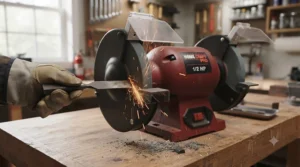
Running at a genuinely low 1,725 RPM on 8-inch wheels with a 1/2 HP motor, this grinder is built specifically for people who sharpen chisels, plane irons, and gouges and refuse to gamble with the tool’s temper. Here’s what the spec sheet won’t tell you, but reviewers note repeatedly: the slower wheel speed isn’t a limitation, it’s the entire design philosophy — you get more control over the grinding process precisely because the wheel isn’t racing past the edge fast enough to generate damaging heat. RIKON sweetens the deal by including a grinding wheel dresser in the box, a $15-$20 accessory most competitors expect you to buy separately.
Reviewers consistently praise the wheel quality as noticeably above average for the category. The honest tradeoff is the tool rests — aggregated feedback describes them as less sturdy than the rest of the machine and fussier to lock at a precise angle than they should be, which is a frustrating weak point on an otherwise purpose-built tool.
Pros:
- ✅ Low 1,725 RPM protects hardened tool edges
- ✅ Includes a grinding wheel dresser in the box
- ✅ Above-average wheel quality per aggregated reviews
Cons:
- ❌ Tool rests are fussier to adjust precisely
- ❌ Underpowered for aggressive metal shaping
Plan for the $190-$230 range — a premium over general-purpose 8-inch models, justified by its narrower, sharper focus.
7. JET IBG-8 — industrial-grade smoothness for serious shops
At the top of this list sits the JET IBG-8, a 1 hp bench grinder that professional users repeatedly rank right behind far pricier Baldor units in forum discussions — which tells you a lot about where it lands on the quality curve.
The full 1 horsepower single-phase motor spins two 8-inch vitrified wheels at 3,600 RPM, and unlike the smaller motors on this list, it simply does not bog down under sustained heavy grinding. Based on the spec comparison, that extra headroom is the whole story: where a 1/2 HP unit strains against a thick steel bar, the IBG-8 barely notices. Safety features stack up impressively too — easy-adjusting spark guards, eye shields, cast iron wheel guards with dust collector ports for hooking up a shop vac, and a heavy-duty toggle switch with a removable safety key that stops anyone else from accidentally firing it up.
Reviewers consistently describe it as quiet in operation, quickly reaching full speed and settling into a low hum rather than a harsh whine — a small detail that matters a lot if your shop shares a wall with a bedroom. The obvious catch is price: this is the most expensive grinder here, and it’s genuinely overpowered if your grinding needs are limited to the occasional garden tool touch-up.
Pros:
- ✅ Full 1 HP motor never bogs down under load
- ✅ Dust collector ports for direct shop-vac hookup
- ✅ Notably quiet, smooth operation once at speed
Cons:
- ❌ Premium pricing versus the rest of this list
- ❌ Overkill for light, occasional home use
Expect a price in the $330-$420 range for this one — it’s an investment, but reviewers consistently frame it as a tool bought once and never replaced.
Practical Usage Guide: Setting Up Your Grinder Right
Getting a new bench grinder home is the easy part. The first 30 days are where most of the avoidable mistakes happen, so let’s walk through them.
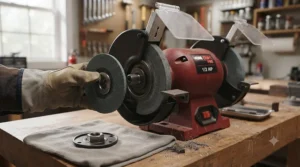
Mount the grinder to a solid workbench or a dedicated stand before you ever flip the switch — a grinder that isn’t bolted down is a grinder that will walk itself right off the edge of your bench the first time you lean into it. Torque the mounting bolts snugly, then double-check them again after the first hour of use, since vibration tends to loosen fresh hardware. Before that first startup, inspect the wheels for hairline cracks by giving each one a gentle tap with a screwdriver handle — a dull thud means trouble, while a clear ring means it’s sound.
Adjust the tool rests to sit no more than 1/8 inch from the wheel face, and set the tongue guards similarly close — this isn’t a suggestion, it’s the gap that keeps a workpiece from getting pulled down between the rest and the spinning wheel. Run the grinder for a full minute with nothing touching the wheels before your first real use, standing to the side rather than directly in front, just in case a wheel that seemed fine actually wasn’t. In the first month, dress your wheels with a wheel dresser as soon as you notice uneven wear or glazing — a glazed wheel grinds poorly and generates far more heat than a freshly dressed one. The single most common rookie mistake is forcing the workpiece into the wheel; let the abrasive do the work, and dip hot metal in water periodically to protect its temper.
Real-World Scenarios: Which Grinder Fits Your Situation
Specs only mean so much until you match them to an actual person doing actual work, so here are three realistic profiles.
Picture a weekend woodworker with a one-car-garage shop, sharpening chisels and plane irons maybe twice a month and working with a tight budget under $150. The Delta 23-196 or the RIKON 80-805 make the most sense here — both prioritize the low-speed control that protects tool temper over raw grinding power, which is exactly what edge work demands. Now picture a small-engine hobbyist who rebuilds mower and chainsaw engines on weekends, dealing with rusted bolts, burred gears, and the occasional deburring job on a fabricated bracket. The DEWALT DW758 fits that role well — enough horsepower to chew through stubborn rust without constantly stalling, at a price that doesn’t feel like overkill for a hobby.
Finally, consider a serious home fabricator who welds trailer frames, builds metal furniture, and treats the shop as a genuine second job. For that level of daily, heavy-duty use, the JET IBG-8’s 1 HP motor and dust collection ports earn their premium price — a lesser motor would simply wear out faster under that kind of load, making the “cheaper” option the more expensive one over five years.
Problem to Solution Guide: Fixing Common Bench Grinder Headaches
Every bench grinder owner eventually runs into the same handful of frustrations. Here’s how to solve the most common ones.
Problem: The grinder vibrates badly, even bolted down. This is almost always an out-of-round or unevenly worn wheel. Dress the wheel with a wheel dresser to restore its roundness, and if the vibration persists, check that the wheel is properly seated against the flange — a loose mounting nut is a common, easily fixed culprit.
Problem: Tools keep overheating and losing their temper. You’re either pressing too hard or running too fast a wheel speed for delicate edge work. Switch to a low-speed or variable-speed model like the Delta 23-196 or RIKON 80-805, dip the workpiece in water every few seconds, and let the wheel — not your arm — do the cutting.
Problem: The wheel glazes over and stops cutting effectively. Glazing happens when metal particles clog the abrasive pores, usually from grinding softer metals like aluminum on a standard steel wheel. Dress the wheel regularly, and never grind non-ferrous metals on a wheel meant for steel.
Problem: Sparks are flying somewhere you didn’t expect. Your spark deflector or tongue guard has likely drifted out of adjustment. Reset it to within 1/4 inch of the wheel, and confirm your eye shield is actually positioned in front of your line of sight, not just sitting there for show.
Problem: The motor bogs down under moderate pressure. You’ve likely outgrown your grinder’s amperage or horsepower rating. This is the clearest sign it’s time to step up from a budget 2-amp unit to something in the 3/4 to 1 HP range covered earlier in this guide.
✨ Don’t Miss These Exclusive Deals!
🔍 Take your home workshop to the next level with these carefully selected bench grinders. Click on any highlighted item to check current pricing and availability. These tools will help you create sharper edges, cleaner welds, and safer results your whole shop will benefit from!
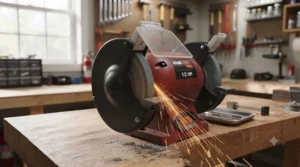
How to Choose a Bench Grinder for Home Shop Use
Cutting through the marketing noise, here’s the actual decision process worth following, step by step.
- Define your primary task first. Are you mostly sharpening woodworking tools, deburring metal, or a bit of everything? Sharpening leans you toward low-speed or variable-speed models; general shop work favors a standard 3,450-3,600 RPM fixed-speed unit.
- Pick your wheel size based on bench space and workload. A 6 inch bench grinder suits tight garages and light-duty tasks, while an 8 inch bench grinder handles bigger jobs like lawnmower blades with less overhang past the housing.
- Match motor power to how hard you’ll push it. Light, occasional use is fine with 1/4 to 1/3 HP; regular shop duty calls for 1/2 to 3/4 HP; daily heavy grinding justifies a full 1 HP motor.
- Decide if variable speed is worth the premium. If you switch between rough shaping and delicate sharpening often, the flexibility pays for itself; if you do one task consistently, a fixed-speed model saves money.
- Check the base material. Cast iron bases resist vibration far better than stamped steel, which directly affects grinding precision and noise.
- Confirm the safety gear included. Eye shields, spark guards, and adjustable tool rests should come standard — anything missing these is worth skipping regardless of price.
- Verify the warranty coverage. A 3-year warranty, like those on both DEWALT models here, signals a manufacturer confident in its own build quality.
According to OSHA’s regulation on abrasive wheels and tools, floor and bench-mounted grinders must include readily adjustable work rests kept within an eighth of an inch from the wheel — a requirement every model on this list meets out of the box, but worth verifying on any grinder you consider elsewhere.
6 Inch Bench Grinder vs 8 Inch Bench Grinder
This is the single most common fork in the road for home shop buyers, and the answer isn’t as simple as “bigger is better.”
A 6 inch bench grinder is lighter, cheaper, and takes up less bench real estate — the WEN BG4260, DEWALT DW756, and Delta 23-196 on this list all fall into that category. The tradeoff is that the housing often extends past the wheel edges, which limits your access when working on longer pieces like full-size lawnmower blades or garden tools. An 8 inch bench grinder, by contrast, spins a larger-diameter wheel that delivers higher rim speed at the same RPM, meaning genuinely faster material removal, plus less curvature pressed into your tool’s cutting edge during sharpening. The DEWALT DW758, WEN BG4280, RIKON 80-805, and JET IBG-8 all fall into this larger category, and they typically cost more and demand a bit more bench space in return.
If your workshop is small and your tasks stay light — kitchen knives, garden shears, the occasional chisel — the 6-inch route saves money without costing you much capability. If you’re regularly working on mower blades, thicker stock, or anything that benefits from faster material removal, the 8-inch category earns its higher price tag. Split the difference by prioritizing bench space if you’re truly tight on room; there’s no shame in a well-chosen 6-inch grinder outperforming an 8-inch one that never gets properly mounted because it doesn’t fit anywhere.
Bench Grinder Amperage Explained
Amperage shows up constantly in bench grinder listings, and it trips up more buyers than horsepower does, mostly because the two numbers aren’t directly interchangeable across brands.
Amperage measures how much electrical current the motor draws, while horsepower estimates mechanical output — and manufacturers don’t always convert between the two consistently, which is exactly why the WEN BG4260 lists 2.1 amps while the DEWALT DW756 lists 5/8 HP for a similarly sized 6-inch wheel. As a rough guide for home shop use: 2 to 3 amps roughly lines up with 1/4 to 1/3 HP and suits light, occasional sharpening; 4 to 6 amps typically lands in the 1/2 to 3/4 HP range appropriate for regular shop duty; and a full 1 HP motor, like the one in the JET IBG-8, generally pulls somewhere around 8 to 10 amps on a standard 120-volt circuit.
What most buyers overlook about bench grinder amperage is that it’s not just about raw power — it’s also about sustained performance under load. A 2.1-amp motor might spin just as fast as a 5-amp motor when idling, but load it down with a thick steel bar and the gap becomes obvious immediately. If you’re on the fence between two similar-looking models, check the amp rating as a tiebreaker: higher amperage within the same wheel size almost always means more headroom before the motor bogs down.
Bench Grinder RPM Rating: What It Means for Your Work
RPM gets treated like a simple speed number, but on a bench grinder it’s really a heat-management number in disguise, and understanding that changes how you shop.
A standard bench grinder rpm rating sits around 3,450 to 3,600 RPM, and that speed is genuinely good for fast material removal — shaping metal, cleaning up welds, and deburring parts all benefit from that pace. The catch, as covered in our RIKON and Delta entries above, is that this same speed generates real heat at the point of contact, and heat is precisely what ruins a hardened cutting edge on a chisel or plane iron. That’s why low-speed grinders exist at roughly 1,725 RPM, and why variable-speed models split the difference by letting you dial in anywhere between those extremes depending on the task in front of you.
One detail worth flagging: the RPM rating printed on the grinder itself is not the only number that matters. Grinding wheels also carry their own maximum RPM rating on their paper blotter, and running a wheel above its rated speed is a genuine safety hazard, not just a performance issue — an overspun wheel can fail catastrophically. Always match replacement wheels to your grinder’s actual operating speed, never the other way around.
Bench Grinder Eye Shield and Safety Essentials
No bench grinder buying guide is complete without a real conversation about safety, because this is a tool that spins abrasive stone at thousands of RPM inches from your face.
Every model featured in this guide ships with a bench grinder eye shield attached to the housing, and that’s not a throwaway feature — it’s a baseline safety requirement. Federal workplace safety regulation holds that anyone using abrasive wheels needs eye protection unless a shield is permanently attached to the bench or stand, and that standard is a sensible baseline for a home shop too, even without an employer watching over your shoulder. That said, the built-in shield alone often isn’t enough for serious work — if eye shields aren’t present or adequate, the operator should wear a proper face shield when grinding, and most experienced shop owners layer separate ANSI Z87.1-rated safety glasses underneath regardless of what’s bolted to the machine.
Beyond eye protection, a handful of habits genuinely reduce risk: keep tool rests within that eighth-inch gap we mentioned earlier, never stand directly in front of the wheel during startup in case it’s cracked and fails as it spins up, and skip loose clothing, dangling jewelry, or unsecured long hair anywhere near the machine. For a deeper walkthrough of workplace-grade practices worth adopting at home, Cornell’s environmental health and safety program covers proper mounting, PPE selection, and pre-use inspection routines in detail.
Common Mistakes When Buying a Bench Grinder for Home Shop
A few recurring errors show up again and again in buyer regret, and most are easy to avoid once you know to look for them.
The biggest one is buying based on wheel size alone, ignoring RPM and motor power entirely — a big 8-inch wheel spinning on an underpowered motor will still bog down under real load, so the wheel diameter tells you less than buyers assume. A close second is skipping the base material check; a stamped-steel base on a budget grinder can undercut precision work no matter how good the motor is, since every bit of vibration transfers straight into your hands. Buyers also frequently overlook whether a grinder is single-speed or variable-speed until after they’ve already committed to sharpening delicate tools on a wheel spinning too fast to keep them cool. Finally, plenty of shoppers chase the lowest price without weighing warranty coverage — a 3-year warranty on a DEWALT unit is worth real money compared to a no-name grinder with no coverage at all, even if the sticker price looks similar at first glance.
Long-Term Cost and Maintenance
The purchase price is only the opening chapter of what a bench grinder actually costs you over its working life.
Replacement wheels typically run somewhere in the $15-$35 range per pair depending on grit and quality, and you’ll want to budget for a new set roughly every one to three years depending on usage frequency — heavier shop use wears wheels down faster and also glazes them sooner if you skip regular dressing. A wheel dresser itself, if not included like it is with the RIKON 80-805, adds another modest one-time cost worth factoring into a budget model’s real price. Electricity draw is genuinely negligible for occasional home use; even the 1 HP JET IBG-8 running for short bursts a few times a week won’t meaningfully move your utility bill.
Where the real cost-per-use math shows up is in motor longevity. A budget 2-amp grinder pushed regularly past its comfortable duty cycle tends to wear out its bearings and windings faster, meaning a $60 grinder replaced every three years can end up costing more over a decade than a $180 grinder that’s still running smoothly at year ten. That’s the honest total-cost-of-ownership argument for stepping up to something like the DEWALT DW758 or JET IBG-8 if you know you’ll be using the tool regularly rather than a few times a year.
Features That Actually Matter (And Those That Don’t)
Marketing copy loves to pile on bullet points, but only a handful genuinely change your day-to-day experience with a bench grinder.
What actually matters: a cast iron base for vibration control, an accurate RPM rating matched to your primary task, adjustable tool rests that lock securely, and real safety gear including a functional eye shield and spark guard. Amperage or horsepower rated appropriately for your workload matters enormously too — it’s the difference between a grinder that shrugs off a rusty bolt and one that stalls out embarrassingly. What matters far less than the spec sheet implies: an integrated work light is genuinely nice to have but won’t make or break your results if your shop is already well-lit, and a dust collection port is a bonus for keeping the shop clean rather than a core performance feature. Flashy paint jobs and marketing badges like “professional grade” printed on a budget unit are pure noise — check the actual motor rating and base material instead of the branding language surrounding them.
Frequently Asked Questions
❓ What size bench grinder is best for a home shop?
❓ How many amps does a bench grinder need for home use?
❓ Is a variable speed bench grinder worth the extra cost?
❓ What RPM is best for sharpening tools on a bench grinder?
❓ Do I need a face shield if my bench grinder already has an eye shield?
Conclusion
A bench grinder for home shop use doesn’t need to be complicated to choose once you know what actually matters: wheel size relative to your bench space, RPM matched to whether you’re shaping or sharpening, motor power rated for how hard you’ll actually push it, and real safety gear that isn’t just there for show. The WEN BG4260 earns its spot for anyone testing the waters on a tight budget, the DEWALT DW756 and DW758 remain sensible middle-ground picks for the widest range of home shops, the Delta 23-196 and RIKON 80-805 serve tool sharpeners who care about protecting an edge’s temper, the WEN BG4280 covers buyers who want one flexible machine, and the JET IBG-8 rewards anyone ready to invest once and stop thinking about it.
Whichever one you land on, mount it securely, keep the tool rests tight, wear real eye protection beyond the built-in shield, and let the wheel do the work instead of forcing it. That’s really the whole secret to getting years of reliable service out of what is, at its core, a wonderfully simple tool.
✨ Ready to sharpen smarter, not harder? Compare current prices on today’s top pick and get your home shop grinding again this week!
Recommended for You
- Electric Top Handle Chainsaw: 7 Best Picks Reviewed for 2026
- Top Handle vs Rear Handle Chainsaw: 7 Picks for 2026
- Top Handle Chainsaw: 7 Best Picks for Arborists in 2026
Disclaimer: This article contains affiliate links. As an Amazon Associate, I earn from qualifying purchases. If you purchase products through these links, we may earn a small commission at no additional cost to you.
✨ Found this helpful? Share it with your friends! 💬🤗
