
In This Article
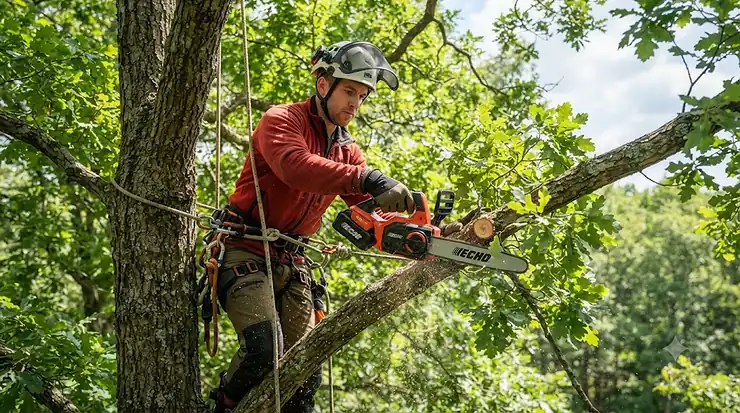
An electric top handle chainsaw is a compact, one-handed saw built for working up in a tree, not down on the ground. That single sentence explains almost everything about why this tool category exists and why it looks nothing like the chainsaw sitting in your garage right now. Where a rear-handle saw wants two hands and stable footing, a top handle model is engineered to be swung, angled, and braced against a harness while you’re thirty feet up a maple with a rope under your boots. That’s not a homeowner tool wearing a costume. It’s climbing gear that happens to cut wood. (If you want the full mechanical backstory of how a chain-and-bar cutting system evolved, Wikipedia’s overview of the chainsaw is a solid primer.)
Here’s the thing that surprised even us digging into this category: battery power has quietly caught up to gas in the top handle class faster than in almost any other saw size. A 36-40V top handle saw today throttles up in under a second, cuts quieter than a leaf blower, and skips the two-stroke oil-mixing ritual that has annoyed climbers for seventy years. That doesn’t mean every battery saw belongs in a canopy. Some of what we cover here is squarely homeowner territory — light pruning, storm cleanup, the occasional Christmas tree farm chore — and we’ll flag that difference clearly as we go, because conflating a $180 pruning saw with a $700 arborist rig does nobody any favors.
We researched seven real, currently available products spanning budget pruning tools up through professional-grade climbing saws, pulled specs straight from manufacturer pages, and layered in aggregated review sentiment from retailers and independent testers so you’re not just reading a features list. Every comparison below explains what a spec actually changes about your Saturday morning or your Tuesday work shift — because a number on a box means nothing until you know what it does in your hands.
Quick Comparison Table
| Product | Voltage / Bar | Weight (tool only) | Best For | Price Range |
|---|---|---|---|---|
| Echo DCS-2500T | 56V / 12″ | ~7.3 lbs | Pro arborists wanting the lightest full-power option | $500-$600 range |
| Husqvarna T542i XP | 40cc-class / 12″ | ~9 lbs | Climbers who want a clutch and backpack-battery flexibility | $700-$900 range |
| Stihl MSA 220 TC-O | 36V / 14″ | 6 lbs powerhead | Stihl loyalists doing heavy canopy removal work | $600-$750 range |
| Greenworks Commercial 48V | 48V / 12″ | ~7.5 lbs | Budget-conscious pros entering the arborist saw category | $500-$600 range |
| Milwaukee M18 FUEL 14″ | 18V / 14″ | 8.6 lbs | M18 ecosystem owners who need fast throttle response | $349 bare tool |
| Ryobi 40V HP 12″ Top Handle | 40V / 12″ | Kit ~13 lbs | Homeowners doing yard maintenance, not climbing | $180-$230 range |
| DeWalt DCCS623B | 20V / 8″ | 4.6 lbs | Light pruning, brush cleanup, cordless pruning saw duty | Under $200 range |
A glance at that table tells a clear story: this is not a one-size-fits-all category, and the price gap between the DeWalt pruning saw and the Husqvarna climbing rig isn’t a rounding error — it’s the difference between two entirely different jobs. The three lightest saws (Echo, Greenworks Commercial, DeWalt) sit under eight pounds because lighter mass matters enormously when your arm is extended overhead for an hour straight. Meanwhile the Ryobi kit weight includes its battery, which is honestly the more useful number for homeowners who won’t be climbing anything. Pay closest attention to the “Best For” column here, because bar length and voltage alone tell you almost nothing about whether a saw belongs in a bucket truck or a backyard shed.
💬 Just one click — help others make better buying decisions too!😊
Top 7 Electric Top Handle Chainsaws: Expert Analysis
Below is the full rundown, sorted roughly from professional climbing gear down to entry-level pruning tools, so you can find where your actual needs fall on that spectrum.
1. Echo DCS-2500T — lightest full-power option built for arborists
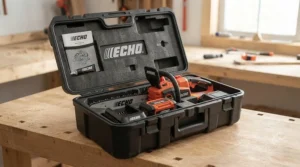
Echo built the DCS-2500T on its 56V X-Series platform, and the standout claim to fame is how much saw they crammed into 7.3 pounds. What most buyers overlook about compact battery saws is that light weight and real cutting power usually trade off against each other — Echo’s brushless motor is the exception, and reviewers consistently note the saw punches well above its weight class. The 12-inch bar and .325 pitch chain are shared with Echo’s gas-powered CS-2511T, so the cutting geometry is proven pro gear, not a battery-only experiment. The .325 pitch chain cuts more efficiently through wood, and in battery applications that efficiency translates directly to extended runtime per charge since removing less material per cut means the motor expends less energy per cut.
Based on the spec comparison against rear-handle and larger top handle saws, this is a saw for pruning and canopy work under roughly 8 inches in diameter — professional climbers typically transition to a larger gas saw when encountering heavier wood during removal operations, so don’t expect it to fell anything meaningful. Aggregated reviewer sentiment from outdoor gear testers is close to unanimous: independent testing found the saw impressively fast for its size, sliced cleanly through six-inch logs, and held its power output all the way through a discharge cycle.
Pros:
✅ Among the lightest pro-grade top handle saws available
✅ Shares chain geometry with Echo’s respected gas top handle
✅ On/off button most rivals skip, saving battery when idle
Cons:
❌ Underpowered for anything beyond 8-inch diameter wood
❌ Premium price relative to bar length
At around $500-$600 for the tool, it’s not the cheapest 12-inch saw on this list — but for a working climber doing precision pruning all day, the weight savings alone justify the premium.
2. Husqvarna T542i XP — first battery top handle with a true clutch
Husqvarna’s flagship battery top handle borrows a feature nobody else on this list has: a mechanical clutch, a first for battery-powered chainsaws. On a gas saw, the clutch prevents the engine from shutting down when you release the trigger or bind the chain; with battery power, it means not having to completely remove the saw from the cut when you stall the motor — simply lift slightly, pull the trigger, and reengage the cut. Here’s what most spec sheets won’t tell you: that small mechanical detail saves real minutes across a workday, because every stalled cut on a clutchless saw means pulling the bar free and resetting your stance.
The T542i XP is built to mimic a 40cc gas saw’s power delivery, and reviewers who’ve run it alongside Husqvarna’s gas equivalents describe the power curve as nearly indistinguishable. One clever option is the ability to use a backpack battery to shift weight off the saw itself — not ideal mid-climb, but genuinely useful for ground-level bucking and extended limbing sessions where fatigue compounds fast.
Pros:
✅ Clutch prevents full cut resets after a stall
✅ Backpack battery option reduces in-hand weight
✅ Power delivery matches 40cc gas performance closely
Cons:
❌ Highest price point among top handle options here
❌ Backpack battery adds cost and isn’t practical while climbing
If your crew already runs Husqvarna gas saws and wants a battery option that feels familiar, this is the model to check current pricing on — typically the $700-$900 range depending on battery configuration.
3. Stihl MSA 220 TC-O — Stihl’s most powerful battery top handle
The MSA 220 TC-O is the most powerful top handle chainsaw in Stihl’s battery-powered lineup, boasting power and performance similar to professional gas-powered top handle chainsaws. That’s not marketing fluff we’re repeating uncritically — it uses the same 3/8-inch PICCO chain and Rollomatic guide bars as Stihl’s gas counterparts, which is exactly how Stihl designed it to help pros switch from gas to battery without relearning their cutting technique.
What stands out in practice is the LED status display and the weather-resistant IPX4 build, both features aimed squarely at professionals working in unpredictable canopy conditions rather than homeowners doing weekend cleanup. A low oil sensor and a captive bar nut round out the professional feature set, eliminating the classic annoyance of a dropped bar nut forty feet up a tree. The magnesium motor housing adds durability where plastic housings on cheaper saws tend to crack after repeated drops in a bucket truck. Honest downside: the AP 300 S battery caps runtime around 38-40 minutes on a charge, which means serious removal crews will want at least one spare battery in rotation.
Pros:
✅ Uses identical bar/chain system as Stihl’s proven gas saws
✅ IPX4 weather resistance for wet-condition climbing work
✅ LED display and captive bar nut reduce field frustration
Cons:
❌ Runtime tops out around 38-40 minutes per charge
❌ Stihl dealer-only sales limit online price comparison
Expect to land in the $600-$750 range depending on whether you buy the kit with battery and charger or the tool alone.
4. Greenworks Commercial 48V Top Handle — arborist-grade power at a lower entry price
This is the pick most buyers miss because Greenworks built its consumer reputation on homeowner tools, but the Commercial 48V line is a genuinely different animal. It’s a 12-inch arborist-specific top handle saw, lightweight at just 7.5 pounds without the battery, with a brushless motor that runs the chain at 64 feet per second and boasts power greater than a 45cc gas model. Reviewers who cover professional battery equipment note the 48V dual-voltage system is compatible with a broader Greenworks Commercial tool line, which matters if your crew is already standardizing on one battery platform.
What the spec sheet won’t tell you, but the design choices suggest, is that Greenworks priced this specifically to undercut Echo and Stihl while matching their power class — a genuine value play rather than a downgrade. On paper this means arborists on a tighter equipment budget get real climbing-saw performance without the premium-brand markup, though the review pool for the commercial line is thinner than for Greenworks’ consumer saws, so long-term durability data is still accumulating.
Pros:
✅ 45cc-equivalent power at a lower price than Echo or Stihl
✅ Compatible with broader 48V Commercial tool ecosystem
✅ Chain speed of 64 fps is competitive with premium rivals
Cons:
❌ Smaller independent review base than legacy pro brands
❌ Resale value likely lower than Stihl or Husqvarna long-term
At roughly $500-$600 with battery and charger included, this is the saw we’d point budget-conscious working arborists toward first.
5. Milwaukee M18 FUEL 14″ Top Handle — fastest throttle response in the M18 ecosystem
Milwaukee’s M18 FUEL Top Handle Chainsaw reaches full throttle in less than one second, and if you’ve ever fought a gas saw’s warm-up lag mid-cut, that number matters more than it sounds like it should. The saw is designed to meet the performance, durability, and ergonomic needs of professional arborists working in a tree or bucket, cutting faster than 35cc gas while eliminating the headaches of gas engines.
Reviewer sentiment from hands-on field testing is largely positive, praising how quickly the saw ramps up and how well it handled clearing storm-damaged oak limbs, though one recurring complaint is the trigger’s small, thin profile requiring an adjusted grip to reach full speed comfortably. Here’s what most buyers overlook: this saw’s real selling point isn’t raw power, it’s ecosystem lock-in. Full compatibility with 250-plus tools on the M18 system means a contractor who already owns M18 drills and impact drivers adds a professional chainsaw without buying a second battery platform — that’s real money saved over a career, not just a nice-to-have.
Pros:
✅ Sub-1-second throttle response beats most rivals
✅ Shares batteries with 250+ existing M18 tool
s✅ Metal bucking spikes and onboard scrench storage
Cons:
❌ Thin trigger design draws consistent complaints
❌ Battery sold separately, adding to real-world cost
Bare tool pricing sits around $349, but factor in an $8.0Ah High Output battery separately if you’re not already in the M18 ecosystem — that pushes total cost closer to $500.
6. Ryobi 40V HP Brushless 12″ Top Handle — best homeowner entry point, not a climbing saw
Let’s be direct about something the marketing copy blurs: Ryobi markets this as having a unique top handle design for increased user control, but this is a residential yard-maintenance tool, not arborist equipment, and treating it as one would be a genuine safety mistake. With a 10-inch cut capacity, adjustable automatic oiler, and side access chain tensioning, it handles small trees, storm limbs, and routine yard trimming.
Aggregated Home Depot review sentiment is a mixed but informative picture. Many homeowners report it cleared branches quickly and praised the case, battery, and charger bundle as strong value for the price. But it’s honest to also report a real negative theme: at least one reviewer described a unit failing within twenty minutes of first use, citing an awkwardly angled bar-oil fill port as a specific design frustration. That kind of split sentiment is normal for budget-tier tools built to a price point, and it’s exactly why we’re reporting both sides rather than cherry-picking the five-star reviews.
Pros:
✅ Comes bundled with battery, charger, and hard case
✅ 10-inch cut capacity covers most yard maintenance needs
✅ Compatible with the broad Ryobi 40V tool platform
Cons:
❌ Not rated or designed for climbing/arborist use
❌ Review sentiment includes some early-failure reports
At $180-$230 depending on the bundle, it’s the most affordable true top handle saw here, but match your expectations to yard work, not tree work.
7. DeWalt DCCS623B — the lightest cordless pruning saw on this list
Weighing just 4.6 pounds tool-only, this 8-inch cordless pruning chainsaw is 61% lighter and three times more compact than DeWalt’s earlier 12-inch compact chainsaw, and that weight drop changes what kind of work makes sense with it entirely. This isn’t trying to compete with Echo or Stihl for climbing duty — it’s a dedicated cordless pruning saw for branch trimming, brush cleanup, and light storm debris, and reviewers consistently frame it that way rather than as a scaled-down felling saw.
The compact body, integrated tip guard, and onboard tensioning wrench make it easier to control in dense limbs and awkward cutting angles, and DeWalt rates it for up to 70 cuts per charge on 4×4 pressure-treated pine with a compact 3.0Ah battery. Reviewers who’ve run it against similar mini chainsaws generally rate the build quality above cheaper off-brand competitors, though one recurring gripe involves the safety-lock button’s left-side placement, which some left-handed users find awkward to reach.
Pros:
✅ Lightest saw on this list at 4.6 lbs tool-only
✅ Auto-oiling and tool-free tensioning simplify upkeep
✅ Compatible with the huge DeWalt 20V battery ecosystem
Cons:
❌ 8-inch bar limits it to genuinely light-duty pruning
❌ Safety button placement awkward for left-handed users
Priced around $180 as a bare tool or roughly $230 with a battery and charger, this is the pick for anyone whose “chainsaw” needs are really just branch and brush duty.
✨ Don’t Miss These Exclusive Deals!
🔍 Take your tree work to the next level with these carefully selected products. Click on any highlighted item to check current pricing and availability. These tools will help you tackle pruning, storm cleanup, and canopy work your family will appreciate!
Practical Usage Guide: Your First 30 Days
Setting up a new electric top handle chainsaw wrong is the single fastest way to sour yourself on the whole category. Start by charging the battery fully before first use — most manufacturers recommend an initial full-cycle charge even though lithium-ion packs don’t technically require it, and it’s a good moment to inspect the bar and chain for shipping damage. Fill the oil reservoir before your first cut, always, since running a chain dry for even thirty seconds accelerates wear on both bar and chain dramatically.
Chain tension deserves daily attention during that first month: a chain that’s too loose can derail off the bar entirely, while one that’s too tight binds and wears prematurely, and all chains stretch with use and need frequent readjustment. Check tension before every session until it becomes muscle memory. The most common first-30-days mistake we see reported across review threads is skipping the automatic oiler check — glance at the oil window before each cutting session, because a clogged or empty oiler is the fastest way to overheat a bar. Finally, resist the urge to bury the tip in a cut during your first week; getting a feel for how a top handle saw’s balance differs from a rear-handle model takes a few sessions, and rushing that learning curve is exactly how kickback incidents happen. West Virginia University Extension’s guide to safe chainsaw operation and maintenance is a useful outside reference for building good habits before you’re relying on muscle memory.
Real-World Scenarios: Which Saw Matches Your Work
Picture a professional arborist named Mia running a two-person tree service crew in coastal Oregon, climbing six to eight jobs a week. Her saw needs to survive drops, rain, and full workdays without flinching — that points toward the Stihl MSA 220 TC-O or Husqvarna T542i XP, both built with IPX-rated housings and pro-grade batteries designed for daily commercial abuse.
Now picture Dave, a homeowner on two wooded acres who trims deadfall and storm damage maybe eight times a year. He doesn’t need climbing-rated gear or a $700 saw — the Ryobi 40V HP 12-inch top handle covers his actual use case at a third of the price, and its included battery and charger mean he’s cutting the same afternoon it arrives.
Then there’s Priya, who tends a small orchard and does light pruning weekly but has never climbed a tree with a saw in her hand. For her, the DeWalt DCCS623B’s 4.6-pound frame and cordless pruning saw design make far more sense than any 12-inch top handle model — less weight means less fatigue across a long pruning session, and the 8-inch bar is plenty for orchard-scale branches.
How to Choose an Electric Top Handle Chainsaw
- Match the saw to the job, not the brand name. A pro climbing rig on a homeowner’s shelf is overkill; a homeowner saw in a bucket truck is a liability.
- Weigh the saw in your hand before committing, if possible. A one-pound difference feels trivial on a shelf and enormous after ninety minutes overhead.
- Check battery ecosystem compatibility first. If you already own tools on a platform (M18, 20V MAX, 40V), staying in that ecosystem saves real money on future batteries.
- Confirm bar length against your typical cut diameter. A 12-inch bar handles most pruning; anything approaching 10-inch-plus diameter wood wants a longer bar or more power.
- Prioritize runtime data over voltage marketing. Higher voltage doesn’t always mean longer runtime — battery amp-hours matter just as much as the volt number on the box.
- Look for weather resistance if you work outdoors regularly. IPX4-rated housings hold up meaningfully better in rain and dew than unrated plastic shells.
- Read aggregated review sentiment, not just the star average. A 4.3-star product with a specific recurring complaint (like Ryobi’s bar-oil fill port) tells you more than a flat number ever will.
Battery Voltage for Top Handle Saws Explained
Battery voltage for top handle chainsaws ranges from 18V (Milwaukee’s M18 platform) up through 56V (Echo’s X-Series), and here’s the honest answer to the question everyone asks first: higher voltage alone doesn’t guarantee more power. Voltage times amperage equals watts, and it’s the watt output combined with motor efficiency that determines actual cutting force — which is exactly why Milwaukee’s 18V M18 FUEL saw competes credibly against 36-56V rivals despite the lower number on the label. What voltage does reliably affect is battery size and weight for a given runtime; higher-voltage packs generally deliver more energy per pound of battery, which matters enormously on a saw you’re holding overhead.
Based on the spec comparison across this list, 36-40V sits in a sweet spot for top handle saws — enough headroom for real cutting power without the bulkier battery packs that 56V+ platforms sometimes require. If you’re choosing between voltage platforms, the smarter question isn’t “which number is bigger” but “which platform do I already own batteries for, and does its runtime match my actual job length.” For broader safety context around powered cutting equipment used in tree care, OSHA maintains a reference list of applicable ANSI standards worth reviewing before buying professional-grade gear.
Electric Top Handle Chainsaw vs Gas Top Handle Chainsaw
The gas-versus-battery debate in top handle saws has genuinely shifted in the last few years, and it’s worth being honest about where each still wins. Gas top handle saws still hold an edge in sustained, all-day removal work on larger diameter wood — there’s no battery swap mid-cut, and fuel is faster to top off than waiting on a charger. But battery saws have closed the gap on power dramatically: several models here, including the Stihl MSA 220 TC-O and Husqvarna T542i XP, are explicitly built to match their manufacturers’ own gas equivalents in cutting performance, not just approximate them.
Where battery wins outright is noise, weight, and instant-on convenience — no pull cord, no two-stroke oil mixing, and meaningfully quieter operation that matters in residential neighborhoods with noise ordinances. The strategic use case for a battery-powered top handle centers on pruning work and smaller removals, where cordless convenience and sufficient power combine effectively, while professionals typically still transition to a larger gas saw for heavier removal work beyond roughly 8 inches in diameter. For most homeowners and even many working arborists doing routine canopy maintenance, that trade-off now favors battery more often than not.
Common Mistakes When Buying a Battery Powered Top Handle Chainsaw
The most expensive mistake buyers make is purchasing bare tool pricing without factoring in a battery and charger, which can add $100-$200 to what looked like a bargain sticker price — always price the full kit before comparing across brands. A close second is buying based on bar length alone; a 14-inch bar on an underpowered motor cuts slower and struggles more than a well-powered 12-inch saw, so power output matters more than raw inches. Third, buyers frequently skip checking whether a saw is genuinely rated for climbing use — a homeowner-grade top handle saw like the Ryobi is not built or certified for aerial arborist work, and using it that way is a real safety gap, not a technicality.
Fourth, ignoring ecosystem lock-in costs buyers money down the road: choosing a battery powered top handle chainsaw on an unfamiliar platform means starting a whole new battery collection from scratch. Finally, plenty of buyers skip aggregated review research entirely and trust manufacturer marketing copy at face value — as the Ryobi case shows, even generally well-reviewed saws can carry a real minority of early-failure reports worth weighing.
Long-Term Cost & Maintenance
Total cost of ownership on a battery powered top handle chainsaw runs lower than gas over a multi-year horizon, mostly because you’re not buying two-stroke fuel and oil mix every season. Batteries do degrade — expect meaningful capacity loss somewhere around the 500-800 charge cycle mark for most lithium-ion packs, which for moderate users translates to roughly three to five years before a replacement battery purchase becomes worthwhile. Chains need periodic sharpening or replacement regardless of power source, typically every 15-20 hours of cutting for moderate use, and that cost is identical across gas and battery models.
Where battery saws save real money is routine maintenance labor: no spark plugs, no carburetor cleaning, no fuel line replacement. Milwaukee specifically markets eliminating pull starts, engine maintenance, and gas-and-oil mixing as a core value proposition, and that’s not just marketing — it reflects genuine hours saved across a working season. Factor a spare battery into your total cost calculation if you’re doing full-day work; a second $150-$250 battery pack often pays for itself in avoided downtime within the first year.
Safety, Regulations & Certification for Arborists
Anyone searching for the best top handle chainsaw for arborists should understand this upfront: owning pro-grade equipment doesn’t substitute for training and certification. ANSI Z133 covers all work performed on or around trees using equipment including chainsaws, aerial lift devices, and climbing gear, whether in residential, commercial, or utility right-of-way contexts, and mandates chain-saw-resistant leg protection along with eye, hearing, and helmet protection calibrated to the specific task. The standard’s work zone rule requires a drop zone calculated at minimum twice the height of the tree segment being removed — a measurable threshold, not a suggestion.
OSHA maintains a reference list of voluntary ANSI standards applicable to the tree care industry, and while compliance with those standards doesn’t automatically satisfy every OSHA requirement, it’s the closest thing the industry has to a shared safety baseline. Beyond regulation, tree care remains one of the more hazardous trades in the country — industry-compiled fatality data from the Tree Care Industry Association is worth a read before assuming any saw, no matter how well-reviewed, makes aerial work inherently safe. None of the saws on this list are inherently “certified” for arborist work in a regulatory sense; certification applies to the operator’s training, not the tool itself, though pro-grade builds like the Stihl, Husqvarna, and Echo models are specifically engineered to the durability and safety-feature expectations that professional arborist work demands.
Lightweight Top Handle Saws and Cordless Pruning Saws: Special Use Cases
Not every buyer searching for a lightweight top handle saw needs full arborist-grade power, and conflating the two is where a lot of buyer’s remorse comes from. If your actual task list is orchard pruning, hedge cleanup, or trimming branches that get in the way of a driveway, a genuine cordless pruning saw like the DeWalt DCCS623B at 4.6 pounds will out-perform a heavier 12-inch saw on comfort alone, even if its raw cutting capacity is smaller.
The lightweight category generally splits into two tiers: sub-5-pound pruning saws with 6-10 inch bars built purely for branch work, and 7-8 pound “lightweight pro” top handle saws like the Echo DCS-2500T and Greenworks Commercial 48V that trim weight without sacrificing real climbing-grade cutting power. Reviewers evaluating extended overhead use consistently note that anything over roughly 9 pounds becomes noticeably fatiguing within an hour of continuous limbing — which is exactly why the weight column in our comparison table above deserves as much attention as the power specs.
Frequently Asked Questions
❓ What is the difference between a top handle and rear handle chainsaw?
❓ Is a battery powered top handle chainsaw good enough for tree removal?
❓ How much does an electric top handle chainsaw cost?
❓ Do I need certification to use a top handle chainsaw professionally?
❓ Which battery voltage is best for a top handle chainsaw?
Conclusion
If there’s one takeaway from digging through seven real electric top handle chainsaws, it’s that this category punishes buyers who shop by spec sheet alone. The Echo DCS-2500T and Husqvarna T542i XP earn their premium prices through genuine climbing-grade engineering, while the Greenworks Commercial 48V proves you don’t have to pay legacy-brand prices to get real arborist power. On the other end, the Ryobi 40V HP and DeWalt DCCS623B serve entirely legitimate — but entirely different — needs: yard maintenance and light pruning, not aerial tree work.
The honest advice we’d give a friend is this: write down what you’ll actually cut, how often, and whether you’ll ever be off the ground while doing it. That answer alone eliminates four of these seven options immediately and makes the remaining choice much easier. Price ranges shift, so always check current pricing before buying, and remember that the “best” battery powered top handle chainsaw is the one sized correctly for your actual job, not the one with the biggest number on the box.
Recommended for You
- Top Handle vs Rear Handle Chainsaw: 7 Picks for 2026
- Top Handle Chainsaw: 7 Best Picks for Arborists in 2026
- Chainsaw Size Guide 2026: 7 Best Bar Lengths Compared
Disclaimer: This article contains affiliate links. As an Amazon Associate, I earn from qualifying purchases. If you purchase products through these links, we may earn a small commission at no additional cost to you.
✨ Found this helpful? Share it with your friends! 💬🤗
