
In This Article
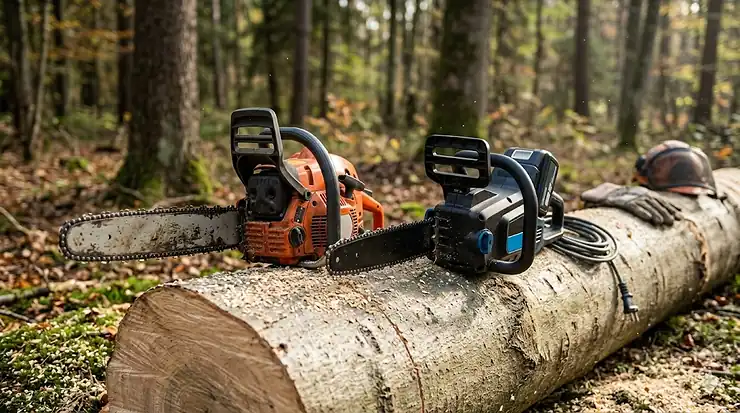
Somewhere in your yard right now, there’s a branch that’s been mocking you since the last storm. Maybe it’s a whole tree, half-collapsed onto the fence like it’s taking a nap it has no intention of waking from. Either way, you’ve landed here because you’re trying to settle the gas vs electric chainsaw question before you spend real money on a tool that’s either going to flood your garage with two-stroke fumes or die on you mid-cut because the battery gauge lied. A chainsaw is a gas or battery or corded-electric powered cutting tool that uses a rotating chain studded with teeth to slice through wood, and the gas vs electric chainsaw debate really just comes down to trading raw, all-day power for quieter, cleaner, lower-maintenance convenience.
For decades the answer was simple: gas wins, full stop, no argument. Electric chainsaws were toys — underpowered, short-lived, the kind of thing you’d buy for trimming a hedge and regret the moment you hit anything thicker than a broomstick. That’s no longer true. Lithium battery technology has closed the gap so aggressively that some cordless models now out-cut gas saws of similar size, and they do it without the carburetor headaches, the ethanol gas going stale in the tank, or the neighbor glaring at you at 7am on a Saturday. Gas still has its place, especially if you’re felling big trees or running a saw for hours without a charging station nearby. But “electric is for wimps” is officially outdated advice.
This guide walks through seven real, currently available chainsaws spanning gas, battery, and corded electric, with honest analysis of who each one actually fits — not just spec sheets copied from a manufacturer’s site. We’ll also dig into runtime, noise, total cost of ownership, and the buying mistakes that trip up most first-time chainsaw shoppers.
What Is a Gas vs Electric Chainsaw, Really?
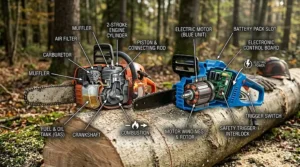
A gas chainsaw runs on a small two-stroke engine fueled by a gas-and-oil mix, delivering unlimited runtime as long as you keep feeding it fuel. An electric chainsaw runs on either a power cord or a rechargeable lithium battery, trading that unlimited runtime for instant starts, near-silent idle, and zero exhaust. Neither is universally “better” — the right pick depends entirely on how much wood you’re cutting and how far you are from an outlet.
Quick Comparison Table: Gas vs Electric Chainsaws at a Glance
| Factor | Gas Chainsaw | Battery Chainsaw | Corded Electric Chainsaw |
|---|---|---|---|
| Power & Runtime | Unlimited runtime, highest raw torque for big logs | 20–45 min per charge depending on battery size | Unlimited runtime, but tethered to an outlet |
| Startup | Pull-cord, can take several pulls when cold | Instant, push-button | Instant, push-button |
| Noise | Loud — often 100+ decibels at the operator’s ear | Quiet — comparable to a vacuum cleaner | Quiet, similar to battery models |
| Maintenance | Spark plugs, air filters, fuel mix, carb cleaning | Minimal — chain sharpening and bar oil only | Minimal — chain sharpening and bar oil only |
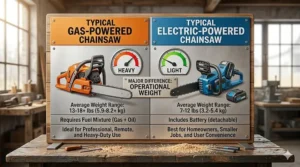
| Weight | Heaviest class overall | Mid-weight; battery adds bulk | Lightest class overall |
| Best For | Felling trees, all-day firewood prep, off-grid work | Mid-size yard work, storm cleanup, occasional felling | Light pruning and cleanup near the house |
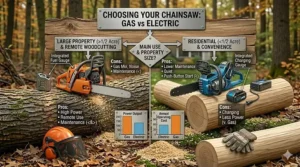
Looking at the table, the pattern is pretty obvious: gas wins on raw stamina, corded electric wins on simplicity and weight, and battery chainsaws are the compromise that’s gotten good enough to be most people’s default choice in 2026. If your property has more than a couple of mature trees or you’re regularly bucking firewood, the unlimited runtime of a gas saw still earns its keep. For everything short of that, a battery saw will probably outperform your actual cutting needs while saving you from carburetor maintenance forever.
💬 Just one click — help others make better buying decisions too!😊
Top 7 Gas and Electric Chainsaws: Expert Analysis
Before ranking anything, it’s worth saying this plainly: there is no single “best” chainsaw, only the best chainsaw for what’s actually growing — or falling — in your yard. The seven below cover the realistic spread, from a $90 trimming saw to a 60cc gas beast built for firewood season.
| Model | Power Source | Bar Length | Price Range | Best For |
|---|---|---|---|---|
| Husqvarna 450 Rancher | Gas, 50.2cc | 18–20 in | Around $420–$480 | All-around homeowner gas saw |
| Echo CS-590 Timber Wolf | Gas, 59.8cc | 18–24 in | Around $400–$470 | Heavy firewood, dense hardwood |
| EGO Power+ CS1815 | Battery, 56V | 18 in | Around $370–$440 | Buyers who want gas-like power, no gas |
| Husqvarna Power Axe 350i | Battery, 40V | 18 in | Around $450–$540 | Premium battery performance |
| Greenworks Pro 80V | Battery, 80V | 18 in | Around $300–$370 | Fast-charge convenience |
| CRAFTSMAN CMECS600 | Corded electric, 12A | 16 in | Around $70–$100 | Budget pruning and yard cleanup |
| WORX WG322 | Battery, 20V | 10 in | Around $90–$140 | Light trimming, small properties |
1. Husqvarna 450 Rancher 20-Inch Gas Chainsaw
The Husqvarna 450 Rancher is the saw most people picture when they imagine “a real chainsaw,” and there’s a reason for that — it’s been the default homeowner gas saw for years running. Under the hood sits a 50.2cc X-Torq engine that Husqvarna tunes for fuel efficiency and lower emissions without gutting torque, paired with an 18 or 20-inch bar depending on the kit you buy. In practice, that engine size means you can fell a mid-size backyard tree or work through a full afternoon of firewood bucking without the saw bogging down in anything short of seasoned oak.
What most first-time buyers overlook is the vibration-dampening system built into the handle — on cheaper 40-something-cc saws, an hour of cutting leaves your hands numb, but the 450 Rancher’s anti-vibe mounts noticeably cut that fatigue during longer sessions. Reviewers consistently flag the air-purge primer and centrifugal air cleaning as genuine time-savers, since they mean fewer flooded starts and a cleaner air filter over the saw’s life. This is the saw for someone with actual acreage, a wood stove to feed, or storm damage that shows up every few years and needs more than a pruning saw to handle.
✅ Pros: serious torque for big wood, easy-access air filter and tensioner, widely available parts and service
❌ Cons: needs gas/oil mixing and regular carb care, loud enough to need hearing protection
Price sits in the Husqvarna 450 Rancher mid-$400s range — not cheap, but it’s a saw that, with basic maintenance, will likely outlast several generations of disposable battery packs.
2. Echo CS-590 Timber Wolf 20-Inch Gas Chainsaw
If the Husqvarna is the all-rounder, the Echo CS-590 Timber Wolf is the specialist you call when wood gets genuinely difficult. Its 59.8cc engine pushes nearly 4 horsepower, and that extra displacement over the 450 Rancher translates directly into faster cuts through thick, knotty, or partially frozen logs — the kind of wood that makes lesser saws stall mid-stroke.
The detail that matters in real use is the G-Force air pre-cleaner, which flings sawdust and debris away from the air filter before it ever gets there. Anyone who’s spent a weekend bucking dusty, bark-shedding firewood knows how fast a standard filter clogs, and this system meaningfully stretches the interval between cleanings. At roughly 13 pounds bare, it’s also surprisingly well-balanced for a saw this powerful, which matters more than raw weight numbers suggest once you’re three hours into a cutting session. This one’s for people processing real volumes of firewood every season, not occasional yard cleanup — anything smaller is overkill for light pruning.
✅ Pros: exceptional power-to-weight for heavy cutting, tool-less chain tensioning, holds up to repeated hard use
❌ Cons: among the louder saws in this lineup, overkill for small properties
The CS-590 typically lands in the $400–$470 range, putting it close to the Rancher in price but a notch above it in sheer cutting force.
3. EGO Power+ CS1815 18-Inch Battery Chainsaw
The EGO Power+ CS1815 is the saw that convinced a lot of skeptics that battery power had actually arrived. EGO pairs an 18-inch bar with a 56V brushless motor and a 6.0Ah ARC Lithium battery, and the company’s own claim — that it delivers performance comparable to a 50cc gas saw — holds up well enough in independent testing that it’s not just marketing fluff.
What stands out in practice is how instantly it gets to full chain speed: no warm-up, no choke, just trigger-pull and go, which makes a real difference if you’re making dozens of short cuts during storm cleanup rather than one long felling session. Testers consistently note that it handles logs in the 20-to-30-inch diameter range without bogging, and the battery display shows remaining charge so you’re not guessing mid-job. This is the chainsaw for someone who wants gas-saw output without gas-saw fuss — homeowners with a half-acre to a couple of acres, or anyone who’s tired of carburetor maintenance.
✅ Pros: near-gas cutting power, instant start, compatible with EGO’s wider 56V tool lineup
❌ Cons: battery and saw together add real heft, runtime drops fast in dense hardwood
Expect to pay in the CS1815 range of roughly $370–$440 for the kit with battery and charger included — genuinely solid value against gas saws at this performance tier.
4. Husqvarna Power Axe 350i 18-Inch Battery Chainsaw
Where the EGO chases raw output, the Husqvarna Power Axe 350i chases refinement, and it shows. The 40V system runs a 7.5Ah battery through a low-vibration brushless motor, and the whole package weighs around 14 pounds fully kitted — noticeably lighter in hand than most 18-inch saws, gas or electric.
The feature that separates this from a merely good battery saw is the push-button boost mode, which draws extra current for tougher cuts and then drops back to a normal, charge-conserving mode for everyday work. It’s the kind of detail you don’t appreciate until you’re three trees into a cleanup job and realize you’re not babying the battery through every cut. The X-Cut chain Husqvarna ships with it is also genuinely sharper out of the box and holds an edge longer than the generic chains bundled with many competitors. This saw suits buyers who already value Husqvarna’s build quality in their gas equipment and want a battery option that doesn’t feel like a downgrade — it’s priced like a premium tool because it performs like one.
✅ Pros: lightest-in-class for an 18-inch saw, boost mode for hard cuts, tool-free chain tensioning
❌ Cons: among the pricier battery options here, Husqvarna’s 40V battery ecosystem is smaller than EGO’s
Pricing tends to run $450–$540, the most expensive battery pick on this list but arguably the best-engineered.
5. Greenworks Pro 80V 18-Inch Cordless Chainsaw
The Greenworks Pro 80V takes a different angle on the same problem: instead of chasing peak power, it chases charging speed. The 80V battery system can go from empty to full in around 30 minutes, which matters enormously if you’re working through a big cleanup job and don’t own a second battery.
In practical terms, an 18-inch bar lets it handle trunks up to roughly 16 inches in diameter, making it a legitimate firewood saw rather than just a pruning tool. Independent testers have noted it cuts aggressively and quickly, though its battery runtime per charge trails some of the EGO and Husqvarna options — which is exactly the tradeoff that rapid recharging is meant to offset. The steel bucking spikes and electronic chain brake round out a feature set aimed squarely at homeowners doing real wood-cutting work, not just trimming. If your routine involves swapping batteries between projects rather than running one long session, the fast-charge angle here is genuinely useful rather than a marketing footnote.
✅ Pros: rapid 30-minute recharge, strong cutting speed for the price, steel bucking spikes for stability
❌ Cons: shorter per-charge runtime than some 18-inch rivals, runs a notch louder than the EGO or Husqvarna
Typical pricing falls in the $300–$370 range, making it the best-value 18-inch battery saw of the bunch.
6. CRAFTSMAN CMECS600 16-Inch Corded Electric Chainsaw
Not everyone needs cordless freedom, and the CRAFTSMAN CMECS600 is built for exactly that audience. A 12-amp motor and 16-inch bar give it enough bite for pruning, light limb cleanup, and small tree work, all without the upfront cost of a battery pack.
The real appeal here is simplicity: plug it in, pull the trigger, and you’ve got unlimited runtime as long as the extension cord reaches. There’s no battery to degrade over years of storage, no fuel to mix, and the ergonomic grip keeps the saw controllable even for users who don’t cut wood often enough to build up forearm strength for it. The obvious limitation is the cord itself — you’re working within roughly 100 feet of an outlet, and you have to stay conscious of where the cord is relative to the chain at all times. For apartment-adjacent yards, rental properties, or anyone who just needs an affordable backup saw in the garage, this is hard to beat on price.
✅ Pros: lowest price point in this lineup, unlimited runtime, no battery to maintain or replace
❌ Cons: tethered to a power outlet, less suited to felling or thick trunks
Expect to pay in the $70–$100 range — about the cost of a tank of gas refills for a season, total.
7. WORX WG322 10-Inch Cordless Chainsaw
Closing out the list is the WORX WG322, the lightest and most approachable saw here by a wide margin. At around 6 pounds with its 20V battery installed, it’s built for one-handed use on small jobs — pruning, deadfall cleanup, and tasks that would otherwise mean dragging out a hand saw.
Independent testers have been genuinely surprised by how well it performs given its size, cutting through dimensional lumber in well under a minute despite running a battery half the voltage of the bigger saws on this list. The auto-tension system is a small but meaningful touch, since it removes the most annoying maintenance step on cheap chainsaws — manually adjusting chain slack with a wrench. This is squarely a saw for someone with a modest yard, a few shrubs, and the occasional fallen branch — not for felling anything you’d call a tree. Buy it expecting a glorified pruning tool, and it’ll genuinely delight you; buy it expecting a firewood saw, and you’ll be disappointed within a week.
✅ Pros: extremely light and easy to control, auto-tension chain system, shares batteries across the Worx Power Share lineup
❌ Cons: short 10-inch bar limits cut diameter, battery runtime is modest
Pricing typically runs $90–$140 depending on whether you buy it bundled with a battery and charger.
✨ Don’t Miss These Exclusive Deals!
🔍 Take your yard work to the next level with these carefully selected chainsaws. Click on any highlighted model above to check current pricing and availability — these tools will help you handle storm cleanup, firewood prep, and pruning your family will actually thank you for.
Real-World Scenarios: Which Chainsaw Fits Your Yard?
Picture three different households. The first is a weekend hobbyist with a quarter-acre lot, two ornamental trees, and a hedge that needs taming twice a year — for them, the WORX WG322 or CRAFTSMAN CMECS600 is plenty, and spending more would just mean paying for power they’ll never use. The second is a family on a couple of acres with a wood stove to feed every winter, where the math changes fast: a saw like the EGO Power+ CS1815 or Greenworks Pro 80V gives them enough cutting capacity for real firewood volume without the gas-engine upkeep, assuming they’re disciplined about keeping a spare battery charged. The third is a rural property owner dealing with storm-felled trees, dense brush clearing, or multiple cords of wood a season — that’s gas-saw territory, full stop, and either the Husqvarna 450 Rancher or the Echo CS-590 will outlast a battery’s patience by hours.
The honest throughline across all three: buy for your heaviest realistic job, not your average one. A saw that’s slightly overpowered for everyday pruning is a minor inconvenience; a saw that’s underpowered the one time you actually need it is a real problem.
Practical Usage Guide: Getting the Most From Your New Chainsaw
Whichever type you land on, a few habits make a real difference in longevity and safety. For gas saws, run the tank dry or use fuel stabilizer before any storage longer than a month — stale ethanol-blended gas is the single biggest cause of carburetor problems homeowners bring to repair shops. For battery saws, avoid storing the pack at full charge through winter; lithium cells age fastest when left fully charged and unused, so 40–60% is the safer storage range.
Across every power type, bar oil discipline matters more than people expect: running a chain dry for even a few minutes accelerates bar and chain wear dramatically, and most “weak cutting” complaints trace back to a dull or under-lubricated chain rather than an underpowered saw. Check chain tension before every session — a chain that’s too loose can derail mid-cut, and one that’s too tight strains the motor or engine. Finally, resist the urge to cut at full throttle the instant you start; letting a gas engine warm for thirty seconds, or letting a battery saw’s chain reach full speed before contact, produces cleaner cuts and less strain on the tool.
⚡ How to Choose Between Gas and Electric: A 6-Step Framework
- Estimate your annual cutting volume. Occasional pruning favors electric; multiple cords of firewood favor gas.
- Check your distance from power. No outlet access for long stretches rules out corded electric entirely.
- Weigh noise tolerance against neighbors. Battery and corded saws run dramatically quieter than gas engines.
- Factor in your physical comfort with maintenance. If carburetor cleaning sounds miserable, electric removes that chore entirely.
- Match bar length to your biggest realistic log. A 10-inch bar can’t safely process a 20-inch trunk, full stop.
- Set a realistic budget including accessories. Extra batteries, bar oil, and chains add real cost beyond the sticker price.
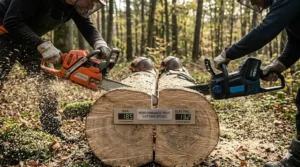
Power, Runtime, and Performance: Gas vs Electric Chainsaw Showdown
| Performance Factor | Gas (50–60cc class) | Battery (40–80V class) | Corded Electric |
|---|---|---|---|
| Time to full power | 3–10 seconds (warm engine) | Instant | Instant |
| Typical runtime | Unlimited (refuel in minutes) | 20–45 minutes per charge | Unlimited |
| Cut speed, hard wood | Fastest overall | Close behind top gas models | Slower than gas or battery |
| Cold-weather reliability | Can struggle to start | Unaffected by temperature | Unaffected by temperature |
The numbers make the chainsaw runtime comparison pretty stark: gas and corded electric both offer effectively unlimited working time, while even the best battery powered chainsaw asks you to plan around 20 to 45 minutes of real cutting before a recharge. What the table doesn’t fully capture is how that gap has shrunk — five years ago, top battery saws lagged gas models by a wide margin in raw cut speed, and now the best ones, like the EGO and Husqvarna entries above, are within a second or two of comparable gas saws on a standard cut test.
Noise, Emissions, and the Neighbor Test
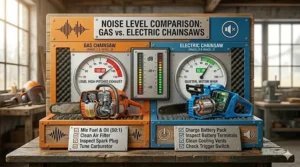
There’s a reason “is it loud” comes up in nearly every chainsaw review: gas saws routinely measure in the 95–105 decibel range at the operator’s ear, which is loud enough that hearing protection isn’t optional, it’s mandatory. Battery and corded models typically run 80–90 decibels, a meaningful enough drop that you can hold a shouted conversation nearby without permanent damage risk. If you live somewhere with tight property lines or noise ordinances, that gap alone can make the decision for you.
On the emissions side, small gas engines are regulated under EPA standards for small spark-ignition equipment, which have pushed two-stroke chainsaw engines toward cleaner combustion over the past two decades — but they still burn fuel and produce exhaust, full stop. A chainsaw emission free option simply means going electric: no tailpipe output, no fuel storage hazard, and no smell lingering on your clothes after an afternoon of cutting. For context on how chainsaws themselves evolved from this exact debate, the Wikipedia overview of chainsaw history is worth a skim.
Long-Term Cost and Maintenance: The Real Total Price
The sticker price is only the opening bid. A gas saw needs ongoing two-stroke fuel mix, periodic spark plugs, air filters, and the occasional carburetor service — modest individually, but it adds up over a saw’s working life. Battery saws trade that for a different cost: lithium packs degrade over roughly 3–5 years of regular use and eventually need replacing, often at a price that rivals a budget chainsaw outright.
| Cost Factor (5-Year Estimate) | Gas Chainsaw | Battery Chainsaw |
|---|---|---|
| Fuel / energy cost | Moderate, ongoing gas purchases | Low, electricity to recharge |
| Replacement parts | Spark plugs, filters, occasional carb kit | Eventual battery replacement |
| Routine maintenance time | Higher — mixing fuel, cleaning carb/filter | Lower — chain care only |
Chainsaw maintenance gas vs battery really comes down to this: gas demands more frequent small interventions, while battery demands one larger, less frequent expense down the road. Neither is free to own — anyone telling you a chainsaw is “maintenance-free” is selling you something.
Features That Actually Matter (and Marketing Hype That Doesn’t)
A tool-free chain tensioner is genuinely useful — you’ll adjust tension often, and not needing a wrench for it saves real time. An automatic oiler is similarly worth prioritizing, since under-lubricated chains are a leading cause of premature bar wear. A chain brake, whether inertia-activated on gas saws or electronic on battery models, is a non-negotiable safety feature, not an upsell.
What matters less than the spec sheet suggests: top-line voltage numbers on battery saws. A 40V saw with a well-matched motor and chain can outperform an 80V saw that’s poorly tuned, so chase independent cut-speed testing over marketing voltage claims. Similarly, horsepower claims on gas saws without matching bar length and chain type context don’t tell you much — a powerful engine paired with a dull, mismatched chain still cuts poorly.
Common Mistakes Buyers Make
Buying based on bar length alone is the single most common error — a longer bar without the engine or motor to drive it just means a slower, more strained cut. Skipping protective gear is another: chaps, eye protection, and hearing protection aren’t optional accessories, they’re part of using the tool safely. Plenty of first-time buyers also underestimate battery runtime, assuming a “45-minute” rating means 45 minutes of continuous cutting rather than 45 minutes of trigger time across an afternoon of intermittent use. And ignoring chain maintenance entirely — never sharpening, never checking tension — is the fastest way to make any chainsaw, gas or electric, perform like a much cheaper model.
Safety Features and Regulations You Shouldn’t Ignore
Chainsaws are dangerous tools regardless of power source, and OSHA’s safe chain saw operation guidelines lay out the baseline practices worth following even for backyard, non-professional use: keep both hands on the handles at all times, maintain secure footing, and never start a saw without the chain brake engaged. Cut-resistant leg protection and proper footwear aren’t overcautious — chainsaw injuries disproportionately affect the lower leg and off-hand precisely because those are the body parts closest to an unpredictable kickback. Whatever you buy from the list above, budget for the safety gear alongside it; it’s a small fraction of the saw’s price and the part you genuinely don’t want to skip.
❓ Frequently Asked Questions
❓ Is an electric chainsaw as powerful as a gas chainsaw?
❓ How long does a battery chainsaw run on one charge?
❓ Are electric chainsaws good for cutting down trees?
❓ How much does it cost to run a gas chainsaw vs an electric chainsaw?
❓ Do battery chainsaws need bar oil?
Conclusion
The gas vs electric chainsaw decision used to be a power-versus-convenience tradeoff with an obvious winner. In 2026, it’s closer to picking the right tool for the job in front of you. If you’re processing real firewood volume or felling trees on acreage, a gas saw like the Husqvarna 450 Rancher or Echo CS-590 still earns its noise and maintenance demands. If your cutting needs top out at storm cleanup, pruning, and the occasional mid-size tree, a battery saw like the EGO Power+ CS1815 or Husqvarna Power Axe 350i will likely outperform what you actually need, minus the carburetor headaches. And if your yard is genuinely small, there’s no shame in the WORX WG322 or CRAFTSMAN CMECS600 quietly doing exactly the job they’re built for.
Buy for your heaviest realistic job, prioritize the safety features over the flashy ones, and you’ll end up with a saw that handles whatever falls in your yard next.
✨ Don’t Miss These Exclusive Deals!
🔍 Ready to stop fighting that branch? Click through to any of the seven chainsaws above to check current pricing and availability, and pick the one that actually matches the wood you’re cutting — not just the one with the biggest number on the box.
Recommended for You
- Best Chainsaw for Homeowners in 2026: 7 Picks That Actually Deliver
- Garage Organization ROI: 7 Best Storage Upgrades That Boost Home Value 2026
- 10 Garage Organization Mistakes to Avoid in 2026
Disclaimer: This article contains affiliate links. As an Amazon Associate, I earn from qualifying purchases. If you purchase products through these links, we may earn a small commission at no additional cost to you.
✨ Found this helpful? Share it with your friends! 💬🤗
