
In This Article
Let’s be honest. Most homeowners don’t think about buying a chainsaw until a storm drops a 40-foot oak across their driveway and suddenly $400 doesn’t sound crazy at all. Or maybe you’ve been eyeing that scraggly cedar along the fence line for two years. Either way, you’re here — and you need real answers, not a spec sheet.
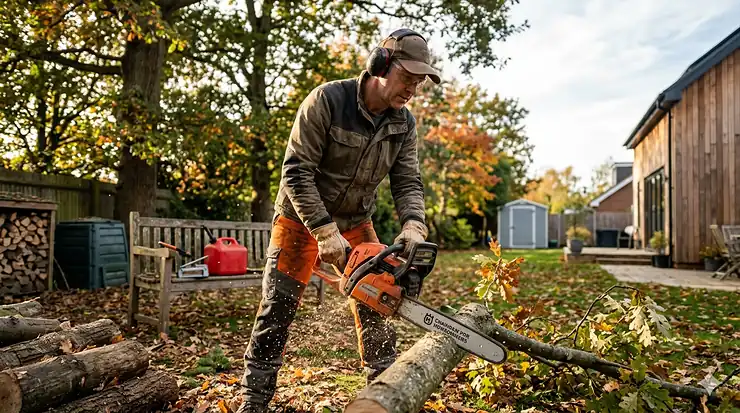
A chainsaw for homeowners occupies a very different space than what a professional logger reaches for. You’re not milling timber eight hours a day. You’re trimming overgrown branches, processing firewood for the fireplace, clearing storm debris, or finally taking down that tree your neighbors have been judging you for. That job calls for a tool that’s manageable, reliable, reasonably safe, and doesn’t require a mechanical engineering degree to maintain.
Here’s the thing the big-box stores won’t tell you: the “best” chainsaw for homeowners doesn’t exist in the singular. The right saw depends on three things — how often you’ll use it, what you’ll cut, and how comfortable you are around power equipment. Someone cutting a handful of small branches twice a year doesn’t need the same machine as someone with five wooded acres and a wood-burning stove to fill.
What is a chainsaw for homeowners? In short, it’s a consumer-grade saw designed for occasional to moderate use — typically featuring bar lengths between 12 and 20 inches, a motor or engine tuned for ease of startup over raw commercial output, and safety features that cater to less-experienced operators.
In this guide, we’ve tested, researched, and compared 7 real chainsaws currently available on Amazon — spanning gas, battery-powered, and corded electric — so you can find the one that matches your actual life, not just some theoretical homeowner archetype. We’ll also cover chainsaw safety (because the CDC reports around 36,000 chainsaw injuries a year, and nearly all of them are preventable), how to choose bar length, what engine CC actually means for you, and the gear checklist you absolutely cannot skip.
Quick Comparison Table: Top 7 Chainsaws for Homeowners at a Glance
| Model | Type | Bar Length | Power | Best For | Price Range |
|---|---|---|---|---|---|
| Husqvarna 455 Rancher | Gas | 20 in. | 55.5cc / 3.5 HP | Heavy-duty land clearing | $$$$ |
| EGO Power+ CS1613 | Battery | 16 in. | 56V / 40cc equiv. | Most homeowners | $$$ |
| DEWALT DCCS670T1 | Battery | 16 in. | 60V FlexVolt | DeWalt tool owners | $$$$ |
| Greenworks 80V GCS80420 | Battery | 18 in. | 80V / 45cc equiv. | Thick logs, large yards | $$$ |
| Oregon CS1500 | Corded | 18 in. | 15 Amp | Budget + near-outlet use | $$ |
| Husqvarna 130 | Gas | 16 in. | 38cc / 2 HP | Light occasional use | $$$ |
| EGO Power+ CS1201 | Battery | 12 in. | 56V compact | Women, beginners, pruning | $$ |
*Price ranges: $$ = under 200, $ $ = 200–$350, $ $$ = $350+*
Looking at this table, a few things jump out. Battery saws now dominate the homeowner sweet spot in both performance and variety — and the voltage numbers aren’t marketing fluff. The jump from 40V to 80V translates directly to faster chain speed through hardwood. If you already own tools from DeWalt or EGO, your battery decision may already be made for you. And for pure budget value with zero charging anxiety, the corded Oregon CS1500 still makes a compelling case.
💬 Just one click — help others make better buying decisions too! 😊
Top 7 Chainsaws for Homeowners: Expert Analysis
1. Husqvarna 455 Rancher — The Gold Standard for Serious Acreage Work
The Husqvarna 455 Rancher (model 965030298) is the chainsaw people talk about in hushed, reverent tones on every woodworking forum on the internet — and the reputation is mostly earned.
Engine & Bar: The 55.5cc X-Torq 2-cycle engine delivers 3.5 HP. That’s not just a number — what it means in practice is that this saw bites through 16-inch hardwood logs with authority, without bogging down the way smaller displacement engines do under load. The 20-inch bar handles trees up to 24 inches in diameter. Most homeowners will never need more bar than this.
What sets it apart: Husqvarna’s Air Injection system — a centrifugal air-cleaning mechanism — removes large debris particles before they reach the air filter. Translation: you’re cleaning that filter a lot less often, which matters if you’re doing extended storm cleanup. The LowVib anti-vibration system is genuinely effective; after 30 minutes of cutting, your hands feel it. With cheaper saws, you feel it in your teeth.
Expert take: This is the saw for homeowners who own serious acreage (more than 2 acres of wooded property), cut their own firewood seasonally, or deal with storm cleanup involving trees over 12 inches in diameter. What most buyers overlook is that the X-Torq engine reduces fuel consumption by up to 20% compared to earlier 2-stroke designs — meaning longer run times before you’re refueling. For occasional light pruning? This is overkill. But if you’re going to own one gas chainsaw for the next decade, this is the one.
Customer feedback: Buyers consistently praise the reliable Smart Start system and the durable build. Some note it’s heavier than expected for newer users at around 13.2 lbs without bar oil.
✅ 3.5 HP handles serious felling work
✅ Air Injection extends engine life dramatically
✅ Smart Start technology reduces pull effort
❌ Heavy — not ideal for prolonged overhead work
❌ Requires gas/oil mixing and regular maintenance
Price range: Around $380–$430. Worth every dollar if you need it.
👉 Check current price and availability on Amazon
2. EGO Power+ CS1613 — The Best Chainsaw for Most Homeowners, Full Stop
If you want one recommendation and nothing else, this is it. The EGO Power+ CS1613 is a 16-inch, 56V cordless chainsaw that comes with a 4.0Ah ARC Lithium battery and charger — and it punches startlingly hard for a battery saw.
Motor & Performance: The brushless motor is rated as equivalent to a 40cc gas chainsaw, with chain speeds reaching 20 m/s. That’s fast enough to make clean, efficient cuts through hardwood and softwood without the stuttering hesitation you get from underpowered cordless options. With the 4.0Ah battery, you can expect up to 220 cuts on a 4×4 — which translates to a solid afternoon of real yard work without recharging. Amazon
What sets it apart: Tool-free chain tensioning via a dial (twist and go, no wrenches), metal bucking spikes for log control, automatic oiling, and a kickback brake with a visible indicator. These are professional-quality features on a homeowner’s tool.
Expert take: The CS1613 makes the most sense for homeowners who cut occasionally — storm cleanup, small tree removal, seasonal firewood from rounds up to 14 inches — and want zero startup fuss. No choke, no prime, no pull cord agony. Push a button and cut. The 56V battery platform also plugs into over 70 other EGO tools (mowers, blowers, trimmers), so if you’re building an outdoor power collection, this ecosystem pays dividends.
Customer feedback: Users love the near-instant startup and quiet operation. A common observation: first-time chainsaw owners felt safe and in control thanks to the responsive brake system.
✅ Push-button start — no gas, no fumes, no pull cord
✅ Up to 220 cuts per charge with 4.0Ah battery
✅ Compatible with entire EGO 56V battery ecosystem
❌ 16-inch bar limits you to trees under ~14 inches in diameter
❌ Performance drops in sustained heavy cutting vs. gas
Price range: Around $230–$280 with battery and charger included. Exceptional value.
👉 Check current price and availability on Amazon
3. DEWALT DCCS670T1 — The Precision Choice for the DeWalt Tool Family
The DEWALT DCCS670T1 is a 16-inch, 60V MAX FlexVolt brushless chainsaw — and its headline feature has nothing to do with the saw itself. It’s the battery.
Battery Ecosystem: DeWalt’s FlexVolt system gives this chainsaw a unique advantage: the same battery powers both 20V MAX and 60V MAX tools. If you’re already running DeWalt 20V drills, impact drivers, or saws, the FlexVolt battery slides in and works, but when connected to the chainsaw, it steps up to deliver 60V performance. That’s genuinely clever engineering. Power Tool Insider
Performance: The 16-inch bar handles most homeowner cutting tasks without fuss — trimming, limbing, firewood processing from rounds up to 12–14 inches. The low-kickback chain and DeWalt’s tight quality control make it the choice if you want a chainsaw that behaves predictably during detailed cuts or working overhead. Power Tool Insider
Expert take: This saw is almost perfectly engineered for the homeowner who already has a garage full of DeWalt tools. If you’re not in that ecosystem, it’s still a premium option — but you’re paying for compatibility you’re not using. Where the DeWalt earns its keep is in precision and build consistency. It doesn’t feel like a consumer-grade afterthought; it feels like a tool.
Customer feedback: Buyers already in the DeWalt ecosystem rate it highly for seamless battery integration. Newcomers note the initial cost feels steep until they factor in shared battery savings.
✅ FlexVolt battery works across the entire 20V MAX ecosystem
✅ Predictable, low-kickback cutting behavior
✅ Professional DeWalt build quality
❌ 16-inch bar is limiting for large trees
❌ Premium pricing without existing DeWalt batteries
Price range: Around $300–$370 with battery and charger. A no-brainer if you’re DeWalt-committed.
4. Greenworks 80V GCS80420 — Maximum Cordless Power for Large Properties
The Greenworks 80V GCS80420 is the 18-inch, 80V brushless cordless chainsaw that proves battery power has genuinely grown up. It comes with a 2.0Ah battery and rapid charger.
Voltage & Performance: 80V is maximum cordless power territory. For dense hardwoods and extended cutting sessions, 80V delivers a noticeable torque advantage over 56V. The 18-inch bar extends your reach compared to most 16-inch competitors, allowing you to fell trees up to 16 inches in diameter comfortably. Greenworks claims power comparable to a 45cc gas chainsaw without the hassle of fumes. Power Tool InsiderGreenworks Tools
What sets it apart: The brushless motor is the unsung hero here. Unlike brushed motors that wear down over time and lose power, brushless motors maintain consistent output throughout their lifespan and run cooler. Add in the 18-inch bar and you get a machine that bridges the gap between light homeowner saws and genuine semi-professional capability.
Expert take: The Greenworks 80V makes the most sense for homeowners with large lots (2+ acres), frequent cutting needs, or who deal with hardwood species like oak and maple that eat through less powerful saws. Greenworks offers compatibility with 75+ tools in their 80V platform — similar logic to EGO, but at a slightly lower price point per tool. The 2.0Ah battery that ships with the GCS80420 is on the small side for extended sessions; plan on a second battery if you’re clearing serious acreage. Amazon
Customer feedback: Praised for its cutting speed through dense wood. The most common caveat: users wish the included battery were larger.
✅ 80V for maximum cordless torque through hardwoods
✅ 18-inch bar extends cutting capacity
✅ Compatible with 75+ Greenworks 80V tools
❌ Included 2.0Ah battery runs low quickly on big jobs
❌ Heavier than 16-inch competitors
Price range: Around $220–$280 with battery and charger. Outstanding power-per-dollar.
👉 Check current price and availability on Amazon
5. Oregon CS1500 — The Brilliant Budget Choice With a Trick Up Its Sleeve
Oregon’s high-power 15 amp CS1500 chainsaw is the first corded electric chainsaw on the market with a chain that can sharpen itself. That’s not a gimmick. That’s legitimately the single biggest maintenance headache of chainsaw ownership — solved. Amazon
The PowerSharp System: The CS1500 chainsaw’s integrated PowerSharp automatic sharpening system lets you sharpen your chain in 5 seconds or less with the pull of a single lever while the saw runs. Most homeowners never sharpen their chainsaw chain — they just wonder why it cuts slower and slower until it’s basically useless. The Oregon CS1500 eliminates that problem entirely. Amazon
Performance: The 15-amp, 18-inch corded electric delivers surprising cutting power — more than enough for limbs, moderate-sized logs, and light tree work within extension cord range. The CS1500 is silent between cuts, lightweight and ergonomically balanced for tree trimming and yard work. Amazon
Expert take: This is the perfect choice for anyone who wants unlimited runtime without the noise, fumes, and maintenance of a gas saw — if your cutting happens within 100 feet of an electrical outlet. That last part is the catch. The cord is a genuine limitation for large-property work. But for a suburban homeowner doing periodic maintenance — trimming storm debris, cutting back overgrown trees near the house, processing small firewood rounds — the CS1500’s cord is never a problem because you’re never far from an outlet anyway. At its price point, this saw represents extraordinary value. Finding Dulcinea
Customer feedback: Near-universal praise for the self-sharpening feature. Some users note chain replacement requires buying Oregon’s proprietary PowerSharp chain — keep that in mind.
✅ Self-sharpening chain in 5 seconds — game-changing for beginners
✅ Unlimited runtime — never recharge
✅ Lowest price of any quality 18-inch saw in this guide
❌ Corded — limits mobility on large properties
❌ Requires Oregon PowerSharp proprietary chain replacements
Price range: Around $130–$160. The best budget chainsaw for homeowners in 2026.
👉 Check current price and availability on Amazon
6. Husqvarna 130 — The Sensible Gas Option for Light Occasional Use
The Husqvarna 130 is a 38cc, 2-HP gas chainsaw with a 16-inch bar — the entry point into Husqvarna’s legendary gas lineup, and a more approachable alternative to the 455 Rancher for homeowners who need gas reliability without gas complexity.
Engine & Handling: At 38cc, this isn’t a powerhouse — but for trees under 14 inches and standard backyard maintenance, it doesn’t need to be. It weighs significantly less than the 455 Rancher, making it easier to control for extended sessions. Husqvarna’s Smart Start technology is present here too, reducing pull-cord effort substantially.
What sets it apart: The Husqvarna 130 is the rare gas saw that a beginner can start confidently on the first or second pull without a PhD in small-engine troubleshooting. The air purge removes air from the carburetor before starting — a small feature that makes a real-world difference on cold mornings. The i-30 starter technology decreases starting effort by 30%. Backyardcorner
Expert take: Choose the Husqvarna 130 over a battery saw when you live in a rural area with long power outages (batteries don’t help when the charger has no electricity), need a saw that’s always ready without a charge cycle, or already own and understand small gas engines. It’s not the cheapest option, but the Husqvarna brand reliability over a 10-year horizon is hard to beat for occasional gas-saw users. The 38cc engine handles light to moderate homeowner tasks comfortably but will bog down on sustained cuts through large hardwood logs — for that, step up to the 455 Rancher.
Customer feedback: Praised for its ease of starting and comfortable weight. Occasional users appreciate not needing to worry about battery charge before cutting.
✅ Gas reliability — starts even after sitting all winter
✅ Lighter and more maneuverable than higher-cc gas saws
✅ Smart Start + air purge = easy cold-morning startups
❌ 38cc limits it to trees under roughly 14 inches
❌ Requires gas/oil mix and regular carburetor maintenance
Price range: Around $250–$310. Good value for the homeowner who wants gas simplicity without the weight of a full rancher saw.
👉 Check current price and availability on Amazon
7. EGO Power+ CS1201 — The Best Lightweight Chainsaw for Women and Beginners
The EGO Power+ CS1201 is a 12-inch, 56V compact chainsaw — and it’s the saw a lot of guides ignore because it sounds too small. That’s a mistake.
Motor & Dimensions: The same 56V brushless motor technology from EGO’s larger saws, compressed into a 12-inch package that weighs dramatically less than anything else in this guide. The included 2.5Ah battery delivers up to 130 cuts on a 4×4 — more than enough for pruning sessions and light yard work.
What sets it apart: This is the best chainsaw under $300 in the lightweight category, and arguably the best entry point for someone who’s genuinely nervous around power saws. The 12-inch bar physically limits the types of cuts you can make in ways that prevent many beginner mistakes — you can’t easily attempt cuts you shouldn’t be attempting. The low weight means less fatigue, better control, and less intimidation.
Expert take: The CS1201 is the ideal first chainsaw for homeowners doing pruning, small branch removal, and occasional cutting of logs under 10 inches — particularly for women who find full-size saws unwieldy, or any beginner building confidence before stepping up. The entire 56V EGO battery is compatible across all EGO models, so this saw can be a stepping stone. Buy the CS1201 now, add a CS1613 later when your comfort and cutting needs grow — same battery, zero waste.
Customer feedback: First-time chainsaw owners consistently call it the least intimidating chainsaw they’ve ever used. Experienced users with small pruning tasks love the weight reduction.
✅ Lightest option in this guide — ideal for extended pruning
✅ 56V EGO battery shares across full ecosystem
✅ Best chainsaw for occasional use under $250
❌ 12-inch bar limits to logs under ~10 inches
❌ Not suitable for felling medium to large trees
Price range: Around $200–$250 with battery and charger. The smartest starter saw you can buy.
👉 Check current price and availability on Amazon
✨ Don’t Miss These Exclusive Deals!
🔍 Take your yard work to the next level with these carefully selected chainsaws. Click any highlighted model to check current pricing and availability. These tools will help you tackle outdoor projects with confidence — and finish them without calling a professional.
How to Choose a Chainsaw for Homeowners: 6 Criteria That Actually Matter
Most buying guides tell you to “consider your needs.” Not very helpful. Here’s what actually matters, ranked by importance.
1. Bar Length: Match It to Your Biggest Cutting Task
The bar length of your chainsaw should be about 2 inches longer than the widest diameter you’ll regularly cut. Cutting a 10-inch log? A 12-inch bar handles it easily. Felling 18-inch trees? A 20-inch bar with authority. What most homeowners get wrong is buying a bar that’s too large — a 20-inch bar on a low-power saw is like putting a trailer hitch on a golf cart. You want bar length and engine power to match.
Common homeowner bar lengths by task:
- 12 inches: pruning, branches under 10 inches
- 14–16 inches: light tree work, storm cleanup, firewood from small logs
- 18–20 inches: medium tree felling, larger firewood processing, land clearing
2. Gas vs. Battery vs. Corded: The Real Trade-offs
Gas wins on raw power and runtime independence. If you’re a quarter mile from an outlet with a dead battery and a storm-downed tree blocking your driveway, gas wins every time. Battery wins on convenience, startup ease, and maintenance-free operation — and has closed most of the power gap in the past two years. Corded wins on budget and uninterrupted runtime near structures. There’s no universally correct answer. There’s only the correct answer for your specific situation.
3. Engine CC (or Voltage): What the Numbers Mean
For gas saws, CC (cubic centimeters) measures engine displacement — bigger CC generally equals more power and fuel consumption. Under 40cc handles light homeowner work. 40–55cc covers most residential needs. Over 55cc approaches semi-pro territory. For battery saws, voltage is the better power indicator — 40V for light work, 56V for the homeowner sweet spot, 80V for heavy cutting. Amp-hours (Ah) determine runtime, not power. A 56V 5.0Ah battery runs longer than a 56V 2.0Ah, but neither is more powerful than the other.
4. Safety Features: Non-Negotiable Checklist
Chain brake: mandatory. This stops the chain in milliseconds during kickback. Low-kickback chain: standard on homeowner models. Front hand guard: protects against chain contact. Anti-vibration system: reduces long-term hand and arm fatigue. Never buy a saw that skimps on these.
5. Weight: Often Underestimated
Anything over 14 lbs gets heavy fast during sustained cutting. Battery saws typically run 10–13 lbs. Gas saws range from 9–15 lbs. Weight matters most for overhead pruning and extended sessions. If you’re cutting more than 30 minutes at a stretch, every pound counts.
6. Brand Ecosystem: Think Long-Term
If you already own a DeWalt drill and a DeWalt circular saw, the DCCS670 pays off immediately through shared batteries. Same logic applies to EGO. Think of your first battery platform purchase as an investment, not just a product decision.
Chainsaw Safety for Homeowners: The Gear Checklist You Cannot Skip
Let’s not sugarcoat this. According to the Centers for Disease Control and Prevention (CDC), hospitals report approximately 36,000 chainsaw-related injuries and deaths annually — almost all of them preventable. According to OSHA, roughly 40% of all chainsaw accidents occur to the legs, 35% occur to the left hand and wrist, and 1% of injuries result in amputation. Adirondack AlmanackAdirondack Almanack
The good news: the right protective gear dramatically reduces your risk. Here’s what you need before you make your first cut. For comprehensive safety guidelines, consult the CDC’s chainsaw safety resources and OSHA’s working safely with chainsaws guide.
The Complete Chainsaw Safety Gear Checklist:
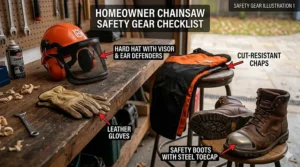
🪖 Helmet with face shield — Flying debris from a chainsaw doesn’t ask permission. A helmet with integrated face shield provides head and eye protection simultaneously.
👂 Hearing protection — Gas chainsaws run at 100+ decibels. Battery saws are quieter but still well above safe exposure levels for extended use. Earplugs or earmuffs every single time.
🧤 Cut-resistant gloves — Not regular work gloves. Chainsaw-rated gloves with cut-resistant material protect your left hand, the most common injury site. Look for CE Cat III Level E rating.
🦺 Chainsaw chaps or pants — These are the single most important piece of gear for homeowners. Cut-resistant pants or chaps and boots with metal reinforcement protect legs and feet — the most common injury zones. They’re not comfortable on a hot day. They’re also the difference between a scare and a hospital visit. Axeandanswered
👟 Steel-toed, cut-resistant boots — Regular work boots don’t cut it here. Chainsaw-specific boots or at minimum steel-toed with ankle coverage.
Behavioral Safety Rules (The Ones Beginners Skip):
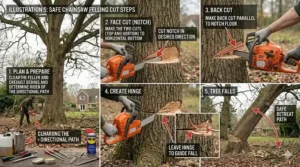
Never cut with the tip of the bar — that’s the kickback zone. Always plan your escape route before felling a tree. Never cut above shoulder height. Two hands on the saw, full stop. Keep bystanders at twice the tree height distance away.
Understanding kickback is essential. Kickback occurs when the teeth on the saw chain catch on something as they rotate around the tip of the bar — causing the bar to be thrown back violently toward the operator. It happens in a fraction of a second and is the primary cause of chainsaw fatalities. Adirondack Almanack
Real-World Scenarios: Which Chainsaw Matches Your Situation?
Different homeowners, different saws. Here are three real user profiles to help you self-identify.
Profile 1: The Suburban Homeowner on a Half-Acre Lot
Meet Sarah. She has a few ornamental trees, one dead maple she needs to take down, and winter storm branches to deal with twice a year. She’s never used a chainsaw. The right pick for Sarah is the EGO Power+ CS1201 as a starter, or the CS1613 if the maple in question has a trunk over 10 inches. Push-button start, lightweight, safe, and zero gas maintenance fits her usage pattern perfectly. Budget: under $280.
Profile 2: The Rural Homeowner With Wooded Acreage
Meet Mike. He heats his home with a wood-burning stove and spends several weekends a year cutting, splitting, and stacking firewood. He deals with oak and hickory. Gas is the right call here — specifically the Husqvarna 455 Rancher, which won’t bog down through seasoned hardwood and will outlast cheaper alternatives by a decade with proper maintenance. Budget: around $400 plus maintenance costs.
Profile 3: The Property Owner Who Already Owns a DeWalt Tool Collection
Meet Jennifer. She has a half-acre suburban yard, a garage full of DeWalt 20V MAX tools, and a few large branches she needs to tackle twice a year. The DEWALT DCCS670T1 is her obvious choice — the FlexVolt battery she might already own powers her chainsaw too. No new ecosystem cost, familiar tool brand, excellent precision. Budget: $300–$370 (potentially less if she already owns the FlexVolt battery).
Chainsaw Bar Length Guide: What Nobody Explains Clearly Enough
Here’s the bar length breakdown in plain language, free from the vague “it depends” answers that plague most guides.
12-inch bar: The lightest and easiest to control. Perfect for pruning branches, cutting small logs under 10 inches, and any overhead work where weight and precision matter more than brute force. This is the best lightweight chainsaw for women or anyone building their first experience with power saws.
14–16-inch bar: The homeowner sweet spot. Handles the vast majority of residential tasks — storm cleanup, removing trees up to 14 inches in diameter, processing firewood from medium-sized logs. Nearly every battery chainsaw in this guide lands here, and for good reason.
18-inch bar: For homeowners straddling the line between residential and serious. You’re now felling trees up to 16 inches with ease and processing larger firewood rounds efficiently. Requires a more powerful motor to avoid bogging down.
20-inch bar: The ceiling for homeowner use. At this bar length, you’re in the territory of the Husqvarna 455 Rancher — a real workhorse that demands a 55cc+ engine to not turn cutting into a slow, frustrating struggle.
One more thing: bar length and maximum cutting diameter aren’t the same. A 16-inch bar can cut a log that’s actually 14 inches wide — the bar needs to reach past center on both sides of the cut. Plan accordingly.
Common Mistakes Homeowners Make When Buying a Chainsaw
These come up constantly in the comments sections and forums, and they’re entirely avoidable.
Mistake #1: Buying a bar that’s too long for the engine. An 18-inch bar on a 38cc engine creates a saw that works sluggishly and fatigues fast. Match bar length to engine power, as outlined above.
Mistake #2: Ignoring the battery platform. People buy a random battery chainsaw without checking whether the battery is compatible with other tools they own or might buy. This is a long-term cost mistake. Platform ecosystems (EGO 56V, DeWalt FlexVolt, Greenworks 80V) are real and valuable.
Mistake #3: Skipping the safety gear. Searching for “chainsaw safety gear checklist” should be the second thing you do after buying a saw. The first is not starting the saw until you’ve bought the gear.
Mistake #4: Buying gas when they’ll use it twice a year. Gas engines that sit for months develop carburetor problems. If you’re not cutting regularly, a battery saw that sits dormant between uses without degrading is smarter and cheaper in the long run.
Mistake #5: Confusing cheap with budget-friendly. A $79 no-name chainsaw from an unheard-of brand isn’t budget-friendly — it’s an underpowered, safety-compromised tool that will disappoint you in its first real use and potentially injure you. The Oregon CS1500 at $130–$160 is budget-friendly. The unknown brand at $79 is a gamble.
Gas vs. Battery Chainsaw for Homeowners: The Definitive Breakdown
The debate that never dies. Gas chainsaws still hold advantages for professional loggers and anyone cutting continuously for hours. But for the homeowner who needs a chainsaw a few times a year, battery wins on almost every metric. Power Tool Insider
| Factor | Gas | Battery | Corded |
|---|---|---|---|
| Startup | Pull cord / choke ritual | Push button instant | Push button instant |
| Runtime | Unlimited (carry fuel) | 45–90 min per charge | Unlimited |
| Power | Highest | High (80V approaches gas) | High |
| Maintenance | Frequent | Minimal | Minimal |
| Noise | Loud (100+ dB) | Moderate (70–80 dB) | Moderate |
| Weight | Medium–Heavy | Medium | Lightest |
| Mobility | Full | Full | Cord-limited |
| Cold weather | Performance drops | Minimal effect | No effect |
| Long-term cost | Higher (fuel, maintenance) | Lower | Lowest |
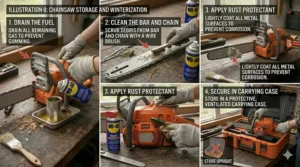
The analysis here is nuanced. Battery saws need chain sharpening, bar oil, and occasional tension adjustment — but they skip the oil changes, air filter cleanings, spark plug checks, carburetor cleanings, and fuel stabilizer requirements that gas saws demand. For a homeowner who cuts 5–10 times a year, that’s a meaningful difference in time and cost. Power Tool Insider
The tipping point toward gas: if you’re felling trees regularly over 16 inches, cutting for more than 2 hours continuously, or working in remote locations far from charging options.
Long-Term Cost & Maintenance: What Owning a Chainsaw Actually Costs You
The sticker price is only the beginning. Here’s what the first three years actually look like for each type.
Gas chainsaw (e.g., Husqvarna 455 Rancher):
Initial cost: $380–$430. Annual fuel (assuming moderate use): $20–$40. Bar and chain oil: $15–$20/year. Air filter, spark plug replacement: $15–$25/year. Chain sharpening or replacement: $20–$40/year. Year 3 total cost of ownership: roughly $500–$560. However, a well-maintained gas saw lasts 15+ years. Amortized over time, it becomes excellent value.
Battery chainsaw (e.g., EGO CS1613):
Initial cost: $230–$280. Annual bar oil: $15/year. Chain replacement (every 1–2 years): $20–$35. No fuel, no spark plugs, no carburetor cleaning. Year 3 total: roughly $310–$360. Battery longevity is the wildcard — EGO’s ARC Lithium batteries are rated for 1,500+ charge cycles, which for most homeowners is effectively lifetime service.
Corded electric (e.g., Oregon CS1500):
Initial cost: $130–$160. Bar oil: $15/year. PowerSharp chain (proprietary): $25–$35 when replacement needed. Year 3 total: roughly $200–$250. The absolute lowest total cost of ownership in this guide.
The verdict: if you’re cutting fewer than 20 times a year, battery or corded electric wins on cost. If you’re cutting weekly or processing serious firewood volume, gas pays off over 5+ years through superior longevity under sustained use.
✨ Don’t Miss These Exclusive Deals!
🔍 Ready to upgrade your outdoor tool game? Click on any highlighted chainsaw in this guide to check current pricing and availability. These are the real tools we’d recommend to a neighbor — tested, researched, and worth every dollar.
FAQ: Chainsaw for Homeowners
❓ What is the best chainsaw for occasional use as a homeowner?
❓ What chainsaw bar length do I need for cutting down trees?
❓ Is a battery chainsaw powerful enough for cutting down trees?
❓ What safety gear do I need before using a chainsaw?
❓ What's the best lightweight chainsaw for women or beginners?
Conclusion: The Right Chainsaw Is the One You’ll Actually Use Safely
Here’s what it comes down to. A chainsaw sitting in your garage because it’s too heavy, too complicated to start, or too intimidating to use safely is a $400 waste. The best chainsaw for homeowners isn’t the most powerful one — it’s the one that fits your skills, your property, and your maintenance tolerance, with the safety gear to match.
For most suburban homeowners: the EGO Power+ CS1613. For budget-conscious homeowners near an outlet: the Oregon CS1500. For serious acreage and firewood cutting: the Husqvarna 455 Rancher. For existing DeWalt users: the DCCS670T1. For beginners and pruning-focused homeowners: the EGO CS1201.
Whatever you choose, buy the safety gear first. Chainsaw work is genuinely rewarding — there’s something deeply satisfying about felling a tree, processing the wood, and stacking it yourself. It’s also unforgiving when things go wrong. Respect the tool, wear the gear, and read the manual before you pull any trigger.
For further reading on chainsaw safety best practices, the New York State Department of Health’s Chainsaw Safety for Homeowners guide is a concise, practical resource worth bookmarking.
✨ Don’t Miss These Exclusive Deals!
🔍 Found your perfect chainsaw? Click the highlighted models above to check current pricing and real-time availability on Amazon. Your next yard project is one good tool away.
Recommended for You
- Garage Organization ROI: 7 Best Storage Upgrades That Boost Home Value 2026
- 10 Garage Organization Mistakes to Avoid in 2026
- 7 Best Garage Storage for Apartment Dwellers (2026 Guide)
Disclaimer: This article contains affiliate links. As an Amazon Associate, I earn from qualifying purchases. If you purchase products through these links, we may earn a small commission at no additional cost to you.
✨ Found this helpful? Share it with your friends! 💬🤗
