
In This Article
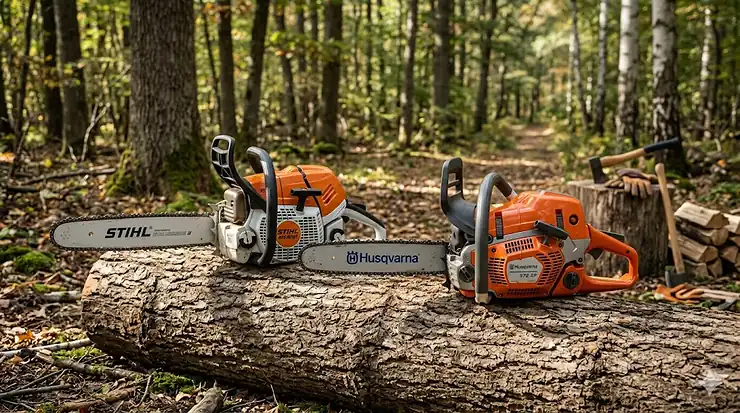
Ask ten old-timers at a sawmill which brand they trust and you’ll get ten confident, slightly different answers — and at least one story about a chainsaw that “just wouldn’t die.” That’s the territory we’re stepping into. The stihl vs husqvarna debate isn’t marketing fluff; it’s a genuine split in engineering philosophy that’s been simmering since both companies started building two-stroke power tools generations ago.
Here’s the part most articles skip: you can’t actually shop the two brands the same way. Husqvarna sells its full homeowner and mid-pro lineup straight through Amazon. Stihl, famously, doesn’t — the company protects its dealer network so tightly that most of its gas saws never touch an online marketplace. That single fact changes how you should approach this whole comparison, and we’ll unpack exactly what it means for your wallet and your warranty.
Below, you’ll get a no-nonsense look at seven real, currently available saws (plus one notable third option that deserves a seat at the table), a breakdown of what separates orange from red beyond paint color, and a decision framework so you’re not just guessing based on which brand your neighbor mentioned at a barbecue. Let’s get into it.
What Is the Real Difference Between Stihl and Husqvarna?
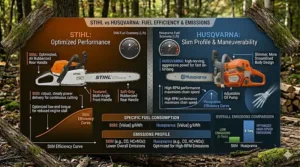
Stihl and Husqvarna are the two dominant chainsaw manufacturers in the world, both German-Swedish heritage brands known for two-stroke engine engineering, but they differ most in distribution and ergonomics: Stihl sells primarily through authorized dealers and emphasizes engine refinement (M-Tronic, Quickstop braking), while Husqvarna sells widely online and leans on X-Torq fuel efficiency and lighter-weight designs for homeowners.
Quick Comparison Table
| Category | Stihl | Husqvarna |
|---|---|---|
| Amazon availability | Limited (mostly battery models) | Full homeowner/mid-pro lineup |
| Engine tech | M-Tronic auto-tuning (pro models) | X-Torq low-emission 2-stroke |
| Best known for | Engine durability, dealer support | Value, fuel efficiency, ergonomics |
| Entry price range | Mid-$200s and up (in-store) | Roughly $180–$220 range |
| Warranty (homeowner use) | Typically 1–2 years | Typically 2 years |
If you’re shopping purely on Amazon, this table already tells you something important: your practical choice set skews Husqvarna, not because it’s the “better” engineering, but because of where each brand chooses to sell. Stihl’s dealer-only strategy means better in-person setup and tuning help, but it also means more friction if you just want to click “buy now” tonight. Husqvarna’s online-first approach trades a little of that hands-on dealer relationship for convenience and, often, a lower entry price.
💬 Found a model you like already? One click helps you compare current pricing — and helps other readers make smarter buying decisions too. 😊
Top 7 Stihl, Husqvarna, and Echo Chainsaws: Expert Analysis
1. Husqvarna 120 Mark III
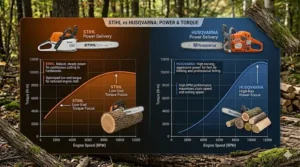
The Husqvarna 120 Mark III is the saw I point beginners toward more than almost any other. It’s a 38cc gas chainsaw with a 14- or 16-inch bar, built around the brand’s X-Torq engine. That engine spec isn’t just a number on a box — X-Torq’s stratified scavenging design means it burns roughly 20% less fuel and emits noticeably less exhaust than older two-stroke designs, which matters if you’re the one breathing over the saw all afternoon.
What most first-time buyers overlook about a saw this size is that it’s not trying to be a felling machine — it’s a firewood-and-pruning tool, and that’s exactly where it shines. Owners consistently mention easy starting and manageable weight as the standout traits, with the most common complaint being that the bar length tops out too early for anyone doing serious bucking.
✅ Pros: Easy pull-start, light enough for all-day pruning, budget-friendly
❌ Cons: Underpowered for trees over a foot thick, smaller fuel tank
Price range: under $230. Verdict: the best “first chainsaw” on this list, full stop.
2. Husqvarna 135 Mark II
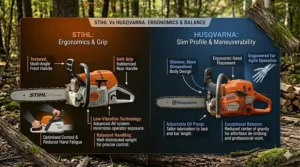
Step up slightly and you land on the Husqvarna 135 Mark II, another 38cc X-Torq saw but with a longer 16-inch bar and a few ergonomic tweaks — most notably an air injection system that filters out larger debris before it reaches the air filter, which in practice means fewer mid-season filter cleanings.
The real-world story here is durability for the price. This is the saw I’d recommend to someone clearing storm debris twice a year rather than someone running it daily. It won’t out-cut a professional saw, but it will start on the second pull in October after sitting in the shed since June, which is worth more to most homeowners than raw horsepower.
✅ Pros: Reliable cold starts, low-maintenance air filtration, comfortable grip
❌ Cons: Same power ceiling as the 120, not built for daily commercial use
Price range: $230–$280. A smart upgrade pick if you want a little more bar without jumping brackets entirely.
3. Husqvarna 450 Rancher
This is the saw that built Husqvarna’s homeowner reputation, and it’s not close. The 450 Rancher runs a 50.2cc, 3.2-HP X-Torq engine on a 20-inch bar, and the spec that actually matters here is the Smart Start system paired with an inertia-activated chain brake — together they mean you’re not yanking the cord six times in the cold, and you’ve got a real safety mechanism if the saw kicks back.
What the spec sheet won’t tell you: this saw genuinely bridges homeowner and small-property-pro use. I’ve watched people fell 12-inch trees and split a winter’s worth of firewood with the same 450 Rancher, and it didn’t complain. The LowVib technology actually reduces forearm fatigue noticeably compared to the smaller models above — you’ll feel the difference after twenty straight minutes of cutting.
✅ Pros: Genuinely versatile power, comfortable for extended sessions, easy starting
❌ Cons: Heavier than entry models, overkill for light pruning
Price range: roughly $350–$430 range. This is the one most “best overall” lists land on, and for once, they’re right.
4. Husqvarna 455 Rancher
The 455 Rancher is the 450’s slightly beefier sibling — same Rancher DNA, bumped up to a 55cc, 3.5-HP engine, still on a 20-inch bar with an automatic oiler. The jump in displacement translates to noticeably faster cuts through dense hardwood, which matters more than people expect once you’re past softwood firewood and into oak or hickory territory.
In practice, this is the saw for someone who already owns a 450-class saw and outgrew it, rather than a true beginner pick. The added weight is real, and a smaller user will feel it by the end of a long cutting session. But if your property has serious hardwood on it, the extra torque pays for itself in time saved per log.
✅ Pros: Strong hardwood performance, durable build, automatic oiling
❌ Cons: Noticeably heavier, more fuel-hungry than the 450
Price range: $400–$480 range. Best for: hardwood-heavy properties and semi-frequent use.
5. Husqvarna 460 Rancher
At the top of the Rancher line sits the 460 Rancher, a 60.3cc, 3.6-HP gas saw with a 24-inch bar and an automatic, adjustable oil pump. This is the saw for people who’ve decided firewood season is basically a part-time job. The adjustable oiler is the detail worth knowing about — you can dial lubrication up for hardwood or down for softer cuts, which extends both bar and chain life if you actually use the feature instead of ignoring it.
The honest take: most homeowners don’t need a 24-inch bar. If you’re cutting trees wider than 20 inches regularly, you’ll appreciate it. If you’re not, the extra weight and fuel consumption are just along for the ride. This is a “buy once” saw for someone clearing acreage, not a casual yard tool.
✅ Pros: Serious cutting capacity, adjustable oiling, built for repeated heavy use
❌ Cons: Heavy, more saw than most homeowners need, higher fuel use
Price range: $450–$550 range. Best for: land clearing, large hardwood, frequent heavy users.
6. Stihl MSA 120 C-BQ Battery Chainsaw
Here’s where the Stihl-on-Amazon story gets interesting. The Stihl MSA 120 C-BQ is a cordless, battery-powered saw with a quick-tensioning chain and Stihl’s QuickStop Super brake — a chain brake responsive enough to engage from hand pressure or sudden kickback inertia. It’s quiet enough that you genuinely don’t need hearing protection, which sounds minor until you’ve used a gas saw for an hour and your ears are still ringing at dinner.
What most buyers overlook: this isn’t a substitute for a gas Rancher-class saw. It’s a precision tool for garden work, small branch cleanup, and quick jobs where hauling out a gas saw feels like overkill. It’s also, notably, one of the only ways to buy genuine Stihl engineering without finding a dealer — which says something about how Stihl segments its product line for online sale.
✅ Pros: Whisper-quiet, no mixing fuel, genuine Stihl chain brake tech
❌ Cons: Limited runtime per charge, not built for felling or heavy bucking
Price range: $180–$230 range (bare tool/set pricing varies). Best for: light-duty Stihl loyalists who don’t want to chase a dealer.
7. Echo CS-590 Timber Wolf
We’re including a non-Husqvarna, non-Stihl wildcard because, frankly, leaving it out of a serious comparison would be doing you a disservice. The Echo CS-590 Timber Wolf is a 59.8cc, professional-grade gas saw built for genuine all-day commercial use, backed by an unusually strong 5-year consumer warranty (1-year commercial) — longer than what either German or Swedish competitor typically offers at this tier.
The detail that matters in practice: Echo’s tool-less, two-piece air filter combined with its pre-cleaner system meaningfully extends the interval between filter services, which is a real time-saver if you’re running the saw commercially rather than seasonally. It cuts in the same performance class as the 455/460 Rancher and gives you a genuine third option if brand loyalty isn’t the deciding factor.
✅ Pros: Exceptional warranty, commercial-grade durability, low-maintenance filtration
❌ Cons: Heavier than comparable Husqvarna models, less brand cachet for resale
Price range: $400–$480 range. Best for: buyers prioritizing warranty length and daily-use durability over brand name.
Top 7 Products Comparison
| Model | Bar Length | Engine/Power | Best For |
|---|---|---|---|
| Husqvarna 120 Mark III | 14–16″ | 38cc gas | Beginners, light pruning |
| Husqvarna 135 Mark II | 16″ | 38cc gas | Occasional storm/yard cleanup |
| Husqvarna 450 Rancher | 20″ | 50.2cc gas | All-around homeowner use |
| Husqvarna 455 Rancher | 20″ | 55cc gas | Hardwood-heavy properties |
| Husqvarna 460 Rancher | 24″ | 60.3cc gas | Land clearing, heavy use |
| Stihl MSA 120 C-BQ | 12–14″ | Battery | Quiet, light garden work |
| Echo CS-590 Timber Wolf | 20–24″ | 59.8cc gas | Daily commercial-grade use |
Looking at the spread above, the Husqvarna 450 Rancher remains the default recommendation for a reason — it sits right at the inflection point where power and weight balance out for most properties. But if warranty length is your priority, the Echo CS-590 quietly outguns both major brands on paper. Buyers who only want Stihl specifically should know they’re choosing from a narrower, battery-skewed slice of the brand’s actual catalog when shopping online.
Buyer’s Decision Framework
Before you scroll back up and just pick the most expensive option, run through this:
- If you’re cutting firewood occasionally and nothing wider than 14 inches → choose a Husqvarna 120 or 135-class saw, because anything bigger is dead weight you’ll resent carrying.
- If you own actual acreage with hardwood trees → choose the 455 or 460 Rancher, because underpowered saws on dense wood just mean more time and more bar wear.
- If noise, fuel mixing, or HOA rules are a real constraint → choose the Stihl MSA 120 C-BQ, because a battery saw solves problems gas simply can’t.
- If warranty coverage outweighs brand prestige for you → choose the Echo CS-590, because five years of consumer coverage is hard to argue with on paper.
This isn’t about which brand “wins.” It’s about matching the tool to the job in front of you, which is the single most common mistake we’ll cover next.
Real-World Scenarios: Who Actually Buys What
Picture three different garages. First, there’s the suburban homeowner with a quarter-acre lot and one big maple that drops limbs every winter storm — that’s a 120 Mark III owner, full stop, and anything bigger just sits unused most of the year. Second, there’s the rural family on five wooded acres heating partly with a wood stove — they’re buying a 450 or 455 Rancher, because that saw will see real, regular work from October through March. Third, there’s the weekend land-clearing crew prepping a lot for a cabin build — they want the 460 Rancher or the Echo CS-590, because they’re measuring productivity in cords per day, not convenience.
None of these buyers should swap saws with each other. The land-clearing crew with a 120 Mark III would be miserable by lunchtime; the suburban homeowner with a 460 Rancher would be lugging around eight pounds of unnecessary saw for a job that needed half that.
How to Choose Between Stihl and Husqvarna
- Start with your actual cutting frequency — weekly use justifies more saw than twice-a-year storm cleanup.
- Measure your largest typical log diameter — a bar should generally exceed that diameter by a couple of inches for clean, single-pass cuts.
- Decide if dealer access matters to you — Stihl’s gas lineup means finding a local dealer; Husqvarna’s online catalog means skipping that step entirely.
- Factor in storage and fuel logistics — if mixing two-stroke fuel is a dealbreaker, a battery saw like the MSA 120 C-BQ removes that friction completely.
- Check warranty terms before brand loyalty — as the Echo CS-590 proves, the “other” brand sometimes covers you longer.
- Price the chain and bar replacements, not just the saw — ongoing costs add up faster than the upfront price suggests.
- Buy slightly more saw than you think you need, not double — underpowered saws strain and overheat; wildly oversized saws just fatigue you for no benefit.
Common Mistakes When Buying a Chainsaw
The single biggest mistake is buying based on bar length alone, as if a 20-inch bar is automatically “better” than a 16-inch one. Bigger bars add weight and reduce maneuverability for jobs that didn’t need the extra reach in the first place. The second mistake is ignoring chain pitch and gauge compatibility when buying replacement chains — an Oregon-brand chain rated for the wrong pitch won’t fit properly even if the box looks similar enough on a store shelf. The third, and most expensive, mistake is skipping basic maintenance like air filter cleaning and chain tensioning, which quietly shortens engine life on every gas model listed above, Stihl, Husqvarna, or Echo alike.
Features That Actually Matter (And Ones That Don’t)
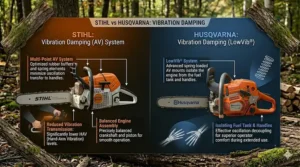
Automatic oiling matters enormously — it’s the difference between a chain that lasts a season and one that seizes mid-cut. Adjustable oiling, found on the 460 Rancher, matters less for casual users but genuinely extends bar life for anyone switching between hardwood and softwood regularly. Anti-vibration systems like Husqvarna’s LowVib matter a lot if you’re cutting for more than fifteen minutes at a stretch — forearm fatigue is real and underrated.
What matters less than marketing suggests: top-end chain speed specs. Beyond a certain threshold, raw chain speed makes almost no practical difference for homeowner-scale cutting; it’s a number that sounds impressive on a comparison table but rarely changes how fast you actually finish a job.
Stihl vs Husqvarna: Dealer Support and Why It Matters
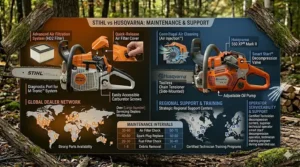
This is the section most chainsaw dealer support comparisons gloss over. Stihl’s selective distribution model means that when something goes wrong, you’re typically walking into a real shop where someone has likely serviced hundreds of the exact saw you’re holding. That’s genuinely valuable for warranty claims and tricky carburetor adjustments. Husqvarna’s broader retail and online presence means faster, easier purchasing, but warranty service sometimes routes through a mail-in process or a less specialized big-box service counter, depending on where you bought it.
Neither approach is objectively superior — it’s a tradeoff between convenience now and hand-holding later. If you’re mechanically confident and just want a saw that runs, Husqvarna’s distribution model removes friction. If you want a relationship with a shop that’ll tune your carb for free at year three, Stihl’s dealer network earns its reputation.
Long-Term Cost, Warranty, and Resale Value
A chainsaw brand warranty comparison usually favors whichever company is currently running a promotion, so look past the marketing and at the baseline terms: homeowner-use coverage on most gas Husqvarna models runs around two years, while Stihl’s standard consumer terms are typically shorter for residential use — though commercial-rated saws like the Echo CS-590 can outpace both with that five-year consumer warranty mentioned earlier.
Chainsaw resale value tends to favor Stihl on the secondhand market, somewhat independent of condition, simply because of brand reputation among buyers who already own Stihl bars and chains. Husqvarna saws hold value reasonably well too, particularly Rancher-series models, since they’re recognizable and parts are easy to source. Either way, routine maintenance — chain sharpening, oil changes, air filter care — affects resale price more than brand ever will; a neglected Stihl sells for less than a well-kept Husqvarna every time.
Chains, Bars, and Aftermarket Parts: Oregon vs OEM
Every saw on this list eventually needs a replacement chain, and this is where an Oregon chainsaw chain enters the conversation. Oregon is a major third-party manufacturer producing chains compatible with most Stihl, Husqvarna, and Echo bar setups, often at a noticeably lower price than OEM replacements. The tradeoff is mostly about consistency: OEM chains are matched precisely to that manufacturer’s bar and sprocket tolerances, while Oregon chains require careful attention to pitch, gauge, and drive-link count to get a proper fit.
For casual users, a quality Oregon chain is a perfectly reasonable, budget-friendly choice. For anyone running a saw commercially day after day, sticking with OEM chains tends to mean fewer tensioning surprises mid-job — a small reliability premium that’s worth paying for once your time has a dollar value attached to it.
Practical Usage Guide: Getting the Most From Your New Saw
Before the first cut, run through a quick checklist: confirm chain tension by lifting the chain at mid-bar — it should sit snug but still pull freely by hand. Mix two-stroke fuel at the exact ratio listed in your manual (most modern Husqvarna and Echo models specify 50:1), since incorrect ratios are the single fastest way to damage a new engine. For the first few tanks, avoid running the saw at full throttle continuously; a brief break-in period helps seat internal components properly.
Ongoing maintenance is simpler than people expect: clean or replace the air filter every 10–15 hours of use, check bar oil levels every fueling, and have the chain professionally sharpened (or learn to do it yourself with a proper file guide) once cutting performance noticeably drops. According to the U.S. Occupational Safety and Health Administration, proper personal protective equipment can prevent or lessen the severity of injuries to workers using chain saws, and that applies just as much in a backyard as on a job site — hearing protection, eye protection, and chainsaw chaps aren’t optional extras, they’re the difference between a close call and a hospital visit. For the full federal guidance, see OSHA’s chainsaw safety resources.
What to Expect: Real-World Performance
On paper, the difference between a 50cc and a 60cc saw looks modest. In practice, that gap shows up as the difference between a clean three-second cut through a 10-inch log and a labored eight-second grind that overheats the chain. Battery saws like the MSA 120 C-BQ feel dramatically different in hand — near-silent, vibration-light, instant-on — but you’ll notice runtime anxiety creep in around the 30-minute mark of continuous cutting, which gas saws simply don’t have to think about.
Cold-weather starting is where homeowner gas saws separate from each other most visibly. Smart Start systems, found across the Husqvarna lineup, genuinely reduce the number of pulls needed on a 20-degree morning compared to older carbureted designs — a small thing that matters enormously the one time you actually need the saw working right now.

Frequently Asked Questions
❓ Is Husqvarna or Stihl better for a homeowner?
❓ Can you buy Stihl chainsaws on Amazon?
❓ What size chainsaw bar do I actually need?
❓ How often should chainsaw chains be replaced?
❓ Are Oregon chainsaw chains as good as OEM chains?
Conclusion
There’s no universal winner in the stihl vs husqvarna debate, and honestly, anyone promising you one is oversimplifying. What you actually have are two different philosophies: Husqvarna optimized for accessibility, fuel efficiency, and a buying process that doesn’t require leaving your couch, while Stihl bet on dealer relationships and engine refinement at the cost of online convenience. Both bets paid off, which is exactly why both brands are still standing after all these decades.
For most readers landing on this comparison, the Husqvarna 450 Rancher remains the smartest single purchase — it’s versatile, well-supported, and genuinely available without hunting down a dealer. If brand loyalty to Stihl runs deep and your needs are lighter-duty, the MSA 120 C-BQ scratches that itch without the dealer chase. And if you’re open-minded about which name is on the housing, the Echo CS-590’s warranty alone makes it worth a serious look. As internal combustion engines used in equipment like these continue evolving under tightening emissions rules, the practical gap between brands keeps narrowing — which, frankly, makes this an unusually good time to buy regardless of which logo you end up with. The two-stroke engines powering most of these saws complete a full power cycle in two strokes of the piston rather than four, a design choice (you can read more on Wikipedia’s two-stroke engine page) that’s stayed remarkably durable even as regulations around it have tightened.
✨ Don’t Miss These Exclusive Deals!
🔍 Take your chainsaw shopping to the next level with the models covered above. Click through to check current pricing and availability before you decide — a few minutes of comparison now saves real money later!
Recommended for You
- Gas vs Electric Chainsaw 2026: 7 Top Picks Worth Buying
- Best Chainsaw for Homeowners in 2026: 7 Picks That Actually Deliver
- Garage Organization ROI: 7 Best Storage Upgrades That Boost Home Value 2026
Disclaimer: This article contains affiliate links. As an Amazon Associate, I earn from qualifying purchases. If you purchase products through these links, we may earn a small commission at no additional cost to you.
✨ Found this helpful? Share it with your friends! 💬🤗
