
In This Article
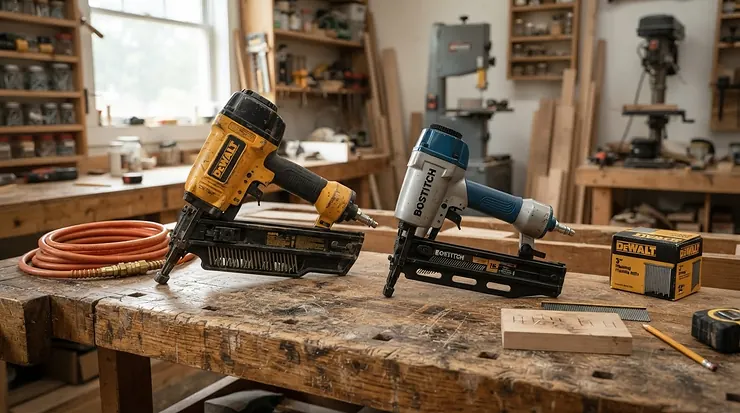
Standing in the tool aisle staring at a wall of nailers is its own special kind of paralysis. Do you grab the pneumatic one with the coiled hose that looks like it belongs in a dentist’s office, or the cordless model that promises freedom but costs twice as much? The pneumatic vs cordless nail gun decision trips up first-time DIYers and seasoned trim carpenters alike, mostly because both camps have genuinely good arguments. A nail gun is simply a driving tool that uses compressed air, battery power, or a combustible fuel cell to fire fasteners into wood, and that power source is exactly what separates a $70 weekend-warrior tool from a $400 job-site workhorse — you can dig into the mechanics of how each type works in this overview of nail gun technology.
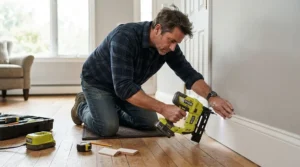
Here’s the short version before we get into specifics: pneumatic nailers are lighter, cheaper, and fire faster, but they chain you to a compressor and 50 feet of hose. Cordless nailers — whether battery powered nail gun models or the hybrid gas-and-battery Paslode design — let you climb a ladder or crawl under a deck without dragging anything behind you, at the cost of weight, battery management, and a steeper up-front price. Neither format is objectively “better.” The right pick depends on whether you’re framing a shed once a year or trimming out three houses a month.
Below, we’ll walk through seven real nailers spanning pneumatic, cordless, and gas-hybrid designs — framing guns, finish nailers, and brad nailers alike — with honest analysis of where each one earns its price tag and where it falls short.
Quick Comparison: Pneumatic vs Cordless Nail Gun at a Glance
| Feature | Pneumatic | Cordless (Battery) | Cordless (Gas + Battery) |
|---|---|---|---|
| Setup time | Slower — needs compressor + hose | Fastest — grab and go | Fast, but fuel cell needs occasional swap |
| Weight | Lightest tool-in-hand | Heaviest (battery adds bulk) | Mid-weight |
| Running cost | Air + oil, very low per-nail cost | Battery replacement over years | Battery + fuel cell refills |
| Best for | High-volume framing, shop use | Remodels, punch-list work, roofs | Trim carpentry, tight spaces |
| Best For | NuMax SFR2190, Metabo HPT NR90AES1 | DEWALT DCN692B, Ryobi P321 | Paslode IM250A-Li2 |
The table above oversimplifies things a little, but it captures the core trade-off: pneumatic tools win on raw speed and cost-per-nail once you already own a compressor, while cordless and battery powered nail gun options win on mobility. The gas-and-battery hybrid, best represented here by the Paslode IM250A-Li2, splits the difference by using a tiny combustion chamber instead of a hose, which is why finish carpenters have leaned on Paslode’s Impulse technology for decades. If you’re outfitting a home shop from scratch, that “Best For” row is a decent shortcut — but keep reading, because the compressor you already own (or don’t) changes this math fast.
💬 Already leaning toward one column? Scroll down to see exactly which model backs up that instinct.
Top 7 Nail Guns: Expert Analysis
We picked these seven to cover the full spectrum: framing, finish, and brad work, across budget, mid-range, and premium price points, and across all three power formats. Every spec below comes from manufacturer documentation and retailer listings, cross-checked against independent reviews where available.
1. NuMax SFR2190 — budget pick for framing on a tight budget
The NuMax SFR2190 is a 21-degree pneumatic framing nailer that undercuts most name-brand competitors by a wide margin while still hitting the specs that matter for framing work. It drives 21-degree plastic collated full round head nails from 2″ to 3-1/2″ long, in 0.113″ to 0.131″ diameter — plenty for subfloors, roof decking, sheathing, and standard wall framing. The anti-dry-fire mechanism keeps the internals from taking damage when the magazine runs empty, and the dual-mode trigger lets you switch between careful single-fire placement and rapid bump-fire for repetitive runs.
Based on the spec comparison, this is a tool built for DIYers and small contractors who fire a few thousand nails a month rather than a few thousand a day. Reviewers consistently note that the NuMax SFR2190 handles 3.5-inch nails confidently and holds up well for the price, though some buyers report the 21-degree full round head nail format is a slightly less common size to restock locally compared to the ubiquitous 30-34 degree clipped-head nails other brands use.
Pros:
- ✅ Anti-dry-fire mechanism protects internals long-term
- ✅ Tool-free depth adjustment speeds up dial-in time
- ✅ Handles a full 2″ to 3-1/2″ nail range for versatility
Cons:
- ❌ 21-degree full round nails are less common to find locally
- ❌ Requires a compressor, so it’s not a grab-and-go tool
At around $80-$110 (check current price, as pneumatic tool pricing shifts with steel costs), the NuMax SFR2190 is one of the easiest ways to add a capable framing nailer to a compressor you already own.
2. Bostitch BTFP12233 — best pneumatic brad nailer for trim work
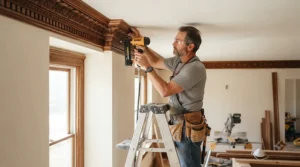
The Bostitch BTFP12233 is an 18-gauge brad nailer built around Bostitch’s Smart Point technology, which shrinks the nose by roughly 80% compared to older Bostitch designs. What most buyers overlook about this feature is that a smaller nose isn’t just cosmetic — it means you can see exactly where the nail is going, which matters enormously on delicate trim, cabinetry, and upholstery work where a half-inch of misplacement ruins the piece.
Running on 70-120 psi and rated at a modest 1.15 CFM, the Bostitch BTFP12233 is easy on a small pancake compressor, unlike framing nailers that gulp air. It drives 5/8″ to 2-1/8″ brad nails, includes a tool-free jam release and dial-a-depth control, and offers a selectable trigger for either sequential (precision) or contact (speed) firing. Reviewers consistently praise the oil-free operation for keeping trim work free of stains, a common complaint with older oil-lubricated pneumatic nailers.
Pros:
- ✅ Smart Point nose improves visibility on tight trim work
- ✅ Low 1.15 CFM draw works with small compressors
- ✅ Oil-free operation avoids staining finished surfaces
Cons:
- ❌ Straight-only magazine limits access in some corners
- ❌ 100-nail magazine means more frequent reloading on big jobs
Priced in the $130-$160 range at most retailers, the Bostitch BTFP12233 delivers real value for anyone doing baseboard, casing, or cabinet trim on a regular basis.
3. Metabo HPT NR90AES1 — lightest pneumatic framing nailer in its class
The Metabo HPT NR90AES1 has been named the “Pro Preferred Nailer” by Builder and Developer Magazine for over a decade running, and the spec sheet explains why: at roughly 7.5 lbs (independent testing measured it slightly lighter, at 7.28 lbs), it’s genuinely one of the lightest 21-degree framing nailers on the market, which matters more than people expect after eight hours of overhead nailing on roof trusses.
Here’s what to weigh before buying: the Metabo HPT NR90AES1 drives 2″ to 3-1/2″ plastic collated nails at 70-120 psi, includes selective actuation (flip-switch between bump and sequential firing) and tool-less depth adjustment, and uses a rear-load magazine with a durable aluminum housing. On paper this means all-day comfort and fast mode switching — but independent testing also flagged a real gap: this model lacks both a dry-fire lockout and a rafter hook, the only nailer among fourteen tested to skip the hanging hook entirely, according to an independent nailer comparison.
Pros:
- ✅ Lightest-in-class body reduces fatigue over long days
- ✅ Selective actuation switches modes without tools
- ✅ Backed by a 5-year manufacturer warranty
Cons:
- ❌ No dry-fire lockout to prevent empty firing
- ❌ Missing a rafter/hanging hook, unlike most competitors
Expect to pay somewhere in the low-to-mid $200s (prices may vary by retailer), which puts it squarely in mid-range territory for a nailer this well-reviewed.
4. DEWALT DCN692B — best gas-free cordless framing nailer
The DEWALT DCN692B markets itself as the world’s first gas-free dual-speed cordless framing nailer, and the dual-speed part is the genuine differentiator here. Speed Setting 1 is tuned for shorter 2″-3″ nails with lower vibration and faster cycling, while Speed Setting 2 kicks in more power for 3-1/4″-3-1/2″ nails driving into dense lumber — a distinction that matters because most single-speed cordless framers either overpower short nails or underpower long ones.
Paired with a 20V MAX 4.0Ah battery, the DEWALT DCN692B can drive up to 700 nails per charge, which is genuinely competitive with a mid-size pneumatic compressor’s output for a morning’s framing work. Reviewers consistently note the brushless motor requires no user-applied lubrication and keeps working in cold weather that causes gas-cell nailers to misfire — a real advantage for late-fall framing crews. At 7.7-7.8 lbs bare, it’s noticeably heavier than a comparable pneumatic gun, since the weight of the motor and gearbox replaces the weight of a hose you’re not carrying.
Pros:
- ✅ Dual-speed motor tunes power to nail length
- ✅ No gas cells needed, and works reliably in cold weather
- ✅ Jam-clearing lever and stall-release lever speed troubleshooting
Cons:
- ❌ Bare tool ships with no battery or charger included
- ❌ Heavier in-hand than pneumatic equivalents
As a bare tool, the DEWALT DCN692B typically runs in the $280-$330 range before you factor in 20V batteries — a real cost if you’re not already inside DEWALT’s ecosystem.
5. Paslode IM250A-Li2 — best cordless-and-fuel hybrid finish nailer
The Paslode IM250A-Li2 occupies a strange middle ground that’s easy to misunderstand: it’s cordless, but it isn’t purely battery powered. A 7.4V lithium-ion battery fires the striker, while a disposable fuel cell supplies the combustion that actually drives each nail — a design Paslode has refined since pioneering cordless Impulse nailers decades ago. What most buyers overlook is how this hybrid setup changes maintenance: you’re managing both a rechargeable battery and fuel cell inventory, not just charging a pack overnight.
At 4.5-4.6 lbs, the Paslode IM250A-Li2 is the lightest cordless finish nailer Paslode makes, and it shows in extended overhead trim work. It drives 16-gauge, 20-degree angled nails from 1-1/4″ to 2-1/2″ long, rated for up to 12,000 nails per battery charge and about 1,200 nails per fuel cell, with a 2-minute quick-charge adding roughly 200 extra shots. Reviewers consistently praise the quick setup for trim work in finished homes where a compressor and hose would be disruptive, though at least one buyer reported a unit that stopped igniting fuel reliably after light use — a reminder that combustion-based nailers carry a different failure mode than pure battery tools.
Pros:
- ✅ Lightest cordless finish nailer in Paslode’s lineup
- ✅ No hose or compressor disruption in finished spaces
- ✅ 2-year service promise backs up a 5-year warranty
Cons:
- ❌ Requires managing both battery charge and fuel cell stock
- ❌ Should not be operated above 5,000 feet elevation
Typically priced in the $350-$420 range, the Paslode IM250A-Li2 commands a premium, but for finish carpenters moving between rooms constantly, the freedom from hoses is often worth it.
6. Milwaukee M18 FUEL 15-Gauge Angled Finish Nailer (2743-20) — most pneumatic-feeling cordless finish nailer
Milwaukee’s pitch for the Milwaukee M18 FUEL 15-Gauge Angled Finish Nailer is that it replicates a pneumatic nailer’s snap without a hose, and the engineering backs that up. A POWERSTATE brushless motor pairs with a “ready to fire” cylinder design and REDLINK PLUS electronic intelligence to eliminate the ramp-up delay that plagues some cordless nailers — the tool is rated to fully sink a 2-1/2″ nail into solid oak on the first pull, every time.
Here’s what the spec sheet won’t tell you, but the engineering implies: because Milwaukee borrowed a nitrogen air-spring mechanism from its 16-gauge siblings rather than a simple flywheel, this line behaves more like a genuine pneumatic gun in hand than most cordless competitors, which is exactly the audience Milwaukee is chasing — pros who’ve resisted cordless finish nailers because of lag. At 6.3 lbs bare, it’s lighter than the DEWALT DCN692B framing nailer, which makes sense given it’s built for trim, not structural framing. It ships as a bare tool, meaning M18 batteries are a separate investment if you’re not already in Milwaukee’s ecosystem.
Pros:
- ✅ Nitrogen air-spring design mimics pneumatic response
- ✅ Dry-fire lockout and tool-free jam release built in
- ✅ LED work light helps in dim job-site corners
Cons:
- ❌ Bare tool only — no battery or charger included
- ❌ Premium pricing puts it above most pneumatic equivalents
Bare-tool pricing generally sits in the $300-$370 range, and that’s before adding an M18 battery pack if you don’t already own one.
7. Ryobi P321 — best cordless brad nailer for DIYers
The Ryobi P321 is Ryobi’s 18-gauge AirStrike brad nailer, and “AirStrike” is Ryobi’s branding for compressed-air-in-a-canister technology built into the tool itself, eliminating hoses and compressors entirely. It drives 5/8″ to 2″ brad nails and, paired with Ryobi’s P108 4.0Ah battery, is rated to fire up to 1,900 nails on a single charge — genuinely enough for a full weekend of trim and cabinet work.
What most buyers overlook here is the ecosystem value: the Ryobi P321 works with any of Ryobi’s 18V ONE+ batteries, a platform spanning well over 175 tools, so if you already own a Ryobi drill or impact driver, this nailer effectively becomes a $100-ish bare-tool add-on rather than a whole new battery investment. Reviewers consistently note the 45%-smaller nose compared to its predecessor, the P320, noticeably improves visibility and access in tight corners like window and door casing.
Pros:
- ✅ Compatible with Ryobi’s massive 18V ONE+ battery ecosystem
- ✅ Slim nose design improves visibility on trim work
- ✅ Dry-fire lockout and low-nail indicator prevent damage
Cons:
- ❌ 1,900 nails/charge trails premium cordless brad nailers
- ❌ Plastic-heavy housing feels less rugged than pro-grade rivals
As a bare tool, the Ryobi P321 usually lands around $90-$130, or roughly $180-$220 in a kit with battery and charger — making it the most accessible cordless option on this list.
Side-by-Side: How the Top 7 Nail Guns Compare
| Model | Power Type | Nail Range | Weight | Best For |
|---|---|---|---|---|
| NuMax SFR2190 | Pneumatic | 2″-3.5″ framing | ~7-8 lbs | Budget framing |
| Bostitch BTFP12233 | Pneumatic | 5/8″-2-1/8″ brad | Light | Trim & cabinetry |
| Metabo HPT NR90AES1 | Pneumatic | 2″-3.5″ framing | 7.5 lbs | All-day framing |
| DEWALT DCN692B | Cordless (battery) | 2″-3.5″ framing | 7.7 lbs | Cordless framing |
| Paslode IM250A-Li2 | Gas + battery | 1.25″-2.5″ finish | 4.5 lbs | Mobile trim work |
| Milwaukee M18 FUEL 2743-20 | Cordless (battery) | 1.25″-2.5″ finish | 6.3 lbs | Pneumatic-feel trim |
| Ryobi P321 | Cordless (battery) | 5/8″-2″ brad | ~5 lbs | DIY brad work |
Looking at the table above, a clear pattern emerges: pneumatic tools cluster at the lighter, cheaper end, while every cordless option adds weight and cost in exchange for mobility — no hose, no compressor noise, no tripping hazard on a ladder. The Metabo HPT NR90AES1 and DEWALT DCN692B sit almost head-to-head on nail range and weight, so the real tiebreaker between them is simply whether you already own an air compressor. Budget-conscious buyers should note the Ryobi P321 delivers real cordless convenience for roughly a third of the price of the premium cordless finish nailers on this list, provided 1,900 nails per charge is enough for your typical job size.
💬 Just one click — help others make better buying decisions too! 😊
Practical Usage Guide: Setting Up and Running Your Nail Gun Right
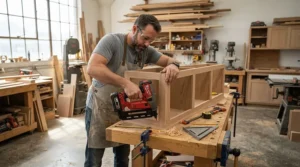
Getting a new nailer out of the box correctly saves you from the most common first-week frustrations. Start by reading the manual’s air pressure or battery specs before your first shot — running a pneumatic gun above its rated 70-120 psi range accelerates seal wear, while undercharging a cordless battery below 20% capacity on models like the DEWALT DCN692B triggers stall warnings mid-job.
For pneumatic tools, add a few drops of pneumatic tool oil to the air inlet before the first use unless the manual specifically says oil-free (like the Bostitch BTFP12233), and drain your compressor’s tank daily to prevent moisture from corroding the nailer’s internals. For cordless models, cycle the battery through a full charge and discharge once before heavy use, and keep a spare pack charged if you’re running a Milwaukee M18 FUEL nailer through a full day of trim work.
Common first-30-day mistakes include overdriving nails by setting depth too aggressive right out of the gate, skipping eye protection because “it’s just trim work,” and firing into material without checking for hidden wiring or plumbing behind the surface — a real hazard the OSHA and NIOSH joint nail gun safety guidance was specifically written to address for both professional crews and DIYers. Set your depth conservatively, test on scrap first, and adjust up rather than starting deep and hoping for the best.
Nail Gun Jam Clearing: A Problem-by-Problem Fix Guide
Every nailer jams eventually, and how you clear it matters for safety as much as speed. Before touching the nose of any nailer, disconnect the air hose on pneumatic models or remove the battery on cordless ones — this single habit prevents the accidental discharge injuries that state-level safety alerts on nail gun triggers specifically warn contractors about.
Problem: Nail bent sideways in the nose. This usually means a warped or defective nail slipped through the magazine. Open the tool-free jam-release door (standard on the Bostitch BTFP12233 and DEWALT DCN692B), remove the bent fastener with pliers, and inspect the remaining strip for other bent nails before reloading.
Problem: Double-feed jam. Two nails try to load at once, usually from an underfilled or improperly seated magazine. Fully empty the magazine, reseat the nail strip so it clicks flush, and reload only genuine or compatible fasteners — off-brand nails are a common cause on tighter-tolerance guns.
Problem: Dry-fire damage. Firing with no nails loaded can bend the driver blade over time. Models with anti-dry-fire protection, like the NuMax SFR2190, largely prevent this; on tools without it, like the Metabo HPT NR90AES1, watch your nail count and stop before the magazine runs empty.
Problem: Fuel cell misfire (gas-hybrid nailers only). If a Paslode IM250A-Li2 stops igniting reliably, check that the fuel cell isn’t expired or that the battery has sufficient charge to run the fan that mixes air and fuel — a low battery is a surprisingly common, easily-missed cause.
Problem: Recurring jams from worn parts. If jams keep happening after correct reloading, the driver blade or O-rings may be worn. This is when a rebuild kit or professional service, rather than repeated DIY fixes, is the right call.
How to Choose a Nail Gun: Your Buyer’s Decision Framework
Cutting through spec sheets is easier with a simple framework. Work through these criteria in order, and you’ll land on the right category before you even start comparing individual models.
- Identify your fastener type first. Framing needs 2″-3.5″ nails and serious power; trim and cabinetry need 16-18 gauge brads and finesse, not force.
- Count your annual usage days. Fewer than 10 days a year points toward a budget pneumatic tool like the NuMax SFR2190; frequent pro use justifies a premium cordless investment.
- Check what you already own. An existing air compressor makes any pneumatic option cheaper overall; an existing 18V or 20V battery platform makes a same-brand cordless nailer nearly free to add.
- Weigh your job-site mobility needs. Ladders, roofs, and crawl spaces favor cordless; a stationary shop or garage favors pneumatic.
- Factor in climate. Gas-hybrid nailers like the Paslode IM250A-Li2 can misfire in cold weather, while pure battery tools like the DEWALT DCN692B hold up better below freezing.
- Set a real budget, not just a tool budget. Add compressor and hose costs to pneumatic totals, and battery/charger costs to bare cordless tools.
- Decide if you’re a beginner or a pro. Beginners benefit from sequential-only triggers and dry-fire lockout; pros often want selectable bump-fire for speed.
If you’re a college student framing a single backyard shed, step 2 alone probably points you to the NuMax SFR2190 paired with a borrowed compressor. If you’re a remodeling contractor climbing scaffolding daily, steps 4 and 5 likely steer you toward the DEWALT DCN692B or Milwaukee M18 FUEL line instead.
Pneumatic vs Cordless Nail Gun: What to Expect in Real-World Performance
Specs only tell half the story — what actually changes day to day is rhythm and fatigue. A pneumatic nailer like the Metabo HPT NR90AES1 fires the instant you pull the trigger, with zero ramp-up, because the compressor is doing the work continuously in the background. That translates to a snappier, more predictable feel over thousands of repetitions, which is why production framing crews still favor air over battery in shop and new-construction settings.
Cordless tools like the DEWALT DCN692B and Milwaukee M18 FUEL 2743-20 have closed much of that gap with brushless motors and, in Milwaukee’s case, a nitrogen air-spring system specifically engineered to mimic pneumatic snap. What most buyers overlook is battery fade: performance on any cordless nailer degrades gradually as the pack drains, so a tool rated for 700-800 nails per charge might feel noticeably weaker on nail number 650 than nail number 50. Pneumatic tools don’t have this problem — as long as the compressor keeps up, output stays constant from the first nail to the last.
Nail Gun vs Screw Gun: Which Fastening Tool Wins for Your Project
The nail gun vs screw gun debate isn’t really a rivalry — it’s a question of holding power versus speed. Nail guns like every model on this list drive fasteners in a fraction of a second, which is why framing crews can sheet an entire wall in minutes rather than hours. Screw guns, by contrast, thread a fastener that resists pull-out and back-out far better than a smooth or ring-shank nail, which matters enormously for subfloor installation, deck framing, and anything that will flex or vibrate over time.
| Factor | Nail Gun | Screw Gun |
|---|---|---|
| Speed | Extremely fast, one trigger pull | Slower, one screw at a time |
| Holding power | Good, better with ring-shank nails | Superior, threads resist pull-out |
| Best For | DEWALT DCN692B, Metabo HPT NR90AES1 for framing speed | Subfloors, decking, structural connections |
| Repairability | Nails are harder to remove cleanly | Screws back out for easy disassembly |
Interpreting the table above: if you’re sheathing a wall or installing trim where speed and clean appearance matter, a nail gun like the NuMax SFR2190 or Bostitch BTFP12233 wins outright. But for subfloors, ledger boards, or anything code requires mechanical fastening on, many builders reach for a screw gun or an impact driver instead, sometimes using both tools on the same job — nails for speed, screws for structural connections that need to resist movement over decades.
Brad Nailer vs Finish Nailer vs Framing Nailer: How to Choose the Right Type
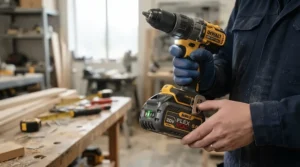
Confusing these three is the single most common mistake first-time buyers make, and it usually means returning a nailer that was never going to work for the job. The distinction comes down to gauge (wire thickness) and nail length, both of which determine holding power and the size of hole left behind.
A brad nailer, like the Bostitch BTFP12233 or Ryobi P321, fires thin 18-gauge nails from 5/8″ to 2-1/8″ long — ideal for delicate trim, shoe molding, and small craft or cabinet work where a visible nail hole would ruin the look. A finish nailer, represented here by the Paslode IM250A-Li2 and Milwaukee M18 FUEL 2743-20, steps up to thicker 15-16 gauge nails up to 2-1/2″ long, giving enough holding power for baseboard, door casing, and crown molding without the bulk of a full framing nail. A framing nailer, like the NuMax SFR2190, Metabo HPT NR90AES1, or DEWALT DCN692B, drives full 2″-3.5″ nails meant to join structural lumber — studs, headers, subfloor, and roof decking.
The practical rule of thumb: if the piece you’re attaching could be lifted off the wall by hand before nailing, a brad nailer is probably strong enough; if it’s structural and would fail a building inspection without proper fasteners, you need a framing nailer, full stop.
Pneumatic Nail Gun CFM Requirement: Sizing Your Air Compressor Correctly
What is the pneumatic nail gun CFM requirement? Most brad and finish nailers need only 0.5-2 CFM at 70-120 psi, while framing nailers typically demand 2-4 CFM under sustained, rapid firing — meaning your compressor’s tank size and recovery rate matter more than its peak PSI rating.
The Bostitch BTFP12233, for example, is rated at a modest 1.15 CFM, meaning even a small 1-2 gallon pancake compressor can keep up comfortably for trim work. Framing nailers like the NuMax SFR2190 and Metabo HPT NR90AES1 draw more air per shot and benefit from a compressor in the 4-6 gallon range or larger if you’re bump-firing rapidly, since a compressor with insufficient recovery rate will cause the nailer to fire progressively weaker, underdriven nails as tank pressure drops mid-job.
| Nailer Type | Typical CFM Need | Recommended Compressor Size |
|---|---|---|
| Brad nailer (18ga) | 0.5-1.5 CFM | 1-2 gallon pancake |
| Finish nailer (15-16ga) | 1-2.5 CFM | 2-4 gallon |
| Framing nailer (21° full round) | 2-4 CFM | 4-6+ gallon |
As the table shows, matching compressor size to nailer type isn’t just about avoiding underpowered shots — a chronically undersized compressor also runs its motor constantly to keep up, shortening its own service life. When in doubt, size up rather than down; a bigger compressor idles fine on a brad nailer, but an undersized one will visibly struggle on a framing gun.
Cordless Nail Guns Explained: Battery Power vs Gas-Powered Fuel Cells
How Battery Powered Nail Gun Technology Works
A battery powered nail gun, like the DEWALT DCN692B, Milwaukee M18 FUEL 2743-20, or Ryobi P321, uses a brushless motor to compress air internally or drive a mechanical striker, entirely replacing the hose-and-compressor setup of pneumatic tools. The trade-off is straightforward: no hose means total mobility, but the battery itself adds real weight, and performance can taper as the charge drops, unlike a compressor that delivers constant pressure regardless of how many nails you’ve already fired.
Gas-Powered Nailer vs Cordless: Which Wins for Trim Work?
The gas-powered nailer vs cordless question really applies to Paslode’s hybrid Impulse line, since the Paslode IM250A-Li2 uses a battery only to run its internal fan and spark system, while a disposable fuel cell supplies the actual combustion energy that drives the nail. This design keeps the tool remarkably light — 4.5 lbs versus 6.3-7.8 lbs for pure battery competitors — but introduces fuel cell inventory management and a documented sensitivity to cold weather and high altitude that pure battery tools don’t share. For finish carpenters prioritizing minimal hand fatigue over an 8-hour day of trim work, that lighter weight often outweighs the extra logistics.
Common Mistakes When Buying a Nail Gun
The most expensive mistake buyers make is matching gauge to the wrong job — buying a brad nailer for deck framing, or a heavy framing gun for delicate trim, both of which waste money and produce worse results than the right tool would have. A close second is ignoring trigger type: contact/bump-fire triggers are faster but riskier, and industry safety reporting consistently recommends full sequential triggers, which only fire once per deliberate trigger pull, as the safer default for anyone still learning a tool.
Buyers also frequently underestimate total cost of ownership on pneumatic tools, forgetting to budget for a compressor, hose, fittings, and oil, then comparing the nailer’s sticker price directly against a cordless model’s higher up-front cost — an apples-to-oranges comparison that misleads more buyers than any single spec. Finally, skipping the CFM requirement entirely and pairing a framing nailer with an undersized compressor is a near-universal first-timer mistake that shows up as inconsistent, underdriven nails within the first hour of use.
Price Range & Long-Term Value Analysis
| Model | Price Range | Value Verdict |
|---|---|---|
| NuMax SFR2190 | $80-$110 | Best raw value for occasional framing |
| Bostitch BTFP12233 | $130-$160 | Strong value for regular trim work |
| Metabo HPT NR90AES1 | Low-to-mid $200s | Worth it for daily framing use |
| DEWALT DCN692B | $280-$330 (bare) | Justified if already in DEWALT’s 20V system |
| Paslode IM250A-Li2 | $350-$420 | Premium price for lightest-in-class mobility |
| Milwaukee M18 FUEL 2743-20 | $300-$370 (bare) | Best for pros wanting pneumatic feel cordless |
| Ryobi P321 | $90-$130 (bare) | Best budget cordless entry point |
Looking at the total-cost picture rather than sticker price alone, the NuMax SFR2190 and Ryobi P321 offer the lowest barrier to entry, but only if you already own the compressor or battery platform each depends on. The Metabo HPT NR90AES1 represents the strongest middle ground for anyone framing regularly without wanting to commit to cordless pricing, while the Paslode IM250A-Li2 only pencils out for buyers who genuinely value the lightest possible tool and are willing to manage fuel cell logistics in exchange.
✨ Don’t miss these exclusive deals!
🔍 Take your nail gun setup to the next level — click any highlighted model above to check current pricing and availability before you buy.

Frequently Asked Questions
❓ Is a pneumatic nail gun stronger than a cordless one?
❓ Can I use any brand of nails in any nail gun?
❓ How long do nail gun batteries last per charge?
❓ Do I need a special compressor for a framing nailer?
❓ Is the Paslode IM250A-Li2 truly cordless if it uses fuel cells?
Conclusion
The pneumatic vs cordless nail gun decision really comes down to one honest question: what does your job site actually look like? If you’re working from a fixed shop or garage with a compressor already humming in the corner, a pneumatic nailer like the Metabo HPT NR90AES1 or NuMax SFR2190 delivers more power per dollar than any cordless competitor can match. If you’re climbing ladders, working on roofs, or moving between rooms in a finished home where a hose becomes a tripping hazard, a battery powered nail gun like the DEWALT DCN692B or Ryobi P321 — or the featherweight gas-hybrid Paslode IM250A-Li2 — earns back its higher price in pure convenience.
None of these seven tools is a bad choice within its category; the mismatches happen when the tool doesn’t fit the job, not when the tool itself is poorly made. Match the gauge and power source to your actual project list, size your compressor correctly if you go pneumatic, and budget for batteries honestly if you go cordless, and you’ll end up with a nailer you’re still happy with years from now.
Recommended for You
- 7 Types of Nail Guns Explained (2026): The No-Guesswork Guide
- Best Cordless Miter Saw: 7 Top Picks for 2026
- 7 Best Miter Saw for Trim Work Picks in 2026
Disclaimer: This article contains affiliate links. As an Amazon Associate, I earn from qualifying purchases. If you purchase products through these links, we may earn a small commission at no additional cost to you.
✨ Found this helpful? Share it with your friends! 💬🤗
