
In This Article
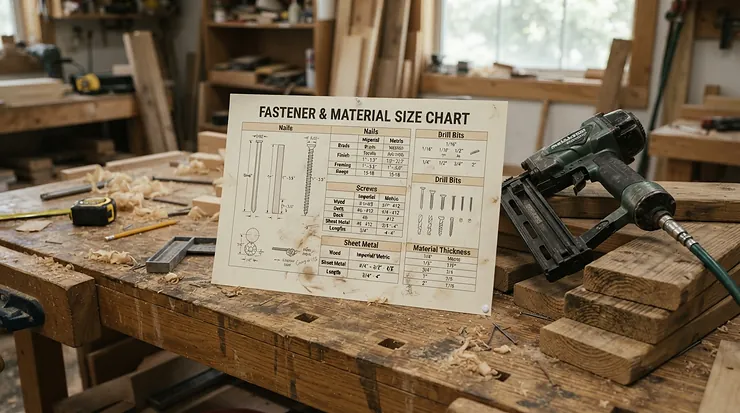
Here’s a confession every fence-building rookie eventually makes out loud: they bought a beautiful stack of cedar, rented a compressor, and then stood in the tool aisle paralyzed because nobody warned them that “just get a nail gun” is not actually advice. A fencing nailer nail size guide exists precisely because the wrong pairing — too short a nail, too smooth a shank, the wrong gauge for the board — is how a fence that should last twenty years starts shedding pickets after two winters. In plain terms, a fencing nailer nail size guide is a reference for matching nail length, diameter, and shank style to the type of fencing nailer and the wood you’re driving it into, so the fastener actually holds instead of just looking like it does.
You don’t need a contractor’s toolbox to get this right, but you do need to understand a few moving parts: the difference between a coil siding nailer and a full-size framing nailer, why a roofing nailer is tempting but wrong for most fence work, and how board thickness dictates nail length far more than any marketing copy will admit. This guide walks through seven real nailers and fasteners worth your money in 2026, breaks down exactly which nail size belongs on which part of your fence, and answers the questions that come up the moment you’re standing at the checkout counter wondering if you grabbed the right box. Prices shift constantly, so treat every dollar figure here as a snapshot — always check current pricing before you buy. Stick around, because the chart alone in this fencing nailer nail size guide will save you a return trip to the hardware store.
Quick Comparison: 7 Fencing Nailers and Fasteners at a Glance
Before diving into full reviews, here’s the short version for anyone in a hurry.
| Product | Type | Nail Size Range | Best For |
|---|---|---|---|
| Freeman PFR2190 | 21° Framing Nailer | 2″ – 3-1/2″ | Budget-friendly post and rail framing |
| NuMax SFR2190 | 21° Framing Nailer | 2″ – 3-1/2″ | Tightest budget, occasional DIY use |
| Bostitch N66C-1 | 15° Coil Siding/Fencing Nailer | 1-1/4″ – 2-1/2″ | High-volume picket installation |
| Makita AN613 | 15° Coil Siding Nailer | 1-1/2″ – 2-1/2″ | Precision depth control, premium builds |
| Metabo HPT NV45AB2M | Coil Roofing Nailer | 7/8″ – 1-3/4″ | Roofing — and a lesson in what NOT to use on fences |
| Paslode CF325XP | Cordless Framing Nailer | 2″ – 3-1/4″ | Remote fence lines with no compressor access |
| Grip-Rite GRC6R92HG | Hot-Dip Galvanized Ring Shank Coil Nails | 2″ x .092″ | The actual fastener that determines long-term hold |
Reading this table sideways for a second: notice how the nail size range narrows as you move from framing nailers (built for thick 2x lumber) toward coil siding nailers (built for thinner pickets and lap siding). The Metabo HPT NV45AB2M sits at the shortest end of that spectrum on purpose — it’s a roofing tool included here so you can see, in black and white, why its nail range simply doesn’t overlap with fence construction the way people assume. Meanwhile the Grip-Rite GRC6R92HG nails are the reminder that the gun is only half the equation; the fastener itself is what fights corrosion and pull-out for the next two decades.
💬 Save this table now — screenshot it before you head to the hardware store so you’re not guessing in the aisle!😊
Top 7 Fencing Nailers and Nails: Expert Analysis
Fence-building forums are full of arguments about “the best” nailer, but the honest answer is that different fences need different tools. Below are seven real, currently available products spanning budget framing nailers, coil siding nailers built for high-volume picket work, a cordless option, a roofing nailer included specifically for comparison, and the collated nail itself — because a $500 nailer loaded with the wrong fastener still fails.
1. Freeman PFR2190 — magnesium-body budget framing nailer
The standout here is weight-to-durability: a die-cast magnesium housing that shaves pounds off the tool without turning it into something that flexes under repeated impact. This 21-degree framing nailer drives plastic-collated full-round-head nails from 2 inches up to 3-1/2 inches, which puts it squarely in range for attaching 2×4 rails to 4×4 posts — the backbone connections of almost any wood fence. Running on 70 to 115 psi with a 55-nail magazine and an interchangeable trigger for single or bump-fire modes, it’s built to keep up with a weekend framing crew without demanding a commercial-grade compressor.
Based on the spec comparison against other sub-$250 framing nailers, the Freeman PFR2190‘s 8.5-pound weight and tool-free depth adjustment strike a real balance most beginner-friendly guns don’t hit; you get pro-adjacent controls without a pro price tag. Reviewers consistently note that the no-mar tip does its job protecting cedar and pressure-treated lumber from dents, though a few mention the tip needs occasional replacement after heavy use. This nailer is for the DIYer building a full privacy fence in a weekend and the small contractor who wants a reliable backup gun, not the crew running eight hours a day, five days a week.
Pros:
- ✅ Lightweight magnesium body reduces fatigue on long framing days
- ✅ Interchangeable trigger for precision or speed as the job demands
- ✅ Backed by Freeman’s seven-year manufacturer warranty
Cons:
- ❌ Smaller nail entry hole makes reloading a bit fussier
- ❌ Not rated for the sustained duty cycle of daily commercial framing
Depending on retailer, the Freeman PFR2190 typically lands in the $130 to $210 range, and whether a hard case is bundled in swings that number noticeably. At the lower end of that range it’s one of the better value plays for anyone framing an entire backyard fence in a single weekend.
2. NuMax SFR2190 — most affordable full-size framing nailer
What makes this one stand out is simple: it’s a genuinely full-size 21-degree framing nailer at a price point that usually belongs to toy-grade tools. It accepts the same 2-inch to 3-1/2-inch plastic-collated nails as its pricier competitors, with a shank diameter range of 0.113 to 0.131 inches that’s plenty for post-to-rail connections on a standard residential fence.
What most buyers overlook about a budget nailer like this is that the anti-dry-fire mechanism — a feature usually reserved for mid-tier tools — is present here too, meaning the gun won’t cycle uselessly when the magazine runs empty and chew up internal components in the process. Aggregated review sentiment across major retailers is unusually strong for the price bracket, with the NuMax SFR2190 holding a 4.6-star average across more than 7,000 verified ratings, and a recurring theme in that feedback is that it holds up far better than its cost would suggest for occasional and light-duty use. The honest caveat: reviewers who framed entire houses with it tend to graduate to something heavier-duty after a season or two.
Pros:
- ✅ Lowest price point of any full-size framing nailer here
- ✅ Anti-dry-fire protection typically missing at this price
- ✅ Dual-mode trigger for sequential or bump firing
Cons:
- ❌ Feed occasionally hiccups with certain plastic-collated nail brands
- ❌ Duty cycle isn’t built for daily professional framing work
Price typically runs in the $100 to $140 range, making the NuMax SFR2190 the nailer to grab if this is your first fence and possibly your last for a while — a genuinely smart way to avoid overspending on a tool you’ll use twice a year.
3. Bostitch N66C-1 — highest-capacity coil nailer for picket runs
The Bostitch name carries weight in this category for a reason, and the standout feature on this 15-degree coil siding and fencing nailer is magazine capacity: it holds up to 300 to 350 coil nails at once, which on a long picket fence run translates directly into fewer reload stops. It accepts both wire-weld and plastic-inserted coil nails from 1-1/4 inches to 2-1/2 inches, with a 0.080 to 0.092-inch shank diameter — exactly the window most cedar and pine pickets call for.
Here’s what the spec sheet won’t tell you outright: the tool-free adjustable exhaust isn’t a gimmick when you’re nailing overhead on a taller privacy fence, since it keeps compressed air (and the dust it kicks up) pointed away from your face rather than back at you. Aggregated customer sentiment on this model is notably positive, with a 4.4-star average across independent retailer reviews, and a common thread is praise for how rarely it jams compared to older coil nailers buyers previously owned. The lightweight aluminum housing, at roughly 4.4 to 4.7 pounds depending on the exact listing, means the fatigue factor on a full day of picket nailing stays manageable. This is functionally a full siding nailer review wrapped into a fencing recommendation, since the two applications overlap so heavily on this tool.
Pros:
- ✅ Massive 300-plus nail magazine cuts reload interruptions
- ✅ Tool-free adjustable exhaust keeps debris away from your face
- ✅ Soft rubber foot protects softwood pickets from surface damage
Cons:
- ❌ Requires a dedicated compressor with steady 70-120 psi output
- ❌ Pricier than a standard framing nailer for the nail-length range it covers
Expect the Bostitch N66C-1 to run in the $260 to $350 range at most retailers, occasionally dipping lower during sales. For anyone installing more than a hundred linear feet of picket fencing, the reload savings alone can justify the jump from a framing nailer.
4. Makita AN613 — smoothest depth control for premium fence builds
Makita’s standout move on this 15-degree coil siding nailer is the nine-setting tool-less depth adjustment, which gives you granular control over how flush each nail sits — critical when you’re working with a mix of cedar, fiber cement trim, and treated pine on the same fence line. It accepts 15-degree wire and plastic collated nails from 1-1/2 to 2-1/2 inches with a 0.090 to 0.099-inch shank diameter, and the 300-nail magazine keeps pace with the Bostitch on capacity.
Based on the spec comparison, the two-mode selector switch (sequential versus contact actuation) is what separates this from entry-level coil nailers: sequential mode is safer and more precise for the final visible picket rows where a misfire would mar the wood, while contact mode speeds up the rougher framing-adjacent work underneath. Reviewers consistently describe the AN613 as running smoother and quieter than older Hitachi-branded siding nailers, and the built-in air duster feature for clearing sawdust off the work surface shows up repeatedly as an unexpected favorite. Who should care: contractors building fences as part of a broader exterior remodel where the same gun also handles siding work, and homeowners who’ve already been burned by a cheaper coil nailer jamming mid-project.
Pros:
- ✅ Nine-position tool-less depth adjustment for precision flush nailing
- ✅ Two-mode selector switches between sequential and contact firing
- ✅ Multi-directional exhaust port keeps air away from the operator
Cons:
- ❌ Premium price relative to comparable coil siding nailers
- ❌ Overkill for a single small DIY fence project
The Makita AN613 generally sits in the $430 to $505 range depending on retailer, positioning it as the splurge pick for anyone who wants one nailer to handle fencing, siding, and trim work across multiple seasons.
5. Metabo HPT NV45AB2M — the roofing nailer that fence builders keep grabbing by mistake
This one earns its spot on the list precisely because it’s the wrong tool that keeps ending up in fence-building carts anyway, and understanding why matters more than the spec sheet itself. The NV45AB2M is a coil roofing nailer built for 7/8-inch to 1-3/4-inch fasteners with a 0.120-inch shank diameter — dimensions tuned for asphalt shingles and insulation board, not structural fence rails or thick pickets. At 5.5 pounds with a 120-nail side-loading magazine and tool-less depth adjustment, it’s genuinely excellent equipment for what it’s designed to do.
What most buyers overlook is that the fastener diameter here (0.120 inches) is actually thicker than most coil siding nails, but the maximum length caps out at 1-3/4 inches — far too short to reach through a 5/8-inch picket into a 2-inch rail with meaningful bite. Reviewers rate this tool highly for roofing work specifically, and the aggregated sentiment across roofing-focused buyers is enthusiastic about its speed (up to three nails per second) and five-year professional warranty. For fencing, though, honest analysis says: skip it, unless you’re specifically attaching thin lattice or trim where the shorter length is actually appropriate.
Pros:
- ✅ Extremely fast cycle rate for high-volume roofing work
- ✅ Lightweight side-load magazine speeds up reloading
- ✅ Five-year professional warranty from Metabo HPT
Cons:
- ❌ Maximum 1-3/4-inch nail length is too short for most rail-to-post fastening
- ❌ Wrong tool category for anything beyond thin trim on a fence
Pricing typically runs $250 to $330. If you already own one for roofing jobs, it can pinch-hit on thin fence trim — but don’t buy it new expecting it to replace a proper fencing nailer.

6. Paslode CF325XP — cordless freedom for fence lines far from any outlet
The headline feature on this cordless framing nailer is right there in the name: no hose, no compressor, no tripping over air lines while you’re forty feet down a property line. The Paslode CF325XP, listed under model number 906300, drives 30-degree paper-collated nails from 2 to 3-1/4 inches using a combination of a rechargeable battery and disposable fuel cell, rated for roughly 9,000 nails per charge and 1,200 nails per fuel cell.
Here’s what the spec sheet doesn’t fully capture: at 7.2 pounds, Paslode markets this as the lightest cordless framing nailer on the market, and based on the spec comparison against pneumatic alternatives, the tradeoff is straightforward — you gain total mobility and lose the raw sustained power of a compressor-fed tool. Reviewers who’ve used it for framing, decking, and fencing applications consistently report it drives flush into treated lumber without hesitation, and the tool-free depth control earns repeated praise for staying adjustable even with gloves on. What the spec sheet won’t tell you, but user reports suggest, is that fuel cells add a recurring cost most buyers don’t budget for upfront — factor that into your total cost of ownership before committing.
Pros:
- ✅ No compressor or hose needed for remote fence lines
- ✅ Lightest cordless framing nailer in its class at 7.2 pounds
- ✅ Tool-free depth control works even with work gloves on
Cons:
- ❌ Ongoing fuel cell costs add up over repeated projects
- ❌ Battery and fuel cell both need charging/replacing mid-job on large builds
Kits with battery and charger typically fall in the $300 to $460 range depending on promotions. For anyone fencing a rural property with no easy compressor access, the convenience alone often justifies the premium.
7. Grip-Rite GRC6R92HG — the actual nail behind every good fencing nailer nail size decision
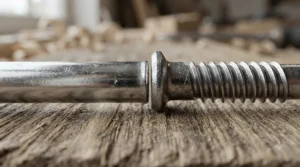
This last entry isn’t a nailer at all — it’s the fastener, and it deserves equal billing because no nail gun on this list matters if you load it with the wrong nail. The Grip-Rite GRC6R92HG is a 15-degree wire-weld coil nail, 2 inches long with a 0.092-inch shank diameter, hot-dip galvanized, and finished with a ring shank for maximum holding power in outdoor lumber.
Based on the spec comparison, the ring shank design is the standout feature here: as the nail is driven in, the raised rings bite into the wood fiber and resist the seasonal swelling-and-shrinking cycle that gradually walks smooth-shank nails back out of a fence board over several years. What most buyers overlook is that “galvanized” isn’t a single standard — hot-dip galvanizing, which this product uses, deposits a noticeably thicker zinc coating than electro-galvanizing, and that thickness is directly responsible for how long the nail resists rust once it’s exposed to rain and humidity. Reviewers and professional fence installers who buy these in bulk consistently describe them as the standard recommendation for siding and fencing applications where corrosion resistance genuinely matters, and manufacturer guidance notes they’re compatible with pressure-treated lumber — not every coated fastener can say that.
Pros:
- ✅ Ring shank design resists seasonal wood movement and pull-out
- ✅ Hot-dip galvanized coating built for long-term outdoor exposure
- ✅ Rated compatible with pressure-treated lumber
Cons:
- ❌ Not usable for cedar or redwood, which call for stainless fasteners
- ❌ Bulk cartons are a poor fit for very small, one-off repair jobs
A tub of roughly 3,600 nails typically runs $90 to $120. Pair these with the Bostitch N66C-1 or Makita AN613 and you’ve solved both halves of the fencing nailer nail size equation at once.
Best Nail Gun for Wood Fence Panels: Matching Tool to Material
Prefab wood fence panels — the kind you buy as a finished 6-foot-by-8-foot unit rather than building board by board — put different demands on a nailer than picket-by-picket construction. Panels are typically framed with thin 1×4 lattice or louver strips over a lighter internal frame, which means the nail doesn’t need the reach of a full framing nailer; it needs precision and a shallow depth setting. Based on the spec comparison across this list, a coil siding nailer like the Bostitch N66C-1 or the Makita AN613 outperforms a framing nailer for panel work specifically because their shorter minimum nail lengths (down to 1-1/4 inches) match panel-frame thickness without blowing through the back side.
Here’s what most panel-fence buyers get wrong: they assume the biggest, most powerful nailer is the safest choice, when in practice an oversized nail through thin lattice just splits the strip. If you’re attaching whole panels to posts rather than building the frame itself, a mid-range framing nailer like the Freeman PFR2190 handles the thicker perimeter rails, while a coil nailer finishes the decorative face. Buying both isn’t overkill — it’s how most professional installers actually work a panel-fence job.
Coil Siding Nailer Basics (and a Quick Siding Nailer Review)
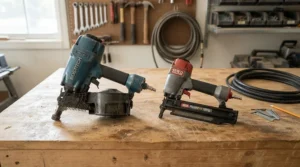
A coil siding nailer looks like a smaller, rounder cousin of a framing nailer, and the difference isn’t cosmetic. Instead of a straight magazine holding a strip of 20 to 40 nails, a coil nailer’s canister-style magazine curls 200 to 350 nails into a circular coil, which is exactly why the Bostitch N66C-1 and Makita AN613 can go so much longer between reloads than any framing nailer on this list. That capacity is the entire reason contractors reach for a coil nailer on long fence runs and continuous siding jobs alike — the two tasks use nearly identical fasteners and firing angles, which is why a siding nailer review and a fencing nailer review end up covering almost the same ground.
If you’re choosing between the two flagship coil nailers here, the honest breakdown is this: the Bostitch N66C-1 wins on raw capacity and price, while the Makita AN613 wins on depth-adjustment precision and firing-mode flexibility. Reviewers consistently note that once you’ve used a coil nailer’s reload speed on a 150-foot fence line, going back to a strip-fed framing nailer for picket work feels like a step backward — the frequent reloading interrupts your rhythm more than most buyers expect going in.
Roofing Nailer vs Fencing Nailer: Why They’re Not Interchangeable
This comparison gets asked constantly because plenty of homeowners already own a roofing nailer from a past shingle job and would love to avoid buying another tool. The short answer, backed by the spec comparison earlier in this fencing nailer nail size guide: a roofing nailer vs a fencing nailer is a mismatch on nail length, nail diameter, and firing angle all at once, and forcing the substitution usually ends in nails that don’t reach far enough to hold structurally.
| Feature | Roofing Nailer (e.g. Metabo HPT NV45AB2M) | Coil Fencing/Siding Nailer (e.g. Bostitch N66C-1) |
|---|---|---|
| Typical nail length | 7/8″ – 1-3/4″ | 1-1/4″ – 2-1/2″ |
| Nail head style | Wide, flat (for shingle tabs) | Standard round head |
| Best surface | Asphalt shingles, insulation board | Wood pickets, siding, thin fence panels |
| Firing angle | 15–16° coil, wide-head fasteners | 15° coil, standard fasteners |
| Fence suitability | Poor — length rarely reaches rail | Good to excellent |
Looking at the table above, the deciding factor really is length and head design rather than raw power — a roofing nailer isn’t underpowered, it’s simply built around a shorter fastener with a wider head that shingles need and pickets don’t. Reviewers who’ve tried the substitution report the same outcome: nails that sit proud of the surface or fail to bite into the rail behind the picket, which is the exact failure mode a fencing nailer nail size guide exists to prevent. If your existing roofing nailer is all you own, it’s genuinely fine for thin lattice trim — just don’t ask it to carry structural rail connections.
Fence Board Thickness Nail Length Chart
This is the single most requested piece of information in any fencing nailer nail size guide, and for good reason — get this wrong and everything else in this article is irrelevant. The right nail length depends almost entirely on how deep it needs to penetrate the receiving rail or post, not just how thick the visible board is.
| Fence Component | Material Thickness | Recommended Nail Length | Shank Diameter | Best Nailer Type |
|---|---|---|---|---|
| Standard picket (dog-ear or flat) | 5/8″ – 3/4″ | 1-1/2″ – 2″ | 0.080″ – 0.092″ | Coil siding nailer |
| Lattice or decorative trim | 3/8″ – 1/2″ | 1-1/4″ | 0.070″ – 0.080″ | Coil siding nailer |
| 2×4 rail into 4×4 post | 1-1/2″ | 2-1/2″ – 3″ | 0.113″ – 0.131″ | Framing nailer |
| Cap rail or top trim board | 3/4″ – 1″ | 2″ – 2-1/2″ | 0.092″ – 0.113″ | Coil siding or framing nailer |
| Post-to-post bracing | 1-1/2″ (2x material) | 3″ – 3-1/2″ | 0.113″ – 0.131″ | Framing nailer |
A quick analysis of that chart: the general rule of thumb professional fence builders follow is that the nail should penetrate at least 1-1/2 times the thickness of the board being fastened, which is why a 3/4-inch picket calls for something closer to a 2-inch nail rather than a 1-inch nail that barely tickles the rail behind it. Undersized nails are the single biggest cause of picket pop-out after a couple of freeze-thaw cycles, according to the pattern seen across DIY forums and contractor complaints alike. When in doubt, size up rather than down — a slightly longer nail that fully seats is always safer than a short one riding loose in the wood grain. For a deeper technical breakdown of matching lumber to fasteners during a full build, this step-by-step wooden fence construction guide covers the framing side in more detail than most retail buying guides bother to.
Ring Shank vs Smooth Shank Fence Nail: Which One Actually Holds
Every nail on this list except the framing nailer fasteners technically comes in both shank styles, and the difference matters more for outdoor fencing than almost any other application. A smooth shank nail relies purely on friction between the nail and the wood fiber, which works fine indoors but degrades outdoors as lumber repeatedly swells with moisture and shrinks as it dries. A ring shank nail — like the Grip-Rite GRC6R92HG featured above — has small raised ridges along the shaft that physically interlock with compressed wood fiber as it’s driven in, and that mechanical grip doesn’t loosen the same way when the board moves seasonally.
Here’s what most buyers overlook: ring shank nails are genuinely harder to remove once driven, which is a feature for a fence you want to last, but a real drawback if you’re building something you expect to disassemble or adjust later, like a temporary garden trellis. Reviewers who’ve had smooth shank picket nails “walk out” of a fence after two or three winters consistently switch to ring shank on the rebuild and report the problem doesn’t recur. The ring shank vs smooth shank fence nail decision really comes down to permanence: build it once with ring shank, or plan on maintenance visits with smooth shank.
Nail Corrosion Resistance for Outdoor Fencing
Nail corrosion resistance is where a fence’s fastener choice quietly determines whether the whole structure holds together or slowly bleeds rust streaks down every picket. Bare steel nails have essentially no place in exterior fencing — moisture reaches them within a season and rust both weakens the fastener and stains the surrounding wood. The main real options are hot-dip galvanized, electro-galvanized, and stainless steel, and they are not remotely equivalent despite often sitting on the same shelf labeled “galvanized.”
Hot-dip galvanizing, the finish used on the Grip-Rite GRC6R92HG nails covered earlier, immerses the fastener in molten zinc to build a coating that’s meaningfully thicker than the thin zinc layer applied through electroplating, and that thickness translates directly into how many years pass before rust reaches the underlying steel. According to the American Galvanizers Association’s technical guidance, hot-dip coatings also corrode preferentially to protect the steel underneath even where the coating gets scratched during installation — a real advantage over thinner coatings that simply wear through. Stainless steel goes a step further and is genuinely required, not just recommended, for cedar and redwood, since the natural tannins in those woods react with galvanized coatings and cause dark staining around every nail head. The practical takeaway for anyone working through a fencing nailer nail size guide: match the metal to the wood species first, then worry about length and gauge second.
How to Choose the Right Fencing Nailer
Cutting through the spec sheets, here’s a straightforward decision process for anyone standing in the tool aisle right now.
- Identify your board thickness first. Thin pickets and lattice call for a coil siding nailer; thick rails and posts call for a framing nailer — check the fence board thickness nail length chart above before shopping.
- Count your linear footage. Under 50 feet of fence line rarely justifies a premium coil nailer’s magazine capacity; over 150 feet, that capacity pays for itself in reduced downtime.
- Check your compressor situation. No compressor or a small pancake unit favors a cordless option like the Paslode CF325XP; a job-site compressor opens up every pneumatic option on this list.
- Match the fastener to the wood species. Cedar and redwood require stainless; pressure-treated pine and fir do fine with hot-dip galvanized ring shank nails.
- Decide on shank style based on permanence. Ring shank for anything meant to last decades; smooth shank only for temporary or easily-disassembled structures.
- Budget for the fastener, not just the tool. A $500 nailer loaded with bargain-bin bright steel nails will still rust out early — the nail cost is small relative to redoing the whole fence.
Practical Usage Guide: Setting Up and Maintaining Your Fencing Nailer
Getting a new pneumatic nailer running correctly starts before the first nail ever fires. Add a few drops of pneumatic tool oil into the air inlet if your model isn’t self-lubricating (check the manual — some coil nailers, including certain Bostitch models, are oil-free), then set your compressor to the low end of the recommended psi range and test-fire into scrap lumber before touching your actual fence boards. Dial the depth adjustment gradually; it’s far easier to sink a nail slightly deeper on the next shot than to back out one that’s already countersunk too far and split the wood around it.
In the first 30 days of ownership, the most common mistake is skipping regular cleaning — sawdust and debris accumulate in the nose and magazine faster on outdoor fence jobs than on interior trim work, simply because you’re working in dirtier conditions. Wipe down the tool and check the O-rings weekly during an active build, and keep the air filter clear so pressure stays consistent shot to shot. A quick maintenance schedule worth adopting: oil before each use (if applicable), clean the nose and magazine weekly, and inspect the no-mar tip monthly for wear, replacing it before it starts denting your visible fence boards.
Real-World Scenarios: Which Nailer Fits Your Fence Project
The weekend DIYer with a quarter-acre backyard: Budget matters more than speed, and the total job might be 80 linear feet of picket fence. The NuMax SFR2190 paired with Grip-Rite GRC6R92HG ring shank nails covers both the rail framing and the picket attachment without a big upfront investment, and the whole project realistically finishes over one long weekend.
The small contractor doing three to five fence jobs a month: Reload speed and durability start mattering more than sticker price. The Bostitch N66C-1 for pickets combined with the Freeman PFR2190 for rail-and-post framing covers the bulk of residential jobs without the premium cost of Makita’s top-tier option, and the combined investment pays for itself within a handful of jobs through faster labor time.
The rural property owner fencing a half-mile of pasture with no power access: Compressor logistics make pneumatic tools impractical across that much ground. The Paslode CF325XP removes the hose-and-compressor problem entirely, and while the fuel cell cost adds up over that much footage, the mobility savings in labor time typically outweigh it.
Common Mistakes When Buying a Fencing Nailer
The most frequent and costly mistake is buying based on nailer type alone without checking nail-length compatibility against your specific board thickness — a shopper grabs a roofing nailer because it’s cheap and already owned, then discovers mid-project it physically cannot drive a nail long enough to reach the rail. A close second is ignoring shank style entirely and grabbing whatever nails are cheapest at checkout, which is how smooth shank fasteners end up in a fence that needed ring shank from day one.
A third recurring error is underestimating compressor requirements — a nailer rated for 70-120 psi paired with an undersized pancake compressor will cycle inconsistently and leave nails proud of the surface. Finally, plenty of buyers skip corrosion resistance altogether to save a few dollars per box, not realizing that a fence rebuild from rust failure costs vastly more than the price difference between bright steel and hot-dip galvanized nails ever would have.
Long-Term Cost & Maintenance
Total cost of ownership on a fencing nailer extends well past the sticker price, and this is where cordless and pneumatic options diverge sharply. A pneumatic nailer like the Bostitch N66C-1 has essentially no ongoing consumable cost beyond the nails themselves and occasional O-ring replacement, assuming you already own or can borrow a compressor. The Paslode CF325XP, by contrast, carries a recurring fuel cell expense — at roughly one fuel cell per 1,200 nails, a large fencing project can burn through several cells, and that cost should be factored into any head-to-head price comparison against pneumatic alternatives.
On the fastener side, the price gap between bright steel and hot-dip galvanized ring shank nails is typically just a few dollars per thousand, which is a rounding error against the labor cost of replacing failed pickets five years down the line. Reviewers and professional installers alike consistently frame galvanized ring shank fasteners as the “spend a little more now” decision with the clearest long-term payoff of anything covered in this guide — cheaper nails are the one place where the savings genuinely aren’t worth it.
Frequently Asked Questions
❓ What size nail do I need for a wood fence?
❓ What gauge nail is best for fence pickets?
❓ Can I use a roofing nailer for fence work?
❓ Are galvanized nails better than stainless for fences?
❓ What PSI do I need to run a coil siding nailer for fencing?
Conclusion
A fencing nailer nail size guide only earns its keep if it changes what you actually buy at checkout, so here’s the distilled version: match nail length to board thickness using the chart above, choose ring shank over smooth shank for anything permanent, and pick hot-dip galvanized or stainless based on wood species rather than whatever’s cheapest on the shelf. Among the seven products covered, the Freeman PFR2190 and NuMax SFR2190 cover rail framing on a budget, the Bostitch N66C-1 and Makita AN613 handle picket and siding work with very different price-to-precision tradeoffs, the Paslode CF325XP solves the no-compressor problem, the Metabo HPT NV45AB2M exists as a cautionary comparison rather than a real recommendation for fencing, and the Grip-Rite GRC6R92HG nails are the unglamorous detail that determines whether any of the above actually holds up for the long haul.
For safety guidance that applies no matter which nailer you choose, the CDC’s NIOSH nail gun safety resource is worth a few minutes before your first project, since pneumatic and cordless framing nailers alike carry real injury risk when trigger discipline slips. Whichever combination of tool and fastener you land on, the underlying principle from this entire fencing nailer nail size guide doesn’t change: get the size right, and the rest of the fence takes care of itself for years to come. For general background on how these tools work mechanically, Wikipedia’s overview of nail gun technology is a solid starting point if you want the deeper history behind the pneumatic designs discussed throughout this guide.
Recommended for You
- Best Coil Nailer For Fencing: 7 Top Picks(2026)
- Coil Framing Nailer vs Stick: 7 Best Picks Compared (2026)
- 21 vs 30 Degree Framing Nailer: 7 Best Picks for 2026
Disclaimer: This article contains affiliate links. As an Amazon Associate, I earn from qualifying purchases. If you purchase products through these links, we may earn a small commission at no additional cost to you.
✨ Found this helpful? Share it with your friends! 💬🤗
