
In This Article
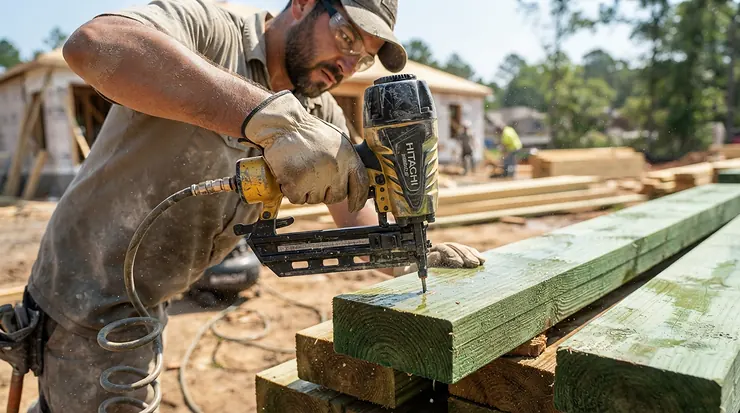
Building a fence by hand, one nail at a time, is the kind of job that turns a Saturday into a weekend and a weekend into a grudge. That’s the whole pitch for the best coil nailer for fencing: it turns a hammer-and-thumb marathon into an afternoon. Instead of reloading every eight or ten nails like you would with a strip nailer, a coil-fed tool carries a spool of hundreds of fasteners curled up in the magazine, so you keep moving down the fence line instead of stopping every few boards. The pneumatic nail gun itself has been a jobsite staple since the mid-20th century, and coil-style magazines are simply the fencing and siding trade’s favorite evolution of that idea.
What is a coil nailer for fencing? A coil nailer for fencing is a pneumatic (or battery-powered) tool that drives nails from a circular coil magazine holding 200 to 400 fasteners, letting you attach pickets, rails, and posts continuously without frequent reloading — ideal for cedar, privacy, and pressure-treated wood fences.
Picking the right one isn’t just about horsepower, though. It’s about matching the nail length range to your pickets and rails, matching the nail material to your wood (cedar plays by different rules than pressure-treated pine), and matching the tool’s weight to the number of hours your arm is willing to hold it overhead. This guide walks through seven real, currently sold coil nailers spanning budget, mid-range, and premium territory, then digs into the nail side of the equation — aluminum, stainless, galvanized, and shank type — because the best coil nailer for fencing paired with the wrong fastener is still a recipe for a fence that sags in five years instead of twenty.
Quick Comparison: Best Coil Nailers for Fencing at a Glance
| Category | Pick | Price Range | Why It Wins |
|---|---|---|---|
| Best Overall | Metabo HPT NV65AH2 | $230–$290 | Pro Preferred award, selective actuation, 5-year warranty |
| Best Value | BOSTITCH N66C-1 | $180–$230 | Lightweight aluminum body, 300-nail magazine |
| Best Budget | Freeman PCN65 | $120–$160 | Lowest entry price, wire and plastic nail flexibility |
| Best Dedicated Fencing Nailer | MAX USA CN550S | $300–$370 | Lightest in class, purpose-built for fencing |
| Best for Posts & Rails | Metabo HPT NV75A5 | $260–$330 | Drives up to 3-inch fasteners for framing duty |
Looking at the table above, the Metabo HPT NV65AH2 earns the all-around nod because it balances weight, warranty, and nail versatility better than anything else in its price bracket. Budget-focused builders will find the Freeman PCN65 does 90% of the job for a fraction of the cost, while anyone framing posts or top rails out of pressure-treated 2x4s should look straight at the Metabo HPT NV75A5 for its 3-inch reach. If fencing is truly all you do, the MAX USA CN550S was engineered specifically for that use case and it shows.
💬 Just one click — help others make better buying decisions too!😊
Top 7 Coil Nailers for Fencing: Expert Analysis
1. Metabo HPT NV65AH2 — Pro Preferred nailer for all-day fence runs
That “Pro Preferred” title isn’t just marketing fluff — Builder and Developer Magazine has handed it to Metabo HPT’s coil siding nailer for twelve years running, and the Metabo HPT NV65AH2 earns it by getting the fundamentals right. It drives 16-degree wire coil nails from 1-1/2″ to 2-1/2″ and 15-degree plastic coil nails from 1-1/2″ to 2-1/4″, covering nearly every picket and rail thickness a residential fence throws at it, and it can fire up to three nails per second when you’re motoring down a straight run. At 4.8 pounds, it won’t wreck your shoulder by lunch, and the side-load, tilt-bottom magazine means reloading is a five-second task rather than a fumbling one.
Based on the spec comparison, what separates this model from cheaper siding nailers is the selective actuation switch — flip it to sequential mode for precise picket placement near corners, then bump-fire mode when you’re just chewing through a straight fence line. Reviewers consistently note the tool-less depth adjustment holds its setting well across a full day, which matters more than it sounds like when you’re alternating between soft cedar and denser treated lumber.
Pros:
- ✅ Selective actuation switch toggles sequential and bump fire fast
- ✅ Side-load tilt-bottom magazine speeds up mid-job reloads
- ✅ Backed by a rare 5-year professional tool warranty
Cons:
- ❌ Runs heavier in the wallet than basic siding nailers
- ❌ Best results depend on genuine Metabo HPT nail coils
In the $230–$290 range at the time of research, the NV65AH2 is the nailer to buy if you want one tool that handles cedar pickets today and a pressure-treated repair job five years from now.
2. BOSTITCH N66C-1 — best all-around value for fence crews
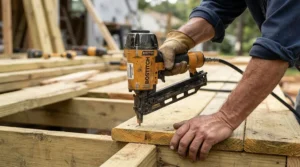
The BOSTITCH N66C-1 has been the default recommendation for siding-and-fencing work for years, and the 300-nail magazine capacity is a big reason why — that’s enough coil to finish an entire section of privacy fence before you even think about reloading. It drives 15-degree wire weld or plastic inserted coil nails from 1-1/4″ to 2-1/2″, with a driving force rated around 500 in-lbs, which is plenty for standard cedar and pine pickets.
What most buyers overlook about this nailer is how much its lightweight aluminum housing (4.4–4.9 lbs depending on the listing) reduces fatigue on a job where you’re holding the tool overhead for hours at a time. The soft rubber foot at the nose is a small detail that pays off repeatedly: it keeps the tool from denting softer cedar and redwood boards, something a metal-nosed competitor can’t claim. Aggregated review sentiment on the N66C-1 is largely positive, with the seven-year Stanley Black & Decker warranty cited as a confidence booster, though a handful of reviewers mention occasional nail head damage when driving into denser hardwood species.
Pros:
- ✅ Lightweight aluminum body barely tires out your swinging arm
- ✅ 300-nail magazine means fewer stops to reload coils
- ✅ Seven-year warranty backs up Stanley Black & Decker’s build quality
Cons:
- ❌ Some owners report occasional nail head damage on hardwood
- ❌ Needs a compressor capable of steady 70-120 psi
At around $180–$230, the BOSTITCH N66C-1 delivers professional-grade output without the professional-grade price tag, which is exactly why it shows up on so many contractors’ trucks.
3. Freeman PCN65 — budget-friendly workhorse for DIY fence builds
If your fence project is a one-time thing rather than a career, the Freeman PCN65 is built for exactly that math. It’s one of the most affordable coil siding and fencing nailers still sold new, and it doesn’t cut corners where it counts: a die-cast magnesium body keeps weight down to around 5.5 pounds, and it accepts both plastic collated nails (1-1/4″ to 2-1/2″) and wire collated nails (1-3/4″ to 2-1/2″), so you’re not locked into one nail supplier.
The spec sheet won’t tell you this, but user reports suggest the anti-dry-fire mechanism is one of the more underrated features here — it keeps the tool from firing (and potentially jamming) once the coil runs low, which is a common failure point on cheaper nailers. Reviewers who’ve used it on storage sheds and fence sections describe it as “well made” and note the 360-degree adjustable exhaust as genuinely useful for keeping debris out of your face. It won’t out-muscle a premium siding nailer on driving force, and the fire lock safety takes a few uses to get comfortable with, but for occasional use it punches well above its price.
Pros:
- ✅ One of the lowest entry prices in the coil class
- ✅ Accepts both wire and plastic collated nails for flexibility
- ✅ Anti-dry-fire mechanism protects internals when the coil runs low
Cons:
- ❌ Slightly less driving force than premium siding nailers
- ❌ Reviewers note the fire lock takes a few uses to learn
Priced around $120–$160 at the time of research, the Freeman PCN65 is the pick for the homeowner building one fence, not seven.
4. MAX USA CN550S — lightest nailer built just for fencing
Most nailers on this list are siding nailers that happen to also handle fencing. The MAX USA CN550S flips that script — MAX built it specifically as a “Fencing Coil Nailer,” and the spec sheet backs up the branding. At 4.4 pounds it’s the lightest coil nailer in its class, and the rapid-fire trigger valve can drive up to 15 nails per second, which is startlingly fast for anyone used to a standard bump-fire nailer.
Here’s what to weigh: the CN550S drives flat wire welded and plastic sheet collated nails from 1″ x .062″ up to 2″ x .098″, a slightly shorter maximum length than the siding nailers above. That’s a deliberate trade-off — this tool is tuned for picket and pallet-style fencing work rather than thick rail or post framing. What most buyers overlook is the patented, self-cleaning maintenance-free end cap filter, which automatically ejects debris when you disconnect the air hose, cutting down on the maintenance routine that eats into weekend project time. The multi-directional exhaust cover and built-in sound reducer also show up in owner feedback as genuinely appreciated touches on long nailing sessions.
Pros:
- ✅ Lightest coil fencing nailer in its class at 4.4 pounds
- ✅ Rapid-fire trigger drives up to 15 nails per second
- ✅ Self-cleaning end cap filter cuts down on maintenance stops
Cons:
- ❌ Maximum 2-inch nail length limits use on thick rails
- ❌ Pricier than general-purpose siding nailers doing similar work
At roughly $300–$370, the MAX USA CN550S costs more than a generalist siding nailer, but if fencing is your bread and butter, purpose-built usually beats general-purpose.
5. Makita AN613 — smoothest nose for angled picket nailing
Makita’s coil siding nailer lineup has quietly built a loyal following among fence contractors, and the current Makita AN613 (which replaced the long-running AN611) keeps the features that made its predecessor a favorite. It accepts wire collated nails from 1-1/4″ to 2-1/2″ and plastic collated nails from 1-1/4″ to 2″, with a magazine capacity in the 300–400 range depending on collation type, and it runs on a wide 65–120 psi pressure window that plays nicely with smaller compressors.
Reviewers consistently note the non-slip nose shape as a standout — it’s specifically engineered for diagonal nailing, which happens constantly on lattice-top fences and angled picket patterns where a straight-on nose tends to skate. On paper this means fewer misfires and cleaner nail placement when you’re working at an angle instead of square to the board, something siding-focused nailers don’t always optimize for. The nine-position depth adjustment (in 1/16″ increments) lets you dial in flush-set nails on cedar one day and slightly countersunk fasteners on treated pine the next. One contractor review directly compared it to the Bostitch N66C-1, noting the Makita’s three-mode selector switch as the more flexible control scheme, even if the Bostitch edges it out on magazine size.
Pros:
- ✅ Non-slip nose grips wood cleanly for angled picket shots
- ✅ Nine depth settings dial in flush or countersunk nailing
- ✅ Built-in air filter keeps internals clean on dusty jobsites
Cons:
- ❌ Sits at a higher price than most siding-class nailers
- ❌ Belt hook placement draws mixed reactions from users
Expect to pay around $280–$340 for the Makita AN613, a fair toll for a nailer that handles angled fence details better than most of its competition.
6. Metabo HPT NV75A5 — most muscle for posts and rails
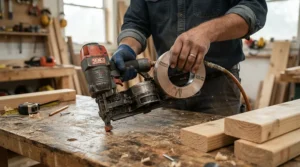
Every fence eventually needs something beefier than picket-gauge nails, whether that’s securing a top rail to a post or blind-nailing a kickboard into pressure-treated framing. The Metabo HPT NV75A5 is built to bridge that gap: it accepts 16-degree wire coil nails from 1-3/4″ all the way to 3″, plus 15-degree plastic coil nails up to 2-1/4″, giving it real reach into framing-grade fastening while still weighing a manageable 5.7 pounds.
What the spec sheet won’t spell out is how much that extra inch of nail length changes what a “fencing nailer” can actually do. A 2-1/2″ nail secures a picket to a rail just fine, but a 3″ fastener is what you want driving through a rail into a post, or through a kickboard into a treated sill — jobs where the shorter siding-class nailers on this list simply can’t reach. Reviewers and Metabo HPT’s own award history (nine consecutive years as the Pro Preferred nailer brand in this class) point to consistent depth-of-drive accuracy even at the longer end of its range, which matters when you’re driving into denser pressure-treated lumber.
Pros:
- ✅ Drives nails up to 3 inches for hefty rail framing
- ✅ Only 5.7 pounds despite bridging siding and framing duty
- ✅ Pro Preferred award nine years running from industry judges
Cons:
- ❌ Overkill and pricier if you only nail pickets
- ❌ Larger fastener range means carrying two nail coil types
Priced around $260–$330, the Metabo HPT NV75A5 is the one to add to your kit if your fence project includes real framing work, not just picket attachment.
7. Grip-Rite GRTCS250 — contractor-grade sleeper pick under the radar
Grip-Rite doesn’t get the brand recognition of Bostitch or Makita among DIYers, but the Grip-Rite GRTCS250 is part of the company’s R.E.D. System line built specifically with contractors in mind, and the spec sheet reads like a direct competitor to nailers costing considerably more. It shoots both 15-degree wire weld coil nails (1-3/4″ to 2-1/2″) and plastic sheet coil nails (1-1/4″ to 2-1/2″), with a magazine capacity of 200–350 fasteners and a lightweight magnesium housing that keeps the tool at 4.8 pounds.
Based on the spec comparison, the GRTCS250’s seven-year tool warranty and 90-day soft parts warranty rival what you’d expect from a much pricier name-brand tool, and the rotating belt hook is the kind of small ergonomic detail that adds up over a full day of moving up and down a fence line. Aggregated feedback describes it as a dependable, no-frills option for siding, fencing, and cedar shake work, though its smaller distribution network means replacement parts and service centers aren’t always as close by as they are for Bostitch or Metabo HPT dealers.
Pros:
- ✅ Magnesium housing keeps the tool light through long fence runs
- ✅ Seven-year tool warranty rivals pricier name-brand competitors
- ✅ Rotating belt hook adds real all-day carry convenience
Cons:
- ❌ Less brand recognition can mean fewer nearby service centers
- ❌ Bump-fire-only trigger on base model limits precision options
At around $180–$240, the Grip-Rite GRTCS250 is proof that the best coil nailer for fencing doesn’t have to carry a household name to get the job done right.
Full Spec Comparison: Nail Range, Weight & Price
| Nailer | Nail Length Range | Weight | Magazine Capacity | Price Range |
|---|---|---|---|---|
| Metabo HPT NV65AH2 | 1-1/2″–2-1/2″ | 4.8 lbs | ~300 | $230–$290 |
| BOSTITCH N66C-1 | 1-1/4″–2-1/2″ | 4.4–4.9 lbs | 300 | $180–$230 |
| Freeman PCN65 | 1-1/4″–2-1/2″ | 5.5 lbs | 200–400 | $120–$160 |
| MAX USA CN550S | 1″–2″ | 4.4 lbs | 200–400 | $300–$370 |
| Makita AN613 | 1-1/4″–2-1/2″ | ~5 lbs | 300–400 | $280–$340 |
| Metabo HPT NV75A5 | 1-3/4″–3″ | 5.7 lbs | ~300 | $260–$330 |
| Grip-Rite GRTCS250 | 1-1/4″–2-1/2″ | 4.8 lbs | 200–350 | $180–$240 |
Scanning the full lineup side by side, the pattern is clear: the MAX USA CN550S trades maximum nail length for pure fencing-specific weight savings, while the Metabo HPT NV75A5 trades a little extra weight for reach into 3-inch framing territory. Everything in the middle — the BOSTITCH N66C-1, Freeman PCN65, Makita AN613, and Grip-Rite GRTCS250 — occupies the same general 1-1/4″ to 2-1/2″ sweet spot that covers the vast majority of picket and rail fastening. If your fence is mostly pickets and rails with the occasional post cap, almost any nailer on this table will do; it’s the edge cases (angled cuts, framing-grade lumber, purpose-built lightness) that should decide your pick.
Practical Usage Guide: Setting Up Your Coil Nailer for a Fence Build
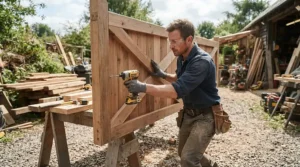
Before you fire a single nail, get the compressor conversation out of the way. Most coil siding and fencing nailers want somewhere between 70 and 120 psi, and a small pancake compressor rated around 4–6 CFM at 90 psi will keep up with steady, non-rapid-fire work — if you’re running the MAX CN550S’s 15-nails-per-second rapid trigger, budget for a bigger tank so you’re not waiting on recovery time every few boards.
Load the coil with the nail points facing the feed mechanism (check your manual — orientation differs slightly by brand), then run a test shot into a scrap piece of the same wood you’re using on the actual fence. Dial the depth adjustment until the nail head sits flush without crushing the wood fibers around it; overdriving is the single most common first-time mistake, and it weakens the fastener’s holding power more than people expect. Oil the tool per the manufacturer’s schedule (a few drops in the air inlet before each session on most pneumatic models), and keep a spare O-ring kit on hand since seals are the most common wear item on any coil nailer.
In the first 30 days, the most common mistakes are running pressure too low (causing nails to stand proud instead of sinking flush) and skipping eye protection because “it’s just a few nails” — both are easy habits to build correctly from day one, and both save you real frustration a month into the project.
Real-World Scenarios: Matching the Nailer to Your Fence Project
Picture a homeowner tackling a 120-foot cedar privacy fence around a backyard pool. Cedar is soft and prone to splitting, so a lighter nailer with fine depth control — like the Makita AN613 or Metabo HPT NV65AH2 — sinks nails cleanly without blowing through the face of the board, and aluminum or stainless fasteners (more on that below) avoid the black tannin streaks cedar is famous for when paired with the wrong metal.
Now picture a contractor building a privacy fence out of pressure-treated pine for a rental property, working on volume and budget. Here the calculus shifts toward driving power and coil capacity over finesse — the BOSTITCH N66C-1 or Grip-Rite GRTCS250, loaded with hot-dip galvanized coil nails, gets pickets up fast without worrying about a chemical reaction between the treatment and the fastener.
A third scenario: a weekend DIYer replacing three sagging rail-to-post connections on an existing fence, not building anything new. This is a job for the Metabo HPT NV75A5 specifically, because 3-inch nails reaching deep into a post give the repair real structural bite that a 2-inch picket nail simply can’t provide. Matching the tool to the scenario — not just the budget — is what separates a fence that lasts one season from one that lasts twenty.
Common Coil Nailer Mistakes (And How to Fix Them)
Problem: Nails backing out over time. This usually means the shank type is wrong for the wood — smooth-shank nails pull loose as pressure-treated lumber cycles through wet and dry seasons. Solution: switch to ring-shank or screw-shank coil nails, which resist pull-out dramatically better in lumber that swells and shrinks.
Problem: Black streaking around nail heads on cedar. This is a chemical reaction between cedar’s natural tannins and standard steel fasteners. Solution: use stainless steel or aluminum nails specifically rated for cedar and redwood.
Problem: Nail heads sinking too deep or standing proud. Usually a depth adjustment or PSI mismatch. Solution: re-run a test shot on scrap after every material change, since cedar and treated pine require different depth settings on the same tool.
Problem: Nailer jamming mid-coil. Often caused by using off-brand nails not properly rated for your specific nailer’s collation angle and wire gauge. Solution: stick to the collation angle and gauge range printed in your manual, even if a cheaper universal coil looks tempting.
Problem: Corrosion staining the fence face within a year. This points to using electro-galvanized or plain steel nails on pressure-treated wood. Solution: switch to hot-dip galvanized (ASTM A153) or stainless steel fasteners, which is now the industry-standard recommendation for treated lumber contact.
How to Choose the Best Coil Nailer for Fencing
- Match nail length to your lumber. Standard 5/8″-to-1″-thick pickets need 1-1/4″–2″ nails; 2x rails and posts need 2-1/2″–3″ fasteners, so check your project’s mix before buying.
- Check the collation angle and gauge. Most siding and fencing nailers run 15- or 16-degree collation — buying off-angle coils later will leave you stuck, so confirm compatibility up front.
- Weigh the tool, literally. Anything under 5 pounds noticeably reduces fatigue on multi-day builds; heavier framing-capable models trade that comfort for reach.
- Consider magazine capacity. A 300–400 nail magazine means fewer reloads on long fence runs, which adds up to real time saved across a whole project.
- Match your air supply. Confirm your compressor’s PSI and CFM output actually meets the nailer’s stated range before you’re stuck mid-project with a starved tool.
- Decide if you need dual firing modes. Sequential mode protects against accidental double-fires near corners; bump-fire mode speeds up long straight runs — the best nailers give you both.
- Factor in warranty and parts availability. A longer warranty backed by a wide dealer network (Bostitch, Metabo HPT) matters more if you’re buying one tool to last a decade.
Fence Nailer Nail Shank Type Explained
The shank — the vertical body of the nail below the head — comes in three common styles for fence work, and picking the wrong one is a quiet, slow-motion way to end up with a leaning fence. Smooth shank nails are the cheapest and easiest to drive, but they offer the least holding power and are the first to work loose as wood expands and contracts through the seasons, especially in pressure-treated lumber that moves more than kiln-dried cedar.
Ring shank (annular) nails have raised rings running up the shank that bite into wood fibers as they’re driven, dramatically increasing pull-out resistance compared to smooth shank — this is the standard recommendation for picket and rail attachment where the wood will see repeated wet-dry cycles. Screw shank (spiral) nails take it a step further, twisting into the wood almost like a screw thread, which delivers the highest holding power of the three but can be slightly more prone to splitting brittle or dry lumber if driven too aggressively. For most fence builds, ring shank strikes the best balance of holding power and split resistance, while screw shank earns its keep on top rails and other high-stress connection points.
Galvanized Nail for Fence Boards vs Other Coatings
Hot-dip galvanized (HDG) coil nails are the baseline recommendation for any fence board making direct contact with pressure-treated lumber. Simpson Strong-Tie’s corrosion resource for treated wood and lumber treaters alike point to hot-dip galvanized fasteners meeting ASTM A153 as the minimum acceptable standard for corrosion resistance against modern ACQ and CA wood preservatives, which are considerably more corrosive to bare and electro-plated steel than the older CCA treatments they replaced.
Electro-galvanized nails look similar on the shelf and cost less, but they carry a noticeably thinner zinc coating that wears through faster, especially on nails labeled G-60 or G-90 — both of which lumber treaters specifically warn against using with today’s ACQ or CA treated wood. What most buyers overlook is that a galvanized nail for fence boards isn’t just about preventing rust on the fastener itself; a corroding nail loses holding strength well before it visibly rusts, which is how a “fine-looking” fence ends up with a wobbly picket seemingly overnight. For fence boards touching treated lumber, hot-dip galvanized coil nails are the safe, code-compliant default.
Aluminum Nails for Fencing: When They Make Sense
Aluminum nails occupy a specific, useful niche in fence building: they’re the go-to fastener for cedar and redwood fencing, where their natural corrosion resistance prevents the ugly black streaking that occurs when standard steel reacts with the tannins in those wood species. Because aluminum won’t rust, it’s also a sensible choice near coastal air or sprinklers, anywhere moisture exposure is a constant rather than an occasional event.
The trade-off is holding strength. Aluminum is a softer metal than steel, so aluminum nails for fencing generally aren’t recommended for structural connections like rail-to-post framing — reserve them for picket faces and trim where appearance matters more than maximum pull-out resistance. They should also never be used in direct contact with pressure-treated lumber, since the chemical preservatives in modern treated wood are specifically incompatible with aluminum and will accelerate corrosion rather than prevent it. In short: great for the cedar privacy fence, wrong tool for the treated-pine one.
Best Nail Gun for Cedar Fence vs Best Nail Gun for Privacy Fence
These two searches often overlap, but they’re not quite the same question, and the distinction is worth untangling. A search for the best nail gun for cedar fence is really a question about finesse: cedar is soft, prone to splitting near edges, and cosmetically sensitive to fastener choice, so the winning combination is a nailer with fine depth control — the Makita AN613‘s nine-position depth dial or the Metabo HPT NV65AH2‘s tool-less adjustment — paired with aluminum or stainless steel nails to avoid tannin staining.
A search for the best nail gun for privacy fence, on the other hand, is usually a volume-and-durability question, since privacy fences run long, often use pressure-treated lumber, and prioritize speed over cosmetic finesse. Here, magazine capacity and driving power take priority over delicate depth control, which is why the BOSTITCH N66C-1‘s 300-nail magazine or the MAX USA CN550S‘s 15-nail-per-second rapid fire tend to be better matches, paired with hot-dip galvanized ring-shank coil nails for the treated lumber underneath. If your fence is both cedar and long, honestly, you split the difference: buy for depth control first, and choose your fastener material based on the wood, not the nailer.
Stainless Steel Fence Nails: Worth the Upgrade?
Stainless steel fence nails sit at the top of the corrosion-resistance ladder, and for good reason — independent testing referenced by fastener manufacturers shows 316-grade stainless steel retaining roughly 95% of its strength after long-term exposure, compared to a steep drop-off for uncoated or under-coated steel in the same conditions. That resistance matters most in coastal environments, near pools, or anywhere a fence sits in near-constant moisture, since Type 304 and 316 stainless are explicitly recommended by treated-wood manufacturers for permanent or high-exposure applications.
The catch is cost: stainless steel coil nails can run several times more expensive than hot-dip galvanized equivalents, which is real money multiplied across a few thousand fasteners on a long fence run. Here’s what to weigh — for a standard backyard privacy fence in a moderate climate, hot-dip galvanized nails are perfectly adequate and code-compliant. For a fence within salt spray range of the coast, around a saltwater pool, or anywhere you genuinely never want to think about fasteners again, stainless steel fence nails earn their premium through decades of avoided repairs rather than any single upfront saving.
Coil Nailer for Pressure Treated Wood: What Changes
Running a coil nailer for pressure treated wood isn’t fundamentally different from any other fencing job, but a couple of details deserve attention. First, the fastener itself has to change — as covered above, only hot-dip galvanized or stainless steel coil nails are appropriate for direct contact with modern ACQ or CA treated lumber, since the copper-based preservatives in today’s treatments corrode plain steel and aluminum noticeably faster than the older chemistries they replaced.
Second, pressure-treated lumber is simply denser and often slightly damper than kiln-dried cedar or pine — a byproduct of the hot-dip galvanizing process being engineered specifically for that kind of moist, chemically treated environment — which means your nailer needs to deliver consistent driving force at the top end of its depth range without stalling. This is where a nailer like the Metabo HPT NV75A5, with its extra reach up to 3 inches and framing-adjacent driving power, earns its keep over a lighter picket-focused tool. Reviewers consistently note that running treated lumber at the low end of a nailer’s recommended PSI range leads to proud, incompletely seated nails — bumping toward the higher end of the compressor’s rated pressure (say, 100–110 psi rather than 70–80) tends to produce cleaner, fully flush results on denser treated stock.
Long-Term Cost & Maintenance
A coil nailer itself is a one-time purchase, but the fasteners running through it are a recurring cost worth budgeting honestly. Hot-dip galvanized coil nails typically run in the budget-friendly range per box, stainless steel runs noticeably higher, and aluminum sits somewhere in between — but the real total cost of ownership calculation has to include repair labor, not just fastener price.
| Fastener Material | Relative Cost | Corrosion Resistance | Best Wood Match |
|---|---|---|---|
| Aluminum | Moderate | High (non-rusting) | Cedar, redwood |
| Hot-Dip Galvanized | Low–Moderate | Good (code minimum) | Pressure-treated pine, standard fencing |
| Stainless Steel (304/316) | High | Excellent | Coastal, poolside, treated wood in severe exposure |
A galvanized-nailed treated fence in a moderate climate can reasonably run 15-plus years before fasteners become a concern, while an under-coated or mismatched fastener choice can show corrosion-driven failures within a couple of seasons — meaning the cheaper nail can quietly become the more expensive long-term choice once you factor in re-nailing labor. On the tool side, budget for periodic O-ring replacement (typically under $20 per kit) and occasional driver blade wear on any pneumatic coil nailer used across multiple projects; it’s a minor recurring cost against the labor hours the tool saves you.
Safety, Regulations & Fastener Compliance for Fence Building
Coil nailers are genuinely useful tools, but they’re still nail guns, and OSHA’s nail gun safety guidance exists because contact-trip triggers can cause double fires if you’re not deliberate about hand and foot placement — sequential (single-shot) trigger mode is the safer default for anyone newer to pneumatic tools, even if bump-fire mode is faster for experienced users on long runs. Safety glasses aren’t optional theater here; coil nails and wire collation fragments genuinely do kick back on occasion.
On the fastener side, building codes reference ASTM A153 as the baseline standard for galvanized fasteners in contact with treated lumber, and most local jurisdictions defer to the International Residential Code’s fastener guidance for treated wood contact — worth a quick check with your local building department if your fence project requires a permit, since setback and height rules vary widely by municipality even though fastener requirements are fairly standardized nationally. The short version: match your fastener material to your wood as covered above, and you’ll clear both the durability bar and the code bar at the same time.
Frequently Asked Questions
❓ Can I use a framing nailer instead of a coil nailer for a fence?
❓ What PSI do I need to run a coil nailer for fencing?
❓ Do coil nailers work with smaller portable compressors?
❓ How many nails do I need for an average wood fence?
❓ Can electro-galvanized nails be used on pressure-treated fence posts?
Conclusion
There’s no single best coil nailer for fencing that wins every category — that’s really the throughline of this whole guide. The Metabo HPT NV65AH2 is the safest all-around buy, the Freeman PCN65 covers a one-time DIY build without draining your tool budget, and the MAX USA CN550S is worth its premium if fencing is genuinely your specialty rather than a side task. Where a lot of people go wrong isn’t the tool at all — it’s pairing a perfectly good nailer with the wrong fastener, whether that’s plain steel against pressure-treated lumber or standard nails staining a cedar fence black within a season.
Take the fastener conversation as seriously as the tool conversation. Match nail material to wood species, match shank type to how much the lumber will move over the seasons, and check your local code requirements if the project needs a permit. Get those decisions right alongside a nailer that fits your hand and your project’s scale, and you’ll end up with a fence that’s still standing straight long after the receipt is forgotten.
Recommended for You
- Coil Framing Nailer vs Stick: 7 Best Picks Compared (2026)
- 21 vs 30 Degree Framing Nailer: 7 Best Picks for 2026
- 7 Best Framing Nailer Picks for 2026: Pro vs Budget Guide
Disclaimer: This article contains affiliate links. As an Amazon Associate, I earn from qualifying purchases. If you purchase products through these links, we may earn a small commission at no additional cost to you.
✨ Found this helpful? Share it with your friends! 💬🤗
