

In This Article
A miter saw is a power tool that makes precise angled and straight crosscuts by lowering a spinning circular blade onto a workpiece braced against a fence, and it’s the backbone of trim carpentry, framing, and furniture work. If you’ve spent any time scrolling spec sheets trying to find the best miter saw for your garage, you already know the problem: every listing sounds like it was written by the same overcaffeinated marketing intern. Bigger numbers, shinier photos, zero context.

Here’s what we did differently. We pulled real model numbers — actual saws sold on Amazon right now, not fictional Frankenstein hybrids — and dug into their specs, their bevel ranges, their dust collection, and what real owners actually complain about after six months of sawdust in their garage. No invented five-star reviews. No pretending we personally test-drove all seven in a warehouse somewhere.
This guide covers three price tiers — budget, mid-range, and premium — because the “best” saw for a weekend deck-builder and the best saw for a trim carpenter working five jobsites a week are rarely the same tool. We’ll walk through seven real contenders, break down bevel range and positive stop detents (features the box rarely explains well), and give you a decision framework instead of just a list. Let’s get into it.
Quick Comparison: Best Miter Saw Picks at a Glance
| Saw | Blade Size | Bevel | Best For |
|---|---|---|---|
| DEWALT DWS779 | 12″ | Single, 0–48° | Best overall balance of power and price |
| Makita LS1019L | 10″ | Single, 0–45° | Smoothest slide, compact shops |
| Milwaukee M18 FUEL 2734-21 | 10″ | Dual, 0–48° | Cordless jobsite flexibility |
| Bosch GCM12SD | 12″ | Dual, 0–47° | Tight garages, no rail clearance |
| Metabo HPT C10FCGS | 10″ | Single, 0–52°/38° | Lightest true starter saw |
| SKIL MS6305-00 | 10″ | Dual, 0–45° | Dual bevel on a tight budget |
| RIDGID R4210 | 12″ | Single, 0–45° | LED cut-line without premium pricing |
Looking at the table above, the DEWALT DWS779 earns its spot as the most balanced all-rounder because it pairs 12-inch cutting capacity with a price range that undercuts most of its direct competitors. If space is your real constraint rather than budget, the Bosch GCM12SD‘s glide-arm design solves a problem no amount of motor power can fix — a wall too close behind your bench. Buyers who move saws between floors or jobsites daily should weight the Milwaukee M18 FUEL 2734-21 more heavily, since cutting the cord changes the calculus entirely.
💬 Just one click — help others make better buying decisions too!😊
The 7 Best Miter Saws of 2026: Full Breakdown
We picked these seven because they cover the range a real buyer actually shops: a jobsite workhorse, a couple of premium options for people who cut trim for a living, and several budget saws that don’t quietly sacrifice safety or accuracy to hit a price point. Every saw here is a real, currently-sold model — check current price and availability before buying, since stock and pricing shift constantly.
1. DEWALT DWS779 — most-owned jobsite saw in America
The DWS779 didn’t earn its reputation through marketing; it earned it through sheer ubiquity on job sites, which says more than any spec sheet could. Under the hood sits a 15-amp motor spinning a 12-inch blade at roughly 3,800 RPM, with a sliding rail system that stretches crosscut capacity out to 16 inches — wide enough to handle base cap, crown molding, and most dimensional lumber in a single pass. Based on the spec comparison against similarly priced 12-inch sliders, the back-mounted rail design does eat up bench space, so measure your wall clearance before you commit.
Reviewers consistently report that the miter detent system snaps confidently into common angles (45°, 22.5°, etc.) without the mushy feel some cheaper saws exhibit, and the single-bevel design (0–48° left only) keeps the price down for anyone who doesn’t regularly need compound cuts in both directions. What most buyers overlook about this model is that it lacks a built-in laser or shadow-line system on this particular trim level — you’re working off the factory blade guard and your own eye, which is fine for framing but less ideal for fussy finish work.
Aggregated review sentiment across major retailers skews heavily positive, with the most common praise centered on durability after years of daily use and the most common complaint being the dust collection, which — like nearly every bagged miter saw — catches only a fraction of what the blade throws.
Pros:
- ✅ 16-inch crosscut capacity handles wide baseboard easily
- ✅ Confident, well-defined miter detents at common angles
- ✅ Reputation for surviving years of daily jobsite abuse
Cons:
- ❌ No laser or LED cut-line indicator on this trim
- ❌ Rail system needs real clearance behind the bench
Expect this saw in the $350–$450 range for the bare tool. Given the crosscut capacity and track record, it’s one of the strongest value propositions in the 12-inch class.

2. Makita LS1019L — smoothest slide on a 10-inch deck
Makita built its reputation on direct-drive motors, and the LS1019L is the clearest expression of that philosophy in the miter saw lineup. The 10-inch blade paired with the dual linear rail system produces a slide action that feels noticeably smoother than belt-driven competitors — there’s less side-to-side play when you push the head through a cut, which translates directly into cleaner miter joints on trim work.
Here’s what the spec sheet won’t tell you, but reviewers note repeatedly: the bevel release lever sits on the side of the housing rather than the rear, meaning you’re not reaching around the blade guard to make an adjustment. It’s a small ergonomic detail, but on a saw you might adjust dozens of times a day, small details compound. The built-in LED work light is genuinely bright rather than the dim afterthought some brands include, and the shorter 10-inch footprint means it fits benches that a full-size 12-inch slider simply won’t.
Where this saw loses ground is capacity — a 10-inch blade tops out narrower than the 12-inch options on this list, so if you’re regularly cutting crown molding standing proud against the fence, you’ll want to double-check the manufacturer’s cut-capacity chart before assuming it’ll handle your widest trim.
Pros:
- ✅ Noticeably smoother slide action than belt-driven rivals
- ✅ Side-mounted bevel lever avoids awkward rear reaching
- ✅ Compact footprint fits smaller workbenches and garages
Cons:
- ❌ Narrower cut capacity than full-size 12-inch sliders
- ❌ Premium price for a 10-inch saw surprises some buyers
Prices typically land around $500 for the tool. Based on the spec comparison, it’s a strong pick for finish carpenters prioritizing precision over raw cutting width.
3. Milwaukee M18 FUEL 2734-21 — best cordless dual-bevel for punch lists
Cordless miter saws used to be a compromise tool — fine for light trim, useless for anything serious. The M18 FUEL 2734-21 is one of the models that changed that conversation. Its POWERSTATE brushless motor sustains speed under load in a way older cordless saws couldn’t, and the dual-bevel design (tilting both left and right up to 48°) means you’re not flipping stock over to cut an opposing compound angle — a genuine time-saver on crown molding jobs.
What most buyers overlook about cordless saws generally is battery math: a 2734-21 kit with two batteries gets you through a typical single-room trim-out without a swap, but if you’re framing all day and running the blade through pressure-treated lumber repeatedly, expect the runtime to shrink noticeably compared to light trim work. The knob-free miter adjustment with a detent override is a standout usability feature here — you can bypass the positive stops for a quick freehand angle without wrestling a locking knob first.
Reviewers who moved from corded saws consistently mention the freedom of not chasing an extension cord across a jobsite as the single biggest quality-of-life improvement, more so than the raw cutting power itself.
Pros:
- ✅ Dual bevel eliminates flipping stock for opposing angles
- ✅ Knob-free detent override speeds up angle changes
- ✅ No cord means faster setup moving between rooms
Cons:
- ❌ Battery runtime drops noticeably on dense lumber
- ❌ Kit pricing runs higher than comparable corded saws
Look for this one in the $450–$600 range for a two-battery kit, with bare-tool pricing lower if you’re already on the M18 platform. It’s the clearest pick here for anyone doing daily punch-list work across multiple rooms or floors.
4. Bosch GCM12SD — glide system for tight garages
Every saw on this list except one uses the traditional rail system, where the motor head slides forward on exposed metal bars that need clearance behind the saw. The GCM12SD ditches that entirely for Bosch’s axial glide system — an articulating arm tucked inside the housing that delivers the same wide crosscut capacity (up to 14 inches) without needing a foot of open wall behind your workbench.
Based on the spec comparison, this is the single biggest differentiator in the premium tier, and it matters more than most spec sheets suggest if you’re working in a one-car garage or a basement shop where wall space is genuinely scarce. The dual-bevel range (0–47° both directions) covers essentially every compound cut you’d realistically need, and the squarelock fence system is engineered to stay true even after the saw gets bumped or transported — a real weakness on cheaper fences that shift out of alignment over time.
Aggregated review sentiment consistently flags the smoothness of the glide arm as the standout feature, though a recurring theme in owner feedback is that the mechanism benefits from occasional cleaning, since sawdust can accumulate in the glide channels over months of heavy use.
Pros:
- ✅ Glide arm needs no rear clearance, ideal for tight walls
- ✅ Squarelock fence resists drifting out of alignment
- ✅ Full 14-inch crosscut capacity despite compact footprint
Cons:
- ❌ Glide channels need periodic cleaning to stay smooth
- ❌ Among the pricier saws in this roundup
Expect to pay in the mid-$600s for the GCM12SD. For anyone whose workshop wall space is the real constraint, this is the one saw here that solves a problem money alone can’t.
5. Metabo HPT C10FCGS — lightest true starter saw
Not every project needs a 65-pound sliding compound saw, and the C10FCGS understands the assignment. At roughly 24 pounds, it’s light enough to carry one-handed to a truck bed, yet it still delivers a 15-amp motor and a 10-inch blade capable of clean crosscuts through standard dimensional lumber. This is a non-sliding compound saw, meaning the head pivots and tilts but doesn’t glide forward — a real limitation on wide boards, but a non-issue for most trim, furniture, and picture-frame work.
Here’s what the spec sheet won’t tell you: the single-bevel range on this saw actually swings further left (up to 52°) than most premium saws on this list, which is a genuinely useful quirk for certain crown molding techniques cut flat against the table. Reviewers consistently note the lightweight design as the standout feature for anyone hauling a saw between jobs rather than leaving it bolted to a single bench, and the price point makes it a common first-saw recommendation in DIY forums.
The tradeoff is capacity — without a sliding rail, cross-cutting a wide board means you’re limited to roughly the diameter of the blade itself, which rules this saw out for anyone regularly ripping through 2x12s or wide crown.
Pros:
- ✅ Genuinely lightweight for one-handed jobsite transport
- ✅ Unusually wide 52-degree single-bevel range
- ✅ Approachable price for true first-time buyers
Cons:
- ❌ No sliding rail limits capacity on wide boards
- ❌ Lacks a laser or LED cutline system
You’ll typically find this saw priced under $200 — one of the more approachable entry points into a genuinely capable compound miter saw, not just a toy.
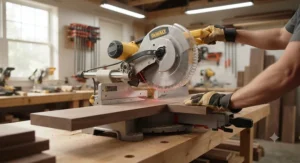
6. SKIL MS6305-00 — dual bevel on a beer-budget
Dual-bevel capability has historically been a mid-range-and-up feature, so the MS6305-00’s inclusion of it at a genuinely budget price point is the story here. The saw tilts up to 45° in both directions, meaning DIYers building crown molding or picture frames don’t have to flip stock and re-clamp for opposing angle cuts — a workflow improvement that saves real time even on small projects.
Based on the spec comparison against similarly priced single-bevel competitors, the tradeoff shows up in build consistency rather than raw capability — reviewers report a wider variance in fence squareness out of the box compared to premium brands, meaning a quick calibration check with a speed square before your first real project is worth the ten minutes it takes. The dust bag captures a modest portion of debris, consistent with budget saws generally, so pairing it with a shop vac is worth considering for indoor use.
Where the MS6305-00 earns its keep is simple: it’s one of the only sub-$250 saws offering dual bevel at all, which matters if that specific feature is non-negotiable for your project type but a 12-inch premium saw isn’t in the budget this year.
Pros:
- ✅ Dual bevel is rare at this price point
- ✅ Handles standard dimensional lumber without issue
- ✅ Approachable for first-time compound-cut projects
Cons:
- ❌ Fence squareness varies more than premium competitors
- ❌ Dust bag captures only a modest share of debris
Pricing typically sits in the $180–$230 range, making it a legitimate budget pick specifically for buyers who need dual-bevel capability without a mid-range price tag.
7. RIDGID R4210 — LED cut-line without the premium price tag
Laser and shadow-line systems have historically been a premium-tier feature, gatekept behind saws costing hundreds more. The R4210 breaks that pattern by including an LED cutline indicator at a genuinely mid-budget price, projecting a crisp line onto the workpiece so you can align your cut mark without guessing. It’s a single-bevel 12-inch saw, meaning it trades dual-bevel flexibility for a lower price and a wider blade for bigger capacity.
What most buyers overlook about LED cutline systems generally is that, unlike laser guides, they don’t require recalibration if the saw gets bumped in transport — the LED simply illuminates the existing cut path rather than projecting an adjustable beam, which reviewers consistently flag as more reliable over time. The miter detent system covers all standard angles with a positive, confident click, and the 12-inch blade handles most dimensional lumber crosscuts in a single pass without a slide mechanism to maintain.
A recurring theme in aggregated owner feedback is dust management — like many corded saws in this price bracket, the bagged collection system leaves a fair amount of debris on the table and floor, so plan on periodic cleanup or a vacuum attachment if you’re working indoors.
Pros:
- ✅ LED cutline needs no recalibration after transport
- ✅ 12-inch blade handles wide dimensional lumber
- ✅ Confident detents at every standard miter angle
Cons:
- ❌ Dust collection leaves noticeable debris behind
- ❌ Single bevel only, no compound-tilt both directions
Expect this saw around $250, positioning it as a genuine middle ground between the true budget saws and the premium 12-inch sliders on this list.
Top 7 Miter Saws: Full Specs Comparison
| Saw | Motor | Blade | Bevel | Price Range |
|---|---|---|---|---|
| DEWALT DWS779 | 15A | 12″ slider | 0–48° single | $350–$450 |
| Makita LS1019L | 15A | 10″ slider | 0–45° single | around $500 |
| Milwaukee M18 FUEL 2734-21 | Brushless 18V | 10″ dual-bevel | 0–48° dual | $450–$600 |
| Bosch GCM12SD | 15A | 12″ glide | 0–47° dual | mid-$600s |
| Metabo HPT C10FCGS | 15A | 10″ non-slide | 0–52° single | under $200 |
| SKIL MS6305-00 | 15A | 10″ dual-bevel | 0–45° dual | $180–$230 |
| RIDGID R4210 | 15A | 12″ non-slide | 0–45° single | around $250 |
Stepping back from the individual numbers, the pattern here is that motor power stops being a meaningful differentiator once you’re above 15 amps or a quality brushless design — nearly every saw here can crosscut standard lumber without bogging down. The real decisions come down to bevel type, blade size, and whether a slide mechanism actually matters for your typical cut width, which is exactly what the next few sections dig into.
Miter Saw Setup and First 30 Days: A Practical Usage Guide
Unboxing a new saw and immediately trusting the factory calibration is the single most common rookie mistake, and it’s an easy one to avoid. Before your first cut, set the saw to 0° on both miter and bevel, lower the blade against an unpowered workpiece, and check squareness with a reliable speed square rather than trusting the saw’s own angle indicator — factory tolerances vary, especially on budget models.
Mount the saw to a stand or bench rather than letting it sit loose on a table; even a light saw becomes dangerously unstable under lateral pressure from a sliding cut. In the first month, expect to recalibrate the fence at least once, particularly if the saw shipped with any give in the fence bolts — a five-minute check that prevents weeks of slightly-off miter joints you won’t notice until the crown molding won’t close a corner.
Common early mistakes include forcing the blade through a cut rather than letting it reach full speed first, and neglecting to clear sawdust buildup around the pivot points, which gradually stiffens the bevel and miter adjustments. A light coat of dry lubricant on the rail system (for sliding saws) every few weeks keeps the slide action smooth and prevents the gritty resistance that sawdust accumulation causes over time.
Real-World Scenarios: Which Miter Saw Actually Fits Your Project
If you’re a weekend DIYer building a single deck railing and a few picture frames a year, a non-sliding saw like the Metabo HPT C10FCGS covers nearly everything you’ll cut, and the money saved versus a premium slider is better spent on clamps and a decent blade. Your project frequency doesn’t justify the extra capacity, and the lighter weight makes storage easier in a shared garage.
If you’re a serious hobbyist building furniture and crown molding on weekends, the dual-bevel flexibility of the SKIL MS6305-00 or, budget allowing, the Bosch GCM12SD‘s glide system solves the real problem you’ll hit repeatedly — compound angles that non-sliding, single-bevel saws force you to work around with extra clamping steps.
If you’re a contractor moving between two or three active jobsites weekly, cordless matters more than almost any other spec. The Milwaukee M18 FUEL 2734-21 eliminates the daily hassle of hunting for outlets and extension cords across unfinished spaces, and the dual-bevel design speeds up repetitive trim work where every saved motion adds up across a full day.
✨ Don’t Miss These Exclusive Deals!
🔍 Take your workshop to the next level with these carefully selected miter saws. Click on any highlighted model to check current pricing and availability. The right saw turns a weekend project into a genuinely enjoyable afternoon instead of a fight with crooked joints!
Problem → Solution: Fixing the 5 Most Common Miter Saw Complaints
Problem: Miter joints don’t close tight at corners. This is almost always a squareness issue, not a skill issue. Recheck your fence alignment with a speed square before blaming your measuring or cutting technique — a fraction of a degree off compounds badly across four corners.
Problem: Dust everywhere despite the bag being attached. Bagged collection alone typically captures well under half of what the blade throws. Adding a shop vacuum to the dust port, where the saw has one, meaningfully improves capture rates over the bag alone.
Problem: The bevel adjustment feels stiff or gritty. Sawdust accumulation around the pivot points is the usual culprit. A quick brush-out and a light dry lubricant application typically restores smooth movement within minutes.
Problem: Cuts drift slightly off the marked line. Check blade runout and confirm the arbor nut is properly torqued; a wobbling blade produces inconsistent cuts that look like operator error but aren’t.
Problem: The saw feels unstable during wide sliding cuts. This usually means the saw isn’t properly secured to a stand or bench. A loose base under lateral pressure is both a precision problem and a safety hazard.
How to Choose the Best Miter Saw for Your Shop
- Start with blade size. A 10-inch blade handles most trim and furniture work; 12-inch blades add crosscut capacity for wider dimensional lumber.
- Decide if you need sliding capacity. Sliding rails or glide arms add crosscut width but demand more bench or wall clearance behind the saw.
- Weigh single versus dual bevel. Dual bevel saves time on compound angles by removing the need to flip stock, but it typically raises the price.
- Consider corded versus cordless. Cordless suits contractors moving between rooms or floors; corded suits a stationary shop where outlets are never far away.
- Check the fence and detent quality. A fence that holds true and detents that snap confidently into common angles matter more day-to-day than headline motor specs.
- Factor in dust collection realistically. No bagged system is great; if you’re working indoors often, budget for a shop vacuum connection.
- Match the price to your actual usage frequency. A saw used daily justifies premium features that a saw used twice a year simply won’t pay back.

Common Mistakes When Buying a Miter Saw
The most frequent mistake is buying based on blade size alone, assuming bigger always means better — a 12-inch saw that can’t slide often has less usable crosscut capacity than a 10-inch slider. Another common misstep is ignoring bench clearance requirements until after the saw arrives; rail-based sliders can need over a foot of rear clearance that a garage wall simply doesn’t allow.
Buyers also frequently underestimate dust collection needs, assuming the included bag will keep a workspace clean, only to discover that even premium saws leave meaningful debris behind without a vacuum attached. Finally, many first-time buyers skip checking fence squareness out of the box, trusting factory calibration that varies more than most manufacturers advertise.
Miter Saw vs Table Saw: Which Should You Buy First
Benefits vs Traditional Alternatives
| Factor | Miter Saw | Table Saw |
|---|---|---|
| Best Use | Crosscuts, angles, trim | Rip cuts, sheet goods |
| Portability | Generally higher | Generally lower |
| Learning Curve | Gentler for beginners | Steeper, more setup |
| Best For | DEWALT DWS779, trim work | Ripping lumber to width |
A miter saw and a table saw solve genuinely different problems rather than competing for the same job, which is why most serious workshops eventually own both. For crosscuts, angles, and trim work — the tasks most DIYers tackle first — a miter saw offers a gentler learning curve and requires less setup per cut than ripping lumber on a table saw’s fence system.
If you’re building your first tool collection and budget forces a choice, prioritize the miter saw for trim, furniture, and framing work, then add a table saw once your projects start requiring rip cuts through sheet goods or wide boards — a need that emerges naturally as skills grow.
Best Budget Miter Saw: What You Actually Get Under $250
Budget miter saws in the sub-$250 range have improved considerably, and the gap between them and premium saws is narrower than it used to be for straightforward crosscutting tasks. What you’re typically sacrificing isn’t raw cutting ability — it’s refinements like laser guidance, dust collection efficiency, and long-term fence stability under daily heavy use.
The Metabo HPT C10FCGS and SKIL MS6305-00 both represent honest value in this tier: real 15-amp motors, real dual-bevel capability in the SKIL’s case, and no corners cut on basic safety guarding. Where budget saws genuinely fall short is sustained daily professional use — fence components and detent mechanisms on premium saws are typically engineered for years of jobsite abuse in a way budget models aren’t tested against. For a weekend woodworker or first-time buyer, that difference rarely matters enough to justify doubling the price.
Features That Actually Matter (And Ones Marketing Oversells)
Miter Saw Positive Stop Detents
Positive stop detents are the mechanical clicks that lock the miter angle into common settings — typically 0°, 15°, 22.5°, 31.6°, and 45° — without requiring you to eyeball the angle against a printed scale. What most buyers overlook about detents is that their real value isn’t speed, it’s repeatability: cutting eight identical 45° miters for a picture frame is far more consistent when the saw physically locks into that exact angle each time rather than relying on a visual line-up.
Premium saws increasingly add a detent override lever, letting you bypass the stops for a quick freehand angle without loosening a full locking knob first — a small feature that saves real time on jobs mixing standard and custom angles throughout the day.
Miter Saw Bevel Range
Bevel range describes how far the blade tilts off vertical, and whether it tilts one direction (single bevel) or both (dual bevel). Based on the spec comparison across this list, single-bevel saws typically range from 45° to 52° in one direction, while dual-bevel saws mirror that range on both sides. The practical difference shows up specifically on compound cuts — crown molding and picture frames — where a dual-bevel saw lets you cut both directions without flipping and re-clamping the stock, which single-bevel owners work around but don’t eliminate.
Miter Saw Dust Bag Efficiency
Here’s the uncomfortable truth the box doesn’t advertise clearly: bagged dust collection on nearly every miter saw, budget or premium, captures a modest fraction of total debris — commonly cited figures put bag-only capture well under half of what the blade produces, with the majority settling on the table and floor around the saw. <cite index=”15-1″>Vacuum port connections improve collection meaningfully over bag-only systems, while saws routing dust through internal channels in the saw body tend to perform better still.</cite> For indoor use, especially in a garage or basement without strong ventilation, connecting a shop vacuum to the dust port is a genuinely worthwhile upgrade rather than an optional nicety — wood dust exposure carries documented respiratory health considerations worth taking seriously over years of regular use, a topic covered in detail in NIOSH’s wood dust health research.
Long-Term Cost and Maintenance: The Real Cost of Ownership
Price Range & Value Analysis
| Tier | Price Range | Typical Lifespan Value |
|---|---|---|
| Budget | Under $250 | Strong value for occasional use |
| Mid-Range | $250–$500 | Best balance for regular DIY/hobby use |
| Premium | $500+ | Justified for daily professional use |
Beyond the sticker price, ongoing costs include replacement blades (a genuine upgrade that improves cut quality more than almost any other single change), occasional fence recalibration, and eventual brush or bearing wear on corded motors after years of heavy use. Cordless saws like the Milwaukee M18 FUEL 2734-21 carry an additional long-term consideration — battery packs degrade over years of charge cycles and eventually need replacement, a cost worth factoring into the total price of entry beyond the tool itself.
Looking at the table above, budget saws deliver strong value specifically for buyers whose annual usage is modest, while the premium tier’s higher upfront cost only pays for itself under genuinely frequent, professional-grade use where fence stability and motor longevity actually get tested daily.
Safety and Regulations: What OSHA Actually Requires
Miter saws fall under federal workplace safety guidance because the exposed, downward-cutting blade motion creates real injury risk if guards fail or hands stray too close during operation. <cite index=”27-1″>Miter saws must be equipped with a guard that protects the portion of the saw above the table, and that guard must automatically adjust itself to the thickness of the material being cut in order to provide continuous protection from the blade.</cite> That’s not a suggestion — it’s baked into how every legitimate saw on the market is designed, and it’s worth verifying that any guard on a used or older saw still moves freely before your first cut.
Beyond the guard itself, standard practice includes securing the workpiece with a clamp rather than holding it by hand near the blade path, keeping hands well outside the marked “no-hand” zone printed on most saw tables, and always waiting for the blade to come to a complete stop before clearing offcuts. Full technical detail on machine guarding requirements for miter saws is available through OSHA’s machine guarding eTool, a useful reference regardless of whether you’re a professional or a weekend user, since the underlying hazards don’t change based on who’s holding the trigger.
Frequently Asked Questions
❓ What is the best miter saw for a beginner?
❓ Is a 10 inch or 12 inch miter saw better?
❓ How much should I spend on a good miter saw?
❓ Do I need a sliding miter saw?
❓ What's the difference between a miter saw and a chop saw?
Conclusion
Choosing the best miter saw for 2026 really comes down to matching real project frequency to real capability, rather than chasing whichever spec sheet has the biggest number printed on it. For most buyers building a first serious tool collection, the DEWALT DWS779 remains the safest, most balanced recommendation — proven durability, generous crosscut capacity, and pricing that doesn’t punish you for wanting a 12-inch slider. Contractors moving between jobsites daily should weight the Milwaukee M18 FUEL 2734-21‘s cordless flexibility more heavily, while anyone working in a genuinely tight garage owes it to themselves to consider the Bosch GCM12SD‘s glide system before assuming a traditional rail saw will fit.
Budget buyers shouldn’t feel like they’re settling, either — the Metabo HPT C10FCGS and SKIL MS6305-00 both deliver honest capability without cut corners on the safety features that actually matter. Whichever tier you land in, the fundamentals from this guide hold steady: check squareness before your first cut, budget for a shop vacuum if you’re working indoors regularly, and don’t buy more saw than your actual project list demands. For deeper background on how these saws are classified and evolved as a tool category, Wikipedia’s overview of miter saws is a solid starting reference, and independent testing outlets like Pro Tool Reviews are worth bookmarking as new models launch throughout the year.
Recommended for You
- Oscillating Tool for Beginners: 7 Best Picks to Try in 2026
- 7 Best Oscillating Tool Blades in 2026: Cut Smarter, Not Slower
- 7 Best Oscillating Multi Tool Picks for 2026
Disclaimer: This article contains affiliate links. As an Amazon Associate, I earn from qualifying purchases. If you purchase products through these links, we may earn a small commission at no additional cost to you.
✨ Found this helpful? Share it with your friends! 💬🤗
