
In This Article
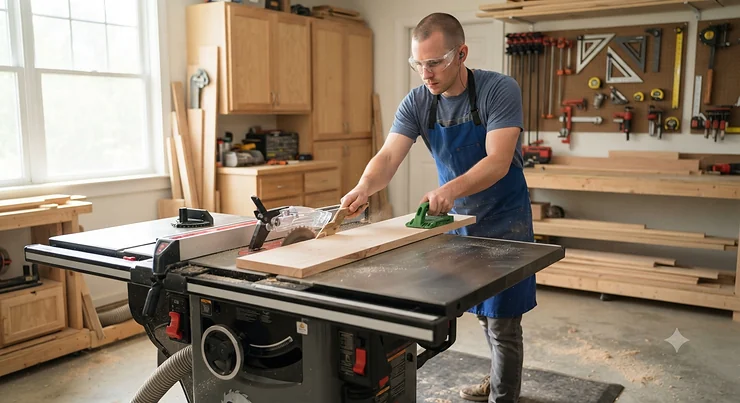
Here’s a confession every table saw for beginners guide should open with: the tool that builds your bookshelves is also the one sending roughly 30,000-plus people to American emergency rooms every single year, according to Consumer Product Safety Commission data. That’s not meant to scare you out of the hobby. It’s meant to reframe the question you’re actually asking. You’re not just shopping for a saw — you’re shopping for the machine that will teach you respect, patience, and the difference between a rip cut and a very bad afternoon.
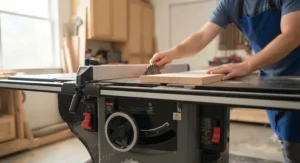
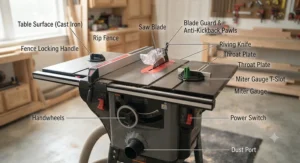
So what is a table saw for beginners, exactly? In plain terms, it’s a stationary or portable saw with a circular blade mounted below a flat table, paired with an adjustable fence and miter gauge, designed to make straight, repeatable cuts in wood and sheet goods safely enough for someone still learning the ropes. The “beginner” part isn’t about a dumbed-down machine — it’s about which specific features (riving knife, blade guard, accurate fence, manageable power) matter most when you haven’t yet built the muscle memory that experienced woodworkers take for granted.
This guide breaks down seven real, currently available table saws spanning budget jobsite models to a premium flesh-detecting machine, plus the safety features, fence quirks, and kickback physics that actually separate a good first saw from an expensive regret. We’ll also walk through setup, real-world buying scenarios, and the mistakes that turn a $300 saw into a $600 saw before you’ve cut a single board. By the end, you’ll know exactly which category fits your garage, your budget, and — most importantly — your fingers.
Quick Comparison Table: 7 Best Table Saws for Beginners at a Glance
| Table Saw | Type | Price Range | Best For |
|---|---|---|---|
| SKIL TS6307-00 | Jobsite, folding stand | $300-$350 | Overall beginner value |
| Kobalt 10-Inch | Jobsite, folding stand | $300-$350 | Wider rip capacity on a budget |
| DEWALT DWE7485 | Compact benchtop | $350-$400 | Small shops and tight storage |
| DEWALT DWE7491RS | Jobsite with rolling stand | $450-$550 | Growing skills, frequent moves |
| Bosch GTS1041A | Jobsite, gravity-rise stand | $550-$650 | One-person setup and breakdown |
| RYOBI 18V ONE+ HP | Cordless benchtop | $250-$300 (tool only) | Battery-based workflows |
| SawStop CTS | Compact, flesh-detection | $900-$1,000 | Maximum safety margin |
Based on the spec comparison above, the split between these seven saws isn’t really about who cuts wood the “best” — nearly all of them will rip a 2×4 or a sheet of plywood competently. What actually separates them is how each one manages the beginner-specific risks: fence drift, portability fatigue, and the sheer cost of a mistake. The SawStop CTS sits in a category of its own on price because it’s solving a different problem than the other six — active injury prevention rather than just cutting performance — while the RYOBI 18V ONE+ HP trades raw power for cordless convenience that the corded models simply can’t offer.
💬 Ready to see current pricing on any of these? Tap a saw above to check availability before it changes.
Just one click — help others make better buying decisions too!😊
Top 7 Table Saws for Beginners: Expert Analysis
Picking a first table saw isn’t about finding the “winner” — it’s about matching a machine’s personality to your project list, your storage space, and how much you’re willing to spend before you’ve made your first real cut. Below are seven real, currently sold models spanning true budget jobsite saws through a premium safety-first machine, each evaluated on the things that matter to someone still building fundamental skills.
1. SKIL TS6307-00 10-Inch Jobsite Table Saw — best all-around beginner value
The standout here is simple: you get a rack-and-pinion fence system, a full-size 10-inch blade, and an integrated folding stand for around $300-350, which is roughly what competitors charge for the saw alone. A 15-amp motor spinning at up to 4,600 RPM handles hardwoods and sheet goods without bogging down, and the 25.5-inch rip capacity is plenty for cabinet parts, shelving, and most furniture projects a beginner tackles in year one. What most first-time buyers overlook is that the rack-and-pinion fence — rather than a cheaper clamp-style fence — is the single feature most responsible for consistent, accurate rip cuts, because it locks parallel to the blade instead of pivoting slightly under pressure. Reviewers consistently report the saw arrives dead-square out of the box, requiring zero fence adjustment before first use, which is unusually good news for a beginner who doesn’t yet know how to diagnose a misaligned fence. On the downside, aggregated feedback flags the stock blade as mediocre on plywood and the dust collection as an afterthought, meaning you’ll want a $40 upgrade blade and a shop vac hookup fairly quickly.
Pros:
- ✅ Rack-and-pinion fence stays accurate under repeated use
- ✅ Folding stand eliminates a separate purchase
- ✅ Strong 15-amp motor for the price point
Cons:
- ❌ Stock blade tears plywood edges
- ❌ Dust collection needs a shop vac to be usable
Expect a price in the $300-$350 range at most retailers, and given the included stand, it’s arguably the best value entry point on this entire list for someone unsure how serious the hobby will become.
2. Kobalt 10-Inch Table Saw — most rip capacity in the budget tier
The Kobalt 10-Inch Table Saw‘s headline feature is its 32-inch rip capacity — a meaningful jump over the 25.5 inches on similarly priced jobsite saws — which matters the moment you’re breaking down a full sheet of plywood into cabinet sides. It shares the rack-and-pinion fence design and folding-leg stand common to this price tier, plus an aluminum throat plate that resists the flexing cheaper plastic inserts show near the blade. Based on the spec comparison, this is the saw for a beginner whose early projects lean toward built-ins, shelving units, or anything sourced from full plywood sheets rather than narrower dimensional lumber. Reviewers note the fence needed only minor bolt adjustments out of the box — not the “dead accurate with zero tweaks” some competitors claim, but close enough that a beginner can dial it in within twenty minutes using the included manual. What the spec sheet won’t tell you is that the extra rip capacity comes at the cost of a slightly larger footprint, so measure your garage or shop space before assuming this fits where a smaller saw would.
Pros:
- ✅ 32-inch rip capacity handles full plywood sheets
- ✅ Aluminum throat plate resists flexing near the blade
- ✅ Rack-and-pinion fence matches pricier competitors
Cons:
- ❌ Larger footprint than comparable budget saws
- ❌ Fence needs minor setup adjustment out of the box
Priced similarly to the SKIL TS6307-00 at roughly $300-$350, the choice between the two often comes down to available shop space versus a slight edge in claimed out-of-box accuracy.
3. DEWALT DWE7485 8-1/4-Inch Compact Table Saw — lightest footprint without sacrificing accuracy
What stands out about the DEWALT DWE7485 is how much refinement DEWALT packed into a genuinely compact body — this is a saw built for people whose “shop” doubles as a one-car garage or a storage closet. The 8-1/4-inch blade trades some depth of cut for a lighter, more maneuverable package, and the rack-and-pinion fence includes positive stops that snap crisply into common measurements, a small touch that beginners appreciate because it removes guesswork from repeat cuts. A 15-amp motor keeps pace with 10-inch saws on hardwood, walnut, and plywood despite the smaller blade, though ripping true 4×4 stock is off the table given the reduced cutting depth. Here’s what the spec sheet won’t tell you: because it lacks a built-in stand, you’ll need a workbench or separate stand purchase, which changes the total cost math compared to jobsite saws that fold their own legs. Aggregated owner feedback consistently praises the DWE7485’s build quality and reliability over years of use, with complaints centering mainly on the missing stand rather than the saw itself.
Pros:
- ✅ Compact, lightweight body fits tight shops
- ✅ Positive-stop fence speeds up repeat measurements
- ✅ DEWALT build quality holds up over years
Cons:
- ❌ No included stand adds to total cost
- ❌ Smaller blade can’t rip 4×4 stock
Expect a $350-$400 range for the saw alone, with an optional rolling stand pushing the full setup closer to $450-$500.
4. DEWALT DWE7491RS 10-Inch Jobsite Table Saw with Rolling Stand — best for a saw that grows with your skills
The DEWALT DWE7491RS earns its spot through sheer versatility: a telescoping table extends the rip capacity to 32.5 inches, the rolling stand’s wide-splay legs add real stability, and the whole package is still light enough to wheel from a garage to a driveway without a second person. Independent testers who cut through stacks of 2×6 studs, plywood, MDF, OSB, and even a 4×4 fence post reported the saw made smooth, square cuts with no fence adjustment needed straight out of the box. That kind of out-of-the-box accuracy is a genuinely big deal for a beginner, because it removes an entire category of early frustration — chasing a fence that won’t stay parallel — before you’ve cut your first board. Based on the spec comparison, this saw sits a notch above pure entry-level jobsite models specifically because the telescoping table and rolling stand solve two beginner pain points (rip capacity and one-person transport) simultaneously rather than forcing a trade-off between them. The trade-off is weight: at roughly 53 pounds, it’s noticeably heavier to lift in and out of a truck bed than the compact DWE7485, though the wheeled stand mitigates that on flat ground.
Pros:
- ✅ Telescoping table gives 32.5 inches of rip capacity
- ✅ Wheeled stand makes one-person transport realistic
- ✅ Reviewers report accurate cuts with zero setup tweaks
Cons:
- ❌ Heavier to lift than compact alternatives
- ❌ Premium price compared to entry jobsite saws
Budget around $450-$550 for this configuration, which lands it as a natural step-up pick for beginners who already suspect woodworking will become a regular habit rather than a one-project experiment.
5. Bosch GTS1041A Worksite Table Saw with Gravity-Rise Wheeled Stand — smoothest one-person setup and breakdown
The Bosch GTS1041A‘s signature trick is its gravity-rise stand, which uses the saw’s own weight to unfold and lock into position — no separate leg-by-leg assembly required, which matters enormously to a beginner who’s setting up and tearing down a saw in a shared garage every weekend. Bosch pairs this with a Smart Guard blade-guard system designed for tool-free removal and reinstallation, addressing a documented real-world problem: guards that are annoying to reinstall tend to get left off permanently, which is exactly the behavior safety engineers want to prevent. What most reviews gloss over is that the gravity-rise mechanism, while brilliant for solo setup, adds bulk and weight that makes the saw less nimble than lighter compact models when maneuvering through doorways or up stairs. Aggregated customer sentiment consistently highlights the smooth, square cuts and sturdy build, with the more common complaint being the premium price relative to jobsite saws that lack the gravity-rise convenience. For a beginner working alone without a second pair of hands to help unfold a stand, this single feature can be worth the price difference on its own.
Pros:
- ✅ Gravity-rise stand unfolds without manual assembly
- ✅ Tool-free Smart Guard encourages consistent use
- ✅ Reviewers report accurate, square cuts
Cons:
- ❌ Heavier and bulkier than compact competitors
- ❌ Priced above comparable jobsite saws
Plan on a $550-$650 range, positioning it as a premium jobsite option rather than a true budget pick.

6. RYOBI 18V ONE+ HP Brushless 8-1/4-Inch Table Saw — best for cordless-committed workshops
The RYOBI 18V ONE+ HP table saw’s standout advantage is battery compatibility — if you already own RYOBI’s 18V ONE+ ecosystem for drills, sanders, or other tools, this saw slots into your existing battery collection instead of demanding a permanent extension cord tether. A brushless motor design squeezes real cutting power out of battery voltage, though on paper this means less sustained torque than a corded 15-amp saw when ripping thick hardwood for extended sessions. What most buyers overlook about cordless table saws generally is that runtime becomes a genuine planning variable — a beginner cutting a full sheet of plywood into parts should expect to swap or recharge batteries mid-project rather than running continuously the way a corded saw allows. Reviewers note the saw is genuinely useful for job-site touch-ups, small furniture builds, and situations without easy outlet access, but it’s not typically the first recommendation for someone whose primary goal is maximizing raw cutting capacity per dollar. Because the tool is frequently sold “bare” (tool only), your effective cost depends heavily on whether you already own compatible batteries and a charger.
Pros:
- ✅ Runs on existing RYOBI 18V ONE+ batteries
- ✅ No cord means setup anywhere in the shop or yard
- ✅ Brushless motor improves efficiency per charge
Cons:
- ❌ Battery life limits continuous heavy cutting
- ❌ Bare-tool pricing hides true total cost
The saw alone typically runs $250-$300, but factor in $100-plus for a battery and charger if you’re not already in the RYOBI ecosystem.
7. SawStop Compact Table Saw (CTS) — best for maximum safety margin
The SawStop CTS exists for one reason above all others: flesh-detection technology that stops the blade in milliseconds on contact with skin, a category of protection no saw on this list — corded or cordless — can match. CPSC staff reviewing SawStop’s own activation data found that over 7,000 real-world triggers of this active injury mitigation technology resulted in no severe injuries, a striking real-world track record for a consumer power tool. Based on the spec comparison, this is the clear pick for households with new woodworkers, teenagers learning the craft, or anyone who has decided that the safety premium is worth paying regardless of raw cutting specs. It’s worth being honest about the trade-off, though: federal regulators themselves note that flesh-detection systems address blade-contact injuries specifically, while a riving knife and careful technique remain necessary for preventing kickback-related incidents, which the CTS doesn’t eliminate on its own. Aggregated owner sentiment is overwhelmingly positive on build quality and peace of mind, with the near-universal caveat being the price gap versus every other saw in this roundup.
Pros:
- ✅ Flesh-detection stops the blade on skin contact
- ✅ Strong real-world safety track record per CPSC data
- ✅ Solid fence and build quality beyond the safety system
Cons:
- ❌ Roughly double the price of comparable jobsite saws
- ❌ Doesn’t eliminate kickback risk on its own
Expect to pay in the $900-$1,000 range, which is a genuine investment for a beginner but one some families decide is non-negotiable.
Setting Up Your First Table Saw the Right Way
A proper beginner table saw setup starts before the saw is even plugged in. Unbox everything and inventory the parts against the manual — missing hardware is common enough that catching it early saves a return-shipping headache later. Bolt the stand or legs first, on a flat, level surface, because a saw that rocks even slightly will transfer that instability into every cut you make. Next, check the blade for square against the table using a reliable square, not by eye, and adjust the tilt stop if it’s off — this single five-minute check prevents dozens of frustrating “why isn’t this square” moments down the road.
With the blade squared, install the riving knife and blade guard per the manual before you do anything else, and resist the urge to skip this step because it feels fiddly on a first attempt. Then calibrate the fence: run a test cut on scrap, measure both ends of the cut for parallel width, and adjust the fence rail bolts until the numbers match front to back. Finally, spend your first week making practice cuts on cheap scrap with the blade set low, focused entirely on stance, push-stick use, and feed rate rather than project output — professionals who teach beginners consistently emphasize that the habits built in week one are the ones that stick for years.
✨ Grab a push stick and a quality blade upgrade before your first real project — they cost less than a single ER copay.
Real-World Scenarios: Which Beginner Table Saw Fits Your Project
Picture a college student in a shared apartment, building a loft bed frame from pine 2x4s on weekends between classes. Storage is the binding constraint here, not power, so the DEWALT DWE7485‘s compact footprint and light weight make more sense than a jobsite saw with a permanently attached stand taking up closet space. A second scenario: a parent setting up a garage workshop specifically so a teenager can learn woodworking safely alongside them. In that household, the safety premium of the SawStop CTS stops being a luxury and starts being the actual point of the purchase, since the flesh-detection system directly addresses the exact risk profile of a less-experienced hand near a spinning blade.
Now consider a weekend renovator tackling built-in shelving and cabinet carcasses cut from full plywood sheets. Here, rip capacity matters more than portability, making the Kobalt 10-Inch or the DEWALT DWE7491RS‘s telescoping table the more practical picks over a compact saw that would require awkward re-positioning mid-cut. And for the contractor’s assistant or hobbyist who bounces between job sites without reliable outlet access, the RYOBI 18V ONE+ HP‘s cordless freedom solves a logistics problem that no amount of extra rip capacity can fix. Matching the saw to the actual use case — not the spec sheet in isolation — is the difference between a tool you reach for constantly and one that gathers sawdust in the corner.
Common Table Saw Problems Beginners Hit in the First 30 Days (And How to Fix Them)
The most frequent early complaint is a fence that “walks” out of parallel during a rip cut, usually traced to loose rail bolts rather than a defective saw — a quick re-tightening and re-measuring session, following the steps in the setup section above, resolves this in most cases. Second is tear-out on plywood edges, which nearly always comes down to the stock blade included with budget saws; swapping in a quality 40-tooth combination blade for $30-$50 solves this almost every time and is one of the cheapest upgrades available. Third, beginners frequently misdiagnose kickback as a “bad saw” when the real cause is an unsupported riving knife position or a pinched cut from a warped board — checking that the riving knife is properly aligned behind the blade, per the manufacturer’s manual, usually clears it up.
A fourth common issue is dust accumulation fouling the blade-height adjustment mechanism, especially on saws with modest dust collection like the SKIL TS6307-00; a shop vac connected to the dust port and a five-minute brush-out after each session prevents this from becoming a recurring headache. Finally, many beginners struggle with bevel-angle drift on saws using a quick-release lever, which is typically solved by re-tightening the bevel lock fully rather than “close enough” — a habit worth building from day one rather than after the third ruined cut.

How to Choose a Table Saw for Beginners
- Match motor power to your material. A 15-amp motor handles hardwoods and thick sheet goods comfortably; anything below that is fine for light hobby work but will bog down on demanding cuts.
- Prioritize fence quality over almost everything else. A rack-and-pinion fence that locks parallel to the blade prevents more frustration than any other single spec on this list.
- Confirm the riving knife and blade guard are included and easy to reinstall. Guards that are annoying to put back tend to get left off permanently, according to CPSC human-factors research.
- Decide how often the saw will travel. A folding stand or wheeled base matters enormously if you’re setting up and breaking down weekly; it matters less in a dedicated permanent shop.
- Set a total budget, not just a saw budget. Factor in a blade upgrade, push sticks, and outfeed support — not just the sticker price of the saw itself.
- Weigh cordless convenience against runtime limits. Battery-powered saws solve access problems but introduce charge-management as a new variable in your workflow.
- Consider your risk tolerance honestly. If a new or younger woodworker will be using the saw regularly, a flesh-detection system like SawStop’s changes the safety math meaningfully.
Best Budget Table Saw Under $500: What Actually Matters
Shopping for the best budget table saw under $500 means accepting a few trade-offs while refusing to compromise on the features tied directly to safety and accuracy. Within that price band, the SKIL TS6307-00, Kobalt 10-Inch, and DEWALT DWE7485 all deliver a rack-and-pinion fence and adequate 13-to-15-amp power — the two specs that matter most for a beginner’s daily experience. What separates them isn’t raw performance so much as which secondary trade-off you’re willing to accept: the Kobalt’s larger footprint for more rip capacity, or the DWE7485’s missing stand for a lighter, more compact body.
| Price Tier | Example Saw | What You Give Up | Best For |
|---|---|---|---|
| Under $350 | SKIL TS6307-00 | Premium fence rigidity, dust collection | First-time buyers on a tight budget |
| $350-$450 | DEWALT DWE7485 | Included stand | Small-footprint shops |
| $450-$650 | DEWALT DWE7491RS / Bosch GTS1041A | Lower sticker price | Frequent transport, growing skills |
Looking at the table above, the honest takeaway is that every saw under roughly $450 asks you to accept some limitation — usually dust collection, blade quality, or a missing stand — and the smart move is to budget for the one or two accessory upgrades (blade, push stick, outfeed roller) that close that gap rather than assuming the saw alone will be plug-and-play perfect. Beginners commonly underestimate this true total cost; a realistic first-saw budget lands closer to $500-$650 once a quality blade, safety gear, and outfeed support are factored in on top of the saw itself.
Table Saw Safety Features Every Beginner Should Understand
Modern table saw safety features exist because the injury data is genuinely sobering: the CPSC has documented tens of thousands of blade-contact injuries annually for decades, with fingers and hands as the overwhelmingly common target. Every saw on this list ships with three baseline protections mandated by current UL 987 standards: a permanent riving knife, a modular blade guard, and anti-kickback pawls. The blade guard is your first line of defense against top-down and side contact, though federal human-factors research has found guards primarily act as a visual and tactile warning against front-approach contact rather than a total barrier.
Beyond the baseline, features diverge by saw tier. A tool-free guard removal system, like Bosch’s Smart Guard, matters because research from CPSC’s own human-factors studies found that guards requiring multiple steps to reinstall are frequently left off permanently after the first removal — meaning ease of reinstallation is itself a genuine safety feature, not just a convenience. At the top of the safety hierarchy sits active injury mitigation technology, currently available on the SawStop CTS, which detects skin contact and stops the blade within milliseconds. For a true beginner, understanding that these are layered protections — not interchangeable ones — matters: a riving knife addresses kickback, a blade guard addresses incidental contact, and flesh-detection addresses the moment those first two protections fail.
Riving Knife vs Splitter: Why This Table Saw Part Saves Fingers
A riving knife is a curved metal plate mounted directly behind the blade that rises, falls, and tilts in sync with it, keeping the cut kerf open so the workpiece can’t pinch the blade and get thrown backward. This is a meaningful upgrade over the older splitter design, which stays fixed in one position and has to be physically removed for certain non-through cuts — a step many woodworkers simply skip re-installing afterward. Every table saw currently sold in the U.S. is required to include a riving knife under the seventh edition of the UL 987 safety standard, which is why all seven products in this guide have one as standard equipment rather than an optional add-on.
It’s worth being precise about what a riving knife does and doesn’t solve. Industry data submitted to CPSC found that only about 17-28% of table saw incidents actually involve kickback in the first place, meaning a riving knife — while genuinely valuable — addresses a meaningful minority of total injury scenarios rather than the majority. For a beginner, the practical takeaway is simple: always keep the riving knife installed and properly aligned for through-cuts, but don’t treat it as a complete safety solution on its own. Pair it with a blade guard, a push stick, and careful hand positioning, and you’re addressing the fuller range of real injury causes documented in CPSC’s own saw injury research.
Table Saw Fence Accuracy: The Difference Between Frustration and Fun
Table saw fence accuracy is arguably the single most underrated spec on any beginner saw, because a fence that drifts even a sixteenth of an inch out of parallel over a long rip cut can bind the workpiece against the blade — a direct kickback risk, not just an annoyance. Rack-and-pinion fence systems, standard on every saw in this guide’s budget and mid-range tiers, use a geared rail that locks the fence perpendicular to the miter slots at multiple points along its length, rather than relying on a single clamp point that can pivot slightly under lateral pressure.
Here’s what most spec sheets won’t tell you: a fence’s accuracy out of the box matters less than how easy it is to re-calibrate when it eventually shifts, because every fence — even excellent ones — needs periodic adjustment as bolts loosen with use. Saws like the DEWALT DWE7485 with positive-stop detents make this recalibration faster because the fence snaps back to known reference points rather than requiring a full remeasure from scratch. For a beginner, the practical habit worth building is simple: check fence-to-blade parallel distance at both the front and back of the table monthly, using a tape measure against the miter slot, and adjust immediately if the numbers diverge by more than about 1/32 inch.
Table Saw Kickback Prevention: What Causes It and How to Avoid It
Kickback occurs when a workpiece pinches against the spinning blade and gets thrown back toward the operator — and per CPSC’s Federal Register findings, a majority of the injuries that follow happen because the stock pulls the operator’s hand directly into the blade during that sudden backward motion. The most common triggers a beginner should watch for are: ripping a warped or bowed board that pinches the blade mid-cut, using the fence and miter gauge simultaneously in a way the saw isn’t designed for, and removing the riving knife for a non-through cut and forgetting to reinstall it.
Prevention starts with the equipment already covered — a properly aligned riving knife and functioning anti-kickback pawls — but technique matters just as much. Stand slightly to one side of the blade’s direct line of fire rather than directly behind it, so that if kickback does occur, the workpiece doesn’t have a clear path toward your torso. Always use a push stick for the final few inches of any rip cut instead of your bare hand, and never attempt to rip a board that’s visibly warped or has a pinched, closing kerf as it feeds through — back the cut out, flip the board, or discard the stock rather than forcing it through.
Table Saw vs Circular Saw: Which Should Beginners Start With
| Factor | Table Saw | Circular Saw |
|---|---|---|
| Cut accuracy on repeat rips | Excellent (fence-guided) | Good with a guide rail |
| Portability | Low to moderate | High |
| Learning curve | Moderate | Low |
| Best for | Furniture, cabinetry, precision | Framing, job-site rough cuts |
Reading the comparison above, the honest answer is that most serious beginners eventually want both, but a table saw earns its place first if your projects lean toward furniture, cabinetry, or anything requiring dead-accurate, repeatable rip cuts. A circular saw remains the better starting tool for rough framing or cutting down sheet goods to a manageable size before finer work begins on the table saw. The two tools are complementary rather than competing, and several of the saws in this guide — particularly the compact DEWALT DWE7485 and cordless RYOBI 18V ONE+ HP — pair naturally with a circular saw workflow for exactly this reason.
Common Mistakes When Buying a Table Saw for Beginners
The single most expensive mistake is buying the cheapest possible saw “to start” and assuming an upgrade can wait — ultra-budget saws with plastic fence components and no rack-and-pinion system frequently drift out of alignment within months, and the accessories purchased for that first saw rarely transfer cleanly to a replacement. A close second is skipping the stand-versus-benchtop decision entirely and discovering after purchase that the saw has nowhere stable to live in a cramped garage. Beginners also commonly underestimate blade quality, assuming the stock blade included with any saw is good enough indefinitely, when in practice a $30-$50 upgrade blade dramatically improves cut quality on plywood and hardwood alike.
Another frequent misstep is ignoring dust collection until sawdust has already fouled the blade-height mechanism — a $30-$50 shop vac adapter solves this proactively rather than reactively. Finally, many first-time buyers focus entirely on motor amperage while overlooking fence quality, when in reality the fence is what determines whether daily use feels smooth or maddening. Prioritizing motor specs over fence accuracy is a classic case of chasing the wrong number on the spec sheet.
Long-Term Cost & Maintenance: What Owning a Table Saw Really Costs
The saw’s price tag is only the entry fee. Realistic ongoing costs include blade replacement (a quality combination blade every 1-2 years for regular use, in the $30-$60 range), push sticks and featherboards (roughly $15-$40 total), and occasional fence recalibration that costs nothing but ten minutes of attention every few months. Dust collection accessories — a shop vac adapter, dust bags, or a dedicated collector for a dedicated shop — add another $50-$150 depending on how serious the setup becomes.
Total cost of ownership over a saw’s first 3-5 years typically runs 20-40% above the sticker price once these accessories and periodic blade replacements are accounted for, meaning a $350 saw realistically becomes a $450-$550 investment over its useful life. That said, this ongoing cost is remarkably consistent across every saw in this guide regardless of price tier — a $1,000 SawStop CTS and a $300 SKIL TS6307-00 both need the same blade upgrades and dust management, so the long-term maintenance math doesn’t meaningfully favor either budget or premium saws. What does change the math is durability: reviewers consistently note that saws with cast-aluminum tables and rack-and-pinion fences, rather than stamped-steel equivalents, tend to hold calibration longer between adjustments, which indirectly reduces the time cost of ownership even if the dollar cost stays similar.
Features That Actually Matter (And Those That Don’t)
Motor amperage above 13 amps genuinely matters for cutting hardwood and thick sheet goods without bogging down — this is not marketing fluff. A rack-and-pinion fence matters enormously, full stop, and is worth prioritizing over almost any other single spec on a beginner saw. Riving knife presence matters, though as covered above, it addresses kickback specifically rather than all injury types. On the other hand, maximum RPM figures printed prominently on packaging matter far less than manufacturers imply — once a motor clears roughly 4,000-4,500 RPM, additional speed makes little practical difference to cut quality for the material a beginner is typically working with. Similarly, bevel-angle range beyond the standard 0-45 degrees is rarely used by beginners in their first year or two, making it a low-priority spec to chase at the expense of fence quality or motor power.

Frequently Asked Questions
❓ What size table saw is best for a beginner?
❓ Is a jobsite table saw good enough for a beginner?
❓ Do beginners need a riving knife on a table saw?
❓ How much should a beginner budget for a first table saw setup?
❓ Is SawStop worth it for a beginner?
Conclusion
Choosing a table saw for beginners ultimately comes down to being honest about three things: your budget, your available space, and how much of a premium you’re willing to pay for safety margin beyond the legally required baseline. The SKIL TS6307-00 and Kobalt 10-Inch cover the true budget end without cutting corners on fence quality; the DEWALT DWE7485 and DEWALT DWE7491RS scale up in capability as your skills and project ambitions grow; the Bosch GTS1041A solves the one-person setup problem elegantly; the RYOBI 18V ONE+ HP answers for cordless flexibility; and the SawStop CTS exists for anyone who’s decided flesh-detection technology is worth the price gap.
Whichever you choose, the fence quality, riving knife, and blade guard matter more to your daily experience and long-term safety than any headline spec on the box. Spend the first week learning the machine on scrap wood before touching a real project, budget for the blade upgrade and push sticks from day one, and treat every single cut — the hundredth as much as the first — with the same level of attention. That habit, more than any individual saw on this list, is what actually keeps beginners safe and their projects square.
✨ Found the right first saw for your shop? Check today’s availability before you start your next project! 🪚
Recommended for You
- 6 Inch vs 8 Inch Bench Grinder: 7 Best Picks for 2026
- Bench Grinder for Knife Sharpening: 7 Sharp Picks (2026)
- Bench Grinder for Home Shop: 7 Picks That Won’t Let You Down (2026)
Disclaimer: This article contains affiliate links. As an Amazon Associate, I earn from qualifying purchases. If you purchase products through these links, we may earn a small commission at no additional cost to you.
✨ Found this helpful? Share it with your friends! 💬🤗
