
In This Article
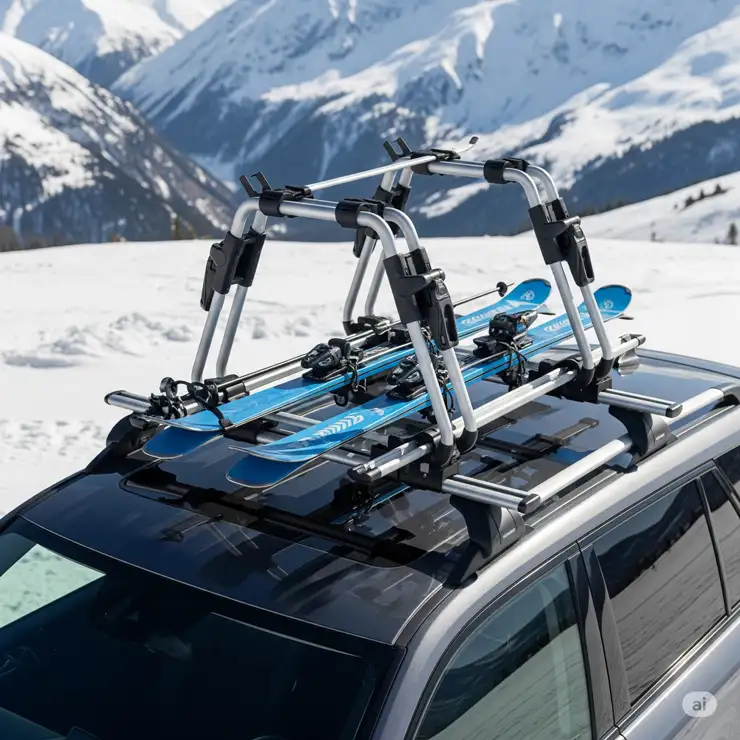
The best ski racks are roof-mounted or hitch-mounted carriers that clamp skis and snowboards to the outside of your vehicle with rubber-padded arms and built-in locks. The best ski racks keep wet, razor-edged gear out of your cabin, protect it from scratches, and open easily with gloves on. Most simply clamp onto crossbars you already own.
Anyone who has driven to a resort with four pairs of skis wedged diagonally across the back seat knows why this matters. Your passengers sit in melted snow, a binding finds the headliner, and the whole car smells like a wet dog. A good roof ski rack ends all of that in about ten minutes of installation.
There is a catch: roof-mounted gear is not free. A national lab study of roof rack fuel consumption estimated that aftermarket racks, the kind that carry bikes and skis, account for roughly 100 million gallons of gasoline a year across the U.S. So the goal isn’t just to buy a rack. It’s to buy the right ski rack for your car, your crew, and the number of days you really ski.
This guide is built from manufacturer specs, retailer listings, and published reviews, and every verdict is framed as analysis, not as lived testing. I’ve picked seven real options spanning budget, mid-range, and premium, then translated each spec into what it means on a snowy Tuesday morning.
Best Ski Racks at a Glance: Quick Comparison
Here is the whole field in one table. Prices are ranges as of October 2026 and shift often, so check current price before you buy.
| Product | Capacity | Style | Price Range | Best For |
|---|---|---|---|---|
| Yakima PowderHound 6 | 6 pairs / 4 boards | Fixed clamp | Low-to-mid $200s | All-round value |
| Thule Universal Ski & Snowboard Rack | 6 pairs / 4 boards | Fixed clamp | Around $200 | Thule quality on a budget |
| Yakima FatCat EVO 6 | 6 pairs / 4 boards | Fixed, aerodynamic | $300–$450 range | Quiet highway driving |
| Kuat Grip 6 | 6 pairs / 4 boards | Slide-out tray | $430–$500 range | Tall SUVs and trucks |
| Thule SnowPack Extender | 6 pairs / 4 boards | Slide-out tray | $550–$600 range | Premium Thule-bar setups |
| BougeRV Lockable Sliding Ski Rack | 6 pairs / 4 boards | Slide-out tray | Under $200 | Budget slide-out convenience |
| Malone LiftLine Compact | 3 pairs / 2 boards | Fixed, compact | $135–$150 range | Solo skiers and couples |
Looking at the table, five of the seven carry the same six-pair load, so capacity alone won’t decide this. The real separators are loading style and price: the slide-out trays (Kuat Grip 6, Thule SnowPack Extender, BougeRV Lockable Sliding Ski Rack) cost more in effort-saved than in dollars, while the fixed clamps like Yakima PowderHound 6 and Thule Universal Ski & Snowboard Rack win on simplicity. If you only ever carry two or three pairs, Malone LiftLine Compact is the sane choice.
💬 Just one click — help others make better buying decisions too!😊
Top 7 Best Ski Racks: Expert Analysis
Below are the seven picks, each with real specs, honest analysis, and a summary of what reviewers consistently report. Where a product’s review pool is thin, I say so instead of papering over it.
1. Yakima PowderHound 6 — the dependable all-rounder
Think of the Yakima PowderHound 6 as the comfortable pair of boots of this category: unflashy, rarely regretted. Roundup reviewers describe it as the top seller in Amazon’s ski-and-snowboard car rack category, which says a lot about what buyers reward: easy fitment and zero drama.
It carries six pairs of skis or four snowboards, and its universal hardware clamps onto round, square, factory, and most aero crossbars. That clamp versatility is the real headline, because if you swap crossbars or change cars, the rack comes with you. Retail listings put it around 8 pounds, light enough to wrestle on and off solo. SKS lock cores keep gear secured to the carrier.
Based on the spec sheet, it suits the skier who hits the hill ten to twenty days a season and wants a set-and-forget carrier. The trade-off is a fixed arm design, so you reach across the roof to load the far side. On a tall SUV, that gets old.
Reviewers describe it as a good rack at a fair price that fits factory crossbars. The visible review pool at some retailers is small, so treat that as directional, not gospel.
Pros:
- ✅ Universal clamps fit most crossbar shapes
- ✅ One-button, glove-friendly operation
- ✅ SKS locks secure skis to the carrier
Cons:
- ❌ Fixed design means reaching across the roof
- ❌ Open-style carriers can whistle at highway speed
Expect the low-to-mid $200s; check current price. Verdict: the best value-per-pair from a proven brand.
2. Thule Universal Ski & Snowboard Rack — Thule pedigree without the premium bill
If the Thule Universal Ski & Snowboard Rack were a person, it would be the reliable friend who shows up early and never makes it weird. It’s the entry point to Thule’s ski lineup, and it holds six pairs of skis or four snowboards.
Retail listings give a loading width of 29.5 inches, an overall width of 34.2 inches, and a weight near 6.9 pounds. Oversized push buttons make it workable in mittens, lock cores are included, and snowboards can sit base to base for maximum capacity. Universal mounting hardware covers Thule bars and most factory systems, so the fit window is wide.
On paper, this is the pick for buyers who want a recognizable brand and real capacity without paying slide-out money. It lacks the reach-saving tray of pricier racks, so it’s best on cars where you can comfortably stand beside the roof.
At the time of research, a mirrored Amazon listing showed roughly 4.4 stars across 445 reviews. Buyers praise easy installation and good value. A few call it cheaper-feeling than expected from Thule, and one BMW X5 owner needed longer security screws for thick factory rails.
Pros:
- ✅ Strong review volume and score for the price
- ✅ Lock cores included in the box
- ✅ Fits Thule and most factory crossbars
Cons:
- ❌ Some buyers find it plasticky for the brand
- ❌ Supplied bolts may run short on thick rails
Price sits around $200; check current price. Verdict: a safe, sensible middle path.
3. Yakima FatCat EVO 6 — aerodynamic, quiet, and generous in capacity
The Yakima FatCat EVO 6 is built for people who care what their roof sounds like at 70 mph. Its low, aerodynamic profile is the whole pitch, and a review roundup claims it stays nearly silent at speeds where cheaper open racks start to whistle.
It carries six pairs of powder skis (up to 136 mm at the tip) or four snowboards, so fat skis genuinely fit. Specs show about 12.75 pounds, 40.5 inches long, tool-free mounting, and a crossbar spread range of 12 to 36 inches. Integrated SKS locks, a SkiLift for binding clearance, and a DoubleJoint hinge for thick boards are built in. The HangOver clamp position shifts the carrier outward so you reach less. T-slot crossbar owners need the SmarT-Slot Kit 2, sold separately.
Analytically, this is for highway-heavy skiers who value quiet and mixed gear. Real-world feedback is polarized: fans praise the looks and capacity (one owner cites ten winters of use), while critics complain about confusing instructions, a plastic ladder-style clamp, and one report of a stuck mechanism after a freezing drive.
Pros:
- ✅ Aerodynamic, low-noise profile
- ✅ Fits skis up to 136 mm at the tip
- ✅ Integrated locks and tall-binding clearance
Cons:
- ❌ Installation instructions draw frequent complaints
- ❌ Plastic clamping ladders worry some owners
Reviewers reference paying $300 or more, so budget in the $300–$450 range; check current price. Verdict: great if you accept a fiddly install.
4. Kuat Grip 6 — slide-out tray that saves your back
The Kuat Grip 6 exists to end the “climb the door sill with a ski in each hand” routine. Its bottom tray slides outward toward you, so you load without stretching over the roof, a feature reviewers single out repeatedly.
It holds six pairs of skis or four snowboards, with a 165-pound maximum load and a weight of 24 pounds. A metal outer shell, GripLock rubber teeth, and Flip Mount hardware handle the gripping and clamping, and the whole system locks. It fits crossbars up to 4.25 inches wide and 1.75 inches thick, and adds about 4.5 inches of height above the bars.
Practical translation: tall-vehicle owners get the biggest payoff, and the generous height clearance suits bigger bindings. One retailer’s video reviewer reminds buyers that the 165-pound figure matters less than your crossbar and roof ratings, which is exactly right.
Reviewers praise the finish, the smooth hinge, and the large glove-friendly handle. At least one buyer reported a break on the highway, an outlier among otherwise glowing feedback but worth knowing.
Pros:
- ✅ Slide-out tray eliminates awkward reaching
- ✅ Big handle works easily with gloves
- ✅ Solid metal construction and clean looks
Cons:
- ❌ Heavy at 24 pounds to swap between cars
- ❌ Premium price for a six-pair carrier
Expect roughly $430–$500; check current price. Verdict: worth it for tall SUVs and daily loaders.
5. Thule SnowPack Extender — premium slide-out with serious safety credentials
The Thule SnowPack Extender is the grown-up version of a slide-out rack: sleek, locked down, and certified. It slides out so you load closer to your body instead of leaning over the roof.
It carries six pairs of skis or four snowboards, measures 34.2 by 2.8 by 5.5 inches, and lists a 29.5-inch loading width. Weight is about 5.4 kg, with a 35 kg maximum load. Typical all-mountain skis run roughly 8 to 10 pounds per pair, so six pairs land comfortably under that figure by rough arithmetic. One-Key locks are included, the raised design clears tall bindings, and Thule cites City Crash testing and TÜV approval. Mounting suits T-tracks and SpeedLink around-the-bar hardware.
For buyers, the analysis is simple: this is a premium rack for people who load often and want that safety paper trail. One review blog advises owning Thule roof bars for the tightest fit, so confirm compatibility first.
At the time of research, REI listed about 4.2 stars across 44 reviews. That’s good, though not the strongest score on this list.
Pros:
- ✅ Extending design reduces roof reaching
- ✅ Raised profile clears tall bindings
- ✅ One-Key locks included
Cons:
- ❌ Highest price on this list
- ❌ Best fit may depend on Thule crossbars
Expect roughly $550–$600; check current price. Verdict: premium engineering for frequent skiers.
6. BougeRV Lockable Sliding Ski Rack — slide-out convenience for under $200
The BougeRV Lockable Sliding Ski Rack is the budget answer to a very expensive question: can you get a slide-out tray without a premium-brand price? On paper, yes.
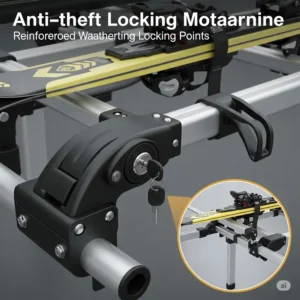
This 28-inch rack holds six pairs of skis or four snowboards, with a sliding extension, rubber-padded “crab” clamps that fit aero, oval, square, and round bars, and a one-key lock securing boards and rack together. Listings even pitch it for fishing rods and paddles, which hints at its flexible clamp design.
Analytically, this suits skiers who want reach-saving convenience at a mid-range price. The weak spot is track record. One roundup notes that the sliding mechanism can collect ice during prolonged subzero use unless you wipe it down, and verifiable review depth was thinner than for the big-name brands.
I’d call it a smart value pick if you commit to a quick wipe-down after cold drives. Skip it if you want a decades-proven brand behind you.
Pros:
- ✅ Slide-out tray at a budget price
- ✅ One key locks gear and rack
- ✅ Clamps fit many crossbar shapes
Cons:
- ❌ Slider can ice up in prolonged cold
- ❌ Shorter track record than established brands
Typically under $200; check current price. Verdict: strong value, with homework required.
7. Malone LiftLine Compact — the cheapest way to stop skiing from inside your car
The Malone LiftLine Compact is for people who ski with one friend and one budget. It’s small, simple, and cheap, which is exactly the point.
The set includes two carriers, two keys, and a hardware kit. Each is about 22 by 4.5 by 2 inches, together they carry three pairs of skis or two snowboards, and the whole kit weighs about 4.75 pounds. Integrated locks, one large push button, and universal brackets for factory and aftermarket bars complete the package. Because it’s compact, it sits comfortably beside a cargo box or bike carrier.
Fuel economy is the surprising upside. In GearJunkie’s review of this rack, a loaded rack cost only about 2 mpg, dropping the reviewer’s car from 39 to 37. That tells you a compact carrier barely dents your gas budget.
Retail review pools were tiny (zero to one reviews on the listings I checked), so the editorial review carries the weight here. The limit is obvious: three pairs won’t cover a family.
Pros:
- ✅ Lowest price on this list
- ✅ Compact enough to share the roof
- ✅ Integrated locks and keys included
Cons:
- ❌ Only three pairs or two boards
- ❌ Fewer comfort features than premium racks
Expect $135–$150; check current price. Verdict: perfect for couples and solo skiers.
Spec-by-Spec Snapshot
Here is how the seven stack up on the details that change daily use.
| Product | Weight | Slide-Out | Locks | Fit Note |
|---|---|---|---|---|
| Yakima PowderHound 6 | ~8 lb (listing) | No | SKS cores | Round, square, factory, aero |
| Thule Universal Ski & Snowboard Rack | ~6.9 lb | No | Lock cores | Thule and factory bars |
| Yakima FatCat EVO 6 | ~12.75 lb | No (HangOver position) | Integrated SKS | 12–36 in bar spread |
| Kuat Grip 6 | 24 lb | Yes | Fully locking | Max bar 4.25 in wide |
| Thule SnowPack Extender | ~5.4 kg | Yes | One-Key | T-track, SpeedLink |
| BougeRV Lockable Sliding Ski Rack | Check listing | Yes | One-key | Aero, oval, square, round |
| Malone LiftLine Compact | ~4.75 lb (pair) | No | Integrated | Universal brackets |
The table shows a clear split. If you swap the rack between cars, the lighter Thule Universal Ski & Snowboard Rack and Yakima PowderHound 6 are easier to handle than the 24-pound Kuat Grip 6. If you load every weekend, the weight penalty pays back in avoided strain.
How to Choose the Best Ski Racks
To choose the best ski racks, match the rack to your crossbars, your headcount, and your vehicle height, then decide how much convenience you’ll pay for. Work through these steps in order:
- Confirm your crossbars. Check shape, width, and spread. The Kuat Grip 6, for example, lists a maximum bar width of 4.25 inches and thickness of 1.75 inches, while the Yakima FatCat EVO 6 lists a 12–36 inch spread.
- Count your pairs. Six pairs or four snowboards suits families; three pairs or two boards, as with the Malone LiftLine Compact, suits pairs of skiers.
- Check binding clearance. Alpine touring bindings and low-profile roofs can collide, so look for raised feet, a SkiLift, or tall-binding design.
- Pick fixed or slide-out. Fixed racks are cheaper; slide-outs spare your back on tall vehicles.
- Verify the locks. One-key systems that secure skis to the rack and the rack to the car beat separate key sets.
- Budget the whole system. Crossbars, rack, and any adapter kits all count toward total cost.
- Weigh noise and mileage. Aerodynamic profiles and compact carriers cost less in whistle and gas.
Features That Actually Matter (And Those That Don’t)
Marketing copy loves adjectives. Here’s what actually earns its keep on the best ski racks.
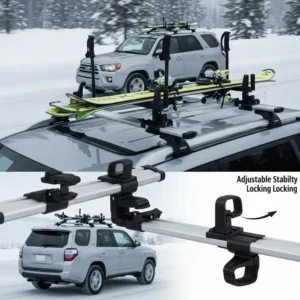
Matters: a slide-out tray if your roof is high, because that single feature changes how often you’ll actually use the rack. Glove-sized release buttons matter more than most buyers expect, since you’ll operate them at -10°F. Locks that secure both gear and rack deserve priority, and so does a hinge that handles thick modern skis, like the DoubleJoint design on the Yakima FatCat EVO 6.
Matters a bit less: finish and color. A mirror-black anodized shell looks lovely, but nobody has ever skied better because of it. Similarly, a headline load rating (the Kuat Grip 6 lists 165 pounds) is secondary to your crossbar and roof ratings, which set the real ceiling.
Doesn’t matter much: extra “universal” claims. Almost every rack here advertises universal mounting, so the useful question is which bar shapes it lists, not whether it says universal. Likewise, don’t pay for capacity you’ll never use. A six-pair carrier on a solo skier’s car is expensive empty space.
Best Ski Racks vs Alternatives: Roof, Hitch, Trunk and Cargo Box
A roof ski rack isn’t the only way to haul gear, and for some cars it isn’t the best way.
| Option | Strength | Trade-Off | Best For |
|---|---|---|---|
| Roof ski rack | Compact, cheap, keeps cabin clear | Wind noise, mileage cost | Most cars with crossbars |
| Hitch-mounted rack | Low loading height, little mileage penalty | Needs a hitch receiver | Trucks and SUVs with hitches |
| Trunk rack | No roof or hitch needed | Blocks the rear window | Cars without bars |
| Roof cargo box | Weatherproof and lockable | Biggest mileage hit | Gear-heavy trips |
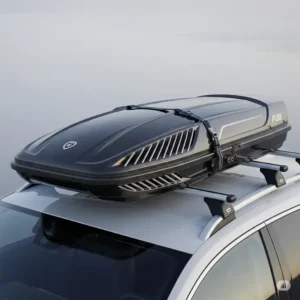
An Oak Ridge National Laboratory study found that a rooftop cargo box cut a compact sedan’s fuel economy from 42.5 to 33 mpg at 60 mph, a 22 percent drop, while a hitch-mounted cargo tray barely moved the needle. You can read the details in the ORNL fuel economy study summary.
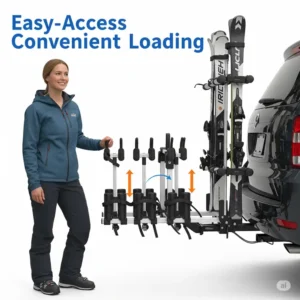
So if your vehicle has a 2-inch hitch receiver, a hitch ski rack is worth a look. One example, VEVOR’s hitch model, lists six pairs of skis, a 165-pound maximum, and a 120-degree tilt for trunk access. For everyone else, a roof rack like the Thule Universal Ski & Snowboard Rack or Malone LiftLine Compact hits the sweet spot of price and simplicity.
Common Mistakes When Buying Ski Racks
Most regret comes from a short list of avoidable errors.
Forgetting the crossbars. Nearly every roof ski rack here needs them. If your car has bare roof, add the bar cost to your budget before comparing carriers.
Ignoring roof ratings. A carrier’s headline load limit doesn’t override your vehicle’s roof rating or your bar capacity. Check the owner’s manual.
Overbuying capacity. Six-pair racks are glorious until you realize you’re a two-person household. The Malone LiftLine Compact exists for exactly that reality.
Skipping binding clearance. Reviewers and rack retailers warn that tall bindings, especially touring setups, can strike low-profile roofs. Look at raised feet or a lift design.
Assuming fit. One BMW owner reviewing the Thule Universal Ski & Snowboard Rack needed longer security screws for thick factory rails. Always compare your bar thickness against the hardware.
Leaving it on all summer. Dead weight and drag cost you mileage for no reason. More on that in the cost section.
Best Ski Racks for Specific Skiers
Different skiers need different racks, and the “best” label depends on who is asking.
Beginners and families. Choose simple, glove-friendly fixed carriers such as the Yakima PowderHound 6. You’ll appreciate the six-pair capacity as kids’ gear multiplies.
Backcountry and touring skiers. Binding height is your enemy. Rack retailers note that tall setups can interfere with low roofs, so prioritize raised designs like the Thule SnowPack Extender or the Yakima FatCat EVO 6.
Snowboarders. Four boards fit on the six-pair carriers, and some reviewers pack snowboards first, then skis on top. One owner even removed snowboard bindings to cut drag.
Sedan owners. Fuel economy matters most. A compact carrier like the Malone LiftLine Compact keeps drag modest.
Tall SUV and truck owners. Slide-outs are the headline. The Kuat Grip 6 and BougeRV Lockable Sliding Ski Rack save you from climbing on door sills.
Bare-roof EV owners. Plan on aftermarket crossbars first, then pick a rack compatible with the bar shape.
Long-Term Cost and Maintenance
A ski rack’s sticker price isn’t its total cost. Here is a rough cost-per-ski-pair view based on the price ranges above.
| Product | Capacity | Approx. Cost per Pair Slot |
|---|---|---|
| BougeRV Lockable Sliding Ski Rack | 6 pairs | Roughly $25–$33 |
| Thule Universal Ski & Snowboard Rack | 6 pairs | Roughly $33 |
| Yakima PowderHound 6 | 6 pairs | Roughly $33–$43 |
| Malone LiftLine Compact | 3 pairs | Roughly $45–$50 |
| Yakima FatCat EVO 6 | 6 pairs | Roughly $50–$75 |
| Kuat Grip 6 | 6 pairs | Roughly $72–$83 |
| Thule SnowPack Extender | 6 pairs | Roughly $92–$100 |
Interpreting that, the premium slide-outs cost roughly three times as much per pair slot as the budget fixed racks. If you ski fifteen days a year, that premium amortizes over many seasons; at five days, probably not.
Then there’s fuel. In Consumer Reports’ roof-carrier testing, an empty roof rack alone cost a sedan nearly 11 percent of its highway fuel economy, while a small SUV lost around 2 percent. Their advice: take it off when you’re not using it.
Maintenance is light. Rinse road salt off, wipe sliding rails dry, and check bolts at the start of each season. Warranty coverage varies, though Yakima FatCat EVO 6, Malone LiftLine Compact and Kuat Grip 6 all list limited lifetime or “No Worries” style coverage.
✨ Ready to Rack Up Your Winter?
🔍 Take your next ski trip to a whole new level with the right carrier on your roof. Click any highlighted product above to check current pricing and availability, and pick the one that fits your crossbars, crew, and budget. Your cabin (and your passengers) will thank you!
Safety, Load Limits and Legal Checks
Safety with the best ski racks is mostly arithmetic and common sense.
Start with load limits. Your vehicle’s roof has a dynamic load rating (often listed in the owner’s manual), your crossbars have their own rating, and the carrier has its own maximum. The lowest number wins. The Kuat Grip 6 lists 165 pounds, the Thule SnowPack Extender lists 35 kg, and a hitch carrier like VEVOR’s lists 165 pounds, but none of those figures override your car.
Check the hardware. Thule cites City Crash testing and TÜV approval for the Thule SnowPack Extender, which is a useful signal, though you should still perform your own wiggle test after installation. Push firmly on the top of the carrier and make sure nothing shifts.
Think about theft. Locks deter opportunistic grabs, and one-key systems such as the Thule SnowPack Extender keep life simple, but they’re deterrents, not vaults.
Finally, consider overhang. Skis that stick well past your bumper can attract attention from police or other drivers, and some jurisdictions regulate overhanging loads, so check your local rules. Generally, loading ski tips toward the rear helps reduce wind lift, though you should confirm manufacturer guidance for your rack.
How to Install and Load Your Rack: A First-30-Days Guide
Good setup beats expensive gear. Here’s a practical routine.
Before the first install. Measure your crossbars (width, thickness, spacing) and compare them to the rack’s listed limits. Mark your preferred position with painter’s tape so reinstalls are fast.
Install day. Seat each clamp, tighten evenly, then apply the wiggle test. If you own a Thule Universal Ski & Snowboard Rack on thick factory rails, check bolt length before you start, since one reviewer needed longer ones.
Loading order. Reviewers recommend a smart sequence: snowboards first, then skis on top. Click bindings in so brakes don’t snag, and stack carefully so the arms close without forcing.
On the road. Recheck tightness at your first fuel stop. Listen for new whistles, which usually mean something has shifted.
After each trip. Wipe locks and rails dry, especially on slide-outs like the BougeRV Lockable Sliding Ski Rack, where moisture can freeze.
Common first-30-day mistakes: forcing a clamp closed on thick skis, forgetting to lock, and leaving the rack on through spring.
Real-World Scenarios: Matching Racks to Skiers
Specs are abstract, so here are three profiles with a matching rack and reasoning.
The sedan commuter. You drive a compact car with aftermarket bars, ski six weekends a year, and carry one friend. Budget is tight. The Malone LiftLine Compact covers three pairs for roughly $135–$150, and its modest drag helps your mileage. Skip the six-pair carriers; you’d be paying for empty space.
The family of five. You own a midsize SUV with factory crossbars, ski ten to fifteen days a season, and need capacity. The Yakima PowderHound 6 or Thule Universal Ski & Snowboard Rack handles six pairs without breaking the bank. Both sit in the low-to-mid $200s range or below.
The weekly warrior. You drive a tall truck or SUV, ski weekends all winter, and travel a few hundred highway miles each trip. Slide-out convenience pays back fast here, so the Kuat Grip 6 or Thule SnowPack Extender make sense, and the Yakima FatCat EVO 6 is worth considering if quiet highway cruising tops your list.
If you’re still stuck, use this quick filter: roof high and skiing often? Slide-out. Budget first? Fixed clamp. Carrying fewer than four pairs? Go compact.
Problem → Solution: Fixing Common Ski Rack Headaches
Even the best ski racks come with quirks, so here are five common ones and fixes.
Problem: bindings bump your roof. Solution: choose a rack with raised feet or lift clearance, like the Thule SnowPack Extender or Yakima FatCat EVO 6, or position gear so brakes face the right way.
Problem: the carrier won’t close on thick skis. Solution: look for a hinge built for modern widths, such as the Yakima FatCat EVO 6‘s DoubleJoint design, and stagger tips and tails.
Problem: ice jams the mechanism. Solution: wipe sliding rails dry after use, particularly on the BougeRV Lockable Sliding Ski Rack, and keep a small scraper in the car.
Problem: wind whistle on the highway. Solution: reviewers report that open-style carriers can hum around 55 mph, while aerodynamic designs stay quieter. Try repositioning the rack, or go aero.
Problem: bolts too short for factory rails. Solution: measure bar thickness first, as one Thule Universal Ski & Snowboard Rack buyer did, and order longer security screws before install day.
FAQ
❓ Do I need crossbars to use the best ski racks?
❓ How many pairs of skis fit on a roof ski rack?
❓ Should I leave a ski rack on all year?
❓ Will a ski rack scratch my car?
❓ Are lockable ski racks worth it?
Conclusion
The best ski racks are the ones that match your crossbars, your crew, and your patience for loading in the cold. For most skiers, the Yakima PowderHound 6 and Thule Universal Ski & Snowboard Rack are the sensible, proven middle. If you value quiet highway drives and big-ski capacity, the Yakima FatCat EVO 6 deserves a look, and if your roof sits high, the slide-outs, Kuat Grip 6 at the premium end and BougeRV Lockable Sliding Ski Rack at the budget end, will save your back.
For couples and solo skiers, the Malone LiftLine Compact is the quiet bargain. And if you want the premium engineering and safety credentials, the Thule SnowPack Extender earns its price for frequent loaders.
Whichever you choose, measure your crossbars first, respect your roof’s load rating, and take the rack off when ski season ends. Do that, and your next drive to the mountain will be about the snow, not the struggle.
🏔️ Ready to haul your gear the smart way? Pick your rack, check current pricing and availability, and get on the road to fresh powder! ⛷️
Recommended for You
- Top 7 Ski Carrier Roof Systems That Transform Your Winter Adventures in 2025
- 7 Best Snowboard Hitch Rack Options That’ll Transform Your Winter Adventures in 2025
- 7 Best Yakima Ski and Snowboard Rack Options For Winter Adventures in 2025
Disclaimer: This article contains affiliate links. As an Amazon Associate, I earn from qualifying purchases. If you purchase products through these links, we may earn a small commission at no additional cost to you.
✨ Found this helpful? Share it with your friends! 💬🤗
