
In This Article
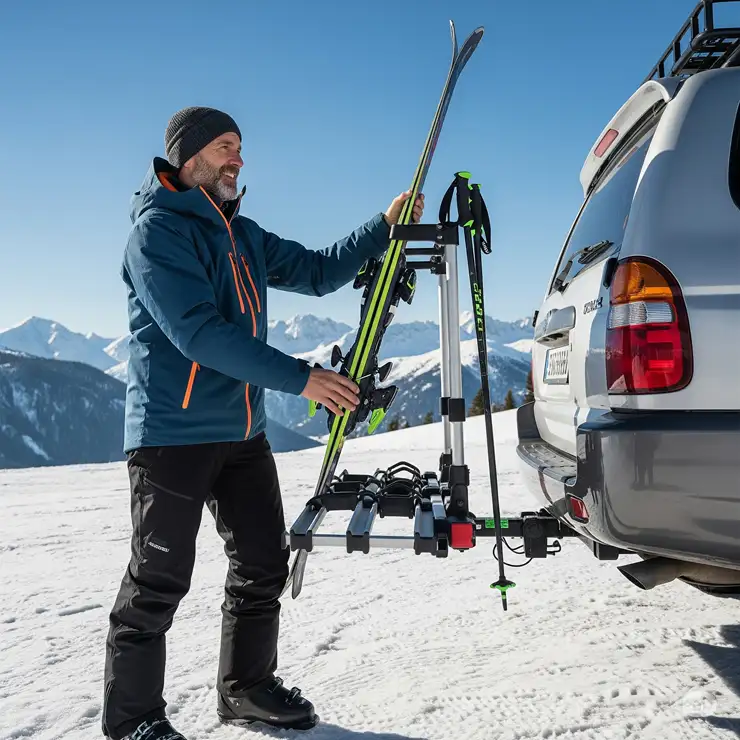
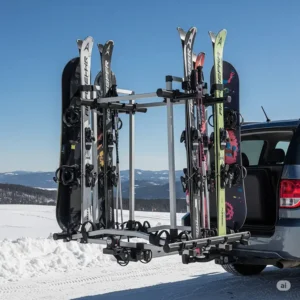
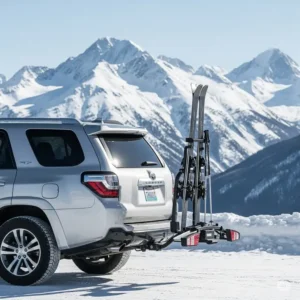
Hitch ski racks are carriers that slot into your vehicle’s trailer hitch receiver and hold skis and snowboards behind the bumper. Most tilt or fold for trunk access and lock the gear in place. They keep equipment at waist height, out of the airflow, and off a slushy roof.
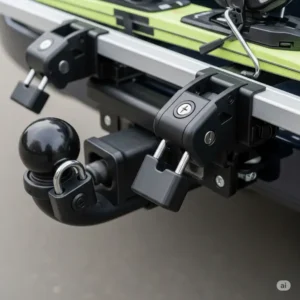
Picture the usual routine. It’s 6:30 a.m., there’s frost on everything, and you’re standing on a wheel arch with a ski in each hand, trying to find the crossbar clamp by feel. Now picture the alternative. You walk to the back bumper, drop the arm, and slide the skis in at hip height. That difference is why hitch ski racks have gone from an oddity to a serious contender.
The trade-off is real, though. You need a receiver, the rack hangs off the back of the car, and the models vary a lot in wobble, locks, and fit. If you want the background on how receivers work, the tow hitch entry on Wikipedia covers the SAE classes and receiver sizes that decide what fits your vehicle.
I compared seven real models across budget, mid-range, and premium tiers. The comparison draws on published specs, expert roundups, and the patterns that show up in user reviews. I haven’t personally tested any of them, and nothing below pretends otherwise. Where a spec or review point couldn’t be confirmed, I say so.
Quick Comparison Table: Hitch Ski Racks at a Glance
| Product | Capacity | Hitch Fit | Build / Load | Best For |
|---|---|---|---|---|
| Arksen Folding Hitch Rack | Up to 6 pairs of skis or 4 boards | 1.25″ or 2″ | Steel, 99 lb | Budget road trips |
| BougeRV Hitch Ski Rack | Adjustable plates (check listing for pair count) | 2″ only | Steel and aluminum alloy | Lighter-weight convenience |
| Buzzrack BUZZSKI | Up to 6 pairs or 4 boards | 1.25″ or 2″ | Folding, tilting | Easy first installs |
| Tyger Auto TG-RK1B707B | Up to 6 pairs or 4 boards | 1.25″ or 2″ | Steel, 130 lb | Best all-rounder |
| HYPERAX Volt SKI | Up to 4 pairs or 2 boards per side | 2″ only | 180 lb | SUVs, RVs, big loads |
| Thule Tram | 6 pairs or 4 boards (2″ fit) | 1.25″ or 2″ | Aluminum, roughly 160-165 lb | Long-term durability |
| Yakima EXO SnowBank | 5 pairs or 4 boards | EXO system base | Swing-arm system | Premium integrated setup |
Read the table in layers. The Tyger Auto TG-RK1B707B is the safest all-round bet because it fits both receiver sizes, carries a solid load, and doesn’t charge extra for locks. The HYPERAX Volt SKI wins on raw capacity but locks you into a 2-inch receiver. Premium buyers should note that the Thule Tram and Yakima EXO SnowBank cost more because you’re buying into a system, not just an arm.
💬 Just one click — help others make better buying decisions too!😊
Top 7 Hitch Ski Racks: Expert Analysis
1. Arksen Folding Hitch Rack — best budget pick for long road trips
The standout here is a tilting entry design that lets you open the trunk without unloading your skis. On a 6-hour drive with a snack cooler in the back, that matters more than any spec.
This rack is steel, rated for about 99 pounds, and fits both 1.25-inch and 2-inch receivers. The height-adjustable plates mean short skis and long boards can share the same carrier. It will also hold fishing rods, paddles, and water skis, which stretches its value past winter.
My read: this is for the buyer who skis a handful of weekends a year and doesn’t want to spend premium money. The 99-pound rating is the lowest in this group, so a family hauling heavy twin-tips and boards should do the arithmetic first. Reviews and roundups flag one recurring theme, which is that it’s heavy enough that a second person helps with installation.
Pros:
- ✅ Fits both 1.25″ and 2″ receivers
- ✅ Tilts so the trunk opens loaded
- ✅ Holds rods and paddles year-round
Cons:
- ❌ Heavy to install solo
- ❌ Lowest load rating in this lineup
Value verdict: budget tier. I couldn’t pin a stable price, so check current price, but expect it to sit well below the premium aluminum carriers. For occasional skiers it’s tough to beat on cost.
2. BougeRV Hitch Ski Rack — padded protection and double locks
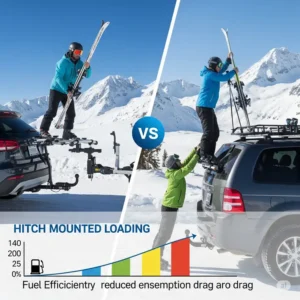
BougeRV’s pitch is gentleness. The lower rack is padded and the upper rack has rubber strips, so your edges and topsheets don’t grind against bare metal for hundreds of miles.
It’s built from steel with rustproof aluminum alloy, includes double locks, and ships with a security strap for extra stability. The adjustable plates handle different ski and board lengths. It fits 2-inch receivers only, so owners of small cars with 1.25-inch hitches should look elsewhere.
On paper, the combination of padding and a stabilizing strap addresses the two biggest complaints about hitch ski racks, which are scratched gear and wobble. Reviewers generally praise the easy install. The most common criticism is that some owners had trouble folding it up while it’s attached to the car.
The honest takeaway is that this suits anyone who owns expensive skis and cares about cosmetic damage. If your vehicle has a 2-inch receiver and you value a protective layer, it’s a strong middle option.
Pros:
- ✅ Padding protects skis and boards
- ✅ Double locks secure rack and gear
- ✅ Included strap helps limit movement
Cons:
- ❌ 2″ receivers only
- ❌ Folding on the vehicle frustrates some owners
Value verdict: mid-range tier. Check current price, since it moves around. The protective touches justify a modest premium over bare-bones budget racks.
3. Buzzrack BUZZSKI — simple install with horizontal slotting
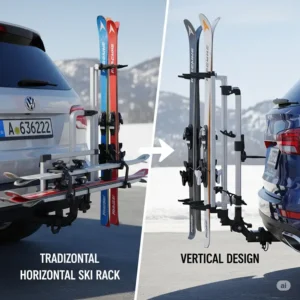
The hook is the horizontal loading style, where skis slot in sideways rather than stacking vertically. That makes first-time loading less of a puzzle.
It carries up to six pairs of skis or four snowboards, fits both hitch sizes, and uses three safety straps with rubber clips. It tilts down for trunk or tailgate access and folds flat when parked. A hitch pin lock is included in some retail listings, which beats paying extra for security.
Here’s what the spec sheet won’t tell you, but user reports suggest: wobble is the recurring gripe. That’s common in this category, because a hitch rack is a long lever bolted to a square tube, and a little play in the receiver gets amplified at the far end. A hitch stabilizer or anti-rattle collar is cheap insurance.
It’s a good fit for beginners who want quick setup and don’t mind adding a stabilizer. If you drive mostly highways, pay attention to how the carrier sits before you leave the driveway.
Pros:
- ✅ Horizontal slots simplify loading
- ✅ Tilts and folds for storage
- ✅ Fits 1.25″ and 2″ receivers
Cons:
- ❌ Some users report noticeable wobble
- ❌ Straps need checking each trip
Value verdict: budget-to-mid tier. Check current price. Add a stabilizer and the value story improves noticeably.
4. Tyger Auto TG-RK1B707B — best overall hitch ski rack for most buyers
Tyger’s trump card is that the locks come built in. Plenty of competitors nickel-and-dime you for a hitch pin lock, and this one doesn’t.
The steel frame wears a black powder coat against rust. The 130-pound rating, six-pair or four-board capacity, and dual 1.25-inch/2-inch fit cover most households. The main pole tilts up to 120 degrees for trunk clearance, the plates adjust in height, and there’s a five-year limited warranty.
Several roundups rank it first among hitch-mount models, and the logic holds up. It has more headroom than budget options, costs far less than aluminum premium systems, and comes with both a rack lock and a hitch lock. The trade-off reviewers note is that the locks must stay engaged when the rack is in use, which slows down unloading in the cold. Some wobble without a stabilizer also shows up in feedback.
It suits families and anyone who wants one rack to handle everything without second-guessing the purchase.
Pros:
- ✅ Dual locks included, no extras needed
- ✅ Fits both hitch receiver sizes
- ✅ Five-year warranty adds confidence
Cons:
- ❌ Locks complicate quick unloading
- ❌ Some wobble without a stabilizer
Value verdict: mid-range tier. Check current price. It’s the strongest value-per-feature pick on this list.
5. HYPERAX Volt SKI — heavy-duty capacity for SUVs and RVs
The HYPERAX Volt SKI is the one you buy when the loads get serious. Its 180-pound capacity tops every other rack in this comparison.
It carries up to four pairs of skis or two snowboards on each side. It tilts down so SUV tailgates open, and it has a three-position design for folded, storage, and open states. Reflective straps are a thoughtful touch for dark parking lots at 5 p.m. in January. It’s rated for 2-inch receivers of Class 3 or higher, and one roundup notes it works on chassis hitches only, so confirm fit before ordering.
In practice, the Class 3 requirement matters. Smaller crossovers with Class 1 or 2 receivers can’t handle it, and loading a rack to its limit also increases leverage on the hitch. Please check your vehicle’s tongue weight rating before piling on gear.
It’s ideal for RV owners, truck drivers, and big families hauling boards, boots, and poles for six.
Pros:
- ✅ Highest weight rating in the group
- ✅ Reflective straps improve visibility
- ✅ Three-position folding design
Cons:
- ❌ 2″ receivers only
- ❌ Overkill for small cars
Value verdict: mid-range tier. Check current price. You’re paying for capacity, so only buy it if you’ll use it.
6. Thule Tram — aluminum durability and glove-friendly operation
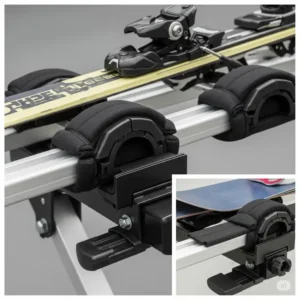
The big push-button release is the headline. With thick gloves on, you can open the Thule Tram without fumbling for a tiny latch.
It uses aluminum construction with soft rubber arms and two one-key locks. Capacity depends on your receiver: six pairs of skis or four snowboards on a 2-inch fit, and four pairs or two boards on a 1.25-inch fit. Per BestReviews, the Tram needs a Thule hanging hitch bike rack to work. Treat it as an add-on to a system, not a standalone rack. Sources also disagree on whether it tilts, so verify before buying if trunk access is important to you.
It’s also the priciest of the group. One comparison chart pegged a full Tram setup near the $1,000 mark. That’s a lot for a carrier, but aluminum doesn’t rust the way steel can, and the rubber arms are kind to your gear.
It’s for skiers who already own a compatible Thule hitch rack, or who treat gear as a long-term investment.
Pros:
- ✅ Aluminum build resists corrosion
- ✅ Large button works with gloves
- ✅ Soft arms protect finishes
Cons:
- ❌ Requires a compatible Thule bike rack
- ❌ Premium cost
Value verdict: premium tier, roughly $1,000+ as a system at the time of research. Check current price. Worth it if you already own the base, otherwise hard to justify.
7. Yakima EXO SnowBank — premium swing-arm system
The distinguishing feature is the integrated lock set. The Yakima EXO SnowBank secures skis, the box, and the hitch connection together.
It’s part of Yakima’s EXO system, which means you’ll need the EXO base (a swing-base unit retails separately). It carries five pairs of skis or four snowboards, and a roundup called the install difficult. The swing-arm design lets you access the rear of the vehicle without removing the whole carrier.
Expect system-level pricing. One comparison chart listed it near the $1,900 mark, which is more than most people spend on a rack. That price makes sense if you’ll also use the base for cargo boxes, bike carriers, and other EXO attachments throughout the year.
It’s for premium shoppers who want a modular platform and plan to use it across seasons.
Pros:
- ✅ Integrated locks cover gear and hitch
- ✅ Swing-arm gives rear access
- ✅ Works across the EXO system
Cons:
- ❌ Needs the separate EXO base
- ❌ Install is considered difficult
Value verdict: premium tier, likely in the $1,500-$2,000 range as a system. Check current price. Only sensible if you’ll use the whole platform.
Practical Usage Guide: Setting Up Hitch Ski Racks Right
Most owners don’t need new gear. They need a better setup. Here’s the sequence that avoids the common headaches.
Before the first drive
- Confirm your receiver size (1.25″ or 2″) and class. The tongue weight rating is stamped on or near the receiver.
- Weigh your gear. Six pairs of skis plus bindings add up faster than you’d think.
- Slide the rack in, seat the pin, and then add a stabilizer or anti-rattle collar. Cheap hardware here pays off in quieter, safer driving.
Loading
- Tips toward the rear, bases together, and brakes or bindings staggered so they nest cleanly.
- Pad the contact points. Even rubber arms can bite into a delicate topsheet after a long haul.
- Tighten straps after the first ten minutes, since gear shifts and settles.
Maintenance schedule
- Every trip: check the pin, locks, and straps.
- Monthly in season: rinse road salt from the hinges and lubricate pivots lightly.
- End of season: wipe it down, inspect for cracked powder coat, and store it folded.
Common first-30-day mistakes
- Skipping the stabilizer, then blaming the rack for wobble.
- Forgetting to engage the tilt lock before opening the trunk.
- Leaving the rack on all summer. It adds fuel drag and hangs your bumper out for a rear-end tap.
✨ Don’t Miss These Exclusive Deals!
🔍 Take your winter road trips to the next level with these carefully selected hitch ski racks. Click on any highlighted product to check current pricing and availability. A rack that fits your hitch and your gear turns a stressful loading routine into something you barely think about!
Real-World Scenarios: Which Rack Fits Which Skier?
Specs are abstract. Here are three profiles to make the choice concrete.
The weekend family of four. Two parents, two kids, a midsize SUV with a 2-inch receiver. They ski eight to ten weekends per season and carry skis, a few boards, and the occasional sled. The Tyger Auto TG-RK1B707B is the natural fit. Its 130-pound rating and dual locks cover that load, and the five-year warranty is reassuring for a rack that lives outdoors in winter. If the budget is tight, the Arksen Folding Hitch Rack is a reasonable step down.
The college student with a small car. A compact hatchback with a Class 1 or 2 hitch, five or six trips a year, and tight money. That rules out any 2-inch-only model. The Buzzrack BUZZSKI and the Arksen Folding Hitch Rack both fit 1.25-inch receivers. I’d add a stabilizer straight away, since small receivers tend to wiggle more.
The RV or truck crowd. Six skiers, boards, and a lot of weight. The HYPERAX Volt SKI was built for exactly this. Just confirm the Class 3 hitch rating and keep the load balanced side to side.
Notice the pattern. Hitch size and vehicle class decide your shortlist before price ever does.
Problem and Solution Guide: Fixing the Common Hitch Ski Rack Complaints
Problem: The rack wobbles. A hitch stabilizer or anti-rattle collar locks the rack tight inside the receiver. A security strap, like the one bundled with the BougeRV Hitch Ski Rack, adds a second line of defense.
Problem: I can’t reach my trunk. Look for a tilt feature. The Arksen Folding Hitch Rack, Tyger Auto TG-RK1B707B, and HYPERAX Volt SKI all pivot down so you can open the hatch loaded.
Problem: I’m worried about theft. Choose a rack with both a gear lock and a hitch lock. The Tyger Auto TG-RK1B707B includes both, and the Yakima EXO SnowBank integrates its locks across the system.
Problem: My skis got scratched. Padding matters. The BougeRV Hitch Ski Rack and the Thule Tram emphasize protective materials, and a spare layer of foam helps on any model.
Problem: Winter salt destroys the hardware. Rinse it regularly. Powder-coated steel racks like the Tyger Auto TG-RK1B707B hold up well but still benefit from care, while the Thule Tram‘s aluminum resists corrosion naturally.
How to Choose Hitch Ski Racks: 7 Steps That Actually Matter
- Check your receiver size. Only 1.25-inch and 2-inch receivers are common. A 2-inch-only rack won’t fit a small car. The NAPA hitch class guide explains how Class I through V map to receiver sizes and tongue weights.
- Confirm tongue weight. Your rack plus gear must stay within your receiver’s rating. Class I is rated around 200 pounds, and Class II is rated around 300-350 pounds.
- Count your pairs. Capacity is quoted in pairs of skis, and snowboards take more room. A six-pair rack typically carries four boards.
- Look at tilt and fold. If you need trunk access, a tilting arm isn’t optional.
- Insist on locks. Built-in gear and hitch locks save money and hassle.
- Match materials to your climate. Steel with a good coating handles most winters. Aluminum costs more but resists salt better.
- Plan for stability. Budget for a stabilizer or confirm the rack includes anti-wobble features.
| Need | Look For | Best Match |
|---|---|---|
| Small car, 1.25″ hitch | Dual-size fit | Buzzrack BUZZSKI |
| Heaviest loads | 180 lb rating | HYPERAX Volt SKI |
| Maximum protection | Padded contact points | BougeRV Hitch Ski Rack |
| Best overall | Locks + warranty | Tyger Auto TG-RK1B707B |
Looking at the table above, dual-size fit decides the small-car shortlist before anything else. The HYPERAX Volt SKI only makes sense if you’ll actually load it heavily, and the BougeRV Hitch Ski Rack is the pick when your skis are the priority. For everyone else, the Tyger Auto TG-RK1B707B is the default choice.
Common Mistakes When Buying Hitch Ski Racks
Ignoring hitch class. The most expensive error is buying a rack your receiver can’t safely carry. A Class 1 hitch and a fully loaded HYPERAX Volt SKI are a bad match.
Assuming every rack fits every hitch. The BougeRV Hitch Ski Rack and HYPERAX Volt SKI are 2-inch only, and the Thule Tram and Yakima EXO SnowBank need compatible base systems.
Buying on capacity alone. Six pairs sounds great until your fat powder skis don’t fit side by side. Check plate spacing and height adjustment.
Skipping the stabilizer. Wobble isn’t a defect in most cases. It’s physics, and a stabilizer is the standard fix.
Forgetting about what it blocks. A hitch rack can cover your plate and taillights. Many states require both to remain visible, so check your local rules.
Hitch Ski Racks vs Roof Racks: Which Wins?
Roof carriers clamp to crossbars and hold two to six pairs. They’re the cheapest route if you already own bars, according to Rack Warehouse’s snow rack guide. Hitch carriers keep everything at waist height and off a wet roof, though some hitch ski carriers adapt to a bike rack or base you already own.
| Factor | Hitch Racks | Roof Racks | Trunk Racks |
|---|---|---|---|
| Loading height | Waist level | Overhead | Rear, mid-height |
| Fuel economy | Smaller penalty | Larger penalty | Moderate |
| Needs | Hitch receiver | Crossbars | Neither |
| Best For | Heavy gear, easy loading | Existing crossbar owners | Rentals, no-hitch cars |
Hitch racks sit below the bumper line and out of the airflow, which helps fuel economy and cabin noise, though they add weight at the back of the car. If you’re tall, short, or carrying a lot, loading at hip height is a real quality-of-life upgrade. If you already own crossbars, the roof path costs less and avoids the hitch question entirely.
Features That Actually Matter (And Those That Don’t)
What matters:
- Locks. A stolen set of skis can cost more than the rack. Built-in locks pay for themselves.
- Tilt. Without it, you unload before every grocery stop.
- Padding. It protects finishes over long drives.
- Stability features. Anti-wobble design or a strap changes how the rack feels at 70 mph.
- Receiver fit. It decides whether the rack works at all.
What doesn’t:
- Capacity beyond your needs. Six pairs is lovely, but a couple of skiers will never fill it.
- Extra accessories. Rod holders and paddle clips are nice, though they shouldn’t drive the decision.
- Brand halo alone. Premium names deliver aluminum and refinement, but a budget steel rack handles most seasons fine.
Long-Term Cost and Maintenance of Hitch Ski Racks
The sticker price tells half the story. Budget steel racks cost less upfront but can show rust at the pivots after a few salty winters if neglected. Powder coating helps, and so does rinsing off road salt. Aluminum systems like the Thule Tram cost more but shrug off corrosion.
Think in cost per season. A mid-range Tyger Auto TG-RK1B707B used for ten years works out to a very small annual cost. A premium Yakima EXO SnowBank system could cost more than ten times that, though the base also carries bikes and cargo boxes the rest of the year. If you won’t use the platform, the premium doesn’t pay off.
Don’t forget add-ons. A stabilizer, replacement straps, and lock cores are small costs, and the Tyger Auto TG-RK1B707B includes locks, which saves a line item. Warranty is another hidden factor, and its five-year coverage is longer than many budget alternatives offer.
| Tier | Typical Examples | Long-Term Verdict |
|---|---|---|
| Budget | Arksen Folding Hitch Rack, Buzzrack BUZZSKI | Great for occasional use |
| Mid-range | Tyger Auto TG-RK1B707B, BougeRV Hitch Ski Rack, HYPERAX Volt SKI | Best balance for frequent skiers |
| Premium | Thule Tram, Yakima EXO SnowBank | Pays off with system reuse |
The pattern is clear. Budget racks suit casual skiers, mid-range options handle most households, and premium systems make sense only when you’ll use the whole platform.
Safety, Regulations and Compliance for Hitch Ski Racks
Start with your receiver. Hitch classes carry specific tongue weight limits, and exceeding them stresses the hitch and the frame. Camping World’s breakdown of hitch types explains how the classes and receiver sizes line up, so you can match them to your vehicle.
Beyond weight, consider visibility. A rack with gear can block your license plate and taillights. Rules vary by state, so confirm local requirements before heading out. Reflective straps, like those on the HYPERAX Volt SKI, help in low light.
Check your owner’s manual for the vehicle’s rated tongue weight too, since it may be lower than the receiver’s. Tighten everything before departure, and recheck after the first few miles. Don’t exceed your lowest rating, whether that’s the rack, the receiver, or the vehicle.
Hitch Ski Racks for Specific Vehicles
Compact cars and small crossovers. These usually carry Class 1 or 2 receivers with 1.25-inch openings. Stick to dual-fit racks like the Buzzrack BUZZSKI, Arksen Folding Hitch Rack, Tyger Auto TG-RK1B707B, or Thule Tram (with fewer pairs on the smaller size).
Midsize and full-size SUVs. A 2-inch Class 3 receiver opens every option. The Tyger Auto TG-RK1B707B and HYPERAX Volt SKI shine here, especially with tilt for liftgates.
Pickups and vans. Sturdy receivers handle heavy loads comfortably. The HYPERAX Volt SKI and Yakima EXO SnowBank both suit trucks that need rear access.
EVs. Many EVs ship without a roof rack option and carry hitch ratings that vary by model. Confirm that your specific vehicle supports a hitch accessory before buying.
FAQ: Hitch Ski Racks
❓ Do hitch ski racks work with a 1.25-inch receiver?
❓ Can I open my trunk with skis on a hitch rack?
❓ Are hitch ski racks safe for highway speeds?
❓ How many skis can a hitch ski rack hold?
❓ Do I need a separate bike rack for a hitch ski carrier?
Conclusion: Which Hitch Ski Racks Should You Buy?
Here’s the short version. If you want one safe answer, buy the Tyger Auto TG-RK1B707B. It fits both receiver sizes, includes locks, carries a healthy load, and comes with a five-year warranty. If budget rules, the Arksen Folding Hitch Rack and Buzzrack BUZZSKI do the job, though a stabilizer is smart on either. Heavy haulers should look at the HYPERAX Volt SKI, and gear-protective skiers will like the BougeRV Hitch Ski Rack. For long-term durability, the Thule Tram and Yakima EXO SnowBank reward the buyers who already own, or will use, the full platform.
Hitch ski racks aren’t perfect. They need a receiver, they add length behind your bumper, and some wobble comes with the territory. But for anyone tired of wrestling skis onto a frozen roof, they turn the loading routine into something almost pleasant.
Check your hitch size, check your tongue weight, and pick the rack that matches your gear and your car.
✨ Ready to haul your gear the easy way? Click any highlighted product above to check current pricing and availability, then hit the slopes with confidence!🎿
Recommended for You
- 7 Best Ski Rack for Toyota Tacoma Options That Transform Your Winter Adventures in 2025
- 7 Best Ski Racks That Will Transform Your Winter Adventures in 2025
- Top 7 Ski Carrier Roof Systems That Transform Your Winter Adventures in 2025
Disclaimer: This article contains affiliate links. As an Amazon Associate, I earn from qualifying purchases. If you purchase products through these links, we may earn a small commission at no additional cost to you.
✨ Found this helpful? Share it with your friends! 💬🤗
