
In This Article
Ask ten machinists what lives in their apron pocket and nine will say a caliper. It is the first tool you grab and, sadly, the last one most people think to verify. A drifting zero or a coolant-fogged display never announces itself. It just quietly turns a good shaft into scrap.
This guide ranks seven real models across budget, mid-range, and premium tiers. I pulled specs from manufacturer data sheets, distributor listings, and published calibration guidance in November 2026. Where I couldn’t verify owner reviews for a model, I say so rather than guess. Expect honest analysis, not a rewritten product page.
What Is a Digital Caliper for Machinists?
A digital caliper for machinists is a handheld electronic measuring tool that reads outside diameters, inside diameters, depths, and steps from a sliding jaw. It shows the result on an LCD, typically resolving 0.0005 inch with ±0.001 inch accuracy. Machinist-grade models add coolant sealing and a stable absolute scale.
Calipers as a tool family have a long history, and the Wikipedia overview of calipers is a handy primer on vernier, dial, and digital variants. What matters here is the practical question: which one earns a place on your bench, and which one just looks good in a catalog?
Quick Comparison: 7 Digital Calipers at a Glance
| Product | Range | Accuracy (6″) | Sealing | Price Range | Best For |
|---|---|---|---|---|---|
| Mitutoyo 500-196-30 | 0-6″ | ±0.001″ | No rating cited in listings | ~$130-$200 | General shop and inspection |
| Mahr MarCal 16 EWRi | 0-6″ | ±0.001″ | IP67 | Mid-$300s to ~$400 | Coolant-heavy shops, QC |
| TESA TWIN-CAL IP67 (00530094) | 0-6″ | ±0.001″ class | IP67 | ~$200-$340 | Data capture, wet environments |
| Starrett 798A-6/150 | 0-6″ | ±0.001″ class | IP67 (per one comparison) | Around $200 | Starrett loyalists |
| Fowler Xtra-Value Plus 54-103-006-0 | 0-6″ | ±0.001″ | IP54 | ~$80-$130 | Value-minded shops |
| iGaging Absolute Origin 100-700-33 | 0-6″ | ±0.001″ | IP54 | ~$40-$60 | Budget absolute scale |
| VINCA DCLA-0605 | 0-6″ | ±0.001″ claimed | IP54 | Under $30 | Rough-stock “beater” |
Prices are ranges at the time of research, so check current price before you buy. The pattern is clear: sealing and brand pedigree drive price far more than the headline accuracy number. Nearly every model here claims ±0.001 inch, so the real differences are in the scale’s stability, the ingress protection, and the slide feel. If you run flood coolant, jump to the IP67 trio (Mahr MarCal 16 EWRi, TESA TWIN-CAL IP67, Starrett 798A-6/150); if you’re mostly dry-cutting, the Fowler Xtra-Value Plus and iGaging Absolute Origin punch above their price.
💬 Just one click — help others make better buying decisions too!😊
Top 7 Digital Calipers for Machinists: Expert Analysis
1. Mitutoyo 500-196-30 Absolute Digimatic — the shop-floor benchmark
If a shop could buy only one digital caliper for machinists to argue over, this is the one most would pick. Its spec sheet reads 0-6 inch range, 0.0005 inch resolution, ±0.001 inch accuracy, and 0.0005 inch repeatability.
The Absolute AOS encoder is the headline feature. The caliper remembers where the jaws sit, so a dead battery or a power-up never costs you your reference. In practice, that means fewer “wait, is it zeroed?” moments mid-job. The 0.35 inch display digits are large enough to read at arm’s length, and the zero key lets you set zero anywhere for comparison measurements, then jump back to true position.
Here’s the honest caveat: the listings I found don’t market this model as coolant-proof. For flood-coolant machines, look at Mitutoyo’s sealed siblings instead. For bench, inspection, and dry-cut work, though, the Mitutoyo 500-196-30 is hard to fault. Independent guides and reviewers consistently praise its build quality and accuracy, and one machinist blog’s roundup names it best overall. The recurring complaint is simply price versus budget brands.
Pros:
- ✅ Absolute scale never loses its origin
- ✅ Big, high-contrast display digits
- ✅ Smooth, well-finished stainless slide
Cons:
- ❌ No coolant-proof rating in the listings I found
- ❌ Costs several times a budget caliper
Expect roughly the $130-$200 range depending on the seller. For most machinists, that is fair money for a tool that holds its zero for years.
2. Mahr MarCal 16 EWRi — IP67 sealing with German-spec discipline
The Mahr MarCal 16 EWRi is built for the shop where chips and coolant are a daily fact of life. The 6 inch version resolves 0.0005 inch and carries a 0.001 inch error limit under DIN 862. Step up to 12 inches and Mahr relaxes that to 0.0015 inch, which is a useful reminder that longer calipers lose precision.
The listings cite IP67 sealing, a CR2032 battery, and dirt wipers built into the slide. Those wipers physically sweep chips from the scale track, which matters at a lathe throwing aluminum swarf. The feature set adds HOLD, PRESET, and counting-direction reversal. PRESET is the sleeper: enter a nominal drawing dimension and read deviation directly, which speeds up repetitive inspection.
My analysis: this is a quality-department caliper that happens to suit a messy shop. Public owner reviews are thin; the distributor pages I found carry only a handful, so I can’t responsibly summarize broad sentiment. Judge it on the data sheet and its sealing.
Pros:
- ✅ IP67 sealing for coolant-soaked environments
- ✅ Integrated dirt wipers protect the scale
- ✅ PRESET and HOLD speed up inspection
Cons:
- ❌ Priciest 6 inch caliper in this lineup
- ❌ Very little public owner-review data
Plan on the mid-$300s to around $400, depending on configuration and calibration certificate. It’s a premium price for premium protection, justified only if your environment demands it.
3. TESA TWIN-CAL IP67 (00530094) — wet-shop toughness with data options
The TESA TWIN-CAL IP67 covers 0-6 inches with 0.0005 inch resolution, and distributor listings for TESA’s 6 inch IP67 line cite the familiar ±0.001 inch class. IP67 means the housing is sealed against dust and temporary immersion, so a coolant splash is a non-event.
What stands out is the data side. One retailer bundles it with a square depth rod, a thumb roller, and a Bluetooth emitter. If your inspection plan involves logging readings, wireless transfer into SPC software removes the most error-prone step in measurement: a human copying digits onto a clipboard. The thumb roller also makes one-handed adjustments easier when your other hand is holding a part.
Here’s what the spec sheet won’t tell you: whether the slide feel justifies the price over a Mitutoyo 500-196-30. I couldn’t verify enough owner reviews on the distributor pages to characterize sentiment, so treat any “feels like butter” claim with suspicion until you’ve handled one.
Pros:
- ✅ IP67 sealing handles coolant and washdown
- ✅ Optional Bluetooth data transfer
- ✅ Thumb roller for one-handed control
Cons:
- ❌ Few verifiable owner reviews online
- ❌ Calibration-certificate versions cost much more
Prices run roughly $200-$340, with the certified version at the top. Worth it for wet shops and data-driven QC; overkill for a garage lathe.
4. Starrett 798A-6/150 — the loyalist’s choice
Starrett is the name machinists invoke whenever the “best brand” argument starts. One machinist-focused writer likens the Starrett-versus-Mitutoyo debate to Chevy versus Ford, and notes Starrett is usually a little cheaper. The Starrett 798A-6/150 is listed in one comparison as IP67-rated at around $195.
Here’s the catch: I could verify that comparison, but not a full manufacturer data sheet. Before buying, confirm the resolution, accuracy, and sealing on Starrett’s current spec page. The reviews I could verify were for Starrett’s battery-free 3202-6 dial caliper, not this digital model, so I won’t borrow their praise.
My analytical take: if your shop already stocks Starrett micrometers, indicators, and squares, a matching caliper keeps your tool wall coherent and your calibration vendor’s paperwork tidy. If you’re brand-agnostic, compare it directly against the TESA TWIN-CAL IP67 and the Mitutoyo 500-196-30 on slide feel at the counter.
Pros:
- ✅ Respected name in precision hand tools
- ✅ IP67 rating reported in one comparison
- ✅ Often priced slightly under Mitutoyo equivalents
Cons:
- ❌ Specs need confirming on Starrett’s data sheet
- ❌ Digital-model owner reviews not verified
Around the $200 range at the time of research. A solid pick, provided you verify the sheet.
5. Fowler Xtra-Value Plus 54-103-006-0 — IP54 without the premium
The Fowler Xtra-Value Plus 54-103-006-0 is the sweet spot for shops that want a branded caliper with real documentation behind it. Listings show 0-6 inch range, 0.0005 inch resolution, ±0.001 inch accuracy, an IP54 rating, a stainless body, and a thumb roller, plus an extra-large fractional display.
IP54 deserves translation: it handles dust and splashing water, but not jetted coolant or submersion. For a dry-cut or mist-coolant hobby lathe, that’s plenty. For a flood-coolant mill, buy an IP67 model. Fowler also sells a NIST-certified version of its Xtra-Value Cal, a handy option if you need paperwork from day one.
One longtime eBay buyer reported that an older Xtra-Value Cal survived years of daily use without failing. That’s a single anecdote, not a statistic, but it fits the brand’s reputation for dependable value. The listings I found don’t clearly state whether this model retains its origin after power-off, so check before ordering.
Pros:
- ✅ Brand backing with accessible documentation
- ✅ IP54 resists dust and light splashing
- ✅ Large, easy-to-read display option
Cons:
- ❌ Not suited to flood coolant
- ❌ Origin-retention behavior unclear in listings
Roughly $80-$130 depending on the seller. Strong value for general shop work.
6. iGaging Absolute Origin 100-700-33 — absolute scale under $60
The iGaging Absolute Origin 100-700-33 is the budget caliper that serious hobbyists keep recommending. The 6 inch version claims ±0.001 inch accuracy, IP54 protection, an SPC/USB data output, a protective case, and a two-year warranty. The 12 inch sibling is listed at ±0.0015 inch, again showing that longer ranges give up precision.
“Absolute Origin” is what you’re paying for. It holds its zero when powered off, eliminating the nagging re-zero ritual of cheaper incremental calipers. The SPC output pipes readings into spreadsheets, though the data cable is typically a separate accessory.
Review sentiment is genuinely informative here. Owners often report readings within one resolution step (0.0005 inch) of known standards. Common complaints include a slightly gritty slide and slow reading stabilization. One machinist-focused review site flagged reliability concerns and measurement errors when the battery runs low, which is why I’d keep a spare battery in the drawer.
Pros:
- ✅ Absolute origin retains zero when powered off
- ✅ IP54 rating and two-year warranty
- ✅ SPC output for data logging
Cons:
- ❌ Slide feel can be gritty
- ❌ Reported errors when battery runs low
Expect roughly $40-$60. For the money, it’s tough to beat, but don’t treat it as your inspection reference.
7. VINCA DCLA-0605 — the sub-$30 rough-stock workhorse
The VINCA DCLA-0605 is the cheapest caliper here, and that’s exactly its point. It’s a 6 inch stainless caliper with IP54 protection, a large LCD, 0.0005 inch resolution, and inch/millimeter/fraction conversion, weighing about 5.3 ounces.
Pay attention to the accuracy claim: ±0.001 inch is paired with ±0.03 mm. That’s a rounding, because 0.03 mm is roughly 0.0012 inch. A small discrepancy, but it shows why you shouldn’t treat budget specs as gospel. Several affiliate roundup sites crown this model an entry-level pick, but those sources aren’t independent, so I can’t present them as verified owner feedback.
My honest analysis: treat the VINCA DCLA-0605 as the caliper you hand to the apprentice for rough stock, layout checks, and “is this close?” questions. Keep your better tool for finish dimensions. It’s a sacrificial caliper, and at this price, that’s a feature.
Pros:
- ✅ Extremely low cost per caliper
- ✅ Stainless body with IP54 protection
- ✅ Handy inch, millimeter, and fraction modes
Cons:
- ❌ Accuracy claim slightly inconsistent between units
- ❌ Independent owner reviews not verified
Under $30. Buy it as a beater, not a benchmark.
How to Choose a Digital Caliper for Machinists
Here’s the short version in seven steps, each with the reasoning behind it:
- Start with your tightest tolerance. A caliper claiming ±0.001 inch should only judge dimensions with tolerances several times looser, so ±0.005 inch or wider is comfortable. Tighter than that, reach for a micrometer.
- Match sealing to your coolant. IP54 handles dust and splashes; IP67 survives flood coolant and brief immersion.
- Insist on an absolute scale. It keeps your reference through battery changes and power-offs, which prevents silent zero errors.
- Check display legibility. Big, high-contrast digits reduce misreads under shop lighting and safety glasses.
- Choose range wisely. Six inches covers most work. Longer calipers (12 inch) typically carry looser accuracy, as the Mahr MarCal 16 EWRi data sheet shows.
- Inspect jaws and slide. Hardened stainless jaws, a smooth slide, and a locking screw tell you how the tool will age.
- Plan for calibration and data. If your quality system needs certificates or SPC output, buy accordingly.
What a Precision Digital Caliper and a 0.001 Inch Accuracy Caliper Really Promise
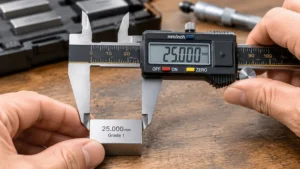
Three terms get tangled on spec sheets. Resolution is the smallest step the display shows (0.0005 inch). Accuracy is how far a reading may stray from truth (±0.001 inch). Repeatability is how consistently the tool returns to the same reading, which the Mitutoyo 500-196-30 lists as 0.0005 inch. A precision digital caliper can have fine resolution and mediocre accuracy; the display digits don’t guarantee the truth behind them.
The authoritative framework is ASME B89.1.14. As Mitutoyo’s technical bulletin on caliper accuracy and calibration explains, it defines two error types: partial surface contact error on the outside jaws, and scale shift error for other measuring faces. Specifications assume 20°C and zero set on the outside faces, which means your inside and depth readings can legitimately carry more error.
Now a reality check on a 0.001 inch accuracy caliper. A ±0.02 mm spec equals about ±0.0008 inch, which is why Mitutoyo-class models list both. The VINCA’s ±0.03 mm is closer to ±0.0012 inch. On a 6 inch tool, those differences are tiny, but they add up if you stack tolerances. The takeaway: ±0.001 inch is a ceiling on error, not a promise of perfection, and the claim only means something if the tool is actually verified.
Micrometer Comparison: When to Put the Caliper Down
A caliper is a generalist; a micrometer is a specialist. In any honest micrometer comparison, the micrometer wins on accuracy. The Wikipedia entry on micrometers covers the screw-gauge principle that gives them their edge. A quality outside micrometer typically resolves 0.0001 inch and, per ISO 3611 grade tables I reviewed, holds tolerances of a few microns on small sizes. That’s roughly ten times tighter than a caliper.
The trade-off is versatility. One micrometer covers one inch of range and measures outside dimensions only, while a single Mitutoyo 500-196-30 reads outside, inside, depth, and step in seconds.
| Tool | Typical Accuracy | Strength | Weakness | Best For |
|---|---|---|---|---|
| Digital caliper | ±0.001″ (6″) | Fast, four measurement modes | Limited precision | Roughing, layout, general checks |
| Dial caliper (e.g., Starrett 3202-6) | ±0.001″ | No battery, instant on | Harder to read, no unit switch | Dry shops, battery-averse users |
| Outside micrometer | ~±0.0001″-0.00025″ | High accuracy, solid feel | One size per tool, outside only | Finish dimensions, tight tolerances |
Looking at the table, the Mitutoyo 500-196-30, Fowler Xtra-Value Plus 54-103-006-0, and other digital calipers dominate on speed, while micrometers own the precision end. The Starrett 3202-6 dial caliper (battery-free, 0.001 inch graduations) is a legitimate alternative if you hate batteries. Think of it as a pair: the caliper gets you close, then the micrometer confirms.
Your First 30 Days: Setup, Zero Checks, and Maintenance
A new tool is only as good as its first month of habits. Here’s a practical routine your digital caliper for machinists will thank you for:
- Day one: Wipe the jaws, close them on a clean lint-free paper pad, and confirm a stable zero. Slide through the full range feeling for gritty spots, then lock and unlock the thumbscrew.
- Week one: Check against a known standard such as a gauge block near the beam, mid-range, and near the jaw tips. If readings differ by more than the claimed accuracy, return it while the warranty is fresh.
- Ongoing: Wipe the scale track and jaws after each job. Keep a spare coin cell nearby, because low batteries are a documented source of erratic readings in budget models.
Common first-month mistakes: squeezing too hard (inconsistent pressure produces inconsistent readings), measuring with the tips instead of the full jaw faces, and using the caliper as a scribe or pry bar. Keep it away from welding and electric engraving pencils, which can damage electronics. Store it in its case, not loose among files.
Lathe Work Measurements: Three Shop Scenarios
Lathe work measurements punish careless technique. Here are three profiles matched to products, with their budgets, environments, and routines.
The hobbyist turner. A home-shop lathe, dry cutting, a few hours a week, a modest budget. The iGaging Absolute Origin 100-700-33 or Fowler Xtra-Value Plus 54-103-006-0 handles roughing and sizing, with a micrometer for final cuts. IP54 sealing is enough here.
The flood-coolant job shop. A production lathe soaking in coolant all shift. The Mahr MarCal 16 EWRi or TESA TWIN-CAL IP67 earns its premium, because IP67 sealing keeps the display alive. Pair it with a VINCA DCLA-0605 for rough-stock checks so your good tool isn’t abused.
The inspector. First-article checks, logged readings, audit paperwork. The Mitutoyo 500-196-30 or the data-ready TESA TWIN-CAL IP67 fits, with certified calibration on a schedule.
Temperature matters more than most people admit. Steel expands roughly 6.5 millionths of an inch per inch per degree Fahrenheit, so a 3 inch steel part 30°F above room temperature grows about 0.0006 inch, which is more than half the caliper’s entire error budget. For aluminum, the figure roughly doubles. Let parts cool, or measure them consistently warm. And always stop the spindle before measuring.
Calibration Standards: ASME B89.1.14, NIST Traceability, and Gauge Blocks
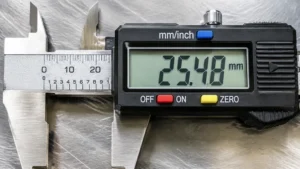
An uncalibrated caliper is just an opinion with a display. ASME B89.1.14 sets the essential requirements for specifying, verifying, and calibrating calipers, complementing the international ISO 13385-1. The verification practice is concrete: test at three to five points depending on range, cover at least 90 percent of the measuring range, and place reference standards from near the beam to near the jaw tips. References include gauge blocks, caliper checkers, and ring gauges, and calipers with knife-edge inside faces get an extra ring-gauge test.
Then there’s traceability. As this Quality Magazine explainer on NIST traceability emphasizes, traceability is a property of the measurement result, backed by a documented, unbroken chain of calibrations. That chain typically runs from NIST standards through ISO/IEC 17025 accredited laboratories to the gauge blocks in your shop. A certificate saying “traceable to NIST” is a starting point, not proof by itself.
Practically, many shops buy a gauge block set, check calipers in-house between outside calibrations, and send them to an accredited lab on an interval set by their quality system. Certificates cost real money: one distributor lists the Fowler Xtra-Value Plus family’s NIST-certified Xtra-Value Cal about $20-$25 above its uncertified twin, while a certified TESA TWIN-CAL IP67 runs roughly $125 above the plain version. Decide up front whether you need the paper.
Machinist Measuring Tools: Building a Kit Around Your Caliper
Your caliper is the first-look instrument in a larger set of machinist measuring tools. A sensible kit, in rough priority order:
- Outside micrometers (0-1″ and 1-2″): for finish dimensions where the caliper runs out of accuracy.
- A gauge block set: the reference your calibration checks depend on.
- A dial or electronic indicator with a magnetic base: for runout, tramming, and comparison measurements.
- Small-hole gauges or telescoping gauges: for bores where caliper inside jaws are awkward.
- A surface plate and height gauge: for layout and inspection.
The idea is a layered workflow: VINCA DCLA-0605 for rough stock, a mid-tier like the Fowler Xtra-Value Plus 54-103-006-0 or Mitutoyo 500-196-30 for daily sizing, and micrometers for final confirmation. Spend your money where tolerance risk is highest, not evenly across every drawer.
Price Range and Value: What You Really Pay Over Five Years
| Tier | Product | Price Range | Value Verdict | Best For |
|---|---|---|---|---|
| Budget | VINCA DCLA-0605 | Under $30 | Great as a disposable beater | Rough stock |
| Budget | iGaging Absolute Origin 100-700-33 | ~$40-$60 | Best absolute scale for the money | Hobby shops |
| Mid | Fowler Xtra-Value Plus 54-103-006-0 | ~$80-$130 | Strong value with documentation | General shop work |
| Mid | Mitutoyo 500-196-30 | ~$130-$200 | Benchmark for dry shops | Inspection and daily use |
| Premium | Starrett 798A-6/150 | Around $200 | Good if you’re a Starrett shop | Brand-consistent kits |
| Premium | TESA TWIN-CAL IP67 (00530094) | ~$200-$340 | Pays off with data and wet work | QC and coolant |
| Premium | Mahr MarCal 16 EWRi | Mid-$300s to ~$400 | Justified by IP67 and wipers | Harsh environments |
The cheapest tool isn’t always the cheapest to own. Replace a sub-$30 caliper twice and you’ve bought a Fowler Xtra-Value Plus; add calibration and scrapped parts and the premium models start looking sensible. Meanwhile, a coin cell costs pennies, so battery expense barely registers. The real long-term costs are certification, replacement, and the price of one scrapped casting.
FAQ
❓ Is a more expensive digital caliper for machinists worth it?
❓ How often should I calibrate a precision digital caliper?
❓ Should I buy a 6 inch or 8 inch digital caliper?
❓ Is IP54 enough for a shop that uses coolant?
❓ Do I need data output on my machinist measuring tools?
Conclusion
The best digital caliper for machinists is the one matched to your environment and tolerances. For flood coolant, the Mahr MarCal 16 EWRi and TESA TWIN-CAL IP67 make sense, with the Starrett 798A-6/150 worth a look if you verify its data sheet. For dry-shop inspection, the Mitutoyo 500-196-30 is hard to beat. On a budget, the Fowler Xtra-Value Plus 54-103-006-0 and iGaging Absolute Origin 100-700-33 deliver real value, while the VINCA DCLA-0605 belongs in the rough-stock drawer.
Remember the larger lesson: a ±0.001 inch caliper is a fast, versatile first look, not a final judge of tight tolerances. Pair it with a micrometer, verify it against gauge blocks, and respect temperature. Do that, and any caliper here will serve you well.
Recommended for You
- Laser Measure For Contractors: 7 Best Proven Picks (2026)
- Socket Set For Beginner DIYers: 7 Best Picks, Zero Regrets (2026)
- Husky Vs Craftsman Socket Set: 7 Smartest Buys In 2026
Disclaimer: This article contains affiliate links. As an Amazon Associate, I earn from qualifying purchases. If you purchase products through these links, we may earn a small commission at no additional cost to you.
✨ Found this helpful? Share it with your friends! 💬🤗
