
In This Article
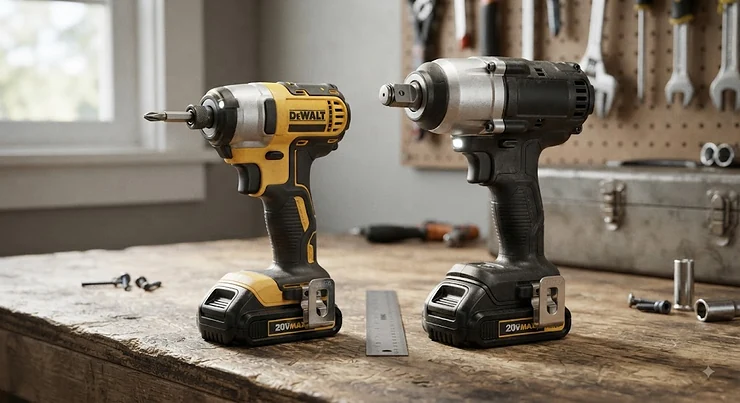
Somewhere in every garage there’s a drawer with three tools that all sort of look like they could do the same job, and a very confident uncle insisting they’re identical. They’re not. impact driver vs impact wrench is one of those searches that sounds like a technicality until you’re standing in the tool aisle holding two boxes that weigh almost the same and cost wildly different amounts. Here’s the 45-word version: an impact driver is a compact, hex-shank tool built for driving screws and small-to-medium fasteners using rotational impacts measured in inch-pounds, while an impact wrench uses a square drive and heavier rotational blows measured in foot-pounds to loosen and tighten large nuts and bolts, most famously lug nuts.

That distinction matters more than it sounds like on paper. Grab the wrong one for a deck build and you’ll strip screw heads all afternoon. Grab the wrong one for a flat tire and you’ll be leaning on a 1/4-inch hex chuck that was never built to survive a rusted lug nut, wondering why nothing’s budging. Below, we researched seven real, currently available tools spanning both categories — compact 12V drivers, full-size 18V and 20V drivers, and 1/2-inch impact wrenches — so you can match torque, drive type, and price to the actual job in front of you, not just the tool with the loudest branding on the box.
We’ll also walk through the mechanical differences that make these tools incompatible with each other’s accessories, when 12V beats 18V, why deck screws and lug nuts live in completely different torque universes, and how to keep either tool running for a decade instead of eighteen months. According to OSHA’s guidance on hand and power tools, tool-related injuries are frequently tied to using the wrong tool for a job rather than tool failure itself — which is a fairly compelling argument for reading past the spec sheet.
Quick Comparison Table
| Tool | Drive Type | Torque Output | Best For | Price Range |
|---|---|---|---|---|
| DeWalt ATOMIC DCF809 | 1/4″ Hex | 1,700 in-lbs | Compact all-around driving | $100–$150 (bare) |
| Milwaukee M18 FUEL 2967-20 | 1/2″ Square | 1,200 ft-lbs | Heavy-duty automotive/lug nuts | $220–$280 (bare) |
| Makita XDT16Z | 1/4″ Hex | 1,600 in-lbs | Precision deck & finish work | $130–$170 (bare) |
| Milwaukee M12 FUEL Surge | 1/4″ Hex | ~1,100 in-lbs (hydraulic) | Quiet, tight-space fastening | $130–$160 (bare) |
| Ryobi ONE+ HP PSBID01 | 1/4″ Hex | 1,700 in-lbs | Budget DIY & weekend projects | $90–$140 (kit) |
| DeWalt DCF894B | 1/2″ Square | 330 ft-lbs | Mid-range lug nut removal | $180–$280 (bare) |
| Ingersoll Rand W7150 | 1/2″ Square | 780 ft-lbs | Shop-grade automotive work | $350–$550 (kit) |
Looking at this lineup, the split is obvious the moment you compare torque units: the drivers top out in the 1,600–1,900 in-lb range while the wrenches operate in a completely different 330–1,200 ft-lb bracket — and since one ft-lb equals 12 in-lbs, that Milwaukee wrench is putting out roughly eight times the twisting force of any driver on this list. Budget shoppers should note that price doesn’t scale purely with power here; the Ryobi ONE+ HP PSBID01 matches the DeWalt driver’s torque output for a fraction of the cost, while the jump from the DeWalt DCF894B to the Ingersoll Rand W7150 buys you nut-busting headroom most weekend mechanics will genuinely need for corroded truck lugs.
💬 Just one click — help others make better buying decisions too!😊
Top 7 Impact Drivers & Impact Wrenches: Expert Analysis
1. DeWalt ATOMIC 20V MAX DCF809 — best compact all-rounder for tight spaces
At just 5.1 inches front to back, the DeWalt ATOMIC 20V MAX DCF809 is built to squeeze into stud bays and cabinet corners that swallow bigger drivers whole. The brushless motor delivers 1,700 in-lbs of torque at up to 2,800 RPM and 3,200 impacts per minute, which in practice means it drives a 3-inch deck screw into pressure-treated lumber in one confident pass rather than the stutter-stop rhythm you get from budget brushed models. Based on the spec comparison, this is squarely a mid-tier tool: it doesn’t chase the raw torque numbers of Makita’s or Milwaukee’s flagship drivers, but it also doesn’t ask you to pay for headroom a homeowner or trim carpenter rarely uses. It’s a strong fit for DIYers building furniture, hanging doors, or doing light deck work who want DeWalt’s 20V MAX battery ecosystem without buying into the pricier XR or POWERSTACK lineup. Reviewers consistently report that the compact size and 2.1-lb weight make it comfortable for overhead work, with the 3-LED ring getting specific praise for eliminating shadow spots in cabinets and crawlspaces.
Pros:
- ✅ Compact 5.1-inch body fits tight framing and cabinet work
- ✅ Brushless motor backed by a 3-year limited warranty
- ✅ Belt clip and 3-LED light aid real jobsite portability
Cons:
- ❌ Single-speed trigger control instead of multi-speed selector
- ❌ Torque trails premium 18V/20V drivers by 100–200 in-lbs
Bare tools typically run in the $100–$150 range, and given the compact size and brand ecosystem, it’s a genuinely solid value pick for anyone already invested in DeWalt 20V batteries.

2. Milwaukee M18 FUEL 2967-20 — most power-dense 1/2″ impact wrench
The Milwaukee M18 FUEL 2967-20 is the tool automotive techs reach for when a lug nut has clearly been over-torqued by the last person who touched it. The POWERSTATE brushless motor delivers up to 1,200 ft-lbs of fastening torque and 1,600 ft-lbs of nut-busting torque, all packed into a 7.6-inch frame that Milwaukee claims is up to two inches shorter than competing high-torque wrenches. What most buyers overlook about this model is the 4-Mode Drive Control, which includes a dedicated bolt-removal mode that snaps a rusted fastener loose at full power, then automatically drops to 750 RPM so you don’t cross-thread the socket coming off. That’s the kind of detail that separates a purpose-built automotive wrench from a general-purpose tool wearing an automotive label. Reviewers frequently cite the auto-shutoff feature — which caps output around 50 ft-lbs to prevent overtightening — as genuinely useful rather than a marketing checkbox, particularly for anyone nervous about warping brake rotors on aluminum wheels.
Pros:
- ✅ Nut-busting torque up to 1,600 ft-lbs handles seized lugs
- ✅ 4-Mode Drive Control with dedicated bolt-removal setting
- ✅ Compact 7.6-inch length for tight wheel-well clearance
Cons:
- ❌ Bare-tool price sits well above budget wrench alternatives
- ❌ Serious overkill torque for basic household fastening tasks
Bare tools land in the $220–$280 range depending on retailer, and for anyone doing regular automotive or heavy fastening work, the value case is strong: this is the kind of tool you buy once.
3. Makita XDT16Z 18V LXT — smartest speed control for finish-sensitive work
The Makita XDT16Z takes a different approach than raw-torque competitors by leaning into control. Its BL brushless motor tops out at 3,600 RPM and 1,600 in-lbs of torque, but the standout feature is Quick-Shift Mode, which electronically searches for the ideal balance of speed and torque per fastener rather than making you guess at a dial. Independent testing from Pro Tool Reviews clocked the XDT16 finishing a mixed battery of drywall screws, self-tapping screws, and ledger screws in under two minutes, a benchmark that held the category lead for months. Here’s what to weigh: this isn’t the highest-torque driver on the market, and Makita’s own newer XGT platform has since out-paced it — but for anyone doing finish carpentry, cabinet installs, or deck ledger work where stripped screws and split trim are real risks, Tightening Mode (T-mode) downshifts automatically as the fastener seats, which meaningfully reduces cam-out on softer woods.
Pros:
- ✅ Quick-Shift Mode auto-balances speed and torque per fastener
- ✅ Four selectable speeds plus dedicated T-mode for finish work
- ✅ Compact 4-9/16″ body at roughly 3.4 lbs with battery
Cons:
- ❌ Raw torque output trails newer flagship-tier drivers
- ❌ Bare tool doesn’t include Makita’s 18V LXT battery
At roughly $130–$170 for the bare tool, the XDT16Z earns its keep on control rather than brute force — a distinction that matters a lot more than spec sheets suggest once you’re driving screws into cedar decking without wanting to fill and re-drive half of them.
4. Milwaukee M12 FUEL Surge 2551-20 — quietest option for finished spaces
The Milwaukee M12 FUEL Surge 2551-20 solves a problem most impact driver marketing ignores entirely: noise. Instead of a traditional hammer-and-anvil mechanism, it uses a FLUID-DRIVE hydraulic powertrain that Milwaukee rates as up to twice as quiet as a standard impact, with the brushless motor spinning up to 3,000–3,200 RPM depending on the source spec sheet. On paper this means less ear-splitting clatter in finished basements, occupied homes, or remodel jobs where the client is standing three feet away wincing at every fastener. As one of the best 12v impact driver options for professionals who work inside occupied spaces, it trades some outright torque for genuinely lower vibration and a 5.2-inch length that gets into cabinet interiors full-size drivers can’t reach. What the spec sheet won’t tell you, but reviewers note, is that the smoother hydraulic impact reduces hand fatigue significantly over a full day of trim or cabinet install work, even though peak torque numbers look modest next to 18V competitors.
Pros:
- ✅ FLUID-DRIVE hydraulic action up to 2x quieter than standard impacts
- ✅ Only 5.2 inches long for cabinet and corner access
- ✅ 4-mode drive control with dedicated self-tapping screw mode
Cons:
- ❌ Lower sustained torque than full-size 18V/20V drivers
- ❌ Not ONE-KEY enabled, unlike some Milwaukee M18 tools
Bare-tool pricing generally sits around $130–$160, making it a smart secondary driver for pros rather than a first tool for someone building a kit from zero.
5. Ryobi ONE+ HP PSBID01 — best budget pick for weekend DIYers
If you’re comparing the best 12v impact driver and full-size 18v impact driver categories purely on price-to-performance, the Ryobi ONE+ HP PSBID01 is hard to beat. It’s 26% more compact and 23% lighter than Ryobi’s previous brushed model, weighing just 1.84 lbs bare, yet the brushless motor still produces up to 1,700 in-lbs of torque and 3,800 impacts per minute — numbers that genuinely compete with drivers costing twice as much. Based on the spec comparison, the single-speed trigger is the clearest concession to price; you’re feathering the trigger for control rather than flipping a mechanical speed selector, which experienced users adapt to quickly but beginners may find less forgiving on delicate trim screws. Reviewers testing this driver against 8-inch GRK ledger screws found it fully drove them in around 27 seconds, calling that performance right in line with expectations for a compact tool, though notably slower than Ryobi’s own higher-end P238 model.
Pros:
- ✅ Torque output rivals drivers costing significantly more
- ✅ Compact, lightweight body ideal for overhead work
- ✅ Backed by RYOBI’s 3-year manufacturer warranty
Cons:
- ❌ Single-speed trigger limits fine control versus multi-speed rivals
- ❌ Compatible only with Ryobi’s ONE+ battery ecosystem
Kits with two batteries, a charger, and a bag typically run $90–$140, which for anyone assembling a first tool kit for deck building or general home projects represents genuinely strong value.

6. DeWalt DCF894B 20V MAX XR — best mid-range wrench for lug nuts
The DeWalt DCF894B sits in an important gap: too much wrench for delicate fastening, but priced well below professional-grade nut-busters. It delivers up to 330 ft-lbs of fastening torque and up to 600 ft-lbs of breakaway torque through a detent-pin anvil, which DeWalt specifically markets for grooved couplings, pipe flanges, and — most relevant to most buyers — wheel lugs. Given that most passenger vehicle lug nuts torque to somewhere between 80 and 120 ft-lbs, this wrench has meaningful headroom for breaking loose corroded fasteners without straining, which is precisely the gap a basic driver can’t fill. The Precision Wrench Control feature pauses briefly before impacting in forward mode to help prevent overtightening, then slows down in reverse as a fastener loosens to reduce run-off — a genuinely practical safety feature rather than a marketing footnote, especially for anyone using this as their primary lug nut removal tool at home. Home Depot’s own buyer Q&A on this model confirms it’s rated for truck lug nut removal specifically, not just passenger car duty.
Pros:
- ✅ 330 ft-lbs fastening torque comfortably exceeds lug nut specs
- ✅ Precision Wrench Control reduces overtightening and run-off
- ✅ Three-mode switch adds real flexibility across applications
Cons:
- ❌ Notably heavier and bulkier than compact impact drivers
- ❌ Kit pricing climbs quickly once batteries are included
Bare tools generally sit in the $180–$280 range, with two-battery kits often landing closer to $350–$420 — a fair middle ground between DIY-grade wrenches and full professional units.
7. Ingersoll Rand W7150 — heaviest-hitting wrench for shop-grade jobs
For anyone who’s fought a rusted lug nut with an underpowered tool and lost, the Ingersoll Rand W7150 exists specifically to end that fight. Ingersoll Rand built its reputation on pneumatic (air-powered) impact wrenches, and the W7150 is explicitly engineered to match the output of their benchmark air tool while running cordless — delivering up to 780 ft-lbs of maximum torque and up to 1,100 ft-lbs of nut-busting torque from a tool weighing under seven pounds. Based on the spec comparison, this places it well above the DeWalt DCF894B and closer to Milwaukee’s flagship territory, though its variable-speed trigger and electronic brake are aimed squarely at shop and fleet technicians rather than occasional home use. Reviewers consistently describe the build quality — a steel-lined aluminum hammer case and chemical-resistant housing — as genuinely industrial rather than prosumer-grade, though some also note the tool runs heavier in the hand than Milwaukee’s more compact competitor, and the forward/reverse selector sits close enough to the grip that a few users report bumping it accidentally mid-use.
Pros:
- ✅ Nut-busting torque up to 1,100 ft-lbs rivals professional air tools
- ✅ Steel-reinforced, chemical-resistant housing built for shop abuse
- ✅ Variable-speed trigger with electronic brake for real control
Cons:
- ❌ Reviewers note it runs heavier than comparable Milwaukee models
- ❌ Forward/reverse selector placement invites accidental switching
Kits with battery and charger typically run $350–$550 depending on battery count, positioning it as the splurge pick for anyone doing frequent, serious automotive or industrial work rather than the occasional flat tire.
Getting Started: Setup, Maintenance & Your First 30 Days
Whichever tool you land on, the first month is where good habits either form or don’t. Charge batteries fully before first use, and resist the urge to run them down to zero repeatedly — modern lithium-ion packs actually prefer partial discharge cycles over deep drains. For impact drivers, always use impact-rated bits; standard driver bits weren’t designed to absorb rotational shock and will shatter under repeated blows, sometimes sending fragments flying. For impact wrenches, impact-rated sockets (usually black oxide finish rather than shiny chrome) matter just as much, since chrome sockets can crack or fracture under impact loads they weren’t engineered to handle.
A common early mistake is over-tightening everything just because the tool can. Both driver and wrench manufacturers build in clutch settings or drive-control modes specifically so you don’t have to muscle every fastener to maximum torque — use them. Wipe down the tool after dusty or wet jobs, keep the chuck or anvil free of debris, and store batteries at room temperature rather than in a hot truck bed, which measurably shortens battery lifespan over time.
Real-World Scenarios: Matching the Tool to the Job
Consider a college student who just moved into a first apartment and wants to hang shelves and assemble flat-pack furniture on weekends. A compact 12V driver like the Milwaukee M12 FUEL Surge or a budget 18V option like the Ryobi PSBID01 covers this completely, with plenty of torque left over and none of the bulk or cost of automotive-grade gear.
Now picture a homeowner tackling a first deck build — an impact driver for deck building is non-negotiable here, since you’re driving hundreds of coated deck screws through pressure-treated lumber. The Makita XDT16Z‘s Quick-Shift Mode and T-mode genuinely earn their keep, reducing stripped screws and cam-out across a long day of repetitive driving; the American Wood Council’s residential deck construction guide is worth a skim before starting, since fastener spacing and ledger attachment specs directly affect structural safety.
Finally, imagine a weekend mechanic who rotates tires and does basic brake work in their own garage. This is squarely impact driver for automotive territory being mistaken for impact wrench territory — a driver simply won’t budge a torqued lug nut, full stop. The DeWalt DCF894B is the sensible entry point, with the Ingersoll Rand W7150 waiting in the wings for anyone who upgrades to more frequent or heavier-duty automotive work.
Problem → Solution: Fixing the Most Common Fastening Headaches
Problem: Screws are stripping before they seat. This is almost always a driver running at full speed with no downshift — switch to a lower speed setting or a driver with T-mode, like the Makita XDT16Z, and let the clutch do the work instead of your trigger finger.
Problem: A lug nut won’t budge even at full power. Rust and corrosion multiply the effective torque needed; a penetrating oil applied 10–15 minutes beforehand, combined with a wrench rated for nut-busting torque like the Milwaukee M18 FUEL 2967-20, resolves the vast majority of stuck-lug situations without resorting to a breaker bar and body weight.
Problem: The tool feels underpowered mid-project. Battery voltage sags under load as a pack depletes — swap to a freshly charged battery rather than assuming the tool itself has failed, since impact tools are especially sensitive to battery state of charge near the bottom of a cycle.
Problem: Bits keep falling out mid-drive. A worn or dirty quick-release collet loses its grip over time; a quick wipe-down and bit reseat usually fixes it, and if it persists, the collet itself may need replacement.
Buyer’s Decision Framework: If This, Choose That
If you’re driving screws, assembling furniture, or doing trim and cabinet work, choose an impact driver — the hex-shank, in-lb torque range is purpose-built for that job. If you’re removing or installing large nuts and bolts, especially lug nuts, choose an impact wrench — nothing else on this list will reliably do that job. If space and weight matter more than raw output, prioritize a 12V driver like the Milwaukee M12 FUEL Surge. If you’re building a first tool kit on a tight budget, the Ryobi ONE+ HP platform delivers the most torque per dollar. If you already own an automotive impact wrench under 500 ft-lbs and keep hitting its limits on rusted fasteners, it’s time to step up to something in the Milwaukee or Ingersoll Rand tier.
Impact Driver vs Impact Wrench: What’s Actually Different
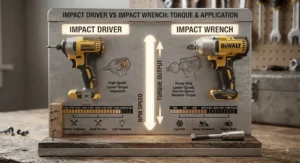
The core distinction comes down to mechanism and intended fastener size. An impact driver uses a rotational impact mechanism — a spring-loaded hammer striking an anvil — to deliver quick, concussive bursts of rotational force measured in inch-pounds, optimized for driving screws through wood, metal, and drywall without stripping the fastener head or stalling the motor. An impact wrench uses a similar concept but scaled up dramatically, with a square-drive anvil designed to transmit far greater torque, measured in foot-pounds, to loosen or tighten large hex-head bolts and nuts.
The practical result: a driver’s compact hex chuck is designed for speed and control on small fasteners, while a wrench’s square drive is built for raw twisting force on large ones. Trying to use one for the other’s job isn’t just inefficient — it’s often mechanically impossible, since the drive systems and bit types genuinely don’t overlap. According to the Power Tool Institute’s safety guidance on impact tools, using accessories not specifically rated for impact applications is one of the more common causes of tool and fastener failure, regardless of which category you’re working in.
How to Choose Between an Impact Driver and an Impact Wrench
- Identify your primary fastener type. Screws and bolts under 1/4 inch point toward a driver; nuts, bolts, and lugs 1/2 inch and up point toward a wrench.
- Check the drive shape you already own accessories for. Hex-shank bit collections work only in drivers; square-drive sockets work only in wrenches.
- Match torque to the job, not the biggest number on the box. Overbuying torque for delicate work risks stripped fasteners and split wood.
- Consider your existing battery platform. Staying within one brand’s voltage ecosystem saves real money over time on batteries and chargers.
- Weigh size against power. Compact 12V tools trade some torque for access in tight spaces; full-size 18V/20V tools trade portability for output.
- Decide how often you’ll use it. Occasional automotive work justifies a mid-range wrench; frequent professional use justifies investing in a premium one.
- Budget for accessories, not just the tool. Impact-rated bits and sockets aren’t optional extras — they’re part of the real cost of ownership.

18V vs 12V Impact Drivers: Matching Voltage to the Job
The best 12v impact driver options, like the Milwaukee M12 FUEL Surge, trade peak torque for size, weight, and often noise — genuinely useful trade-offs for cabinet work, electrical, and any job where you’re reaching into tight enclosures repeatedly throughout the day. An 18v impact driver, by contrast, typically delivers 20–40% more torque and sustains that output longer under heavy repeated use, which matters for deck building, framing, and anything involving longer or larger fasteners driven in volume.
Here’s what to weigh: 12V tools aren’t simply “smaller versions” of 18V drivers — they’re a genuinely different design target, optimized around access and control rather than raw output. Buyers who need both often end up owning one of each rather than trying to force a single driver to cover every scenario, and manufacturers clearly design their lineups around that assumption, since nearly every major brand — DeWalt, Milwaukee, Makita, Ryobi — sells parallel 12V and 18V/20V driver lines rather than consolidating around one voltage.
Hex Shank vs Square Drive: Why These Two Tools Don’t Share Bits
This is the mechanical root of the entire impact driver hex shank vs square drive question, and it’s worth understanding rather than memorizing. A hex shank bit has a hexagonal cross-section that locks into a driver’s quick-release collet via spring-loaded detents — fast to swap, but only rated for the smaller torque loads a driver produces. A square drive socket, by contrast, slides over a square-profile anvil and is held in place either by a detent ball or a friction/hog ring, engineered specifically to transmit much higher torque without slipping or rounding off under load.
What most buyers overlook is that this isn’t an arbitrary design choice — a square drive socket forced onto a hex-shank tool (via an adapter) will underperform badly on genuinely large fasteners, since the adapter itself becomes the weak link. Reviewers who’ve tried mixing accessory types across tool categories consistently report the same outcome: adapters work fine for light-duty use but fail or slip under the torque loads a real impact wrench is designed to handle.
Torque Explained: ft-lb vs In-lb and Why It Matters
The impact wrench ft-lb vs impact driver in-lb distinction trips up more buyers than almost anything else in this category, mostly because the numbers look deceptively similar until you do the conversion. One foot-pound equals twelve inch-pounds, meaning a wrench rated at 330 ft-lbs — like the DeWalt DCF894B — is actually producing torque in the neighborhood of 3,960 in-lbs, roughly double what even a strong driver like the Milwaukee M18 FUEL 2967-20’s 1,200 ft-lb rating would suggest at first glance, and more than double the DeWalt DCF809 driver’s 1,700 in-lb output.
Manufacturers use different units specifically because the applications operate at genuinely different scales: quoting a wrench’s torque in inch-pounds would produce numbers so large they’d be harder to compare meaningfully, while quoting a driver’s torque in foot-pounds would produce decimal fractions that undersell what’s actually a very capable tool for its category. Once you internalize the 12-to-1 conversion, comparing tools across categories becomes straightforward rather than confusing.
Safety & Regulations: Using Impact Tools the Right Way
Impact tools are generally low-risk when used correctly, but a few practices matter more than manufacturers’ manuals sometimes emphasize. Always use accessories rated specifically for impact applications — standard chrome sockets and non-impact bits can shatter under repeated concussive force, sending fragments outward. Hearing protection is worth taking seriously during extended use; impact mechanisms are genuinely loud, and cumulative exposure adds up faster than most users expect during a full day of use.
For automotive work specifically, never rely on an impact wrench alone for final lug nut tightening — impact tools are excellent for speed but notoriously inconsistent for precision, which is exactly why the Tire Industry Association’s RIST method for wheel installation specifically calls for finishing with a calibrated torque wrench rather than stopping once an impact wrench “feels” tight. Over-torquing lug nuts with an impact wrench alone is a documented cause of stretched studs, warped rotors, and — in worst cases — wheel separation at highway speed.
Frequently Asked Questions
❓ Can an impact driver remove lug nuts?
❓ Is a cordless impact wrench strong enough for truck lug nuts?
❓ What size impact wrench do I need for lug nuts?
❓ Do impact drivers and impact wrenches use the same batteries?
❓ Is 12V or 18V better for a first impact driver?
Conclusion
The impact driver vs impact wrench question isn’t really a competition — it’s a mismatch in job description that happens to look similar on a store shelf. Drivers handle the huge volume of screws and small fasteners that make up most home and trim projects, measured in inch-pounds and built around a hex chuck optimized for speed and control. Wrenches handle the comparatively rare but higher-stakes job of large nuts and bolts, most commonly lug nuts, measured in foot-pounds and built around a square drive optimized for raw twisting force.
Among the seven tools covered here, the DeWalt ATOMIC DCF809 and Ryobi ONE+ HP PSBID01 cover general driving duty at two different price points, the Makita XDT16Z and Milwaukee M12 FUEL Surge add precision and quiet operation for finish-sensitive work, and the DeWalt DCF894B, Milwaukee M18 FUEL 2967-20, and Ingersoll Rand W7150 scale from mid-range to shop-grade automotive muscle. Match the tool to the fastener you’re actually turning, not the one with the biggest number on the box, and you’ll spend a lot less time fighting your own toolbox.
✨ Don’t Miss These Exclusive Deals!
🔍 Take your fastening projects to the next level with these carefully selected tools. Click on any highlighted item to check current pricing and availability. These picks will help you finish decks, drivetrains, and everything in between without stripping a single screw.
Recommended for You
- Impact Driver vs Drill Driver 2026: 7 Tools Tested & Ranked
- Best Impact Driver 2026: 7 Top Picks Tested & Compared
- Angle Grinder Disc Types Explained: 7 Must-Know Picks (2026)
Disclaimer: This article contains affiliate links. As an Amazon Associate, I earn from qualifying purchases. If you purchase products through these links, we may earn a small commission at no additional cost to you.
✨ Found this helpful? Share it with your friends! 💬🤗
