
In This Article
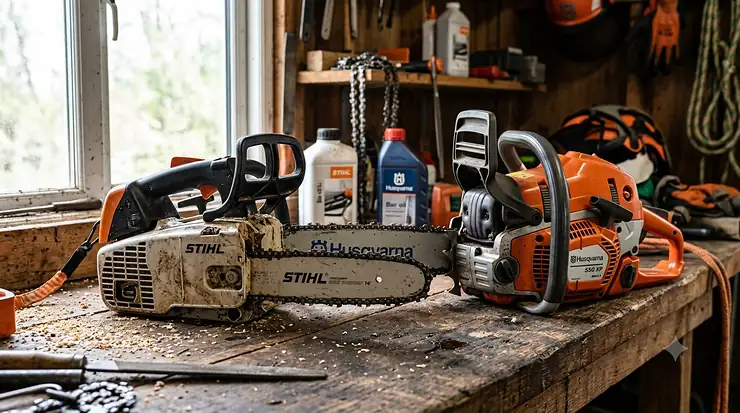
If you’ve spent any time shopping for a chainsaw, you’ve probably noticed two very different shapes staring back at you: one with a small handle sitting right on top of the saw body, and one with a longer body and a handle tucked behind it. That’s the entire top handle vs rear handle chainsaw debate in a nutshell — but the “why” behind the shapes matters a lot more than most product listings let on.
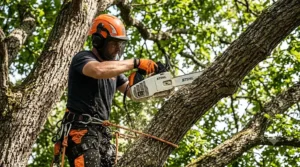
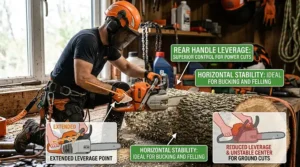
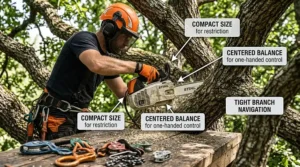
Here’s the short version: a top handle chainsaw is built to be carried and used one-handed-adjacent (more on that misconception in a minute) while climbing or working from a bucket truck, and a rear handle chainsaw is built to be used two-handed on solid ground. Pick the wrong one and you’re either fighting an awkward, underpowered saw on the ground or hauling 13 pounds of rear-handle saw up into a tree canopy where it has no business being.
I’ve spent time pulling real specs from current production saws — Echo, Makita, Milwaukee, DeWalt, EGO, and Oregon all make models that are genuinely worth comparing — and I’ll walk through what separates a saw that’s “fine for the backyard” from one that’s actually built for the tree. We’ll also clear up a safety myth about top handle saws that gets repeated constantly in forums and is, frankly, wrong.
Quick Comparison: Top Handle vs Rear Handle
| Top Handle Chainsaw | Rear Handle Chainsaw | |
|---|---|---|
| Designed for | Climbing arborists, bucket-truck work | Ground-level cutting, felling, bucking |
| Typical weight | 5–10 lbs (power head) | 12–20+ lbs |
| Typical bar length | 10″–16″ | 16″–20″+ |
| Handle position | On top, in line with the bar | Behind the engine, low and back |
| Hand operation | Two hands required by safety standards (same as rear handle) | Two hands, more leverage and stability |
| Best for | Pruning, limbing aloft, light arborist work | Firewood, felling, heavy bucking |
| Who buys it | Professional/trained arborists, tree care crews | Homeowners, ranch/farm owners, landscapers |
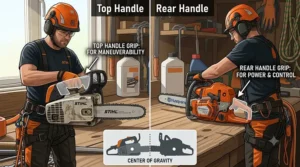
A quick read of that table tells the real story: this isn’t a “which is better” question, it’s a “which job are you doing” question. A top handle saw’s lighter weight and inline balance make it maneuverable in awkward positions up in a tree, but that same compact size means less bar length and less raw power for bucking large logs. A rear handle saw trades portability for stability and cutting capacity — it’s the tool you reach for once your feet are back on the ground.
💬 Just one click — help others make better buying decisions too! 😊
💬 Found a saw that fits your situation below?
One click helps you compare current pricing and lets others benefit from your research too! 😊
Top 7 Chainsaws: Expert Analysis
I picked a real, current spread across both categories — three top handle saws for arborist-style work and four rear handle saws for ground work — covering gas, battery, and corded options at different price points.
1. Echo CS-2511T — Best Overall Top Handle for Trained Arborists
The Echo CS-2511T is a 25cc, 2-stroke gas saw with a dry power-head weight of just 5.2 lbs, making it, per Echo’s official spec sheet, one of the lightest gas chainsaws sold in North America. That weight number matters more than it sounds — when you’re holding a saw at full extension from a harness for ten minutes at a stretch, every ounce shows up in your forearm by the end of the day.
What the spec sheet won’t tell you is how that weight changes your cutting rhythm. A heavier top handle saw forces you to brace against the trunk or a limb constantly; the CS-2511T lets you make controlled cuts in awkward positions without fighting the tool itself. It’s also got a dual-post chain brake, which adds durability most cheaper top-handle imports skip.
This saw is for trained, working arborists — not a homeowner’s first chainsaw. If you’re climbing and pruning professionally, it’s hard to beat for the price.
✅ Pros: Exceptionally light, professional-grade 2-stroke engine, easy-access chain tensioner
❌ Cons: Gas maintenance (mixing fuel, air filter care), 2-stroke exhaust smell in tight canopy work
Price range: in the $400s for the bare power head with bar and chain — check current listing, as gas equipment pricing shifts with fuel-system component costs.
2. Makita XCU09SM1 — Best Battery Top Handle for Pros Already on 18V
The Makita XCU09SM1 runs on Makita’s 18V LXT platform (two batteries combined for 36V) and Makita rates its outer-rotor brushless motor as delivering power equivalent to a 30cc gas saw, with a 16″ bar and chain speed up to 3,940 feet per minute. Weight is 7.5 lbs without the batteries, 10.3 lbs with them installed.
In practice, what that 30cc-equivalent rating means is you’re not stepping down in cutting performance to go battery — you’re trading 2-stroke maintenance for battery swaps. The appeal here isn’t just “no gas,” it’s that if you already run Makita 18V drills, blowers, or other yard tools, this saw shares batteries with everything else in your kit. That’s a real cost advantage most buyers overlook when comparing sticker price alone — you’re not buying a whole new battery ecosystem.
✅ Pros: Shares Makita’s 18V battery system, no mixed gas, lower noise for residential jobs
❌ Cons: Heavier than the Echo gas option once batteries are in, runtime capped by battery capacity
Price range: $500–$600 range for the kit with battery and charger — bare-tool versions run less if you already own LXT batteries.
3. Milwaukee M18 FUEL Top Handle Chainsaw (2826-20T) — Best for Existing M18 Owners
Milwaukee’s 14″ top handle saw (full manufacturer specs) uses their POWERSTATE brushless motor, rated at up to 2.7 HP peak, and Milwaukee’s own testing claims it cuts faster than a 35cc gas saw. It’s built around the same M18 battery platform used across Milwaukee’s broader power tool line, so reaching full throttle takes under a second — no pull cord, no choke.
The practical upside here is instant-on reliability. Climbing arborists who’ve fought a flooded carburetor 30 feet up a tree understand exactly why that matters. The tradeoff is that, like the Makita, your real-world runtime depends entirely on which M18 battery you pair it with — the high-output and FORGE batteries Milwaukee recommends aren’t cheap add-ons if you don’t already own them.
✅ Pros: Instant start, strong M18 battery ecosystem, includes climbing scabbard with tie-off points
❌ Cons: Battery cost adds up fast if buying bare tool only, 14″ bar limits larger limb work
Price range: roughly $300–$350 for the bare tool, more once you add a battery and charger — current promos vary.
4. Echo CS-590 Timber Wolf — Best Gas Rear Handle for Heavy Ground Work
This is the workhorse of the lineup. The Echo CS-590 “Timber Wolf” runs a 59.8cc 2-stroke engine (official specs), available with an 18″ or 20″ bar, with a dry weight around 13.2 lbs. It’s marketed for farm, ranch, and homestead use, and that framing is accurate — this is not a precision arborist tool, it’s a saw built to chew through firewood-sized rounds and storm cleanup without complaint.
What most buyers miss when comparing displacement numbers: a 59.8cc engine on a rear handle saw isn’t just “more power,” it’s more torque under load, which means the chain doesn’t bog down halfway through a thick oak round the way smaller saws do. If your main use case is bucking firewood every fall, that torque reserve is the difference between one clean pass and a saw that stalls and needs re-starting mid-cut.
✅ Pros: Strong torque for thick hardwood, simple two-piece air filter for easy cleaning, translucent fuel tank
❌ Cons: 2-stroke maintenance, louder than electric/battery alternatives, heavier for extended use
Price range: $350–$400 range — check current listing for the 18″ vs 20″ bar versions, as they’re typically priced differently.
5. DEWALT 60V MAX FlexVolt Chainsaw (DCCS672X1) — Best Battery Rear Handle for DEWALT Owners
The DEWALT DCCS672X1 pairs an 18″ bar with DEWALT’s 60V FlexVolt battery system, and in independent lab testing it averaged just over 5 seconds per cut on a 9-inch test log with a charge time of roughly 1.3 hours. Total weight with battery comes in at about 18 lbs 10 oz.
The real-world value case here is platform overlap again — if you’re already running DEWALT’s 20V/60V FlexVolt tools for other yard or jobsite work, this saw slots into a battery system you’ve already paid for. Independent testing has also noted it can outperform some name-brand competitors on raw cutting speed for its class, even though it runs slightly heavier than comparable battery saws.
✅ Pros: Strong cutting speed for a battery saw, fits the broad DEWALT 20V/FlexVolt ecosystem, no 2-stroke maintenance
❌ Cons: Heavier than some battery competitors, premium price for the kit with battery included
Price range: $300–$400 depending on kit configuration (bare tool vs. battery-and-charger kit).
6. EGO Power+ CS2005 — Best Premium Battery Rear Handle
The EGO CS2005 pairs a 20″ bar with EGO’s 56V battery platform and posted some of the fastest cut times in independent 2026 testing — around 3.45 seconds on a 9-inch log, with a total weight (saw plus battery) around 19 lbs. EGO’s lineup at this tier also includes an electronic chain brake layered on top of the mechanical one, a low-oil sensor, and multiple power modes to balance runtime against raw cutting force.
What that “multiple power modes” feature actually buys you in practice: you can run a lower-power, longer-runtime mode for an afternoon of light pruning, then switch to full power for the occasional thick round, without needing two different saws. For homeowners who want gas-like performance without ever touching a fuel can, this is currently one of the strongest battery options on the rear-handle side.
✅ Pros: Fastest cut times in this roundup, electronic + mechanical chain brake, low oil sensor
❌ Cons: Premium price for a battery saw, battery and charger sold separately on some kit configurations
Price range: $400–$450 for the kit with battery and charger — confirm exact bar length and battery inclusion before buying, as EGO sells multiple kit configurations.
7. Oregon CS1500 — Best Budget Pick (Corded Electric)
The Oregon CS1500 is a corded electric saw, and it’s the clear budget anchor of this list. Independent noise testing measured it at 86.6 decibels — quieter than several gas saws in the same size class — and because it draws power externally rather than carrying a battery or fuel tank, it’s noticeably lighter to swing than comparable electric or gas saws.
The catch, and it’s an important one: corded means you’re tethered to an outlet or a long extension cord, so this is a saw for pruning and light cutting close to the house, not for storm cleanup out in a back acre. If your chainsaw needs are “trim the hedge line and clean up the occasional fallen branch in the yard,” the CS1500 covers that at a fraction of the cost of anything else on this list.
✅ Pros: Lowest cost of entry, lightweight without a battery or fuel tank, intuitive controls for first-time users
❌ Cons: Cord limits range, not suited to heavy bucking or felling, less powerful than gas/battery options here
Price range: typically under $130 — one of the most affordable entries in this entire category.
Quick Product Comparison
| Model | Type | Power Source | Bar Length | Weight (approx.) | Best For |
|---|---|---|---|---|---|
| Echo CS-2511T | Top Handle | Gas (25cc) | 14″ | 5.2 lbs | Pro arborists |
| Makita XCU09SM1 | Top Handle | Battery (36V) | 16″ | 7.5–10.3 lbs | Pro, Makita owners |
| Milwaukee 2826-20T | Top Handle | Battery (M18) | 14″ | ~7 lbs | M18 owners |
| Echo CS-590 | Rear Handle | Gas (59.8cc) | 18″/20″ | 13.2 lbs | Firewood, farm use |
| DEWALT DCCS672X1 | Rear Handle | Battery (60V) | 18″ | ~18.6 lbs | DEWALT owners |
| EGO CS2005 | Rear Handle | Battery (56V) | 20″ | ~19 lbs | Homeowners wanting gas-like power |
| Oregon CS1500 | Rear Handle | Corded electric | 18″ | Lightest in class | Budget/light pruning |
Looking at this table, the split is pretty clean: the top handle saws cluster around 5–10 lbs and 14″–16″ bars because that’s the sweet spot for one-tree-at-a-time aerial work, while the rear handle saws scale up to 18″–20″ bars because ground work rewards raw cutting capacity over portability. The Oregon CS1500 stands apart as the only non-gas, non-high-voltage-battery option, and that’s exactly why it’s priced so far below the rest.
Power Source Comparison: Gas vs Battery vs Corded
| Gas | Battery | Corded Electric | |
|---|---|---|---|
| Runtime | Unlimited (refuel) | Limited by battery, swappable | Unlimited (near outlet) |
| Maintenance | Highest (fuel mix, filters, spark plug) | Lowest | Lowest |
| Power for big jobs | Highest | Close behind, improving yearly | Lowest |
| Noise | Loudest | Quiet | Quiet |
| Upfront cost | Mid | Mid–High (plus battery cost) | Lowest |
| Best use case | All-day heavy work, off-grid | Most homeowner and many pro tasks | Light, near-the-house pruning |
The gap between gas and battery chainsaws has narrowed enormously — both the Makita and Milwaukee top handle saws in this roundup claim performance matching or beating comparable gas displacement classes. Where gas still wins outright is multi-hour, all-day jobs far from an outlet or charger, since you can always carry another can of fuel but you can’t always carry five spare batteries. For everything short of that, a battery saw increasingly makes more practical sense than people assume.
How to Choose Between Top Handle and Rear Handle (Step-by-Step)
- Identify where you’ll actually be standing when you cut. If your feet leave the ground — climbing, ladder work, bucket truck — you need a top handle saw. If your feet stay on the ground, a rear handle saw will always out-cut and out-stabilize a top handle equivalent.
- Check your training and local regulations. Top handle saws are professional/trained-arborist tools in most contexts; some jurisdictions and employers restrict their use to certified climbers. If you’re a homeowner, a rear handle saw is almost always the right call even for tree work, paired with a pole saw for height.
- Match bar length to your typical wood diameter. A bar should generally be a couple inches longer than the thickest material you cut regularly — oversizing it just adds weight and kickback risk for no benefit.
- Decide your tolerance for maintenance. If you don’t want to mix fuel, clean a carburetor, or replace a spark plug, a battery or corded saw removes that entirely at a modest cost in runtime.
- Consider what battery platform you already own. If you’ve got DEWALT, Makita, or Milwaukee batteries from other tools, staying in that ecosystem saves real money over buying a separate, incompatible battery system.
- Set a realistic budget band. Corded electric saws like the Oregon CS1500 start under $150; mid-tier gas and battery saws run $300–$500; premium battery and pro-grade top handle saws can exceed $500–$600 once kitted with batteries.
- Buy the saw for your most demanding regular job, not your rarest one. If you fell large trees once a year but prune small branches weekly, a rear handle saw plus a hand pruning saw for height usually beats owning an underpowered top handle saw you barely use.
Real-World Scenarios: Matching the Saw to the Job
The weekend homeowner with a few backyard trees: Light pruning, the occasional storm-downed branch, nothing over 8 inches thick. The Oregon CS1500 or a similarly sized battery saw covers this completely — there’s no reason to spend $400+ on a saw that will sit in the garage 50 weeks a year.
The rural property owner cutting firewood every fall: Bucking and splitting cordwood from felled trees calls for torque and bar length over portability. The Echo CS-590’s 59.8cc engine and 18″–20″ bar options are built exactly for this kind of repetitive, heavy-load cutting season after season.
The working arborist climbing daily: Weight and balance in-hand matter more than almost anything else here. The Echo CS-2511T or Makita XCU09SM1 — both under 8 lbs as a bare power head — reduce fatigue across a full day of aerial pruning in a way a heavier saw simply can’t.
The tool-ecosystem owner who already has batteries: If you’re sitting on a drawer full of DEWALT 20V, Makita 18V, or Milwaukee M18 batteries from other tools, the math changes. Buying the bare-tool version of the matching chainsaw (DCCS672X1, XCU09SM1, or 2826-20T) usually costs less than starting a new battery platform from scratch, even if the sticker price looks similar to a competitor’s full kit.
Common Mistakes When Buying a Top Handle or Rear Handle Saw
- Buying a top handle saw “because it looks more pro,” with no climbing training. It’s not a status symbol — it’s a tool for a specific job most homeowners never actually do. A rear handle saw will be safer and more capable for ground-level yard work.
- Oversizing the bar length. A longer bar doesn’t cut faster; it adds weight, increases kickback energy, and is genuinely harder to control if you’re cutting wood well under the bar’s rated capacity most of the time.
- Ignoring battery platform overlap. Buying into a brand-new battery ecosystem for one tool, when you already own a compatible platform from another brand’s drill or trimmer, is one of the most avoidable extra costs in this category.
- Skipping PPE because the saw is “lighter” or “quieter.” Battery and corded saws cut just as aggressively as gas saws of similar class — chainsaw chaps, eye, and hearing protection apply regardless of power source.
- Assuming “top handle” means “one-handed.” This is probably the single most common and most dangerous misunderstanding in this whole category — and it gets its own section below.
Safety & Regulations: What the Rules Actually Say About Top Handle Saws
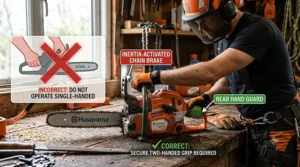
Here’s the part most buying guides get wrong, and it matters: a top handle chainsaw is not designed or approved for one-handed operation, despite the name and despite how often you’ll see it used that way online.
The ANSI Z133 safety standard — the industry standard for arboricultural operations in the U.S., overseen with the Tree Care Industry Association — is explicit that a chain saw shall be operated with two hands at all times, with the only narrow exception being a documented case where two-hand operation would create a greater hazard than a brief one-handed adjustment (for example, a climber needing a hand free for a split second to stay balanced while topping a tree). OSHA’s logging standard echoes this two-hand requirement. The compact top handle shape exists to improve balance and control while climbing and reaching into awkward positions — not to invite one-handed cutting.
Major tree care employers treat this as a firing-level safety rule, not a guideline. If you’re buying a top handle saw for personal or professional arborist use, plan to pair it with proper training (ANSI Z133-based instruction, ideally) rather than assuming the tool’s compact size makes it inherently safer to use casually — it doesn’t.
For ground-level rear handle work, the same two-hand rule applies, but the saw’s longer body and rear-set handle naturally encourage the correct grip and stance, which is part of why most safety educators consider rear handle saws the more forgiving option for untrained or infrequent users.
Features That Actually Matter (And Ones That Don’t)
Actually matters:
- Bar and chain length matched to your typical cut diameter — this affects safety (kickback) and efficiency more than almost any other spec.
- Dry/bare weight of the power head — especially for top handle saws used aloft for extended periods.
- Chain brake design (mechanical, and electronic where available) — a meaningful safety feature, not marketing fluff.
- Battery platform compatibility with tools you already own — a genuine, ongoing cost factor.
Matters less than the marketing suggests:
- Peak horsepower claims in isolation — sustained cutting performance under load matters more than a brief peak number.
- Decibel ratings down to a single digit — useful for general comparison, but hearing protection is required regardless of which saw you buy.
- Bundled accessories (extra chains, cases) — nice to have, but shouldn’t be the deciding factor between two saws with different core specs.
Long-Term Cost & Maintenance: Gas vs Battery Ownership
Sticker price is only part of the real cost. A gas saw needs 2-stroke fuel mixed at the correct ratio, periodic air filter cleaning, spark plug replacement, and occasional carburetor service — modest individual costs that add up over years of seasonal use, plus the time investment of doing it yourself or paying a small engine shop.
A battery saw avoids nearly all of that, but batteries themselves are a wearing component — expect noticeably reduced capacity after a few hundred charge cycles, and a replacement battery for a 56V–60V platform can cost a meaningful fraction of the saw’s original price. If you’re already invested in a battery ecosystem (DEWALT, Makita, Milwaukee), that cost is partially absorbed by tools you already own; if you’re starting fresh, factor the battery cost into your total comparison rather than just the bare-tool price.
Corded electric saws like the Oregon CS1500 have essentially no consumable maintenance beyond the chain itself, which is part of why they remain the lowest total-cost option for light, near-the-house use.
FAQ
❓ Is a top handle chainsaw good for a beginner?
❓ Can you use a top handle chainsaw on the ground?
❓ Do top handle chainsaws require one-handed use?
❓ Is a battery chainsaw powerful enough for firewood?
❓ What size chainsaw bar do I need for general yard work?
Conclusion
The top handle vs rear handle chainsaw decision really comes down to one question: are your feet on the ground when you’re cutting, or aren’t they? Top handle saws — like the Echo CS-2511T, Makita XCU09SM1, and Milwaukee 2826-20T — exist for trained arborists working aloft, where light weight and balance beat raw power. Rear handle saws — the Echo CS-590, DEWALT DCCS672X1, EGO CS2005, and budget-friendly Oregon CS1500 — exist for everything you do standing on solid ground, where stability and cutting capacity matter more than portability.
If you take one thing away from this guide beyond the product picks, let it be the safety point: a top handle saw’s compact shape was never designed as license for one-handed cutting. Buy the right saw for where your feet will actually be, train properly if you’re going aloft, and the rest of this decision gets a lot simpler.
✨ Don’t Miss These Exclusive Deals!
🔍 Take your tree care setup to the next level with these carefully selected saws. Click on any highlighted model to check current pricing and availability. The right chainsaw makes every yard job faster and safer!
Recommended for You
- Top Handle Chainsaw: 7 Best Picks for Arborists in 2026
- Chainsaw Size Guide 2026: 7 Best Bar Lengths Compared
- Chainsaw for Cutting Firewood: 7 Best Picks for 2026
Disclaimer: This article contains affiliate links. As an Amazon Associate, I earn from qualifying purchases. If you purchase products through these links, we may earn a small commission at no additional cost to you.
✨ Found this helpful? Share it with your friends! 💬🤗
