
In This Article
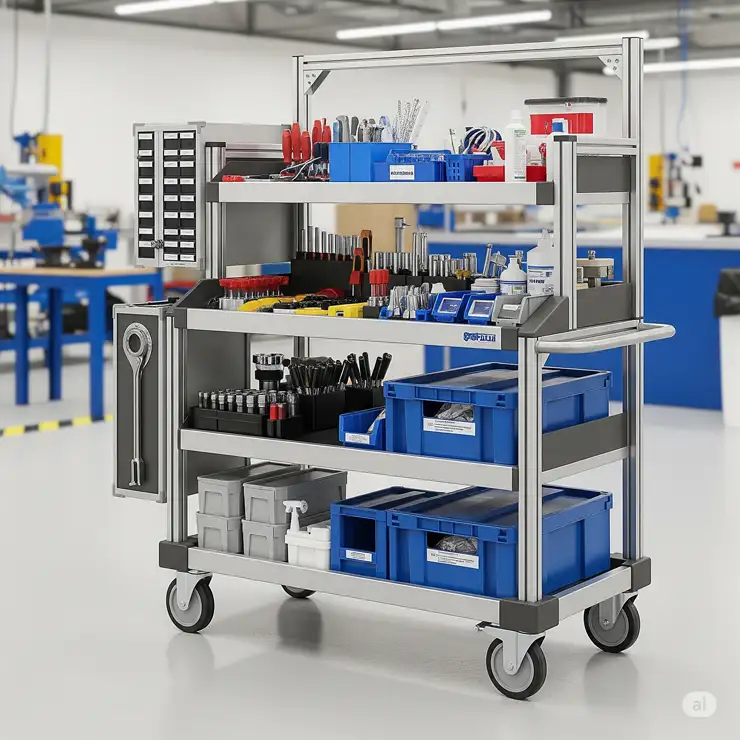
Every garage, studio, classroom, and workshop has a ghost: the third trip. Two armloads of gear are already staged by the door, one more case is still back at the bench, and your lower back is filing a complaint. A well-chosen equipment cart kills that third trip. A badly chosen equipment cart just invents a new problem, a wobbly, squeaky, overloaded contraption you’ll curse every time a wheel catches a door threshold.
That’s the real stakes here. The label “equipment cart” covers flimsy mesh-bin organizers, commercial structural-foam haulers, and six-foot rolling workbenches. Same name, wildly different tools.
So here’s the plan. This guide researched seven real, widely available options across budget, mid-range, and premium tiers. That meant reading spec sheets, cross-checking capacities, and boiling down what reviewers on major retail listings keep repeating. There are no invented testing stories and no fake quotes. You get honest analysis of what the numbers mean for your gear, your floors, and your spine.
Along the way you’ll see why caster design (the swivel-wheel mechanism under nearly every rolling cart) matters more than most buyers expect. You’ll also learn how capacity ratings can mislead, and which equipment cart suits which life, from dorm-room hobbyist to weekend contractor to small-studio owner.
One housekeeping note: every price below is a range based on research at the time of writing. Prices move constantly, so check current price before you buy.
Quick Comparison: Best Equipment Cart Options at a Glance
| Product | Type | Capacity (as listed) | Price Range | Best For |
|---|---|---|---|---|
| Amazon Basics 3-Tier Rolling Utility Cart | Mesh-bin organizer | Light-duty | Under ~$60 | Dorms, crafts, light garage duty |
| Simple Houseware 3-Tier Heavy Duty Metal Utility Rolling Cart | Metal shelf cart | ~220 lb (per one roundup) | Under ~$80 | Indoor multi-room storage |
| Olympia Tools Pack-N-Roll Folding Collapsible Service Cart | Folding service cart | 150 lb | ~$80-$110 | Trunks, events, small spaces |
| WEN 73002 Service Utility Cart | Plastic 2-shelf | 500 lb | ~$100-$175 | Workshop and garage hauling |
| Rubbermaid Commercial Heavy Duty 2-Shelf Utility Cart (FG450088BLA) | Structural-foam commercial | 500 lb | ~$250-$400 | Daily professional use |
| Rubbermaid Commercial Xtra Equipment Cart with Lockable Doors (B56121) | Enclosed, lockable | 300 lb | ~$600-$800 | Secure, out-of-sight storage |
| Seville Classics UltraHD 11-Drawer Rolling Workbench | Workbench cart | Check listing | ~$550-$700 | Serious workshops |
Look at the pattern: capacity doesn’t climb in a straight line with price. The WEN 73002 Service Utility Cart and the Rubbermaid Commercial Heavy Duty 2-Shelf Utility Cart (FG450088BLA) both list 500 lb, yet sit in different price brackets. What you pay for at the high end is durability, security, and fit-out, not raw lifting power. The Rubbermaid Commercial Xtra Equipment Cart with Lockable Doors (B56121) lists a lower capacity than either, but it solves a problem the open carts can’t: keeping gear out of sight and under lock.
💬 Just one click — help others make better buying decisions too!😊
Top 7 Equipment Cart Picks: Expert Analysis
Each pick below comes with spec interpretation, an honest take on who it suits, and a summary of the sentiment found in real reviews and roundups. Where reviews couldn’t be verified, the text says so.
1. Amazon Basics 3-Tier Rolling Utility Cart — cheapest way to stop carrying things
The pitch is simplicity: three recessed mesh-bottom bins on a metal frame with rubber swivel casters. The mesh drains and breathes, which suits damp cleaning supplies and art materials. The catch is that small loose items, like screws and beads, slip through, so you’ll want liners or trays. The swivel casters pivot freely on hard floors, though this cart was never meant for a job site.
On paper, this is an organizer that happens to roll. That makes it a smart equipment cart for dorm rooms, craft corners, and light garage duty. It’s a poor fit for anything dense, such as paint cans or battery packs. Roundups consistently position it as a value pick and flag lower capacity than steel service carts, plus occasional build-quality misses.
Pros:
- ✅ Three roomy recessed bins
- ✅ Swivel rubber casters roll smoothly
- ✅ Budget-friendly entry point
Cons:
- ❌ Lower capacity than heavy-duty steel carts
- ❌ Mesh bottoms let small items slip
Price range: budget tier, under roughly $60 at the time of research. Verdict: excellent for light organizing, wrong for hauling.
2. Simple Houseware 3-Tier Heavy Duty Metal Utility Rolling Cart — steadiest light-duty organizer
This cart’s calling card is rigidity at a low price. The metal frame carries a capacity of roughly 220 lb according to one roundup, and reviewers describe assembly as quick, about 15 minutes with a screwdriver. The four 2-inch swivel casters are the detail to study. They’re designed for smooth floors, not grass, gravel, or door-threshold bumps.
Here’s what the spec sheet won’t shout: small wheels make this a strictly indoor equipment cart. Treat it as a mobile shelf for a studio, classroom, or home office and you’ll love it. Treat it as a patio hauler and you’ll be fighting it. One roundup calls it the safest pick for multi-room indoor organization, and the main caveat raised is wheel size.
Pros:
- ✅ Sturdy metal frame for the price
- ✅ Assembly reportedly takes about 15 minutes
- ✅ Three tiers keep supplies visible
Cons:
- ❌ Small casters limit it to smooth floors
- ❌ Not built for tools or job sites
Price range: under roughly $80, check current price. Verdict: strong value for indoor organization.
3. Olympia Tools Pack-N-Roll Folding Collapsible Service Cart — folds flat when the day is done
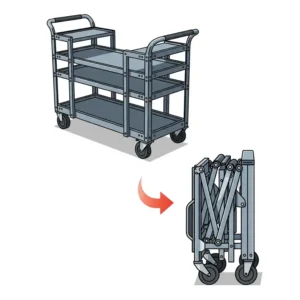
Collapsibility is the headline. The Pack-N-Roll lists a 150 lb capacity, which is modest on paper. It’s also the honest number for something that folds. A roundup specifically praises its rigidity, noting the cart resists the chassis sway that makes cheap folding carts feel loose. It also credits the wheels for coping with uneven concrete, such as garage transitions.
Folding changes the use case. If your equipment cart has to live in a car trunk between events, or in a closet between projects, a 500 lb monster is the wrong answer. This one suits musicians, vendors, and DIYers with small spaces. It’s less suited to someone loading engine blocks.
Pros:
- ✅ Collapses for trunk or closet storage
- ✅ Rigid feel for a folding design
- ✅ Wheels handle uneven concrete
Cons:
- ❌ 150 lb capacity caps heavy loads
- ❌ Hinged designs add a wear point over time
Price range: roughly $80-$110. Verdict: the right tool if storage space is your biggest constraint. Individual customer reviews weren’t verifiable in enough volume to summarize, so lean on the spec sheet.
4. WEN 73002 Service Utility Cart — 500 lb capacity at toolbox money
The WEN 73002 Service Utility Cart pairs a plastic body with a listed 500 lb capacity and a 40 by 17 inch footprint. Plastic means it won’t rust and resists scuffing, which a roundup flags as a big reason it’s called the most heavy-duty pick in its category. The casters swivel in all four directions, so the cart can spin on a dime.
All-swivel is a double-edged feature. It’s brilliant in tight garages and shops. On a ramp or slope, though, a loaded cart can drift because no wheels are fixed to keep it tracking straight. The narrow 17-inch width slips through doorways and along garage walls with room to spare. That makes this a practical shop equipment cart for people who’d rather spend on tools than on carts.
Pros:
- ✅ 500 lb listed capacity
- ✅ Scuff-resistant, rust-free plastic
- ✅ Four-way swivel maneuvers in tight spaces
Cons:
- ❌ No fixed wheels for straight tracking
- ❌ Plastic flexes less gracefully than steel under abuse
Price range: roughly $100-$175. Verdict: probably the best capacity-per-dollar option in this roundup.
5. Rubbermaid Commercial Heavy Duty 2-Shelf Utility Cart (FG450088BLA) — the commercial-grade workhorse
Structural-foam construction is the signature here. The listing describes a polyethylene body that won’t rust, dent, chip, or peel, with dimensions of 39 by 17-7/8 by 33-1/4 inches and a 500 lb rating across two shelves. It rolls on four 5-inch thermoplastic casters, two fixed and two swivel, and it ships with assembly required. It’s made in the USA, and the unit weighs about 28 lb.
The fixed-plus-swivel layout is the underrated detail. It makes the cart track straight down long hallways, like a grocery cart, at the cost of wider turning arcs. A roundup does flag that only two of the four wheels swivel as a drawback, which is fair if you work in tight corners. For foodservice, janitorial, and facilities teams that push a cart daily, that straight tracking is exactly what you want in a durable equipment cart.
Pros:
- ✅ Rust-proof, dent-resistant foam body
- ✅ 5-inch casters handle thresholds better
- ✅ Light for its capacity at about 28 lb
Cons:
- ❌ Only two swivel casters limit tight turns
- ❌ Priced well above consumer carts
Price range: roughly $250-$400. Verdict: the sensible buy if the cart will see daily work for years.
6. Rubbermaid Commercial Xtra Equipment Cart with Lockable Doors (B56121) — security built into the sides
This is the odd one out, deliberately. The Rubbermaid Commercial Xtra Equipment Cart with Lockable Doors (B56121) wraps its contents in enclosed sides with lockable doors, rated at 300 lb and standing about 37 inches tall. It exists for one reason: so people can’t see or grab what’s inside.
Think AV carts in a school, medical supplies down a hallway, or cleaning chemicals that shouldn’t sit in plain sight. Enclosure adds weight and blocks oversize items, so it won’t haul a long ladder. But if theft or tampering is your actual risk, no open-shelf cart can solve it. Reviews specific to this model weren’t verifiable in enough volume to summarize here. Check current customer feedback on the listing before committing, because at this price band you’ll want to confirm real-world door and latch durability.
Pros:
- ✅ Lockable doors protect valuable gear
- ✅ Enclosed sides hide contents from view
- ✅ Commercial-brand build quality
Cons:
- ❌ Highest price in this roundup bracket
- ❌ Enclosure limits oversize or awkward loads
Price range: roughly $600-$800. Verdict: worth it only if security is a genuine requirement.
7. Seville Classics UltraHD 11-Drawer Rolling Workbench — a full workshop on wheels
Scale is the point. This steel cabinet workbench lists 11 lined drawers, a two-door cabinet, a solid hardwood top about 72 inches wide and 1.5 inches thick, and 5-inch heavy-duty wheels, two of them locking, plus a push bar and corner bumpers. Dimensions come in at roughly 77 by 20 by 37.5 inches.
The two locking wheels matter more than they look. A rolling bench that creeps while you hammer is useless, so those locks turn a cart into a stable work surface. Sentiment is strong: one major retailer listing shows roughly 4.6 out of 5 across more than 2,400 ratings, with about 79 percent at five stars and about 5 percent at one star. Reviewers praise how heavy-duty it feels. The recurring warning is assembly, which one reviewer said took days because every drawer must be folded and screwed together.
Pros:
- ✅ 11 lined drawers plus a cabinet
- ✅ Locking wheels double as a stable bench
- ✅ Thick hardwood top handles real projects
Cons:
- ❌ Assembly is long and fiddly
- ❌ Too big for small rooms
Price range: roughly $550-$700. Verdict: premium, but justified for anyone who needs storage and a work surface in one.
Top 7 Equipment Cart Specs Side by Side
| Product | Build | Casters / Mobility | Load (as listed) | Price Range | Best For |
|---|---|---|---|---|---|
| Amazon Basics 3-Tier Rolling Utility Cart | Metal frame, mesh bins | Rubber swivel | Light-duty | Under ~$60 | Light organizing |
| Simple Houseware 3-Tier Heavy Duty Metal Utility Rolling Cart | Metal frame | Four 2-inch swivel | ~220 lb | Under ~$80 | Smooth indoor floors |
| Olympia Tools Pack-N-Roll Folding Collapsible Service Cart | Folding frame | Per listing | 150 lb | ~$80-$110 | Portability |
| WEN 73002 Service Utility Cart | Plastic | Four-way swivel | 500 lb | ~$100-$175 | Shop hauling |
| Rubbermaid Commercial Heavy Duty 2-Shelf Utility Cart (FG450088BLA) | Structural foam | 2 fixed + 2 swivel, 5-inch | 500 lb | ~$250-$400 | Daily commercial use |
| Rubbermaid Commercial Xtra Equipment Cart with Lockable Doors (B56121) | Enclosed, lockable | Per listing | 300 lb | ~$600-$800 | Security |
| Seville Classics UltraHD 11-Drawer Rolling Workbench | Steel, hardwood top | 5-inch, 2 locking | Check listing | ~$550-$700 | Workshops |
The table exposes a trade-off that star ratings hide. The WEN 73002 Service Utility Cart wins on raw capacity per dollar, while the Rubbermaid Commercial Heavy Duty 2-Shelf Utility Cart (FG450088BLA) wins on long-term durability and caster size. Buyers who only need an indoor shelf on wheels will be better served by the Simple Houseware 3-Tier Heavy Duty Metal Utility Rolling Cart, since paying for 500 lb you’ll never load is wasted money.
What Is an Equipment Cart?
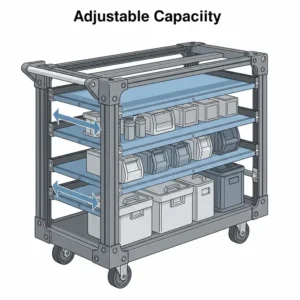
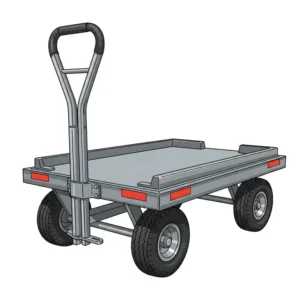
An equipment cart is a wheeled platform, shelf unit, or cabinet built to move tools, gear, or supplies without carrying them. Most models use four casters, a push handle, and one to three load-bearing shelves or drawers. Capacities run from light-duty organizers around 100 lb to commercial haulers rated at 500 lb or more.
That definition hides real variety, so it helps to sort the category into five families:
- Organizer carts: mesh or metal tiers on small casters, like the Amazon Basics 3-Tier Rolling Utility Cart. Best indoors with light loads.
- Service and utility carts: open shelves with larger wheels, such as the WEN 73002 Service Utility Cart. Built for hauling.
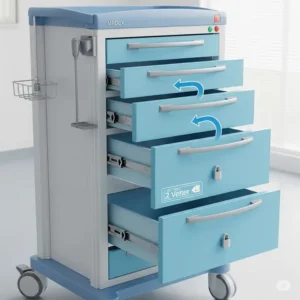
- Enclosed equipment carts: lockable doors and sides, like the Rubbermaid Commercial Xtra Equipment Cart with Lockable Doors (B56121). Built for security.
- Workbench carts: drawers plus a work surface, such as the Seville Classics UltraHD 11-Drawer Rolling Workbench.
- Folding carts: collapsible frames like the Olympia Tools Pack-N-Roll Folding Collapsible Service Cart, designed for storage-limited users.
Knowing which family you’re shopping in saves hours. Comparing an organizer cart to a workbench cart is like comparing a bicycle to a pickup truck: both roll, but the job is completely different.
How to Choose an Equipment Cart
Picking the right equipment cart comes down to seven decisions, in roughly this order:
- Weigh your heaviest realistic load, then add about 30 percent. Listed capacities assume even distribution on a flat floor, which real life rarely delivers.
- Match the casters to your floors. Small hard wheels suit smooth indoor surfaces, while larger 5-inch wheels cope better with thresholds and uneven concrete.
- Decide between all-swivel and fixed-plus-swivel. All-swivel turns tightly but drifts on slopes, while mixed layouts track straight but turn wider.
- Measure your tightest doorway or elevator. A 17-inch-wide equipment cart clears most openings that a 25-inch-wide one won’t.
- Choose open or enclosed. Open shelves are faster to load, while enclosed doors protect valuable gear.
- Pick the material for your environment. Structural foam and plastic shrug off moisture, steel excels at rigidity, and mesh bins suit light, damp items.
- Check assembly effort and warranty. Some carts assemble in minutes while a large rolling bench can eat a weekend, and the Rubbermaid Commercial Heavy Duty 2-Shelf Utility Cart (FG450088BLA) class of products typically carries a limited manufacturer warranty worth reading.
Equipment Cart vs Hand Truck vs Folding Wagon
Sometimes the right answer isn’t a cart at all. Here’s how the three main options compare:
| Option | Strength | Weakness | Best For |
|---|---|---|---|
| Equipment cart | Stable shelves, organized storage | Needs flat floors | Moving varied gear around a building |
| Hand truck | Handles tall, narrow, heavy items | Needs tilting, no shelves | Boxes, appliances, kegs |
| Folding wagon | Rolls over grass and gravel | Open bed, less organized | Outdoor and event hauling |
A hand truck concentrates weight over two wheels, so it excels with a single heavy box but fails with loose items. Folding wagons such as the Amazon Basics Collapsible Heavy Duty Utility Wagon, listed at 265 lb capacity, win outdoors. Heavy garden carts such as the Gorilla Carts Steel Utility Cart, rated around 1,000 lb, go further still but are overkill indoors.
An equipment cart earns its keep when you move a variety of items and want them organized in transit. If your day is “one heavy thing up the stairs,” buy the hand truck. If your day is “twelve small things across a building,” buy the cart. And if your day is “everything, but mostly outside,” a wagon probably beats both.
Features That Actually Matter (And Those That Don’t)
Marketing copy loves adjectives. Here’s what’s worth your attention.
Matters: casters. Wheel diameter, material, and swivel layout decide how a cart behaves day to day. Larger wheels roll over threshold gaps with less effort, and non-marking tires protect floors. One known annoyance is caster flutter, the side-to-side shimmy familiar from a wobbly shopping cart wheel. Better bearings and quality swivels reduce it.
Matters: brakes. Many commercial carts ship without them, according to published spec listings. If your cart will double as a stationary work surface, look for locking wheels, as on the Seville Classics UltraHD 11-Drawer Rolling Workbench.
Matters: lipped shelves. A raised edge stops items from sliding off during turns, a feature Rubbermaid highlights on its heavy-duty carts.
Doesn’t matter: the phrase “heavy duty.” It isn’t a regulated term. Always trust the numeric capacity and the construction details instead.
Doesn’t matter: color and trim. Unless you’re matching a branded space, pay for steel, foam, and wheels, not paint.
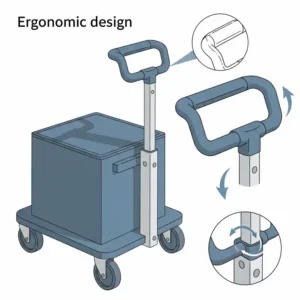
Depends: handle design. Fixed ergonomic handles help daily users, while removable or folding handles help storage-limited ones.
✨ Don’t Miss These Exclusive Deals!
🔍 Take your workspace to the next level with these carefully selected carts. Click on any highlighted product to check current pricing and availability. The right equipment cart will help you create a smoother, safer workflow you’ll feel in your back every single day!
Long-Term Cost & Maintenance
Sticker price is only the opening bid. The smarter measure is cost per year of useful service.
Consider a purely hypothetical comparison. A lightweight cart in the budget bracket might last two seasons of regular use before wheels crack or shelves sag. A commercial polyethylene cart in the several-hundred-dollar range could plausibly serve for many years. Divide each price by its likely lifespan and the pricier option often lands cheaper per year, though your own results will vary with load and usage.
Maintenance is blessedly boring:
- Monthly: wipe down wheels and axles, clearing hair, thread, and debris that bind swivels.
- Quarterly: re-tighten shelf and caster hardware, since vibration loosens screws.
- Twice a year: apply a light lubricant to swivel bearings if your caster type calls for it.
- As needed: replace worn casters rather than the whole cart. Industrial suppliers sell replacement casters for common commercial carts, which can extend cart life dramatically.
Hidden costs matter too. A workbench cart like the Seville Classics UltraHD 11-Drawer Rolling Workbench costs real time to assemble, and time is money if you bill hourly. An enclosed unit like the Rubbermaid Commercial Xtra Equipment Cart with Lockable Doors (B56121) may also save money indirectly if it prevents theft of expensive gear.
Equipment Cart Safety and Load Guidelines
A cart makes lifting safer only if you use it properly. Manual material handling remains a major driver of workplace injuries. The CDC’s NIOSH publication on ergonomic guidelines for manual material handling notes it contributes to a large share of the more than half a million musculoskeletal disorder cases reported in the United States each year. A cart is one of the simplest ways to reduce that exposure.
Practical habits that follow from the guidance:
- Load heavy items low. A low center of gravity resists tipping and makes steering easier.
- Push rather than pull when possible. Pushing generally gives better control and posture, and ergonomics literature notes that the force needed to start a cart moving is typically higher than to keep it rolling.
- Never exceed listed capacity, and mind the per-shelf limit. Some carts list a total rating split across shelves.
- Avoid slopes with all-swivel carts. Drift is a real hazard.
- Keep sight lines clear. A stack that blocks your view invites collisions.
OSHA also addresses this territory. Its materials handling and storage guidance stresses that workers need to understand both manual handling hazards and safe equipment operation. In a workplace, treat any equipment cart as part of a training and safety routine, not just a purchase.
Equipment Cart for Specific Audiences
Beginners and Home Users
You don’t need commercial muscle. A light organizer like the Amazon Basics 3-Tier Rolling Utility Cart or the Simple Houseware 3-Tier Heavy Duty Metal Utility Rolling Cart covers laundry rooms, craft corners, and bathrooms. Prioritize easy assembly and smooth indoor casters.
Tradespeople and Weekend Builders
Choose capacity and durability. The WEN 73002 Service Utility Cart gives serious load ratings at a friendly price, while the Seville Classics UltraHD 11-Drawer Rolling Workbench suits anyone running a home shop who wants everything within arm’s reach.
Schools, Clinics, and Offices
Security and cleanability dominate. The Rubbermaid Commercial Xtra Equipment Cart with Lockable Doors (B56121) keeps contents hidden, while the Rubbermaid Commercial Heavy Duty 2-Shelf Utility Cart (FG450088BLA) handles shared daily use.
Mobile Vendors and Performers
Storage and transport rule everything. The Olympia Tools Pack-N-Roll Folding Collapsible Service Cart folds into a trunk, which beats any fixed-frame cart for people who load and unload constantly.
Older Adults and Anyone Protecting Their Back
Look for ergonomic handles, lighter frames, and larger wheels. The roughly 28 lb Rubbermaid Commercial Heavy Duty 2-Shelf Utility Cart (FG450088BLA) is notably light for its 500 lb rating.
Practical Usage Guide: Setting Up and Maintaining Your Equipment Cart
Here’s the part Amazon listings never cover: the first 30 days.
Day one: assemble with a plan. Lay out all parts and hardware before touching a screwdriver. Tighten everything only loosely at first, then fully tighten once the frame is square. Large builds like the Seville Classics UltraHD 11-Drawer Rolling Workbench reward patience, so reserve an afternoon, not an hour.
First week: test your load pattern. Roll the loaded cart through every route you’ll use, including doorways and any threshold. If a wheel catches, note it now rather than spilling gear later.
Zone the shelves. Heavy items on the bottom, frequently used items at hip height, and small loose pieces in tubs or trays. On mesh-bin models like the Amazon Basics 3-Tier Rolling Utility Cart, line the bins so small parts stay put.
Set a parking spot. Carts left in doorways become obstacles. A marked spot, ideally near an outlet if you charge tools, keeps the cart from drifting into traffic.
Common first-30-day mistakes:
- Skipping the post-assembly hardware recheck, which is the number-one cause of wobble
- Overloading one shelf instead of distributing weight
- Ignoring caster debris until a wheel binds
- Using a smooth-floor cart on rough ground
After week four, schedule the monthly wipe-down and quarterly re-tighten from the maintenance routine above. Five minutes of care protects a purchase that can run into hundreds of dollars.
Real-World Scenarios: Which Equipment Cart Fits Your Life?
The following profiles are illustrative examples built from the specs above, not real customer stories.
Scenario 1: The college student on a budget. Picture a student moving supplies between a dorm room and a shared kitchen daily, with about $60 to spend. Floors are smooth and loads are light. The Amazon Basics 3-Tier Rolling Utility Cart fits perfectly, since capacity and caster size aren’t the bottleneck. If more rigidity is wanted, the Simple Houseware 3-Tier Heavy Duty Metal Utility Rolling Cart adds frame strength for a bit more money.
Scenario 2: The weekend contractor. Imagine someone hauling tools between a garage and a driveway several times a week, with $150 to $400 to spend. Loads are heavy and floors are uneven. The WEN 73002 Service Utility Cart is the value choice, while the Rubbermaid Commercial Heavy Duty 2-Shelf Utility Cart (FG450088BLA) is the buy-it-once choice if the budget stretches.
Scenario 3: The small studio or clinic owner. Consider a professional with valuable equipment, a shared space, and a budget above $600. Theft and tampering are real worries. The Rubbermaid Commercial Xtra Equipment Cart with Lockable Doors (B56121) solves the security problem directly, which an open equipment cart simply can’t.
Scenario 4: The traveling vendor. A pop-up seller loads a car three times a week and has little storage at home. The Olympia Tools Pack-N-Roll Folding Collapsible Service Cart folds for trunk and closet, and its 150 lb limit is fine for stock boxes and signage.
Problem → Solution: Fixing Common Equipment Cart Headaches
Problem: the cart wobbles or squeaks. Retighten shelf and caster hardware, then clean and lightly lubricate swivel bearings. Wobble after assembly usually means hardware was tightened before the frame was square.
Problem: it won’t roll straight. All-swivel layouts like the WEN 73002 Service Utility Cart naturally wander on slopes. Load weight evenly, steer deliberately, and avoid ramps. If straight tracking is a daily need, a fixed-plus-swivel design like the Rubbermaid Commercial Heavy Duty 2-Shelf Utility Cart (FG450088BLA) is the better match.
Problem: items slide off in turns. Choose lipped shelves, or add non-slip liner mats and bungee cords. Tubs with lids also tame loose items.
Problem: the cart rolls away while you work. Choose a model with locking casters, as on the Seville Classics UltraHD 11-Drawer Rolling Workbench, or add aftermarket locking casters where the stem size allows.
Problem: small parts fall through. Mesh bins like those on the Amazon Basics 3-Tier Rolling Utility Cart need liners or trays. It’s a two-minute fix that prevents lost hardware.
Problem: the cart is too wide for a doorway. Measure first. A 17-inch-wide design clears openings a wider cart won’t.
FAQ
❓ How much weight can an equipment cart hold?
❓ What is the best equipment cart for a garage?
❓ Are enclosed equipment cart models worth the extra cost?
❓ Can I use an equipment cart outdoors?
❓ How do I keep an equipment cart from rolling away?
Conclusion
Choosing an equipment cart isn’t glamorous, but it quietly shapes how your whole workday feels. The right one turns three trips into one. The wrong one becomes a squeaky obstacle in your own space.
Here’s the short version. If you want the cheapest sensible upgrade, the Amazon Basics 3-Tier Rolling Utility Cart and the Simple Houseware 3-Tier Heavy Duty Metal Utility Rolling Cart cover indoor organizing. If portability rules, the Olympia Tools Pack-N-Roll Folding Collapsible Service Cart folds away. For serious hauling at friendly prices, the WEN 73002 Service Utility Cart is hard to beat, while the Rubbermaid Commercial Heavy Duty 2-Shelf Utility Cart (FG450088BLA) is the long-haul commercial pick. Need security? The Rubbermaid Commercial Xtra Equipment Cart with Lockable Doors (B56121) locks it down. And if your cart doubles as a workshop, the Seville Classics UltraHD 11-Drawer Rolling Workbench is the premium all-in-one.
Match capacity to your heaviest load, casters to your floors, and design to your space. Do that, and almost any pick on this list will serve you well.
Recommended for You
- 15 Best Sports Equipment Storage Solutions That Transform Your Space in 2025
- 15 Best Exercise Ball Rack Solutions That Will Transform Your Home Gym in 2025
- 10 Best Medicine Ball Rack Options For Ultimate Gym Organization in 2025
Disclaimer: This article contains affiliate links. As an Amazon Associate, I earn from qualifying purchases. If you purchase products through these links, we may earn a small commission at no additional cost to you.
✨ Found this helpful? Share it with your friends! 💬🤗
