
In This Article
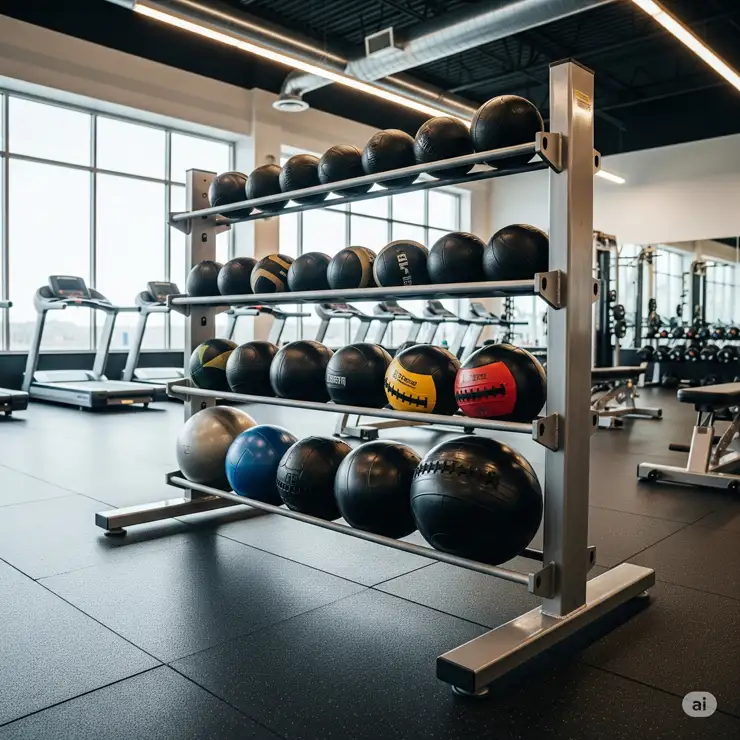
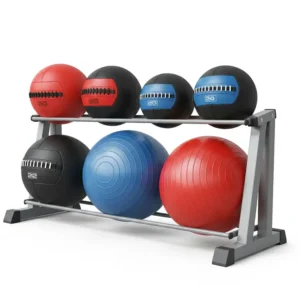
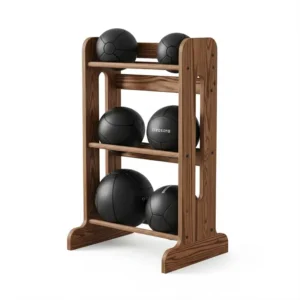
A medicine ball rack is a purpose-built storage stand, tree, or wall mount that holds weighted balls (medicine balls, slam balls, and wall balls) off the floor in individual cradles or shelves. It keeps heavy, round, roll-happy equipment organized, visible, and safe to grab, while freeing up valuable training space.
Weighted balls are the most disobedient equipment in your gym. Dumbbells stay put. Barbells lean politely. A 12-pound medicine ball? It drifts across the floor like it has somewhere better to be, then stops exactly where your foot lands. The tool has real pedigree, too: the term “medicine ball” dates back to at least the 1870s, and modern balls run from roughly 2 to 25 pounds, with some reaching about 14 inches across. That spread of sizes is precisely why picking the right medicine ball rack is trickier than it looks.
This guide ranks seven real options across budget, mid-range, and premium tiers, from a corner-sized tree to a rolling rack for group classes. Everything here is built from published specs, retailer listings, and aggregated review themes. None of it is hands-on testing, and where verifiable review data runs thin, I say so. Prices appear as ranges only because they change constantly.
Medicine Ball Rack Quick Comparison: 7 Picks at a Glance
| Product | Capacity | Style | Best For |
|---|---|---|---|
| Champion Sports MBR1 Medicine Ball Tree | Single-column tree (confirm count on listing) | Freestanding | Tight budgets and small corners |
| Body-Solid GMR5B | 3 balls | Freestanding, short | Apartments and beginners |
| Valor Fitness BG-50 | 5 balls | Freestanding upright | Home gyms that use wall balls |
| Body-Solid GMR10B | 6 balls | Freestanding upright | Classic medicine ball sets |
| Body-Solid GMR20 | 10 balls up to 16 in. | Freestanding upright | Big collections, small studios |
| Otoolling 4-Tier Rolling Rack | Up to 20 balls (per listing) | Rolling, tiered | Group classes and mobility |
| Valor Fitness BG-53 | Up to 250 lb total | Wall-mounted | Floor-space purists |
Looking at the table, the Valor Fitness BG-50 and Body-Solid GMR10B sit in the sweet spot for most home gyms, while the Otoolling 4-Tier Rolling Rack is the only one built for roll-it-to-the-class logistics. Buyers with a handful of balls and almost no space should start with the Body-Solid GMR5B or the Champion Sports MBR1. And if your floor is already a puzzle, the Valor Fitness BG-53 deletes the footprint entirely.
💬 Just one click — help others make better buying decisions too!😊
Top 7 Medicine Ball Racks: Expert Analysis
Each pick below follows the same logic: what the specs mean in practice, who the rack suits, and what reviewers consistently report. Think of it as a spec sheet translated into plain English.
1. Champion Sports MBR1 Medicine Ball Tree — budget-friendly corner saver
Where this one earns its keep is footprint. At roughly 14 by 11 inches of floor and 52 inches of height, the Champion Sports MBR1 stacks balls skyward instead of sideways. That makes it the easiest medicine ball rack here to slide beside a bench or behind a door.
Tree-style racks cradle each ball in an open ring, so ring size is the spec to respect. Champion sells this storage family in several styles and sizes, and the listing family highlights welded-steel construction. What the spec sheet won’t tell you is that count and diameter vary by variation, so confirm both on the exact page before checking out. On paper, it suits someone with a small set of standard-size balls who wants storage without a weekend project.
Reviewers on retail listings generally praise the build quality, and one buyer felt strongly enough about assembly to post a how-to. Translation: clear half an hour and keep a wrench handy. The Champion line also carried an Amazon’s Choice badge at the time of research, though badges come and go.
Pros:
- ✅ Tiny floor footprint for its height
- ✅ Welded steel build
- ✅ Slips into corners and closets
Cons:
- ❌ Ring size limits oversized wall balls
- ❌ Assembly takes patience
Comparable single-column trees were listed from the high-$90s to around $150 at other retailers, so check current price. Value is strong when your ball count matches the rack.
2. Body-Solid GMR5B — short, swiveling rings for tiny spaces
The Body-Solid GMR5B is the rare rack that won’t dominate a room. Figures from the closely related GMR5 listing put it near 26 inches tall in the three-ball setup, with a footprint of about 21.5 inches square and a weight under 10 pounds. A low stack means you lift a 14-pounder from knee height instead of hoisting it overhead.
Its party trick is two rings that pivot 360 degrees. You can angle the openings toward your workout zone rather than the wall, a small touch that matters in cramped rooms. The GMR5 listing also describes adding a tier to reach four balls. Confirm whether your variant supports that before counting on it.
Verifiable independent reviews were thin at the time of research, so treat this as a spec-driven pick. It did carry an Amazon’s Choice badge during the research window. Based on the spec comparison, it suits apartment dwellers and beginners with two or three balls who care more about tidiness than capacity.
Pros:
- ✅ Low profile keeps heavy balls at easy reach
- ✅ Rings pivot to face your workout area
- ✅ Light enough to reposition solo
Cons:
- ❌ Only three balls in the base setup
- ❌ Little room to grow a collection
Expect around $85-$110, so check current price. It’s a fair value if three slots are truly enough.
3. Valor Fitness BG-50 — built around 14-inch wall balls
The standout feature here is wall-ball friendliness. Valor designed the Valor Fitness BG-50 with 14-inch wall balls in mind, which is exactly where many tree racks stumble. Five steel-tube brackets mount to a U-shaped base with a cross-support beam, and the whole thing measures about 23 by 19.25 by 63.5 inches.
Capacity numbers vary by listing: Valor’s product page cites 50 pounds per bracket and 250 pounds total, while another Valor page cites 40 and 200. Either way, five brackets of normal-weight balls sit comfortably inside the limit. The wide base and cross beam help when you’re yanking a ball from the top slot without a flinch of wobble.
Buyers on a retail listing describe quick assembly and a professional look. One noted an earlier rack couldn’t hold wall balls, while this one handles them alongside slam balls. A three-year warranty appears on the listing.
Pros:
- ✅ Handles 14-inch wall balls and slam balls
- ✅ Stable U-shaped base with cross support
- ✅ Quick assembly reported by buyers
Cons:
- ❌ Capacity figures differ between listings
- ❌ Stands over five feet tall
Look for roughly $90-$125, so check current price. This is the value leader for wall-ball households.
4. Body-Solid GMR10B — polished upright for classic med ball sets
If your collection is a classic graduated set, the Body-Solid GMR10B speaks your language. It stores up to six balls: standard medicine balls from 2 to 16 pounds, or dual-grip balls from 6 to 20 pounds. A curved oval upright keeps every tier reachable, and the specs list about 20 by 21 by 63 inches at roughly 29 pounds.
Heavy-gauge steel and a lifetime frame-and-weld warranty (per Body-Solid’s data sheet) give it the strongest durability story in this group. The catch? Published ball-diameter limits are less explicit than on the larger Body-Solid GMR20, so measure oversized wall balls before buying.
Verifiable review volume was small at the time of research, so lean on the manufacturer specs and warranty here. On paper, the compact footprint and six-slot layout suit home gyms that want a clean, commercial-looking tower.
Pros:
- ✅ Curved upright makes every tier easy to reach
- ✅ Lifetime frame-and-weld warranty
- ✅ Fits standard and dual-grip balls
Cons:
- ❌ Diameter limits less clear for wall balls
- ❌ Priciest per slot among freestanding picks
Retailers listed it across roughly $145-$225, so check current price. Premium, but warranty-backed.
5. Body-Solid GMR20 — ten slots for growing collections
When one tower isn’t enough, the Body-Solid GMR20 doubles down: up to ten medicine or wall balls, with diameters up to 16 inches. It measures about 26 by 26 by 56 inches and weighs 46 pounds, with all-welded foot caps.
Two numbers matter most. At 56 inches, it stands shorter than the 63-inch uprights, so the top tier is generally easier to reach. And at 46 pounds empty, it has more ballast to resist tipping when loaded. The tradeoff is footprint: roughly 4.7 square feet, bigger than any other freestanding rack here, though per-ball it’s among the most space-efficient.
Verified review sentiment was limited, so this recommendation rests on specs and the brand’s in-home lifetime warranty. It fits garages and small studios where a dozen members share a set.
Pros:
- ✅ Ten-ball capacity in one unit
- ✅ Accepts balls up to 16 inches
- ✅ Heavier frame for stability
Cons:
- ❌ Largest freestanding footprint tested here
- ❌ Overkill for small collections
U.S. pricing varied too much across retailers to quote a reliable range, so check current price and judge value by cost per slot.
6. Otoolling 4-Tier Rolling Rack — mobile storage for up to 20 balls
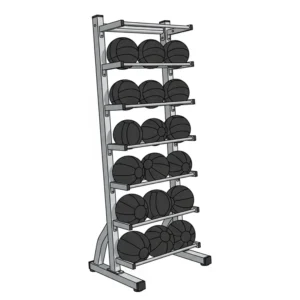
Mobility is the pitch. The Otoolling 4-Tier Rolling Rack sits on wheels and, per its listing, holds up to 20 medicine, slam, and wall balls. It carried a Best Seller tag in the Strength Training Medicine Balls category at the time of research.
Published specs were sparse, so here’s the practical read. A “20-ball” claim usually assumes smaller balls, and fewer large wall balls will fit. Twenty 10-pound balls would put about 200 pounds on casters. Confirm the wheels lock, because comparable four-tier rolling racks from other brands list combined capacities near 500 pounds and tier spacing around 15 inches. That’s useful context when you check this listing’s dimensions.
Verifiable review detail was limited, so treat it as a promising but under-documented pick. It makes the most sense for classes and shared spaces where you roll equipment to the work zone and park it afterward.
Pros:
- ✅ High capacity for group training
- ✅ Wheels move balls to the workout zone
- ✅ Tiered layout organizes mixed sizes
Cons:
- ❌ Thin published specs on the listing
- ❌ Large footprint when fully loaded
Comparable rolling racks ran roughly $130-$250, so check current price. Strong value only if the dimensions and caster locks check out.
7. Valor Fitness BG-53 — wall-mounted, zero floor footprint
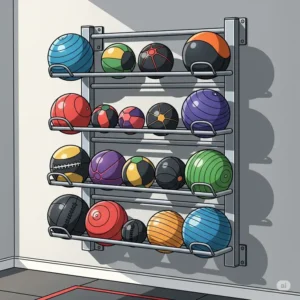
The Valor Fitness BG-53 takes a radical approach to the floor-clutter problem: it removes itself from it. This wall-mounted rack uses heavy-duty powder-coated steel, six adjustable support poles, and five adjustable positions, and Valor rates it for up to 250 pounds of balls.
Wall mounting changes the risk profile. Your balls are only as secure as your studs, so plan to hit solid framing (16-inch stud spacing is common in U.S. homes). The adjustable poles are the underrated feature, since they let you space slots for mixed ball sizes instead of living with fixed rings.
Verifiable review volume was tiny at the time of research, so evaluate it on specs and installation honesty. It suits dedicated garage walls and anyone who treats floor space as sacred.
Pros:
- ✅ Frees the entire floor footprint
- ✅ Adjustable poles fit mixed ball sizes
- ✅ 250 lb rated capacity
Cons:
- ❌ Must anchor into studs
- ❌ Commits you to one location
Listed around $150 on Valor’s own site, so check current price. Fair value if you have the wall for it.
Top 7 Medicine Ball Racks Side by Side
| Product | Dimensions (L×W×H) | Floor Space per Ball (approx.) | Price Range | Best For |
|---|---|---|---|---|
| Champion Sports MBR1 | 14 × 11 × 52 in. | About 1 sq. ft. total | ~$100-$150 (similar trees) | Corners and tight budgets |
| Body-Solid GMR5B | ~21.5 × 21.5 × 26 in. | ~1.1 sq. ft. | ~$85-$110 | Apartments |
| Valor Fitness BG-50 | 23 × 19.25 × 63.5 in. | ~0.6 sq. ft. | ~$90-$125 | Wall-ball households |
| Body-Solid GMR10B | 20 × 21 × 63 in. | ~0.5 sq. ft. | ~$145-$225 | Graduated ball sets |
| Body-Solid GMR20 | 26 × 26 × 56 in. | ~0.5 sq. ft. | Check current price | Large collections |
| Otoolling 4-Tier Rolling Rack | Check listing | Varies by loadout | ~$130-$250 (similar racks) | Group classes |
| Valor Fitness BG-53 | Wall-mounted | None | ~$150 | Floor-space purists |
The footprint math tells a clear story. By my back-of-envelope calculation from listed dimensions, the Body-Solid GMR10B and Body-Solid GMR20 each use about half a square foot per ball, while the Body-Solid GMR5B costs nearly double that because it holds only three. If you plan to grow your collection, the larger uprights waste the least space. For the leanest possible footprint, the Valor Fitness BG-53 wins by default.
✨ Don’t Miss These Exclusive Deals!
🔍 Take your home gym organization to the next level with these carefully selected products. Click on any highlighted item to check current pricing and availability. These racks will help you create a clutter-free training space you’ll love!
Medicine Ball Rack Setup and Maintenance: Your First 30 Days
A medicine ball rack looks like a no-brainer to assemble, which is exactly when people skip steps. Here’s a practical playbook the listings won’t hand you.
Day 1: build it right. Assemble on a level surface and snug every bolt only after all hardware is threaded; tightening early can misalign the frame. Place the finished rack where you’ll actually train, then check that it doesn’t rock. A shim or felt pad under one foot fixes most wobble.
Day 1: load low to high. Put the heaviest balls on the lowest tiers. It lowers the center of gravity and spares your back, and it’s a standard storage principle for any tiered rack.
Week 1: label the slots. Sort by weight, left to right or bottom to top, and stick with it. A consistent layout turns a rack into a system, so you grab the right ball without thinking.
Week 2: do the recheck. Retighten fasteners after the first few days of use. Hardware settles, and a loosened bolt is the usual culprit behind a rack that “suddenly” feels sketchy.
Day 30 and monthly after: wipe and inspect. Dust and chalk build up in cradles, and a quick wipe-down keeps soft-shell balls clean. Manufacturers of cradle-style racks note that supporting soft balls in a cradle helps them keep their shape.
Common first-month mistakes: overloading the top tier, parking a rolling rack without locking the wheels, and mounting a wall rack into drywall instead of studs. Every one is avoidable with ten minutes of attention.
Real-World Scenarios: Matching a Medicine Ball Rack to Your Space
Specs are abstract. Here are three buyer profiles, with the reasoning behind each match.
The apartment trainee. Picture a four-day-a-week exerciser with a 9-by-10-foot spare room, three balls (6, 10, and 14 pounds), and a modest budget. The Body-Solid GMR5B fits: three slots, a short frame, and rings that swivel toward the workout area. Spending more would buy capacity this person doesn’t need.
The garage gym regular. Here’s someone training in a two-car garage with five or six balls, including a couple of wall balls for conditioning circuits. The Valor Fitness BG-50 handles wall balls natively, while the Body-Solid GMR10B is the cleaner pick if the collection is mostly standard medicine balls. Concrete floors are forgiving, so stability matters more than finish.
The youth-team coach. Think twelve athletes, twenty balls, and a gym shared with other programs. Research backs the training: a 12-week randomized trial in young female handball players found the medicine ball group made greater gains on throw tests than controls. For logistics, the Otoolling 4-Tier Rolling Rack lets staff roll equipment out and park it, and the Body-Solid GMR20 works if the gym has a dedicated corner. Daily use means pick the build with the strongest published specs and verify the casters lock.
Medicine Ball Rack Problems and Fixes
Four common frustrations come up again and again. Each has a specific fix.
Problem: balls roll out of the rack. Open-ring trees depend on ball diameter. Measure your largest ball and match it to the rack’s cradle size, and load heavy balls low. A Champion Sports MBR1 variation with the right ring size solves most escapes.
Problem: the rack wobbles. Uneven floors are the usual cause. Shim the feet, retighten hardware, and keep heavy balls near the bottom. A heavier frame like the Body-Solid GMR20 resists tipping better than lightweight stands.
Problem: wall balls don’t fit. Many racks were designed for standard medicine balls. The Valor Fitness BG-50 was built around 14-inch wall balls, and the Body-Solid GMR20 lists a 16-inch limit.
Problem: floors get scratched or noisy. Add felt or rubber pads under metal feet. For a rolling rack like the Otoolling 4-Tier Rolling Rack, park it on a mat and lock the wheels so it doesn’t drift.
Problem: no good floor space at all. Go vertical on the wall. The Valor Fitness BG-53 reclaims the entire footprint, provided you hit studs.
How to Choose a Medicine Ball Rack
Seven decisions determine whether a rack feels like a gift or a regret.
- Count your balls, then add two. Collections grow. Buying exact capacity means re-buying within a year.
- Measure ball diameter. Wall balls are often around 14 inches, while smaller medicine balls fit most rings. A rack that holds ten standard balls may hold six wall balls.
- Check per-tier weight. Coaches commonly use 10- to 13-pound balls for power testing, and balls can run much heavier. Make sure each slot’s rating clears your heaviest ball.
- Weigh footprint against height. A tall, narrow rack saves floor but demands ceiling clearance; a short, wide rack is easier to reach.
- Pick your style. Freestanding is flexible, rolling is mobile, and wall-mounted is space-free but permanent.
- Inspect the build. Welded steel, a wide base, and cross supports matter more than color.
- Read the warranty. A lifetime frame warranty, like the one Body-Solid GMR10B lists, signals confidence.
Medicine Ball Rack vs. Alternatives: Wall Mounts, Shelves, and the Floor Pile
| Option | Floor Space | Ball Protection | Best For |
|---|---|---|---|
| Freestanding medicine ball rack (e.g., Valor Fitness BG-50) | Moderate | High: individual cradles | Most home gyms |
| Wall-mounted rack (e.g., Valor Fitness BG-53) | None | High: if mounted properly | Dedicated garage walls |
| Open shelving | Moderate | Medium: balls can roll | Mixed-gear storage |
| Bins or crates | Moderate | Low: balls pile and deform | Temporary storage |
| The classic floor pile | High | Lowest: trip hazard | Nobody, really |
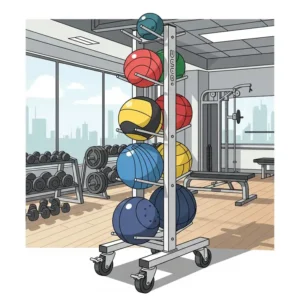
The case for a dedicated medicine ball rack is less about aesthetics and more about behavior. Visible, labeled slots make you more likely to grab the right ball, and cradles keep balls from rolling underfoot. Bins and shelves cost less, but they pile balls together and invite the tripping hazard a rack exists to prevent. Wall mounts beat everything on footprint, but they demand studs and a permanent commitment, so renters usually do better with a freestanding unit like the Body-Solid GMR10B.
Features That Actually Matter (And Those That Don’t)
What matters:
- Cradle diameter. If your ball doesn’t fit the ring, nothing else counts.
- Per-tier and total load ratings. These tell you how much abuse the frame was designed to handle.
- Base geometry. A U-shaped or wide base, like the Valor Fitness BG-50 uses, resists tipping better than narrow legs.
- Weld quality and build material. Welded steel is the durability baseline.
- Reach height. A 56-inch rack like the Body-Solid GMR20 puts the top tier closer than a 63-inch upright.
What doesn’t:
- Headline ball counts without sizes. “Holds 20” means little without a diameter.
- Color and logos. Pretty, sure. Structural, no.
- “Commercial grade” labels on home-priced racks. Check the warranty and load ratings instead of trusting adjectives.
Marketing loves the big number. Spec reading tells you whether that number applies to your balls.
Common Mistakes When Buying a Medicine Ball Rack
Buying by ball count alone. Capacity depends on diameter. A rack that lists ten slots may only comfortably hold a few 14-inch wall balls.
Ignoring ceiling and doorway clearance. A 63-inch upright is fine in most rooms, but measure before you build it where you can’t tip it upright.
Skipping weight distribution. Top-loading heavy balls is how racks tip. Load low to high every time.
Treating a rolling rack as a parking-lot toy. Casters are for relocation, not storage. Lock them, especially when a rack like the Otoolling 4-Tier Rolling Rack is loaded with dozens of pounds per tier.
Mounting into drywall. A wall rack such as the Valor Fitness BG-53 needs solid framing, not anchors in drywall.
Assuming one rack fits every ball type. Slam balls, wall balls, and dual-grip balls differ in size. Confirm compatibility, or pair a smaller rack like the Body-Solid GMR5B with a second for oversize balls.
Long-Term Cost and Maintenance of a Medicine Ball Rack
A medicine ball rack is a one-time purchase with almost no running cost, so the real math is cost per slot and years of service.
| Product | Price Range | Slots | Approx. Cost per Slot |
|---|---|---|---|
| Valor Fitness BG-50 | ~$90-$125 | 5 | ~$18-$25 |
| Body-Solid GMR10B | ~$145-$225 | 6 | ~$24-$38 |
| Body-Solid GMR5B | ~$85-$110 | 3 | ~$28-$37 |
| Body-Solid GMR20 | Check current price | 10 | Varies |
| Otoolling 4-Tier Rolling Rack | Check current price | Up to 20 (per listing) | Varies |
The Valor Fitness BG-50 is the cheapest per slot among the racks with published numbers, and the Body-Solid GMR10B charges a premium for its lifetime frame-and-weld warranty, which is real money saved if a weld ever fails. The Body-Solid GMR5B costs more per slot because you’re buying compactness, not capacity.
Maintenance is minimal: wipe cradles, recheck fasteners monthly, and inspect welds if you move the rack. A well-built steel rack should outlast several generations of balls, so durability and warranty usually beat a small upfront saving.
Safety Guide: Load Ratings, Anchoring, and Housekeeping
Home gyms aren’t regulated workplaces, but the principles carry over. OSHA’s general-industry rule says storage of material shall not create a hazard, and it also expects storage areas to stay free of trip hazards. A rogue medicine ball on a gym floor is exactly that.
Three habits do most of the work:
- Respect load ratings. Stay under per-tier and total limits. For example, the Valor Fitness BG-50 lists 250 pounds total on one page and 200 on another, so use the lower number to be safe.
- Anchor when in doubt. Wall-mounted racks like the Valor Fitness BG-53 must go into studs with the supplied hardware. Freestanding racks gain extra security from anchoring, especially around kids.
- Keep heavy items low. Load the lowest tiers first, and never climb or hang on a rack.
For light-commercial studios, follow the manufacturer’s instructions and inspect racks regularly for damage, loose hardware, or out-of-plumb frames. Safety experts generally recommend regular inspection programs for storage racks, and that advice scales down nicely to a home gym.
FAQ
❓ How many balls can a medicine ball rack hold?
❓ Can a medicine ball rack store wall balls and slam balls too?
❓ Should I anchor my medicine ball rack to the wall or floor?
❓ How much floor space does a medicine ball rack need?
❓ Is a wall-mounted medicine ball rack better than a freestanding one?
Conclusion
Picking a medicine ball rack comes down to matching capacity, ball size, and space. For the best all-around value in a home gym, the Valor Fitness BG-50 combines wall-ball compatibility with a stable frame at a friendly price. If you own a graduated set of standard balls and want warranty-backed durability, the Body-Solid GMR10B is the polished choice. Larger collections point to the Body-Solid GMR20, while the Otoolling 4-Tier Rolling Rack suits groups that need to move equipment. Tight on space? The Body-Solid GMR5B and Champion Sports MBR1 keep things compact, and the Valor Fitness BG-53 frees the floor entirely.
Whichever you choose, measure your biggest ball, count your slots, and check the load ratings. A good medicine ball rack turns a floor hazard into a system you’ll actually enjoy using.
✨ Don’t Miss These Exclusive Deals!
🔍 Take your home gym organization to the next level with these carefully selected products. Click on any highlighted item to check current pricing and availability. These racks will help you create a clutter-free training space you’ll love!
Recommended for You
- 15 Best Basketball Storage Rack Solutions That Transform Your Space in 2025
- 10 Best Ball Cage Solutions For Maximum Training Efficiency in 2025
- 10 Best Ball Rack Solutions for Ultimate Sports Organization in 2025
Disclaimer: This article contains affiliate links. As an Amazon Associate, I earn from qualifying purchases. If you purchase products through these links, we may earn a small commission at no additional cost to you.
✨ Found this helpful? Share it with your friends! 💬🤗
