
In This Article
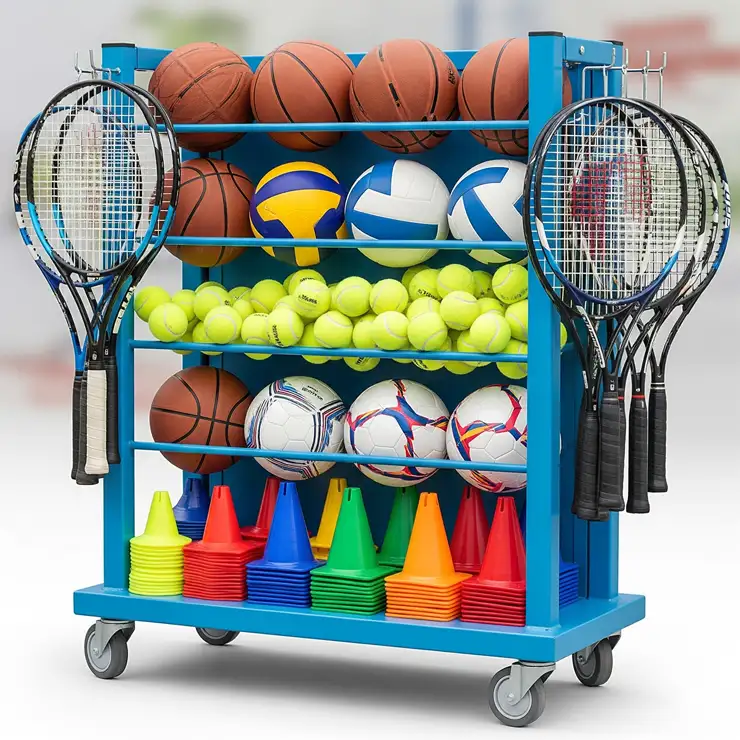
So, what is a cart for sports equipment? It’s a wheeled carrier (a folding wagon, ball hopper, caddy, rolling rack, or lockable locker) built to move and store balls, bats, cones, and team gear so you don’t carry it by hand. The good ones fold small, roll over real surfaces, and turn three exhausting parking-lot trips into one.
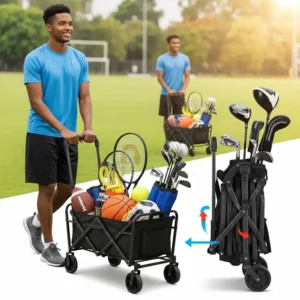
Nobody mentions the cost until you’re standing in a field with a mesh bag of soccer balls cutting into your shoulder. Hauling gear is a job. Lifting, carrying, pushing, pulling: manual material handling is a recognized source of strain and injury, and a sports season is a weekly dose of it. A decent cart hands that job to four wheels.
But “decent” is doing heavy lifting in that sentence. A garage organizer, a pickleball caddy, and a gym-grade ball locker share a category name and almost nothing else. Pick wrong and you’ve bought an expensive coat rack.
That’s why this guide goes beyond a simple list. We narrowed the field to seven real, currently listed products across budget, mid-range, and premium tiers. Then we picked them apart using manufacturer specs, retailer rating data, and independent roundups. To be upfront, this is research-driven analysis, not a claim that anyone personally rolled each cart down a gym hallway. Where reviews couldn’t be verified, we say so.
By the end, you’ll know which cart for sports equipment fits your sport, your surface, your trunk, and your budget. You’ll also know how to set it up, keep it rolling, and dodge the classic mistakes. Prices are ranges only because they shift constantly, so check current price before you buy.
Quick Comparison: Seven Carts for Sports Equipment at a Glance
Here’s the bird’s-eye view. Specs come from manufacturer and retailer listings, and price ranges reflect what appeared during research.
| Product | Type | Capacity / Load | Price Range | Best For |
|---|---|---|---|---|
| Fitvids Sports Equipment Organizer | Rolling rack with baskets and hooks | 24″ x 18″ x 18″ frame | Under $40 | Garage tidy-up on a budget |
| Wilson 75 Ball Pick-Up Hopper | Ball hopper | 75 balls | Under $100 | Solo tennis and small lessons |
| Mac Sports Collapsible Folding Outdoor Utility Wagon | Folding wagon | 150 lb | $60–$90 range | All-purpose team and family hauling |
| Mac Sports Folding Wagon with Tailgate and Table | Folding wagon with brakes | 300 lb | $80–$120 range | Coaches with heavy, mixed loads |
| Champion Sports Pro Collapsible Volleyball Cart (VCPRO) | Hammock-style ball cart | 24 volleyballs | Around $100 | Gym drills and PE classes |
| GoSports Ball Caddy with Wheels | Ball caddy | 140 pickleballs or 175 tennis balls | Around $100 | Pickleball and tennis practice |
| Champion Sports All Pro Lockable Ball Locker (MBLX) | Locking steel locker | About 30 balls, 220 lb | $500–$1,300 range, seller-dependent | Schools and shared gyms |
Looking at the table, the two Mac Sports wagons cover the widest range of sports for the least money, while the Champion Sports Pro Collapsible Volleyball Cart (VCPRO) and GoSports Ball Caddy with Wheels are sport-specific tools. The Champion Sports All Pro Lockable Ball Locker (MBLX) sits in a different league entirely. It is infrastructure, not a trunk-friendly accessory, and the price reflects that.
One caution when reading any spec table: capacities depend on ball size. A cart rated for 24 volleyballs holds far more tennis balls, and a weight rating tells you nothing about volume. Match both numbers to your actual gear.
💬 Just one click — help others make better buying decisions too!😊
Top 7 Carts for Sports Equipment: Expert Analysis
1. Fitvids Sports Equipment Organizer — cheapest way to tame a garage
The standout trait is pure economy: a rolling steel rack with baskets and hooks that costs less than a casual dinner out. Its frame measures roughly 24 inches deep, 18 wide, and 18 high, small enough to tuck beside a bike or under a workbench. That low profile makes it a catch-all for balls and gloves rather than a tall stand for bats and hockey sticks.
Based on the spec comparison, this is a home organizer first and a transport cart second. The hooks suit jump ropes, helmets, and mesh bags, and the baskets corral loose balls. A rolling base of this kind is designed for a smooth garage slab, so expect trouble on gravel, wet grass, or curbs.
On reviews, a verifiable pool for this exact listing was thin during research, mostly deal-tracker chatter. Durability is an open question, so check current review totals first.
Pros:
- ✅ Compact footprint fits tight garage corners
- ✅ Baskets plus hooks handle mixed gear
- ✅ Rolling base beats lugging bins around
Cons:
- ❌ Low height limits tall items like bats
- ❌ Independent review history is hard to verify
Priced under $40 at the time of research, the Fitvids Sports Equipment Organizer is a low-risk starter if you mainly want order out of chaos. Check current price.
2. Wilson 75 Ball Pick-Up Hopper — court-side classic that saves your back
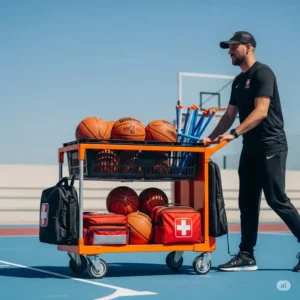
The hook is simple: it lifts 75 balls to a comfortable height so you collect them without squatting. The plated steel frame is the unglamorous heart of it. The no-spill lid means a tipped hopper on a windy day doesn’t become a tennis-ball avalanche. Lockable legs matter more than they sound, because they hold the hopper at working height instead of letting it wobble.
Here’s what to weigh. Seventy-five balls is the sweet spot for a solo player or a small lesson, but a full clinic burns through that in one drill. And because it’s a hopper rather than a wagon, it carries balls only. Rackets, cones, and water bottles need a second bag, which matters if your goal is one trip from the car.
Sentiment-wise, the retailer listing showed roughly 4.1 out of 5 stars across about 129 reviews at the time of research. That’s solid without being glowing. We couldn’t verify detailed review themes, so treat it as headline sentiment only.
Pros:
- ✅ No-spill lid keeps balls contained in transit
- ✅ Lockable legs give stable working height
- ✅ Plated steel frame suits frequent use
Cons:
- ❌ Carries balls only, not rackets or cones
- ❌ Seventy-five balls runs out fast in clinics
The Wilson 75 Ball Pick-Up Hopper tends to land under $100, which makes it a strong value for solo and small-group racquet players. Check current price.
3. Mac Sports Collapsible Folding Outdoor Utility Wagon — the all-rounder reviewers keep rewarding
If one cart for sports equipment had to cover soccer, Little League, and Saturday picnics, this is the safest bet. It uses a steel frame with a polyester fabric bed and is rated for 150 lb. It weighs roughly 22 lb empty, and published roundups describe it folding to a few inches thick. That 150 lb rating handles a bucket of balls, cones, a cooler, and a few chairs, but not a full travel-team arsenal.
What most buyers overlook is the fold. A wagon that collapses flat disappears into a hatchback cargo area or a closet, while a rigid cart permanently eats a corner of the garage. Wirecutter’s tested folding-wagon guide has named this wagon its best all-around pick, citing the balance of price, weight, and ease of use.
Retailer listings for the Mac Sports wagon family showed roughly 4.7 out of 5 across a few hundred ratings. Reviewers consistently cite a solid build, a square fold, and good value for the money.
Pros:
- ✅ Folds compact for trunks and closets
- ✅ Strong ratings and independent testing praise
- ✅ Steel frame handles everyday team loads
Cons:
- ❌ Fabric bed dislikes pointed, hard-edged gear
- ❌ 150 lb ceiling limits heavy equipment hauls
At roughly $60–$90, the Mac Sports Collapsible Folding Outdoor Utility Wagon is the value benchmark in this guide.
4. Mac Sports Folding Wagon with Tailgate and Table — 300 lb muscle with brakes
The standout here is brakes plus a zippered tailgate. Brakes sound like a luxury until your loaded wagon starts creeping down a sloped sideline. The tailgate lets long items, like canopy poles or a bat bag, poke out the back instead of fighting the bed. The rear table gives you a spot for a scorebook, drinks, or a phone.
The 300 lb rating is double the base model, so this one suits coaches hauling balls, a water cooler, pop-up tents, and a first-aid kit in one go. A reviewer comparing models noted a longer handle and 9-inch rubber tires, and bigger tires roll over grass and gravel far better than the small wheels on garage organizers.
Sentiment is strong. The retailer listing showed about 4.8 out of 5 across roughly 3,366 ratings at the time of research. That’s a large pool, and a rating that high across thousands of reviews rarely happens by accident.
Pros:
- ✅ 300 lb capacity covers heavy team loads
- ✅ Brakes hold the wagon on slopes
- ✅ Tailgate accommodates longer equipment
Cons:
- ❌ Bulkier than the base Mac Sports wagon
- ❌ Higher price than basic folding wagons
Expect the Mac Sports Folding Wagon with Tailgate and Table in the $80–$120 range. For coaches, that’s strong value.
5. Champion Sports Pro Collapsible Volleyball Cart (VCPRO) — hammock-style, built for fast drills
The hook is the hammock-style reinforced nylon bag on an aluminum frame, which holds 24 volleyballs and lets players grab from any side. That “all-around access” design matters in fast drills, where a single-side hopper creates a traffic jam. A storage bin below adds room for cones or a pump.
Specs worth interpreting: the non-marring swivel casters protect hardwood, and the frame folds for storage. One retailer lists 3-inch polyurethane casters, which are fine on a gym floor but poor on gravel or cracked asphalt. The same spec sheet shows a 90 lb rated load and no wheel lock, so on a slightly sloped floor, expect the loaded cart to wander. Dimensions also differ between listings (55 inches long in one, 41 inches tall in another), so confirm them against your storage space.
For reviews, we could not verify a meaningful pool for this exact model. Read current buyer feedback before ordering.
Pros:
- ✅ Aluminum frame keeps weight manageable
- ✅ Open access suits fast, crowded drills
- ✅ Non-marring casters protect gym floors
Cons:
- ❌ Small casters struggle outdoors
- ❌ No wheel lock on at least one spec sheet
Around $100 puts the Champion Sports Pro Collapsible Volleyball Cart (VCPRO) at fair value for indoor programs.
6. GoSports Ball Caddy with Wheels — high-volume caddy for pickleball and tennis
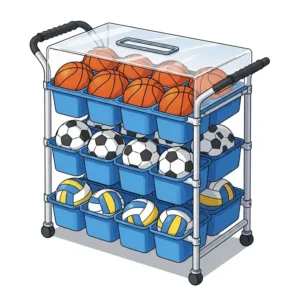
The hook is volume. The bag holds 140 pickleballs open (about 100 closed) or 175 tennis balls open (about 125 closed). That’s enough for a full clinic. The frame is powder-coated steel on 360-degree casters, and the bag detaches so you can carry it separately from the frame. At around 15 lb, it’s easy to load in a trunk.
Based on the spec comparison, the detachable bag is the underrated feature. It means the heavy part of your session, the loaded balls, can ride in your arms or a car seat while the frame folds flat. One caution: at least one retailer’s description cites a much smaller capacity, so verify the capacity on the listing you’re buying from.
On sentiment, the retailer review pool was small at the time of research (a few reviews, all positive), too thin to draw conclusions. A roundup site did single out the powder-coated steel frame as built for frequent use.
Pros:
- ✅ Huge capacity for full practice sessions
- ✅ Detachable bag simplifies transport
- ✅ Steel frame suits frequent daily use
Cons:
- ❌ Small review pool limits confidence
- ❌ Listings disagree on capacity claims
At around $100, the GoSports Ball Caddy with Wheels is fairly priced for clubs and regulars.
7. Champion Sports All Pro Lockable Ball Locker (MBLX) — gym-grade security on wheels
The standout is the lockable top with safety hinges and chains, built on 1-inch square steel tubing with a black powder-coated finish. It holds up to about 30 balls, with heavy-duty swivel casters and a 220 lb rated load. It measures roughly 47 by 24 by 37 inches and weighs about 55 lb, and it needs assembly.
Here’s what to weigh: this is not a trunk cart. A 55 lb empty weight means you roll it down a hallway, not load it in a hatchback. The lock is the point. In a shared gym, balls tend to wander, and a locking cart keeps your inventory where you left it.
Reviews were not verifiable. Retailer pages showed review links but no usable content, so lean on the build specs and your school’s purchasing channel.
Pros:
- ✅ Locking lid protects shared inventory
- ✅ 1-inch steel tubing built for abuse
- ✅ 220 lb capacity handles mixed gear
Cons:
- ❌ Heavy and requires assembly
- ❌ Premium price with wide seller variance
Prices ranged from roughly $500 to well over $1,000 depending on the seller, so shop around. For institutions, the Champion Sports All Pro Lockable Ball Locker (MBLX) is a long-term purchase, not an impulse buy.
How to Choose a Cart for Sports Equipment (7 Steps)
A great cart is a matching game between your gear, your surface, and your trunk. Work through these in order.
- Weigh your typical load first. Add up balls, bags, a cooler, and cones. Your weight rating should sit well above that number, not right at it.
- Match the surface. Smooth gym floors tolerate small non-marring casters. Grass and gravel demand bigger, softer tires.
- Decide between fold and stay. If it rides in your car, folded size is everything. If it lives in a gym closet, it can be rigid and heavy.
- Check the contact points. Look at wheel type, brakes or locks, and handle height. These are the parts you touch every session.
- Measure your storage. Folded dimensions beat unfolded ones for car owners. Use a tape measure, not a guess.
- Verify listing details. As the GoSports capacity mismatch shows, retailer copy can disagree. Cross-check capacity and dimensions.
- Do cost-per-use math. A cart used 40 times a season costs a fraction of a dollar per outing within a year or two, so durability beats a cheap sticker price.
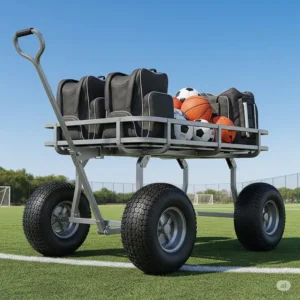
Features That Actually Matter (And Those That Don’t)
Marketing copy loves adjectives. Spec sheets reward nouns. Here’s how to separate them.
Features that earn their keep: wheel size and type, brakes or locks, a frame material that matches your use, a bed that won’t sag, and a fold that really is compact. Independent testers such as Bob Vila’s folding-wagon test stress this point. The best wagons collapse into a small footprint and travel well to the beach, park, or campsite. A wagon you can’t get into the trunk is just yard art.
Features that matter less: cup holders (nice, rarely decisive), color options, and “military-grade” language. A rear table is genuinely useful for coaches, but only if you’d actually set things on it.
Then there are features that depend on you. Brakes are essential if you coach on a sloped field and irrelevant on a flat gym. A detachable bag is a gift if you carry a lot, and a nuisance if you don’t. The spec sheet won’t tell you this, but your own routine will.
The practical filter: for every feature, ask “when does this save me time or effort in a normal session?” If you can’t name the moment, don’t pay for it.
What to Expect: Real-World Performance
Specs describe a cart in a vacuum. Practice happens on gravel lots, cracked asphalt, and hardwood that someone just waxed.
Consider surface first. Small casters, like the 3-inch ones listed for the Champion Sports Pro Collapsible Volleyball Cart (VCPRO), roll beautifully on smooth gym floors and badly on rough outdoor surfaces. By contrast, the wagon-style Mac Sports Folding Wagon with Tailgate and Table pairs bigger rubber tires with brakes, which makes it the better outdoor performer by design.
Next is load behavior. A fully packed hopper or caddy is top-heavy, and a loaded GoSports Ball Caddy with Wheels with 140 pickleballs will tip more readily on a slope than an empty one. Wagons spread weight low and wide, which is why they feel steadier when loaded.
Then there’s handling effort. A cart’s rated capacity and its comfortable capacity are different things. A 150 lb wagon filled to 150 lb is a workout on a grass field, while the same wagon at 60 lb glides. Plan for about half the rated capacity in daily use.
Finally, think setup time. A folding cart that takes 90 seconds to unlock and snap open gets used less than one that deploys in ten seconds, so in practice, speed of setup is a durability feature. Gear you avoid using doesn’t last long either.
Cart for Sports Equipment vs Traditional Alternatives
Before wheels, there were bags, buckets, and sheer stubbornness. Here’s how they compare.
| Option | Strengths | Weaknesses | Best For |
|---|---|---|---|
| Cart for sports equipment | Rolls loads, saves your back, holds gear upright | Costs more, needs storage space | Regular team or club use, like the Mac Sports Collapsible Folding Outdoor Utility Wagon |
| Duffel or ball bag | Cheap, packs flat | Loads your shoulder, offers no organization | Light, occasional carrying |
| Five-gallon bucket | Almost free, sturdy | Awkward to carry, forces bending | Occasional ball retrieval on a budget |
| Multiple trips by hand | Costs nothing | Slow, tiring, injury-prone | Very short distances |
The table makes the trade-off plain. Every alternative to a cart costs less cash and more effort, and the effort compounds. A Wilson 75 Ball Pick-Up Hopper beats a bucket on a court because of its height and lid, even though both hold balls.
The real decision isn’t cart versus no cart. It’s whether your use is regular enough to justify buying one. If you’re hauling gear weekly or more, a cart pays for itself in saved energy long before it pays for itself in saved dollars. If you play twice a year, a duffel and a good attitude are fine.
Common Mistakes When Buying a Cart for Sports Equipment
These are the pitfalls that turn a good purchase into a closet resident.
- Buying on capacity alone. A high weight rating means nothing if the cart is too bulky to load. Check folded dimensions against your trunk before checking anything else.
- Ignoring the surface. A gym cart on gravel is a frustration machine. Match wheels to terrain, not to the photo.
- Trusting one retailer’s description. The GoSports capacity mismatch is a reminder that listings contradict each other. Cross-check two sources.
- Skipping brakes or locks. On any slope, a loaded cart behaves like it has a mind of its own. If you coach outdoors, brakes are worth the extra.
- Overbuying. A locking steel locker is overkill for a backyard. Start with the load, not the dream setup.
- Forgetting upkeep. A cart left damp in a trunk grows mildew. Plan for a quick dry-and-wipe routine.
Practical Usage Guide: Setup, Maintenance, and Your First 30 Days
A cart for sports equipment pays off only if it stays in working order. Here’s a simple routine.
First-use setup. Unbox it and check every fold lock and handle joint before loading. Tighten any hardware that arrived loose, and test the brakes or casters on flat ground. If it needs assembly, like the Champion Sports All Pro Lockable Ball Locker (MBLX), allow time and a second pair of hands.
Load smart. Put heavy items low and centered, and lighter, taller items on top. With a ball caddy such as the GoSports Ball Caddy with Wheels, keep the bag from overstuffing so the frame can fold cleanly later. Distribute weight so the cart doesn’t lean when you stop.
Weekly care. Wipe fabric beds and frames after wet sessions and let everything air dry fully before folding. Check wheels for embedded gravel or hair, which stiffens casters fast. A drop of lubricant on swivel points keeps them quiet.
Common first-30-day mistakes. Overloading in the first week, folding while damp, and leaving the cart in a hot car all shorten its life. If a fold mechanism starts to stick, clean it before forcing it.
Treat the first month as a break-in. If anything feels loose or wobbly, fix it now, while the return window is still open.
✨ Don’t Miss These Exclusive Deals!
🔍 Ready to stop hauling gear the hard way? Click on any highlighted product above to check current pricing and availability. A well-matched cart can make every practice smoother for your whole team!
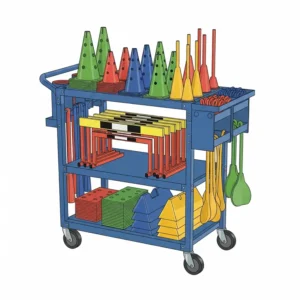
Real-World Scenarios: Matching Carts to Real Buyers
These are composite profiles for illustration. They show how the specs translate into decisions.
The Saturday soccer coach. Picture a coach with 14 kids, a hatchback, and a budget around $100. The load is balls, cones, pinnies, and a cooler, all on grass. That points to the Mac Sports Folding Wagon with Tailgate and Table, whose brakes, large tires, and 300 lb rating match the terrain and the weight, and which folds into the cargo area.
The pickleball regular. Imagine someone who drives fifteen minutes to a public court three times a week and wants 100-plus balls ready. The GoSports Ball Caddy with Wheels fits, because the bag detaches and the frame folds. Court surfaces are smooth, so the casters work as designed.
The middle-school PE teacher. This teacher shares a gym, runs a volleyball unit, and needs fast ball access for a crowded class. The Champion Sports Pro Collapsible Volleyball Cart (VCPRO) suits those indoor drills. If the school also loses balls regularly, the district might invest in the Champion Sports All Pro Lockable Ball Locker (MBLX) for overnight security.
The garage-bound parent. A tidy-up job with a $40 budget points to the Fitvids Sports Equipment Organizer. Each profile has a different budget, surface, and storage limit, and each lands on a different cart.
Buyer’s Decision Framework: If This, Choose That
Use this as a quick filter.
- If you haul mixed gear outdoors, choose a wagon like the Mac Sports Collapsible Folding Outdoor Utility Wagon, because wide wheels and a flexible bed handle varied loads.
- If you coach on slopes or with heavy gear, choose the Mac Sports Folding Wagon with Tailgate and Table, because brakes and 300 lb capacity add safety margin.
- If you play racquet sports solo, choose the Wilson 75 Ball Pick-Up Hopper, because it saves your back at a modest price.
- If you run indoor volleyball drills, choose the Champion Sports Pro Collapsible Volleyball Cart (VCPRO), because open access and non-marring casters suit gyms.
- If you need security in a shared space, choose the Champion Sports All Pro Lockable Ball Locker (MBLX), because the locking lid protects inventory.
Priority checklist before you buy:
- What’s the heaviest load I’ll carry?
- What surface will it roll on?
- Does it fit my car or closet when folded?
- Do I need brakes, locks, or both?
- Is the price justified by how often I’ll use it?
Long-Term Cost & Maintenance
Sticker price is only part of the equation. What matters is cost per use. At 40 sessions a season, a cart that costs $100 works out to about $2.50 per session in year one, and that number falls every season you keep using it. Here’s the illustrative math.
| Tier | Example Products | Price Range | Cost per Use (40 uses/season) | Value Verdict |
|---|---|---|---|---|
| Budget | Fitvids Sports Equipment Organizer | Under $40 | About $1 or less | Great for light home use |
| Value | Mac Sports Collapsible Folding Outdoor Utility Wagon | $60–$90 range | About $1.50–$2.25 | Best all-round value |
| Mid-range | GoSports Ball Caddy with Wheels | Around $100 | About $2.50 | Fair for frequent users |
| Premium | Champion Sports All Pro Lockable Ball Locker (MBLX) | $500–$1,300 range | Varies with shared use | Only sensible for institutions |
The numbers show why durable mid-range wagons beat bargain carts in the long run. A $40 cart replaced every season costs more than a $90 wagon that lasts several. The premium locker looks absurd on a per-use basis for one person, but it makes sense when dozens of students share it daily.
Maintenance costs are small but real. Plan for the occasional replacement wheel or bag, a bit of lubricant, and a dry storage spot. Treat those as part of total cost of ownership, and the smarter purchase becomes obvious.
Safety: Loading, Lifting, and Using Your Cart Responsibly
Even a great cart can cause problems if you use it carelessly. Start with the biggest hazard, which is your own back. NIOSH’s ergonomic guidelines for manual material handling note that handling work drives a large share of the musculoskeletal disorders reported in the United States each year. A cart reduces that risk, but only if you still lift smart when loading it.
Practical rules:
- Respect the weight rating. Overloading bends frames and stresses wheels.
- Load low and balanced. Top-heavy carts tip.
- Use brakes or locks on any slope. Never leave a loaded cart on an incline unattended.
- Don’t treat a utility wagon as a child carrier unless the manufacturer says it’s designed for that.
- Push, don’t pull, where possible, and avoid twisting while carrying.
For institutions, weight and tipping matter more. A 55 lb steel locker is a pinch-point hazard around students, so assign a responsible adult to move it.
FAQ
❓ How much weight can a folding wagon hold for sports gear?
❓ What is the best cart for sports equipment for a youth soccer coach?
❓ Can a cart for sports equipment go on grass or gravel?
❓ How many pickleballs does a ball caddy hold?
❓ Is a hopper or a wagon better for racquet-sport practice?
Conclusion
The best cart for sports equipment isn’t the biggest or the priciest. It’s the one that matches your load, your surface, and your trunk. For most people, that’s a folding wagon: the Mac Sports Collapsible Folding Outdoor Utility Wagon for general use, or the Mac Sports Folding Wagon with Tailgate and Table when you need brakes and extra capacity. Racquet players will appreciate the Wilson 75 Ball Pick-Up Hopper or the GoSports Ball Caddy with Wheels, volleyball programs fit the Champion Sports Pro Collapsible Volleyball Cart (VCPRO), and budget garage tidy-ups suit the Fitvids Sports Equipment Organizer. If a school or club needs lockable storage, the Champion Sports All Pro Lockable Ball Locker (MBLX) is built for that job.
A few honest reminders. Several of these products had thin or unverifiable review pools, so we flagged that rather than guessing. Listings sometimes disagree on specs, and prices move constantly, so verify before you buy. Most importantly, size your purchase to how often you’ll use it. A cart used weekly pays you back in saved effort every single session.
So measure your trunk, weigh your gear, think about your surface, and choose the cart that makes practice feel easier. Your shoulders will thank you.
Recommended for You
- Ultimate Equipment Cart Guide: 15 Best Models That Boost Productivity 340% in 2025
- 15 Best Sports Equipment Storage Solutions That Transform Your Space in 2025
- 15 Best Exercise Ball Rack Solutions That Will Transform Your Home Gym in 2025
Disclaimer: This article contains affiliate links. As an Amazon Associate, I earn from qualifying purchases. If you purchase products through these links, we may earn a small commission at no additional cost to you.
✨ Found this helpful? Share it with your friends! 💬🤗
