
In This Article
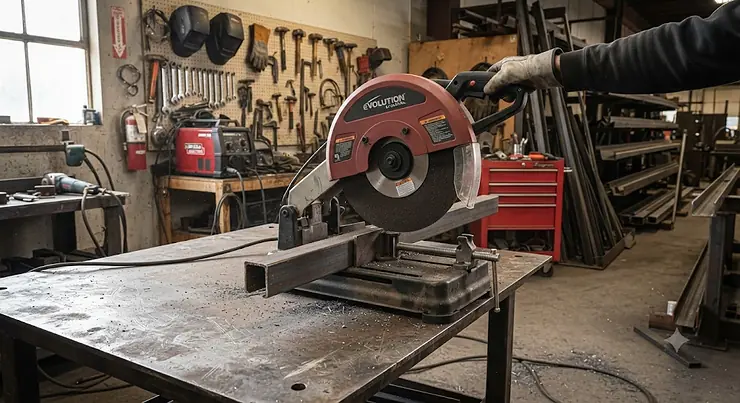
A cut off saw for metal is, at its core, a stationary or handheld power tool that uses a fast-spinning abrasive or carbide-tipped wheel to shear through steel, aluminum, and other metal stock in a single controlled pass. Think of it as the difference between hacking through a steak with a butter knife and slicing it with a proper chef’s blade — both technically “cut,” but only one does it without a fight. If you’ve ever tried muscling through half-inch angle iron with a reciprocating saw, you already know why this category exists.

Picking the right cut off saw for metal in 2026 means wading through corded 14 inch chop saws, cordless portables, and cold-cut alternatives that all claim to be the fastest thing in the shop. We dug into real specs, aggregated review sentiment, and manufacturer documentation for seven current models — spanning budget, mid-range, and premium tiers — so you don’t have to cross-reference a dozen tabs yourself. Along the way we’ll also cover the practical side nobody puts on the spec sheet: how abrasive discs are rated, why sparks matter more than most buyers assume, and what actually wears out a blade. For a quick primer on how the category works mechanically, the Wikipedia entry on abrasive saws is a solid starting point before you commit to a purchase.
Whether you’re outfitting a home workshop, a mobile welding rig, or a full fabrication bay, this guide breaks down which cut off saw for metal actually earns its spot on your bench — and which ones are just loud.
Quick Comparison: 7 Best Cut Off Saws for Metal at a Glance
| Product | Motor / Power | Speed | Best For |
|---|---|---|---|
| DeWalt D28715 | 15A corded | 3,800 RPM | Budget-conscious first-time buyers |
| Ridgid R41422 | 15A corded | 3,600 RPM | Buyers who want a lifetime warranty |
| Milwaukee 6177-20 | 15A / 4.0 max HP | 3,900 RPM | Daily pro use on thick stock |
| Makita LW1401 | 15A corded | 3,800 RPM | Fast repetitive tube and pipe cuts |
| Metabo HPT CC14SFSM | 15A / 2,000W | High-speed | Hauling between jobsites |
| Evolution S355CPSL | Corded, TCT blade | Cold-cut | Indoor or spark-sensitive work |
| DeWalt DCS692 | 60V cordless | 6,600 RPM | No-outlet, remote-site cutting |
Looking at the table above, the split really comes down to motor speed versus blade technology: the Milwaukee 6177-20 and Makita LW1401 both push past 3,800 RPM for raw abrasive speed, while the Evolution S355CPSL trades RPM for a carbide blade that skips the sparks entirely. Budget shoppers gravitate toward the DeWalt D28715, but anyone cutting daily should weigh the Ridgid R41422‘s lifetime warranty against the extra ten dollars a month it effectively costs. If your job site doesn’t have a reliable outlet, the DeWalt DCS692 is really the only entry here built to solve that specific problem.
💬 Already have a favorite? Skip ahead to the full breakdown below and see how it stacks up.
Top 7 Cut Off Saws for Metal: Expert Analysis
1. DeWalt D28715 — best value corded 14 inch chop saw
The DeWalt D28715 earns its budget-pick status by not cutting corners where it counts. Its 15-amp motor spins a 14-inch abrasive wheel at roughly 3,800 RPM, which is plenty of speed to get through angle iron, conduit, and rebar without bogging down mid-cut. In practice, that motor-to-wheel-diameter ratio means the saw rarely stalls on stock under an inch thick, which is where cheaper 10-amp saws tend to choke.
What most buyers overlook about this model is the quick-lock vise, a feature usually reserved for pricier saws. Instead of cranking a threaded vise handle a dozen turns per cut, you slide the jaw into place and lock it with one motion — a small thing that adds up over a full day of repetitive cuts. It’s aimed squarely at DIYers, hobby welders, and anyone doing occasional metal fabrication who doesn’t want to pay a premium for daily-duty features they’ll rarely use.
Aggregated buyer feedback across major retail sites consistently flags the vise and the price-to-power ratio as the standouts, while a recurring complaint centers on the stock abrasive wheel wearing down faster than aftermarket replacements. That’s a common theme across the whole budget tier, not just this model.
Pros:
- ✅ Quick-lock vise speeds up repetitive cutting
- ✅ 15-amp motor rarely bogs down on standard stock
- ✅ Widely available parts and accessories
Cons:
- ❌ Stock abrasive wheel wears faster than premium blades
- ❌ No cold-cut or cordless option in this line
Expect to find the DeWalt D28715 in the $150-$200 range at the time of research — check current pricing before buying, since retailer promotions shift often. For the money, it’s hard to beat as an entry point into dedicated metal cutting.

2. Ridgid R41422 — best backed by a lifetime warranty
The Ridgid R41422 takes a different angle on value: instead of racing for the fastest RPM, it leans on a 15-amp motor at roughly 3,600 RPM paired with a genuinely lifetime warranty — an outlier in a category where most manufacturers cap coverage at three to five years. That warranty alone changes the math on cost-per-year for anyone planning to keep a saw for a decade or more.
The steel base and heavy-duty vise are built to resist twisting under load, which matters more than it sounds — a base that flexes even slightly during a cut can throw off squareness on repeated pieces. Here’s what to weigh: at roughly 35 pounds, this isn’t a saw you’re tossing in a truck bed daily, so it’s better suited to a semi-permanent shop station than a saw that travels from site to site.
Reviewers consistently note the vise’s clamping force as a highlight, particularly when locking down round stock that tends to spin under blade pressure on lesser saws. A smaller number of aggregated reviews mention the 3,600 RPM speed feeling noticeably slower than the Milwaukee and Makita options in this guide when cutting thicker rebar.
Pros:
- ✅ Genuine lifetime warranty, rare in this category
- ✅ Heavy-duty vise resists material slippage
- ✅ Steel base holds up under repeated heavy cuts
Cons:
- ❌ Heavier at 35 lbs, less practical for daily hauling
- ❌ Slower RPM than several rivals on thick stock
At the time of research, the Ridgid R41422 sits in the $180-$230 range. If you’re the type who keeps a tool for fifteen years, the warranty alone can justify the modest premium over the D28715.
3. Milwaukee 6177-20 — best for daily professional cutting capacity
If the earlier two saws are aimed at the occasional user, the Milwaukee 6177-20 is built for someone who’s running it eight hours a day. Its 15-amp motor delivers a maximum of 4.0 horsepower and drives the 14-inch abrasive wheel up to 3,900 RPM, giving it a 5-inch round-stock cutting capacity — noticeably larger than the roughly 4-inch capacity typical of this class. That extra inch of capacity matters more than it sounds like on paper: it’s the difference between cutting 4-inch pipe in one pass versus flipping and re-clamping it.
Based on the spec comparison, the oversized wheel guards and all-ball-bearing construction point toward a saw engineered for continuous-duty environments like fabrication shops and rental fleets rather than the occasional garage project. Milwaukee backs it with a 5-year warranty, which is shorter than Ridgid’s lifetime coverage but still well above the corded-tool average.
Aggregated commentary from tool review outlets, including a detailed breakdown from Pro Tool Reviews, highlights the saw’s 40-pound weight as “fairly portable” for a machine in this power class, alongside praise for the oversized debris guard.
Pros:
- ✅ 5-inch round cutting capacity beats most 14-inch rivals
- ✅ 5-year warranty backs a genuinely heavy-duty build
- ✅ Oversized guards contain more flying debris
Cons:
- ❌ Priced at the top of the corded 14 inch cut off saw field
- ❌ At 40 lbs, awkward to carry solo up stairs or ladders
Expect the Milwaukee 6177-20 to run in the $230-$280 range — a fair ask if you’re putting hours on it weekly rather than monthly.
4. Makita LW1401 — fastest for repetitive tube and pipe cuts
The Makita LW1401 targets shops that cut a lot of round and square tubing, and its spec sheet backs that up: a 15-amp motor spins the wheel at roughly 3,800 RPM, and Makita rates the saw for stock up to 5-inch round, 4-11/16-inch square tube, and rectangular sections as large as 4 by 7-5/8 inches. That’s a wider capacity spread than most competitors bother to publish, which suggests Makita built this specifically with structural and HVAC fabricators in mind.
On paper this means less time re-positioning odd-shaped stock and more time actually cutting — a real productivity gain if your workday is built around dozens of near-identical cuts rather than one-off jobs. Makita’s reputation for tight manufacturing tolerances also shows up in the vise mechanism, which locks with less play than several rivals in this guide.
Pro Tool Reviews’ hands-on coverage of this line called it one of the strongest high-speed abrasive options currently on the market, while also flagging a short list of refinements that would push it further ahead — useful context if you’re comparing it against the cold-cut alternatives further down this list.
Pros:
- ✅ Wide capacity range for round, square, and rectangular tube
- ✅ Tight vise tolerances reduce material shift mid-cut
- ✅ Strong reputation for build consistency
Cons:
- ❌ No cordless variant in the current lineup
- ❌ Premium pricing relative to the DeWalt and Ridgid options
Pricing for the Makita LW1401 typically falls in the $190-$240 range at the time of research, positioning it as a mid-to-upper-tier pick.
5. Metabo HPT CC14SFSM — lightest for hauling between jobsites
Not every metal-cutting job happens in a fixed shop, and the Metabo HPT CC14SFSM was clearly designed with that reality in mind. Its 15-amp, 2,000-watt motor delivers strong cutting power while the saw itself carries a lighter, more portable build than several 14-inch rivals — a meaningful advantage if you’re loading and unloading a saw from a truck multiple times a week.
Here’s what the spec sheet won’t tell you outright: lighter chop saws in this category generally trade some base rigidity for that reduced weight, so expect slightly more vibration on thick cuts compared to the heavier Milwaukee and Ridgid models. That’s a reasonable trade for a mobile electrician, HVAC tech, or metal fabricator who values maneuverability over maximum stiffness. The trigger’s lock-off button is a small but genuinely useful safety feature for anyone tossing the saw in and out of a van repeatedly.
Because independently verified customer review data on this specific model is thinner than for the longer-established DeWalt and Milwaukee lines, we’re leaning more heavily here on published spec analysis rather than claiming aggregated sentiment we can’t confirm — an honest gap rather than a filled-in guess.
Pros:
- ✅ Noticeably lighter than most 14-inch competitors
- ✅ Strong power-to-weight ratio for a portable saw
- ✅ Lock-off trigger adds accidental-start protection
Cons:
- ❌ Smaller accessory and parts ecosystem than DeWalt or Milwaukee
- ❌ Lighter base may flex slightly more under heavy stock
The Metabo HPT CC14SFSM generally lands in the $130-$170 range, making it one of the more affordable ways into a genuinely portable cut off saw for metal.

6. Evolution S355CPSL — best for burr-free, low-spark cutting
The Evolution S355CPSL breaks from the abrasive-wheel format entirely, using a 14-inch carbide-tipped (TCT) blade instead of a consumable abrasive disc. That single design choice changes almost everything about how the saw behaves: cuts come out essentially burr-free, meaning you can often skip the deburring step altogether, and the “cold cut” process generates dramatically less heat and far fewer sparks than a spinning abrasive wheel.
Based on the spec comparison, the tradeoff is upfront cost against long-term blade economics. Evolution’s own documentation on this platform points to blade life measured in the thousands of cuts rather than the dozens you’d get from an abrasive wheel — which matters enormously for anyone running high cut volumes, since it changes the cost-per-cut math even though the initial blade price is steeper. The saw also miters up to 45 degrees and includes a soft-start motor to reduce strain on the gearbox.
What most buyers overlook is where this saw actually shines: indoor fabrication, spark-sensitive environments near flammable materials, and finish-critical work where a clean edge saves labor downstream. It’s a poor fit if your only priority is the lowest sticker price.
Pros:
- ✅ Burr-free cuts skip a deburring step entirely
- ✅ Dramatically fewer sparks than abrasive alternatives
- ✅ TCT blade life far outlasts abrasive discs
Cons:
- ❌ Higher upfront cost than any abrasive chop saw here
- ❌ Replacement TCT blades cost more per unit than wheels
Expect the Evolution S355CPSL to sit in the $350-$450 range — a premium that mostly pays for itself if you’re cutting metal daily and value your time on deburring.
7. DeWalt DCS692 — best portable cut off saw with no cord required
For anyone who’s ever run an extension cord reel across a job site just to make one cut, the DeWalt DCS692 solves a specific and annoying problem. It’s a 60V FlexVolt cordless cut-off saw with a brushless motor rated up to roughly 6,600 RPM, driving a 9-inch blade for cuts up to 3-1/4 inches deep — smaller capacity than the stationary 14-inch saws above, but built for a completely different use case.
What the spec sheet won’t tell you is how much the beltless, all-metal drivetrain matters day to day: no belts to tension or replace means less mid-job maintenance, and the instant-on brushless motor skips the ramp-up delay some cordless tools suffer from. A 5-position rotatable guard lets you angle the cut for visibility in tight corners, which matters when you’re cutting rebar or steel in awkward field positions rather than at a bench.
Based on the spec comparison, this is the clearest pick among the seven for anyone doing remote-site work — landscaping, fencing, demolition, or field repairs — where running power simply isn’t an option. It’s a poor substitute for a stationary chop saw if your primary need is repetitive bench cutting of thick stock.
Pros:
- ✅ No cord or generator needed on remote sites
- ✅ Brushless motor delivers instant-on power
- ✅ Beltless drivetrain reduces routine maintenance
Cons:
- ❌ 9-inch blade capacity is smaller than 14-inch stationary saws
- ❌ Battery kit pricing runs well above corded alternatives
The DeWalt DCS692 kit, including batteries and charger, typically runs in the $700-$850 range at the time of research — a real investment, but one that’s justified almost entirely by portability rather than raw cutting capacity.
Setting Up and Running Your New Metal Chop Saw: The First 30 Days
Getting a new metal chop saw dialed in correctly during the first month prevents most of the frustration owners report later. Start by checking the abrasive wheel’s marked maximum RPM against your saw’s actual no-load speed before the first cut — mismatched ratings are a leading cause of wheel failure, and it takes thirty seconds to verify. Next, square the vise and fence using a known-straight piece of scrap; even a one-degree misalignment compounds badly over dozens of repeat cuts.
During the first ten to fifteen cuts, resist the urge to force the blade through material. Let the wheel’s speed do the work, applying steady, moderate downward pressure rather than muscling it — forcing an abrasive wheel not only produces worse cuts but accelerates wear dramatically. Clean out the debris tray or dust chute every few uses rather than waiting until it’s overflowing; packed metal shavings near the motor housing are a common cause of premature failure reported across owner forums.
A common first-month mistake is skipping the manufacturer’s break-in guidance entirely, particularly on saws with a soft-start feature — those motors are calibrated for a specific ramp-up pattern, and repeatedly forcing full-speed engagement early can shorten brush or bearing life. Finally, re-torque any base or fence bolts after the first week; vibration from initial use commonly loosens factory-torqued hardware slightly, and a quick check with a wrench avoids alignment drift down the line.
Real-World Scenarios: Which Cut Off Saw Matches Your Job
Picture a hobbyist welder working out of a two-car garage on weekends, building trailer frames and gate hardware from mild steel angle iron. Budget matters, cuts happen in batches rather than continuously, and portability is a non-issue since the saw lives in one spot. For that profile, the DeWalt D28715 or Ridgid R41422 both make sense — the choice really comes down to whether the lifetime warranty is worth the modest price gap.
Now consider a mobile fabrication contractor who drives to different sites weekly, sometimes cutting steel studs indoors near finished drywall where sparks are a genuine liability. That combination of portability and spark sensitivity points toward either the Metabo HPT CC14SFSM for its lighter build, or the Evolution S355CPSL if the indoor spark reduction outweighs the extra cost — a trade worth making if a single scorched wall repair would cost more than the price difference between the two saws.
Finally, picture a rural property owner or fencing crew working fields with no reliable power source, cutting T-posts, gate hardware, and the occasional rebar section entirely off-grid. Running a generator just for one saw rarely pencils out. That’s precisely the gap the DeWalt DCS692 was built to close — trading some cutting capacity for total independence from an outlet.

How to Choose a Cut Off Saw for Metal
Picking the right cut off saw for metal comes down to matching a handful of specs to your actual workload rather than chasing the highest number on the box. Here’s the process worth following:
- Identify your typical stock size and shape first. A saw rated for 4-inch round capacity is fine for conduit and angle iron but will frustrate anyone regularly cutting 5-inch pipe.
- Decide between abrasive and cold-cut (TCT) technology. Abrasive wheels cost less upfront and cut faster per pass; TCT blades cost more but last far longer and produce cleaner, spark-reduced cuts.
- Weigh portability against capacity. Cordless models like the DCS692 sacrifice some cutting depth for the freedom to work anywhere, which matters enormously if power access is inconsistent.
- Check the warranty terms carefully. A lifetime warranty on the Ridgid effectively changes the total cost of ownership if you plan to keep the tool for a decade or longer.
- Match motor speed to material thickness. Higher RPM saws generally clear thinner stock faster, while thicker or harder material benefits more from motor torque and blade quality than raw speed.
- Factor in indoor versus outdoor use. Spark-heavy abrasive cutting indoors near combustibles is a genuinely different safety calculation than the same cut performed outside.
- Budget for consumables, not just the tool. Abrasive wheels wear out regularly and add real cost over a saw’s lifetime — a detail the sticker price never reflects.
Common Mistakes When Buying a 14 Inch Cut Off Saw
The most common mistake buyers make with a 14 inch cut off saw is assuming all 14-inch models are functionally interchangeable simply because the blade diameter matches. In practice, motor amperage, RPM, and cutting capacity vary meaningfully between models — the Milwaukee 6177-20‘s 5-inch round capacity versus a typical 4-inch capacity elsewhere is a good example of a difference that doesn’t show up unless you actually compare spec sheets side by side.
A second frequent error is underestimating consumable costs. Buyers often compare only the sticker price of the saw itself, ignoring that abrasive wheels need regular replacement and that pricier TCT blades, while longer-lasting, carry a steeper per-unit cost. Reviewers consistently note this gap surprises first-time buyers more than any other factor.
A third mistake is ignoring warranty length entirely in favor of a marginally lower price. The Ridgid R41422‘s lifetime coverage versus a typical three-year warranty elsewhere can matter more over a decade of ownership than a twenty or thirty dollar difference at checkout. Finally, many buyers skip checking whether their existing 120V circuit can even handle a 15-amp motor continuously — a detail worth confirming before the saw ever ships.
✨ Ready to stop guessing and start cutting? Compare current pricing on today’s top picks before your next project.
Cut Off Saw vs Angle Grinder vs Cold Saw: Which Wins for Metal
An angle grinder fitted with a cutting wheel is the most common alternative to a dedicated chop saw, largely because most shops already own one. The tradeoff is control: a handheld grinder relies entirely on operator steadiness for a straight cut, while a stationary chop saw’s fixed pivot and vise produce consistent, repeatable results every time. For one-off cuts in awkward positions, the grinder wins on flexibility; for volume production work, the chop saw wins decisively on consistency and speed.
A cold saw, represented here by the Evolution S355CPSL, trades the abrasive wheel’s raw speed for a carbide blade that runs cooler, produces far less spark, and leaves a burr-free edge. Based on the spec comparison, cold saws generally take slightly longer per individual cut than an abrasive wheel at full RPM, but that time is frequently recovered by skipping the deburring step afterward.
| Method | Cut Speed | Spark Level | Edge Finish | Best For |
|---|---|---|---|---|
| Angle grinder | Fast, operator-dependent | High | Rough, needs deburring | One-off or awkward-angle cuts |
| Abrasive chop saw | Fast, consistent | High | Some burring | High-volume repeat cuts |
| Evolution S355CPSL (cold saw) | Moderate, consistent | Minimal | Burr-free | Indoor or finish-critical work |
The data above makes the decision fairly binary: if sparks and burrs are a real operational concern, the cold-cut route pays for itself; if raw cutting speed on outdoor jobs matters more than finish quality, an abrasive saw like the Milwaukee 6177-20 or DeWalt D28715 remains the faster, cheaper choice.
Portable Cut Off Saw vs Stationary Chop Saw: Picking Your Setup
Choosing between a portable cut off saw and a stationary bench-mounted model really comes down to where your work actually happens. A stationary saw like the Ridgid R41422 or Makita LW1401 benefits from a heavier base that resists movement during a cut, which improves accuracy on repeat work — but that same weight is a liability the moment a job requires moving between locations.
A genuinely portable cut off saw, whether that’s a lighter corded model like the Metabo HPT CC14SFSM or a cordless option like the DeWalt DCS692, sacrifices some rigidity and, in the cordless case, some cutting capacity in exchange for going anywhere without setup. What most buyers overlook is that “portable” doesn’t automatically mean “cordless” — several corded 14-inch saws are light enough to move between sites, they simply still need an outlet or generator once there.
If your work is genuinely fixed — a home shop, a fabrication bay, a school workshop — the stationary route generally delivers more accuracy and capacity per dollar. If your work moves with you, paying the portability premium is usually worth it the first time you avoid dragging a generator across a field.
What to Expect: Real-World Performance on Steel, Aluminum, and Rebar
Specs on a box rarely translate directly into what a cut actually feels like, so here’s the practical translation. On mild steel angle iron and standard rebar, any of the abrasive saws in this guide — the DeWalt D28715, Ridgid R41422, Milwaukee 6177-20, or Makita LW1401 — will clear a typical cut in roughly five to fifteen seconds depending on stock thickness, motor amperage, and wheel condition. Expect a shower of sparks and a burred edge that needs a quick pass with a file or grinder before welding.
Aluminum behaves differently: it cuts faster than steel due to lower hardness but tends to gum up an abrasive wheel with softer metal residue if the wheel isn’t rated for non-ferrous material. The Evolution S355CPSL‘s carbide blade handles aluminum notably better in this regard, since TCT blades are less prone to loading up with soft metal debris than bonded abrasive discs.
On the DeWalt DCS692, expect a slightly slower cut on thick stock than the stationary saws simply due to the smaller 9-inch blade and battery-driven power delivery, but the tradeoff of zero setup time and total site freedom often outweighs a few extra seconds per cut for field applications like fencing or emergency repairs.
Abrasive Disc RPM Rating: Why It’s a Matter of Life or Death
Every abrasive disc carries a maximum RPM rating stamped on its label, and that number isn’t a suggestion — it’s a hard engineering limit tied directly to the wheel’s structural design. Spin a wheel faster than its rated speed and the centrifugal force can exceed what the bonded abrasive material can withstand, leading to a catastrophic wheel burst rather than a simple wear failure. This is precisely why OSHA’s abrasive wheel machinery standard, 1910.215, requires guards, work rests, and speed verification before any wheel is mounted.
In practice, that means checking your saw’s actual no-load spindle speed against the wheel’s rated maximum every single time you swap discs — not just when the saw is new. A worn spindle bearing can occasionally push a saw’s actual RPM slightly above its rated speed over years of use, which is one reason routine maintenance checks matter as much as the initial purchase decision. OSHA’s separate standard on portable powered tool guarding, 1910.243, specifically requires ring-testing new wheels and confirming spindle speed compatibility before mounting.
Reviewers consistently note that saws with clearly labeled RPM specs and audible speed indicators — features present on models like the Milwaukee 6177-20 and Makita LW1401 — make this daily check faster and less error-prone than saws with less obvious labeling.
Metal Cut-Off Sparks Safety: Fire Prevention and PPE
Cutting metal with an abrasive wheel routinely throws sparks well beyond what most people intuitively expect — often several feet, and hot enough to ignite sawdust, cardboard, or dry vegetation on contact. This is formally classified as “hot work” under fire safety codes, alongside welding and grinding, precisely because the ignition risk is comparable even though a chop saw feels less dramatic than a welding torch.
Basic PPE is non-negotiable here: safety glasses or a face shield, hearing protection given the sustained noise of a 3,800-plus RPM motor, and flame-resistant clothing if you’re cutting for extended periods. Beyond personal protection, clearing the cutting area of combustible material and keeping a fire extinguisher within reach is standard practice on any job site that takes hot work seriously, as outlined in institutional hot work programs like Bates College’s environmental health and safety guidance, which mirrors the industry-standard NFPA 51B framework most facilities follow.
What most buyers overlook is that saws generating fewer sparks by design — like the Evolution S355CPSL‘s carbide cold-cut blade — genuinely reduce this risk category rather than just producing a nicer-looking cut. If you’re regularly cutting indoors or near flammable storage, that spark reduction is a real safety upgrade, not just a convenience.
📌 Don’t Cut Corners on Safety — Gear Up Before Your Next Project!
Before your next session at the saw, double – check your PPE and clear your cutting area of anything combustible. A few minutes of prep beats a shop fire every time.
Cut-Off Saw Blade Wear Rate: What Determines How Long a Wheel Lasts
An abrasive wheel’s blade wear rate depends on four main variables: the hardness and thickness of the material being cut, how much downward pressure the operator applies, whether the wheel is rated correctly for the material, and simple cut volume over time. A wheel constantly forced through material rather than allowed to cut at its natural pace wears dramatically faster, since excess pressure generates more friction heat and accelerates the breakdown of the bonding resin holding the abrasive grains together.
Based on the spec comparison across this guide, abrasive wheels on saws like the DeWalt D28715 or Ridgid R41422 typically need replacement measured in dozens of cuts on thicker stock, while the carbide-tipped blade on the Evolution S355CPSL is rated for a use life measured in the thousands of cuts — a difference that fundamentally changes the long-term cost equation even though the TCT blade costs considerably more upfront.
Reviewers consistently flag a recurring pattern: stock wheels included with budget saws tend to wear faster than premium aftermarket replacements, which is why many owners in aggregated feedback report switching to a higher-grade wheel brand within the first few uses rather than sticking with the included disc long-term.
Long-Term Cost & Maintenance: The Real Total Cost of Ownership
The sticker price on any cut off saw for metal is only part of the real cost. Abrasive wheels for saws like the DeWalt D28715, Ridgid R41422, Milwaukee 6177-20, and Makita LW1401 are a recurring expense, and heavy users can go through several wheels a month depending on cut volume — a cost that adds up meaningfully over a saw’s working life. Factor that consumable spend into your comparison rather than judging purely on the upfront number.
The Evolution S355CPSL flips this calculation: its carbide blade costs far more per unit, but lasts long enough that heavy users often come out ahead on a per-cut basis within a year or two of regular use. For occasional users, though, that math works less favorably, since the blade’s long lifespan matters less if it’s rarely spinning in the first place.
Warranty coverage plays into total cost too. The Ridgid R41422‘s lifetime warranty effectively removes long-term repair risk from the equation, while the Milwaukee 6177-20‘s 5-year coverage still beats the industry norm. Maintenance itself is fairly light across all seven saws here — periodic debris clearing, vise lubrication, and bolt re-torquing — but the DeWalt DCS692‘s beltless drivetrain specifically eliminates one common maintenance item that corded saws with belt-driven designs still require.
FAQ
❓ What's the difference between a cut off saw and a chop saw for metal?
❓ Can a 14 inch cut off saw cut stainless steel?
❓ Is a dewalt cut off saw better than Milwaukee for daily use?
❓ How often should I replace an abrasive cut-off wheel?
❓ Are portable cut off saw options as powerful as stationary models?
Conclusion
Choosing the right cut off saw for metal really comes down to matching the tool to how and where you actually work, not chasing whichever spec sheet has the biggest number. Budget-conscious buyers and occasional users get excellent value from the DeWalt D28715, while anyone planning to keep a saw for the long haul should seriously weigh the Ridgid R41422‘s lifetime warranty. Daily professional users cutting thicker stock will likely get the most out of the Milwaukee 6177-20 or Makita LW1401, and anyone prioritizing clean, low-spark cuts indoors should look hard at the Evolution S355CPSL. For work that happens off-grid, the DeWalt DCS692 remains the clearest answer.
Beyond the tool itself, the details that don’t show up on a spec sheet — correct RPM matching, spark safety, and realistic blade wear expectations — matter just as much to a safe, cost-effective ownership experience as the initial purchase decision. Treat those factors as part of the buying decision, not an afterthought once the saw arrives.
Whichever model fits your workload, verify current pricing and availability before purchasing, since promotions and stock shift regularly across retailers.
Recommended for You
- Track Saw vs Table Saw 2026: 7 Picks That End the Debate
- Cabinet Table Saw vs Contractor Table Saw: 7 Picks Compared (2026)
- Portable Table Saw Guide 2026: 7 Best Picks
Disclaimer: This article contains affiliate links. As an Amazon Associate, I earn from qualifying purchases. If you purchase products through these links, we may earn a small commission at no additional cost to you.
✨ Found this helpful? Share it with your friends! 💬🤗
