
In This Article
Somewhere in every DIYer’s life there’s a moment of reckoning with a hammer, a fistful of finish nails, and a piece of trim that just split down the middle for absolutely no good reason. That’s usually the moment people start Googling the best brad nailer overall, and honestly? Good instinct. An 18-gauge brad nailer is one of those tools that quietly changes how you build things — crown molding goes up straight, picture frames stop looking like a toddler assembled them, and cabinet trim stops fighting you every step of the way.
This guide breaks down seven real, current-production brad nailers spanning budget pneumatic guns you can grab for well under $100 up through premium cordless models built for guys who nail trim for a living. We’re covering both pneumatic and battery-powered options, because the “right” brad nailer genuinely depends on whether you already own a compressor or you’d rather never think about one again. Along the way we’ll dig into nail length range, magazine angle, and how much actual holding power that thin 18-gauge wire really has — because a spec sheet without context is just a list of numbers nobody asked for.
Quick Comparison: Best Brad Nailer Overall at a Glance
Before we go deep on all seven, here’s the express-lane version for anyone who just needs a nudge in the right direction.
| Nailer | Power Type | Nail Range | Best For |
|---|---|---|---|
| DeWalt DCN680 | Cordless (20V) | 5/8″–2-1/8″ | Best Overall |
| Metabo HPT NT50AE2 | Pneumatic | 5/8″–2″ | Best Value |
| Bostitch BTFP12233 | Pneumatic | 5/8″–2-1/8″ | Best Budget |
| Ryobi P320 Airstrike | Cordless (18V) | 5/8″–2″ | Best Budget Cordless |
| Porter-Cable PCC790LA | Cordless (20V) | 5/8″–2″ | Lightest Cordless |
| Makita AF506 | Pneumatic | 5/8″–2″ | Best Build Quality |
| Milwaukee M18 FUEL 2746-21CT | Cordless (18V) | 5/8″–2-1/8″ | Best Pro Cordless |
Looking at the table, the split is pretty clean: if you already own an air compressor, the Metabo HPT NT50AE2 and Bostitch BTFP12233 deliver pro-level results for the least amount of money. If cordless freedom matters more than upfront cost, the DeWalt DCN680 hits the sweet spot of price and capability, while the Milwaukee M18 FUEL 2746-21CT is the one to grab if fire rate and job-site durability matter more than saving a hundred bucks. We’ll unpack exactly why below.
💬 Just one click — help others make better buying decisions too!😊
Top 7 Brad Nailers: Expert Analysis
We researched actual specifications, verified availability, and pulled aggregated review sentiment from retailer pages, hands-on outlets, and long-term owner forums for every nailer below. Prices are shown as ranges only since retail pricing shifts constantly — always check current pricing before buying.
1. DeWalt DCN680 — best all-around cordless brad nailer
The standout here is simple: it drives a wider nail range than almost anything else on this list while cutting the compressor out of the equation entirely. The DCN680 runs on DeWalt’s 20V MAX platform and fires 18-gauge brads from 5/8 inch all the way up to 2-1/8 inches, which covers everything from delicate shoe molding to chunkier crown profiles without swapping tools.
A micro nose design improves sight lines and nail-placement accuracy compared to DeWalt’s older DC608 model, and the tool includes tool-free jam release, a tool-free selectable trigger for sequential or bump-fire modes, and tool-free depth adjustment for countersinking. What most buyers overlook about this model is that the depth wheel genuinely matters here — because the nail range is so wide, you’ll be re-adjusting depth more often than with a single-length pneumatic gun, and DeWalt made that adjustment painless on purpose.
Based on hands-on testing coverage, one reviewer fired over 300 brads on a single 2.0Ah battery and still had two of three charge bars remaining — solid runtime for a full afternoon of trim work. The trade-off reviewers consistently flag: the tool locks out firing once only 11 brads remain in the magazine, a threshold some testers feel is too conservative compared to rival nailers that run closer to empty before cutting off.
Who should buy this: trim carpenters and serious DIYers who already own DeWalt 20V batteries, or anyone tired of dragging a hose around a job site.
Pros:
- ✅ Widest nail range in this lineup (5/8″–2-1/8″)
- ✅ True tool-free depth, jam, and trigger-mode adjustments
- ✅ Compatible with the massive DeWalt 20V MAX battery ecosystem
Cons:
- ❌ Locks out with 11 brads still in the magazine, wasting capacity
- ❌ Bare-tool pricing means battery and charger cost extra if you don’t already own DeWalt gear
At a price that typically lands in the mid-$200s for the full kit, and closer to the $150-$200 range for the bare tool, the DeWalt DCN680 earns its spot as the best brad nailer overall for anyone who wants pneumatic-level performance without an air hose.
2. Metabo HPT NT50AE2 — best value pneumatic pick
At barely over two pounds, this is the nailer that makes your wrist forget it’s holding a tool at all. The NT50AE2 weighs just 2.2 pounds, thanks to an aluminum-core body, and drives 18-gauge brads from 5/8 inch to 2 inches at operating pressures between 70 and 120 psi.
Here’s what the spec sheet won’t tell you outright: that featherweight build isn’t a gimmick, it’s why finish carpenters can run this nailer overhead for hours without their shoulder giving out. A selective actuation switch lets you toggle between bump and sequential fire, and tool-free depth adjustment paired with a reload indicator round out the practical feature set. One trade-off worth flagging honestly: this model does not include a dry-fire lockout, so an empty magazine won’t stop you from pulling the trigger — pay attention to that reload window.
Reviewers who’ve used this nailer extensively describe it as having earned serious industry credibility over time; it was named the Pro Preferred Nailer for multiple consecutive years by Builder and Developer Magazine, which says a lot for a tool that regularly sells for well under $100.
Who should buy this: anyone with an existing compressor who wants near-pro performance without paying pro prices — this is arguably the best budget brad nailer for shops that already run pneumatic tools.
Pros:
- ✅ Remarkably light at 2.2 lbs for reduced fatigue
- ✅ Selective bump/sequential firing modes
- ✅ Multi-year “Pro Preferred” industry recognition
Cons:
- ❌ No dry-fire lockout, so empty-magazine misfires are possible
- ❌ Requires ongoing pneumatic oil maintenance, unlike cordless rivals
Typically priced under $100, the Metabo HPT NT50AE2 is one of the strongest value plays in the entire pneumatic brad nailer category.
3. Bostitch BTFP12233 — best budget brad nailer overall
If you’re specifically hunting for the best budget brad nailer, this is usually the one that pops up first, and for good reason. The Smart Point nose is roughly 80% smaller than Bostitch’s older nailer designs, which makes a genuine difference when you’re trying to place a brad precisely on a narrow piece of shoe molding without guessing where the tip actually is.
The nailer accepts 5/8-inch to 2-1/8-inch fasteners, includes Dial-A-Depth control, a tool-free jam release mechanism, and a selectable trigger system for sequential or contact operation. It’s also oil-free, which matters more than people expect — nobody wants surprise oil spots bleeding through a fresh coat of paint on baseboard.
Reviewers who’ve run this tool through actual trim jobs report it handled brads of all lengths into oak, ash, and pine boards without splitting any of them during side-by-side testing. What most buyers don’t realize: the kit itself is unusually generous for the price, bundling a carrying case, three no-mar tips, and a belt hook with a built-in pencil sharpener — small details, but ones that add up when you’re comparing raw value.
Who should buy this: budget-conscious DIYers and first-time trim carpenters who want a genuinely capable pneumatic nailer without spending big.
Pros:
- ✅ Smart Point nose dramatically improves nail-placement accuracy
- ✅ Oil-free operation avoids staining fresh trim work
- ✅ Backed by a 7-year limited warranty
Cons:
- ❌ Requires a compressor and hose, unlike the cordless options here
- ❌ Some listings cap nail length at 2 inches rather than 2-1/8 inches, so double-check before buying
Retail pricing generally sits in the $130–$160 range, making the Bostitch BTFP12233 the clear pick when “cheap” and “reliable” both need to be true at once.
4. Ryobi P320 Airstrike — best budget cordless brad nailer
Cordless doesn’t have to mean expensive, and the P320 is the proof. Running on Ryobi’s 18V ONE+ platform — a battery ecosystem shared across dozens of other tools — this nailer drives 18-gauge brads from 5/8 inch to 2 inches, firing up to 700 nails per charge on a standard battery, with reports of up to 1,700 nails per charge when paired with a higher-capacity 4.0Ah battery.
It offers single and bump-fire modes rated up to 60 nails per minute, tool-free drive-depth adjustment, tool-free jam clearing, and dry-fire lockout — a genuinely surprising feature list for a tool priced under $100 as a bare unit. Based on the spec comparison, that dry-fire lockout is actually a step up from some pricier pneumatic rivals on this list, since it engages once only 0-5 brads remain in the magazine, protecting your workpiece from accidental dry hits.
Reviewers consistently note it’s best suited for casual DIY jobs and beginners rather than daily production work — a common complaint centers on the nailer’s weight relative to its all-plastic-and-rubber-overmold housing during extended overhead use. If you already own Ryobi ONE+ batteries from a drill or driver, that shared-battery convenience alone can justify the purchase.
Who should buy this: anyone with existing Ryobi ONE+ batteries who wants a genuinely capable budget brad nailer for occasional projects.
Pros:
- ✅ Dry-fire lockout protects your workpiece automatically
- ✅ Shares batteries with the entire Ryobi ONE+ tool lineup
- ✅ Dual bump and sequential firing modes
Cons:
- ❌ Can feel front-heavy during extended overhead sessions
- ❌ Not recommended by reviewers for structural or high-volume production work
Priced under $100 as a bare tool, the Ryobi P320 Airstrike is frequently cited as the best budget brad nailer for anyone already inside the Ryobi ecosystem.
5. Porter-Cable PCC790LA — lightest cordless brad nailer here
At just 5.9 pounds, this is the lightest battery-powered nailer in our lineup, and reviewers repeatedly point to that low weight as the defining reason to pick it over bulkier cordless competitors. It accepts 18-gauge nails with a fastener length capacity of 5/8 to 2 inches, and the included 1.5Ah battery drives up to 450 nails per charge, with capacity extending to roughly 1,300 shots per charge if you upgrade to Porter-Cable’s larger 4.0Ah battery.
Here’s what the spec sheet won’t tell you: this nailer’s magazine, depth wheel, and jam-release system were all specifically engineered for one-handed operation, which matters enormously when you’re holding a piece of crown molding in place with your other hand fifteen feet up a ladder. Sequential firing mode works reliably with correct depth settings, though bump fire mode isn’t available — a deliberate trade-off that favors control over raw speed.
One honest drawback flagged across multiple reviews: the kit doesn’t ship with a hard carrying case the way some competitors do, so budget for separate storage if that matters to you.
Who should buy this: DIYers tackling crown molding and detail trim work where a lightweight, precise tool beats raw firing speed.
Pros:
- ✅ Lightest cordless brad nailer on this list at 5.9 lbs
- ✅ Tool-free jam clearance and depth adjustment
- ✅ Dual LED lights improve visibility in tight corners
Cons:
- ❌ No bump-fire mode, only sequential
- ❌ No hard case included in the standard kit
Kits typically run in the $130-$170 range depending on battery configuration, positioning the Porter-Cable PCC790LA as a strong mid-tier cordless choice.
6. Makita AF506 — best build quality in a pneumatic nailer
Makita built its reputation on tools that survive being dropped off a truck bed, and the AF506 carries that same philosophy. The aluminum body, magazine, and cylinder are engineered for long-lasting durability, while the whole unit weighs just 2.9 pounds — light enough for all-day use, heavy enough to feel solidly built in the hand.
It operates between 70 and 120 psi and drives 18-gauge brads from 5/8 inch to 2 inches, with a narrow-nose design specifically engineered for tight, confined spaces like cabinet interiors and corner trim joints. What most buyers overlook: the built-in air duster is a small addition that saves real time, letting you blow sawdust off your line without reaching for a separate tool.
Reviewers consistently describe long-term reliability as this nailer’s biggest selling point — its average user rating sits around 4.8 out of 5, and owners frequently cite decades of trust in the Makita brand as a factor in their purchase. One honest caveat reviewers raise: it costs more than comparable budget pneumatic nailers, so you’re paying a premium specifically for build quality and brand reliability rather than any single standout feature.
Who should buy this: cabinet installers and pros who want the most durable pneumatic option and are willing to pay slightly more for it.
Pros:
- ✅ All-aluminum body built for job-site abuse
- ✅ Narrow nose accesses tight cabinet and corner spaces
- ✅ Built-in air duster clears debris without extra tools
Cons:
- ❌ Priced higher than comparable pneumatic budget nailers
- ❌ Shorter maximum nail length (2 inches) than some rivals here
Expect to pay in the $150–$190 range, which puts the Makita AF506 solidly in the mid-tier — a smart pick when durability matters more than shaving off the last few dollars.
7. Milwaukee M18 FUEL 2746-21CT — best premium cordless brad nailer
For contractors who fire thousands of brads a week, this is the nailer built to keep up without complaint. Using a nitrogen air-spring mechanism combined with a POWERSTATE brushless motor and REDLINK PLUS intelligence, the 2746-21CT delivers what Milwaukee describes as pneumatic-level performance with zero ramp-up time between trigger pulls — meaning there’s no lag waiting for the tool to “charge” before firing, unlike some earlier cordless nailer designs.
Testers who’ve run this nailer note it consistently sinks nails cleanly below the surface across poplar, pine, red oak, and maple without extra force, and Milwaukee’s second-generation redesign specifically improved line-of-sight to the nail-placement point and reduced overall tool weight compared to the original model. Based on the spec comparison, this is the closest any cordless nailer on this list comes to matching true pneumatic firing speed and consistency.
The honest trade-off reviewers raise most often: this is a genuinely heavier, bulkier tool than the budget cordless options here, and some woodworkers specifically note the added weight and bulk make it less ideal for extended shop use versus job-site trim work where the cordless freedom outweighs the heft.
Who should buy this: professional trim carpenters and remodelers already invested in Milwaukee’s M18 battery platform who need production-level reliability.
Pros:
- ✅ Zero ramp-up time between shots, unlike older cordless designs
- ✅ Clean, consistent drives across both hard and soft woods
- ✅ No gas cartridges required, unlike some rival cordless systems
Cons:
- ❌ Noticeably heavier than budget cordless competitors
- ❌ Premium pricing puts it out of reach for casual DIY budgets
Typically priced in the $300-$400 range for the kit, the Milwaukee M18 FUEL 2746-21CT is the pick for professionals who value speed and durability over saving money upfront.
Full Spec Comparison: All 7 Brad Nailers Side by Side
| Nailer | Weight | Magazine Capacity | Firing Modes | Best For |
|---|---|---|---|---|
| DeWalt DCN680 | Compact, cordless | 110 nails | Sequential + Bump | Best Overall |
| Metabo HPT NT50AE2 | 2.2 lbs | 100 nails | Sequential + Bump | Best Value |
| Bostitch BTFP12233 | 3.1 lbs | 100 nails | Sequential + Contact | Best Budget |
| Ryobi P320 Airstrike | ~5-7 lbs w/ battery | 105 nails | Sequential + Bump | Best Budget Cordless |
| Porter-Cable PCC790LA | 5.9 lbs | 100 nails | Sequential only | Lightest Cordless |
| Makita AF506 | 2.9 lbs | 100 nails | Sequential | Best Build Quality |
| Milwaukee M18 FUEL | Heavier, kit-dependent | Standard magazine | Sequential + Bump | Best Pro Cordless |
The spread here tells its own story: pneumatic nailers like the Metabo HPT NT50AE2 and Makita AF506 stay under three pounds because they don’t carry a battery or motor, while cordless models trade that lightness for the freedom of no hose. If magazine capacity is your priority for high-volume trim jobs, the DeWalt DCN680‘s 110-nail capacity edges out the rest of the field by a small but real margin.

Brad Nailers vs. Traditional Alternatives
| Method | Speed | Precision | Learning Curve |
|---|---|---|---|
| Hand Hammer & Finish Nails | Slow | Low-Moderate | Low |
| 16-Gauge Finish Nailer | Fast | Moderate | Low-Moderate |
| 18-Gauge Brad Nailer | Fast | High | Low |
An 18-gauge brad nailer sits in a genuinely useful middle ground. It’s dramatically faster than hand-nailing trim, and because the nail wire itself is thinner than the 16-gauge nails used in finish nailers, it’s far less likely to split delicate moldings, especially near board ends. The trade-off is holding power — which we’ll get into shortly — but for the trim, molding, and light furniture work most people actually do, that trade-off rarely matters in practice.
✨ Don’t Miss These Exclusive Deals!
🔍 Take your trim carpentry to the next level with these carefully selected nailers. Click on any highlighted model to check current pricing and availability.
Practical Usage Guide: Setup, First Shots & Avoiding Rookie Mistakes
Getting a new brad nailer dialed in takes about ten minutes if you do it in the right order. Start by loading a full strip of nails matched to your project’s material thickness — a good rule of thumb is keeping nail length under three times the thickness of the material you’re nailing into, which helps prevent blowout on the far side of thin trim.
Next, fire two or three test shots into a scrap piece of the actual material you’ll be using, not a random 2×4. Adjust the depth-of-drive dial gradually; you want the nail head flush or just barely countersunk, never punched deep enough to tear the wood fibers around it. For pneumatic models like the Bostitch BTFP12233 or Metabo HPT NT50AE2, set your compressor within the manufacturer’s recommended psi range before you even pick up the tool — running pressure too high is the single most common cause of over-driven nails in the first month of ownership.
Maintenance differs sharply by power type. Pneumatic nailers need a drop of pneumatic tool oil in the air inlet roughly every few hours of active use to stay smooth. Cordless nailers like the DeWalt DCN680 and Milwaukee M18 FUEL 2746-21CT skip that entirely, but do need their contact tip and no-mar pads checked periodically for wear, since a worn tip is a sneaky source of misfires.
Real-World Scenarios: Matching the Nailer to Your Project
The weekend crown molding project. If you’re installing crown molding in one or two rooms and don’t own a compressor, the DeWalt DCN680‘s wide nail range and tool-free depth adjustment mean you won’t be swapping tools between the crown itself and the shoe molding underneath it.
The first-apartment picture-frame hobbyist. For light framing and small furniture builds where budget matters more than firing speed, the Ryobi P320 Airstrike or Metabo HPT NT50AE2 both deliver more than enough performance without straining a starter tool budget.
The full-time trim contractor. Someone running baseboard and casing across multiple job sites daily needs firing speed and battery-swap convenience above all else — that’s exactly the environment the Milwaukee M18 FUEL 2746-21CT was engineered for, where zero ramp-up time actually adds up to real hours saved across a week.
Problem → Solution: Fixing Common Brad Nailer Headaches
Problem: Nails splitting delicate trim near board ends. Reviewers consistently recommend pre-drilling a pilot hole with a thin nail set, or angling your shot slightly away from the very edge of the board rather than firing straight into end grain.
Problem: Nail heads sitting proud instead of flush. This is almost always a depth-adjustment issue rather than a tool defect — dial the depth wheel deeper in small increments and re-test on scrap before committing to your actual workpiece.
Problem: Frequent jams mid-project. On pneumatic models, check your compressor psi first; running too low a pressure is a common, overlooked jam trigger. On cordless models like the Porter-Cable PCC790LA, a partially discharged battery can cause the same symptom, so charge fully before troubleshooting further.
Problem: Nailer won’t fire at all. Nearly every nailer on this list, including the Ryobi P320 Airstrike, includes a dry-fire lockout or reload indicator specifically to prevent this — check your remaining nail count before assuming something’s broken.
Problem: Uneven results between softwood and hardwood. This is where nail-gauge and drive-force actually matter; models like the Metabo HPT NT50AE2 and Bostitch BTFP12233 were tested successfully across oak, ash, and pine, but expect to increase depth settings slightly when switching from soft pine to dense hardwood.
How to Choose the Best Brad Nailer Overall
What is a brad nailer? A brad nailer is a pneumatic or battery-powered tool that drives thin, 18-gauge nails, typically ranging from 5/8 inch to 2-1/8 inches long, into wood for trim, molding, and light woodworking projects, chosen specifically because thin brads are less likely to split delicate materials than thicker finish nails.
Here’s how to actually narrow down your choice:
- Decide between pneumatic and cordless first. If you already own a compressor, pneumatic models like the Bostitch BTFP12233 deliver more value per dollar than cordless equivalents.
- Check the nail length range against your typical projects. Wider ranges like the DeWalt DCN680‘s 5/8″-2-1/8″ mean fewer tool swaps between tasks.
- Weigh magazine capacity against your project scale. Large trim jobs benefit from higher-capacity magazines like the 110-nail DeWalt DCN680.
- Consider tool weight relative to how you’ll hold it. Overhead crown molding work rewards lighter tools like the 2.2-pound Metabo HPT NT50AE2.
- Look for tool-free depth and jam adjustments. Every nailer reviewed here includes at least tool-free depth adjustment — treat its absence as a dealbreaker on any other model you’re considering.
- Match battery platform to tools you already own. A Ryobi P320 Airstrike or DeWalt DCN680 becomes noticeably cheaper in practice if you already own batteries from that same brand’s other tools.
- Set a realistic budget band before shopping. Deciding upfront whether you’re in the sub-$100 tier or the $300+ professional tier prevents decision fatigue once you start comparing specific models.
Brad Nailer Nail Length Range Explained
Nail length range is one of the most misunderstood specs on any brad nailer listing. Every model in this guide accepts 18-gauge brads somewhere between 5/8 inch on the short end and roughly 2 inches to 2-1/8 inches on the long end, but that range isn’t just a number to skim past — it determines how many different projects a single nailer can actually handle without you buying a second tool.
Shorter brads, in the 5/8-to-1-inch range, are built for thin trim, delicate molding overlays, and cabinet face-frame work where you genuinely don’t want a nail poking through the back side of a thin board. Longer brads, up in the 1-1/2-to-2-1/8-inch range, are meant for thicker baseboard, door casing, and light furniture assembly where you need real holding depth into the substrate behind the trim piece. Models like the DeWalt DCN680 and Bostitch BTFP12233, both rated to 2-1/8 inches, give you the most flexibility across a full trim-out project without switching tools mid-job. This nail gauge comparison matters especially for buyers who aren’t sure whether they need a brad nailer or a finish nailer for a given project — as a rule, if your trim is thicker than about 3/4 inch, it’s worth checking whether a 15- or 16-gauge finish nailer might actually hold better long-term.
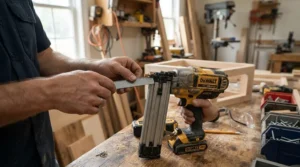
Brad Nailer Magazine Angle: Does It Matter?
Most 18-gauge brad nailers, including every model in this guide, use a straight magazine rather than an angled one. That’s a meaningful difference from framing and finish nailers, where angled magazines are common specifically to help the tool’s nose fit into corners and tight stud bays. Brad nailers skip the angle almost entirely because the nails themselves are so thin and short that a straight magazine doesn’t create the same clearance problems.
What this means in practice: don’t expect a brad nailer to squeeze into the same tight, angled corners a 21-degree framing nailer can access. Instead, straight-magazine brad nailers compensate with narrow nose designs — the Makita AF506‘s ultra-narrow nose is a direct example of this design philosophy, letting the tool reach into confined cabinet interiors and corner trim joints without needing an angled magazine at all. If tight-space access is your top priority, prioritize nose width over magazine angle when comparing brad nailers, since angle simply isn’t the variable doing the work in this tool category.
18-Gauge Nail Holding Power: What the Spec Sheet Won’t Tell You
Here’s the honest trade-off nobody puts on the box: 18-gauge brads are thin by design, which is exactly what makes them so good at avoiding splits in delicate trim — and exactly why they’re not meant for structural or load-bearing connections. Reviewers specifically caution against using brad nailers for structural work or anywhere secure, permanent bindings are required, since the thin gauge simply doesn’t offer the shear strength that thicker 15- or 16-gauge finish nails provide.
In practical terms, that means brad nailers excel at attaching trim, molding, and light panel work to a substrate that’s doing the real structural holding — think baseboard held against drywall backed by studs, not a load-bearing joint in furniture construction. For anything bearing real weight or stress, pair your brad nailer work with wood glue for added holding strength, or step up to a finish nailer or screws for the connection itself. Where 18-gauge brads genuinely shine is in resisting the visible splits that heavier nails cause in narrow shoe molding, delicate casing, and picture-frame corners — the entire reason this nail gauge exists as its own category in the first place.
Brad Nailer vs. Finish Nailer: What’s the Real Difference
The core distinction comes down to gauge and intended holding strength. Brad nailers fire thinner 18-gauge nails specifically because they’re less likely to split fine wood moldings than the thicker 16-gauge nails a finish nailer uses. That thinner wire is the entire value proposition of a brad nailer — and also its biggest limitation.
Finish nailers, by contrast, drive thicker 15- or 16-gauge nails with noticeably more holding power, making them the better choice for door and window casing, baseboard in high-traffic areas, or anywhere a connection needs to survive years of seasonal wood movement without loosening. If your project list leans heavily toward delicate trim, cabinet face frames, and picture framing, every nailer in this guide will serve you well. If it leans toward heavier casing and structural-adjacent trim work, it’s worth budgeting for a finish nailer as a companion tool rather than asking a brad nailer to do a job it wasn’t built for.
Common Mistakes When Buying a Brad Nailer
The single most common mistake is buying based on price alone without checking nail length range against your actual project list — a sub-$100 nailer that only reaches 1-1/4 inches won’t help much on baseboard that needs 2-inch brads. A close second: ignoring battery-platform overlap. If you already own cordless tools from DeWalt, Ryobi, or Milwaukee, buying a bare-tool nailer on that same platform can save real money versus a “kit” price that bundles a battery you don’t need.
Buyers also frequently underweight weight and balance, assuming all nailers in the same price bracket feel similar in the hand — they don’t, and a half-pound difference matters enormously during overhead crown molding work. Finally, skipping the warranty comparison is a mistake worth avoiding: the Bostitch BTFP12233’s 7-year warranty stands out clearly against shorter coverage on some competing budget models, and that’s a real factor in total cost of ownership, not just marketing fine print.
Long-Term Cost & Maintenance: Pneumatic vs. Cordless
Pneumatic nailers like the Metabo HPT NT50AE2 and Bostitch BTFP12233 carry a lower upfront price, but that math only holds if you already own a compressor — buying one specifically for a brad nailer erases most of the savings. Ongoing costs stay modest: periodic pneumatic oil, occasional no-mar tip replacement, and compressor maintenance you’re likely already budgeting for if you own other air tools.
Cordless nailers shift the cost structure entirely. The DeWalt DCN680 and similar models cost more upfront, especially as a bare tool if you’re starting a new battery platform from scratch, but they eliminate hose and compressor logistics completely — a real time savings on job sites where setup and teardown eat into billable hours. Battery replacement every few years is the main long-term cost to plan for, though shared-platform buyers who already own compatible batteries sidestep that cost almost entirely. Over a multi-year ownership period, neither category is dramatically cheaper than the other; the deciding factor is really whether you value lower purchase price or lower daily friction more.
Safety Guide: Using Your Brad Nailer Without a Trip to the ER
Brad nailers are safer than framing nailers by design, thanks to their thinner gauge, but they’re still pneumatic or spring-driven tools capable of real injury. More than 37,000 people are treated for unintentional nail gun injuries in emergency rooms each year according to data compiled by the U.S. Consumer Product Safety Commission and NIOSH, and that figure spans both job-site and consumer use.
The sequential trigger setting present on every nailer in this guide is your best safety tool — it requires a fresh trigger pull for every single shot, which meaningfully reduces the risk of accidental double-fires compared to bump-fire mode. Always keep the tool’s contact safety tip against the work surface before pulling the trigger, and never bypass or tape down that safety mechanism, no matter how much faster it might feel. For anyone using a pneumatic model regularly on a job site, it’s worth reviewing OSHA’s nail gun safety standards directly, since compliance requirements differ slightly between consumer DIY use and regulated workplace environments.
Basic PPE matters more than people expect: safety glasses are non-negotiable given how thin, fast-moving brads ricochet off hard materials, and hearing protection is worth considering if you’re running a compressor-based nailer for extended sessions. Disconnect air supply or remove the battery before clearing any jam — a jammed nailer that’s still powered is exactly the scenario most injury reports describe.
Frequently Asked Questions
❓ What is the best brad nailer overall for a first-time DIYer?
❓ Can a brad nailer replace a finish nailer completely?
❓ What size air compressor do I need for a pneumatic brad nailer?
❓ How long does a cordless brad nailer battery typically last per charge?
❓ Is an 18-gauge brad nailer strong enough for baseboard installation?
Conclusion
Choosing the best brad nailer overall really comes down to two honest questions: do you already own a compressor, and how much do you value cordless freedom over upfront savings? If the answer leans pneumatic, the Metabo HPT NT50AE2 and Bostitch BTFP12233 both deliver excellent results without draining your wallet. If cordless convenience wins out, the DeWalt DCN680 earns its spot as the most well-rounded pick in this entire lineup, with the Milwaukee M18 FUEL 2746-21CT waiting in the wings for anyone who nails trim for a living and needs production-grade speed.
Whichever direction you go, the seven nailers covered here represent genuinely different corners of the market rather than seven flavors of the same tool — which means there’s a real, honest answer here for nearly every project, budget, and skill level. Test your depth settings on scrap first, respect the safety basics, and your next trim project should go up straighter and faster than the last one did.
Recommended for You
- Best Cordless Finish Nailer for Trim: 7 Picks for 2026
- 15 Gauge vs 16 Gauge Finish Nailer: 7 Best Picks for 2026
- Best Finish Nailer Overall: 7 Top Picks Tested for 2026
✨ Found this helpful? Share it with your friends! 💬🤗
