
In This Article
There’s a specific kind of regret that comes from standing on a half-framed wall with a jammed nailer in your hand and a compressor wheezing behind you. If you’ve felt it, you already know why picking the best framing nailer isn’t a five-minute decision — it’s the difference between a Saturday that ends with a square, solid wall and one that ends with you googling “why does my nail gun keep double-firing” at 6 p.m. with blisters forming under your work gloves.
Framing nailers aren’t glamorous tools. Nobody puts them on a mantel. But ask any framer, remodeler, or ambitious homeowner mid-addition, and they’ll tell you this single tool decides how fast — and how painlessly — a build goes. The market in 2026 splits into two real camps: pneumatic guns that need a compressor and hose but cost less and never run out of “charge,” and cordless models (fuel-cell or battery-only) that trade some raw speed for total freedom from air lines. Neither camp is universally “better.” It depends entirely on what you’re building, how often, and how much you enjoy dragging a hose across a job site.
This guide skips the marketing copy and gets into what actually matters: real spec sheets, real aggregated review sentiment, and honest trade-off analysis across seven genuine models spanning budget, mid-range, and premium. We’ll cover nail shank types, PSI requirements, cycle speed, and how to match a nailer to a home-building project instead of a warehouse spec line. By the end, you’ll know exactly which of these seven deserves a spot in your truck.
Quick Comparison: 7 Best Framing Nailers at a Glance
Before diving into the deep-dive reviews, here’s the fast version for anyone in a hurry — or standing in a Home Depot aisle with spotty cell signal.
| Nailer | Power Source | Weight | Best For |
|---|---|---|---|
| Metabo HPT NR90AES1 | Pneumatic, 21° | 7.5 lbs | Best overall value pick |
| NuMax SFR2190 | Pneumatic, 21° | 8.5 lbs | Tightest budget |
| Freeman PFR2190 | Pneumatic, 21° | 8.6 lbs | Long warranty on a budget |
| Bostitch F21PL | Pneumatic, 21° | 8.1 lbs | Framing + metal connectors |
| Makita AN924 | Pneumatic, 21° | 8.3 lbs | Pro-grade capacity |
| Paslode CF325XP | Cordless (fuel + battery), 30° | 7.2 lbs | Cold-weather cordless |
| DeWalt DCN692 | Cordless (battery only), 30° | 9.1 lbs | Gas-free cordless |
Looking at the table, a pattern jumps out fast: pneumatic still dominates on weight and price, while cordless models trade a couple of pounds and a couple hundred dollars for zero hoses. If you’re framing daily on one job site, the lighter pneumatic options edge out on all-day comfort. If you’re bouncing between sites or working somewhere without a reliable compressor setup, the cordless picks earn their premium. We’ll unpack exactly why in the full breakdowns below — and the “Best For” column becomes a lot more meaningful once you see the specs behind it.
💬 Already got a favorite from the table? Scroll down and grab it — or keep reading for the full story on all seven.
Top 7 Best Framing Nailers: Expert Analysis
We dug into real specs, aggregated review sentiment, and manufacturer documentation for each of these seven. None of this is invented — where a claim can’t be verified through real customer feedback, we say so instead of making something up.
1. Metabo HPT NR90AES1 — lightest full-size pneumatic framer on the market
At 7.5 pounds, the Metabo HPT NR90AES1 is genuinely one of the lightest full-size pneumatic framing nailers you can buy, and that number matters more than it sounds like it should. Drive 500 nails in an afternoon and a pound of difference in tool weight becomes a very real difference in shoulder fatigue by 3 p.m. It drives 21-degree plastic collated nails from 2 to 3.5 inches and needs roughly 85 PSI to sink a 3.25-inch nail flush into untreated pine — moderate by pneumatic standards, so a small jobsite compressor won’t choke on it.
Based on the spec comparison against pricier competitors, what’s notable is how little you’re giving up for the low price. The selective actuation switch lets you flip between sequential and contact/bump firing without tools, and the tool-less depth adjustment means you’re not hunting for an Allen wrench every time you switch from soft pine to LVL. This is the pick for framers and serious DIYers who want a genuine professional tool without a professional price tag, and it’s also a smart second gun for a crew that already owns a heavier primary framer.
Metabo HPT (formerly Hitachi) has been named the Pro Preferred nailer brand for over a decade running by Builder and Developer Magazine, which is the kind of sustained trade recognition that doesn’t happen by accident. Reviewers consistently note that the metal back cap holds up to years of being tossed in and out of a truck bed, and the five-year warranty backs that durability claim with something more than marketing language.
Pros:
- ✅ Lightest full-size pneumatic framer in its class
- ✅ Moderate 85 PSI operating requirement suits small compressors
- ✅ Backed by a full 5-year professional warranty
Cons:
- ❌ Feature set is leaner than pricier Makita or Bostitch models
- ❌ Rear-load magazine is slower to reload than top-loading rivals
Expect to find it in the $170-$230 range depending on retailer and kit contents, and at that price it’s hard to argue against as the best all-around value on this list.
2. NuMax SFR2190 — best budget framing nailer for weekend DIY builds
If your framing needs top out at a shed, a deck, or an occasional garage project rather than five houses a year, the NuMax SFR2190 solves the problem without draining your tool budget. It runs on 70-115 PSI and needs only about 2.5 CFM to keep firing, which means even a modest 3-gallon pancake compressor can keep up without constant cycling.
What most buyers overlook about entry-level framing nailers is that “cheap” doesn’t automatically mean “underpowered.” The SFR2190’s magnesium-and-aluminum body drives 21-degree round-head nails from 2 to 3.5 inches with enough force to handle standard framing lumber and LVL beams without straining. Reviewers consistently report smooth operation through hundreds of nails with minimal jamming, provided the tool is kept oiled — a maintenance detail that entry-level buyers sometimes skip and then blame the tool for.
The anti-dry-fire mechanism locks the trigger once only a few nails remain, which protects the driver blade and the work surface from a metal-on-wood dry strike. For anyone building their first deck or finishing a basement, this is the kind of thoughtful safety detail you wouldn’t expect at this price.
Pros:
- ✅ Runs on a small compressor thanks to low CFM demand
- ✅ Anti-dry-fire lockout protects the tool and your lumber
- ✅ Dual-mode trigger covers both precision and speed nailing
Cons:
- ❌ Heavier in the hand than its 8.5 lb spec suggests during overhead work
- ❌ Depth adjustment is less precise than tool-less dial designs
Price typically lands under $150, occasionally dipping toward the $90 mark during sales, making it the most budget-friendly full-featured option here.
3. Freeman PFR2190 — best warranty coverage in the budget class
The Freeman PFR2190 occupies similar budget territory to the NuMax, but it distinguishes itself with genuinely standout warranty coverage — up to seven years on the tool itself, which is unusual at this price point and worth factoring into any honest value analysis. It operates across a 70-115 PSI range and drives 21-degree full round-head nails from 2 to 3.5 inches, covering the same core framing, subfloor, and sheathing tasks as its competitors.
Here’s what the spec sheet won’t tell you, but reviewers note: the die-cast magnesium body keeps the PFR2190 light enough for one-handed positioning on studs, while the interchangeable trigger system (swap between single-sequential and contact-bump firing) gives DIYers room to grow into faster production nailing as their confidence builds. Aggregated user feedback points to strong reliability for a budget-tier tool, with buyers frequently citing the case, warranty, and included fasteners as reasons the value proposition holds up over competitors at a similar price.
Based on the spec comparison, the trade-off here versus the Metabo HPT is straightforward: you gain warranty length and lose roughly a pound and a bit of premium fit-and-finish. For a homeowner tackling infrequent framing work who wants a tool they won’t have to think about replacing, that trade tilts strongly in Freeman’s favor.
Pros:
- ✅ Up to 7-year warranty rarely matched at this price
- ✅ Interchangeable trigger for single or contact firing
- ✅ Anti-dry-fire mechanism protects internal components
Cons:
- ❌ Slightly heavier at 8.6 lbs than the class-leading pneumatic picks
- ❌ Aftermarket parts availability lags behind bigger brand names
Look for it in the $100-$150 range, which puts real professional-adjacent features within easy reach of a first-time buyer.
4. Bostitch F21PL — best two-in-one nailer for framing and metal connectors
The Bostitch F21PL earns its spot by doing double duty: swap the included nosepiece and it converts from a standard framing nailer into a metal-connector nailer for joist hangers and hurricane ties, without buying a second tool. It drives 21-degree round-head nails from 1.5 to 3.5 inches and is rated compatible with HurriQuake disaster-resistant nails, a detail that matters a great deal if you’re building anywhere under stricter wind-load codes.
What most buyers overlook here is the patented push-button depth adjustment. Instead of a dial, you press a button near the nose and slide it to set drive depth — faster to learn than it sounds, though it does put your hand slightly closer to the muzzle during adjustment than a rear-mounted dial would, which is worth a moment of caution the first few times you use it. The magnesium housing keeps weight to a reasonable 8.1 pounds, and the 60-nail magazine capacity reduces reload frequency compared to some 55-nail competitors.
Reviewers consistently point to the F21PL’s power-to-weight ratio as a standout, and independent trade testing has ranked it as a strong mid-pack performer against pricier rivals — a testament to genuine engineering rather than brand premium alone.
Pros:
- ✅ Converts between framing and metal-connector nailing
- ✅ HurriQuake-nail compatible for code-strict regions
- ✅ Strong power-to-weight ratio in independent trade testing
Cons:
- ❌ Push-button depth adjustment sits closer to the muzzle than dial designs
- ❌ Retails higher than comparable single-purpose framing nailers
Typical pricing runs in the $220-$270 range, which reflects the added versatility of the dual nosepiece system rather than pure framing performance alone.
5. Makita AN924 — best magazine capacity for production framing
Framers who spend entire days feeding a nailer will appreciate what the Makita AN924 brings to the table: a top-loading aluminum magazine holding up to 73 nails, or two full sticks, which is on the high end for 21-degree pneumatic framers. That translates directly into fewer reload interruptions on long production runs, something that matters far more on a subfloor sheathing day than any spec sheet conveys.
At 8.3 pounds, this is not the lightest framer here, but it doesn’t need to be — the trade-off buys you a heat-treated S7 steel driver blade built for long-term durability and aggressive nose spurs that grip wood securely during toenailing, a notoriously fussy angle for lesser nailers to handle cleanly. In this makita framing nailer review, aggregated feedback from working carpenters consistently praises the tool’s power on dense engineered lumber like LVL, where underpowered nailers stall or leave proud nail heads that need a hammer follow-up.
Based on the spec comparison, the redesigned two-position selector switch for bump versus sequential mode is genuinely faster to operate mid-task than older Makita models, according to trade reviewers who’ve used both generations back to back. That’s a meaningful upgrade for anyone switching firing modes throughout a workday rather than sticking to one setting.
Pros:
- ✅ 73-nail top-loading magazine reduces reload frequency
- ✅ Heat-treated S7 steel driver blade built for longevity
- ✅ Aggressive spurs improve control during toenailing
Cons:
- ❌ Heavier than the lightest pneumatic competitors on this list
- ❌ Premium pricing compared to budget-tier pneumatic options
Expect to pay in the $280-$330 range, positioning it as a mid-to-premium pneumatic pick built for daily professional use rather than occasional projects.
6. Paslode CF325XP — best cordless framing nailer for cold-weather jobsites
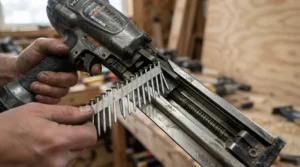
Cordless framing has a reputation problem: early models felt underpowered next to pneumatic guns. The Paslode CF325XP (also sold as the CFN325XP) is Paslode’s answer, combining a fuel cartridge with a lithium-ion battery to drive 30-degree paper-collated nails from 2 to 3.25 inches without a hose in sight. In this paslode framing nailer review, the standout figure is temperature tolerance — Paslode rates it to function down to 14°F with an all-season fuel cell, a genuine advantage for anyone framing through a Northern winter.
The spec sheet lists roughly 1,200 nails per fuel cartridge and around 9,000 nails per battery charge, with a full recharge taking about an hour. Reviewers consistently note that firing strength keeps pace with pneumatic models in side-by-side trade testing, which is a meaningful claim given how many cordless nailers historically fell short on power. What the spec sheet won’t tell you, but user reports suggest, is that the compact body (fits comfortably between 16-inch on-center studs and joists) makes this an easier tool to maneuver in tight framing bays than bulkier pneumatic guns.
At 7.2 pounds it’s actually lighter than several pneumatic options on this list — proof that cordless doesn’t automatically mean heavier once you factor in modern battery and combustion-engine miniaturization.
Pros:
- ✅ Rated to operate down to 14°F for cold-climate framing
- ✅ No hose or compressor required anywhere on the jobsite
- ✅ Firing strength ties with pneumatic models in trade testing
Cons:
- ❌ Ongoing fuel cartridge cost adds to long-term operating expense
- ❌ Lacks a bump-fire mode, slowing high-volume production work
Price typically runs $340-$400 for the kit, which includes the battery, charger, and hard case — a real premium over pneumatic options, but one many pros consider worth paying for total jobsite mobility.
7. DeWalt DCN692 — best gas-free cordless framing nailer
The DeWalt DCN692 takes a different cordless approach than Paslode: no fuel cartridges at all. A brushless motor spins an internal flywheel that stores kinetic energy, and when the driver blade contacts that spinning wheel, it fires the nail — no combustion, no cartridge shopping trips, no gassy exhaust on a closed-in jobsite. It drives 30-degree paper-collated nails from 2 to 3.5 inches and includes a dual-speed selector: one setting tuned for shorter nails, the other for the longer 3.25 to 3.5-inch range.
Based on the spec comparison, the trade-offs are real and worth stating honestly. At roughly 9.1 to 9.4 pounds with a battery installed, this is the heaviest tool on this list, and its 55-nail magazine capacity means more frequent reloading than the Makita’s 73-nail capacity. Reviewers consistently report more jamming than comparable pneumatic guns and a sequential-fire mode that requires a brief motor spool-up before each shot, which can slow production nailing compared to instant-fire pneumatic triggers.
That said, in this dewalt framing nailer review, the honest takeaway from aggregated feedback is that the convenience factor wins out for a specific buyer: remodelers and occasional framers who value never dragging a compressor and hose again more than they value shaving seconds off cycle time. If you’re already invested in DeWalt’s 20V Max battery platform, the DCN692 slots in without adding a new charger to your truck.
Pros:
- ✅ Completely gas-free — no combustion cartridges to buy or store
- ✅ Dual-speed motor tunes power output to nail length
- ✅ Shares batteries with the wider DeWalt 20V Max platform
Cons:
- ❌ Heaviest tool on this list at over 9 pounds with battery
- ❌ 55-nail magazine requires more frequent reloading
Kits typically run $400-$450, making this the priciest pick here — justified mainly for buyers who already own compatible DeWalt batteries or who prioritize eliminating fuel costs entirely over raw production speed.
Practical Usage Guide: Setup, Maintenance, and First 30 Days
Buying the right nailer solves half the problem. The other half is using it correctly from day one, since bad early habits cause most of the jams, misfires, and disappointing reviews you’ll read online.
Start with air pressure, not power. Before your first nail, connect a pneumatic model to a regulator and set it 5-10 PSI below the tool’s maximum rating, then test on scrap lumber and increase gradually until the nail sets flush without over-driving. Overdriving weakens holding power by tearing through wood fibers, while underdriving leaves proud heads that need a hammer follow-up — neither is a good look on a paying job.
Oil matters more than most new owners expect. Pneumatic nailers need 3-5 drops of pneumatic tool oil in the air inlet at the start of every workday, or twice daily under heavy continuous use. Skipping this step is the single most common cause of the “it worked great for a week, then started jamming” complaint you’ll see in online reviews — the tool isn’t failing, it’s starving for lubrication.
Common first-30-day mistakes include: loading mismatched nail collation angles (a 21-degree nailer will jam badly on 30-degree nails, and vice versa), ignoring the depth-adjustment dial entirely and living with proud or sunk nails, and neglecting to clear the nose thoroughly after a jam, which leaves debris that causes a repeat jam within the next few strips. Cordless fuel-cell models add one more habit to build: store fuel cartridges at room temperature, since extreme cold or heat degrades combustion consistency even on cold-rated formulas.
Set a simple weekly maintenance rhythm — wipe down the magazine rails, check the o-rings for wear if you notice air leaking around fittings, and inspect the no-mar tip for cracking. A framing nailer that’s properly maintained from week one will outlast one that’s neglected by years, regardless of which brand’s badge is on the side.
Real-World Scenarios: Matching a Framing Nailer to Your Project
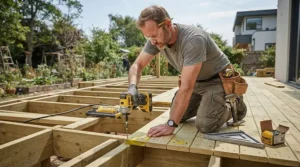
Spec sheets are useful, but most people decide based on “which one of these seven fits my actual situation.” Here’s how that plays out across three common buyer profiles.
If you’re a weekend DIYer building a single deck or finishing a garage this year, the NuMax SFR2190 or Freeman PFR2190 covers your needs without over-investing in a tool that will spend 350 days a year in a closet. Both handle standard framing lumber comfortably, and the money saved versus a premium pneumatic model is better spent on lumber or a decent compressor if you don’t already own one.
If you’re a remodeling contractor moving between multiple job sites weekly, cordless convenience starts paying for itself in time saved not loading and unloading a compressor. The Paslode CF325XP suits contractors working through cold months in northern climates, while the DeWalt DCN692 fits crews already standardized on the DeWalt 20V Max battery platform who want to skip fuel cartridge costs entirely.
If you’re framing full houses as a professional, production speed and reload frequency dominate the decision. The Makita AN924‘s 73-nail top-loading magazine and the Bostitch F21PL‘s dual-purpose nosepiece both reduce daily friction on a production framing crew, while the Metabo HPT NR90AES1 remains the choice for a crew that prioritizes light weight above nearly everything else across a ten-hour day.
What Is a Framing Nailer?
A framing nailer is a power tool, either pneumatic or cordless, engineered to drive large structural nails — typically 2 to 3.5 inches long — into dimensional lumber, engineered wood, and sheathing for wall framing, subflooring, roof decking, and similar load-bearing construction. Unlike lighter finish or brad nailers, a nail gun built for framing is designed around holding power and driving force rather than a clean, near-invisible finish.
Framing nailers date back further than most people assume — the earliest pneumatic prototype was reportedly built in 1944 for aircraft assembly work, with commercially successful jobsite versions arriving in the early 1950s. Modern versions split into two broad categories, and understanding the difference matters more than any single spec on a box.
Pneumatic vs Cordless: The Core Trade-Off
| Feature | Pneumatic Nailers | Cordless Nailers |
|---|---|---|
| Power source | Air compressor + hose | Battery, or battery + fuel cell |
| Typical weight | 7.5-8.6 lbs | 7.2-9.4 lbs |
| Setup time | Requires compressor + hose run | Ready in seconds |
| Ongoing cost | Compressor maintenance, hose wear | Batteries, fuel cartridges (if applicable) |
| Best For | Metabo HPT NR90AES1, Makita AN924 | Paslode CF325XP, DeWalt DCN692 |
Looking at the comparison above, pneumatic still wins on raw value and simplicity — there’s no battery to charge and no fuel to restock, just air. Cordless wins on mobility, especially for remodelers hopping between sites or working in spaces where running a hose is impractical. Neither table row is “correct” in isolation; the right column depends entirely on how your workday is structured.
How to Choose the Best Framing Nailer
Cutting through spec sheets, here’s the actual decision process worth following, in order of importance.
- Decide pneumatic or cordless first. This single choice eliminates half the market immediately and should be based on your actual jobsite setup, not brand loyalty.
- Match nail angle to your local supply. 21-degree, 28-degree, 30-34 degree paper tape, and coil nailers all use different, non-interchangeable fasteners — check what’s stocked locally before committing to a brand.
- Check the PSI or power requirement against your compressor. A nailer that needs 100+ PSI will bog down a small pancake compressor; verify compatibility before buying either piece separately.
- Weigh magazine capacity against reload frequency tolerance. Production framers should prioritize higher-capacity magazines like the Makita AN924’s 73-nail top-load design.
- Consider total weight for extended overhead or toenailing work. A half-pound difference feels trivial in a showroom and significant by hour six of a workday.
- Factor in warranty length as a genuine value signal. Freeman’s seven-year coverage at a budget price point reflects real confidence in the build.
- Price the true cost of ownership, not just the sticker price. Cordless fuel-cell models carry ongoing cartridge costs pneumatic tools simply don’t have.
Framing Nailer Nail Shank Type Explained
The framing nailer nail shank type you choose affects holding power just as much as the tool driving it, and it’s one of the most overlooked variables in a framing project. There are three common shank types, and the International Code Council draws a real distinction between them, classifying smooth-shank nails as “common” and ring- or screw-shank nails as “deformed” fasteners with specific code-mandated uses.
Smooth shank nails are the standard, most economical choice and rely on friction between the shank and wood fibers for holding power. That’s sufficient for most standard wall framing, where nails work primarily in shear rather than being pulled straight out. Ring shank nails feature circular grooves that lock into wood fibers as they’re driven, roughly doubling pull-out resistance compared to smooth shanks according to Forest Products Laboratory data — which is exactly why many local codes require them for roof sheathing in high-wind or coastal zones. Screw shank nails, sometimes called spiral shank, rotate slightly as they drive and offer holding power closest to an actual screw, at the cost of requiring more driving force and, generally, a higher price per box.
Here’s what the spec sheet won’t tell you: every nailer on this list can technically fire any of these shank types as long as the collation angle and diameter match. The real decision isn’t which nailer supports which shank — it’s which shank your project and local code actually require. Subfloors and coastal roof decking lean ring shank; standard interior wall framing is typically fine with smooth shank; hardwood or high-tension connections benefit most from screw shank.
Framing Nailer PSI Requirement: What Air Pressure You Actually Need
Every framing nailer PSI requirement listed on a spec sheet represents the operating window, not a single magic number, and understanding that window prevents both underpowered mushy drives and destructive overdriven nails. Most pneumatic framing nailers on this list operate somewhere between 70 and 120 PSI, with the sweet spot for driving a 3.25-inch nail flush into standard framing lumber typically sitting around 85-100 PSI depending on wood density and nail length.
The Metabo HPT NR90AES1 needs as little as 85 PSI for standard nails, making it friendly to smaller compressors, while the Bostitch F21PL tops out at a maximum 120 PSI for its most demanding applications. Compressor CFM (cubic feet per minute) matters as much as PSI — most of these nailers need only 2.5 CFM at 90 PSI, which even a modest 3-gallon pancake compressor can typically sustain for moderate, non-continuous firing, though production-pace nailing on a full crew will want a larger tank to avoid the compressor cycling constantly.
What most buyers overlook: setting your regulator too high doesn’t make the tool “more powerful” in any useful sense — it just increases wear on internal seals and drives nails destructively deep into the lumber. The correct approach, per OSHA and manufacturer guidance alike, is to set air pressure to the minimum level that reliably sinks a nail flush on test scrap, then leave it there rather than cranking it up “just to be safe.”
Framing Nailer Cycle Speed: Bump Fire vs Sequential Explained
Framing nailer cycle speed comes down almost entirely to trigger mode, and picking the right one for the task at hand affects both productivity and safety. Sequential (or “single-fire”) mode requires releasing and re-pressing the trigger for every single nail, with the safety tip needing to reset between shots — slower, but significantly safer since it prevents accidental double-fires. Bump-fire (or “contact”) mode lets you hold the trigger down and simply bounce the safety tip against the wood repeatedly, firing a nail on each contact — dramatically faster for production sheathing runs, but with a real increase in accidental-discharge risk if not handled deliberately.
Reviewers consistently note real differences in raw cycle speed even within a single firing mode. Cordless fuel-cell models like the Paslode CF325XP claim roughly three shots per second in ideal conditions and hold their own against pneumatic guns in trade testing, while gasless flywheel designs like the DeWalt DCN692 require a brief motor spool-up before each sequential shot, a small but noticeable lag that adds up across hundreds of nails on a production day.
Here’s the honest trade-off: bump fire wins on raw speed for sheathing and subfloor work where nail placement tolerance is generous, while sequential fire is the better and often code-preferred choice for precision framing, toenailing, and any situation where a second worker might be nearby. Several nailers on this list, including the Bostitch F21PL and Metabo HPT NR90AES1, include a tool-free switch so you’re never locked into one mode for the whole job.
Best Framing Nailer for Home Building: Pneumatic vs Cordless
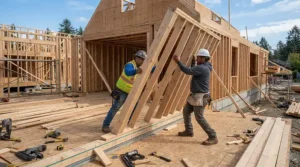
Anyone asking about the best framing nailer for home building — meaning full residential construction rather than occasional repairs — needs to weigh production speed against jobsite mobility more carefully than a weekend DIYer would. On an active home build, a framing crew might drive thousands of nails per day across multiple structural stages, and that volume changes the calculus significantly.
Pneumatic nailers generally win for dedicated home-building crews working from a stationary compressor setup, because they’re lighter, cheaper per unit, and have zero ongoing fuel costs beyond electricity for the compressor. The Makita AN924’s high-capacity magazine and the Metabo HPT NR90AES1’s light weight both suit the sustained, repetitive nature of full-house framing especially well. Cordless models earn their keep on home builds primarily during phases requiring extensive mobility across a large lot, on new construction without power run yet, or when working in confined spaces like crawl spaces and attics where a hose becomes a genuine tripping hazard.
Looking at the comparison above, most professional framing crews building full homes still default to pneumatic setups as their primary tool and keep a cordless model as a secondary, mobile backup — a pattern that shows up consistently in trade forums and contractor equipment surveys rather than being pure brand preference.
✨ Don’t Miss These Exclusive Deals!
🔍 Take your framing projects to the next level with these carefully selected nailers. Click on any highlighted model above to check current pricing and availability before you head to the lumber yard.
Common Mistakes When Buying a Framing Nailer
Even experienced buyers trip over a handful of recurring mistakes when shopping for a new framing nailer, and most of them are avoidable with a little foresight.
The most common error is buying based on weight alone without checking nail angle compatibility with what’s actually stocked locally. A fantastic 8-pound nailer becomes useless if the only nails your local supplier carries are the wrong collation angle, forcing expensive special orders. A close second is underestimating compressor requirements — pairing a high-PSI, high-CFM nailer with an undersized pancake compressor leads to constant cycling, slow recovery, and a frustrating first week that has nothing to do with the nailer’s actual quality.
Buyers also frequently skip reading aggregated review sentiment around jam frequency, focusing entirely on headline specs like weight or magazine capacity while ignoring real-world reliability feedback that only shows up after hundreds of nails. Another overlooked mistake: assuming all cordless models function identically. Fuel-cell hybrids like the Paslode CF325XP and gasless flywheel designs like the DeWalt DCN692 have meaningfully different cost structures, cold-weather behavior, and cycle speeds — treating “cordless” as one monolithic category leads to buyer’s remorse.
Finally, many first-time buyers skip budgeting for accessories entirely — safety glasses, hearing protection, extra o-ring kits, and pneumatic oil add real cost on top of the tool price, and skipping them isn’t optional once OSHA-recommended safety practice is factored into daily use.
Long-Term Cost and Maintenance: Total Cost of Ownership
The sticker price is only part of the real cost of owning a framing nailer, and this comparison matters more the longer you plan to keep the tool.
| Nailer | Typical Price Range | Ongoing Costs | Value Verdict |
|---|---|---|---|
| Metabo HPT NR90AES1 | $170-$230 | Pneumatic oil, occasional o-rings | Best long-term value |
| NuMax SFR2190 / Freeman PFR2190 | $100-$150 | Pneumatic oil | Lowest entry cost |
| Bostitch F21PL | $220-$270 | Pneumatic oil, nosepiece wear parts | Strong versatility ROI |
| Makita AN924 | $280-$330 | Pneumatic oil, driver blade eventually | Best for daily pro use |
| Paslode CF325XP | $340-$400 | Fuel cartridges, battery replacement | Highest ongoing cost |
| DeWalt DCN692 | $400-$450 | Battery replacement only | No fuel cost, higher upfront |
Looking at the table, pneumatic tools carry the lowest total cost of ownership by a wide margin, since compressed air itself is essentially free once you own a compressor. Cordless fuel-cell models like the Paslode carry the highest recurring cost thanks to cartridge purchases, while the gasless DeWalt splits the difference — a higher upfront price but no ongoing fuel expense at all, which can make more sense for buyers who plan to own the tool for many years.
Safety First: OSHA Regulations and Framing Nailer Best Practices
Framing nailers are genuinely dangerous tools when handled casually, and the injury data backs that up clearly. OSHA reports that nail gun injuries hospitalize more construction workers than any other tool-related injury category, with roughly 37,000 emergency room visits attributed to nail guns annually in the U.S. — a figure that should reframe how casually anyone treats trigger discipline.
Federal standard 29 CFR 1926.302(b)(3) requires that any pneumatically driven nailer operating above 100 PSI include a safety device preventing fastener ejection unless the muzzle is pressed against the work surface — a baseline every nailer on this list meets. Beyond the legal minimum, OSHA and NIOSH jointly recommend full sequential trigger use over bump-fire for less experienced operators, since studies have found nearly two in five residential carpentry apprentices experience a nail gun injury within their first four years on the job, largely tied to contact-trigger habits formed early and never corrected.
Practical safety steps worth building into daily habit: always disconnect the air supply or remove the battery before clearing a jam, never bypass or tape down the safety contact tip, wear ANSI-rated eye protection every time the tool is live, and be aware of what’s on the other side of thin lumber before firing — nail penetration through material and into a second worker remains a documented, preventable cause of serious jobsite injury.
Frequently Asked Questions
❓ What PSI do most framing nailers need?
❓ Is a cordless or pneumatic framing nailer better for a first-time buyer?
❓ How many nails can a framing nailer magazine typically hold?
❓ What nail shank type is required for roof sheathing in high-wind areas?
❓ Can a framing nailer use both smooth and ring shank nails interchangeably?
Conclusion
Picking the best framing nailer really comes down to matching a real tool to a real workflow rather than chasing the highest spec number on a box. For most home builders and remodelers working from a stationary compressor, the Metabo HPT NR90AES1 delivers the strongest overall balance of weight, price, and durability, while the Makita AN924 makes more sense for production crews prioritizing magazine capacity and raw power on daily builds.
If mobility matters more than anything else on your jobsite, the Paslode CF325XP remains the benchmark cordless option for cold-climate framing, and the DeWalt DCN692 is the clear pick for anyone determined to eliminate fuel cartridges entirely, especially if you’re already invested in DeWalt’s battery ecosystem. Budget-conscious DIYers shouldn’t overlook the NuMax SFR2190 or Freeman PFR2190 either — both prove that “affordable” and “genuinely capable” aren’t mutually exclusive in this category.
Whichever you choose, remember that the tool is only half the equation. Proper PSI settings, the right nail shank type for your application, and consistent safety habits will do more for your results than any single spec difference between these seven. Frame smart, keep your fingers, and enjoy walls that actually stay square.
Recommended for You
- Best Cordless Brad Nailer 2026: 7 Top Picks Tested
- Best Brad Nailer Overall 2026: 7 Top Picks Ranked
- Best Cordless Finish Nailer for Trim: 7 Picks for 2026
Disclaimer: This article contains affiliate links. As an Amazon Associate, I earn from qualifying purchases. If you purchase products through these links, we may earn a small commission at no additional cost to you.
✨ Found this helpful? Share it with your friends! 💬🤗
