
In This Article
Somewhere in your garage, there’s probably a drawer full of dead batteries and a drill that groans like it’s asking for retirement. That’s usually the moment people start hunting for the best cordless drill set, and honestly, it’s a smarter move than replacing one tool at a time. A cordless drill set is a matched pair (or trio) of a drill/driver and impact driver, sharing one battery platform, sold together at a price that beats buying each tool separately. Think of it as the power-tool version of a starter kitchen knife set — you get the essentials, matched and ready, instead of assembling a mismatched collection over years.
If you’ve also searched for the best drill driver combo kit specifically, you’re in the right place — that’s essentially what every kit below is, a drill/driver paired with an impact driver on one battery platform.
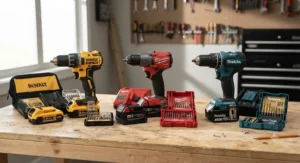
The problem is that the market is loud. DeWalt, Milwaukee, Ryobi, Bosch, Makita, Black+Decker, and Craftsman all insist their kit is the one you need, and their marketing copy reads suspiciously similar no matter the brand. Torque numbers get thrown around like a pissing contest, “brushless” gets slapped on everything, and somehow every kit claims to be “professional grade” whether it costs $80 or $400.
The modern electric drill has been around in some form since the late 1800s, but the cordless version — the one you’re actually shopping for — is a much more recent convenience, and today’s brushless motors and lithium-ion batteries have come a long way from those first clunky cordless models.
This guide cuts through that. We’re going to walk through seven real, currently available kits — not fictional composites — with honest analysis of what the specs actually mean once you’re standing in your garage with a bit in the chuck. You’ll get real aggregated review sentiment (not invented quotes), genuine torque and clutch breakdowns, a battery voltage comparison that finally makes sense, and a buyer’s framework so you’re not guessing. Whether you’re outfitting a first apartment toolbox or replacing a contractor’s daily driver, there’s a kit here that fits.
Quick Comparison Table
| Kit | Motor Type | Drill Torque | Impact Torque | Price Range | Best For |
|---|---|---|---|---|---|
| Ryobi ONE+ HP 18V | Brushless | 400-450 in-lbs | Up to 1,700 in-lbs | $100-$140 | Budget DIYers |
| Black+Decker 20V MAX | Brushed | ~450 in-lbs | 1,375 in-lbs | Under $100 | First-time buyers |
| Craftsman V20 CMCK200C2 | Brushed | 280 UWO | 1,460 in-lbs | $100-$150 | Homeowners, warranty seekers |
| DeWalt DCK240C2 | Brushed | 300 UWO | 1,400 in-lbs | $200-$250 | General contractors |
| Bosch 18V Compact | Brushless | 400-480 in-lbs | 1,400 in-lbs | $180-$230 | Finish carpentry |
| Makita XFD131 18V LXT | Brushless | 440 in-lbs | N/A (drill only) | $150-$190 | Weight-conscious pros |
| Milwaukee M18 FUEL 2997-22 | Brushless | 1,200 in-lbs | 1,800-2,000 in-lbs | $300-$400 | Heavy-duty daily use |
Looking at the spread here, the jump from brushed to brushless motors is really the dividing line that matters most. The Ryobi ONE+ HP 18V proves you don’t need a $300 budget to get brushless efficiency, while the Milwaukee M18 FUEL 2997-22 sits in a different weight class entirely — its 1,200 in-lbs of drill torque is roughly triple what most kits under $250 offer. Budget-conscious buyers should note that brushed motors like those in the Black+Decker 20V MAX and Craftsman V20 CMCK200C2 kits aren’t necessarily “worse,” they just trade some runtime and motor lifespan for a lower sticker price.
💬 Found a kit that fits your budget already? Tap through to check today’s price before it changes!😊
Top 7 Cordless Drill Sets: Expert Analysis
Here’s the breakdown of seven real kits worth your money, ranging from entry-level to full-blown jobsite workhorses. Every pick below is currently sold, and every torque figure comes straight from manufacturer spec sheets or third-party lab testing.
1. Ryobi ONE+ HP 18V Brushless Compact Drill/Driver Kit — best overall value for DIYers
The standout here isn’t raw power, it’s the ratio of performance to price. Ryobi managed to cram a genuinely useful brushless motor into a kit that regularly sells for less than what other brands charge for tool-only versions. The drill delivers around 400-450 in-lbs of torque with a two-speed gearbox (0-450 / 0-1,700 RPM), and the compact head length means it slides into cabinet interiors and stud bays without the usual knuckle-scraping fight. What most buyers overlook about the ONE+ platform is its sheer size: it’s grown into one of the largest cordless ecosystems in North America, spanning over 300 tools that all share the same battery. Reviewers consistently report strong torque for a compact tool, praising the balance and light weight, though a recurring complaint involves the chuck occasionally slipping on smooth-shank bits under heavy load. Based on the spec comparison, this kit is squarely aimed at homeowners and weekend renovators rather than daily jobsite abuse — the batteries included are typically compact 1.5-2.0 Ah packs, fine for a Saturday project but not an eight-hour framing day.
Pros:
- ✅ Brushless motor at a genuinely budget-friendly price point
- ✅ Compact head length excels in tight cabinets and joists
- ✅ Massive ONE+ battery ecosystem for future tool purchases
Cons:
- ❌ Included batteries are small-capacity, limiting all-day runtime
- ❌ Chuck can slip on some smooth-shank bits under load
Ryobi drill set review discussions online tend to circle back to the same theme: incredible value if you’re not pushing it into commercial territory. At its price range, check current price before buying, since Ryobi frequently bundles this kit with extra batteries during seasonal sales.

2. Black+Decker 20V MAX Drill/Impact Combo Kit — most affordable entry point
This is the kit people buy when they just need something that works and don’t want to think about it further. The BD2KITCDDI pairs an LDX120 drill/driver with a BDCI20 impact driver, and while neither tool is brushless, the impact driver’s 1,375 in-lbs of torque is respectable for the price tier. Here’s what the spec sheet won’t tell you: the 11-position clutch is noticeably coarser than the 20+ position clutches found on pricier kits, meaning your control over screw depth is less precise, especially with softer woods like pine or cedar. Aggregated customer sentiment describes it as reliable for basic household tasks — hanging shelves, assembling furniture, deck boards — but underpowered for repeated masonry or hardwood work. Based on the spec comparison, this is the drill set for someone who drills a dozen holes a month, not someone renovating a kitchen. The single included battery (rather than two) is worth flagging, since you’ll be waiting on the charger mid-project more often than with dual-battery kits.
Pros:
- ✅ Lowest price point of any kit on this list
- ✅ LED work lights on both tools for dim spaces
- ✅ POWERCONNECT battery works across other B+D tools
Cons:
- ❌ Only one battery included, so no hot-swapping
- ❌ Brushed motor means shorter runtime per charge
If your projects are occasional and light-duty, this kit gets the job done without asking much of your wallet. Check current price, since Black+Decker rotates this SKU through frequent home center promotions.
3. Craftsman V20 2-Tool Combo Kit (CMCK200C2) — best warranty backing for homeowners
Craftsman built its reputation on being the tool brand your grandfather trusted, and while the company has changed hands more than once, the CMCK200C2 still leans on that legacy of dependable, no-nonsense hardware. The CMCF800 impact driver actually out-torques several pricier competitors at 1,460 in-lbs, running at 2,800 RPM and 3,100 BPM, which means driving 3-inch deck screws won’t leave you waiting. The CMCD700 drill/driver delivers 280 UWO of power through a two-speed gearbox. What most buyers overlook about Craftsman kits is that the brand’s aftermarket support and accessory availability at Lowe’s is broader than niche brands, so replacement batteries and chargers are easy to find locally rather than waiting on shipping. Reviewers note solid build quality for the price, though a subset of long-term owners flag battery capacity fade after roughly two years of regular use — a fairly normal lithium-ion lifespan, not a defect unique to Craftsman.
Pros:
- ✅ Impact driver torque beats several pricier rivals
- ✅ Two batteries included standard, unlike some budget kits
- ✅ Wide retail availability for parts and accessories
Cons:
- ❌ Battery capacity noticeably fades after ~2 years of heavy use
- ❌ Brushed motor runs warmer under sustained load
At a price generally in the $100-$150 range, this kit rewards buyers who value driving power over drilling finesse. Check current price at Lowe’s, where Craftsman kits often see the deepest seasonal discounts.
4. DeWalt 20V MAX Drill/Impact Combo Kit (DCK240C2) — most popular jobsite standard
There’s a reason so many product reviewers name this kit their default recommendation: it’s the tool equivalent of a Honda Civic — not flashy, but reliable, everywhere, and easy to service. The DCD771 drill/driver produces 300 UWO with a two-speed transmission (0-450 / 0-1,500 RPM), while the DCF885 impact driver delivers 1,400 in-lbs of torque in a genuinely compact 5.55-inch body. Based on the spec comparison, DeWalt’s real advantage isn’t any single spec winning outright, it’s the 20V MAX ecosystem depth — over 300 standalone tools share this battery, meaning today’s drill kit purchase becomes tomorrow’s compatible circular saw or shop vacuum without buying another charger. Reviewers consistently praise the balance of price and reliability, with tens of thousands of verified purchases backing it up, though some buyers note the batteries included (1.3 Ah) are on the smaller side and benefit from an upgrade to 4.0 Ah packs for longer sessions.
Pros:
- ✅ Broadest standalone tool ecosystem in the US market
- ✅ 20-second delay LED work lights on both tools
- ✅ Backed by thousands of verified owner reviews
Cons:
- ❌ Included 1.3 Ah batteries feel thin for extended use
- ❌ Brushed motor, unlike some brushless rivals at similar price
DeWalt DCK240C2 pricing tends to hover in the $200-$250 range depending on retailer promotions, so check current price and compare against DeWalt’s occasional bundle deals with extra batteries.
5. Bosch 18V Compact 2-Tool Combo Kit — best clutch precision for finish work
Bosch doesn’t shout about specs the way American brands do, and that restraint actually reflects the tool’s personality: quiet, precise, built for control rather than brute force. The GSR18V-series drill/driver offers 20-25 clutch positions depending on the exact model variant, noticeably finer than the 10-11 positions found on entry-level kits, which matters enormously when you’re driving cabinet hinges or delicate trim screws where stripping a hole means redoing the whole piece. The GDR18V impact driver delivers up to 1,400-1,800 in-lbs of torque depending on configuration, with a compact 4.9-inch head length that squeezes into stud bays other brands can’t reach. Here’s what most buyers overlook: Bosch’s all-metal chuck and Electronic Cell Protection genuinely extend battery lifespan compared to unprotected packs, something that pays off two or three years down the line rather than on day one. Aggregated reviewer sentiment is mixed on power-to-price ratio — some testers find the torque merely adequate rather than class-leading for the money, particularly against the Craftsman V20 at a lower price.
Pros:
- ✅ Finest clutch adjustment granularity on this list
- ✅ Compact 4.9-in impact driver head for tight stud bays
- ✅ Electronic Cell and Motor Protection extend battery life
Cons:
- ❌ Torque numbers lag behind similarly priced rivals
- ❌ Premium pricing for what some reviewers call adequate power
Bosch cordless drill set pricing generally lands in the $180-$230 range. Check current price, since Bosch kits see less frequent discounting than DeWalt or Ryobi.
6. Makita XFD131 18V LXT Brushless Driver-Drill Kit — lightest swing weight in its class
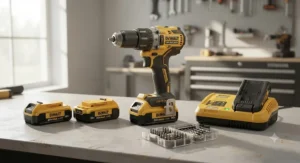
This one’s a single-tool kit rather than a 2-tool combo, and that’s actually the point — if you already own an impact driver or don’t need one, paying for a second tool you won’t use is wasted money. The XFD131 weighs just 3.8 lbs with its 3.0 Ah battery attached, noticeably lighter in the hand than most 2-tool kits’ drill component, which matters more than people expect during a full day of overhead work like installing crown molding or running conduit. The brushless motor delivers 440 in-lbs of max torque through a mechanical two-speed transmission (0-500 / 0-1,900 RPM), and Makita’s Star Protection Computer Controls communicate with compatible batteries to optimize output and prevent overheating. Based on the spec comparison, the real story here is Makita’s 18V LXT system being the largest cordless platform in the world by tool count, so buyers already invested in Makita batteries from other tools get a drill that slots right in. Reviewers note the fast-charging 3.0 Ah battery reaches full charge in about 30 minutes, a meaningful advantage if you’re bouncing between jobs.
Pros:
- ✅ Lightest drill-only weight for reduced overhead fatigue
- ✅ Fast-charging battery reaches full charge in ~30 minutes
- ✅ Slots into the world’s largest 18V tool ecosystem
Cons:
- ❌ No impact driver included, so it’s not a true combo kit
- ❌ Torque trails behind heavier-duty brushless competitors
Typically priced in the $150-$190 range for the kit configuration, this is worth checking current price on if you’re building a Makita-first toolbox rather than starting from zero.
7. Milwaukee M18 FUEL 2-Tool Combo Kit (2997-22) — most powerful for demanding jobs
If your projects involve concrete anchors, structural lag bolts, or eight-hour days rather than weekend touch-ups, this is the kit that stops feeling like overkill. The M18 FUEL hammer drill delivers 1,200 in-lbs of torque and 2,000 RPM through its POWERSTATE brushless motor, a figure that dwarfs every other kit on this list, while the companion impact driver produces up to 1,800-2,000 in-lbs of fastening torque. What most buyers overlook about the FUEL line is REDLINK PLUS intelligence, which actively communicates between tool and battery to prevent overload damage — a feature that matters when you’re routinely pushing tools to their limits rather than babying them. The included REDLITHIUM XC5.0 batteries are genuinely large-capacity packs, not token starter batteries, meaning this kit is ready for sustained daily use out of the box. Reviewers who’ve compared it directly against DeWalt and Bosch equivalents consistently rank it at or near the top for raw drilling speed under heavy load, though a handful note the drill’s overall length, while compact for its class at 6.9 inches, still feels substantial next to Makita’s LXT lineup.
Pros:
- ✅ Highest torque figures of any kit on this list
- ✅ Large 5.0 Ah batteries included standard, not token packs
- ✅ REDLINK PLUS intelligence protects tool and battery from overload
Cons:
- ❌ Highest price point on this list by a wide margin
- ❌ Overkill for casual homeowner projects
Pricing generally runs $300-$400 depending on retailer and current promotions. Check current price, as Milwaukee kits fluctuate more than most based on seasonal contractor sales.
Cordless Drill Battery Voltage Comparison: 12V vs 18V vs 20v Cordless Drill Set vs 24V
Voltage numbers are probably the most misunderstood spec in the entire power tool aisle, and manufacturers haven’t exactly helped by muddying the waters with marketing math. Here’s the honest breakdown: an 18V tool and a “20V MAX” tool are functionally almost identical. The “20V MAX” label refers to the battery’s peak voltage measured with no load, while the actual working voltage under load settles closer to 18V — DeWalt, Craftsman, and Black+Decker all use this labeling convention, while Milwaukee, Ryobi, Bosch, and Makita stick with the more honest nominal 18V figure. As the U.S. Department of Energy explains in its overview of lithium-ion battery technology, the internal chemistry of these packs is what actually determines usable energy and discharge rate, not the number printed on the case.
For context, 12V platforms (like Bosch’s compact line) trade power for size and weight, ideal for electricians and installers working overhead or in tight cavities all day. The mainstream 18V/20V MAX tier — where six of our seven picks live — represents the sweet spot for most buyers: enough torque for framing, decking, and general construction, without the bulk of professional-grade 24V+ tools. FLEX’s 24V platform and Makita’s 40V XGT system push into genuinely heavier-duty territory, aimed at contractors replacing corded tools entirely rather than supplementing them. If you’re deciding between a 20v cordless drill set and something in the 12V compact class, ask yourself honestly whether you’re drilling pilot holes in drywall or sinking 4-inch structural screws — the answer usually picks the platform for you.
Drill Set Torque Settings Explained
Torque numbers get printed in bold on every box, but the figure alone tells you almost nothing without context. In./lbs. (inch-pounds) measures rotational force — how hard the tool can twist a fastener or bit before stalling. A drill/driver producing 400 in-lbs is plenty for driving deck screws into pine, but an impact driver rated at 1,400+ in-lbs exists specifically because impact mechanisms deliver rotational hammer blows rather than continuous torque, letting them drive lag bolts and structural screws that would stall a standard drill or strip the driver bit. This is exactly why every kit on our list pairs a lower-torque drill with a much higher-torque impact driver rather than relying on one tool for both jobs.
Here’s the practical translation: under 500 in-lbs is comfortable for general household drilling and driving into softwoods. The 500-1,000 in-lbs range (where Bosch and mid-tier drills land) starts handling denser hardwoods and repeated fastening without motor strain. Above 1,000 in-lbs, you’re in impact driver and heavy-duty hammer drill territory — the Milwaukee 2997-22’s 1,200 in-lbs drill torque exists for masonry anchors and continuous-duty applications where lesser motors would overheat. Drill set torque settings on the tool itself (usually a numbered dial behind the chuck) let you cap the maximum torque the tool applies before it stops rotating, which brings us to clutch settings.
Drill Clutch Settings Guide: Getting It Right Every Time
The clutch dial is the small numbered ring just behind the chuck, and it’s the single most underused feature on any drill in this roundup. Its job is simple: it disengages the motor from the chuck once a preset resistance is reached, preventing you from stripping screw heads, snapping brittle fasteners, or punching a driver bit straight through drywall. Kits with more clutch positions — Bosch’s 20-25 settings versus Black+Decker’s 11 — give finer control, which matters more than it sounds like on paper. Reviewers consistently note that low clutch settings (positions 1-5) suit delicate work like cabinet hinges or drywall screws near the surface, while higher settings (15 and above) push toward full drilling torque with no slip-clutch protection at all.
A drill clutch settings guide worth following in practice: start low, test on a scrap piece of the actual material you’re using, and increase incrementally until the screw sinks flush without stripping. Softwoods like pine need less clutch resistance than hardwoods like oak; drywall anchors need almost none. The drill icon on most dials marks the maximum-torque setting reserved purely for drilling holes, where you want zero clutch slip interrupting the bit. Skipping this step is probably the single most common reason DIYers strip screw heads and blame the tool rather than the setting.

How to Choose the Best Cordless Drill Set
Picking the right kit comes down to matching specs to how you’ll actually use the tools, not chasing the highest number on the box. Consumer Reports’ cordless drill testing breaks tools into light-duty, general-use, and heavy-duty tiers based on lab-measured power and runtime, which is a genuinely useful lens for narrowing your own search. Here’s the framework, broken into steps:
- Define your project frequency first. Occasional household use points toward budget brushed kits like Black+Decker or Craftsman; daily or weekly use justifies brushless motors and their longer lifespan.
- Match torque to your hardest material. If you’re only ever driving into softwood and drywall, 400-500 in-lbs covers you. Decking, hardwood, or masonry pushes you toward 1,000+ in-lbs impact torque.
- Weigh battery platform commitment. Since batteries rarely cross brands, pick the ecosystem (DeWalt, Milwaukee, Ryobi, etc.) you’re most likely to expand into over the next five years.
- Check included battery capacity, not just count. Two small 1.3 Ah batteries can actually offer less total runtime than one larger 4.0 Ah pack — read the fine print.
- Prioritize clutch settings for finish work. Cabinetry, trim, and furniture assembly benefit enormously from 20+ clutch positions; framing and rough carpentry care less.
- Consider weight for overhead tasks. If you’re installing ceiling fixtures or crown molding regularly, Makita’s lighter drill-only option may beat a heavier 2-tool combo.
- Budget for accessories. Bit sets, extra batteries, and a proper case often cost as much as the tool discount you’re chasing — factor total cost, not just sticker price.
Common Mistakes When Buying a Cordless Drill Set
Even careful shoppers trip over the same handful of errors. First, buyers frequently choose based on voltage number alone, assuming a “20V” tool automatically beats an “18V” one — as covered above, that’s largely marketing math, not a real performance gap. Second, people underestimate battery importance, focusing entirely on the tool while ignoring that a 1.5 Ah battery and a 4.0 Ah battery from the same brand can mean drastically different runtimes on the same drill.
Third, shoppers often buy a 2-tool combo kit when they only need one tool, effectively paying extra for an impact driver that sits in a drawer. Fourth — and this one’s sneaky — some buyers assume higher price always means higher quality, when in reality Craftsman’s impact driver in our roundup actually out-torques DeWalt’s at a lower price point; brand reputation and raw spec performance don’t always move together. Finally, ignoring the clutch and torque settings entirely, then blaming the tool for stripped screws, is a mistake that costs buyers confidence in a perfectly good drill.
Best Cordless Drill Set for Beginners vs Pros
A first-time buyer assembling flat-pack furniture and hanging pictures has fundamentally different needs than a contractor framing decks five days a week, and no single kit optimizes for both. Beginners generally do better with simpler, lower-torque kits like the Black+Decker 20V MAX or Ryobi ONE+ HP — the learning curve on clutch settings and bit selection is gentler, and the lower price means a costly mistake (a stripped bit, a dropped tool) stings less. These buyers also benefit from kits with fewer accessories to manage; a 2-tool kit with one battery keeps things simple rather than juggling multiple packs and chargers.
Professionals and serious DIYers doing renovation work should lean toward the DeWalt, Bosch, or Milwaukee end of the spectrum, where higher torque, brushless efficiency, and larger-capacity batteries translate directly into fewer interruptions during an eight-hour day. The decision framework below builds on this split, but the short version is: match the tool’s ceiling to your actual workload, not your aspirational one.
Practical Usage Guide: Your First 30 Days With a New Drill Set
Getting the most from a new kit starts before you ever pull the trigger. Charge both included batteries fully before first use — most lithium-ion packs ship at a partial charge, and a full initial cycle helps the battery’s internal electronics calibrate properly. Once charged, spend ten minutes testing clutch settings on scrap wood rather than your actual project; this single habit prevents more stripped screws than any other precaution.
During the first month, avoid storing batteries at full charge in hot environments like a closed garage in summer — heat is the single biggest factor in long-term lithium-ion capacity loss, more so than charge cycles themselves. Rotate between your included batteries rather than running one to zero repeatedly, which extends overall pack lifespan. A common early mistake is over-tightening the chuck by hand past the ratcheting clicks, which can actually damage the jaws over time; most modern ratcheting chucks are designed to self-tighten under load, so a firm hand-twist is genuinely enough. Finally, keep the drill’s vents clear of sawdust buildup, especially with brushed-motor kits, since airflow restriction is a leading cause of premature motor wear. It’s also worth reviewing OSHA’s guidance on hand and power tool safety, which covers practical basics like eye protection and secure bit insertion that apply just as much in a home garage as on a jobsite.
Real-World Scenarios: Which Cordless Drill Set Fits Your Life
Consider a first-time homeowner tackling a weekend of shelving, curtain rods, and the occasional flat-pack dresser. Budget matters more than raw power here, frequency of use is low, and the environment is entirely indoors — the Black+Decker 20V MAX or Ryobi ONE+ HP both fit comfortably, with the Ryobi edging ahead thanks to its brushless motor and larger tool ecosystem for future purchases like a leaf blower or shop vacuum.
Now picture a weekend renovator rebuilding a deck twice a year and handling occasional drywall and trim work in between. This buyer needs more torque headroom and better clutch precision than the entry-level tier offers, without the premium price of professional-grade tools — the DeWalt DCK240C2 or Bosch 18V Compact kit both thread that needle, with Bosch pulling ahead for anyone doing finish carpentry where clutch precision protects expensive trim material.
Finally, imagine a contractor or serious hobbyist running the tool five days a week across framing, decking, and structural fastening. Battery life, torque ceiling, and motor durability under sustained heat all matter more than upfront price — the Milwaukee M18 FUEL 2997-22 is built for exactly this environment, with its REDLINK PLUS protection and oversized batteries designed for daily abuse rather than occasional use.
Buyer’s Decision Framework
If you drill fewer than ten holes a month and mostly assemble furniture, choose an entry-level brushed kit like Black+Decker or Craftsman because the lower price reflects your actual usage without wasted capability. If you’re renovating rooms or building outdoor structures several times a year, choose a mid-tier brushless kit like Ryobi ONE+ HP or DeWalt DCK240C2 because the extra torque and runtime prevent mid-project frustration. If your work involves finish carpentry, cabinetry, or delicate trim, choose the Bosch 18V Compact kit because its clutch precision protects material cost that dwarfs the tool price difference. If you’re using the tool daily in demanding conditions — framing, decking, structural fastening — choose the Milwaukee M18 FUEL because anything less will eventually bottleneck your workday with overheating or dead batteries.
Long-Term Cost & Maintenance
The sticker price is only part of the real cost of ownership. Battery replacement is the recurring expense most buyers forget to budget for — lithium-ion packs typically lose meaningful capacity after 300-500 charge cycles, translating to roughly two to four years of regular use depending on how hard they’re worked and how they’re stored. A replacement 18V/20V battery generally costs $50-$100 depending on capacity and brand, which is worth factoring into your total cost of ownership, especially for brands where batteries are pricier relative to the tool itself.
Brushless motors, present in the Ryobi, Bosch, Makita, and Milwaukee kits here, cost more upfront but eliminate carbon brushes entirely, meaning there’s essentially nothing to wear out mechanically inside the motor — brushed motors in the Black+Decker, Craftsman, and DeWalt kits will eventually need brush replacement or motor service after years of heavy use, though for occasional household tasks this may never actually come up in the tool’s practical lifespan. Chuck maintenance is simple across all brands: occasional light lubrication and keeping debris out of the jaws prevents the most common failure mode, a chuck that won’t fully tighten. Buying into a larger battery ecosystem (DeWalt or Milwaukee, given their 250-300+ tool lineups) also pays long-term dividends, since future tool purchases skip the battery and charger cost entirely.
Frequently Asked Questions
❓ What is the best cordless drill set for beginners?
❓ Is 20V better than 18V for a cordless drill?
❓ How many clutch settings does a good drill driver combo kit need?
❓ Do brushless drill motors really last longer than brushed ones?
❓ What torque do I need for deck screws and framing work?
Conclusion
There’s no single best cordless drill set — there’s only the right kit for your actual workload, and hopefully this breakdown made that decision easier rather than more overwhelming. If you’re assembling furniture and hanging shelves a few times a year, the Ryobi ONE+ HP or Black+Decker 20V MAX will serve you well without wasted spend. If you’re stepping up into regular renovation projects, the DeWalt DCK240C2 remains the industry’s default recommendation for good reason, while the Bosch 18V Compact rewards anyone prioritizing finish-work precision over raw torque. And if your days involve real structural work, the Milwaukee M18 FUEL 2997-22 simply outperforms everything else on this list.
Whatever you land on, remember that battery capacity and clutch settings matter as much as the torque number printed on the box — sometimes more. Match the tool to the job in front of you, not the one you might hypothetically tackle someday, and you’ll get years of reliable use out of whichever kit you choose.
✨ Don’t Miss These Exclusive Deals!
🔍 Take your toolbox to the next level with these carefully selected cordless drill sets. Click on any highlighted kit to check current pricing and availability. These tools will help you finish projects faster and with results your whole family will notice!
Recommended for You
- Cold Cut Saw vs Abrasive Cut Off Saw: 7 Best Picks for 2026
- 7 Best Cut Off Saw For Metal Picks in 2026
- Track Saw vs Table Saw 2026: 7 Picks That End the Debate
Disclaimer: This article contains affiliate links. As an Amazon Associate, I earn from qualifying purchases. If you purchase products through these links, we may earn a small commission at no additional cost to you.
✨ Found this helpful? Share it with your friends! 💬
