
In This Article
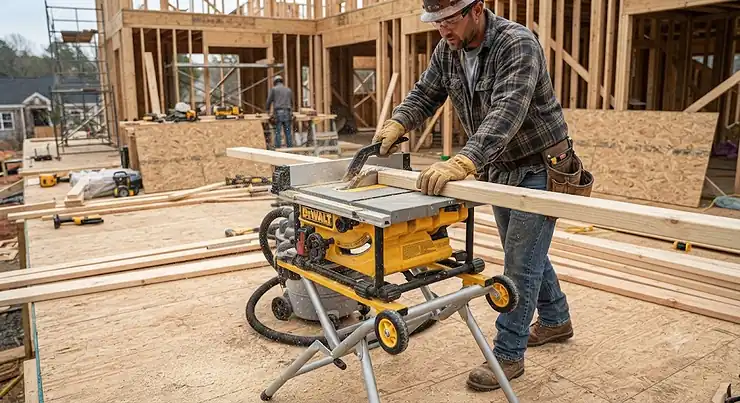
Buying a portable table saw used to mean picking whichever orange or blue box was on sale at the home center. Not anymore. Somewhere between 2020 and now, this category quietly turned into one of the most competitive corners of the power tool market, and that’s genuinely good news for you. A portable table saw is a compact, jobsite-ready version of a full-size cabinet saw — smaller footprint, lighter body, and usually a folding or rolling stand so it can travel from truck bed to driveway to garage without needing a forklift. It trades some rip capacity and raw horsepower for the one thing a cabinet saw can never offer: the ability to show up wherever the work is.
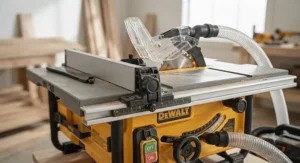
That tradeoff is exactly why this guide exists. Motor specs alone won’t tell you whether a saw survives five years of truck rides, and glossy marketing copy definitely won’t tell you that a popular model ships with a dust port that doesn’t fit a standard shop-vac hose (yes, that’s a real problem, and we’ll get into it). According to Wikipedia’s overview of table saw design, the category has evolved considerably from stationary shop equipment into these purpose-built jobsite variants, and the pace of change hasn’t slowed. So instead of repeating spec sheets, we dug through real aggregated reviews, manufacturer documentation, and independent testing data to build a comparison that actually helps you choose. Below you’ll find seven real, currently sold saws — budget, mid-range, and premium — broken down by what the numbers mean once you’re actually standing at the saw with a stack of plywood.
Quick Comparison Table
Here’s the short version before we go deep. Every saw below is a genuine 2026-available model, and every price listed is a range rather than a snapshot — check current price at the time you’re buying, since retailers adjust pricing constantly.
| Saw | Rip Capacity | Weight (w/ stand) | Stand Type | Best For | Price Range |
|---|---|---|---|---|---|
| DeWalt DWE7491RS | 32-1/2″ | ~90 lbs | Rolling | Pros wanting fence accuracy | $450-$600 |
| Bosch GTS15-10 | 32-1/8″ | 91 lbs | Gravity-Rise wheeled | Dado work & heavy rip capacity | $550-$700 |
| SawStop Jobsite Saw PRO | 25-1/2″ | ~99 lbs | Folding/rolling | Safety-first buyers | $1,300-$1,650 |
| Skilsaw SPT99-11 | 25″ | 49 lbs (saw only) | Rolling, 16″ wheels | Framing crews, dense hardwood | $400-$550 |
| Ridgid R4514 | ~30″ | ~95 lbs | Gravity-rise wheeled | Best value for pros | $450-$550 |
| Skil TS6307-00 | 25.5″ | 51 lbs | Integrated folding | Budget DIYers | $220-$320 |
| Flex FX7221 | 30.5″ | ~65 lbs | Rolling | Cordless/no-outlet jobsites | $550-$800 |
A few things jump out once you line these up side by side. The rip capacity gap between the top three (DeWalt DWE7491RS, Bosch GTS15-10, and Flex FX7221) and everything else is small enough that it rarely decides a purchase on its own — the real differentiators are stand design, dust management, and how each fence behaves under repeated use. Weight tells a different story: the Skilsaw SPT99-11 and Skil TS6307-00 are dramatically lighter as bare saws, which matters enormously if you’re the one lifting it into a truck bed every morning. Price, meanwhile, splits into three obvious tiers, with the SawStop Jobsite Saw PRO occupying a category of one thanks to its safety technology.
💬 Bookmark this comparison — you’ll want to scroll back to it once you’ve read the full breakdowns below.
💬 Just one click — help others make better buying decisions too!😊
Top 7 Portable Table Saws: Expert Analysis
1. DeWalt DWE7491RS — the fence that never drifts
The standout here isn’t the motor, it’s the rack-and-pinion telescoping fence, and that single detail is why this saw has anchored jobsite trailers for the better part of a decade. The 15-amp motor spins the 10-inch blade at 4,800 RPM, and the 32-1/2-inch rip capacity means a full 4×8 sheet of plywood goes through without repositioning or extra support. It also accepts a dado stack up to 13/16 of an inch, which is a genuine rarity in this price bracket — most direct competitors simply can’t do dado cuts at all.
Based on the spec comparison, this saw earns its reputation from consistency rather than flash. What most buyers overlook is that the fence’s rack-and-pinion mechanism locks parallel and stays there under lateral pressure, session after session, which is the single biggest complaint buyers have about cheaper alternatives. This is the saw for a working contractor who rips the same cut forty times in an afternoon and can’t afford to babysit a fence that walks out of square. Reviewers consistently report the fence holding zero measurable drift across extended use, and the rolling stand sets up fast enough to matter on a tight schedule.
Pros:
- ✅ Rack-and-pinion fence stays parallel under repeated use
- ✅ 32-1/2″ rip capacity handles full sheet goods in one pass
- ✅ Rare dado-stack compatibility up to 13/16″
Cons:
- ❌ Rolling stand is bulkier to store than folding-leg designs
- ❌ Motor RPM trails some newer rack-and-pinion competitors
At around $450 to $600 depending on retailer, this remains one of the strongest value-per-dollar picks on this list — the fence alone justifies the premium over bargain-bin saws.
2. Bosch GTS15-10 — biggest rip capacity, dust-port headache
Bosch’s current jobsite flagship replaced the long-running 4100XC-10, and the headline upgrade is a new rack-and-pinion fence plus a deeper 3-9/16-inch cut at 0 degrees — enough to clear 4x lumber in a single pass, something the older Bosch design couldn’t quite manage. Rip capacity comes in at 32-1/8 inches to the right of the blade and 14-1/8 inches to the left, putting it essentially neck-and-neck with the DeWalt above. The 15-amp motor tops out at 3,800 RPM, about 150 RPM faster than its predecessor.
Here’s what the spec sheet won’t tell you: independent testers measured the redesigned dust port at 2.23 inches internally with a 2.47-inch outer diameter, a nonstandard size that doesn’t reliably fit common shop-vac hoses without an adapter. That’s a real, sourced complaint worth weighing before you buy, especially if indoor dust control matters to your work. On the plus side, the rack-and-pinion fence upgrade is a legitimate step forward for precision, and the dado capacity matches the DeWalt at 13/16 of an inch.
Pros:
- ✅ 32-1/8″ rip capacity with deeper 3-9/16″ cutting depth
- ✅ New rack-and-pinion fence improves squaring accuracy
- ✅ Accepts dado stacks up to 13/16″
Cons:
- ❌ Redesigned dust port is a nonstandard size for many shop vacs
- ❌ Heavier than the Skilsaw and Flex at roughly 91 lbs
Priced in the $550 to $700 range, this saw is worth the premium over the DeWalt specifically for buyers who need dado capability and can solve the dust-port fitment issue with an adapter.
3. SawStop Jobsite Saw PRO — flesh-detection safety no rival matches
Every product on this list has a standout feature; this one has a standout category. SawStop’s flesh-detection technology uses electrical conductivity to sense skin contact with the spinning blade and fires a brake cartridge that both stops and retracts the blade in a fraction of a second, reportedly limiting contact injuries to a minor nick rather than a serious laceration. No other portable jobsite saw manufacturer currently offers this. Beyond the safety system, it runs a comparable 15-amp motor and includes standard rip-fence and miter functionality, though its 25-1/2-inch rip capacity is noticeably smaller than the DeWalt or Bosch above.
Based on the spec comparison, the honest tradeoff is capacity and cost versus risk mitigation. What most buyers overlook is that the blade-brake system doesn’t eliminate kickback risk, so the riving knife and blade guard still need to stay installed rather than being removed in the mistaken belief that the safety tech alone is sufficient — a point reinforced by federal machine-guarding standards for table saws generally, covered in more depth later in this guide. This is the saw for a shop owner, school program, or solo contractor who has decided that finger safety is worth a real premium and a smaller table.
Pros:
- ✅ Flesh-detection blade brake is unique in this category
- ✅ Reduces potential injury severity dramatically on contact
- ✅ Standard safety features remain intact alongside the brake tech
Cons:
- ❌ Smaller 25-1/2″ rip capacity than direct-drive competitors
- ❌ Significant price premium over every other saw on this list
Expect to pay in the $1,300 to $1,650 range — a steep jump, but for many buyers the safety technology alone makes the value case on its own terms.
4. Skilsaw SPT99-11 — worm-drive torque no direct-drive matches
This is the one genuinely different engineering approach on the list. Instead of a direct-drive motor, the SPT99-11 uses worm-drive gearing — the same mechanism that makes worm-drive circular saws the framing crew’s favorite — and the gear reduction produces roughly 30% more torque at the blade compared to direct-drive saws pulling the same 15-amp current. In practice, that means it holds RPM steady when ripping something dense like 4×4 white oak posts, where direct-drive competitors noticeably bog down. The 3-5/8-inch cutting depth clears a 4×4 post in a single pass, and the saw body alone weighs just 49 pounds — the lightest full-size portable saw on this list.
Here’s what most buyers overlook: worm drives need scheduled maintenance that direct-drive saws don’t. A break-in oil change at 10 hours is not optional, and skipping the 50-hour interval afterward risks real gear damage. The saw also runs louder, at roughly 94 decibels versus about 89 on the DeWalt, and it has no dado capability due to its riving-knife design. If your work involves dense hardwood ripping and you don’t mind the maintenance routine, reviewers consistently note this saw shines exactly where direct-drive saws struggle.
Pros:
- ✅ Roughly 30% more torque at the blade than direct-drive saws
- ✅ Lightest full-size saw body at 49 lbs
- ✅ 16″ wheels handle stairs and rough terrain well
Cons:
- ❌ Requires scheduled oil changes or risks gear damage
- ❌ No dado-blade capability and noticeably louder in operation
Priced from about $400 to $550, this is the specialist’s pick — best for hardwood-heavy framing work, less ideal if dado joinery is part of your regular workflow.
5. Ridgid R4514 — gravity-rise value pick for pros
Ridgid’s approach here is straightforward: skip the flashiest features and nail the fundamentals at a fair price. Independent testing clocked this saw’s blade speed at 4,800 RPM, the highest of any saw tested in its comparison group, and its roughly 30-inch rip capacity puts it in the same conversation as the DeWalt and Bosch above. The gravity-rise wheeled stand folds and deploys quickly, and the miter gauge is a noticeable step up in build quality from what typically ships with budget saws.
Based on the spec comparison, the compromise is the rip fence. Unlike the DeWalt and Bosch, it doesn’t use a rack-and-pinion adjustment system, which makes squaring the fence to the blade a slightly slower, more deliberate process rather than a quick spin of a wheel. What most buyers overlook is that this tradeoff is exactly how Ridgid keeps the price down while matching or beating the top-tier saws on raw cutting numbers. Reviewers consistently note this as a “checks the right boxes” saw — nothing to complain about, nothing flashy, just solid value.
Pros:
- ✅ Highest tested blade speed among comparable saws at 4,800 RPM
- ✅ Gravity-rise stand deploys in seconds
- ✅ Above-average miter gauge build quality for the price
Cons:
- ❌ Fence lacks rack-and-pinion adjustment, slower to square
- ❌ Fewer premium accessories included than Bosch or DeWalt kits
In the $450 to $550 range, this is arguably the strongest dollar-for-dollar pick for a working pro who doesn’t need dado capability or a rack-and-pinion fence.

6. Skil TS6307-00 — lightest budget saw with a built-in stand
If your budget or your storage space is the limiting factor, this is the saw built for you. It’s the smallest saw on this list with a rip capacity of about 25.5 inches, and it measures a compact roughly 2 feet by 2 feet when folded — small enough to tuck into a garage corner that a rolling-stand saw simply won’t fit into. Unlike every other entry here, it sits on foldable legs rather than a collapsible wheeled base, and at just 51 pounds it’s genuinely easy for one person to lift and carry without wheels at all.
Here’s the honest analytical take: the foldable-leg design is a little slower to set up and break down than a gravity-rise stand, but the broad stance it creates gives the saw noticeably less wobble than saws that rely on narrower wheeled bases. What most buyers overlook is that a 15-amp motor at this price point is still a real, capable motor — it handles plywood, softwood, and light hardwood cleanly, even if it’s not built for all-day dense-hardwood ripping. Reviewers consistently frame this as the practical entry point for DIYers and hobbyists who don’t need pro-level rip capacity.
Pros:
- ✅ Integrated folding stand needs zero separate assembly
- ✅ Lightest saw-plus-stand combo on this list at 51 lbs
- ✅ Compact 2’x2′ folded footprint fits tight storage spaces
Cons:
- ❌ Smallest rip capacity on this list at 25.5″
- ❌ No wheels, so setup takes slightly longer than gravity-rise stands
At a budget-friendly $220 to $320, this is the clear pick for anyone prioritizing price and portability over maximum capacity.
7. Flex FX7221 — first cordless saw that cuts 4×4 in one pass
This is the saw that changes the conversation about what “portable” even means. The FX7221 runs on a 24V Stacked Lithium battery system (a 10.0Ah pack is standard in the kit) and is marketed as the first cordless 10-inch table saw capable of cutting a 4×4 post in a single pass, thanks to a 3-5/8-inch cutting depth at 0 degrees. Rip capacity comes in at 30.5 inches to the right of the blade, and it includes a rack-and-pinion fence system along with a CUTSENSE feature that automatically stops the blade after each cut to conserve battery runtime.
Based on the spec comparison, the real advantage here isn’t raw power, it’s flexibility: an optional AC power adapter lets this same saw run corded on job sites where an outlet is available, then switch back to battery power where it isn’t. What most buyers overlook is how much this matters for remote framing sites, older homes without reliable circuits, or any job where running an extension cord is genuinely impractical. Reviewers consistently point to the LED fence worklight and battery-status indicator as small but appreciated touches you won’t find on corded-only competitors.
Pros:
- ✅ Hybrid battery-or-AC operation fits outlet-free jobsites
- ✅ Rack-and-pinion fence matches corded competitors for precision
- ✅ CUTSENSE auto-stop conserves battery life between cuts
Cons:
- ❌ Full kit with battery and charger costs more than comparable corded saws
- ❌ Battery runtime still limits truly all-day cutting sessions
The bare tool starts around $550, with the full battery-and-charger kit landing closer to $700-$800 — a real premium, but one aimed squarely at buyers who’ve been burned by extension cords one too many times.
Practical Usage Guide: Setup, First Cuts, and 30-Day Maintenance
Getting a new portable table saw dialed in correctly in the first week saves you from chasing inaccurate cuts for years afterward. Start by squaring the blade to the miter slot before you square the fence to the blade — doing it in the reverse order just means resquaring everything twice. Most saws ship with the fence slightly out of parallel from shipping vibration, so check it with a combination square on both the front and back of the blade before your first real cut, not just the front.
The most common first-30-days mistake is skipping the riving knife and blade guard reinstallation after a dado cut or non-through cut, then simply forgetting to put it back. Build a habit of reinstalling the guard immediately after any specialty cut, before the saw gets used again. For maintenance, wipe down and lightly wax the table surface every few weeks to keep material sliding smoothly rather than catching, and check the fence rail bolts for the slight loosening that comes from truck-bed vibration — a quarter-turn with an Allen key every couple of weeks keeps a rack-and-pinion fence from developing play. If you’re running a worm-drive saw like the Skilsaw SPT99-11, mark your calendar for that 10-hour break-in oil change; it’s the single most skipped maintenance step reviewers flag as a cause of premature gear wear.
Real-World Scenarios: Matching Saws to Actual Jobs
Picture a solo remodeling contractor who drives to two or three residential jobs a week, mostly cabinetry and trim work, and needs a saw light enough to carry up a flight of stairs alone. The Skil TS6307-00 or the Skilsaw SPT99-11 both fit that profile well — one prioritizes low weight and simplicity, the other prioritizes cutting torque for denser trim stock.
Now picture a framing crew working a new-construction site with no power hookup yet, cutting pressure-treated 4x4s and dimensional lumber all day. The Flex FX7221 solves the power problem outright, and its one-pass 4×4 capacity matches the actual work being done, while the optional AC adapter covers them once the site gets wired.
Finally, picture a weekend hobbyist building garage shelving and the occasional furniture project, working mostly with plywood and softwood, budget-conscious, and short on storage space. The Skil TS6307-00 again earns its keep here — its rip capacity is plenty for shelving cuts, and its folded footprint tucks into a garage corner between projects.
Buyer’s Decision Framework
If you rip full sheet goods regularly and need the fence to stay square without babysitting, choose a rack-and-pinion saw like the DeWalt DWE7491RS or Bosch GTS15-10, because fence drift compounds error across every subsequent cut. If personal injury risk is your top priority regardless of cost, choose the SawStop Jobsite Saw PRO, because no other saw on this list offers equivalent blade-contact protection. If you’re cutting dense hardwood or thick posts all day, choose the Skilsaw SPT99-11 for its torque advantage, accepting the maintenance tradeoff. If your jobsite has no reliable power source, choose the Flex FX7221 for its hybrid battery-or-AC flexibility. And if budget or storage space is your binding constraint, choose the Skil TS6307-00, because its integrated stand and light weight solve the problem a bigger saw would create.
✨ Ready to compare options side by side? Check current prices before you decide — availability shifts often.
How to Choose the Best Jobsite Table Saw
Finding the best jobsite table saw for your specific work comes down to weighing a handful of factors against each other rather than chasing the single “best” spec.
- Match rip capacity to your actual material, not your aspirational projects — 25 inches is plenty if you rarely handle full sheet goods.
- Prioritize fence type if repeat-cut accuracy matters more than raw power; rack-and-pinion designs hold square longer under use.
- Weigh portability against capacity honestly — a 49-pound saw you’ll actually load into the truck beats a 100-pound saw that stays in the garage.
- Check dado compatibility early if joinery work is part of your regular process, since it eliminates entire saws from consideration.
- Factor in power source realistically — cordless flexibility is a genuine advantage on sites without reliable outlets.
- Treat safety technology as a real cost-benefit decision, not an afterthought, especially for solo operators without a second set of hands nearby.
- Budget for accessories (zero-clearance inserts, outfeed support, dust adapters) since base kits rarely include everything you’ll eventually want.
DeWalt vs Bosch: Table Saw Review Face-Off
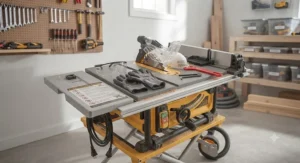
Since these two saws dominate so much of the jobsite conversation, they deserve a direct comparison beyond their individual product cards above.
DeWalt Table Saw Review: Is the DWE7491RS Still Worth It in 2026?
The short answer, based on the spec comparison and years of aggregated contractor feedback, is yes. The rack-and-pinion fence remains the standout reason this saw keeps appearing on “best of” lists year after year, and its 32-1/2-inch rip capacity and dado compatibility haven’t been meaningfully surpassed by newer competitors at a similar price. What most buyers overlook is that DeWalt hasn’t needed to chase flashy redesigns because the core fence mechanism already solved the problem competitors are still iterating toward.
Bosch Table Saw Review: What the GTS15-10 Gets Right (and Wrong)
Bosch’s answer is a legitimate step forward on paper — a new rack-and-pinion fence, deeper cut capacity, and marginally higher blade speed than its 4100-series predecessor. According to Pro Tool Reviews’ ongoing jobsite saw testing, the fence upgrade genuinely closes the gap with DeWalt on precision. But the redesigned dust port’s nonstandard fitment is a real, documented drawback that undercuts an otherwise strong upgrade, and it’s the kind of detail that only shows up once you’ve actually tried to hook up a shop vac.
Pros:
- ✅ Rack-and-pinion fence closes the accuracy gap with DeWalt
- ✅ Slightly deeper cutting depth handles 4x lumber more easily
Cons:
- ❌ Nonstandard dust port complicates shop-vac hookup
The honest verdict: choose the DeWalt DWE7491RS if dust-port compatibility with your existing shop vac matters, and choose the Bosch GTS15-10 if the marginally deeper cut and dado capability outweigh that inconvenience for your specific work.
Portable Table Saw Weight and Stand Options: What Actually Matters
Portable Table Saw Weight: What the Spec Sheet Won’t Tell You
Weight numbers on a spec sheet are almost meaningless without context, because “45 pounds” means something completely different depending on whether that’s the bare saw or the saw with a steel wheeled stand attached. The Skilsaw SPT99-11 at 49 pounds is a bare-saw figure; add its rolling stand and total transport weight climbs considerably higher. What actually matters in practice is how the weight is distributed and whether wheels do the heavy lifting for you. A 90-pound saw on a smooth-rolling gravity-rise stand is genuinely easier to manage solo than a 60-pound saw with no wheels at all, especially over gravel or stairs. If you’re regularly working solo without help loading a truck, weigh the wheeled-stand saws in this list more heavily than the raw bare-saw number suggests.
Table Saw Folding Stand vs Rolling Stand vs Integrated Base
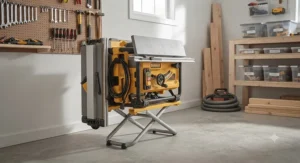
A portable table saw with stand generally falls into three categories, and each solves a different problem. Rolling stands, like the ones on the DeWalt DWE7491RS and Ridgid R4514, prioritize quick wheeled mobility across a flat jobsite. Gravity-rise stands, as seen on the Bosch GTS15-10, use the saw’s own weight to lower and raise the stand in a single motion, which is faster to deploy but occasionally less rigid feeling than a fixed rolling frame. A table saw folding stand, like the leg-based design on the Skil TS6307-00, sacrifices some setup speed for a dramatically smaller storage footprint and, thanks to its wider leg stance, often less wobble than a narrow wheeled base. If storage space is tight, the folding-leg approach wins; if you’re moving the saw across a jobsite multiple times a day, a wheeled stand wins on convenience alone.
Features That Actually Matter (And Those That Don’t)
Rip capacity beyond what your typical material actually requires is the single most overhyped spec in this category — an extra 5 inches of capacity you use twice a year doesn’t outweigh a heavier saw you have to carry every single day. Fence type, on the other hand, matters enormously and consistently, since it affects the accuracy of every cut you make for the life of the saw. Motor amperage numbers are largely marketing noise once you’re comparing 15-amp saws against other 15-amp saws — RPM under load and torque delivery tell you far more about real cutting performance than the amp rating alone. Dust collection, too often treated as an afterthought in marketing copy, genuinely affects both air quality and how much time you spend cleaning up afterward, and as the Bosch dust-port issue shows, it’s worth checking before you buy rather than after.
Jobsite Table Saw Dust Port and Safety Regulations Guide
A jobsite table saw dust port isn’t a nice-to-have accessory feature — it’s a real health and cleanup consideration, particularly for indoor or enclosed-space work. Independent measurements found the Bosch GTS15-10’s redesigned dust port measuring 2.23 inches internally with a 2.47-inch outer diameter, a size that didn’t match standard shop-vac hoses in testing, forcing some buyers to source an adapter separately. The DeWalt DWE7491RS, by comparison, uses a more conventional 2-1/2-inch port that pairs more readily with common shop vacs, though even that setup can lose some dust to a secondary port near the riving knife if it isn’t also connected. Reviewers consistently note dust capture rates around 80 to 85 percent when a decent shop vac is properly connected to a well-designed port — a meaningful difference from the loose sawdust cloud you get without any dust collection at all.
Beyond dust, table saw safety is governed by real regulatory standards worth knowing. OSHA’s machine guarding requirements for table saws call for a self-adjusting hood guard above the blade, a spreader or riving knife to prevent kickback, and anti-kickback fingers on ripping operations — standards that apply in professional settings and are simply good practice at home too. Regardless of whether your saw includes flesh-detection technology like the SawStop Jobsite Saw PRO, the guard and riving knife should stay installed for every standard cut; blade-brake technology addresses contact injuries specifically, not kickback, which remains a separate hazard requiring its own guarding.
Common Mistakes When Buying a Portable Table Saw
The single most common mistake is buying based on rip capacity alone and ignoring fence type entirely, which leads to frustration on every single cut rather than just the occasional oversized one. A close second is underestimating actual transport weight — buyers frequently check the bare-saw weight and are surprised by how much heavier the saw-plus-stand combination feels in practice, a gap Bob Vila’s hands-on table saw testing highlights repeatedly across models. A third mistake is skipping dado-capability research upfront, only to discover mid-project that a saw’s riving-knife design makes dado cuts impossible without a separate blade-guard removal process. Finally, plenty of buyers overlook dust collection entirely until they’re already breathing sawdust in an enclosed garage, when a five-minute check of port size and shape before purchase would have avoided the problem.
Long-Term Cost & Maintenance
The sticker price is only part of the total cost of owning a portable table saw. Corded direct-drive saws like the DeWalt DWE7491RS and Ridgid R4514 have relatively low ongoing maintenance costs beyond blade replacement and occasional fence-bolt tightening. The Skilsaw SPT99-11‘s worm-drive design adds a recurring cost most buyers don’t budget for: scheduled oil changes, which are cheap individually but add up in time and consumables over years of use, and skipping them risks a gear-replacement bill that dwarfs the saw’s original price. Battery-powered saws like the Flex FX7221 shift cost structure entirely — the upfront kit price is higher, but there’s no fuel or oil expense, and battery replacement down the road becomes the main long-term cost to plan for. The SawStop Jobsite Saw PRO carries a unique cost consideration too: the blade-brake cartridge is a consumable that needs replacing after it fires, a cost worth factoring into the saw’s already-higher price of entry.

Frequently Asked Questions
❓
What is a portable table saw used for?
❓ How heavy is a typical portable table saw?
❓ Is a folding stand or rolling stand better for a jobsite table saw?
❓ Do all portable table saws have a standard dust port size?
❓ Is a cordless portable table saw powerful enough for real jobsite work?
Conclusion
There’s no single best portable table saw for everyone, and that’s really the point of this whole guide. If fence accuracy is your top priority, the DeWalt DWE7491RS remains the safest bet nearly a decade into its run. If dado capability and slightly deeper cuts matter more, the Bosch GTS15-10 earns its premium despite the dust-port quirk. Safety-first buyers have a genuinely unique option in the SawStop Jobsite Saw PRO, hardwood specialists should look hard at the Skilsaw SPT99-11‘s torque advantage, value-focused pros will find a lot to like in the Ridgid R4514, budget and storage-conscious DIYers fit well with the Skil TS6307-00, and anyone tired of extension cords should seriously consider the Flex FX7221‘s hybrid flexibility. Match the saw to how you actually work, not to whichever spec sheet has the biggest number, and you’ll end up with a tool that earns its keep for years.
✨ Don’t Miss These Exclusive Deals!
🔍 Take your portable table saw shopping to the next level with these carefully selected picks. Click on any highlighted model above to check current pricing and availability, and find the saw that actually fits how you work. 🚧🪚
Recommended for You
- Table Saw For Beginners: 7 Safe Picks That Won’t Bite Back (2026)
- 6 Inch vs 8 Inch Bench Grinder: 7 Best Picks for 2026
- Bench Grinder for Knife Sharpening: 7 Sharp Picks (2026)
Disclaimer: This article contains affiliate links. As an Amazon Associate, I earn from qualifying purchases. If you purchase products through these links, we may earn a small commission at no additional cost to you.
✨ Found this helpful? Share it with your friends! 💬🤗
