
In This Article
What are tin snips for sheet metal? They’re hand-powered cutting tools built like heavy-duty scissors, with short hardened blades and long handles that slice thin steel, aluminum and copper without a power tool. The right tin snips for sheet metal match your material’s thickness, your cut direction and the grip your hand can hold all afternoon.

Here’s the part most buyers learn the expensive way: a good pair of snips is a lever, not a pair of scissors with an attitude. Tin snips come in several patterns, and the compound-action “aviation” design was first developed to cut aluminum in aircraft construction. That heritage explains the red, green and yellow handles, borrowed from an airplane’s navigation lights. It’s also why aviation tin snips remain the default in HVAC shops, roofing trucks and garage workshops.
So why does a 2026 buyer’s guide matter? The category is crowded with look-alikes, and the differences hide in the details: forged versus cast blades, offset versus straight handles, and an 18 gauge rating that means one thing on mild steel and another on stainless. This guide ranks seven real models, from a budget pair in the mid-teens to a premium double-cut that can run near $100. It shows where each one earns its keep in ductwork fabrication, gutters, flashing and metal roofing panels.
A note on honesty before we dive in. Everything below comes from manufacturer specifications, trade-review roundups and aggregated reviewer sentiment. I haven’t swung these tools myself, so you won’t find invented bench-test heroics, only spec-grounded reasoning and plain-spoken trade-offs. Think of it as a knowledgeable friend reading the fine print so you don’t have to, with straight cut tin snips advice you can act on today.
Quick Comparison: Tin Snips for Sheet Metal at a Glance
Capacities below are the makers’ published ratings, and price ranges are approximate at the time of research. Prices vary by retailer, so check current price before buying.
| Product | Cut Type | Published Steel Capacity | Price Range | Best For |
|---|---|---|---|---|
| Crescent Wiss M3R | Straight, wide left and right curves | 18 ga low-carbon steel | $20-$30 | All-round shop and job-site use |
| Malco M2007 Max2000 | Offset, straight and right cuts | 18 ga mild and galvanized, 20 ga stainless | $45-$60 | HVAC ductwork fabrication |
| Midwest MWT-6510S | Offset, straight and wide curves | 18 ga cold-rolled, 22 ga stainless | $35-$45 | Long straight runs, forged-blade fans |
| Milwaukee 48-22-4532 | Offset, straight cutting | 18 ga cold-rolled, 22 ga stainless | $20-$30 | Forged blades on a mid budget |
| Malco M2004 Max2000 Double Cut | Straight, double cut | 22 ga mild and galvanized | $60-$100 | Round duct and stovepipe |
| Klein Tools 89556 | Straight, wide curves | 24 ga steel, 28 ga stainless | Around $30 | Thin gauge, roofing, gloved hands |
| Hurricane 10 Inch Aviation Tin Snips | Straight | Listings vary, 18-20 ga | $13-$16 | Budget DIY and occasional use |
Looking at the comparison above, the Crescent Wiss M3R is the safest single purchase because one yellow-handled pair covers straight cuts and gentle curves. If long runs of ductwork fabrication are your daily bread, the Malco M2007 Max2000 and Midwest MWT-6510S justify their higher prices with offset geometry and stainless ratings. Budget buyers should note that the Hurricane 10 Inch Aviation Tin Snips trade blade length and published precision for a bargain price, while the Klein Tools 89556 shines on thin gauge but isn’t built for 18 gauge steel.
💬 Just one click — help others make better buying decisions too!😊
Top 7 Tin Snips for Sheet Metal: Expert Analysis
Each pick below pairs the published specs with what they mean at the bench. Where independent review data was thin, I say so rather than paper over it.
1. Crescent Wiss M3R — the benchmark straight cut workhorse
The yellow-handled Crescent Wiss M3R is the pair other snips get measured against, because one tool covers straight cuts plus wide left and right curves.
It’s a 9¾-inch compound-action design rated for up to 18 gauge low-carbon rolled steel, with serrated molybdenum blades and a free-floating pivot. In practice, the serrations bite and hold the sheet so it doesn’t skate sideways mid-cut. The compound linkage multiplies your grip, so 20 gauge galvanized flashing feels like cardboard rather than armor. Crescent also advertises up to 8 miles of steel per pair. That’s a marketing number, but it hints at edge life.
Based on the spec sheet, this is the pair for someone who owns exactly one snip. Its one limit is radius: tight turns call for the red Wiss M1R or green Wiss M2R siblings. Aggregated reviewer sentiment is strongly positive, with trade roundups citing roughly a 4.7 average across thousands of ratings. Owners often mention a spring that doesn’t wear out the hand on long runs. I found no consistent defect pattern in the sources reviewed.
Pros:
- ✅ One pair handles straight and gentle curved cuts
- ✅ Strong spring-action feed reduces hand fatigue
- ✅ Single-handed latch suits left and right hands
Cons:
- ❌ Tight-radius cuts need the red or green siblings
- ❌ Straight handles keep knuckles close to the sheet
Expect roughly the $20-$30 range, depending on retailer. For this versatility, the value verdict is excellent.

2. Malco M2007 Max2000 — offset leverage built for long duct runs
The Malco M2007 Max2000 is a right-cut offset snip that trade roundups keep recommending to HVAC techs, and its spec sheet explains why.
It’s a 10-inch tool with a 1¼-inch cut length, a serrated upper jaw of hardened alloy steel, a forged lower jaw and compound head-to-handle linkage. Malco publishes capacities of 18 gauge mild and galvanized steel and 20 gauge stainless. It also lists aluminum up to 0.062 inch. The offset handle lifts your hand above the sheet, so the offcut curls away instead of colliding with your knuckles. The narrower grip opening is meant to suit both large and small hands. The spring is a replaceable part (M2000S), which matters for long-term cost.
The practical takeaway: this is among the strongest published capacities in this roundup, and it cuts straight lines, sharp right angles and 5-inch circles. Reviewer sentiment is generally warm. One supplier-page reviewer reported noticeably less effort after moving up from Wiss, and a roundup credits it with 10-plus years of daily use. Rating samples on some retailer pages are small, though, so treat the praise as directional.
Pros:
- ✅ Offset geometry keeps hands clear on long cuts
- ✅ Published 18 gauge galvanized and 20 gauge stainless capacity
- ✅ Replaceable spring and limited lifetime warranty
Cons:
- ❌ Costs more than comparable budget offset snips
- ❌ Direction-specific, so left curves need the M2006
Expect roughly the $45-$60 range. If you cut duct weekly, the value verdict is a confident yes.
3. Midwest MWT-6510S — forged molybdenum blades for clean straight runs
The Midwest MWT-6510S is a made-in-USA offset snip that appeals to people who care about what the blade is made of.
Its blades are hot drop-forged from molybdenum alloy steel and Austemper heat-treated, then precision ground. Published capacity is 18 gauge cold-rolled steel and 22 gauge stainless, with a cut length of roughly 1¼ to 1½ inches depending on the listing. It weighs about 15 ounces. Midwest claims 20 percent less effort than conventional snips. That’s a manufacturer claim rather than an independent measurement, but forged, heat-treated blades plausibly hold their edge longer than cast ones.
The offset body flows material away from the blades and keeps your hand above the work. That matters when you’re running a long cut down a full sheet of flashing or a roof panel. It also means the pair excels at straight lines and wide curves, while tight turns need the left or right models. Independent review data was thinner than for the Wiss. The glowing tinner testimonials I found sit on the manufacturer’s own site, so weigh them as marketing. Trade roundups do file it among premium straight-run options.
Pros:
- ✅ Forged molybdenum blades hold a precision edge
- ✅ Offset design suits long cuts on full sheets
- ✅ Published stainless rating and USA manufacture
Cons:
- ❌ Costs more than the Wiss M3R for similar steel capacity
- ❌ Tight curves need left or right siblings
Expect roughly the $35-$45 range. It’s a fair price for forged blades.
4. Milwaukee 48-22-4532 — forged blades at a friendly price
The Milwaukee 48-22-4532 brings forged serrated blades, which are usually a premium feature, into the $20-$30 neighborhood.
This 10-inch, roughly one-pound offset snip has a 45-degree handle offset, a flush pivot bolt and a bolt lock that helps hold tension. It also has a one-handed metal lock, chrome plating and a lanyard hole. Milwaukee publishes 18 gauge cold-rolled steel and 22 gauge stainless capacity, and says forged blades deliver up to 10 times more cuts than cast blades. That comparison is against cast blades, not against rival forged snips.
What the spec sheet won’t tell you, but the design implies, is that the lanyard hole is a quiet win for roof work. A dropped pair of snips is a slow, awkward descent. The flush pivot also helps avoid snagging on the stock. One honest caveat: I couldn’t verify a deep pool of independent reviews, and at least one distributor page listed none. A trade roundup does praise the offset design for cutting flat sheet where straight snips scrape knuckles. That fits the geometry.
Pros:
- ✅ Forged serrated blades at a modest price
- ✅ Lanyard hole helps tether on roofs and ladders
- ✅ Offset handle keeps knuckles clear of flat sheet
Cons:
- ❌ Limited independent review data to lean on
- ❌ Straight cutting pattern limits tight curves
Expect roughly the $20-$30 range. On paper, it’s the value pick among forged-blade snips.
5. Malco M2004 Max2000 Double Cut — distortion-free cuts in round duct
The Malco M2004 Max2000 Double Cut is a specialist, and it’s the pair to buy when keeping duct round matters more than raw capacity.
Instead of two blades it has three, with a sharp-tipped center jaw that removes a narrow strip rather than bending the metal aside. A curved cutting edge on that center jaw reduces cutting force, and the self-starting point makes blind cuts easy. Malco’s published capacities are lower than its other Max2000 models: about 0.040 inch aluminum, 0.034 inch copper and galvanized steel (22 gauge), and 0.030 inch mild steel (22 gauge). The cut length is 1⅜ inches, and the tool weighs 16 ounces.
For ductwork fabrication, that capacity ceiling is the whole story. Light-gauge round pipe and stovepipe suit it, while 18 gauge sheet does not. In exchange, the cut edge stays clean and the pipe stays round, which saves reshaping time. Independent review data was sparse, and supplier listings mostly repeat the spec sheet, so I won’t pretend otherwise. The broader Max2000 family earns steady praise in trade roundups.
Pros:
- ✅ Cuts light-gauge round duct without distortion
- ✅ Self-starting center jaw handles blind cuts
- ✅ Made in the USA with a limited lifetime warranty
Cons:
- ❌ Capacity tops out around 22 gauge steel
- ❌ Costs more than general-purpose aviation snips
Expect a wide $60-$100 range depending on seller. Buy it only if round duct is your regular diet.

6. Klein Tools 89556 — replaceable blades for thin-gauge and roofing jobs
The Klein Tools 89556 is a traditional tinner’s snip rather than a compound-action design, and that shapes everything about it.
It’s 12 inches long with 3.5-inch high-carbon blades, all-steel construction and large handle openings sized for gloves. It’s rated for 24 gauge steel and 28 gauge stainless, plus copper, aluminum and vinyl. The headline feature is replaceable blades. Klein sells a kit (89555) with two blades and the hardware to install them. That turns a dull edge into a ten-minute repair instead of a trip to the store.
The long blade means fewer re-bites on a long cut, which gives a cleaner edge on thin sheet. Because there’s no compound linkage, though, you’re doing the work yourself, hence the lighter capacity rating. Review snippets I found were mixed in a useful way. One buyer praised how easily it cut galvanized roof paneling, and another said it was fine but not for lengthy cutting. Others said it came out larger than expected. Treat it as a thin-gauge specialist.
Pros:
- ✅ Replaceable blades extend the tool’s life
- ✅ Long 3.5-inch cut reduces re-biting
- ✅ Generous handles accommodate work gloves
Cons:
- ❌ Capacity limited to roughly 24 gauge steel
- ❌ Reviewers say it tires hands on long cutting sessions
Expect to pay around $30. For thin-gauge work, it’s a fair price.
7. Hurricane 10 Inch Aviation Tin Snips — the budget straight cut pick
The Hurricane 10 Inch Aviation Tin Snips are the entry ticket: a straight cut pair that costs about as much as lunch.
They use chrome vanadium blades, a rubberized TyreGrip handle and a safety latch, and weigh roughly 0.9 pound. Listings disagree on capacity, quoting anywhere from 18 to 20 gauge cold-rolled steel. When the sources conflict, plan around 20 gauge and treat 18 gauge as a stretch. That caution matters because pushing beyond rating is the fastest way to chip a blade.
Retail listings show a 4.6-star average across thousands of ratings. Reviewers repeatedly cite comfort and value, and one listed use case is a kitchen tin backsplash. Recurring gripes are modest: some wish the blades were longer, and smaller-handed users note the grips sit far apart when relaxed. For gutters, light flashing, tin crafts and weekend projects, these deliver straight cut tin snips performance without a cheque to match. Professionals will outgrow them.
Pros:
- ✅ Very low price for aviation tin snips
- ✅ Soft rubberized grip reduces hand strain
- ✅ Safety latch keeps blades closed in a toolbox
Cons:
- ❌ Short blade length means more re-biting
- ❌ Wide grip span challenges smaller hands
Expect roughly the $13-$16 range. For occasional use, the value verdict is hard to argue with.
✨ Don’t Miss These Top Picks!
🔍 Take your metalwork to the next level with these carefully selected snips. Click on any highlighted item to check current pricing and availability. These tools will help you create clean, professional cuts you’ll be proud of!
How to Use Tin Snips for Sheet Metal: A First-30-Days Playbook
Owning the right pair is half the job. Technique is the other half, and it’s free.
Setup. Scribe your line with a marker or scratch awl and support the sheet so the offcut can fall or curl freely. Pinching a sheet against a bench edge works well for flashing. Put on glasses and gloves before the first cut, because fresh sheet edges are as sharp as they look.
Cutting technique.
- Open the jaws fully and cut with the back two-thirds of the blades, where leverage is highest.
- Stop short of the blade tips and re-bite, rather than closing fully each time. This avoids stepped notches and tearing.
- Make long, steady cuts instead of short jabs, since choppy cuts leave burrs that snag skin.
- Let the offcut curl away. Offset snips are designed to push it clear.
Maintenance schedule.
- Weekly: wipe the blades and add a drop of light oil at the pivot.
- Monthly: check the pivot bolt. Loose bolts cause chewed edges, and over-tight ones cause stiffness.
- Always: latch the snips before storing them.
Common mistakes in the first 30 days. New owners often cut wire, screws or banding with sheet metal snips, which chips blades fast. Others twist the tool sideways mid-cut or push 16 gauge material through a pair rated for 18. If a cut needs two hands and a prayer, switch tools instead of forcing it.
Problem → Solution Guide: Fixing the Five Most Common Snip Headaches
Most frustrations trace back to a handful of causes, and each has a quick fix.
1. Ragged, chewed edges. The pivot is usually loose or the blades are dull. Tighten the bolt first. If the edge is still rough, a Klein Tools 89556 owner can swap blades, and others should consider replacing the pair.
2. Hand fatigue by noon. A straight-handled snip with no compound linkage is working you hard. Step up to a compound-action pair like the Crescent Wiss M3R, or an offset model like the Midwest MWT-6510S for long runs.
3. Curled, distorted round duct. Standard snips bend the strip they remove. The Malco M2004 Max2000 Double Cut is built for exactly this problem.
4. The tip stalls on thick material. You’ve exceeded the gauge rating. Check your sheet metal gauge against the snip’s published capacity, then move to power shears or a nibbler if needed.
5. Cut hands. Gloves matter more than most people think. The MSC Industrial guide to handling sheet metal safely notes that A4-rated cut-resistant gloves, resisting a cutting load of 1,500 to 2,199 grams, are useful for sheet metal cutting. It also warns that a glove you like because it’s orange may only be an A2.
Real-World Scenarios: Which Snips Match Your Job?
Specs only matter when they meet a real workload. Here are three buyer profiles, with the logic spelled out.
The HVAC apprentice (budget $50-$100, daily use). This buyer cuts galvanized duct all day. The Malco M2007 Max2000 is the logical anchor for long, repetitive cuts thanks to its offset body and published 18 gauge galvanized rating. Add the Malco M2004 Max2000 Double Cut later if round pipe becomes common. That’s a roughly $110-$160 two-tool kit for a trade that rewards good edges.
The homeowner replacing gutters and flashing (budget under $40, a few weekends a year). Frequency is low, so durability premiums don’t pay back. The Hurricane 10 Inch Aviation Tin Snips handle light gauge for a mid-teens price. If you also want a pair for stainless trim or thicker material, the Milwaukee 48-22-4532 adds forged blades and a lanyard hole for ladder work, in the $20-$30 range.
The roofer installing metal roofing panels (budget $30-$60, weekly use). Panels are cut in awkward positions, often on a slope. The Klein Tools 89556 suits thin panel stock and is glove-friendly, and replaceable blades suit grit and coating wear. Pair it with the Midwest MWT-6510S for longer, cleaner straight cuts, and tether whichever one you carry.
How to Choose Tin Snips for Sheet Metal (7 Steps)
Use these seven steps in order. They remove most of the guesswork.
- Identify your thickest material. Match it to the sheet metal gauge, then pick snips rated at or above it. Rated capacity is a ceiling, not a target.
- Pick your cut pattern. Yellow handles cut straight and wide curves, red cut left, and green cut right. If you can only afford one pair, yellow is the flexible choice.
- Decide offset or straight handles. Offset snips lift your hand off the sheet and suit long cuts. Straight handles suit tight spaces.
- Check the blade steel. Forged blades, as on the Milwaukee 48-22-4532, are marketed for longer life than cast. Cast molybdenum designs like the Crescent Wiss M3R are well proven.
- Test the grip. A narrow or wide grip span changes fatigue, so hand size matters. Larger handles help with gloves.
- Weigh upkeep. Replaceable blades or springs extend the life of a pair, while sealed designs get replaced whole.
- Match price to frequency. Cutting weekly justifies a premium pair, and cutting twice a year rarely does.
Sheet Metal Gauge: What Your Tin Snips Can Actually Cut
Gauge confuses everyone, and for a good reason. As Metal Supermarkets’ gauge-to-thickness charts explain, gauge numbers aren’t tied to inches or millimeters, and the same number can mean different thicknesses in different metals. Higher gauge simply means thinner.
| Gauge | Mild Steel (in) | Galvanized (in) | Stainless (in) | Aluminum (in) | Best For |
|---|---|---|---|---|---|
| 16 | .0598 | .0635 | .0625 | .0508 | Power shears, not snips |
| 18 | .0478 | .0516 | .0500 | .0403 | Top rating of the Wiss M3R and Malco M2007 Max2000 |
| 20 | .0359 | .0396 | .0375 | .0320 | Everyday work for most aviation snips, including the Hurricane 10 Inch Aviation Tin Snips |
| 22 | .0299 | .0336 | .0313 | .0254 | Round duct with the Malco M2004 Max2000 Double Cut |
| 24 | .0239 | .0276 | .0250 | .0201 | Ceiling for the Klein Tools 89556 |
| 26 | .0179 | .0217 | .0188 | .0159 | Easy for any pair here |
Actual thickness varies with tolerances, so treat the numbers as guides. Notice that galvanized steel is thicker than mild steel at the same gauge, thanks to its zinc coating. That’s why makers publish separate capacities for each material. The practical rule is to stay a gauge or two under the rating for stainless, which is tougher on blades than mild steel.
Aviation Tin Snips vs Straight Cut Tin Snips vs Power Shears
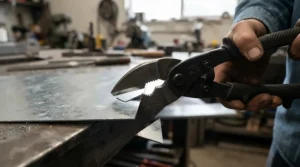
The three families solve different problems, and picking the wrong one explains most disappointment. Compound-action aviation tin snips multiply leverage through a linkage, so you can cut thicker material with less squeeze. Traditional straight cut tin snips like the Klein Tools 89556 have longer blades and simpler mechanics, which suits thin sheet and long cuts but costs you effort at the limit. Power options, such as drill-mounted shear attachments or electric shears, remove the effort entirely but add cost, noise and bulk.
| Type | Strength | Trade-Off | Best For |
|---|---|---|---|
| Compound-action aviation snips | High leverage, compact, versatile | Shorter cut length per bite | General work with the Wiss M3R |
| Offset aviation snips | Hand clearance on long cuts | Direction-specific | Duct and roofing with the Midwest MWT-6510S |
| Traditional straight cut tin snips | Long blades, simple, glove-friendly | Lower capacity | Thin gauge with the Klein Tools 89556 |
| Double-cut snips | Clean, undistorted pipe cuts | Light-gauge limit | Round duct with the Malco M2004 Max2000 Double Cut |
| Power shears | Effortless on long runs | Cost, power source, bulk | Production cutting |
Reading the table, hand snips win on portability, cost and control, while power shears win on sheer volume. If you cut a few dozen feet a month, snips are the smart buy. If you’re ripping hundreds of feet of panel, consider power shears alongside a good pair of snips for trimming. Most professionals end up carrying both.
Tin Snips for Ductwork Fabrication and Metal Roofing Panels
Two audiences buy more snips than anyone else, and their needs are different.
Ductwork fabrication is about repeatability. Rectangular duct involves long straight cuts and corner notches, which is where offset designs like the Malco M2007 Max2000 shine. Round duct and stovepipe are another story, and the double-cut Malco M2004 Max2000 Double Cut exists for the seams and curves that bend ordinary blades. Malco also notes its serrated lower jaw grips layered metals and seams, which helps at S-cleats.
Metal roofing panels are about access and coatings. You’re often cutting on a slope, with one hand holding a sheet, so a lanyard hole like the one on the Milwaukee 48-22-4532 is genuinely useful. Thin panel stock suits the Klein Tools 89556, and its replaceable blades address wear from grit. For long cuts along ribs, power shears are faster, so use snips for trim, flashing and corner work. Cut carefully, since scratches and burrs can compromise coatings, and always check panel thickness against the pair’s rating.
Safety, Regulations and Gloves for Cutting Sheet Metal
Snips look gentle compared with a grinder, but sheet metal injuries are mostly hand lacerations and eye strikes. OSHA’s hand and power tools guidance is blunt that hand tools can cause severe injuries when used or maintained improperly.
Practically, that means three habits. First, wear eye protection. OSHA’s eye and face standard (29 CFR 1910.133) requires employers to provide it where flying particles are a hazard, and protective eyewear should meet ANSI/ISEA Z87.1. Second, wear hand protection matched to the task. OSHA’s hand protection rule (29 CFR 1910.138) requires appropriate selection, and cut-rated gloves keep your dexterity. Third, inspect tools before use, since a loose pivot or chipped blade is both a quality and a safety problem.
These are workplace rules, and a homeowner isn’t bound by them. They remain the best benchmark available, and the cost of gloves and glasses is trivial against an emergency room visit.
Long-Term Cost and Maintenance: What Your Snips Really Cost
Cost per use tells a different story than sticker price. A $15 pair that lasts two seasons costs roughly the same per year as a $45 pair that lasts five, and the pricier pair usually cuts better throughout. One trade roundup claims 10-plus years of daily use from the Malco M2007 Max2000. That’s a single source, so treat it as optimistic, but the replaceable spring (M2000S) does extend the tool’s life.
Replaceable blades change the math even more. The Klein Tools 89556 blade kit, which includes two blades and hardware, costs a fraction of a new pair, and that turns a wear item into a repair. Warranties help too. Milwaukee and Malco list limited lifetime coverage on the models above.
Maintenance is cheap: oil the pivot, keep the bolt snug, store latched and dry, and don’t cut hardware. If you rarely cut metal, the Hurricane 10 Inch Aviation Tin Snips at the low end make economic sense. If you cut weekly, step up, because better blades mean less effort and cleaner edges every day.

FAQ: Tin Snips for Sheet Metal
❓ Can tin snips for sheet metal cut stainless steel?
❓ Which aviation tin snips work best for left-handed users?
❓ Is it worth paying more for forged-blade snips?
❓ Can I use sheet metal cutting shears on ribbed roofing panels?
❓ How often should I replace or sharpen snips?
Conclusion: Choosing the Right Tin Snips for Sheet Metal
The best tin snips for sheet metal are the ones that match your gauge, your cut direction and your hand, not the ones with the loudest packaging. For most people, the Crescent Wiss M3R is the sensible starting point: one pair, straight cuts plus gentle curves, and a long track record. Trades that live on long runs, especially ductwork fabrication, will get more from the offset Malco M2007 Max2000 or the forged Midwest MWT-6510S. Value-minded buyers should look at the Milwaukee 48-22-4532, while the Malco M2004 Max2000 Double Cut is a specialist for round duct.
For thin-gauge work and metal roofing panels, the Klein Tools 89556 earns its keep with replaceable blades and glove-friendly handles. If you only cut occasionally, the Hurricane 10 Inch Aviation Tin Snips keep the cost near zero. Whatever you choose, check the sheet metal gauge first, wear eye and hand protection, and treat the rated capacity as a ceiling.
Prices change often, so check current pricing before you buy. Pick the pair that fits the job in front of you, and the cutting takes care of itself.
Recommended for You
- Utility Knife For Box Cutting: 7 Best Picks For 2026
- Moisture Meter For Wood Flooring: 7 Best Picks Ranked (2026)
- Bosch Vs DeWalt Laser Measure: 7 Best Picks Ranked (2026)
Disclaimer: This article contains affiliate links. As an Amazon Associate, I earn from qualifying purchases. If you purchase products through these links, we may earn a small commission at no additional cost to you.
✨ Found this helpful? Share it with your friends! 💬🤗
