
In This Article
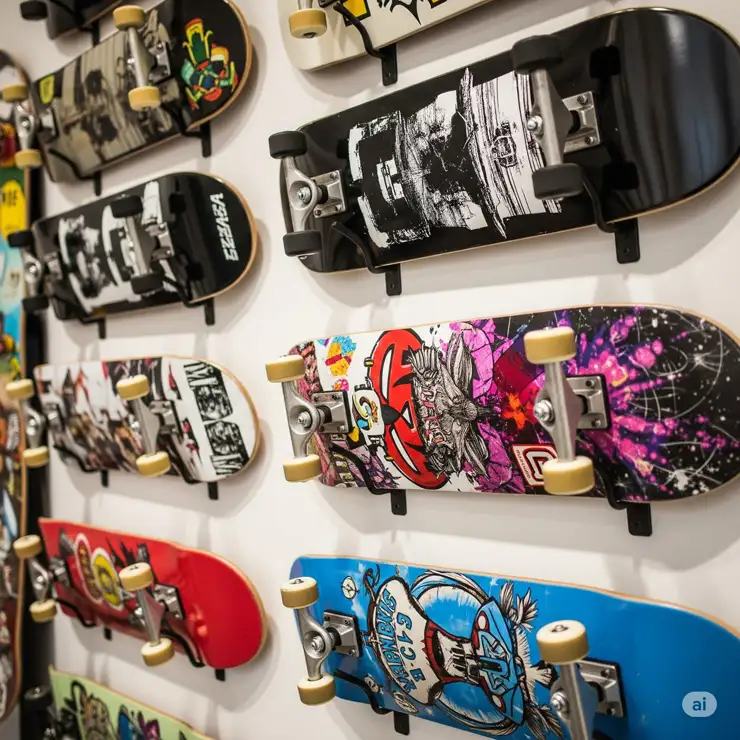
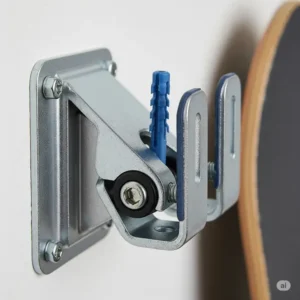
A skateboard wall mount is a bracket, hook, or rack that fastens to a wall and holds a skateboard deck or complete board off the floor, either for storage or as display art. Most designs either grip the deck’s existing truck holes or cradle it from underneath.
Here’s the problem it solves. Boards pile up. The one you rode into the ground, the one that survived three apartments, the shiny deck you bought for the graphic alone: they all end up leaning in a corner, collecting dust and dings. A good skateboard wall mount turns that pile into a gallery. 🛹
The category looks simple, but the details bite. Some mounts need no deck drilling at all. Others suspend a board a few inches off the wall so it appears to float. Plenty are sold in giant multipacks that look like bargains until you realize you needed one sturdy piece, not ten thin ones. Deck construction matters too. Per Encyclopedia.com’s overview of skateboard manufacturing, a typical deck runs around 32 inches long and roughly 8 inches wide, built from layered veneer. That’s a lot of leverage hanging off two small screws.
This guide compares seven real products, all with verifiable listings, and does something Amazon’s product pages won’t: it explains what each spec means once the board is on your wall. Some products here have thin review histories. Where that’s the case, I say so plainly instead of dressing up guesses.
Prices below are ranges, because they shift constantly. Check current pricing before you buy.
Quick Comparison Table: Which Skateboard Wall Mount Fits Which Setup?
Start here if you’re skimming. The table sorts each pick by mounting style and the buyer it suits best.
| Product | Mount Style | Price Range | Best For |
|---|---|---|---|
| HoverMount by SkateHoarding | Gravity-balance floating | Premium end | HoverMount suits collectors who hate drilling decks |
| Skateptych Phantom (Ghost Hanger) | One-screw floating | Under $15 | Skateptych Phantom suits cheap, clean decor |
| StoreYourBoard Floating Mount | Floating, deck display | Around $10 | StoreYourBoard Floating Mount suits first-timers |
| StoreYourBoard Minimalist Rack | Padded aluminum cradle | $15-$25 | StoreYourBoard Minimalist Rack suits rotating storage |
| Famiron 10-Pack Aluminum Hangers | Floating/horizontal | Mid-$20s | Famiron suits shops and big collections |
| DYAUS 360° Rotating Mount | Rotating, extending | Mid-teens | DYAUS suits straightening crooked boards |
| DEYOFA Multi-Floor Rack | Tiered rack | Varies by tier | DEYOFA suits multi-board walls |
Reading across, the StoreYourBoard Floating Mount delivers the best entry-level value, while the HoverMount earns its premium only if keeping a deck pristine matters more than price. Anyone building a wall of five or more boards should look hard at the Famiron multipack or the DEYOFA rack, since buying single mounts one at a time costs more per board and creates uneven spacing.
💬 Just one click — help others make better buying decisions too!😊
Top 7 Skateboard Wall Mount Picks: Expert Analysis
Every pick below follows the same logic: what the spec means in practice, who it fits, what real reviewers report, and whether the price range makes sense.
1. HoverMount by SkateHoarding — mounts without drilling your deck
The standout feature is the patented gravity-balance system, which holds a deck without drilling extra holes in it. That matters if your board is a collector’s piece, because drilling can permanently hurt resale value.
Specs worth translating: it’s designed for all skateboard types, including longboards, and reviewers describe a plastic hanger that suspends the deck at a pleasing distance from the wall. On paper, “gravity balance” means weight does the clamping rather than hardware squeezing through the deck. The practical upside is a cleaner look, since once the board is hung the mount is largely hidden.
Based on the design, this is a display-first mount. It suits a retired pro model or sentimental deck you want to show without modification. One caveat from review themes: a swinging or bumped board can knock the wall, and one reviewer upgraded to stronger metal anchors for a tighter fit against the drywall. That’s good advice for any heavy mount.
Aggregated sentiment skews positive on easy installation and appearance. The recurring complaint is price, with several buyers calling it expensive for a plastic piece. Expect it at the premium end of this roundup. Value verdict: worth it for valuable decks, overkill for a beater.
Pros:
- ✅ No extra drilling into your deck
- ✅ Works with longboards and standard decks
- ✅ Nearly invisible once board is hung
Cons:
- ❌ Priced above most competing mounts
- ❌ Wall bumps possible if board swings
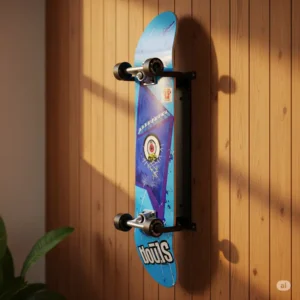
2. Skateptych Phantom (Ghost Hanger) — floating look from a single screw
This one wins on simplicity. The design relies on a one-screw wall install, and reviewers say the included hardware handles mounting into drywall or a stud. You thread the nuts out to the depth you want, then cap the screws so the deck stays put.
Here’s the spec that actually matters: the deck holes are intentionally tight. A reviewer figured this out after mounting, noting the small holes reduce play so the board doesn’t sag. That’s a design choice, not a flaw, though it surprises first-timers who expect a loose slide-fit.
Note the Ghost Hanger name appears on listings that some retailers mark as discontinued, so availability varies by seller. Verify what you’re actually buying and who ships it.
Review sentiment is warm. Buyers praise how easy it is to install and say the board looks like it hovers. Two practical warnings emerge from the reviews: the mount is built for display rather than frequent removal, since you’d unscrew the end pieces every time, and driving screws through the plastic can make them hot. One reviewer also said you must anchor the wall block after the long screws are in, so you’ll need a drill extender in tight spots.
Typical price range: under $15. Value verdict: superb for a display deck you rarely touch.
Pros:
- ✅ Single-screw wall install saves measuring time
- ✅ Tight holes keep the deck from sagging
- ✅ Budget-friendly price range
Cons:
- ❌ Awkward for frequent board swapping
- ❌ Some listings flagged discontinued
3. StoreYourBoard Floating Mount — the best-reviewed beginner option
Why does a roughly $10 piece of hardware keep showing up in recommendations? Because the maker has spent years refining it. The brand describes this as the result of years of experimenting with how to show a deck while barely touching the wall, and says it includes a drill bit and a lifetime warranty.
One feature deserves attention: it supports mounting a complete skateboard, not just a bare deck. The brand explains that complete setups are heavier, so you use two displays and pass the bolts through the deck, riser, and trucks after removing the inner truck hardware. That’s honest, useful guidance Amazon listings often skip, and it tells you this mount is more structural than the cheapest acrylic clips.
The brand’s own page shows 134 reviews, but I could not verify the individual written themes, so I won’t summarize them beyond that count. Treat the brand’s claim that pros and industry companies use it as company marketing, not independent proof.
Based on the specs, this suits beginners wanting a proven, low-risk first mount. Price range: around $10 per unit, so a complete board costs roughly double. Value verdict: hard to beat if you’re mounting one or two decks.
Pros:
- ✅ Lifetime warranty and included drill bit
- ✅ Can hold complete boards using two units
- ✅ Adjustable stud spacing for clean alignment
Cons:
- ❌ Complete-board install needs truck hardware removal
- ❌ Individual review themes weren’t verifiable
4. StoreYourBoard Minimalist Skateboard Display Rack — padded cradle for easy swapping
Unlike the floating mounts above, this is a cradle. It’s aluminum with a foam rubber base that cushions the deck and adds friction so it doesn’t slip. The board lies nearly flat against the wall, which means it barely sticks into the room.
The numbers: it’s rated for up to 30 lbs and measures about 3.75″ x 2″ wide by 3″ high. Screws and drywall anchors come in the box. Thirty pounds sounds modest, but a complete skateboard typically weighs well under that, so you have headroom. Just remember that rating assumes a good anchor into a decent wall.
This is the pick for people who actually ride their boards. Lift the deck out, ride, put it back. No unscrewing caps, no lost hardware. It also pairs well with a second rack for horizontal display or storage.
The brand’s page shows 15 reviews at a five-star average, a small pool, so confidence is moderate rather than high. I could not read the individual comments.
Price range: roughly $15-$25 depending on sale timing. Value verdict: strong for rotation-style storage, less dramatic for pure art display.
Pros:
- ✅ Padded base protects deck graphics
- ✅ Drop-in design for frequent swapping
- ✅ Hardware and drywall anchors included
Cons:
- ❌ Small review pool limits confidence
- ❌ Less “floating” drama than screw-through mounts
5. Famiron 10-Pack Aluminum Skateboard Hangers — built for whole collections
Need to hang a dozen decks? This is the mass-solution. The listing, model S010N, packs ten aluminum hangers designed for horizontal display and floating mounts.
What does ten-pack really mean? Each board typically uses two hangers horizontally, so ten units cover roughly five boards, or ten if you hang them vertically with one apiece. Similar aluminum multipacks advertise two-screw-hole designs, which offer better stability and the option of using only one screw for easier alignment. I can’t confirm those details for Famiron specifically, so check the listing before assuming.
Aluminum matters here. It resists rust and deformation better than cheap plastic, and it handles repeated tightening. Similar listings include protective plastic spacers to stop metal caps from scratching your deck, a feature worth confirming on this one.
I could not verify real customer reviews for this particular Famiron listing, so there’s no aggregated sentiment to report. Price tracking shows a third-party new price in the mid-$20s as of April 2026, which works out to a couple of dollars per hanger.
Value verdict: excellent per-piece pricing for shops, skate crews, and serious collectors, with the caveat that unverified quality means you should inspect on arrival.
Pros:
- ✅ Very low cost per hanger
- ✅ Aluminum build resists rust
- ✅ Enough units for a full gallery wall
Cons:
- ❌ Real reviews were unverifiable
- ❌ Overkill if you only own one board
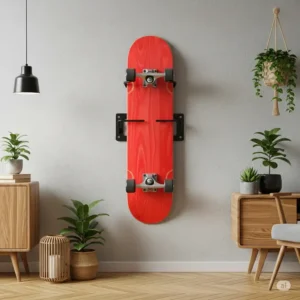
6. DYAUS 360° Rotating Skateboard Wall Mount — fixes crooked boards after install
Here’s a problem that annoys everyone eventually: you mount the board, step back, and it’s tilted two degrees. A rotating mount solves it. The DYAUS (model DY0006) advertises 360° rotation and an extending design, so you can adjust angle after the board is up.
That echoes a goal in a patent covering this style of hanger: being rotatable and adjustable on the wall even after mounting, allowing further straightening, per Google Patents’ listing for US9291304. The same document notes that some existing hangers require drilling larger holes in the deck, which can damage and devalue it. A rotating mount that avoids that is meaningful for display perfectionists.
The extending feature adds depth, which helps if you want a stronger “floating” shadow effect or need clearance past a baseboard.
I couldn’t verify genuine customer reviews for the DYAUS listing, so I can’t report sentiment. Price tracking shows a third-party new price in the mid-teens as of April 2026.
Value verdict: a sensible mid-priced choice for people who care about alignment, though unproven by review volume.
Pros:
- ✅ Post-install angle adjustment
- ✅ Extending depth control
- ✅ Mid-teens price range
Cons:
- ❌ No verifiable reviews found
- ❌ Rotating joints add potential wobble points
7. DEYOFA Multi-Floor Skateboard Rack — tiered storage for several boards
Not every wall wants a gallery. Sometimes you want a rack. The DEYOFA line comes in 4-floor and 6-floor versions, marketed for skateboards, skis, and snowboards.
The tier count is the key spec. Four tiers handle a typical household of boards, while six suit a garage or shop. Because it’s a multi-purpose rack, it also accommodates winter gear, which makes it a year-round storage tool rather than a skate-only fixture.
Analytical take: racks concentrate weight into one mounting zone, so load planning matters. Multiple boards stacked vertically can add up fast, and you should anchor into studs rather than relying on drywall alone. That’s an inference from how racks distribute load, not a DEYOFA-published claim.
I found no verifiable reviews or specific weight rating for the DEYOFA listing, so verify capacity before loading it.
Price range varies by tier count. Value verdict: promising for multi-board households, but treat it as a stud-mount project and confirm specs.
Pros:
- ✅ Holds multiple boards in one footprint
- ✅ Also handles skis and snowboards
- ✅ Choice of four or six tiers
Cons:
- ❌ Weight rating wasn’t verifiable
- ❌ Needs stud mounting for safe loads
Side-by-Side Specs and Evidence
| Product | Key Spec | Price Range | Review Evidence | Best For |
|---|---|---|---|---|
| HoverMount | Gravity-balance, no deck drilling | Premium end | Positive on install, price criticized | Collectors |
| Skateptych Phantom | One-screw wall install | Under $15 | Warm, display-focused | Display decks |
| StoreYourBoard Floating Mount | Complete-board capable with two units | Around $10 | 134 reviews on brand site | Beginners |
| StoreYourBoard Minimalist Rack | 30 lb rating, foam base | $15-$25 | 15 reviews, five-star average | Frequent riders |
| Famiron 10-Pack | Ten aluminum hangers | Mid-$20s | Not verifiable | Big collections |
| DYAUS 360° | Rotating, extending | Mid-teens | Not verifiable | Alignment fans |
| DEYOFA Rack | 4 or 6 tiers | Varies | Not verifiable | Multi-board walls |
The table makes the tradeoff visible: the mounts with the strongest evidence (StoreYourBoard pair, HoverMount) are also the ones with clear design logic, while the cheapest multipacks leave you gambling on quality. If your deck matters, pay for evidence. If you’re outfitting a skate shop wall, the Famiron pack’s per-piece cost wins, provided you inspect the first few units.
How to Choose a Skateboard Wall Mount
Pick wrong and you’ll either fight your wall or scratch your graphics. Work through these steps in order.
- Decide display versus storage. Display mounts lock the deck in place with caps and nuts; storage racks let you lift the board out. Choosing display when you ride weekly is the most common regret.
- Check your wall. Drywall, plaster, brick, and concrete need different anchors. Stud locations also dictate where you can mount a heavy rack.
- Weigh your board. A bare deck is light, but a complete board with trucks and wheels is not. The 30 lb rating on the StoreYourBoard Minimalist Rack shows how manufacturers think about this limit.
- Protect the deck. Look for padding, plastic spacers, or no-drill designs like the HoverMount.
- Count your boards. One board means a single mount; five means a multipack or rack.
- Plan the alignment. Rotating designs like the DYAUS forgive crooked marks; fixed mounts demand a level and patience.
- Check warranty and returns. A lifetime warranty, as the StoreYourBoard brand offers, is rare in budget hardware.
Treat the list as a filter, not a ranking. Most buyers eliminate three of the seven options by step three.
Skateboard Wall Mount Installation Guide: A Practical Walkthrough
This is where your wall mount succeeds or fails, and it’s precisely what product listings gloss over.
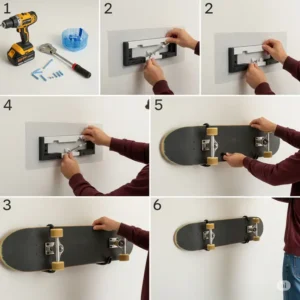
Step 1: Choose the height and spot
Hang display decks near eye level, roughly 57-60 inches to the board’s center, the standard gallery rule. Garage storage can sit lower. Mark with painter’s tape first so you can step back and judge.
Step 2: Find studs
A stud finder is optional but wise. Studs offer the strongest support, per general hanging guidance, and for racks like the DEYOFA they’re close to mandatory. Where no stud lines up, use rated anchors.
Step 3: Pre-fit the hardware
Thread the screws or posts through the deck holes and set the depth before touching the wall. Cap or tighten them. This prevents the “oops, the board won’t fit” moment.
Step 4: Mark, drill, anchor
Use a level. Drill pilot holes slightly smaller than the anchor body, tap anchors flush, then drive screws. For the Skateptych Phantom, remember the reviewer tip about needing a drill extender when long screws are already in place.
Step 5: Hang and test
Press gently on the deck in each direction. Check again after a week; anchors settle.
Maintenance schedule
Re-tighten caps every few months, wipe dust off padded mounts, and avoid humid walls. The deck is wood; moisture warps it.
Common first-30-day mistakes
Over-tightening plastic, skipping the level, and mounting a complete board on a single flimsy hanger top the list.
Real-World Scenarios: Matching Mounts to Real Buyers
Specs are abstract. Profiles are not. Here are three situations and the logic behind each pick.
Scenario 1: The renter with one favorite deck
You rent a one-bedroom, own a single retired board, and want it on the wall without a drilling disaster. A pair of the StoreYourBoard Floating Mount units, or the Skateptych Phantom for a single board, keeps the cost under about $20. Two small anchor holes patch with spackle at move-out. Budget: low. Frequency: set and forget.
Scenario 2: The weekend rider who rotates boards
You own three boards, ride them on different days, and want them off the garage floor. The StoreYourBoard Minimalist Rack fits: lift out, ride, return. Budget: moderate. Frequency: weekly. Two racks per board give horizontal stability.
Scenario 3: The collector with a gallery wall
You have eight decks with graphics worth showing. Mix a Famiron ten-pack for the bulk with a HoverMount for the one board that cannot be drilled. Budget: medium to high. Frequency: almost never touched.
The reasoning behind each is the same: match removability to how often you touch the board.
Problem-Solution Guide: Fixing the Usual Skateboard Wall Mount Headaches
Problem 1: The board hangs crooked
Solution: use a rotating mount like the DYAUS 360°, or loosen the caps and rotate the board before final tightening. Mark holes with a level, never by eye.
Problem 2: The mount feels loose in drywall
Solution: swap included plastic anchors for stronger ones. One HoverMount reviewer used metal anchors compressing against the drywall for a tighter hold. Better yet, find a stud.
Problem 3: The deck bangs the wall
Solution: add felt or rubber bumpers behind the board, and mount away from door frames and high-traffic hallways. Rattling doors transmit vibration to the wall.
Problem 4: Hardware heats up or strips plastic
Solution: drive screws slowly. Reviewers of the Skateptych Phantom noted screws getting hot when turned through plastic.
Problem 5: You keep losing the little caps
Solution: choose a drop-in rack like the StoreYourBoard Minimalist Rack instead of screw-through hardware, or keep spares in a labeled bag.
Wall Types, Anchors, and Weight: The Safety Section
Your mount is only as strong as what it’s screwed into. Drywall anchors are typically rated for 150 pounds or less, according to Hunker’s anchor guide, and the guide advises choosing an anchor rated at or above the weight it will carry. Standard expansion versions usually top out around 25 pounds, while self-threading types can reach about 75.
For a bare deck, that’s plenty. For a complete board on one hanger, it’s marginal. For a multi-tier rack like the DEYOFA, studs are the answer.
Wall type changes everything:
- Drywall: use rated anchors, or screws into studs.
- Brick or concrete: masonry anchors or concrete screws, which means a hammer drill.
- Plaster: toggle-style anchors tend to hold best, since plaster crumbles around cheap plastic ones.
Heavier loads also deserve toggles. Strap-toggle styles, per Angi’s anchor guide, balance strength with simplicity and some hold over 80 pounds.
One honest limit: manufacturer ratings assume a steady load, not a bump or a kid swinging on the board. Build in a safety margin, and never hang anything over a crib or a seating area.
Common Mistakes When Buying a Skateboard Wall Mount
Most regrets trace back to five errors.
Buying for looks instead of use. A gorgeous floating mount frustrates anyone who rides the board weekly. Match the mount to your habit.
Trusting multipack photos. Ten hangers for under $30 is tempting, but unverified listings like the Famiron pack deserve an inspection on arrival.
Ignoring wall type. Plastic anchors in drywall are fine for a bare deck, not for a loaded rack.
Forgetting complete boards weigh more. Trucks, wheels, and bearings change the physics. The StoreYourBoard Floating Mount guidance to use two units for a complete board exists for a reason.
Skipping the deck-protection check. Metal caps against graphics leave marks. Look for spacers or padding.
Avoid these five and you’ll sidestep most return shipments.
Skateboard Wall Mount vs Alternatives: Which Approach Wins?
Mounts aren’t the only way to display a board. Here’s how they compare.
| Method | Deck Damage Risk | Cost | Removability | Best For |
|---|---|---|---|---|
| Skateboard wall mount (floating) | Low to moderate | Low | Moderate | Display |
| Skateboard wall mount (cradle rack) | Very low | Low to moderate | Excellent | Frequent riders |
| Adhesive strips | None | Low | Good, but risky with weight | Very light decks |
| Wall hooks on trucks | None | Very low | Excellent | Complete boards in garages |
| Display case | None | High | Limited | Valuable collectibles |
Floating mounts win on aesthetics; cradle racks like the StoreYourBoard Minimalist Rack win on practicality. Adhesive strips tempt renters but fail under the weight of a complete board, and hooks looped around trucks work for garage storage while hiding the graphic. A display case protects a valuable deck best, but it costs several times what a mount does.
For most people, a dedicated skateboard wall mount remains the sweet spot between cost, safety, and looks. Choose a case only for decks worth hundreds, and hooks only when appearance doesn’t matter.
Features That Actually Matter (And Those That Don’t)
Marketing copy loves buzzwords. Here’s the filter.
Matters:
- Material. Aluminum and reinforced plastics outlast thin acrylic. The Famiron and StoreYourBoard mounts use aluminum.
- Padding or spacers. They prevent scratches on graphics.
- Included anchors. The StoreYourBoard Minimalist Rack ships with them, saving a hardware-store run.
- Warranty. Lifetime coverage is a real signal of confidence.
- Adjustability. Rotating or extending designs like the DYAUS reduce install stress.
Doesn’t matter much:
- “Universal fit” claims. They’re nearly meaningless without dimensions; check deck width and thickness yourself.
- Color. Black, silver, and clear all vanish behind a graphic.
- Giant multipack counts. More pieces don’t mean better quality.
- “Patent-pending” language. It describes a filing, not performance.
Spend your attention on material, padding, and anchors, and ignore the rest.
Long-Term Cost and Maintenance: What a Skateboard Wall Mount Really Costs
Total cost of ownership is dominated by one decision: how many boards are you hanging?
| Setup | Boards Hung | Approx. Price Range | Cost Per Board |
|---|---|---|---|
| Single StoreYourBoard Floating Mount | 1 deck | Around $10 | About $10 |
| StoreYourBoard Minimalist Rack pair | 1 board | $30-$50 | $30-$50 |
| Famiron ten-pack | 5 decks | Mid-$20s | About $5 |
| HoverMount | 1 deck | Premium end | Highest |
Cost per board drops sharply with multipacks, which explains the Famiron appeal. Premium single mounts like the HoverMount cost far more per board but protect a deck’s resale value, and for a rare piece the math can favor paying up.
Maintenance is minimal. Tighten caps twice a year, wipe dust, and recheck anchors after the first week. A lifetime warranty, where offered, turns the mount into a one-time purchase. Over a decade, even a premium mount costs pennies per day of display.
Skateboard Wall Mount for Specific Audiences
For beginners
Start with a StoreYourBoard Floating Mount. The price is low, the brand explains complete-board mounting, and the warranty removes risk.
For collectors
Prioritize no-drill designs. The HoverMount protects value, and a display case may still be worth it for the crown jewel.
For parents and kids
Mount low enough for a kid to see, high enough to stay out of reach, and always into studs. A bedroom rack like the DEYOFA needs stud mounting to be safe.
For skate shops and crews
Buy in bulk. A Famiron ten-pack gives uniform spacing, and rotating DYAUS units help align odd-shaped boards.
For renters
Pick one-screw mounts like the Skateptych Phantom to limit wall repair. Keep spackle and a putty knife handy for move-out.
Each audience wants a different balance of cost, risk, and flexibility, so no single mount wins everywhere.
✨ Don’t Miss These Exclusive Deals!
🔍 Take your skateboard wall mount setup to the next level with these carefully selected products. Click on any highlighted item to check current pricing and availability. These tools will help you create an authentic display your whole crew will love!
FAQ: Skateboard Wall Mount Questions Answered
❓ How many skateboard wall mounts do I need per board?
❓ Can a skateboard wall mount damage my deck?
❓ Will a skateboard wall mount hold a complete board with wheels?
❓ Do I need studs to install a skateboard wall mount?
❓ What is the cheapest skateboard wall mount that is still worth buying?
Conclusion: Pick the Mount That Matches How You Ride
A skateboard wall mount is one of those small purchases that quietly improves a room. Done right, it rescues boards from the closet pile, protects the graphics you love, and turns years of riding into something you can look at every day.
The picks here cover every angle. The HoverMount protects collectible decks without drilling. The Skateptych Phantom and StoreYourBoard Floating Mount deliver floating looks at bargain prices. The StoreYourBoard Minimalist Rack suits boards you still ride, while the Famiron ten-pack and DEYOFA rack handle bigger collections. The DYAUS 360° fixes the crooked-board problem that haunts every first install.
Remember the honest caveats: several of these listings had few or no verifiable reviews, so inspect hardware on arrival and anchor into studs wherever weight is a question. Match the mount to your habits, your wall, and your budget, then take ten minutes with a level and a pencil.
Your boards earned a better spot than the floor. 🛹
Recommended for You
- Top 10 Fantastic Ping Pong Racket Holders for 2025
- Tennis Racket Wall Holder: 15 Best Storage Solutions That Transform Your Space in 2025
- 12 Best Pickleball Racket Holder Solutions That Will Transform Your Game in 2025
Disclaimer: This article contains affiliate links. As an Amazon Associate, I earn from qualifying purchases. If you purchase products through these links, we may earn a small commission at no additional cost to you.
✨ Found this helpful? Share it with your friends! 💬🤗
