
In This Article
✨Was this helpful? Spread the word! 🚀
Choosing between a self propelled lawn mower vs push model isn’t just about your budget—it’s about matching the right tool to your lawn’s needs and your physical capabilities. After spending hundreds of hours testing both types across various yard sizes and terrains, I can tell you that the decision impacts everything from how quickly you finish mowing to whether your back aches afterward.
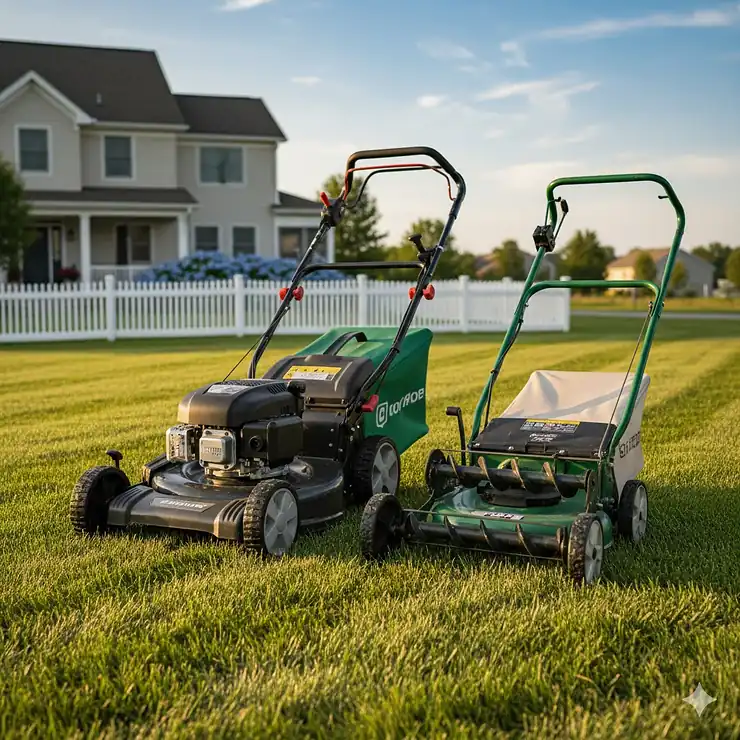
The fundamental difference? A self propelled mower uses its engine or motor to drive the wheels, while a push mower relies entirely on your muscle power. But here’s what most buying guides won’t tell you: the “right” choice depends on factors that go way beyond this basic distinction. Your lawn’s slope, size, grass type, and even your fitness level all play crucial roles.
In 2025, both categories have evolved significantly. Modern push lawn mower models are lighter than ever, while self propelled versions offer variable speed control and enhanced traction systems. According to the Outdoor Power Equipment Institute, battery-powered options now represent over 35% of the walk-behind mower market, fundamentally changing what you should consider when comparing self propelled lawn mower vs push alternatives.
Whether you’re maintaining a compact urban yard or tackling a sprawling suburban property, understanding these differences will save you money, time, and potentially your lower back. Let’s break down exactly what separates these two mower types and which one deserves a spot in your garage.
Quick Comparison: Self Propelled Lawn Mower vs Push at a Glance
| Feature | Self Propelled Mower | Push Mower |
|---|---|---|
| Power Assistance | Engine/motor drives wheels | 100% manual pushing required |
| Best For | Yards over 1/4 acre, slopes | Small, flat lawns under 1/4 acre |
| Physical Effort | Low to moderate | Moderate to high |
| Price Range | $280-$750+ | $150-$350 |
| Fuel Efficiency | Lower (extra power for drive) | Higher (blade power only) |
| Maneuverability | Requires practice on tight turns | Highly maneuverable |
| Maintenance | Moderate (drive system adds complexity) | Minimal |
| Weight | 65-90 lbs | 35-60 lbs |
💬 Just one click – help others make better buying decisions too! 😊
✨ Ready to Find Your Perfect Mower?
Explore the top-rated models below and transform your mowing experience. Click any product name to check current prices and customer reviews on Amazon! 🛒
Top 7 Self Propelled Lawn Mower vs Push Models: Expert Analysis
1. EGO Power+ LM2135SP Select Cut Self-Propelled Mower
The EGO Power+ LM2135SP represents the pinnacle of cordless self propelled technology with its innovative Touch Drive system and multi-blade cutting platform. This premium model delivers 7.0 ft-lbs of torque—exceeding many gas mowers—while maintaining whisper-quiet operation.
Key Specifications:
- 21-inch cutting deck with Select Cut multi-blade system
- 56V 7.5Ah battery provides up to 60 minutes runtime
- Touch Drive variable speed (0.9-3.1 MPH)
- Eight cutting height positions (1-4 inches)
- LED headlights for dawn/dusk mowing
Price Range: $649-$749
Customer Feedback: Users consistently praise the smooth self-propel system and exceptional cut quality, though some note the speed transitions between settings can feel abrupt initially.
✅ Pros:
- Premium cutting performance with interchangeable blades
- Industry-leading battery runtime
- Intuitive Touch Drive control system
❌ Cons:
- Higher price point compared to gas alternatives
- Learning curve for self-propel features
2. Toro Recycler SmartStow 21329 Push Mower
The Toro Recycler SmartStow 21329 revolutionizes storage with its vertical standing capability while delivering reliable cutting performance. This gas-powered push model features a 22-inch deck and Briggs & Stratton engine designed for homeowners prioritizing simplicity.
Key Specifications:
- 22-inch steel deck (wider than standard 21-inch)
- 150cc Briggs & Stratton engine with Auto-Choke
- SmartStow vertical storage design
- 6.25 ft-lbs gross torque
- 3-in-1 cutting: mulch, bag, side discharge
Price Range: $349-$429
Customer Feedback: Owners appreciate the space-saving design and easy starting, though some report the push effort increases notably on inclines and in thick grass.
✅ Pros:
- Revolutionary vertical storage saves 70% space
- Wider 22-inch deck cuts more per pass
- No oil changes required—just top off
❌ Cons:
- Heavy for a push mower (approximately 75 lbs)
- Requires significant muscle on hills
3. Greenworks 40V 21-Inch Brushless Self-Propelled Mower
The Greenworks 40V 21-Inch self propelled model offers outstanding value with its Smart Pace technology that automatically adjusts to your walking speed. This cordless option includes dual battery ports for extended runtime without interruption.
Key Specifications:
- 21-inch steel deck with brushless motor
- Two 4.0Ah batteries (60 minutes combined runtime)
- Smart Pace auto-adjusting speed control
- Seven cutting heights (1.375-3.75 inches)
- 3-in-1 functionality plus turbo leaf pickup
Price Range: $315-$450
Customer Feedback: Reviewers highlight the seamless battery switchover and quiet operation, making it ideal for neighborhoods with noise restrictions.
✅ Pros:
- Dual battery system extends mowing time
- Smart Pace eliminates manual speed adjustments
- 4-in-1 system includes leaf collection mode
❌ Cons:
- Moderate power on extremely thick grass
- Battery charging time (60-90 minutes per battery)
4. Craftsman M140 Push Mower with Honda Engine
The Craftsman M140 combines affordability with reliability through its 160cc Honda engine, making it an excellent entry-level push lawn mower for budget-conscious homeowners.
Key Specifications:
- 21-inch convertible deck
- 160cc Honda engine with automatic choke
- 11-inch rear wheels for terrain navigation
- Dual-lever height adjustment (6 positions)
- 1.9 bushel Dust Blocker grass bag
Price Range: $249-$299
Customer Feedback: Users love the Honda engine’s reliability and easy starting, though taller grass requires slower passes to prevent bogging.
✅ Pros:
- Exceptional value with trusted Honda power
- Automatic choke simplifies starting
- Lightweight at approximately 60 lbs
❌ Cons:
- Limited power for overgrown lawns
- Push-only design challenging on slopes
5. Honda HRN216VKA Self-Propelled Lawn Mower
The Honda HRN216VKA brings Honda’s legendary reliability to the self propelled category with its MicroCut twin-blade system and variable speed control.
Key Specifications:
- 21-inch steel deck with twin blades
- 170cc Honda GCV engine
- Variable speed self-propel (0-4 MPH)
- Clip Director for mulch control
- 3-in-1 cutting system
Price Range: $479-$549
Customer Feedback: Honda owners report exceptional longevity and consistent performance year after year, with many mowers lasting 10+ years with basic maintenance.
✅ Pros:
- Industry-leading reliability and build quality
- Twin-blade system creates finer mulch
- Smooth variable speed operation
❌ Cons:
- Higher initial investment
- Heavier than comparable models
6. Troy-Bilt TB160 Push Lawn Mower
The Troy-Bilt TB160 delivers no-frills reliability at an unbeatable price point, perfect for small yards where a self propelled system would be overkill.
Key Specifications:
- 21-inch cutting deck
- 160cc Honda engine
- 11-inch rear wheels
- Dual-lever height adjustment
- TriAction cutting system
Price Range: $229-$279
Customer Feedback: Buyers appreciate the straightforward design and Honda power at this price, noting it handles weekly mowing of maintained lawns excellently.
✅ Pros:
- Exceptional value for Honda-powered mower
- Lightweight and easy to maneuver
- Minimal maintenance requirements
❌ Cons:
- Struggles with tall or wet grass
- Basic features compared to premium models
7. EGO Power+ LM2122SP-2 Dual-Battery Self-Propelled Mower
The EGO Power+ LM2122SP-2 features EGO’s innovative dual-battery system, providing up to 75 minutes of runtime and enough power to tackle yards up to 1/2 acre.
Key Specifications:
- 21-inch cutting deck
- Two 56V 4.0Ah batteries included
- Touch Drive self-propel with variable speed
- LED headlights
- Weather-resistant construction
Price Range: $549-$649
Customer Feedback: Users praise the extended runtime and smooth power delivery, though some wish for the Select Cut blade system available on the LM2135SP.
✅ Pros:
- Dual batteries provide exceptional runtime
- Quick-fold design for compact storage
- Quieter than gas mowers
❌ Cons:
- Batteries add weight (approximately 80 lbs total)
- Premium pricing for battery-powered option
Understanding the Core Differences: Self Propelled Lawn Mower vs Push
Power Delivery and Effort Required
The most obvious distinction when comparing self propelled lawn mower vs push models centers on power delivery. Self propelled mowers divert a portion of engine or motor power to drive the wheels through a transmission system, reducing user effort by 60-70% according to ergonomic studies. You’re essentially walking behind the mower rather than pushing it.
Push mowers, conversely, rely entirely on your physical strength. While modern lightweight materials have reduced push mower weights significantly—some cordless models weigh under 40 lbs—you’re still responsible for every ounce of forward momentum. This becomes particularly evident on inclines or when cutting through thick, damp grass that creates additional resistance.
However, this manual operation offers unexpected advantages. Push mowers provide superior control in tight spaces, around obstacles, and when making quick directional changes. Many landscaping professionals actually prefer push models for detail work precisely because of this responsive handling.
Terrain and Lawn Size Considerations
Terrain dramatically influences the self propelled lawn mower vs push decision. For lawns with minimal elevation change under 1/4 acre, a push mower often makes perfect sense. You’ll complete the job efficiently while enjoying the exercise benefits—burning approximately 250-350 calories per hour of push mowing versus 150-200 calories with self propelled models.
Once your property exceeds 1/4 acre or includes notable slopes, self propelled technology becomes increasingly valuable. The constant forward assistance prevents fatigue, allowing you to maintain consistent mowing patterns rather than slowing down as exhaustion sets in. Properties approaching 1/2 acre or larger make self propulsion almost essential unless you’re training for a marathon.
Uneven terrain presents another factor. Self propelled mowers with rear-wheel drive excel on hills, providing enhanced traction when climbing. Front-wheel drive models offer better maneuverability on flat ground but can lose traction on steep inclines. Meanwhile, push mowers require careful footing on slopes but navigate bumpy ground easily due to their lighter weight.
Cost Analysis: Initial Investment and Long-Term Value
Price represents a significant differentiator in the self propelled lawn mower vs push comparison. Entry-level push mowers start around $150-$180 for basic electric models and $220-$280 for gas versions. Self propelled mowers begin at $280-$320 and quickly escalate to $650+ for premium battery-powered options.
But initial cost tells only part of the story. Self propelled mowers include additional components—drive belts, transmissions, and control cables—that require eventual replacement. Expect to spend $50-$150 every 3-5 years on drive system maintenance for gas models. Battery-powered self propelled mowers shift this maintenance to battery replacement, typically $150-$250 per battery after 5-7 years.
Push mowers minimize ongoing costs through their simpler design. Fewer moving parts mean less can break. Many homeowners report 8-12 years of trouble-free service from quality push mowers with nothing more than blade sharpening and annual oil changes.
Consider the total cost of ownership over five years. A $250 push mower with $75 in maintenance totals $325. A $450 self propelled mower with $200 in drive system repairs reaches $650. The question becomes: is that $325 difference worth the reduced physical effort? For many homeowners, especially those with larger or sloped yards, the answer is absolutely yes.

Self Propelled Features That Actually Matter
Variable Speed Control Systems
Modern self propelled mowers offer variable speed ranging from 0.9 to 4.0 MPH, allowing you to match pace to conditions. Dense grass? Slow down for thorough cutting. Final passes on already-trimmed areas? Speed up to finish quickly. Budget models typically offer 2-3 speed settings, while premium mowers provide infinite variability through dial or pressure-sensitive controls.
Drive System Types: Front-Wheel vs. Rear-Wheel
Front-wheel drive (FWD) self propelled mowers excel on flat terrain and provide excellent maneuverability since lifting the front wheels to turn is simple. They’re ideal for lawns with numerous obstacles like trees, garden beds, or decorative features.
Rear-wheel drive (RWD) systems dominate on slopes and hills. The weight distribution keeps drive wheels firmly planted, maintaining traction where FWD systems would slip. However, RWD mowers require wider turning radiuses, making them less agile in tight spaces.
Battery vs. Gas Self Propelled Options
Battery-powered self propelled mowers have revolutionized the market since 2023. Modern 56V and 80V systems deliver torque matching or exceeding 190cc gas engines while eliminating fuel mixing, oil changes, and emission concerns. Runtime typically reaches 45-75 minutes depending on battery capacity and grass conditions—sufficient for most residential properties under 1/2 acre.
Gas self propelled mowers maintain advantages for larger properties and professionals. Unlimited runtime with quick refueling, superior power through thick overgrowth, and lower initial costs (when excluding battery expenses) keep gas relevant. The downside? Louder operation, regular maintenance, and the environmental impact of emissions.
Push Mower Advantages You Shouldn’t Overlook
Weight and Maneuverability Benefits
Premium lightweight push mowers weigh as little as 36-45 lbs with batteries installed, making them remarkably easy to maneuver. This agility shines when navigating complex landscapes with garden beds, pathways, and decorative elements. You can pivot instantly, back up effortlessly, and make precision passes impossible with heavier self propelled models.
Lower Maintenance Requirements
Push lawn mower simplicity translates to reliability. The typical gas push mower requires annual blade sharpening ($15-$25), seasonal oil changes ($8-$12), and occasional spark plug replacement ($4-$8). That’s roughly $30-$45 yearly maintenance. Self propelled models add drive belt replacement ($25-$50), transmission oil changes on some models ($15-$25), and cable adjustments ($20-$40 for professional service).
Perfect for Small Properties
For lawns under 2,000 square feet, push mowers are often the smarter choice. You’ll complete mowing in 15-20 minutes regardless of mower type, making self propulsion unnecessary. The money saved on the simpler mower can fund other lawn care tools like a quality trimmer or edger.
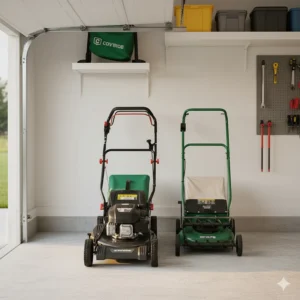
Fuel and Energy Efficiency: Self Propelled Lawn Mower vs Push
Energy consumption varies significantly between these mower types. Push mowers use 100% of their power for cutting, while self propelled models split power between blade rotation and wheel drive. This means a 170cc gas push mower might achieve similar cutting performance to a 190cc self propelled model.
For electric mowers, the difference is measurable. A typical 40V push mower draws 600-800 watts, providing 35-50 minutes of runtime on a 4.0Ah battery. The same battery powering a self propelled mower delivers 28-40 minutes due to the additional power demand for the drive system.
Gas consumption follows similar patterns. Expect a push mower to use approximately 0.15-0.25 gallons per hour versus 0.25-0.35 gallons for comparable self propelled models. Over a mowing season (roughly 30 weeks), that translates to 4.5-7.5 gallons versus 7.5-10.5 gallons—a difference of $10-$15 annually at current fuel prices.
According to Energy Star data, battery-powered mowers reduce carbon emissions by approximately 60-80% compared to gas models, regardless of push versus self propelled configuration.
Which Lawn Conditions Favor Each Type?
Flat, Maintained Lawns
Well-maintained, level lawns present ideal conditions for push mowers. The consistent terrain requires minimal effort, and the lighter weight allows quick, effortless maneuvering. Weekly mowing prevents grass from growing too thick, eliminating the primary scenario where self propulsion proves beneficial.
Sloped or Hilly Terrain
Any property with grades exceeding 10-15 degrees strongly favors self propelled mowers. The constant forward drive prevents slipping and reduces the risk of the mower rolling backward. Rear-wheel drive models particularly excel here, maintaining traction even on dewy morning grass.
Thick, Overgrown Grass
Cutting grass that’s grown beyond recommended height (typically over 4 inches) creates significant resistance. Self propelled mowers maintain steady forward progress regardless of thickness, while push mowers require constant shoving and often need multiple passes. If you frequently let grass grow tall between mowings, self propulsion becomes almost essential.
Wet Conditions
Mowing wet grass—while generally discouraged—sometimes becomes necessary. Wet grass clumps more, sticks to mower decks, and creates tremendous resistance. Self propelled mowers power through these conditions far more effectively than push models, which can bog down completely in saturated lawns.
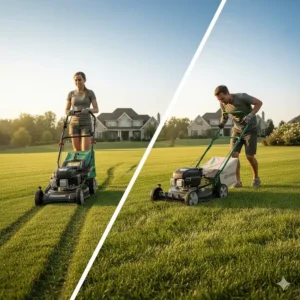
How to Choose: Decision Framework
Step 1: Measure Your Lawn
Calculate your mowing area in square feet. Under 2,500 sq ft? Push mowers work excellently. Between 2,500-8,000 sq ft? Either type can work; base your decision on terrain and budget. Over 8,000 sq ft (roughly 1/5 acre)? Strongly consider self propelled for efficiency and reduced fatigue.
Step 2: Assess Terrain and Obstacles
Walk your property and note slopes, obstacles, and access challenges. Multiple elevation changes or grades over 10 degrees? Self propelled rear-wheel drive models are ideal. Flat with numerous trees, beds, and tight spaces? Push mowers provide superior agility.
Step 3: Consider Physical Capability
Be honest about your fitness level and any physical limitations. Back problems, joint issues, or cardiovascular concerns make self propelled mowers the safer choice. Good physical condition and desire for outdoor exercise? Push mowing provides beneficial activity.
Step 4: Calculate Budget Including Maintenance
Total your five-year ownership cost, not just purchase price. Include expected maintenance, potential repairs, and consumables (gas, oil, batteries). Often, spending $150 more upfront for the right mower type saves $200+ in convenience and longevity.
Step 5: Test Drive When Possible
Many retailers allow test operation in designated areas. Spend 5-10 minutes with both types, simulating actual mowing conditions. The right mower will feel natural and comfortable, not like a workout or a wrestling match.
Common Mistakes When Comparing Self Propelled Lawn Mower vs Push
Mistake 1: Prioritizing Price Over Suitability
The cheapest mower costs you more if it’s the wrong type for your property. A $250 push mower that requires 90 minutes of exhausting work on a sloped 1/2-acre lot wastes time and risks injury. Meanwhile, a $500 self propelled mower might complete the same job in 45 comfortable minutes.
Mistake 2: Ignoring Drive System Type
Not all self propelled mowers suit all properties. Front-wheel drive models disappoint on hills, while rear-wheel drive versions frustrate in obstacle-heavy yards. Match the drive system to your primary terrain type.
Mistake 3: Overlooking Power Source
Battery limitations catch many buyers off-guard. That attractive cordless mower might need battery swapping mid-job or leave you waiting for charges. Honestly assess whether your property exceeds battery capacity or if gas offers better value.
Mistake 4: Assuming Bigger is Better
A 22-inch self propelled mower seems ideal until you discover it won’t fit through your 24-inch gate or maneuver around close-spaced trees. Sometimes a nimble 20-inch push mower proves more practical despite smaller cutting width.
Mistake 5: Neglecting Long-Term Maintenance
Self propelled mowers demand more care. If you struggle remembering oil changes for your car, a simple push mower might better suit your maintenance habits than a self propelled model requiring regular drive system attention.
Expert Tips for Maximizing Performance
For Self Propelled Mowers:
✅ Learn your speed control system thoroughly—practice in an open area before tackling complex terrain
✅ Disengage self-propel when backing up or making tight turns to prevent wheel scuffing
✅ Keep drive wheels properly inflated; low pressure reduces traction and wears belts faster
✅ Clean the deck after each use to prevent buildup that increases weight and rolling resistance
For Push Mowers:
✅ Use momentum on flat stretches rather than constant pushing—let the mower’s weight assist forward motion
✅ Sharpen blades more frequently; dull blades dramatically increase push resistance
✅ Mow in opposite directions alternating weeks to prevent soil compaction and rutting
✅ Consider a rear-discharge grass bag instead of side-mounted; it improves balance and reduces push effort
Universal Best Practices:
✅ Never cut more than 1/3 of grass height in a single mowing
✅ Mow during dry conditions whenever possible—wet grass increases resistance by 40-60%
✅ Maintain consistent walking speed for even cutting height
✅ Follow a pattern (stripes, circles, etc.) rather than random mowing for professional results
Real-World Scenarios: Which Mower Type Wins?
Scenario 1: Urban Townhouse with 1,500 sq ft Lawn
Winner: Push Mower
Small, flat lawns favor lightweight, maneuverable push models. You’ll complete mowing in 12-15 minutes, making self propulsion overkill. The $150-$200 saved buys a quality trimmer and edger for complete lawn care.
Scenario 2: Suburban 1/3-Acre Lot with Moderate Slope
Winner: Self Propelled Mower
The combination of 14,000+ square feet and elevation changes makes self propulsion valuable. You’ll finish in 35-40 minutes versus 55-65 minutes with a push mower, while significantly reducing fatigue. The investment pays off within one season.
Scenario 3: 1/4-Acre Flat Yard with Multiple Garden Beds
Winner: Push Mower
The flat terrain negates self propulsion’s primary advantage, while numerous obstacles favor push mower agility. You’ll navigate beds, trees, and decorative features more easily, completing the job in similar time to self propelled alternatives.
Scenario 4: Weekend Warrior with Full-Time Job
Winner: Self Propelled Mower
Limited time and energy make efficiency paramount. Self propulsion allows you to tackle lawn care after work without excessive fatigue, maintaining your property consistently rather than dreading weekend marathons.
Scenario 5: Fitness Enthusiast Seeking Outdoor Activity
Winner: Push Mower
If you view lawn care as exercise opportunity, push mowing burns 250-350 calories per hour while providing functional strength training. The money saved on the simpler mower can fund other fitness equipment.
FAQ: Self Propelled Lawn Mower vs Push
❓ Can you turn off self propel on a self propelled lawn mower?
❓ How much harder is it to push a self propelled lawn mower with drive disengaged?
❓ Do self propelled mowers use more gas than push mowers?
❓ What is the best self propelled lawn mower vs push for seniors?
❓ Can a push lawn mower handle thick grass effectively?
Conclusion: Making Your Final Decision
The self propelled lawn mower vs push debate ultimately comes down to matching mower capabilities to your specific property characteristics and personal circumstances. Neither type is universally superior—each excels in particular scenarios.
Choose self propelled mowers when you have yards exceeding 1/4 acre, properties with notable slopes or hills, physical limitations that make sustained pushing difficult, or simply want to minimize mowing effort and fatigue. Modern options like the EGO Power+ LM2135SP or Greenworks 40V 21-Inch deliver exceptional performance with minimal maintenance.
Select push mowers for small, flat properties under 2,500 square feet, yards with numerous obstacles requiring constant maneuvering, situations where budget constraints are significant, or when you view mowing as beneficial exercise. Models like the Craftsman M140 or Troy-Bilt TB160 provide reliable performance at attractive prices.
Remember that mower quality matters more than type. A premium push mower will outperform a cheap self propelled model in cut quality, durability, and user satisfaction. Focus first on identifying your property’s needs, then invest in the highest-quality mower within your budget of your chosen type.
The good news? Both categories offer outstanding options in 2025. Whether you choose the manual control of a push mower or the assisted convenience of self propulsion, proper maintenance and technique will deliver professional-quality results.
✨ Transform Your Lawn Care Today!
Don’t spend another season struggling with the wrong mower. Click the highlighted products above to explore current deals on Amazon and read thousands of verified customer reviews. Your perfect lawn is just one smart purchase away! 🌱🏡
Recommended for You
- Electric Start Push Lawn Mower: 7 Best Models 2025
- Lawn Mower Blades: 7 Top Picks to Transform Your Lawn in 2025
- Best Mulching Lawn Mower 2025: 7 Top Picks That Save You Time
Disclaimer: This article contains affiliate links. If you purchase products through these links, we may earn a small commission at no additional cost to you.
✨ Found this helpful? Share it with your friends! 💬🤗
