
In This Article
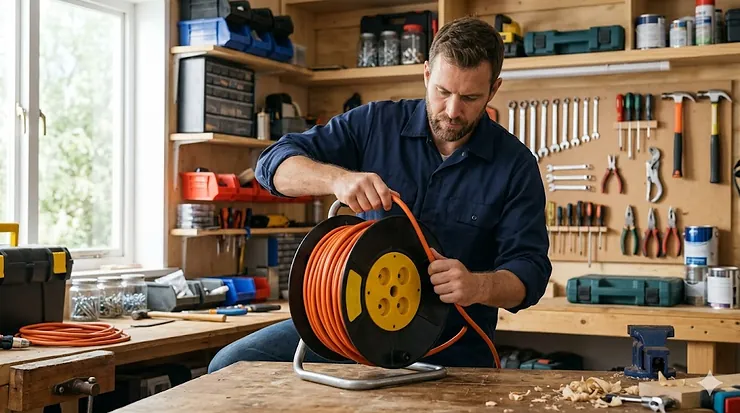
You know that moment when you need an extension cord and find yourself wrestling with a 50-foot knot that looks like it was tied by an angry octopus? That’s the moment most people realize they need an extension cord storage reel. But here’s what the product listings won’t tell you—not all cord reels are created equal, and choosing the wrong one means you’ll be fighting with it instead of using it.
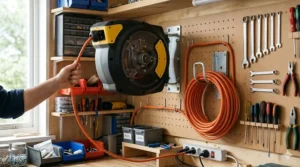
I’ve spent the better part of two decades working in garages, workshops, and construction sites, and I can tell you this: proper cord management isn’t just about aesthetics. It’s about safety, efficiency, and actually being able to find your tools when you need them. According to OSHA electrical safety standards, improper extension cord storage contributes to workplace hazards including trip falls and electrical shorts. A good extension cord storage reel solves these problems while saving you time and frustration.
What most buyers overlook is that an extension cord storage reel is really three products in one: a storage solution, a safety device, and a time-saver. The right reel protects your cords from damage (those kinks and tangles literally shorten cord lifespan), keeps them organized and accessible, and prevents the safety hazards that come with cords sprawled across your garage floor. Whether you’re looking for a retractable extension cord holder, a wall mounted cord reel, or a portable electric cord organizer, understanding the real-world differences between these systems will save you from buying the wrong solution twice.
Quick Comparison: Top Extension Cord Storage Reels at a Glance
| Product | Type | Capacity | Outlets | Price Range | Best For |
|---|---|---|---|---|---|
| DEWENWILS Hand-Wind Reel | Open/Manual | 150 ft (16/3) | 4 grounded + circuit breaker | $45-$65 | Budget-conscious DIYers |
| Woods Side-Crank Reel | Open/Manual | 150 ft (16/3) | None (empty reel) | $35-$50 | Cord storage only |
| DEWENWILS 30FT Retractable | Wall/Ceiling Mount | 30 ft fixed | 3 grounded + LED | $70-$95 | Small garages |
| VEVOR 30FT Retractable | Wall/Ceiling Mount | 30 ft fixed | 3 grounded + LED | $65-$90 | Overhead workspace |
| TerraBloom 25FT Retractable | Wall/Ceiling Mount | 25 ft fixed | 3 grounded + LED | $55-$75 | Compact spaces |
| Iron Forge Cable Manual Reel | Open/Manual | 100 ft (16/3) | None (empty reel) | $30-$45 | Portable use |
| Bayco KW-110 | Open/Manual | 100 ft (16/3) | None (empty reel) | $25-$40 | Light-duty home use |
Looking at this comparison, you’ll notice a clear divide: retractable models cost roughly 50-80% more than manual reels, but they include built-in cords and outlets—meaning you’re not just buying storage, you’re buying a complete power distribution system. The manual reels are “empty” and require you to supply your own extension cord, which gives you flexibility in cord length and gauge but adds an extra purchase. For homeowners who already own quality extension cords, the manual reels like the Woods or Iron Forge represent better value. But if you’re setting up a garage workshop from scratch, the all-in-one retractable units eliminate the guesswork and deliver immediate functionality.
💬 Just one click — help others make better buying decisions too!😊
Top 7 Extension Cord Storage Reels: Expert Analysis
1. DEWENWILS Extension Cord Storage Reel with 4-Grounded Outlets
This hand-crank reel caught my attention because it bridges the gap between bare-bones storage and full power distribution. The DEWENWILS model features four grounded outlets built right into the reel face, rated for 10A/125V/1250W, with a circuit breaker that cuts power automatically if you exceed the amp rating. In practice, this means you can power multiple tools simultaneously without worrying about overload—something the empty reels can’t offer.
The metal stand provides stability that cheaper plastic models lack, and the swivel crank handle makes winding genuinely effortless compared to fixed-handle designs. What the spec sheet won’t tell you is that the locking mechanism at the base prevents the reel from spinning while you’re working, which sounds trivial until you’ve chased a runaway reel across your garage floor. This reel handles 12/3, 14/3, or 16/3 gauge cords up to 150 feet, giving you versatility for both heavy-duty and everyday use.
Customers consistently praise the solid construction and the convenience of having outlets on the reel itself. A few note that the circuit breaker can be overly sensitive with certain power tool combinations, but that’s actually a feature—it’s protecting your equipment from damage.
Pros:
✅ Four outlets eliminate the need for additional power strips
✅ 10A circuit breaker prevents overload damage
✅ Metal construction outlasts plastic competitors
Cons:
❌ Heavier than plastic models (portability trade-off)
❌ Circuit breaker may trip with multiple high-draw tools
Around $45-$65, this represents excellent value for anyone who needs both storage and power distribution. If you run multiple tools simultaneously or want built-in electrical protection, the extra cost over empty reels pays for itself in convenience.
2. Woods Extension Cord Storage Reel
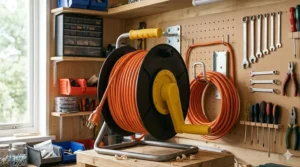
The Woods reel is what I recommend when people already own quality extension cords and just need proper storage. This side-mounted crank design holds up to 150 feet of 16/3 gauge cord or 125 feet of heavier 14/3 cord, and the tangle-free winding mechanism actually lives up to its name—unlike cheaper reels where the cord bunches on one side.
Here’s the key detail most buyers miss: the wide base isn’t just for stability during storage. It’s engineered to stay planted when you’re rapidly unwinding cord for a job. I’ve used reels that tip over the moment you pull cord quickly, turning a 30-second setup into a frustrating ordeal. The Woods design prevents that entirely. The carry handle adds genuine portability, making this ideal for contractors who move between job sites or homeowners who store it in a basement but use it in the yard.
The thermoplastic construction resists temperature extremes and shattering—critical if your garage isn’t climate controlled. One frequently mentioned customer insight: the 150-foot capacity rating is accurate for new, flexible cord, but older or stiffer cords may max out closer to 125 feet depending on gauge and jacket thickness.
Pros:
✅ Side-crank design allows faster winding than center-handle models
✅ Temperature-resistant plastic survives garage extremes
✅ Wide base prevents tipping during use
Cons:
❌ No built-in outlets (requires separate extension cord)
❌ Actual capacity varies with cord stiffness
Priced around $35-$50, this is the value champion for cord-storage-only needs. You’re not paying for features you don’t need, just rock-solid storage that works.
3. DEWENWILS 30 Ft Retractable Extension Cord Reel
Moving into wall-mounted territory, this DEWENWILS retractable model transforms how you think about garage power access. The 30-foot 16/3 gauge SJTW cord retracts automatically via spring mechanism, with a ratcheting lock that holds any length you need. What makes this genuinely useful in real-world scenarios is the 180-degree swivel mounting bracket—you can mount it in a corner and still pull cord to reach the opposite end of your workspace without binding or twisting.
The three grounded outlets include an LED indicator that lights when powered, eliminating the “is this thing even on?” confusion in dimly lit garages. The 10-amp circuit breaker provides overload protection, and the 4-foot lead-in cord gives you flexibility in mounting location without being too close to an outlet. For small to medium garages (roughly 20×20 feet), this 30-foot reach covers most workbench scenarios.
Where this model earns its keep is in the daily convenience factor. No more coiling and uncoiling cords before and after every project. Pull what you need, lock it, work, then release and let it retract. Users report the auto-retract stays smooth even after hundreds of cycles, and the cord itself resists kinking better than cheaper alternatives. The main limitation is reach—30 feet sounds adequate until you’re working on a vehicle at the far end of a two-car garage.
Pros:
✅ Automatic retraction eliminates manual coiling
✅ 180-degree swivel reaches multiple work zones
✅ LED indicator shows power status clearly
Cons:
❌ 30-foot length insufficient for larger garages
❌ Fixed cord gauge limits heavy-tool use
In the $70-$95 range, this delivers premium convenience for smaller workspaces where the 30-foot limitation isn’t a deal-breaker. If your garage is your primary workspace and you value speed over flexibility, this is your solution.
4. VEVOR Retractable Extension Cord Reel 30 FT
The VEVOR model competes directly with the DEWENWILS above but typically runs $5-$15 less, making it attractive for budget-focused buyers. The core specs mirror its competitor: 30 feet of 16AWG/3C SJTOW cord, three lighted outlets, 10-amp circuit breaker, and wall or ceiling mounting with 180-degree swivel. So what’s different?
Build quality feedback suggests slightly lighter construction—the housing feels less robust, though it’s still ETL listed for safety compliance. The real-world impact is minimal for residential use but matters if you’re running a professional shop with daily use. Where the VEVOR distinguishes itself is in the retraction mechanism smoothness. Several long-term users note it retracts slightly faster than the DEWENWILS, which is great until the cord slaps back too quickly and startles you. The adjustable stopper helps control this, letting you set a minimum retraction point to keep the outlets within easy reach.
For DIY homeowners working on weekend projects, the VEVOR delivers 90% of the DEWENWILS performance at a lower price point. The difference becomes noticeable only under heavy, daily professional use.
Pros:
✅ Lower price than comparable models
✅ Fast retraction saves time between tasks
✅ ETL listing ensures safety standards
Cons:
❌ Lighter construction may reduce longevity under heavy use
❌ Fast retraction can be aggressive without stopper adjustment
Around $65-$90, this is the smart choice for cost-conscious shoppers who need retractable convenience but won’t be using it daily in a professional capacity.
5. TerraBloom Retractable Extension Cord Reel 25 FT
Here’s where compact spaces meet smart engineering. The TerraBloom 25-foot model targets home garages, workshops, and tight quarters where every foot of space matters. The 14-gauge wire is beefier than the 16-gauge competitors, supporting up to 11 amps instead of 10—a seemingly small difference that actually matters when you’re running power-hungry tools like compressors or circular saws.
The lifetime replacement warranty immediately signals TerraBloom’s confidence in their product longevity, and customer feedback backs this up with reports of units functioning smoothly years after purchase. The retraction mechanism uses a slower, controlled rewind compared to the VEVOR, which users appreciate for safety and reduced wear on the cord itself. The LED power indicator is brighter than average, visible even in well-lit garages.
The 25-foot length is this model’s defining characteristic. If your workspace is genuinely compact—a single-car garage, a basement workshop, a utility room—this length prevents cord excess while providing adequate reach. Mounting it centrally on a ceiling gives roughly 12 feet of radius coverage, perfect for workbench-focused tasks. The trade-off is obvious: larger spaces require either multiple units or acceptance of limited reach.
Pros:
✅ 14-gauge wire handles higher amp draw than competitors
✅ Lifetime warranty demonstrates manufacturer confidence
✅ Slower retraction reduces cord wear
Cons:
❌ 25-foot length limits workspace coverage
❌ Premium price for shorter reach
Priced around $55-$75, the TerraBloom makes sense when space constraints are your primary concern and you value build quality over maximum reach. The 14-gauge upgrade and lifetime warranty justify the cost if you’re powering serious tools regularly.
6. Iron Forge Cable Extension Cord Storage Reel with Metal Stand
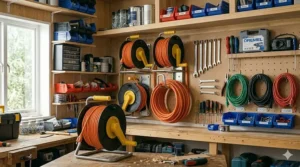
The Iron Forge Cable reel represents pure functionality without frills. This open-frame manual reel holds up to 100 feet of 16-gauge cable, 75 feet of 14-gauge, or 50 feet of 12-gauge, accommodating everything from light-duty to heavy contractor cords. The all-metal construction—both the stand and the reel frame—outlasts plastic alternatives in harsh garage environments where temperature swings, impacts, and chemical exposure are routine.
What makes this model worth considering is the portability factor. The metal carry handle is genuinely comfortable and balanced, making it easy to transport the reel from garage to yard to job site without awkward juggling. The high-quality PVC reel casing protects against dings and scratches while remaining lightweight enough not to add excessive weight.
As an American veteran-owned company, Iron Forge Cable has built a reputation for straightforward products that work. Users appreciate the no-nonsense design—there’s no circuit breaker to reset, no outlets to fail, just a solid reel that stores your cord properly. The simplicity also means fewer potential failure points. If you prefer to control your own cord gauge and length based on specific tasks, this reel gives you complete flexibility.
Pros:
✅ All-metal construction survives harsh environments
✅ True portability with balanced carry handle
✅ Accommodates various cord gauges and lengths
Cons:
❌ Requires separate extension cord purchase
❌ No electrical features (outlets, circuit protection)
At $30-$45, this is the minimalist’s choice. You’re paying for durable storage and portability, nothing more. If you already own extension cords and just need proper storage that lasts, the Iron Forge delivers exceptional value.
7. Bayco KW-110 Cord Reel
The Bayco KW-110 wraps up our list as the budget-friendly entry point to proper cord storage. This center-spin handle design accommodates 16/3 extension cords up to 100 feet, using a hand-slide mechanism that’s faster than it looks. The thermoplastic construction resists shattering and temperature extremes—critical for garages that see both summer heat and winter cold.
The built-in stand is more basic than the Woods or Iron Forge models but adequate for residential use. Where the Bayco earns its keep is in the plug capture holes—small details that prevent cord ends from dangling and getting damaged. You feed the plug end through the hole, wind up your cord, and when you need it, you only unwind what you actually need instead of the entire 100 feet.
This is Bayco’s bread-and-butter product, and they’ve refined it over decades. Users report reliable performance for occasional home use—seasonal decorations, lawn equipment, infrequent garage projects. The limitations emerge with frequent use or professional demands, where the plastic components show wear faster than metal alternatives. For homeowners who use extension cords monthly rather than daily, this reel does exactly what’s needed without overspending.
Pros:
✅ Lowest price point for cord storage
✅ Plug capture holes prevent end damage
✅ Temperature-resistant plastic lasts in climate extremes
Cons:
❌ Plastic construction less durable than metal under heavy use
❌ Center-spin handle slower than side-crank designs
Priced around $25-$40, the Bayco is perfect for casual users who need basic storage without premium features. It won’t impress professional contractors, but it’ll serve the average homeowner well for years.
Setting Up Your Extension Cord Storage System: A Practical Guide
Most people buy a cord reel and then struggle with the actual implementation. Here’s what actually works based on field experience, not just what sounds good on paper.
Step 1: Choose Your Mounting Location (For Fixed Reels)
Wall-mounted and ceiling-mounted reels need strategic placement. Mount too close to your workbench and the cord dangles in your way. Mount too far and you’re constantly stretching to reach. The sweet spot for ceiling-mounted retractable reels is directly above the center of your primary work zone, roughly 7-8 feet high. This height keeps the reel out of your workspace while maintaining easy outlet access. For wall-mounted units, position them at shoulder height (5-6 feet) near power tool storage—you want minimal steps between grabbing a tool and plugging it in.
Step 2: Test Your Reach Before Permanent Mounting
Before drilling holes, temporarily position the reel and physically walk through your common tasks with the cord at maximum extension. Can you reach your vehicle’s far side? Your table saw? The yard connection? Map this out before committing to permanent mounting. I’ve seen too many expensive retractable reels mounted in “logical” locations that turn out to be 5 feet short of actual working zones.
Step 3: Consider Cord Gauge for Your Tools
Empty manual reels give you gauge flexibility—use it. If you’re powering a circular saw or air compressor (high-draw tools), you need 12-gauge minimum. Running string lights or a radio? 16-gauge handles it fine and coils more compactly. The right approach: buy two reels if needed. One with 12-gauge for power tools, one with 16-gauge for light-duty tasks. This prevents unnecessarily hauling heavy cord for simple jobs.
Step 4: Maintain the Mechanism
Even quality reels need basic maintenance. Every few months, check the winding mechanism for debris—garage dust and sawdust accumulate in the gears and springs. A quick spray with compressed air prevents binding. For retractable models, lubricate the spring mechanism annually with silicone spray (not WD-40, which attracts dust). This 30-second task extends reel life by years.
Step 5: Mark Your Cords for Voltage Rating
If you’re using manual reels with multiple cords, mark each cord’s voltage rating with colored tape at both ends. This prevents the dangerous mistake of using a 125V-rated cord for 220V equipment. It sounds obvious, but in a cluttered garage with multiple cords, it’s easier to grab the wrong one than you’d think.
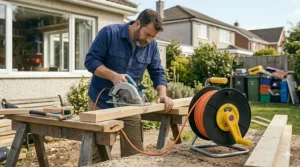
Extension Cord Storage Reel vs. Wall Hooks: The Real-World Comparison
Let’s address the elephant in the garage: are cord reels actually better than just hanging your extension cords on wall hooks? I’ve used both systems extensively, and the answer depends on how you work.
Wall Hooks: The Case For
Wall hooks cost maybe $5, install in minutes, and work indefinitely with zero moving parts. For someone who uses one extension cord occasionally—maybe monthly lawn equipment or holiday lights—hooks are genuinely sufficient. You’re not fighting with tangles daily, and the simplicity means nothing breaks. Hooks also accommodate irregular cord lengths and multiple cords side-by-side without compatibility concerns.
Cord Reels: The Case For
Cord reels prevent tangles completely, not just reduce them. If you’re in and out of your garage daily, unwinding and re-coiling manually becomes tedious fast. A good reel cuts this from a 2-minute task to a 10-second task, compounding time savings. More importantly, reels prevent the damage that occurs when cords are hastily coiled—kinks, jacket cracks, internal wire stress. A $50 cord lasts twice as long on a reel compared to hook storage because it’s never bent sharply or tangled.
The real dividing line is frequency of use. Use extension cords weekly or more? A reel pays for itself in time and cord longevity within months. Use them monthly or less? Hooks work fine and save money.
The Hybrid Approach
Many professionals use both: wall-mounted retractable reels for their primary work zone (the cord they use daily), and wall hooks for specialty cords used occasionally (outdoor-rated cords, different gauges, backups). This combines the convenience of instant access for frequent tasks with the economy of hooks for irregular use.
How to Choose an Extension Cord Storage Reel That Actually Fits Your Needs
Product specs tell you what a reel can do, but they don’t tell you what you actually need. Here’s how to match features to real-world requirements.
Factor 1: Frequency of Use Determines Mechanism Type
Daily users benefit most from retractable reels—the automatic retraction saves cumulative hours over months. Weekend warriors and occasional users are better served by manual reels, which cost less and have fewer parts to fail. A hand-crank manual reel works perfectly fine when you’re using it twice monthly; the convenience premium of auto-retraction doesn’t justify the cost difference.
Factor 2: Workspace Size Dictates Cord Length
Measure your garage or workshop diagonal (corner to corner), then add 10 feet. That’s your minimum functional cord length. A 30-foot retractable reel works in a single-car garage or 15×15 workshop. Double garages (20×20 or larger) need 50+ feet to avoid constantly repositioning. Don’t buy based on “should be enough”—measure and confirm.
Factor 3: Tool Amperage Requirements Override Convenience Features
If you regularly run high-draw tools (table saws, compressors, welders), cord gauge matters more than reel features. A 12-gauge cord on a basic manual reel beats a 16-gauge cord on a fancy retractable reel every time. Check your highest-draw tool’s amp rating and ensure your cord gauge handles it with safety margin. 12-gauge for 15+ amps, 14-gauge for 10-15 amps, 16-gauge for under 10 amps.
Factor 4: Storage vs. Power Distribution
Decide whether you’re buying cord storage or a power distribution system. Empty manual reels store your existing cords. Retractable reels with built-in outlets become your workshop’s power hub. If you frequently need multiple outlets in different locations, the built-in outlet models eliminate extension cord stacking and create cleaner workspaces. If you already have quality cords and just need proper storage, empty reels save money without sacrificing functionality.
Factor 5: Portability vs. Permanent Mounting
Contractors and mobile users need portable reels with quality carry handles. Homeowners with dedicated workshops benefit from wall or ceiling-mounted units that free up floor space. If you’re renting or might move, portable units avoid permanent installations. Own your space and have wall/ceiling access? Mounted reels optimize workspace efficiency permanently.
Common Mistakes When Buying Extension Cord Storage Reels
I’ve watched countless people buy the wrong cord reel, get frustrated, and then buy again. Here’s how to avoid that expensive learning curve.
Mistake 1: Buying Based on Maximum Capacity Instead of Typical Use
A reel that holds 150 feet of 16-gauge cord sounds impressive until you realize you only own 50 feet of cord. The extra capacity adds size, weight, and cost for no benefit. Buy for the cord you actually own plus maybe 25% growth room, not theoretical maximum capacity. Oversized reels are harder to mount, heavier to move, and cost more than appropriately sized options.
Mistake 2: Ignoring Cord Gauge Compatibility
Not all reels accommodate all gauges equally. Some reels rated for “up to 150 feet of 16-gauge” actually struggle with 100 feet of 12-gauge because the thicker diameter fills the reel faster. If you use heavy-duty 12-gauge cords, verify the reel’s capacity for that specific gauge, not just the maximum footage with lighter cord.
Mistake 3: Assuming Retractable Means Automatic Quality
Cheap retractable reels fail spectacularly—the spring mechanism breaks, the cord tangles inside the housing, or the retraction becomes so weak it won’t pull the cord back. Brand reputation matters more with retractable models than manual reels because there are more failure points. Stick with established brands (DEWENWILS, Woods, VEVOR, TerraBloom) that have consistent quality feedback rather than no-name budget options.
Mistake 4: Neglecting Circuit Protection for Power Tool Use
If you’re powering tools, circuit breakers aren’t optional extras—they’re essential safety features. Without overload protection, you’re one faulty tool or overloaded circuit away from damaged equipment or fire risk. Manual empty reels don’t include circuit protection, so you need it in your extension cord. Retractable models with built-in circuit breakers provide this protection automatically, which justifies their higher cost for professional use.
Mistake 5: Mounting Retractable Reels Without Testing Swivel Range
That 180-degree swivel bracket is only useful if your mounting location allows full rotation. Mount too close to a wall corner or ceiling joist and you’ve reduced your effective range significantly. Before drilling mounting holes, hold the reel in position and rotate it through its full range while someone pulls the cord to various work zones. Confirm it works in practice, not just in theory.
Cable Management Garage: Creating a Complete Cord Organization System
An extension cord storage reel is one piece of comprehensive cable management. Here’s how to build a complete system that handles all your garage power needs according to cable management best practices.
Layer 1: Primary Power Distribution
Your main retractable cord reel or frequently-used manual reel should be your primary power source, positioned for maximum workspace coverage. This handles 80% of your daily power needs—charging tools, running equipment, temporary lighting. Position this reel centrally and ensure it reaches all primary work zones.
Layer 2: Specialty Cords on Secondary Storage
Outdoor-rated cords, different gauges for specific tools, and backup cords belong on wall hooks or smaller secondary reels. These aren’t accessed daily but need organized storage to remain in good condition. Label each cord clearly with amp rating, length, and intended use (e.g., “12/3 50ft Outdoor – Power Tools”). This prevents grabbing the wrong cord in poor lighting.
Layer 3: Cord Accessories and Adapters
Create a dedicated storage zone for adapters, surge protectors, and cord accessories. A small parts organizer mounted near your primary reel keeps these items accessible without cluttering your main workspace. Lost adapters and buried surge protectors waste time—dedicated storage solves this.
Layer 4: Safety Integration
Every garage power system needs GFCI protection, especially near water sources or outdoor connections. Install GFCI outlets where your reels plug in, providing automatic protection against ground faults. Combine this with the circuit breakers in quality reels for comprehensive electrical protection that exceeds OSHA general requirements for safety.
Layer 5: Maintenance Zone
Reserve shelf space near your cord storage for maintenance supplies: electrical tape, cord repair materials, replacement parts, and cleaning supplies. When your reel needs attention, having everything in one place means you actually do the maintenance instead of postponing it indefinitely.
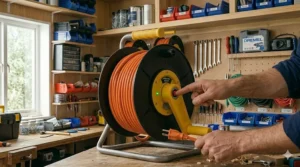
Wire Organization Systems: Beyond Basic Storage
Professional-grade wire organization systems integrate multiple elements into cohesive workspace management. Here’s how to think beyond individual products.
Vertical Storage Optimization
Wall-mounted reels free up floor space, but you can optimize further by stacking storage vertically. Mount your primary retractable reel at working height (5-6 feet), secondary manual reels above (7-8 feet), and accessory hooks below (3-4 feet). This vertical zoning creates clear organization: frequently used items at prime height, occasional items higher up, and specialty items lower where they don’t obstruct vision.
Color Coding for Instant Identification
Professional workshops use color-coded cord systems: red for high-amperage 12-gauge, yellow for medium 14-gauge, orange for light-duty 16-gauge. Extend this system to your reels by marking them with matching colored tape or labels. In dim lighting or rushed situations, color coding prevents the dangerous mistake of grabbing inadequate cord for high-draw tools.
Power Zone Planning
Rather than one central power distribution point, create zone-based systems. Workbench zone: retractable reel with triple outlets for hand tools and chargers. Vehicle zone: manual reel with long 12-gauge cord for power washers and air compressors. Storage zone: simple wall hooks for seasonal cords. This distributed approach eliminates cord stretching and repositioning.
Integration with Dust Collection
If you run power tools with dust collection systems, coordinate your cord storage with vacuum hose storage. Wall-mounted retractable reels pair naturally with overhead dust collection hoses, keeping both power and suction organized and accessible. This integrated approach prevents the cord-and-hose tangle that plagues many workshops.
Smart Labeling Systems
Beyond simple identification, label reels with usage instructions and capacity warnings. “Max 15A – Reset breaker after overload” or “12-gauge only – No 16-gauge” prevents user error, especially in shared workshops or when you’re working fast. Laminated labels survive garage conditions better than tape or marker.
Cord Storage Solutions for Specific Garage Situations
Different garage setups demand different cord storage approaches. Here’s how to match solutions to specific scenarios.
Scenario 1: The Renter’s Garage
Temporary mounting solutions work best when you can’t drill into walls permanently. Portable manual reels with sturdy stands (like the Iron Forge Cable or Woods models) provide full functionality without permanent installation. Pair these with damage-free adhesive hooks for secondary cord storage. When you move, everything relocates cleanly without patching drywall or explaining holes to landlords.
Scenario 2: The Multi-User Family Workshop
Multiple users with different skill levels need idiot-proof systems. Retractable reels with automatic retraction and circuit breakers protect against amateur mistakes—people can’t forget to coil cords properly if the reel does it automatically, and circuit breakers prevent overload damage from tool-stacking. Clear labeling and color coding help all users identify the right cord for their task without extensive electrical knowledge.
Scenario 3: The Professional Contractor’s Mobile Setup
Portability and durability trump convenience features. Heavy-duty manual reels with metal construction survive truck beds and job site abuse. The DEWENWILS hand-wind model with built-in outlets and circuit breaker provides power distribution without requiring wall mounting, functioning effectively in temporary work locations. Invest in weatherproof cord materials (SJTOW-rated) that handle outdoor exposure without degradation.
Scenario 4: The Compact Single-Car Garage
Space efficiency is paramount. Wall or ceiling-mounted retractable reels free up floor space, and shorter 25-30 foot lengths provide adequate coverage without excess cord clutter. The TerraBloom 25FT model suits this scenario perfectly—adequate reach for a small space, premium build quality that justifies permanent mounting, and automatic retraction that keeps the limited space organized effortlessly.
Scenario 5: The Large Two-Car Workshop
Comprehensive coverage requires either long cords (50+ feet) or multiple distribution points. Consider two mounted retractable reels positioned strategically to cover different zones rather than one extremely long cord. This approach provides better coverage, reduces cord stretching across workspaces, and allows simultaneous multi-zone projects without cord conflicts.
Long-Term Cost Analysis: Is a Premium Reel Worth It?
Price differences between budget and premium reels range from 100-200%, but the total cost picture includes factors beyond purchase price.
Cord Longevity Impact
Proper reel storage extends cord lifespan significantly. A quality extension cord costs $30-$80 depending on gauge and length. Improper storage (tangled piles, sharp bends, exposure to damage) reduces cord life from 10+ years to 3-5 years. A $50 premium reel that preserves a $60 cord for an extra 5 years pays for itself through prevented replacement costs alone.
Time Value Calculation
Manual coiling takes roughly 1-2 minutes per use. Automatic retractable reels reduce this to 10-15 seconds. For daily users, that’s 5-10 minutes saved per week, or 4-8 hours annually. If your time value is even $20/hour, that’s $80-$160 in saved time yearly. The premium for a retractable reel ($40-$60 over manual models) pays back within one year for frequent users.
Maintenance and Repair Costs
Cheap reels fail within 2-3 years and aren’t economically repairable—replacement cost equals original purchase. Quality reels from established brands last 10+ years with basic maintenance and offer replacement parts for common failure points (springs, handles, outlet modules). The $30 savings on a budget reel becomes a $30 additional expense when you replace it prematurely.
Safety Cost Avoidance
Circuit breaker protection in premium reels prevents tool damage from overload conditions. One prevented power tool burnout ($100-$500 depending on tool) justifies the $20-$40 premium for circuit-protected models. GFCI and overload protection aren’t luxuries—they’re insurance against expensive failures.
The Break-Even Calculation
For occasional users (monthly or less), budget manual reels ($25-$40) represent optimal value. The convenience premium of automatic retraction and built-in outlets doesn’t pay back with infrequent use. For weekly users, mid-tier reels ($50-$70) balance cost and features effectively. Daily professional users should invest in premium models ($80-$120) where the quality difference, time savings, and longevity justify the upfront cost within the first year.
❓ Frequently Asked Questions
❓ Can I use any extension cord with a manual storage reel?
❓ What's the difference between SJTW and SJTOW extension cord ratings?
❓ How do I prevent retractable cord reels from retracting too fast?
❓ Can wall-mounted extension cord reels support outdoor use?
❓ Why does my circuit breaker trip even when I'm not exceeding the amp rating?
Conclusion: Finding Your Perfect Extension Cord Storage Solution
After analyzing seven top extension cord storage reels, the truth is straightforward: the best reel depends entirely on how you work. The budget-conscious occasional user thrives with the Bayco KW-110 or Woods manual reel—simple storage that costs under $50 and lasts years with minimal fuss. The daily workshop user who values time and convenience finds the extra cost of the DEWENWILS or VEVOR retractable models justified within months through saved time and enhanced workflow.
The dividing line isn’t just price—it’s frequency of use, workspace size, and whether you need storage alone or complete power distribution. Empty manual reels accommodate your existing quality cords with flexibility to swap gauges as needed. All-in-one retractable units with built-in outlets become your garage’s power hub, eliminating the constant cord swapping and connection juggling that slows projects down.
What actually matters in 2026 is moving beyond tangled cord piles that waste time and damage equipment. Whether you invest $30 in a basic manual reel or $95 in a premium retractable system, proper cord storage pays for itself through preserved cord lifespan, time savings, and the simple pleasure of grabbing your extension cord and getting to work instead of fighting with knots for five minutes first.
Start by measuring your workspace diagonal, identifying your highest-draw tools, and honestly assessing how often you use extension cords. Match those factors to the products analyzed above, and you’ll land on the right solution without expensive trial-and-error purchasing. Your garage organization deserves better than trial-and-error learning.
Recommended for You
- 7 Best Power Tool Charging Stations That End Garage Chaos 2026
- 7 Best Paint Can Storage Rack Solutions for 2026
- 7 Best Lumber Storage Racks for Garage: Transform Your Space 2026
Disclaimer: This article contains affiliate links. As an Amazon Associate, I earn from qualifying purchases. If you purchase products through these links, we may earn a small commission at no additional cost to you.
✨ Found this helpful? Share it with your friends! 💬🤗
