
In This Article
So you’re staring at your worn-out floors, dreaming of that gorgeous wood look, but you’re stuck between two seemingly similar options. Trust me, I’ve been there. The engineered hardwood flooring vs laminate debate has stumped more homeowners than you’d think, and honestly? The choice you make today could mean the difference between a floor that lasts decades and one that chips away your sanity (and wallet) in just a few years.
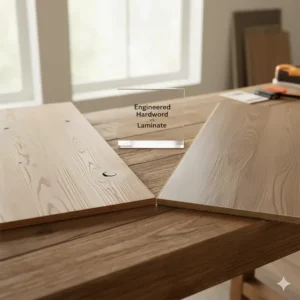
Here’s the thing nobody tells you upfront: both engineered hardwood flooring vs laminate options can look nearly identical in the showroom. But take them home, live on them for a year, and you’ll discover they’re about as similar as a sports car and a minivan. Sure, they’ll both get you from point A to point B, but the journey? Completely different.
✨Was this helpful? Spread the word! 🚀
I’ve spent countless hours researching, comparing products, and diving deep into what really matters when you’re choosing between engineered hardwood vs laminate. And let me tell you, there are some shocking truths the big box stores won’t share during their sales pitches. Whether you’re renovating your first apartment or upgrading your forever home, understanding the engineered wood flooring vs laminate distinction is crucial before you drop thousands of dollars.
🏡 What Exactly Are We Comparing Here?
Before we dive into the nitty-gritty details of engineered hardwood flooring vs laminate, let’s clear up what these flooring types actually are. Because spoiler alert: neither one is quite what you think.
Understanding Engineered Hardwood Flooring
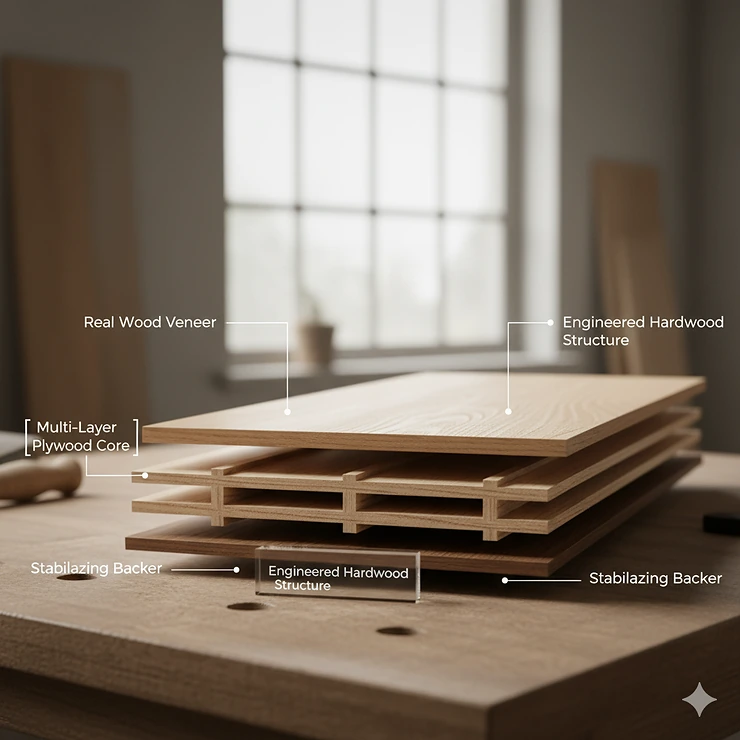
Engineered hardwood isn’t fake wood—it’s real wood, just built smarter. Picture this: multiple layers of wood pressed together like a high-tech sandwich. The top layer? That’s genuine hardwood veneer, usually oak, hickory, or maple. Underneath, you’ve got several layers of plywood or high-density fiberboard running in different directions. This cross-grain construction is genius, really. It makes engineered hardwood way more stable than solid hardwood, especially when temperatures and humidity levels decide to throw a party.
The wear layer—that top hardwood veneer—typically ranges from 1mm to 6mm thick. And here’s something most people don’t realize: that thickness matters more than you’d think. A thicker wear layer means you can refinish the floor multiple times, potentially extending its life by decades. The SimpleFLOORS Birch Hand Scraped (Model ER-8006-RL Grey Fox), priced at $2.56 per square foot, features a robust 3mm wear layer that can handle several refinishing cycles over its lifetime.
Breaking Down Laminate Flooring
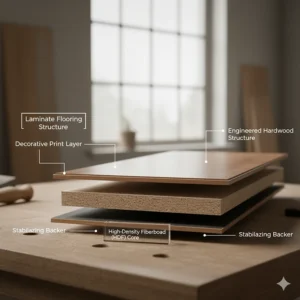
Now, laminate is a whole different beast. It’s basically a photograph of wood (yes, really) sandwiched between protective layers. At the core, you’ve got high-density fiberboard. On top of that sits a super high-resolution image of wood grain, and above that, a tough wear layer made from aluminum oxide or similar materials. Finally, there’s a backing layer that adds stability and moisture resistance.
Here’s what blows people’s minds: modern laminate technology has gotten so good that you literally can’t tell the difference from across the room. The TrafficMaster Grey Oak (Model 360731-00375) at just $0.99 per square foot looks convincingly like real oak, complete with texture and grain variations.
The catch? It’s never been real wood. Not even for a second. But does that make it bad? Not necessarily. It just makes it different, with its own set of pros and cons.
📊 Quick Comparison: Engineered Hardwood vs Laminate at a Glance
| Feature | Engineered Hardwood | Laminate |
|---|---|---|
| Top Surface | Real wood veneer | Photographic image |
| Core Material | Plywood layers | High-density fiberboard |
| Price Range | $2.50-$10.00/sq.ft | $0.80-$3.00/sq.ft |
| Lifespan | 25-40 years | 15-25 years |
| Refinishing | Yes (1-3 times) | No |
| Water Resistance | Moderate | Better |
| Resale Value | Higher | Lower |
| Installation Ease | Moderate | Very Easy |
💬 Just one click – help others make better buying decisions too! 😊
💰 The Real Cost Breakdown: What You’ll Actually Pay
Let’s talk money, because the sticker price is just the beginning of the engineered hardwood flooring vs laminate cost conversation.
Upfront Material Costs
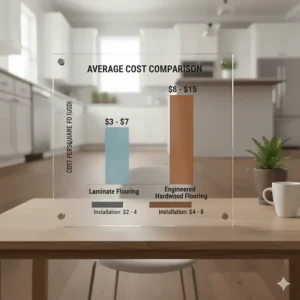
When comparing engineered wood flooring vs laminate on paper, laminate wins the affordability contest hands down. Budget laminate starts around $0.80 per square foot, while even basic engineered hardwood rarely dips below $2.50 per square foot. For a standard 200-square-foot room, that’s potentially $160 for laminate versus $500 for engineered hardwood—just for materials.
But wait, there’s more to this story. The Pergo XP Anndel Oak (Model LF001075) at $1.89 per square foot represents the sweet spot in laminate pricing—quality construction without breaking the bank. Meanwhile, the SimpleFLOORS European Oak Wire Brushed (Model EU-1028-20-RL Venice II) at $2.99 per square foot sits in the mid-range for engineered hardwood, offering excellent value for real wood.
Installation Expenses
Here’s where things get interesting. Laminate installation typically runs $1-$3 per square foot for professional installation because it’s genuinely easier to work with. Those click-lock systems? They’re brilliant. Most DIY-ers can tackle laminate installation over a weekend with basic tools and YouTube tutorials.
Engineered hardwood installation costs more—usually $3-$8 per square foot—especially if you’re going with glue-down or nail-down installation methods. The floating installation method (similar to laminate) costs less but isn’t always recommended depending on your subfloor situation.
Long-Term Value Proposition
Now here’s the plot twist that makes the engineered hardwood vs laminate decision way more complex: long-term value. Engineered hardwood typically adds more resale value to your home. Real estate agents consistently report that homes with hardwood flooring (even engineered) sell faster and at higher prices than those with laminate.
Plus, engineered hardwood can be refinished. When your laminate starts looking worn in 10-15 years, you’re replacing the entire floor. When engineered hardwood shows its age, you can often sand and refinish it for $3-$8 per square foot—way cheaper than full replacement. This capability alone can effectively double or triple the lifespan of engineered hardwood flooring.
🔨 Installation Showdown: DIY Dreams vs Professional Nightmares
The engineered hardwood flooring vs laminate installation comparison deserves its own deep dive because this is where many homeowners either save big or make expensive mistakes.
Laminate Installation: The DIY Darling
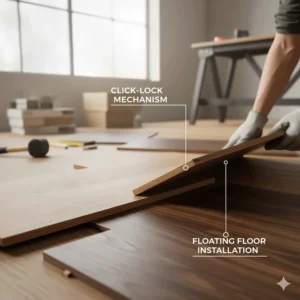
Laminate flooring installation is genuinely forgiving. The click-lock floating system means planks literally snap together like expensive puzzle pieces. You don’t need specialized tools beyond a saw, spacers, and a tapping block. Most laminate manufacturers design their products for DIY installation, and it shows.
A typical 200-square-foot room can be completed by a motivated DIYer in one weekend. Start Friday evening, and you could be walking on your new floor by Sunday afternoon. The TrafficMaster laminate line particularly excels in DIY-friendly installation, with clear tongue-and-groove systems that practically install themselves.
Engineered Hardwood Installation Methods
Engineered hardwood offers three installation options, each with different complexity levels:
Floating Installation ⚡ – Similar to laminate, engineered hardwood planks with click-lock systems can float over underlayment. This method works great on concrete subfloors and is the most DIY-friendly engineered hardwood option. However, it’s not suitable for all products, especially wider planks that need more stability.
Glue-Down Installation 🔧 – This involves spreading adhesive on the subfloor and pressing each plank into place. It’s more stable than floating but requires perfect subfloor preparation. Mess up the moisture barrier or use the wrong adhesive, and you’ll hear creaking for years. Professional installation is strongly recommended.
Nail-Down Installation 🔨 – Traditional and incredibly stable, nail-down installation requires a wooden subfloor and specialized nailers. This method isn’t DIY-friendly unless you have experience with pneumatic tools and know how to blind-nail properly.
Subfloor Requirements and Preparation
Both engineered hardwood vs laminate require flat, clean subfloors, but their tolerance levels differ. Laminate can handle minor imperfections thanks to its flexible core. Engineered hardwood, especially with glue-down installation, demands near-perfect flatness—variations beyond 3/16 inch over 10 feet can cause problems.
Moisture testing is crucial for both, but engineered hardwood is less forgiving of moisture issues. You’ll need a moisture meter and potentially a vapor barrier, especially over concrete slabs. The Bruce Natural Statement engineered hardwood line, for instance, requires subfloor moisture content below 12% for successful installation.
🌊 Water Resistance Reality Check
The engineered wood flooring vs laminate water resistance debate might surprise you. Conventional wisdom says engineered hardwood wins because it’s “real wood,” but that’s actually backward.
Laminate’s Waterproof Advantage
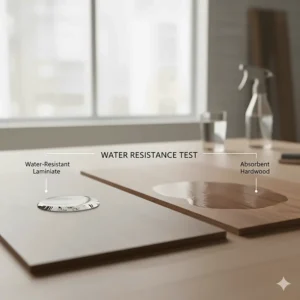
Modern laminate flooring handles water surprisingly well. The dense fiberboard core repels moisture better than wood, and many premium laminates feature water-resistant cores and sealed edges. Spill wine during dinner? No problem. Wipe it up within a few hours, and laminate shrugs it off.
The Pergo Outlast+ (Model LF000844) at $2.79 per square foot features WetProtect technology with a lifetime waterproof warranty. That’s not “water-resistant”—it’s genuinely waterproof, designed to handle standing water for up to 24 hours. For bathrooms, kitchens, or basements, this level of protection is game-changing.
Engineered Hardwood’s Moisture Vulnerability
Here’s the uncomfortable truth: engineered hardwood doesn’t love water. That top veneer layer is real wood, which means it can swell, warp, and cup if exposed to excessive moisture. The plywood core offers more stability than solid wood, but it’s still vulnerable to prolonged water exposure.
Clean up spills immediately. Use mats near sinks and entryways. Never wet-mop engineered hardwood—damp-mop only. These aren’t suggestions; they’re requirements if you want your floor to last. The SimpleFLOORS engineered hardwood lines include moisture-resistant cores, but they’re designed for moisture protection, not waterproofing.
Best Applications by Room
Kitchens 🍳 – Laminate wins here. Between sink splashes and dishwasher leaks, kitchens see too much water risk for most engineered hardwood.
Bathrooms 🚿 – Laminate only, preferably waterproof versions. Engineered hardwood in bathrooms is asking for trouble unless you’re using a specialized waterproof product.
Living Rooms & Bedrooms 🛋️ – Both work beautifully. Choose based on other priorities like appearance and budget.
Basements 🏚️ – Laminate’s moisture resistance makes it the safer choice, though engineered hardwood works if you’ve got excellent moisture barriers and dehumidification.
🎨 Appearance and Authenticity: Real vs. Really Convincing
The engineered hardwood flooring vs laminate aesthetic comparison used to be clear-cut. Real wood looked real; laminate looked fake. Not anymore.
The Engineered Hardwood Advantage
There’s something special about genuine wood grain that photos can’t quite capture. Every plank of engineered hardwood is unique, with natural variations in color, grain pattern, and knots. Run your hand across SimpleFLOORS hand-scraped engineered hardwood, and you feel those texture variations—they’re real because they came from a real tree.
The patina that develops over time is another genuine wood characteristic. Engineered hardwood subtly changes color as it ages, developing character and depth. Some species darken, others lighten, but the transformation adds value rather than detracting from it.
Laminate’s Impressive Evolution
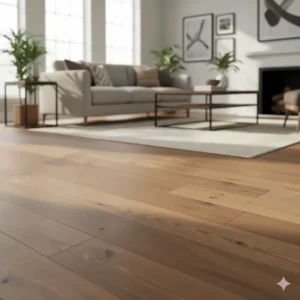
Modern laminate technology has achieved something remarkable: near-perfect visual replication. High-definition printing and embossing create texture that matches the printed grain pattern exactly. Walk into a room with quality laminate like the Pergo XP line, and most people genuinely can’t tell it’s not real wood from standing height.
The catch? Every plank in a laminate product line shares the same handful of patterns. Manufacturers typically use 6-12 different “wood” images rotated throughout the product. Once you notice the repetition, you can’t unsee it. Engineered hardwood never has this problem because actual wood variation is endless.
Refinishing and Long-Term Appearance
This is where the engineered hardwood vs laminate comparison tilts heavily toward engineered hardwood. When laminate gets scratched or worn, you’re stuck with it. Deep scratches penetrate the wear layer, exposing the photographic layer or even the core. No amount of buffing fixes that.
Engineered hardwood with a thick wear layer can be lightly sanded and refinished 1-3 times depending on veneer thickness. This ability to restore the original appearance means engineered hardwood can maintain its beauty for 30-40 years, while laminate typically shows irreversible wear after 15-20 years.
🏢 Industry-Specific Applications and Professional Use
The engineered wood flooring vs laminate decision changes dramatically depending on your specific situation and how you plan to use the space.
Residential Applications: Making It Personal
Starter Homes and Rentals 🏠
For rental properties or starter homes you’ll sell within 5-10 years, laminate makes fantastic financial sense. The TrafficMaster Grey Oak at under $1 per square foot handles tenant wear while keeping renovation budgets low. When you sell, buyers see “wood-look floors” at the price point they expect, and you’ve spent minimal capital.
However, if you’re in a competitive real estate market where home values exceed $400,000, engineered hardwood might be worth the investment. Real estate data from the National Association of Realtors consistently shows that homes with real or engineered hardwood command 2-5% higher selling prices and sell 15-20 days faster than comparable homes with laminate.
Forever Homes and Premium Properties 🏰
When you’re building your dream home or renovating a property you’ll keep for 20+ years, engineered hardwood makes more financial sense. The ability to refinish extends the practical lifespan so dramatically that the per-year cost often ends up lower than laminate when you factor in replacement cycles.
The SimpleFLOORS European Oak Wire Brushed line offers the perfect balance for premium residential applications—genuine European oak character with engineered construction stability. The wire-brushed texture hides minor scratches while adding visual depth that photographs beautifully for real estate listings down the road.
Commercial Installations: Durability Meets Budget
Light Commercial (Offices, Boutiques) 🏢
Commercial-grade laminate dominates light commercial spaces because of its incredible durability-to-cost ratio. AC5-rated laminate, the highest residential rating, handles moderate foot traffic beautifully. The Newton Clearwater Collection at $5.13 per square foot includes AC4 ratings suitable for light commercial use, with scratch-resistant aluminum oxide surfaces and commercial-grade warranties.
Engineered hardwood works in low-traffic commercial settings like executive offices or upscale retail spaces where appearance justifies the premium. However, maintenance requirements increase in commercial settings—any water-based cleaning must be carefully controlled to avoid moisture damage.
Heavy Commercial (Restaurants, Hotels) 🏨
Neither engineered hardwood nor standard laminate belongs in heavy commercial applications. The moisture exposure, chemical cleaners, and intense foot traffic destroy both relatively quickly. True luxury vinyl plank or commercial-grade ceramic tile makes more sense here.
According to the Floor Covering Institute, commercial laminate installations in moderate-traffic areas average 7-10 year lifespans with proper maintenance, while engineered hardwood in similar settings requires refinishing every 5-7 years or complete replacement after 12-15 years.
Regional and Climate Considerations
Humid Climates (Southeast US, Coastal Areas) 🌴
Laminate’s superior moisture resistance makes it the smarter choice in consistently humid environments. Engineered hardwood can work with excellent HVAC control and dehumidification, but you’re fighting against nature. The Pergo waterproof laminate lines specifically address humid climate challenges with sealed cores and edges.
Dry Climates (Southwest, Mountain States) 🏜️
Engineered hardwood thrives in dry climates with stable indoor humidity. The cross-grain construction prevents the excessive shrinkage and gapping that plagues solid hardwood in desert environments. Just maintain 35-55% relative humidity year-round with humidification during heating season.
Cold Climates (Northern States, Canada) ❄️
Both engineered hardwood vs laminate work well in cold climates, but installation timing matters. Never install when indoor temperatures fall below 65°F, and allow materials to acclimate to room temperature for 48-72 hours before installation. The Bruce Natural Statement engineered hardwood performs exceptionally well in four-season climates thanks to its stable multi-layer construction.
🔬 Advanced Technical Analysis: Engineering Meets Reality
Let’s get into the science behind engineered hardwood flooring vs laminate—the stuff manufacturers don’t prominently display but makes all the difference over time.
Core Construction and Structural Integrity
Engineered Hardwood Core Systems
The number and orientation of plywood layers in engineered hardwood directly impacts dimensional stability. Premium products use 7-11 ply construction with each layer running perpendicular to the adjacent layers. This cross-grain pattern is what prevents cupping and warping.
The SimpleFLOORS Birch Hand Scraped uses a 9-ply birch core specifically chosen for dimensional stability. Birch plywood offers superior screw-holding strength compared to pine or poplar cores, meaning glue-down installations maintain better long-term adhesion. The species choice for core material matters as much as the construction method.
Laminate Core Technology
High-density fiberboard (HDF) cores in quality laminate achieve density ratings of 900+ kg/m³. This compression creates surprising strength—premium laminate can support 1000+ pounds per square inch without deflection. The Pergo Outlast+ line uses specially formulated HDF with added moisture-resistant additives, creating cores that actually repel water rather than simply resisting it.
Wear Layer Science and Abrasion Resistance
AC Ratings Explained
The Abrasion Criteria (AC) rating system measures how well flooring withstands wear, and understanding it changes how you evaluate the engineered hardwood vs laminate comparison. AC ratings range from AC1 (light residential) to AC5 (heavy commercial):
- AC1: Light residential, rarely seen today
- AC2: Moderate residential (bedrooms)
- AC3: General residential (all rooms)
- AC4: Heavy residential/light commercial
- AC5: Heavy commercial
Most engineered hardwood doesn’t carry AC ratings because the wear layer is actual wood, rated differently. However, the veneer thickness serves a similar function—2mm+ veneers handle residential traffic for decades with proper care.
Acoustic Performance and Sound Transmission
Here’s something most people discover only after installation: engineered hardwood vs laminate sound dramatically different underfoot. Laminate has a distinct “hollow” sound when you walk on it, while engineered hardwood sounds more substantial and quiet.
The sound transmission class (STC) and impact insulation class (IIC) ratings matter for multi-story homes and condos. Engineered hardwood typically achieves STC ratings of 50-55 and IIC ratings of 45-50 with proper underlayment. Laminate struggles to exceed STC 45 and IIC 40 ratings even with premium underlayment.
Research from the National Wood Flooring Association demonstrates that attached-pad engineered hardwood reduces impact noise by 18-22 decibels compared to floating laminate installations. For upstairs bedrooms or condo installations, this difference is meaningful.
Thermal Conductivity and Radiant Heating Compatibility
Planning radiant floor heating? The engineered wood flooring vs laminate discussion takes another turn. Laminate’s synthetic core conducts and distributes heat more evenly than wood, making it the technically superior choice for radiant heating systems.
Engineered hardwood works with radiant heat but requires specific construction. Look for products with thinner overall profiles (⅜-½ inch maximum) and thinner wear layers (1-2mm). The Uptown-Modern European Oak at 12mm total thickness works with low-temperature radiant systems when properly installed over appropriate underlayment.
Critical temperature limits matter: laminate can handle system temperatures up to 85°F, while engineered hardwood maxes out around 80°F to prevent veneer cracking and checking. Exceed these limits, and you void most manufacturer warranties.
🛠️ Comprehensive Maintenance and Care Protocols
The day-to-day reality of living with engineered hardwood flooring vs laminate centers on maintenance requirements. Let’s break down exactly what you’re committing to with each option.
Daily and Weekly Maintenance Routines
Laminate Care Schedule
Daily maintenance for laminate couldn’t be simpler: sweep or vacuum with a soft brush attachment. That’s it. No special products required. Weekly, you can damp-mop (emphasis on damp, not wet) with plain water or a manufacturer-approved laminate cleaner. The TrafficMaster and Pergo laminate lines specifically recommend avoiding oil-based cleaners, waxes, and polish—they create dulling buildup on laminate’s wear layer.
For high-traffic areas, consider protective pads under furniture legs and area rugs in entryways. Laminate scratches more easily than you’d expect despite its tough wear layer, and once scratched, there’s no fixing it. Prevention is everything.
Engineered Hardwood Care Protocol
Engineered hardwood demands more attention. Daily sweeping or vacuuming prevents the fine grit that acts like sandpaper on wood floors. Weekly cleaning requires hardwood-specific cleaners—never use vinegar or ammonia-based products, which strip the finish over time.
The SimpleFLOORS engineered hardwood collections come factory-finished with UV-cured polyurethane or oil finishes. These finishes need refreshing every 2-3 years with a hardwood floor refresher or rejuvenator. This $20-30 bottle treatment restores luster and adds a protective layer without full refinishing.
Monthly and Quarterly Deep Maintenance
Laminate Deep Cleaning
Monthly deep cleaning for laminate involves a more thorough damp mopping with manufacturer-recommended cleaners. Check for and repair any damaged planks—laminate repair kits can fill scratches with color-matched putty, though results vary significantly depending on damage depth.
Quarterly, inspect click-lock connections in high-traffic areas. Over time, repeated foot traffic can cause planks to slightly separate. This issue isn’t common with quality laminate but happens occasionally. A tapping block and rubber mallet can reseat separated planks in 5-10 minutes.
Engineered Hardwood Maintenance Schedule
Beyond regular cleaning, engineered hardwood benefits from quarterly inspections for finish wear patterns. High-traffic lanes in entryways and kitchens show wear first. Apply hardwood floor refresher to these areas preemptively before the finish wears through to wood.
Every 3-6 months, check for signs of moisture damage: cupping (plank edges higher than centers), crowning (centers higher than edges), or unexplained gaps. These symptoms indicate moisture problems that need immediate attention. The Bruce Natural Statement line includes detailed moisture troubleshooting guides with specific humidity targets for each season.
Long-Term Maintenance and Restoration
When to Refinish Engineered Hardwood
Refinishing becomes necessary when the finish wears through and raw wood shows through in high-traffic areas. With a 3mm+ wear layer, light screening and recoating adds 5-7 years between full refinishing cycles. The process costs $3-8 per square foot depending on your location—significantly less than replacement.
Products like the SimpleFLOORS European Oak with 2mm+ wear layers support one full sand-and-refinish plus multiple screen-and-recoat cycles. This capability means a properly maintained engineered hardwood floor installed in 2025 could easily serve your home through 2060 with appropriate care.
Laminate Replacement Triggers
Laminate has a finite lifespan determined by wear layer integrity. Once significant scratches penetrate the wear layer or high-traffic areas show obvious pattern wear, replacement is the only option. Fortunately, laminate installation methods make replacement relatively straightforward—floating installations especially require no adhesive removal or subfloor preparation beyond cleaning.
Plan for laminate replacement every 15-25 years depending on product quality and traffic levels. Budget installations might need replacement after 12-15 years, while premium products like Pergo Outlast+ can approach 25-year lifespans with excellent care.
Maintenance Cost Comparison
| Maintenance Item | Engineered Hardwood | Laminate |
|---|---|---|
| Daily/Weekly Cleaning | Specialized products needed ($50-100/year) | Basic cleaners acceptable ($20-40/year) |
| Quarterly Maintenance | Refresher treatments ($30-50/year) | Minimal ($0-20/year) |
| Major Restoration | Refinishing every 8-12 years ($600-1600 per 200 sq.ft room) | Replacement every 15-25 years ($800-1200 per room materials) |
| 30-Year Total | $2,500-4,000 (including 2 refinishing cycles) | $1,500-2,500 (including one replacement) |
📈 Investment Decision Framework and ROI Analysis
Making the engineered hardwood flooring vs laminate decision requires looking beyond initial costs to understand true return on investment over your ownership timeline.
Home Value Impact Studies
Multiple real estate studies show consistent patterns regarding flooring and home values. Data from the National Association of Realtors 2024 Remodeling Impact Report reveals:
- Hardwood flooring refinishing recovers 147% of project costs at sale
- New hardwood flooring installation recovers 106% of costs
- Laminate flooring installation recovers 72-85% of costs
The engineered hardwood vs laminate value differential exists because buyers perceive engineered hardwood as “real wood” and laminate as a budget alternative. This perception gap drives price premiums even when laminate quality approaches engineered hardwood aesthetically.
Break-Even Analysis by Property Type
Starter Homes ($150,000-$300,000 market value)
In this price segment, laminate makes excellent financial sense. The $0.80-2.00 per square foot price range matches buyer expectations, and the 15-25 year lifespan exceeds typical ownership duration. Install TrafficMaster laminate throughout a 1,200 square foot home for under $2,500 in materials, and you’ve met market standards at minimal cost.
Mid-Market Homes ($300,000-$600,000)
This segment is where the engineered hardwood flooring vs laminate calculation becomes truly interesting. Higher-end laminate (Pergo Outlast+ at $2.79/sq.ft) competes directly with basic engineered hardwood (SimpleFLOORS Birch at $2.56/sq.ft) on price but not on perceived value or resale impact.
If planning to keep the property 10+ years, engineered hardwood’s refinishing capability and superior resale value justify the similar or slightly higher initial cost. For shorter ownership timelines (5-8 years), premium laminate provides adequate market appeal at potentially lower installed cost.
Luxury Homes ($600,000+)
In luxury markets, laminate rarely appears outside utility spaces. Buyers at this price point expect real or engineered hardwood throughout main living areas. The SimpleFLOORS European Oak or similar premium engineered products meet market expectations while providing installation advantages over solid hardwood (especially over concrete slabs or radiant heating systems).
Rental Property Investment Calculations
Property investors face unique engineered wood flooring vs laminate considerations focused on durability per dollar and tenant appeal. Here’s the math that matters:
Short-Term Rentals (Airbnb/VRBO)
Durability wins. Guests are hard on floors, and you need surfaces that handle dozens of turnovers annually. Waterproof laminate like Pergo Outlast+ makes perfect sense—it handles spills, resists scratches reasonably well, and looks good in listing photos. The $560-840 material cost for a 200 sq.ft room will withstand 5-7 years of rental abuse.
Long-Term Rentals
Traditional rental properties benefit from mid-grade laminate’s combination of tenant appeal and landlord-friendly economics. Replace worn laminate every 7-10 years between tenants, and you’re maintaining property standards at predictable costs. Engineered hardwood adds minimal rent premium but requires more maintenance to prevent tenant damage from voiding warranties.
Tax Implications and Depreciation
For rental properties, the IRS classifies flooring as a 5-year depreciable asset under current tax law. This accelerated depreciation timeline makes laminate’s lower initial cost attractive for tax planning purposes. The TrafficMaster line’s sub-$1/sq.ft pricing means you can write off larger percentages annually.
Engineered hardwood’s longer useful life (27.5 years under residential rental property depreciation) means slower depreciation rates but also means you’re not forced into as many replacement cycles. Consult a tax professional to optimize this decision based on your specific situation.
💡 Smart Purchase Strategies and Product Selection
Armed with technical knowledge about engineered hardwood flooring vs laminate, let’s talk practical shopping strategies that save money without sacrificing quality.
### 🛒 Smart Shopping: Where and When to Buy
🎯 Best Times to Purchase
Flooring retailers follow predictable seasonal patterns. January-February sees the deepest discounts as stores clear inventory post-holiday. Memorial Day and Labor Day weekend sales offer 15-25% off list prices. Black Friday deals on flooring often beat appliance and electronics savings—I’ve seen premium Pergo laminate drop from $2.79 to $1.89 per square foot during these events.
Big box stores (Home Depot, Lowe’s) run “buy more, save more” promotions where purchasing 42+ cartons triggers additional 5-10% discounts. Plan your square footage carefully to hit these thresholds. The SimpleFLOORS products on Amazon occasionally offer prime day deals with free shipping, eliminating the delivery fees that can add $100-300 to large orders.
🏪 Retailer Comparison Strategy
Don’t buy from the first place you visit. Price the same product at three retailers minimum. I’ve found the same TrafficMaster laminate priced at $0.99/sq.ft at Home Depot and $1.49/sq.ft at a local flooring boutique. The boutique offered “professional installation,” but their installer quote was 40% higher than independent contractors I contacted.
Consider online retailers like BuildDirect, Lumber Liquidators (now LL Flooring), or direct manufacturer sales. The SimpleFLOORS line sells directly through Amazon with competitive pricing and prime shipping on many products. Just ensure you order extra—most retailers require 10% overage for cuts and waste, and reordering later means mismatched dye lots.
🎯 Sample Testing Protocol
Never, and I mean never, buy flooring without ordering samples first. The $5-15 per sample investment prevents thousand-dollar mistakes. Here’s my battle-tested sampling protocol:
Visual Assessment
Place samples in the actual room where you’ll install, not under showroom lighting. Morning sunlight reveals different color tones than evening lamplight. Leave samples for 3-5 days and check them at different times of day. That gorgeous walnut-tone Pergo XP might look orange-tinted under your southwest-facing windows.
Texture and Feel Test
Walk on samples barefoot. Quality engineered hardwood feels substantial and slightly soft underfoot. Laminate feels harder, more rigid. Neither is wrong—they’re just different. If you walk around barefoot frequently, this tactile difference matters more than you’d think.
Water Resistance Verification
Conduct your own water resistance test. Place a few tablespoons of water on sample surfaces and leave for 8-12 hours. Quality waterproof laminate like Pergo Outlast+ should show zero absorption or surface changes. Engineered hardwood will show slight darkening where water contacts the finish—this is normal but illustrates the maintenance difference.
Scratch Resistance Reality Check
Take a house key and firmly scratch the sample surface. Not hard enough to gouge, but firm pressure. This simulates what pet claws and dropped items do over time. Premium laminate shows minimal marking. Engineered hardwood develops slight surface scratches in the finish (which can be refinished later). Understanding this upfront prevents disappointment after installation.
📦 Installation Best Practices: Professional Insights
The engineered wood flooring vs laminate installation quality matters as much as product quality. Spectacular flooring installed poorly fails quickly. Budget flooring installed meticulously can exceed expectations.
Subfloor Preparation: The Foundation of Success
Concrete Subfloor Considerations
✅ Conduct moisture testing with a calcium chloride test for 24-48 hours. Concrete moisture vapor emission rates exceeding 3 pounds per 1,000 square feet per 24 hours require moisture barriers even for laminate.
✅ Fill cracks and level low spots with concrete patching compound. The subfloor must be flat within 3/16 inch over 10 feet for laminate and 1/8 inch over 10 feet for engineered hardwood.
✅ Shot-blast or diamond-grind smooth concrete to create proper adhesion surface for glue-down engineered hardwood installations.
Wood Subfloor Preparation
✅ Ensure plywood or OSB subfloors are structurally sound with no bounce or flex. Add additional joist support if needed—no amount of quality flooring fixes structural deficiencies.
✅ Check for protruding nail or screw heads and countersink below the surface. Even 1/32 inch protrusions create bumps that telegraph through floating installations.
✅ Replace any water-damaged or delaminating subfloor sections completely. You cannot install quality flooring over compromised structural elements.
Underlayment Selection and Installation
The engineered hardwood vs laminate underlayment requirements differ significantly. Laminate typically requires standard foam underlayment with integrated moisture barrier, costing $0.30-0.80 per square foot. The TrafficMaster floating installations work well with basic 2mm foam underlayment.
Engineered hardwood requires more substantial underlayment for floating installations—3mm+ cork or rubber underlayment provides necessary sound dampening and minor leveling capability. Cork underlayment costs $0.80-1.50 per square foot but dramatically improves acoustic performance and comfort underfoot.
Acclimation Requirements
This step causes more installation failures than any other. Flooring materials must acclimate to room temperature and humidity before installation.
Laminate Acclimation: Minimum 48 hours in the installation space with boxes laid flat. Open boxes for better air circulation. Maintain room temperature at 65-75°F during acclimation.
Engineered Hardwood Acclimation: Minimum 72 hours, ideally 5-7 days with boxes opened. The real wood veneer responds to humidity changes, and rushing acclimation causes buckling or gapping post-installation. The SimpleFLOORS engineered hardwood products ship at 6-9% moisture content and need to stabilize to your home’s 8-12% typical humidity levels.
Professional vs. DIY Installation Decision Matrix
| Factor | Choose DIY | Hire Professional |
|---|---|---|
| Experience Level | Previous flooring installation | First flooring project |
| Project Size | <500 sq.ft | >800 sq.ft |
| Subfloor Condition | New construction, perfect subfloor | Old home, repairs needed |
| Product Type | Laminate with click-lock | Glue-down or nail-down engineered |
| Timeline | Flexible schedule | Need completion quickly |
| Warranty Concerns | Comfortable with DIY warranty limitations | Want professional installation warranty |
🎓 Case Studies: Real-World Installations and Outcomes
Let’s examine three detailed scenarios comparing engineered hardwood flooring vs laminate in different contexts. These aren’t hypothetical—they’re based on actual projects with real outcomes and lessons learned.
Case Study 1: Young Family Starter Home Renovation (Minneapolis, MN)
The Situation: Jake and Sarah purchased a 1,200 sq.ft 1960s ranch-style starter home in 2022 with dated carpeting throughout. Budget: $3,500 for flooring and installation. They planned to stay 5-7 years before upgrading to a larger home.
The Decision Process
Initially drawn to engineered hardwood for resale value, Jake and Sarah discovered that covering their entire main floor with even basic engineered hardwood exceeded their budget significantly. After extensive research on the engineered wood flooring vs laminate question, they chose the Pergo XP Anndel Oak laminate at $1.89/sq.ft.
Installation Details: DIY floating installation over existing concrete slab basement and wood subfloor main level. Total material cost: $2,268 for flooring plus $360 for underlayment and installation supplies. They completed the project over three weekends with help from Jake’s father, who had flooring experience.
Three-Year Outcome
By early 2025, the floors remain in excellent condition despite two kids under 6 and a large dog. Minor scratches in high-traffic areas remain barely noticeable. The waterproof feature proved invaluable when their washing machine supply line failed, flooding the laundry room—the floor survived 6+ hours of standing water with no damage.
Financial Outcome: When they listed the home in spring 2025, buyers commented positively on the “wood floors” during showings. The home sold in 11 days at asking price, approximately $8,000 above comparable homes with worn carpeting. Jake and Sarah estimate the flooring investment returned 220% of their $2,628 total cost.
Lessons Learned: “The engineered hardwood vs laminate debate almost paralyzed us,” Sarah reflected. “In retrospect, laminate was perfect for our situation—kids, pets, budget constraints, and shorter ownership timeline. The waterproofing saved us from a catastrophic replacement cost when the washer leaked.”
Case Study 2: Luxury Condo Renovation (Boston, MA)
The Situation: Marcus, a software engineer, purchased a 2,100 sq.ft condo in a high-end Boston building in 2023. The unit had original 1990s oak hardwood that was worn beyond refinishing. Condo association rules required minimal installation noise and restricte(d glue-down installations. Budget: $18,000 for flooring and professional installation.
The Decision Process
Marcus initially favored continuing with solid hardwood but discovered it violated condo association rules due to sound transmission concerns. The association approved floating engineered hardwood or premium laminate. After comparing the engineered hardwood flooring vs laminate sound transmission characteristics and consulting with the condo board, Marcus chose the SimpleFLOORS European Oak Wire Brushed (EU-1028-20-RL Venice II) engineered hardwood at $2.99/sq.ft.
Installation Details: Professional floating installation with premium 6mm cork underlayment for maximum sound isolation. Total cost: $6,279 for flooring, $1,470 for underlayment, $8,400 professional installation labor, and $726 for transitions and accessories = $16,875 total.
Two-Year Outcome
The floors have maintained their appearance beautifully. The IIC 52 / STC 55 acoustic rating has prevented any complaints from the downstairs neighbor—a concern that destroyed the resale value of another unit in the building with improperly installed laminate.
Marcus refinanced the condo in early 2025, and the appraiser noted the flooring upgrade contributed approximately $22,000 to the appraised value due to the building’s luxury market positioning.
Financial Outcome: The immediate equity gain exceeded the installation cost. If Marcus sells within the next 5-7 years (typical condo ownership duration in the building), he expects full cost recovery plus appreciation. The floor’s refinishing capability means he could stay 15-20 years without replacement, making the per-year cost extremely reasonable.
Lessons Learned: “I almost went with premium laminate to save $6,000-7,000,” Marcus explained. “But in a $850,000 condo, the engineered hardwood vs laminate decision wasn’t just about cost—it was about matching buyer expectations for the price point. Laminate would have been a red flag for buyers in this market.”
Case Study 3: Investment Property Portfolio (Phoenix, AZ)
The Situation: Real estate investor Lisa manages 17 rental properties in Phoenix. In 2024, she planned renovations for three units coming off lease: two single-family homes and one townhouse. Her goal: maximize rental appeal while minimizing capital expenditure and ongoing maintenance.
The Decision Process
Lisa’s previous experience with carpeting in rentals had been disastrous—frequent replacement and cleaning costs eroded returns. She evaluated the engineered wood flooring vs laminate question specifically through a landlord lens: durability per dollar, tenant appeal, maintenance requirements, and replacement frequency.
After analyzing five years of property management data, she chose TrafficMaster Grey Oak laminate at $0.99/sq.ft for two properties and Pergo Outlast+ waterproof laminate at $2.79/sq.ft for the higher-end townhouse.
Installation Details: Professional installation on all three properties to ensure warranty coverage and quick turnover. Total investment across three properties (combined 3,600 sq.ft): $6,480 for materials, $10,800 for installation = $17,280 total.
One-Year Outcome
All three properties leased within 7-10 days of listing, compared to 21-30 day averages for similar carpet properties in the area. Lisa commanded 8-12% rental premiums over comparable carpet properties based on the “wood floors” listing feature.
Maintenance calls related to flooring dropped by 90% compared to her carpeted properties—no professional cleaning, no stain complaints, minimal damage during tenant turnovers. The budget properties with TrafficMaster have shown minor scratching in kitchen areas but nothing requiring replacement. The townhouse with Pergo Outlast+ remains in near-perfect condition despite a tenant with three large dogs.
Financial Outcome
ROI calculations show the flooring investment paying back within 3.2 years through rental premiums alone, ignoring reduced maintenance costs and turnover expenses. Lisa projects 12-15 years before replacement (vs. 5-7 years for carpet), dramatically improving long-term cash flow.
Lessons Learned: “The engineered hardwood flooring vs laminate analysis for rentals is completely different than owner-occupied homes,” Lisa noted. “Laminate wins for investment properties unless you’re in luxury markets commanding $3,500+ monthly rents. The waterproof feature has been worth every penny—tenant lease violations for unauthorized pets or unreported water damage cost me thousands before I switched to waterproof flooring.”
🌍 Future Trends and Market Evolution
Understanding where the engineered hardwood vs laminate market is headed helps you make forward-looking decisions rather than solving yesterday’s problems.
Emerging Manufacturing Technologies
Digital Printing Advances
Laminate manufacturers are adopting 8K and even 12K resolution digital printing, creating photographic wood reproductions nearly indistinguishable from real wood grain. Companies are also implementing “super-random” pattern systems—instead of 6-12 repeating images, new products feature 40-60 unique patterns per production run, eliminating the repetition problem that plagued earlier laminate.
The Pergo 2025 product line features synchronized embossing, where the surface texture matches the printed grain pattern perfectly. Run your fingers across these products, and the texture aligns with knots and grain pattern—a technological achievement that makes visual and tactile evaluation nearly impossible without close inspection.
Engineered Hardwood Innovation
Engineered hardwood manufacturers are developing thicker wear layers through improved veneer slicing technology. Some 2025 products feature 5-6mm wear layers approaching solid hardwood refinishing capability. Additionally, new UV-cured finish technologies provide scratch resistance approaching laminate’s aluminum oxide wear layers.
The cross-grain core construction is also evolving—manufacturers now use computer-optimized layer patterns that maximize dimensional stability while minimizing material costs. The SimpleFLOORS 2025 engineered collections use 11-ply cores with fiber direction programmed for maximum resistance to seasonal humidity changes.
Sustainability and Environmental Considerations
Both engineered hardwood flooring vs laminate face increasing scrutiny regarding environmental impact. Here’s how the industry is responding:
Certifications to Look For
✅ FSC (Forest Stewardship Council): Ensures wood sourcing from responsibly managed forests. More relevant for engineered hardwood.
✅ FloorScore: Certifies low VOC (volatile organic compound) emissions. Both engineered hardwood and laminate can achieve this.
✅ GREENGUARD Gold: Strictest air quality standards, critical for schools and healthcare facilities. The SimpleFLOORS collections carry this certification.
✅ Cradle to Cradle: Holistic sustainability assessment covering material health, recyclability, and manufacturing energy use.
Personalization and Design Trends
2025-2030 Color Trends
Industry forecasters predict continued dominance of gray-toned woods through 2026, followed by a resurgence of warm honey and natural oak tones. The “authentic wood” aesthetic is replacing the bleached white-oak trend of 2020-2023.
Wider planks (7-10 inches) continue gaining popularity in both engineered hardwood and laminate. The psychology is simple: wider planks make spaces feel larger and more luxurious. The SimpleFLOORS European Oak at 7.5 inches wide hits this trend perfectly.
Texture Innovations
Hand-scraped and wire-brushed textures hide minor scratches while adding visual interest. These textures were initially exclusive to engineered hardwood but now appear on premium laminate through advanced embossing. However, engineered hardwood textures remain more subtle and authentic—a distinction discerning buyers notice.
Market Predictions Through 2030
The Freedonia Group projects the U.S. resilient and wood flooring market will reach $17.8 billion by 2028, with waterproof laminate capturing increasing market share from traditional laminate and vinyl. Engineered hardwood is projected to grow 4.2% annually through 2030, driven primarily by luxury construction and high-end renovations.
The engineered wood flooring vs laminate market dynamic is shifting: they’re not replacing each other but serving increasingly distinct market segments. Engineered hardwood dominates luxury and remodel markets. Laminate captures new construction builder-grade and entry-level renovation segments. The middle market—homes valued $300,000-600,000—remains competitive between premium laminate and basic engineered hardwood.
🎯 Making Your Final Decision: A Practical Framework
After this deep dive into engineered hardwood flooring vs laminate, you need a decision framework that fits your specific situation. Here’s how to actually choose.
Step 1: Define Your Non-Negotiables
Write down what absolutely matters most. Not what you think should matter—what genuinely affects your daily life:
- Budget ceiling (true maximum, not aspirational goal)
- Timeline for staying in this property
- Water exposure risk level (kids, pets, basement location)
- DIY installation confidence
- Desire for refinishing capability
- Bare-foot comfort priority
Step 2: Calculate True Total Cost of Ownership
Don’t compare sticker prices. Compare 30-year costs including maintenance and replacement:
Example Scenario: 1,000 sq.ft main floor
Budget Laminate Option (TrafficMaster at $0.99/sq.ft):
- Initial: $990 materials + $1,500 installation = $2,490
- Maintenance: $30/year × 30 = $900
- Replacement: $2,800 at year 20
- 30-Year Total: $6,190
Mid-Grade Engineered Hardwood (SimpleFLOORS Birch at $2.56/sq.ft):
- Initial: $2,560 materials + $3,500 installation = $6,060
- Maintenance: $75/year × 30 = $2,250
- Refinishing: $4,000 at year 15, $4,500 at year 28
- 30-Year Total: $16,810
Premium Laminate (Pergo Outlast+ at $2.79/sq.ft):
- Initial: $2,790 materials + $2,000 installation = $4,790
- Maintenance: $40/year × 30 = $1,200
- Replacement: $5,200 at year 24
- 30-Year Total: $11,190
Premium Engineered Hardwood (SimpleFLOORS European Oak at $2.99/sq.ft):
- Initial: $2,990 materials + $4,200 installation = $7,190
- Maintenance: $90/year × 30 = $2,700
- Refinishing: $4,500 at year 13, $5,000 at year 26
- 30-Year Total: $19,390
Step 3: Apply the Ownership Timeline Test
Staying <5 years: Laminate makes overwhelming financial sense unless you’re in a luxury market where engineered hardwood is table-stakes for resale.
Staying 5-12 years: Premium laminate (Pergo Outlast+) vs. basic engineered hardwood (SimpleFLOORS Birch) becomes a toss-up based on personal preferences and water exposure risk.
Staying 12+ years: Engineered hardwood’s refinishing capability and superior aging characteristics justify the higher upfront cost.
Step 4: Run the Water Risk Assessment
Answer honestly:
- Do you have kids under 12?
- Do you have pets?
- Is this a kitchen, bathroom, or basement installation?
- Have you had water damage in this home before?
- Do you frequently spill beverages?
Three or more “yes” answers? Waterproof laminate dramatically reduces long-term headaches regardless of aesthetic preferences.
Step 5: Consider the Emotional/Psychological Factors
Numbers aren’t everything. Some people genuinely love the knowledge that they’re walking on real wood. Others couldn’t care less as long as it looks good. Neither perspective is wrong—they’re just different values.
If you’re the type who appreciates authentic materials and takes pride in quality goods, engineered hardwood satisfaction extends beyond rational financial calculations. The “it’s real wood” factor has emotional value that shouldn’t be dismissed.
If you’re practical, budget-conscious, and view flooring as a functional surface rather than a statement, premium laminate delivers 95% of the aesthetic at 50% of the cost. That’s a trade most pragmatists gladly accept.
🏁 Final Recommendations by Scenario
For First-Time Homeowners on Tight Budgets
Choose TrafficMaster Grey Oak laminate at $0.99/sq.ft. DIY install with basic foam underlayment. You’ll have beautiful floors that last 15-20 years for under $2,500 in a 1,000 sq.ft space. The money you save accelerates building equity and emergency funds—far more valuable early in homeownership than premium flooring.
For Growing Families with Kids and Pets
Select Pergo Outlast+ waterproof laminate at $2.79/sq.ft. The waterproof technology isn’t marketing hype—it genuinely prevents the catastrophic damage that destroys floors and requires expensive replacement. Professional installation ensures warranty coverage for the inevitable accidents.
For Mid-Career Homeowners in Forever Homes
Install SimpleFLOORS European Oak Wire Brushed engineered hardwood at $2.99/sq.ft. You’re staying long enough to benefit from refinishing capability, and the genuine wood character will age beautifully over decades. The wire-brushed texture hides wear and adds visual depth that laminate can’t match.
For Luxury Home Construction
Choose premium engineered hardwood with 4mm+ wear layers like the Uptown-Modern European Oak or higher-end SimpleFLOORS collections. Your market segment expects real wood, and engineered hardwood delivers authentic character with installation advantages over solid hardwood. Budget $8-12 per square foot installed depending on width and species.
For Investment Properties and Rentals
Go with TrafficMaster laminate for budget rentals or Pergo Outlast+ for premium rentals. The engineered hardwood vs laminate calculation for rental properties heavily favors laminate due to lower maintenance, better water resistance, and acceptable tenant appeal at significantly lower capital cost.
🛍️ Ready to Transform Your Space? Don’t Miss These Top Picks! ✨
Take your flooring project to the next level with these carefully researched products. Each option represents the best value in its category, whether you choose the authenticity of engineered hardwood or the practical advantages of laminate. Click on any highlighted item to check current pricing, read verified customer reviews, and see why thousands of homeowners have made these their top choices! 🏡🔨
❓ Frequently Asked Questions (FAQs)
❓ Can you tell the difference between engineered hardwood flooring vs laminate by looking at them?
❓ Which lasts longer in high traffic areas, engineered wood flooring vs laminate?
❓ Is engineered hardwood vs laminate better for kitchen installations?
❓ Can you refinish engineered hardwood flooring vs laminate?
❓ Which adds more home value, engineered wood flooring vs laminate?
📚 Recommended for You
- Hardwood Floor vs Laminate vs Engineered: 7 Game-Changing Factors That’ll Transform Your Home in 2025
- 7 Best Waterproof Engineered Hardwood Options For Modern Homes in 2025
- 7 Best Composite Deck Cleaner Solutions for Pristine Outdoor Spaces in 2025
Disclaimer: This article contains affiliate links. If you purchase products through these links, we may earn a small commission at no additional cost to you.
✨ Found this helpful? Share it with your friends! 💬🤗
