
In This Article
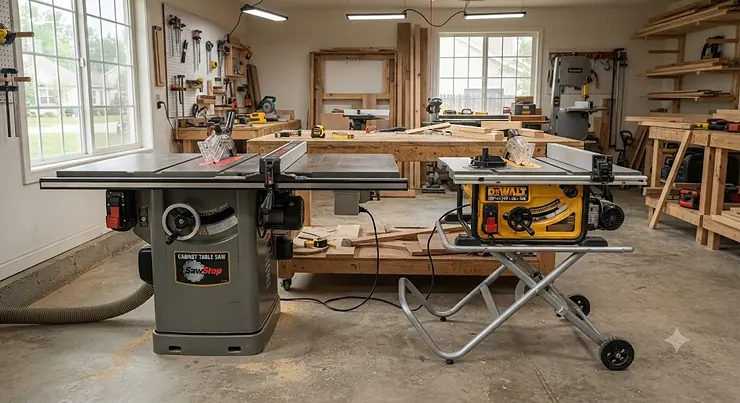
Here’s the question that stalls more shop upgrades than any other: cabinet table saw vs contractor table saw — which one actually earns its floor space? A cabinet table saw is a fully enclosed, heavy-motor stationary saw built for daily professional use, while a contractor table saw is a lighter, open-base machine designed to balance power with portability and a smaller price tag. Both cut wood. Only one of them will still feel tight and accurate a decade from now, and it isn’t always the one you’d expect.
I’ve spent the last few weeks pulling apart spec sheets, cross-referencing owner forums on LumberJocks and Woodworking Talk, and comparing what manufacturers claim against what actual shop owners report. What follows isn’t a rehash of Amazon bullet points — it’s an honest breakdown of seven real saws, why cabinet saws weigh what they weigh, why some contractor saws vibrate like a paint mixer and others don’t, and where a Makita fits into a decision that usually comes down to money, mobility, and how much dust you’re willing to breathe.
If you’re outfitting a one-car-garage shop or a full production shop, the “right” saw looks completely different. Let’s get into the specifics before you spend four figures on the wrong category of machine.
Cabinet Table Saw vs Contractor Table Saw: Quick Comparison
| Feature | Contractor Saw | Cabinet Saw | Hybrid/Small-Shop Saw |
|---|---|---|---|
| Typical motor | 1.5–1.75 HP, often universal or induction | 3–5 HP induction | 1.5–2 HP induction |
| Typical weight | 200–300 lbs | 400–650+ lbs | 300–400 lbs |
| Power requirement | 120V standard | 120V or 240V | 120V |
| Price range | Around $500–$1,800 | Around $1,800–$3,500+ | Around $900–$1,500 |
| Best For | Delta 36-6023, home shops needing mobility | Powermatic PM2000B, daily production use | Jet JPS-10TS, small shops wanting cabinet feel |
Looking at the table, the gap isn’t just price — it’s mass, and mass is what actually determines how a saw behaves under a hard rip cut. A contractor saw’s open base trades weight for portability, which is exactly why it’s cheaper to ship and easier to roll out of a two-car garage on a Saturday morning. A cabinet saw’s sealed base does the opposite: it traps the motor’s mass low and close to the blade, which is the entire reason cabinet saws feel planted even when you’re pushing hard maple through a full-depth rip. The hybrid/small-shop category exists specifically to split that difference for people who don’t have room for 500 pounds of cast iron but still want more rigidity than an open contractor stand provides.
💬 Already leaning toward one category? Compare current prices before they change!
💬 Just one click — help others make better buying decisions too!😊
Top 7 Table Saws: Expert Analysis
1. Ridgid 10-Inch Cast Iron Contractor Table Saw — most affordable route to real cast iron
Ridgid’s entry-level contractor saw is the one people buy when they’ve outgrown a benchtop model but aren’t ready to spend cabinet-saw money. The cast iron main table and full-size extension wings are the standout feature here, and they matter more than the spec sheet suggests. A 13-amp induction-style motor delivers enough torque for hardwood ripping without bogging down, and the cast iron surface means the table itself is doing real vibration dampening work rather than just holding the fence rails in place. Based on the spec comparison against similarly priced stamped-steel-top saws, the extra weight up front pays for itself in flatness that holds over years, not months.
This is squarely a saw for hobbyists and DIYers building furniture on weekends rather than production shops running eight-hour shifts. Reviewers consistently report that the fence needs a careful initial alignment out of the box, and a recurring theme in owner forums is that the trunnion assembly can develop wobble under heavy daily use — a legitimate limitation worth knowing before you buy, not something the listing photos will tell you.
Pros:
- ✅ Cast iron top holds flatness better than stamped steel
- ✅ Genuinely budget-friendly entry into serious woodworking
- ✅ Wheeled base makes repositioning in a small shop realistic
Cons:
- ❌ Fence often needs manual alignment out of the box
- ❌ Trunnion can loosen under sustained heavy-duty use
Expect to pay in the $500-$600 range at the time of research, and check current pricing before buying since availability shifts often. For a first “real” table saw, it’s a defensible value pick — just budget time for tuning.
2. Makita 2705X1 — deepest cut capacity in the contractor class
The makita table saw conversation almost always starts here. What most buyers overlook about the 2705X1 is that it isn’t really a jobsite saw pretending to be a contractor saw — the 3-5/8-inch depth of cut is deeper than nearly everything else in this price bracket, which means it can rip a 4×4 post in a single pass where 3-1/8-inch saws need two. The 15-amp motor pairs with an electric brake that stops the blade in seconds rather than milliseconds, which isn’t SawStop-level safety tech but is still faster than a coasting blade on a bare induction motor.
Here’s what the spec sheet won’t tell you: the 25-inch rip capacity is noticeably shorter than the 30-plus inches you’ll find on Ridgid or Delta’s contractor saws, so if you’re routinely breaking down full plywood sheets, this Makita will feel cramped. Aggregated review sentiment across retailer sites is consistently strong on build quality and fence smoothness, with the recurring complaint being that the stand, while sturdy, adds bulk that undercuts the “semi-portable” branding.
Pros:
- ✅ Deepest cut capacity in its price class
- ✅ Electric brake stops the blade faster than no-brake competitors
- ✅ Smooth, easy-to-adjust fence system
Cons:
- ❌ Rip capacity shorter than most contractor-class rivals
- ❌ Included stand adds bulk despite “portable” positioning
Priced in the $550-$650 range, this is the pick for someone cutting more dimensional lumber and dado joints than full sheet goods.
3. Delta 36-6023 10-Inch Contractor Table Saw — best fence for the money
Delta’s contractor saw has survived multiple ownership changes at the company and remains a forum favorite for one specific reason: the Biesemeyer-style fence. On a table saw, the fence is arguably more important than the motor, because a fence that drifts out of parallel ruins every cut downstream of it, and this T-square design locks down front and back with minimal deflection. Paired with a cast iron main table and matching extension wings, the whole platform stays flatter over years of use than saws that cut corners on the wings.
Based on years of aggregated forum sentiment from sites like Woodworking Talk, owners consistently rate this saw’s fence above the Ridgid’s, even when they concede the Ridgid wins on raw affordability. The honest tradeoff: replacement parts and accessories can be harder to source than for Ridgid or DeWalt, since Delta’s contractor line has changed hands often enough that support isn’t always consistent.
Pros:
- ✅ Biesemeyer-style fence outperforms most in this price tier
- ✅ Cast iron table and wings stay flat long-term
- ✅ Strong reputation for accuracy among long-term owners
Cons:
- ❌ Replacement parts can be harder to track down
- ❌ Standard V-belt on some trims transmits more vibration than a link belt
Look for it in the $600-$750 range, and budget an extra $20-$30 for a link-style anti-vibration belt if the trim you find ships with a standard V-belt.
4. SawStop Contractor Saw CNS175-TGP236 — contractor pricing tier with flesh-detection safety
This is the saw that changes the entire “cabinet vs contractor” conversation, because it drags SawStop’s patented safety system down into contractor-saw territory. The standout feature is obvious: a conductive blade signal that detects skin contact and fires a brake to stop and drop the blade below the table in milliseconds, turning what would be a serious laceration into a nick. That’s not marketing spin — it’s documented, patented technology that’s been independently discussed by safety researchers, including in CPSC human-factors testing on blade-contact injuries.
What most buyers overlook is that you’re also getting a genuinely well-built 1.75 HP contractor platform underneath that safety system — a T-Glide-style fence, cast iron table, and the kind of fit and finish SawStop is known for at the cabinet-saw tier. Reviewers consistently note that the brake cartridge and blade need replacing after an activation (a real cost, not free), and that wet or conductive material can trigger false stops if you’re not using the bypass mode correctly.
Pros:
- ✅ Flesh-detection safety unmatched at this price tier
- ✅ Cast iron table and quality fence rival pricier saws
- ✅ Strong resale value due to brand reputation
Cons:
- ❌ Brake cartridge replacement adds cost after any activation
- ❌ Premium pricing versus non-safety contractor saws
Expect a price in the $1,700-$1,900 range — a real premium over a standard contractor saw, but one that buys categorically different injury protection, not just marginal build-quality gains.
5. Jet JPS-10TS ProShop II — best table saw for small shop upgrades
If you’re searching specifically for the best table saw for small shop use, this is where the hybrid category earns its keep. The standout feature is the cast iron wings paired with an enclosed cabinet-style base — you get noticeably better dust containment and vibration control than an open contractor stand, without needing 240V service or the floor footprint a full cabinet saw demands. The redesigned arbor lock speeds up blade changes, a small feature that saves real time if you swap between rip and dado blades often.
Here’s what matters in practice: a 52-inch rip capacity on some trims lets a small shop handle full sheet goods despite the saw’s comparatively compact stance, and the magnetic paddle switch with quick-release riving knife makes safety-feature swaps faster than on most contractor saws. Aggregated buyer sentiment consistently praises the onboard storage and dust shroud; the honest downside is that it’s still heavier than a true contractor saw, so “small shop” doesn’t mean “one person moves it alone.”
Pros:
- ✅ Cabinet-style dust control in a smaller footprint
- ✅ Quick-release riving knife speeds up safety changes
- ✅ Strong rip capacity relative to its compact stance
Cons:
- ❌ Heavier than a true contractor saw despite smaller footprint
- ❌ Premium over basic contractor saws for the added rigidity
Pricing generally lands in the $1,000-$1,300 range, positioning it as the sensible middle step between a contractor saw and a full cabinet saw.
6. Grizzly G1023RLX — best value cabinet saw for serious hobbyists
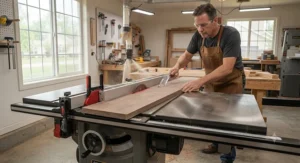
Grizzly built a reputation on delivering cabinet-saw specs at prices that undercut the established professional brands, and the G1023RLX is the clearest example. A 5 HP motor handles thick hardwoods without hesitation, the left-tilting blade design is generally considered safer for bevel cuts than right-tilt designs (since the blade tilts away from the fence rather than toward it), and the heavy cast-iron cabinet construction is doing serious vibration-dampening work at this size and mass.
Based on the spec comparison against Powermatic and SawStop’s cabinet lines, the G1023RLX delivers comparable cutting performance for meaningfully less money. The honest caveat, and one that shows up repeatedly in long-form reviews: Grizzly’s quality control has documented variation between units, so a pre-delivery inspection of trunnion smoothness and table flatness is worth the extra ten minutes before you sign for delivery.
Pros:
- ✅ 5HP motor handles hardwoods with room to spare
- ✅ Left-tilt blade design improves bevel-cut safety
- ✅ Meaningfully cheaper than comparable Powermatic or SawStop cabinet saws
Cons:
- ❌ Documented QC variation between individual units
- ❌ Heavy enough that professional installation help is worth the cost
Price generally falls in the $1,800-$2,200 range — one of the strongest value propositions in the cabinet-saw category if your unit checks out at delivery.
7. Powermatic PM2000B — premium cabinet saw benchmark
Powermatic has been the professional cabinet-saw standard for decades, and the PM2000B is the current flagship that keeps that reputation intact. The standout feature on the PM2000T trim is the ArmorGlide industrial coating, which reduces the force needed to push material across the table by roughly half compared to bare cast iron, resists rust without waxing, and is rated for a genuinely high number of passes before it shows wear. For a shop where lumber crosses that tabletop all day, every day, that fatigue reduction is not a gimmick.
Here’s the honest 2026 question: with Powermatic’s prices climbing, is the premium over Grizzly or Harvey still justified? Based on the spec comparison, the answer depends on your use case — a production shop running daily, multi-hour shifts benefits from the trunnion precision and finish quality in ways a weekend hobbyist may never notice. Reviewers consistently praise the smooth gas-assisted blade elevation system, while some buyers note that the price gap over Harvey’s comparable cabinet saws has widened enough to warrant cross-shopping before committing.
Pros:
- ✅ ArmorGlide coating measurably reduces feed effort and rust risk
- ✅ Trunnion precision holds up under daily production use
- ✅ Gas-assisted elevation makes height adjustments effortless
Cons:
- ❌ Premium pricing has widened the gap versus Harvey and Grizzly
- ❌ Overkill for anyone cutting fewer than a few hours per week
Expect a price in the $2,800-$3,400 range depending on configuration — the ceiling of this comparison, and a saw that’s genuinely built to justify it for full-time shops.
Setting Up and Maintaining Your New Table Saw
Getting a new saw home is the easy part. In the first 30 days, the most common mistake is skipping fence and blade alignment because the saw “looks square out of the box” — it rarely is, and even a sixteenth of an inch of drift compounds badly over an 8-foot rip. Use a dial indicator or a reliable straightedge to check that the miter slots run parallel to the blade before you cut anything that matters.
Wax the cast iron table with a paste wax (not furniture polish) every few weeks if you don’t have an ArmorGlide-style coating — this reduces feed friction and prevents surface rust, especially in humid shops. Check belt tension monthly on belt-drive saws; a loose poly-V belt is a common, overlooked source of vibration that gets blamed on the motor when it’s actually just slack in the drivetrain. Swap a stock blade guard’s flimsy factory anti-kickback pawls for aftermarket versions if you notice binding, and keep a running log of blade changes so you’re not guessing when the last sharpening happened.
Dust collection deserves its own attention: connecting even a modest 1.5 HP dust collector to a saw’s 4-inch port dramatically cuts airborne fines compared to running the saw bare, which matters both for lung health and for keeping trunnions clear of the sawdust that eventually gums up smooth adjustment.
Real-World Scenarios: Matching a Saw to Your Shop
Picture a college student renting a garage space and building furniture on weekends between semesters — budget is tight, the saw needs to roll in and out for landlord inspections, and total floor time is maybe six hours a week. A contractor saw like the Ridgid or Delta fits that life; a 500-pound cabinet saw does not, both financially and physically.
Now picture a semi-retired hobbyist who finally has a dedicated two-car-garage shop and builds heirloom furniture full-time. Space isn’t the constraint, budget is more flexible, and daily use over years is the priority — this is exactly the buyer a Grizzly G1023RLX or Powermatic PM2000B is built for, because the extra mass and motor headroom translate directly into consistency over a decade of cuts.
Finally, picture a small custom-cabinet business running two or three jobs a week from a converted single-car garage. Floor space is genuinely scarce, but daily professional use rules out a flimsy contractor stand. This is the buyer who should be looking at a small-shop hybrid like the Jet ProShop II — enough rigidity to survive daily use, without demanding the square footage a full cabinet saw requires.
Buyer’s Decision Framework
If your total shop time is under five hours a week and budget is the top priority, choose a contractor saw, because the weight and price savings outweigh the accuracy gains you likely won’t notice yet. If you’re cutting daily in a dedicated space and plan to keep the saw for a decade or more, choose a cabinet saw, because the trunnion precision and vibration control compound in your favor every single cut. If floor space is your hardest constraint but daily use is real, choose a hybrid or small-shop saw, since it’s built specifically for that middle ground.
Quick priority checklist: (1) How many hours a week will it actually run? (2) Is the space permanent or does it need to move? (3) Is 240V service available or will you be stuck on a 120V circuit? (4) What’s the real all-in budget including a decent blade and dust collection? Answer those four honestly before you look at a single spec sheet.
Cabinet Table Saw vs Contractor Table Saw: The Real Structural Differences
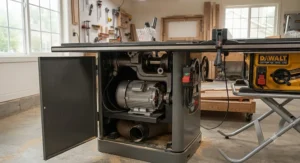
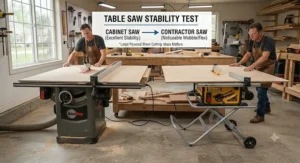
The difference between these two categories is structural, not incremental, and it starts with the trunnions — the assembly that controls blade height and tilt. On a contractor saw, the trunnions typically mount to the underside of the table itself, which keeps the design simple and light but means the table’s cast iron is doing double duty as both cutting surface and structural support. On a cabinet saw, the trunnions mount to the enclosed cabinet base, which isolates the tilting mechanism from the table and lets the far heavier, fully enclosed steel or cast iron cabinet absorb vibration that would otherwise transmit straight into your cut.
This is also where cabinet saw weight becomes the headline spec rather than a footnote. Cabinet saws commonly land in the 400 to 650-plus pound range, while contractor saws typically run 200 to 300 pounds. That difference isn’t wasted material — the enclosed steel base on a cabinet saw is what reduces vibration and boosts durability in the first place, while an open-frame contractor or jobsite stand trades that rigidity for lighter weight and portability. Extra mass resists the harmonic vibration that a spinning blade and motor naturally generate, and less vibration means straighter cuts, longer bearing life, and dramatically less bevel drift over months of use.
The dust collection story follows the same logic: an enclosed cabinet base traps sawdust and routes it toward a single collection port far more efficiently than an open contractor stand, where dust simply falls onto the shop floor. If you’ve ever wondered why professional shops feel cleaner around the saw than a home garage does, this is a big part of the answer.
What Makes the Best Contractor Table Saw in 2026
Chasing the best contractor table saw isn’t about horsepower alone — amperage numbers are easy to inflate and hard to compare honestly across brands. What actually separates a good contractor saw from a mediocre one is fence rigidity, table flatness out of the box, and whether the trunnions hold alignment after a hundred hours of use rather than just on day one.
Prioritize a cast iron main table over stamped steel every time; the weight difference directly affects vibration and heat dissipation during long rip cuts. Check whether the fence is a T-square or Biesemeyer-style design that locks front and back, since single-point-lock fences drift more over time. Confirm the saw includes (or can accept) a proper riving knife and modular blade guard — not every budget contractor saw ships with both as standard, and retrofitting them later costs real money. Finally, weigh mobility honestly: a wheeled base only matters if you’re actually moving the saw regularly, and cheap caster kits are a common point of failure reported across owner forums.
Table Saw Motor Type: Induction vs Universal Explained
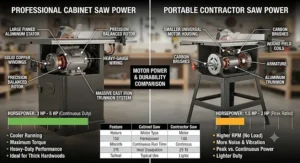
This is one of the most misunderstood specs on any saw listing, and it directly explains why a lightweight jobsite saw and a 500-pound cabinet saw both claim “powerful motors.” Induction motors are typically heavier than universal motors, which is exactly why they suit stationary tools that benefit from the extra weight to cut down on rattling and improve stability — the smaller, lighter universal alternative is what makes sense instead for handheld or portable tools. That single tradeoff explains almost every design choice downstream of it.
As Popular Woodworking’s motor primer puts it, induction motors are the tortoise of the pair — rugged, quiet, heavy, and built for the long haul, while universal motors spin much faster and pack more horsepower per pound but wear out sooner under sustained use. In practice, that means nearly every contractor and cabinet saw worth buying runs an induction motor, because these machines are expected to run for hours at a stretch cutting hardwood, not in the quick bursts a router or circular saw handles. Universal motors show up almost exclusively in benchtop and some portable jobsite saws, where light weight matters more than duty cycle.
The honest tradeoff on induction motors: they’re more expensive to manufacture, heavier to ship and install, and slower to spin up from a dead stop. None of that matters once the saw is bolted in place and running daily — which is exactly why you’ll never find a genuine cabinet saw running a universal motor, no matter how the spec sheet is worded.
Table Saw Vibration Dampening: Why Mass and Cast Iron Matter
Vibration isn’t just an annoyance — it’s the enemy of every clean rip cut and precise miter joint you’ll ever attempt. Cast iron is the go-to material precisely because it has a strong dampening effect that mitigates vibration, and a properly manufactured cast iron table also stays flat and stable for years rather than months. That’s why even entry-level contractor saws use cast iron for the main table even when the extension wings are cheaper stamped steel.
The trunnion assembly matters just as much as the tabletop. Cast iron trunnions are significantly denser and more rigid than aluminum, which gives the motor and blade a more stable platform to sit on — the practical result is less vibration, more accurate cuts, and far greater durability under heavy use. Aluminum trunnions show up mostly on entry-level and contractor-grade saws where affordability and lighter shipping weight are the priority, while cabinet saws almost universally use cast iron trunnions because vibration control at that price point isn’t optional.
Total mass compounds this effect. A 550-pound cabinet saw simply doesn’t move the way a 230-pound contractor saw does when you push a piece of 8/4 hard maple through a full-depth rip — the extra weight anchors the whole system, which is the real reason experienced woodworkers describe cabinet saws as feeling “planted” the moment you first flip the switch.
Best Table Saw for Small Shop: Space-Saving Picks
If your search brought you here looking for the best table saw for small shop use specifically, the calculus is different from either extreme in this guide. A full cabinet saw’s footprint and weight can genuinely be impractical in a one-car garage, while a bare-bones contractor saw’s open stand and unenclosed dust path can feel like a step backward if you’re used to a clean workspace.
The sweet spot is a hybrid saw like the Jet ProShop II, which delivers an enclosed, cabinet-style base and cast iron wings in a footprint that a single person can still maneuver around a compact shop. Look specifically for a mobile base rated for the saw’s full weight, foldable extension wings if rip capacity beyond 30 inches isn’t a daily need, and overhead dust collection ports rather than just a bottom port, since small shops benefit disproportionately from cleaner air in a confined space. A rolling cart for the miter gauge and push sticks nearby also matters more in tight quarters, where clutter around the saw becomes a real safety issue fast.
Common Mistakes When Buying a Table Saw
The single most common mistake is buying based on horsepower alone. A 5 HP cabinet saw motor sitting on a badly aligned fence will cut worse than a well-tuned 1.75 HP contractor saw, because accuracy comes from the whole system, not the motor rating in isolation. A close second is ignoring electrical requirements — some cabinet saws need a dedicated 240V circuit, and discovering that after delivery day is an expensive surprise.
Buyers also frequently underestimate weight logistics. A 500-pound saw needs a plan for getting it off the truck, through a doorway, and onto a level floor — not an afterthought once it’s already on your driveway. Skipping a pre-purchase check of fence quality is another repeat offender; a cheap fence turns every future project into a fight, regardless of how good the motor is. Finally, plenty of buyers forget to budget for a quality blade and dust collection setup, both of which affect cut quality and safety as much as the saw itself.
Long-Term Cost & Maintenance
The sticker price is never the real cost of a table saw. A quality carbide-tipped blade runs a real recurring expense as it dulls and needs sharpening every few months of regular use, and belt-drive saws need periodic belt and pulley replacement that budget contractor saws often need sooner than premium cabinet saws built with better components. Dust collection add-ons — hoses, a cyclone separator, filters — can add several hundred dollars to the true cost of ownership on any saw category.
Where cabinet saws earn back their premium is longevity: a well-maintained cabinet saw with cast iron trunnions can run accurately for decades, while budget contractor saws more commonly need trunnion or bearing work within the first several years of heavy use. If you’re running the numbers on cost-per-project over a ten-year horizon, a cabinet saw’s higher upfront cost often evens out against a contractor saw’s higher repair frequency — but only if your actual usage justifies that horizon in the first place.
Safety, Regulations & Compliance Guide
Table saw safety isn’t optional paperwork — it’s genuinely one of the more injury-prone tools in a home shop. According to CPSC data cited in the Federal Register, an estimated 33,400 emergency-department-treated table saw injuries occurred in a single recent year, with roughly 92 percent of those linked directly to blade contact. That statistic is exactly why riving knives and modular blade guards aren’t a nice-to-have anymore.
Kickback — when the blade catches stock and throws it back toward the operator — happens more often during ripping than crosscutting, and it’s more likely whenever safeguards aren’t used or poor-quality lumber is fed into the blade. For workplace settings, OSHA’s machine guarding standard requires a self-adjusting blade guard, a riving knife or spreader, and anti-kickback fingers on ripsaws — and while home shops aren’t legally bound by OSHA, the same hazards apply regardless of whether you’re on a payroll.
Whichever saw you buy, keep the factory guard and riving knife installed for standard cuts, use a push stick for anything under six inches wide, and never stand directly behind the blade line. SawStop’s flesh-detection system is a meaningful additional layer, not a replacement for those fundamentals — the blade-brake technology doesn’t control kickback, which can be just as serious as a blade cut, so guards and riving knives should stay installed even on saws with active injury-mitigation technology.
What Is a Cabinet Table Saw vs Contractor Table Saw?
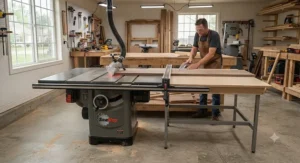
A cabinet table saw is a heavy, fully enclosed stationary saw with a 3-5 HP induction motor built for daily professional use, while a contractor table saw is a lighter, open-base saw with a smaller motor designed for portability and a lower price point. The core tradeoff is mass versus mobility — cabinet saws deliver superior accuracy and dust control, while contractor saws deliver a lower barrier to entry and a machine you can actually move by yourself.
FAQ
❓ Is a cabinet table saw worth the extra money over a contractor saw?
❓ Can I run a cabinet table saw on a regular 120V outlet?
❓ How much does a contractor table saw weigh compared to a cabinet saw?
❓ What's the better motor type for a table saw, induction or universal?
❓ Is the Makita 2705X1 a cabinet saw or a contractor saw?
Conclusion
The cabinet table saw vs contractor table saw decision really comes down to an honest audit of how often you’ll actually use the machine and how much floor space you’re willing to dedicate to it permanently. A contractor saw like the Ridgid, Makita 2705X1, or Delta 36-6023 rewards a hobbyist who needs mobility and a manageable price tag, while a cabinet saw like the Grizzly G1023RLX or Powermatic PM2000B rewards someone running daily production work where extra mass and motor headroom compound in their favor over years, not months.
If you’re stuck in the middle, don’t ignore the hybrid tier — the Jet ProShop II exists precisely for shops that need more rigidity than a contractor stand but can’t spare cabinet-saw square footage. And regardless of which category you land in, the SawStop Contractor Saw deserves serious consideration if flesh-detection safety outweighs a few hundred dollars of savings elsewhere, because no spec sheet number matters more than what happens if your hand ever meets a spinning blade.
Whatever you choose, budget for a quality blade and real dust collection alongside the saw itself — the machine is only half of what actually determines your cut quality.
✨ Don’t Miss These Exclusive Deals!
🔍 Take your table saw upgrade to the next level with these carefully selected picks. Click on any highlighted item to check current pricing and availability. These tools will help you build cleaner, safer, more accurate cuts for years to come!
Recommended for You
- Portable Table Saw Guide 2026: 7 Best Picks
- Table Saw For Beginners: 7 Safe Picks That Won’t Bite Back (2026)
- 6 Inch vs 8 Inch Bench Grinder: 7 Best Picks for 2026
Disclaimer: This article contains affiliate links. As an Amazon Associate, I earn from qualifying purchases. If you purchase products through these links, we may earn a small commission at no additional cost to you.
✨ Found this helpful? Share it with your friends! 💬🤗
