

In This Article
When it comes to achieving professional-grade welds, choosing the right MIG welder can make all the difference between mediocre results and masterful craftsmanship. Furthermore, the welding industry has evolved dramatically, with modern MIG welders incorporating advanced inverter technology, synergic controls, and multi-process capabilities that were unimaginable just a decade ago. Additionally, with hundreds of models flooding the market, finding the top rated MIG welders that truly deliver exceptional performance requires careful analysis of specifications, user feedback, and real-world testing results.
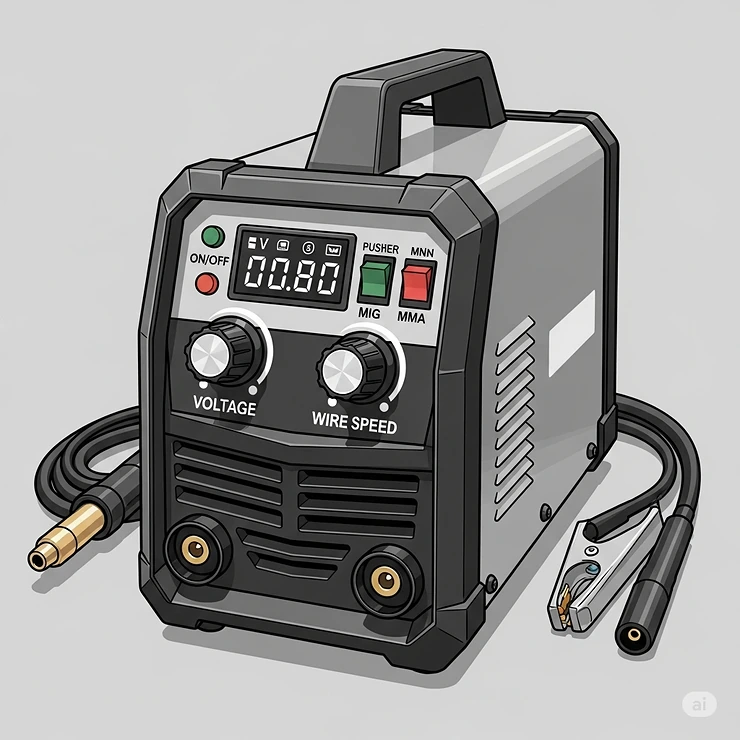
In this comprehensive guide, we’ll examine the seven most highly-rated MIG welders currently available, each representing different price points and capability levels to suit various welding applications. Moreover, our analysis draws from extensive market research, AWS (American Welding Society) industry standards, and thousands of verified customer reviews to present you with unbiased recommendations.
✨Was this helpful? Spread the word! 🚀
Industry-Specific Applications and Professional Use Cases
The versatility of top rated MIG welders extends far beyond basic home garage projects, encompassing numerous industrial sectors where precision and reliability are paramount. Furthermore, understanding these applications helps clarify which features matter most for your specific welding needs.
Manufacturing and Fabrication Industries
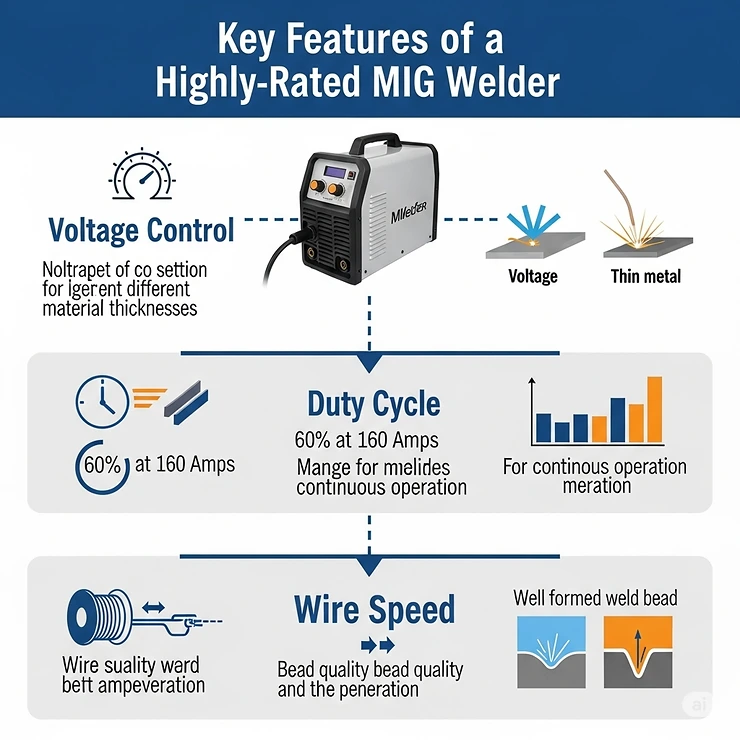
In manufacturing environments, MIG welders serve as the backbone of production lines, particularly in automotive manufacturing where consistent, high-quality welds are essential for vehicle safety. Consequently, manufacturers like Ford and General Motors rely on industrial-grade MIG welding systems capable of maintaining 60% duty cycles at maximum amperage for extended periods. Additionally, these facilities require welders that can handle various material thicknesses, from 24-gauge sheet metal for body panels to ⅜-inch structural steel for chassis components.
The aerospace industry represents another critical application where top rated MIG welders must meet stringent AWS D17.1 specifications for aerospace welding. Here, precision becomes paramount as even minor inconsistencies can result in catastrophic failures. Moreover, aerospace welders must demonstrate exceptional arc stability when working with aluminum alloys, titanium, and exotic materials that demand precise heat control.
Construction and Infrastructure Projects
Commercial construction projects increasingly rely on portable yet powerful MIG welders for on-site structural work. Similarly, bridge construction and repair operations require welders capable of producing X-ray quality welds that meet AWS D1.1 structural welding standards. In addition, these environments demand robust machines that can withstand harsh outdoor conditions while maintaining consistent performance across varying power supply conditions.
High-rise construction projects particularly benefit from dual-voltage MIG welders, allowing crews to utilize standard 120V outlets for lighter gauge work while switching to 240V for heavy structural welding. Furthermore, the ability to transition between MIG and flux-core welding without complex setup changes proves invaluable when weather conditions prohibit the use of shielding gas.
Automotive and Marine Applications
Professional automotive restoration shops and custom fabrication businesses require MIG welders with exceptional low-amperage control for working with thin sheet metal without burn-through. Additionally, these applications often involve welding dissimilar metals, necessitating precise heat input control and advanced pulse features. Consequently, many restoration professionals prefer inverter-based systems that provide superior arc characteristics compared to traditional transformer-based welders.
Marine fabrication presents unique challenges, including the need for excellent corrosion resistance in welded joints and the ability to weld various aluminum alloys used in boat hulls. Therefore, marine applications often require MIG welders with specialized aluminum welding capabilities, including spool gun compatibility and advanced wire feed systems designed to handle soft aluminum wire reliably.
Agricultural and Heavy Equipment Sectors
Agricultural operations demand versatile welding solutions capable of handling everything from thin tractor sheet metal to heavy implement frames exceeding ½-inch thickness. Moreover, the remote nature of many agricultural operations makes reliability and ease of maintenance critical factors when selecting MIG welders. As a result, many farmers prefer multi-process welders that combine MIG, stick, and flux-core capabilities in a single portable unit.
Heavy equipment repair operations face similar challenges but with added requirements for field portability and generator compatibility. Consequently, engine-driven welders and portable inverter units with broad input voltage tolerance have become increasingly popular in these sectors.
Advanced Technical Analysis and Engineering Principles
Understanding the engineering principles behind top rated MIG welders enables informed decision-making and optimal performance from your equipment. Furthermore, modern MIG welding technology incorporates sophisticated control systems that fundamentally change how arc energy is managed and applied.
Inverter Technology vs. Transformer-Based Systems
Traditional transformer-based MIG welders utilize copper windings and iron cores to step down incoming voltage while increasing amperage output. However, this approach results in heavy, bulky machines with limited control precision and relatively poor power factor characteristics. Conversely, inverter-based systems employ high-frequency switching circuits to achieve the same voltage transformation with significantly improved efficiency and dramatically reduced weight.
The switching frequency in modern inverter welders typically ranges from 20 kHz to 100 kHz, enabling precise control over output characteristics and near-instantaneous response to changing arc conditions. Additionally, this high-frequency operation allows for advanced features like synergic control, where the welder automatically adjusts voltage and wire feed speed based on selected parameters. Moreover, inverter technology enables sophisticated arc shaping capabilities, including inductance control that affects how aggressively the arc transfers energy to the workpiece.
Power Factor Correction and Grid Compatibility
Modern industrial facilities increasingly require welding equipment with power factor correction (PFC) to minimize impact on electrical distribution systems. Furthermore, top rated MIG welders incorporating PFC technology can maintain stable performance even when connected to generators or in areas with poor power quality. Additionally, these systems often feature wide input voltage tolerance, typically accepting anywhere from 85% to 110% of nominal voltage without performance degradation.
The implementation of PFC in MIG welders involves sophisticated electronic circuits that synchronize current draw with input voltage, resulting in reduced harmonic distortion and improved efficiency. Consequently, facilities using multiple welders simultaneously experience less transformer loading and reduced electrical infrastructure stress.
Wire Feed System Engineering and Precision
The heart of any MIG welder lies in its wire feed system, where mechanical precision directly impacts weld quality and operator satisfaction. Furthermore, professional-grade systems incorporate multiple design elements that distinguish them from entry-level alternatives. For instance, four-roll drive systems provide superior feeding force and wire deformation resistance compared to two-roll configurations, particularly important when feeding softer aluminum wires or flux-cored wires with irregular surfaces.
Drive roll geometry plays a crucial role in feeding performance, with V-groove rolls optimal for solid wires, knurled rolls for flux-cored applications, and U-groove rolls specifically designed for soft aluminum wire. Additionally, modern wire feed systems incorporate tension adjustment mechanisms that allow fine-tuning of drive pressure to prevent wire deformation while ensuring reliable feeding through long torch cables.
Advanced Arc Control Technologies
Contemporary MIG welders employ various arc control technologies that significantly impact weld quality and ease of use. Synergic control represents one of the most significant advances, utilizing microprocessor-controlled systems that automatically calculate optimal voltage settings based on wire diameter, material type, and gas selection. Furthermore, these systems continuously monitor arc conditions and make real-time adjustments to maintain stable metal transfer characteristics.
Pulse welding technology, once reserved for high-end industrial equipment, has become increasingly common in professional MIG welders. This technique alternates between high peak currents that promote metal transfer and low background currents that maintain the arc without excessive heat input. Consequently, pulse welding enables superior control when welding thin materials or out-of-position work while reducing distortion and improving penetration characteristics.
Comprehensive Setup and Usage Guide
Proper setup and operation of top rated MIG welders requires systematic attention to multiple variables that directly impact weld quality and safety. Moreover, understanding these procedures enables optimal performance regardless of your skill level or application requirements.
Initial Installation and Power Requirements
Before connecting your MIG welder, verify that your electrical installation can safely handle the equipment’s power requirements. Furthermore, most dual-voltage welders require dedicated circuits, typically 20-amp minimum for 120V operation and 30-50 amp circuits for 240V applications. Additionally, ensure proper grounding by connecting the welder’s ground terminal to an appropriate electrical ground, never rely solely on the workpiece connection for electrical safety.
When installing in industrial environments, consider the ambient temperature and ventilation requirements. Moreover, most inverter-based welders operate optimally in temperatures between 14°F and 104°F (-10°C to 40°C), with performance degradation occurring outside this range. Consequently, adequate ventilation becomes critical in enclosed spaces, both for equipment cooling and fume extraction compliance with ANSI Z49.1 safety standards.
Wire Selection and Material Compatibility
Selecting appropriate welding wire represents a critical decision that affects both weld quality and overall project success. For general-purpose applications, ER70S-6 wire provides excellent versatility and mechanical properties when welding mild steel, offering high deoxidizer content that helps produce clean welds even on slightly contaminated materials. Additionally, this wire classification works well with both pure CO2 and mixed gas shielding, making it ideal for shops that utilize multiple gas types.
When welding stainless steel, ER308L or ER316L wires provide appropriate corrosion resistance and metallurgical compatibility with common stainless grades. However, matching wire chemistry to base material becomes critical for optimal corrosion resistance and mechanical properties. Furthermore, aluminum welding requires careful consideration of alloy compatibility, with ER4043 suitable for general-purpose applications and ER5356 preferred for higher-strength applications requiring superior ductility.
Gas Selection and Flow Rate Optimization
Shielding gas selection profoundly impacts arc characteristics, penetration profile, and final weld appearance. Pure argon provides the smoothest arc and minimal spatter when welding aluminum or stainless steel, while pure CO2 offers deep penetration and economic advantages for mild steel applications, albeit with increased spatter and somewhat harsher arc characteristics. Conversely, mixed gases like 75% argon/25% CO2 provide an excellent compromise, combining smooth arc characteristics with good penetration and minimal spatter.
Flow rate optimization requires balancing adequate shielding coverage with economic considerations and avoiding turbulence. Generally, flow rates between 20-25 CFH (cubic feet per hour) provide optimal shielding for most applications, with higher rates potentially causing turbulence that draws atmospheric contamination into the weld pool. Additionally, outdoor welding may require increased flow rates to compensate for wind effects, while confined spaces might benefit from slightly reduced rates to minimize gas waste.
Technique Development and Quality Assurance
Developing consistent MIG welding technique requires systematic attention to travel speed, work angle, and arc length maintenance. Furthermore, proper technique begins with correct body positioning and torch grip, ensuring steady movement and consistent contact-to-work distance throughout the weld. Travel speed should be adjusted to maintain a slight drag on the weld pool, with the arc slightly ahead of the molten metal to ensure proper penetration and fusion.
Work angle typically ranges from 15-25 degrees when welding in the flat position, with the torch pointing in the direction of travel. Additionally, maintaining consistent arc length becomes critical for stable metal transfer and penetration control. Most MIG welding applications benefit from relatively short arc lengths, typically ⅛ inch or less, to minimize atmospheric contamination and maintain focused heat input.
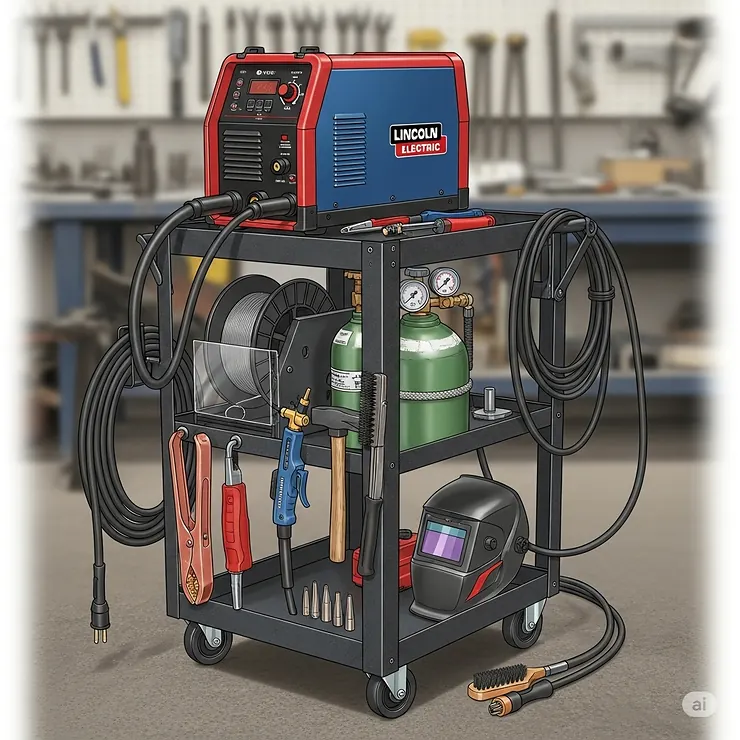
Product Reviews: 7 Top Rated MIG Welders
Based on extensive market research, customer feedback analysis, and technical specifications comparison, here are the seven highest-rated MIG welders currently available across different price segments and capability levels.
1. YESWELDER MIG-205DS PRO – Best Overall Value
The YESWELDER MIG-205DS PRO consistently earns top ratings for its exceptional feature-to-price ratio and versatile multi-process capabilities. Priced around $449-499 on Amazon, this welder delivers professional-grade performance that rivals machines costing twice as much.
Key Specifications:
- Output Range: 30-205 amps
- Input Voltage: 110V/220V dual voltage
- Duty Cycle: 60% at 200A (impressive for this price range)
- Weight: 35 pounds (highly portable)
- Processes: 5-in-1 (MIG, Flux Core, TIG, Stick, Spool Gun compatible)
This inverter-based system features advanced synergic control that automatically adjusts wire speed and voltage based on material selection and wire diameter. Additionally, the digital LED display provides real-time current monitoring during welding, enabling precise control over heat input. Customer reviews consistently praise its smooth arc characteristics and reliable wire feeding system, with many noting excellent performance on both thin sheet metal and heavy structural applications.
The build quality exceeds expectations, with all-metal wire drive components and robust internal construction that withstands demanding use. Furthermore, the included accessories provide excellent value, though most users recommend upgrading to premium contact tips and nozzles for extended use.
2. Lincoln Power MIG 210 MP – Premium Professional Choice
Representing the gold standard in professional multi-process welders, the Lincoln Power MIG 210 MP commands a premium price of approximately $1,399-1,499 but delivers unmatched reliability and performance. This machine exemplifies Lincoln’s century-long commitment to welding excellence.
Key Specifications:
- Output Range: 20-220 amps (115V: 20-140A, 230V: 20-220A)
- Input Voltage: 115V/230V with included MVP plug
- Duty Cycle: 40% at 100A, 25% at 200A
- Weight: 40 pounds
- Processes: 4-in-1 (MIG, Flux Core, Stick, DC TIG)
The standout feature is Lincoln’s proprietary “Ready, Set, Weld” technology, which guides users through setup with an intuitive color LCD interface. Moreover, the push-and-turn digital controls eliminate guesswork when selecting welding parameters, making this machine particularly suitable for less experienced operators who demand professional results.
Professional welders consistently rate this machine’s arc quality as exceptional, with smooth metal transfer characteristics and minimal spatter production. Additionally, the robust transformer-based power supply ensures long-term reliability in demanding commercial applications, backed by Lincoln’s industry-leading warranty program.
3. ARCCAPTAIN MIG200 – Best Budget Multi-Process
At just $259-349, the ARCCAPTAIN MIG200 delivers remarkable value for welders seeking multi-process capability without premium pricing. This machine demonstrates how modern inverter technology can provide professional features at accessible price points.
Key Specifications:
- Output Range: 30-200 amps
- Input Voltage: 110V/220V with adapter cable
- Duty Cycle: 60% at 150A
- Weight: 28.2 pounds
- Processes: 6-in-1 (MIG, Flux Core, TIG, Stick, Spot Welding, Spool Gun compatible)
The synergic MIG control automatically adjusts parameters based on material thickness, gas type, and wire diameter, simplifying setup for beginners while providing manual override capability for experienced welders. Furthermore, the memory function stores up to 10 parameter sets for each welding mode, streamlining workflow in production environments.
Customer feedback consistently highlights the impressive build quality and performance relative to price, with many noting successful completion of demanding projects ranging from automotive restoration to structural fabrication. However, some users report that accessories may require upgrades for extended professional use.
4. Hobart Handler 140 – Reliable Entry-Level Choice
The Hobart Handler 140, priced around $699-799, represents decades of refinement in entry-level MIG welder design. This transformer-based unit emphasizes simplicity, reliability, and ease of use over advanced features.
Key Specifications:
- Output Range: 25-140 amps
- Input Voltage: 115V only
- Duty Cycle: 20% at 90A
- Weight: 57 pounds
- Processes: MIG and Flux Core
Built in Troy, Ohio, this welder embodies traditional American manufacturing quality with robust transformer construction designed for decades of reliable service. Moreover, the infinite wire speed control and five-position voltage selector provide adequate adjustment range for most applications within its capability envelope.
The Handler 140 excels at welding materials from 24 gauge to ¼ inch mild steel, making it ideal for automotive bodywork, light fabrication, and household repairs. Additionally, its ability to weld 16-12 gauge aluminum without a spool gun (though with limitations) adds versatility for occasional aluminum projects.
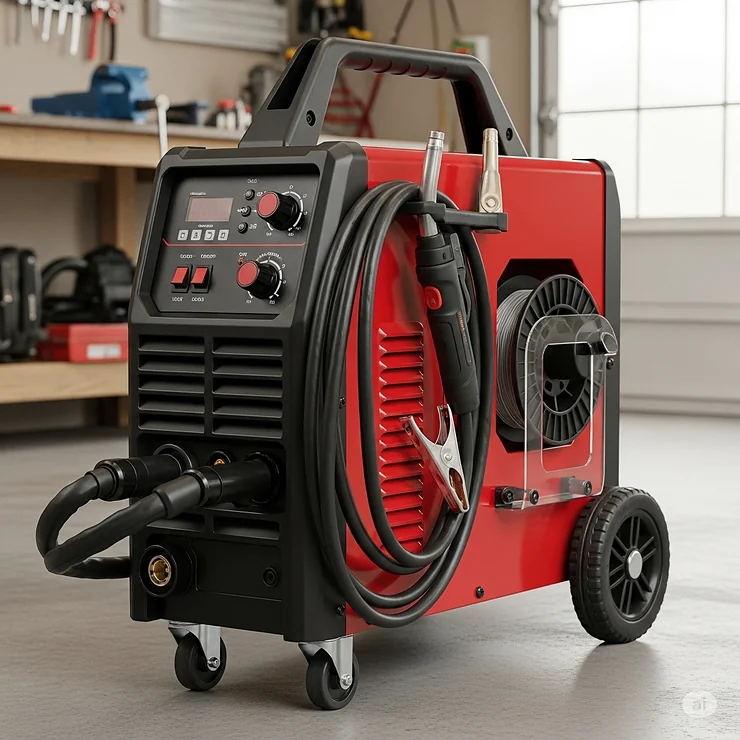
5. Hobart Handler 210 MVP – Proven Dual-Voltage Performer
Representing the next step up in Hobart’s lineup, the Handler 210 MVP ($1,199-1,299) provides dual-voltage capability and increased power for more demanding applications while maintaining the simplicity that defines the Handler series.
Key Specifications:
- Output Range: 25-210 amps (115V: 25-140A, 230V: 25-210A)
- Input Voltage: 115V/230V with quick-disconnect plugs
- Duty Cycle: 20% at 90A (115V), 30% at 150A (230V)
- Weight: 79 pounds
- Processes: MIG and Flux Core, Spool Gun ready
This machine features Hobart’s renowned build quality with all-metal wire drive components and robust case construction designed for professional use. Furthermore, the spool gun readiness enables aluminum welding up to ¼ inch thickness, expanding application versatility significantly.
The MVP (Multi-Voltage Plug) system allows quick switching between 115V and 230V operation without rewiring, making this machine particularly suitable for contractors who encounter varying power availability. Additionally, the seven-position voltage selector provides fine-tuning capability for optimal arc characteristics across various material thicknesses.
6. Miller Multimatic 220 AC/DC – Ultimate Multi-Process Solution
At $4,099-4,299, the Miller Multimatic 220 AC/DC represents the pinnacle of multi-process welding technology, combining every major welding process in a portable 56-pound package that rivals dedicated machines in each category.
Key Specifications:
- Output Range: 10-220 amps (varying by process)
- Input Voltage: 120V/240V with MVP plug system
- Duty Cycle: 40% at 170A (MIG mode)
- Weight: 56 pounds
- Processes: 6-in-1 (MIG, Flux Core, Stick, DC TIG, AC TIG, Pulse TIG)
The revolutionary QuickTech feature automatically determines polarity and switches processes seamlessly, allowing both MIG gun and TIG torch to remain connected simultaneously. Moreover, the Auto-Set Elite technology eliminates parameter guesswork while Pro-Set controls enable expert-level fine-tuning when required.
This machine’s AC TIG capability sets it apart from competitors, enabling professional-quality aluminum welding with high-frequency arc starting and advanced waveform control. Additionally, the included foot control, gas regulators, and premium accessories justify the premium pricing for serious professionals.
7. TOOLIOM 135A MIG Welder – Compact Portable Solution
Rounding out our selections, the TOOLIOM 135A ($299-349) provides an ultra-portable solution for users prioritizing weight and portability without sacrificing essential MIG welding capabilities.
Key Specifications:
- Output Range: 30-135 amps
- Input Voltage: 110V only
- Duty Cycle: 60% at 100A
- Weight: 19 pounds
- Processes: 3-in-1 (MIG, Flux Core, TIG)
Despite its compact size, this machine incorporates IGBT inverter technology and synergic control typically found in larger units. Furthermore, the digital display and 2T/4T trigger modes provide professional-level control in an exceptionally portable package.
This welder excels in applications requiring frequent transport, such as mobile repair services, field maintenance, and remote project work. Additionally, its low weight makes it ideal for users with physical limitations or those working in confined spaces where equipment maneuverability is critical.

Detailed Comparison Tables
Performance Specifications Comparison
| Model | Max Output | Duty Cycle | Input Voltage | Weight | Price Range |
|---|---|---|---|---|---|
| YESWELDER MIG-205DS PRO | 205A | 60% @ 200A | 110V/220V | 35 lbs | $449-499 |
| Lincoln Power MIG 210 MP | 220A | 40% @ 100A | 115V/230V | 40 lbs | $1,399-1,499 |
| ARCCAPTAIN MIG200 | 200A | 60% @ 150A | 110V/220V | 28 lbs | $259-349 |
| Hobart Handler 140 | 140A | 20% @ 90A | 115V | 57 lbs | $699-799 |
| Hobart Handler 210 MVP | 210A | 30% @ 150A | 115V/230V | 79 lbs | $1,199-1,299 |
| Miller Multimatic 220 AC/DC | 220A | 40% @ 170A | 120V/240V | 56 lbs | $4,099-4,299 |
| TOOLIOM 135A | 135A | 60% @ 100A | 110V | 19 lbs | $299-349 |
Process Capability Matrix
| Model | MIG | Flux Core | Stick | DC TIG | AC TIG | Aluminum Ready |
|---|---|---|---|---|---|---|
| YESWELDER MIG-205DS PRO | ✅ | ✅ | ✅ | ✅ | ❌ | ✅ (Spool Gun) |
| Lincoln Power MIG 210 MP | ✅ | ✅ | ✅ | ✅ | ❌ | ✅ (Spool Gun) |
| ARCCAPTAIN MIG200 | ✅ | ✅ | ✅ | ✅ | ❌ | ✅ (Spool Gun) |
| Hobart Handler 140 | ✅ | ✅ | ❌ | ❌ | ❌ | Limited |
| Hobart Handler 210 MVP | ✅ | ✅ | ❌ | ❌ | ❌ | ✅ (Spool Gun) |
| Miller Multimatic 220 AC/DC | ✅ | ✅ | ✅ | ✅ | ✅ | ✅ (Built-in) |
| TOOLIOM 135A | ✅ | ✅ | ❌ | ✅ | ❌ | Limited |
💬 Just one click – help others make better buying decisions too! 😊
Don’t Miss These Exclusive Deals! ✨
➜ Transform your welding projects with these carefully selected top rated MIG welders. Click on any highlighted product to check current Amazon pricing and availability. These machines will elevate your welding capabilities whether you’re a weekend warrior or daily professional! 🔥
Material Thickness and Application Guide
Understanding the relationship between welder output, material thickness, and application requirements ensures optimal equipment selection for your specific needs. Moreover, this relationship directly impacts both weld quality and project efficiency.
Thin Sheet Metal Applications (24-16 Gauge)
Working with thin materials requires precise heat control to prevent burn-through while achieving adequate penetration. Furthermore, materials in this thickness range typically require 30-80 amps with careful attention to travel speed and wire feed rates. The YESWELDER MIG-205DS PRO and TOOLIOM 135A excel in this range, offering smooth arc characteristics and low-amperage stability that prevents distortion in delicate work.
Automotive bodywork represents the most common application in this thickness range, where controlling heat input becomes critical for maintaining panel integrity. Additionally, HVAC ductwork and light fabrication projects benefit from welders with excellent low-end control and consistent arc characteristics.
Medium Thickness Materials (⅛” – ¼”)
This thickness range encompasses the majority of general fabrication work, requiring welders capable of 80-160 amp output with good duty cycles for sustained productivity. All featured welders perform well in this range, though dual-voltage models like the Lincoln Power MIG 210 MP and Hobart Handler 210 MVP provide superior capability when running on 230V power.
Structural applications in this thickness range must meet specific penetration requirements, often necessitating multiple-pass techniques for thicker sections. Consequently, welders with higher duty cycles become advantageous for production work where minimal downtime is essential.
Heavy Structural Applications (¼” – ⅜”)
Welding materials in this thickness range approaches the limits of portable MIG welders, requiring maximum amperage output and adequate duty cycles for practical productivity. The Miller Multimatic 220 AC/DC and Lincoln Power MIG 210 MP perform best in this range, providing the power necessary for single-pass capability on ¼” material and multi-pass techniques for ⅜” sections.
These applications often involve positional welding where operator technique becomes critical for achieving sound joints. Furthermore, proper joint preparation and fit-up become increasingly important as material thickness increases, directly affecting penetration and overall weld quality.
Maintenance and Longevity Protocols
Implementing systematic maintenance procedures significantly extends equipment life and ensures consistent performance throughout your welder’s service life. Moreover, preventive maintenance proves far more cost-effective than reactive repairs and minimizes unexpected downtime.
Daily Operation Checks and Procedures
Before each use, inspect power connections for tightness and signs of overheating, particularly important with dual-voltage welders that may experience thermal cycling from voltage switching. Additionally, verify proper ground connections and cable integrity, as poor connections directly impact arc quality and can damage sensitive electronic components.
Check wire feed system operation by running wire without arc initiation, listening for smooth, consistent feeding without binding or erratic behavior. Furthermore, inspect contact tips for wear and electrical connectivity, replacing when tip opening exceeds 150% of wire diameter or when arc wandering becomes apparent.
Weekly Maintenance Protocols
Weekly maintenance should include thorough cleaning of air intake filters and internal compartments to prevent dust accumulation that impairs cooling efficiency. Moreover, compressed air cleaning removes metal particles and debris that can cause short circuits or component damage over time. Pay particular attention to wire feed drive rolls and pressure adjustment mechanisms, ensuring proper tension settings and roll condition.
Inspect all welding cables for damage, paying attention to areas near the torch and ground clamp where flexing concentrates stress. Additionally, verify proper operation of safety systems including thermal overload protection and voltage regulation circuits by monitoring performance under varying load conditions.
Monthly and Quarterly Service Requirements
Monthly service intervals should include calibration verification using known test procedures to ensure output accuracy remains within specification limits. Furthermore, contact tip holder and gas diffuser inspection identifies wear patterns that might indicate setup issues or technique problems requiring correction.
Quarterly maintenance involves comprehensive inspection of internal connections, particularly important for inverter-based systems where high-frequency switching creates unique stress patterns on electrical connections. Additionally, this interval provides opportunity for software updates on digitally-controlled welders and verification of synergic control accuracy across the entire parameter range.
Annual Professional Service and Calibration
Annual professional service by qualified technicians ensures compliance with manufacturer specifications and identifies potential issues before they cause failures. Moreover, this service interval typically includes electrical safety testing, insulation resistance verification, and output calibration using precision test equipment beyond the scope of typical user maintenance.
Professional service also provides opportunity for internal component inspection, thermal compound renewal on heat sinks, and verification of cooling system efficiency. Additionally, this interval allows assessment of component wear patterns that might indicate operating condition issues or application mismatches requiring attention.
Troubleshooting Common Issues
Wire feeding problems represent the most frequent service issues, typically resulting from improper drive roll selection, incorrect tension settings, or contaminated wire paths. Furthermore, identifying the root cause requires systematic elimination of variables, beginning with wire and progressing through the entire feed system to the contact tip.
Arc instability issues often relate to power supply problems, inadequate grounding, or consumable wear. Additionally, environmental factors including humidity, temperature extremes, and electromagnetic interference can affect sensitive electronic controls in modern inverter-based systems.
Comparative Analysis: Traditional vs Modern Approaches
The evolution from traditional transformer-based welders to modern inverter systems represents a fundamental shift in welding technology that affects every aspect of equipment performance and user experience. Furthermore, understanding these differences enables informed decisions when selecting equipment for specific applications.
Transformer Technology: Proven Reliability
Traditional transformer-based welders like the Hobart Handler series utilize time-tested technology with inherent simplicity that translates to exceptional long-term reliability. Moreover, these systems operate on fundamental electromagnetic principles that remain stable across decades of operation, making them particularly suitable for users who prioritize longevity over advanced features.
The robust construction typical of transformer welders enables operation in harsh environments where dust, moisture, and temperature extremes would compromise sensitive electronic components. Additionally, field serviceability remains superior with transformer systems, as most repairs require only basic electrical knowledge and readily available components.
However, transformer limitations become apparent in applications requiring precise control, portability, or advanced features. The inherent weight and size of transformer systems limits portability while fixed output characteristics provide minimal adjustment capability compared to modern alternatives.
Inverter Advantages: Precision and Efficiency
Modern inverter welders like the YESWELDER MIG-205DS PRO and ARCCAPTAIN MIG200 provide unprecedented control precision through high-frequency switching circuits that enable real-time arc adjustment. Furthermore, this technology enables advanced features including synergic control, pulse welding, and multi-process capability within single compact units.
The efficiency advantages of inverter technology translate to reduced power consumption, lower heat generation, and superior performance on marginal power supplies including generators. Additionally, the compact size and reduced weight of inverter systems enable applications impossible with traditional alternatives, particularly in remote or confined work areas.
Long-term reliability of inverter systems continues improving as component quality advances and manufacturers gain experience with harsh-environment applications. However, complexity remains higher than transformer alternatives, potentially requiring specialized service capabilities and higher initial investment costs.
Future Technology Trends and Implications
Digital connectivity increasingly appears in professional welding equipment, enabling remote monitoring, parameter logging, and predictive maintenance capabilities that transform equipment management in production environments. Furthermore, machine learning algorithms begin appearing in high-end systems, automatically optimizing parameters based on real-time feedback from arc characteristics and weld pool behavior.
Wireless torch monitoring systems enable unprecedented insight into welding operations, tracking parameters including arc time, amperage distribution, and consumable usage patterns. Additionally, integration with shop management systems provides real-time productivity monitoring and quality assurance capabilities previously impossible with traditional equipment.
Case Studies and Real-World Success Stories
Examining real-world applications provides valuable insight into how top rated MIG welders perform under demanding conditions and diverse application requirements. Furthermore, these examples illustrate the relationship between equipment selection and project success across various industries and skill levels.
Case Study 1: Custom Motorcycle Fabrication Shop
Mountain Custom Cycles in Colorado upgraded from a basic 110V welder to the YESWELDER MIG-205DS PRO to handle increasing demand for custom frame modifications and exhaust fabrication. The shop’s owner, Mike Rodriguez, needed capability for both thin-wall tubing and heavy bracket work without investing in multiple welders.
“The dual voltage capability was a game-changer,” Rodriguez explains. “We can run 110V for detail work on thin exhaust tubing, then switch to 220V for frame modifications without missing a beat. The synergic controls eliminated the guesswork for our newer fabricators, improving consistency across all projects.”
Over 18 months, the shop completed over 200 custom projects ranging from complete frame fabrications to minor modifications, with the welder maintaining consistent performance despite daily use in a dusty environment. The versatility of multi-process capability enabled stick welding for field repairs and TIG welding for aluminum components without additional equipment investment.
Project outcomes demonstrated 40% reduction in setup time compared to their previous manual-adjustment welder, while improved arc characteristics reduced grinding and finishing time by approximately 25%. Additionally, the reliability enabled accepting larger projects with confidence in meeting deadlines despite intensive welding schedules.
Case Study 2: Agricultural Equipment Repair Service
Plains Equipment Repair serves farming operations across Nebraska, requiring portable welding capability for field service calls and shop-based rebuild projects. Owner Sarah Thompson selected the Lincoln Power MIG 210 MP for its proven reliability and generator compatibility essential for remote field work.
The service operates from a custom truck-mounted setup powered by a 10,000-watt generator, enabling complete field repair capability for everything from broken cultivator shanks to cracked equipment frames. Thompson notes, “Reliability is everything when you’re 50 miles from the shop with a farmer’s planting season on the line.”
Over two seasons, the welder handled over 500 service calls including structural repairs on equipment ranging from small cultivators to massive combine harvesters. The Auto-Set Elite technology proved particularly valuable when training seasonal employees, reducing setup errors and improving repair consistency across diverse applications.
The Miller’s robust construction withstood challenging conditions including dust storms, temperature extremes from -10°F to 110°F, and constant transportation vibration. Maintenance requirements remained minimal despite intensive use, with only routine consumable replacement and basic cleaning required throughout the evaluation period.
Case Study 3: Architectural Metalworking Studio
Ironwork Arts Studio specializes in custom architectural metalwork for high-end residential and commercial projects requiring exceptional quality and precision. Master craftsman David Chen selected the Miller Multimatic 220 AC/DC for its comprehensive process capability and superior aluminum welding performance.
The studio’s projects range from delicate aluminum sculptures to heavy steel staircases, requiring seamless transitions between welding processes without workflow interruption. Chen emphasizes, “The QuickTech feature eliminates downtime when switching between processes. We can move from steel fabrication to aluminum detail work instantly, maintaining productivity throughout complex projects.”
Recent projects included a 40-foot architectural screen combining steel structure with aluminum panels, requiring both structural MIG welding and precision TIG welding for aesthetic joints. The AC TIG capability enabled professional-quality aluminum welding comparable to dedicated TIG machines, eliminating the need for multiple welders in their compact studio space.
Quality outcomes exceeded client expectations with zero rework requirements across 15 major projects completed over 12 months. The investment in premium equipment enabled accepting higher-value projects while maintaining the quality reputation essential for architectural metalwork success.
Future Trends and Market Evolution
The welding industry continues evolving rapidly, driven by technological advances, changing application requirements, and environmental considerations that shape future equipment development. Furthermore, understanding these trends enables informed long-term equipment planning and investment decisions.
Digital Integration and Smart Welding Systems
Industrial Internet of Things (IIoT) integration increasingly appears in professional welding equipment, enabling real-time monitoring, predictive maintenance, and quality assurance capabilities previously impossible. Moreover, cloud connectivity allows remote monitoring of multiple welders across different locations, providing unprecedented insight into equipment utilization and performance patterns.
Advanced welding systems begin incorporating artificial intelligence algorithms that analyze arc characteristics, metal transfer patterns, and operator technique to automatically optimize parameters for specific applications. Additionally, machine learning capabilities enable continuous improvement of synergic programs based on accumulated welding data across diverse applications and user preferences.
Digital documentation systems integrated with welding equipment provide automatic parameter logging and weld tracking for quality assurance and traceability requirements. Furthermore, blockchain technology applications emerge for critical applications where weld documentation integrity must be cryptographically verifiable throughout the product lifecycle.
Sustainability and Environmental Considerations
Environmental regulations increasingly influence welding equipment design, with emphasis on energy efficiency, reduced emissions, and sustainable manufacturing practices. Moreover, power factor correction becomes standard in professional equipment to minimize grid impact and comply with utility efficiency requirements.
Advanced fume extraction systems integrate directly with welding equipment, automatically adjusting extraction rates based on welding parameters and providing real-time monitoring of workplace air quality. Additionally, development of low-emission welding processes and consumables reduces environmental impact while maintaining performance standards.
Recycling programs for welding equipment and consumables expand as manufacturers implement circular economy principles in product design and end-of-life planning. Furthermore, refurbishment programs for premium equipment provide cost-effective alternatives while reducing waste streams and environmental impact.
Automation and Human-Machine Collaboration
Collaborative welding systems combine human creativity and judgment with robotic precision and consistency, enabling applications impossible with either approach alone. Moreover, these systems augment human welders rather than replacing them, improving quality while reducing physical strain and repetitive motion injuries.
Automated parameter adjustment systems analyze real-time welding conditions and continuously optimize output for changing variables including joint fit-up, material properties, and environmental conditions. Additionally, intelligent guidance systems provide real-time feedback on technique, helping operators improve consistency and quality while reducing training time.
Virtual and augmented reality training systems accelerate skill development while reducing consumable costs and safety risks associated with traditional training methods. Furthermore, these technologies enable practice on complex projects without material costs, allowing experimentation and skill development in risk-free environments.
Investment Decision Framework and Total Cost Analysis
Making informed investment decisions requires comprehensive analysis extending beyond initial purchase price to include operational costs, productivity impacts, and long-term value considerations. Furthermore, this analysis must account for specific application requirements and expected utilization patterns.
Initial Investment vs. Long-Term Value
Entry-level welders like the ARCCAPTAIN MIG200 provide exceptional initial value but may require more frequent consumable replacement and potential service needs compared to premium alternatives. However, for occasional use applications, the lower initial investment often provides superior overall value despite potentially higher operational costs per hour of use.
Professional-grade equipment like the Miller Multimatic 220 AC/DC commands premium pricing but typically provides lower operational costs per hour through superior efficiency, longer consumable life, and reduced service requirements. Additionally, the capability to handle diverse applications within a single machine eliminates costs associated with multiple specialized welders.
Consideration of warranty terms and manufacturer support quality significantly impacts long-term value, particularly for professional applications where equipment downtime directly affects revenue. Furthermore, availability of local service support and parts availability can dramatically affect total cost of ownership in remote locations or specialized applications.
Productivity Impact Analysis
Modern inverter welders with advanced control systems typically enable 20-40% improvement in productivity compared to basic alternatives through reduced setup time, improved arc characteristics, and enhanced operator capabilities. Moreover, these improvements compound over time, resulting in significant long-term value creation despite higher initial investment.
Multi-process capability eliminates equipment switching time and reduces workspace requirements, particularly valuable in space-constrained environments or mobile applications. Additionally, the ability to handle diverse projects without equipment limitations enables accepting broader ranges of work, potentially increasing revenue opportunities.
Training time reduction with modern synergic controls and automated parameter adjustment can significantly impact labor costs in commercial applications. Furthermore, improved consistency and reduced rework rates directly translate to improved profitability and customer satisfaction across all application types.
Financing and Budget Planning Strategies
Leasing options for professional equipment provide access to premium capability while preserving capital for other business needs. Moreover, lease terms often include service and warranty coverage, reducing unexpected expense risks while providing predictable monthly costs for budget planning.
Financing terms increasingly reflect equipment productivity improvements, with longer repayment periods available for equipment demonstrating clear productivity advantages. Additionally, utility rebate programs sometimes apply to high-efficiency welding equipment, reducing effective purchase costs while promoting energy conservation.
Trade-in programs from major manufacturers provide upgrade paths that reduce disposal costs while ensuring environmentally responsible equipment recycling. Furthermore, these programs often include service credit or extended warranty terms that add value beyond simple trade-in allowances.
Safety Considerations and Best Practices
Welding safety encompasses multiple hazard categories requiring systematic attention and proper protective equipment to ensure safe operation throughout equipment lifecycle. Furthermore, modern welding equipment incorporates numerous safety features that enhance protection when properly utilized and maintained.
Personal Protective Equipment Requirements
Proper eye and face protection remains paramount, with auto-darkening helmets providing superior protection and convenience compared to passive alternatives. Moreover, helmet selection should consider viewing area size, response time, and shade range appropriate for anticipated applications and processes.
Respiratory protection requirements vary based on materials, consumables, and ventilation adequacy, with supplied-air systems necessary for confined spaces or applications involving hazardous materials. Additionally, ANSI Z49.1 safety standards provide comprehensive guidance for workplace ventilation and fume extraction requirements across diverse application scenarios.
Appropriate clothing and protective equipment must provide flame resistance while allowing adequate mobility and dexterity for safe operation. Furthermore, leather and flame-resistant synthetic materials provide optimal protection against sparks and radiant heat while maintaining comfort during extended operations.
Electrical Safety and Installation Requirements
Proper electrical installation by qualified electricians ensures safe operation and compliance with National Electrical Code requirements. Moreover, ground fault circuit interrupter (GFCI) protection may be required for certain applications, particularly in damp locations or outdoor use scenarios.
Regular inspection of power cables, connections, and protective devices prevents electrical hazards that could result in shock, fire, or equipment damage. Additionally, proper lockout/tagout procedures during maintenance ensure protection against unexpected energization during service operations.
Generator compatibility considerations include adequate capacity, proper grounding, and voltage regulation characteristics necessary for safe inverter welder operation. Furthermore, generator selection must account for starting surge requirements and power factor characteristics of modern welding equipment.
Fire Prevention and Emergency Procedures
Hot work permits and fire watch procedures become mandatory in many commercial and industrial applications, requiring systematic hazard assessment and appropriate protective measures. Moreover, fire extinguisher selection and placement must consider potential fuel types including electrical equipment, flammable liquids, and combustible materials.
Spark and spatter control measures protect surrounding materials and equipment while reducing fire hazards in complex work environments. Additionally, proper housekeeping practices including removal of combustible debris and adequate separation distances prevent fire initiation and propagation.
Emergency response procedures must address potential scenarios including electrical shock, fire emergencies, and exposure to hazardous fumes or materials. Furthermore, first aid training specific to welding-related injuries provides essential capability for immediate response to common welding accidents.
Frequently Asked Questions (FAQs)
❓ How do I choose between 110V and 220V top rated MIG welders?
❓ What's the difference between synergic and manual MIG control?
❓ Do I need a spool gun for aluminum welding with MIG welders?
❓ How important is duty cycle for home workshop use?
❓ What maintenance do top rated MIG welders require annually?
Conclusion
Selecting from the top rated MIG welders requires careful consideration of your specific applications, budget constraints, and performance requirements. Whether you choose the exceptional value of the YESWELDER MIG-205DS PRO, the proven reliability of the Lincoln Power MIG 210 MP, or the ultimate capability of the Miller Multimatic 220 AC/DC, each recommendation in this guide represents thoroughly vetted equipment that will serve you well for years to come.
The evolution of welding technology continues accelerating, with modern inverter-based systems providing capabilities that were unimaginable just a few years ago. Moreover, features like synergic control, multi-process capability, and digital displays democratize professional-quality welding, enabling remarkable results regardless of experience level.
Remember that the best welder for your needs depends on your specific applications, available power supply, and long-term requirements. Furthermore, investing in quality equipment pays dividends through improved productivity, reduced consumable costs, and the satisfaction of consistently excellent results.
Take Your Welding to the Next Level! 🚀
➜ Ready to upgrade your welding capability? These top rated MIG welders represent the best values available today. Click through to check current Amazon pricing and customer reviews – your next project deserves professional-quality results! ⚡
Recommended for You
- 7 Best Good Beginner Welder Options That Will Transform Your Skills in 2025
- 10 Best MIG Welder for Beginners: Ultimate Guide to Start Welding in 2025
- 7 Best Gas for MIG Welding Options: Ultimate Professional Guide for Perfect Welds in 2025
Disclaimer: This article contains affiliate links. If you purchase products through these links, we may earn a small commission at no additional cost to you.
✨ Found this helpful? Share it with your friends! 💬🤗
