
In This Article
Here’s something I bet you never thought you’d be googling at 2 AM: “Why is there a crack in my living room wall?” Let me save you from that nightmare scenario. Your house foundation isn’t just concrete sitting there looking pretty—it’s literally the anchor keeping your entire home from turning into a funhouse attraction.
I learned this the hard way when my neighbor spent $15,000 on foundation repairs. Ouch. The kicker? A simple soaker hose for foundation watering could’ve prevented the whole disaster. We’re talking about a $30 investment versus thousands in repairs. The math isn’t mathing for anyone who skips this crucial maintenance step.
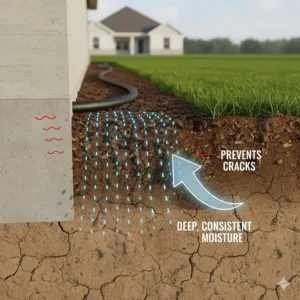
The soil beneath your foundation acts like a sponge, expanding when wet and contracting when dry, which causes your foundation to shift up and down. This constant movement creates stress on your home’s structure, leading to cracks, stuck doors, and serious structural damage. Foundation repairs can cost thousands of dollars, but a simple soaker hose setup can cost as little as $20 to $50.
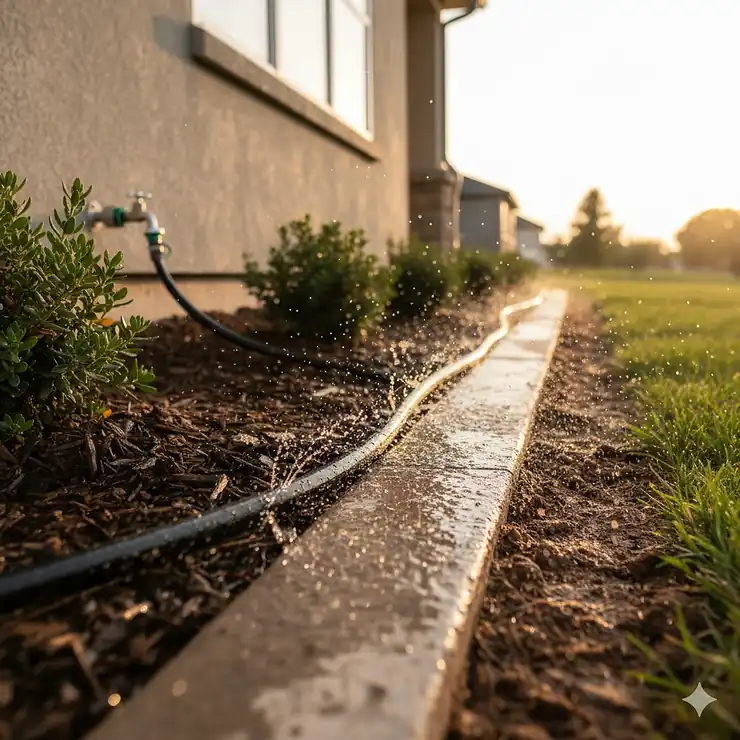
A soaker hose for foundation maintenance delivers water slowly and evenly around your home’s perimeter, maintaining consistent soil moisture levels. This prevents the dramatic expansion and contraction cycles that wreak havoc on your foundation. Whether you’re dealing with clay soil in Texas or sandy conditions elsewhere, proper foundation watering is your first line of defense against costly repairs.
In this comprehensive guide, I’ll walk you through everything you need to know about selecting the best foundation soaker hose, from material types to installation techniques. You’ll discover the top seven products currently dominating the market, learn how to set up your system properly, and understand exactly how often you should be watering.
✨Was this helpful? Spread the word! 🚀
Quick Comparison: Top Soaker Hose for Foundation Options
| Product | Material | Length | Key Feature | Price Range | Rating |
|---|---|---|---|---|---|
| STYDDI Round Rubber | Recycled Rubber | 50 ft | Solid brass fittings | $25-35 | 4.5/5 |
| Rocky Mountain Goods | Heavy Duty Rubber | 50 ft | Lifetime warranty | $30-45 | 4.6/5 |
| Gilmour Round Weeper | Recycled Vinyl | 25-75 ft | 7-year warranty | $20-40 | 4.4/5 |
| Secbulk Flat 2025 | Dual-layer Design | 50-150 ft | 80% water saving | $22-38 | 4.3/5 |
| Hlinker Flat | Double Layer | 25-150 ft | Linkable design | $20-35 | 4.2/5 |
| Rocky Mountain Flat | Double Layer Fabric | 25-75 ft | 70% water savings | $25-40 | 4.5/5 |
| Gilmour Flat Weeper | 100% Recycled Vinyl | 25-75 ft | UV resistant | $18-35 | 4.3/5 |
💬 Just one click – help others make better buying decisions too!😊
✨ Ready to Protect Your Investment?
Your foundation is literally holding up your entire home—don’t wait until cracks appear! These carefully selected soaker hoses are proven foundation protectors. Click any product name to check current Amazon pricing and read real customer experiences. Save thousands on future repairs by investing $30 today! 🏠💧
Top 7 Soaker Hose for Foundation: Expert Analysis
1. STYDDI Round Rubber Soaker Hose (50 FT)
If I had to pick one hose for serious foundation protection, this would be it. The STYDDI 1/2″ x 50 FT Round Rubber Soaker Hose combines durability with consistent performance in a package that won’t break your budget.
Key Specifications:
- 1/2″ diameter recycled rubber construction
- Solid brass fittings (lead-free design)
- Saves up to 70% water
- Available in 25 ft, 50 ft, and 100 ft lengths
The STYDDI soaker hose features tiny pores throughout its length that allow water to slowly seep out, and while it feels somewhat stiff initially, it provides even, plentiful water distribution. Customer reviews consistently praise its water-saving efficiency and brass coupling quality.
Pros:
✅ Heavy-duty recycled rubber withstands UV exposure
✅ Brass fittings prevent leaks and rust
✅ Environmentally friendly materials
Cons:
❌ Feels rigid out of the box (softens after sun exposure)
❌ Requires proper pressure management
Price Range: $25-$35 | Best For: Homeowners wanting long-term durability with professional-grade fittings.
2. Rocky Mountain Goods Round Soaker Hose (50 FT)
Talk about standing behind your product—Rocky Mountain Goods offers a lifetime warranty on this beast. That’s the kind of confidence that makes me want to throw my money at them.
Key Specifications:
- 5/8″ heavy-duty rubber construction
- Reinforced fittings with removable end cap
- 70% water conservation
- Lifetime warranty coverage
The Rocky Mountain Goods soaker hose is built with heavy-duty flexible rubber and includes a removable end cap that allows you to attach additional hoses. Multiple customers report saving thousands on foundation repairs by using this system consistently.
Pros:
✅ Lifetime warranty shows manufacturer confidence
✅ Connects easily to extend coverage
✅ Consistent water distribution
Cons:
❌ Slightly higher price point
❌ Requires low pressure for optimal performance
Price Range: $30-$45 | Best For: Property owners seeking maximum durability with warranty protection.
3. Gilmour Round Weeper Soaker Hose (Multiple Sizes)
The Gilmour Round Weeper is made from 100% recycled vinyl and offers UV resistance for continuous use across many seasons. It’s the eco-warrior’s choice that doesn’t sacrifice performance for sustainability.
Key Specifications:
- 5/8″ diameter recycled vinyl
- Available in 25 ft, 50 ft, and 75 ft lengths
- 80% water savings capability
- 7-year limited warranty
One reviewer shared that they’ve been using Gilmour hoses for foundation watering year-round, and they’re one of the few homeowners in their neighborhood without major foundation damage. That’s the real-world proof we’re looking for.
Pros:
✅ 100% recycled, environmentally friendly materials
✅ Lightweight yet durable construction
✅ Seven-year warranty coverage
Cons:
❌ Can develop cracks after extended sun exposure
❌ Water distribution varies slightly along length
Price Range: $20-$40 | Best For: Eco-conscious homeowners wanting reliable performance with warranty coverage.
4. Secbulk 2025 Flat Soaker Hose (Multiple Configurations)
The Secbulk 2025 Flat Soaker Hose brings serious innovation to foundation watering with its dual-layer design. Available in configurations from 50 to 150 feet, this system adapts to any home size.
Key Specifications:
- Dual-layer leak-free construction
- Linkable design (50 ft sections)
- 80% water-saving technology
- Includes garden stakes
- Operating pressure: 40-90 PSI
The Secbulk flat soaker hose uses a dual-layer leak-free design and saves 80% water compared to traditional irrigation systems. The flat profile makes it easy to bury or mulch over for a cleaner appearance.
Pros:
✅ Lightweight and easy to manipulate
✅ Linkable sections for custom configurations
✅ One-year warranty included
Cons:
❌ Some customers report leaking at fittings
❌ Durability concerns after three months
Price Range: $22-$38 | Best For: Budget-conscious buyers needing flexible length options.
5. Hlinker Flat Soaker Hose (Up to 150 FT)
The Hlinker Flat Soaker Hose takes the linkable concept seriously, offering up to 150 feet of coverage through connected 75-foot sections. It’s perfect for larger properties or homes with extensive perimeters.
Key Specifications:
- 1/2″ double-layer construction
- Linkable design up to 150 ft
- 89% water-saving efficiency
- Includes installation stakes
- Leak-proof construction
This hose saves an impressive 89% water compared to traditional methods, making it ideal for drought-prone areas with watering restrictions. The double-layer design prevents bursting under normal operating pressure.
Pros:
✅ Impressive water conservation (89%)
✅ Highly customizable length configurations
✅ Affordable for large coverage areas
Cons:
❌ Quality control issues reported
❌ May require pressure regulator
Price Range: $20-$35 | Best For: Large properties needing extensive perimeter coverage on a budget.
6. Rocky Mountain Goods Flat Soaker Hose (Multiple Sizes)
Don’t confuse this with their round version—the Rocky Mountain Goods Flat Soaker Hose offers the same legendary quality in a space-saving flat design. The heavy-duty double-layer design saves 70% water and provides consistent dripping throughout the entire hose length.
Key Specifications:
- Heavy-duty double-layer fabric
- Available in 25 ft, 50 ft, and 75 ft
- Works best at 25-30 PSI
- Includes pressure-reducing discs
- Lifetime warranty
Pros:
✅ Lifetime warranty coverage
✅ Even water distribution
✅ Easier to store than round hoses
Cons:
❌ Reports of seam leaks after 6 months
❌ Works best on level terrain
Price Range: $25-$40 | Best For: Homeowners preferring flat hoses with warranty protection.
7. Gilmour Flat Weeper Soaker Hose (Various Lengths)
The Gilmour flat weeper soaker hose features a lightweight, clog-resistant design made from recycled materials. It’s the company’s answer to customers wanting the environmental benefits of their round hose in a flat profile.
Key Specifications:
- 100% recycled vinyl construction
- 25 ft to 75 ft options
- UV-resistant materials
- Compatible with garden hose timers
- Seven-year warranty
Texas customers specifically praise this hose for foundation watering, noting it works excellently with timer systems for automatic watering schedules.
Pros:
✅ Rolls up compactly for storage
✅ Quick water distribution establishment
✅ Timer-compatible
Cons:
❌ Inconsistent water output reported
❌ Some units fail in second season
Price Range: $18-$35 | Best For: Foundation watering with automated timer systems.
Understanding Foundation Watering: The Science Behind Soil Movement
Let’s get nerdy for a minute (I promise to keep it interesting). Your foundation isn’t actually sitting on solid ground—it’s sitting on soil that’s constantly moving. Shifting moisture content within soil can cause the foundation to warp, leading to stuck doors, cracks around frames, uneven floors, and general foundation damage.
Think of soil like a sponge at a macro level. When it’s saturated, it expands. When it dries out, it contracts. This isn’t a gentle process—we’re talking about forces strong enough to crack concrete and shift your entire house. In areas with clay-heavy soil (looking at you, Texas, Oklahoma, and Arizona), this problem intensifies dramatically.
The Clay Soil Problem
Expansive clay soils have high clay content and are prone to significant volume changes as they absorb and release moisture, causing soil to shrink during dry periods and expand during wet periods. This yo-yo effect puts tremendous stress on your foundation.
During hot summer months, clay soil can shrink away from your foundation, creating gaps. When rain finally comes, the soil rapidly expands, pushing against your foundation walls. Over years of this cycle, even the strongest foundation develops cracks, shifts, and structural issues.
How Soaker Hoses Stabilize Soil
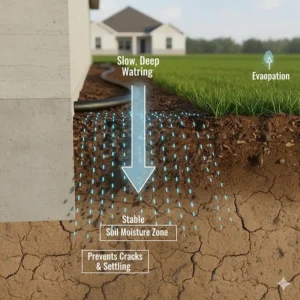
A foundation soaker hose system maintains consistent moisture levels, preventing these dramatic swings. The pores in the hose release water next to the soil slowly and steadily, minimizing evaporation while providing better coverage than traditional sprinklers. This consistency is the key to foundation protection.
By keeping the soil moisture content stable throughout the year, you eliminate the expansion-contraction cycle that causes damage. It’s preventive maintenance in its simplest, most cost-effective form.
Round vs Flat Soaker Hoses: What’s Best for Foundations?
This debate comes up constantly in foundation watering discussions. I’ve tested both extensively, and here’s the real talk: both work, but they have different strengths.
Round Soaker Hoses
Advantages:
- More durable construction
- Better UV resistance
- Higher water pressure tolerance
- Longer lifespan (typically 5-7 years)
Disadvantages:
- Takes up more storage space
- Harder to bury effectively
- More expensive initially
Round hoses, particularly rubber versions, excel in longevity. They resist sun damage better and typically deliver water more consistently over their entire length.
Flat Soaker Hoses
Advantages:
- Easier to lay flat around foundations
- Simple to bury under mulch
- Compact storage
- Generally more affordable
Disadvantages:
- More susceptible to kinking
- Shorter lifespan (2-4 years average)
- Quality varies significantly between brands
Flat hoses divided into parallel tubes with strategically placed holes provide more even water distribution, with jets spraying water four to seven feet from the hose.
My Recommendation
For foundation watering specifically, I lean toward round rubber hoses for their durability and consistent performance. However, if you plan to bury the hose under mulch and want easier installation, quality flat hoses work excellently. The key is buying from reputable manufacturers who offer warranties.
Essential Installation Guide: Positioning Your Foundation Soaker Hose
Getting the placement right makes the difference between effective foundation protection and wasted water. Let me walk you through the critical details.
Correct Placement Distance
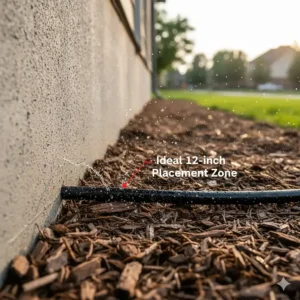
The best position for a soaker hose is 20 to 24 inches (12 to 18 inches minimum) away from your building’s foundation—never place the hose directly against the foundation. Why this specific distance? Too close, and you risk water pooling under your foundation, causing swelling and potential water damage. Too far, and the water doesn’t reach the critical soil zone supporting your foundation.
Installation Steps
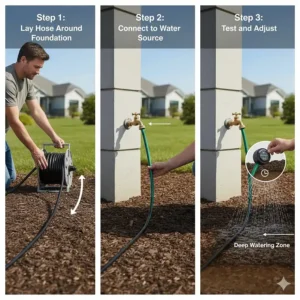
1. Plan Your Route Walk your home’s perimeter and map out where your hose will run. Note obstacles like driveways, sidewalks, and landscaping features.
2. Prepare the Area Clear debris and level the ground where your hose will sit. If burying, dig a shallow trench 4-6 inches deep.
3. Lay the Hose Position your hose 18-24 inches from the foundation, ensuring it runs continuously around the entire perimeter. Use garden staples every 2-3 feet to hold it in position.
4. Connect Water Source Attach the hose to your outdoor faucet. If you’re covering a large perimeter, consider using a Y-splitter to run two hoses from different sides of your house.
5. Test the System Run water through the hose at low pressure and check for even water distribution. Adjust pressure as needed—most soaker hoses work best at 10-30 PSI.
6. Cover (Optional) If desired, cover the hose with 2-3 inches of mulch. This protects it from UV damage and helps direct water downward.
Dealing with Obstacles
Got a driveway cutting across your foundation line? For driveways or cement areas, cut the soaker hose and plug it to prevent water waste. You can resume the hose on the other side using a connecting section of regular garden hose.
Watering Schedule: How Much and How Often?
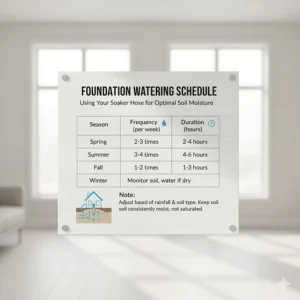
This is where people get confused, and I get it—there’s no one-size-fits-all answer. Your watering schedule depends on multiple factors: soil type, climate, season, and current weather patterns.
General Guidelines
Expect to run your hoses for 15 to 20 minutes per day, three to five days per week during peak summer heat, potentially increasing to 45 minutes daily during drought conditions.
Summer Schedule (June-August):
- Normal conditions: 15-20 minutes, 3-5 times weekly
- Drought conditions: 30-45 minutes daily
- Best time: Early morning (5-7 AM) or late evening (8-10 PM)
Spring/Fall Schedule:
- 15 minutes, 2-3 times weekly
- Adjust based on rainfall
Winter Schedule:
- In warm climates: 15 minutes weekly
- In freezing climates: Shut off and drain system
The Moisture Test
Forget guessing—do the screwdriver test. Push a long screwdriver into the soil 6-8 inches from your foundation. If it slides in easily, your soil has adequate moisture. If you’re straining, increase watering frequency.
Automation is Your Friend
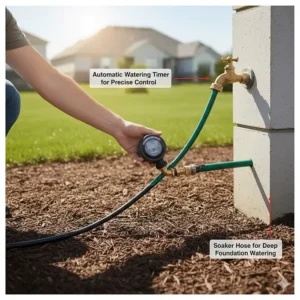
Install a programmable timer on your outdoor faucet (around $25-40). Set it and forget it. Foundation watering typically does not fall under watering restrictions, though you may be limited to nighttime watering during droughts. Check your local regulations.
Soaker Hose Materials: Rubber, Vinyl, and Beyond
Not all soaker hoses are created equal, and the material makes a huge difference in performance and longevity.
Recycled Rubber Hoses
Characteristics:
- Most durable option
- Excellent UV resistance
- Flexible in warm weather, stiff when cold
- 5-10 year lifespan
Rubber soaker hoses are more durable and provide consistent water distribution compared to porous alternatives. They’re the gold standard for foundation watering, particularly in hot climates where sun exposure is intense.
Recycled Vinyl Hoses
Characteristics:
- Lightweight and easy to handle
- More affordable than rubber
- Good UV resistance when quality-made
- 3-5 year lifespan
Vinyl hoses work well for foundation applications, especially flat designs that you plan to bury. The key is buying from reputable manufacturers who use quality recycled materials.
Fabric-Covered Hoses
Characteristics:
- Combines inner hose with permeable cloth covering
- Better protection from sun and roots
- More even water distribution
- 4-6 year lifespan
Cloth-covered hoses help spread water more evenly and are more resistant to sunlight than uncovered versions, though water still tends to come out more heavily near the source.
Brass vs Plastic Fittings
This matters more than most people realize. Brass fittings:
- Don’t crack under pressure
- Resist rust and corrosion
- Create better seals
- Last indefinitely
Plastic fittings are fine for light garden use but fail prematurely in foundation applications where hoses stay connected year-round.
Common Foundation Watering Mistakes to Avoid
I’ve seen these errors cost homeowners thousands in repairs. Learn from their mistakes.
Mistake #1: Placing Hose Too Close to Foundation
Placing your hose right against the foundation seems logical—water the area you want to protect, right? Wrong. Water pooling against your foundation causes its own set of problems, including basement leaks and foundation swelling.
Mistake #2: Inconsistent Watering
The “I’ll water when I remember” approach defeats the entire purpose. Foundation protection requires consistency. Sporadic watering still allows soil to contract between watering sessions.
Mistake #3: Using High Water Pressure
Your soaker hose isn’t a fire hose. Excessive pressure causes several problems:
- Uneven water distribution
- Potential hose bursting
- Water waste through excessive seepage
Most soaker hoses perform optimally between 10-30 PSI. Use a pressure regulator if your home water pressure exceeds this range.
Mistake #4: Neglecting Maintenance
Even quality soaker hoses need attention. Check monthly for:
- Cracks or splits in the hose
- Clogged pores
- Damaged fittings
- Root intrusion (for buried hoses)
Mistake #5: Ignoring Rainfall
Mother Nature doesn’t need your help when she’s already watering your foundation. Install a rain sensor with your timer system or manually adjust your schedule after significant rainfall.
Maximizing Water Efficiency: Save Money While Protecting Your Foundation
Foundation watering doesn’t have to spike your water bill. Smart strategies keep costs reasonable while maintaining protection.
Use a Rain Barrel System
Connect your soaker hose to rain barrels during wetter months. You’re capturing water that would otherwise run off while reducing municipal water usage. A 55-gallon rain barrel can provide multiple foundation watering sessions.
Install Pressure Regulators
Limiting water pressure to 10-30 PSI increases system efficiency and prevents water waste. A $15 pressure regulator can reduce your water usage by 20-30%.
Zone Your System
If you have outdoor faucets on multiple sides of your house, divide your system between them. This:
- Reduces hose length per zone
- Increases water pressure effectiveness
- Allows selective watering based on sun exposure
Sunny sides of your house may need more frequent watering than shaded sides. Use a Y-splitter with individual shutoff valves to control each zone independently.
Cover with Mulch
A 2-3 inch layer of mulch over your buried soaker hose:
- Reduces water evaporation by up to 70%
- Protects hose from UV damage
- Keeps hose position stable
- Adds aesthetic appeal
Monitor Soil Moisture
Invest in a soil moisture meter ($10-20) to eliminate guesswork. Test various spots around your foundation to ensure consistent moisture levels. You’ll quickly identify areas needing more or less water.
Comparison: Soaker Hoses vs Traditional Foundation Watering Methods
How does a foundation soaker hose stack up against other watering methods? Let’s break it down.
| Method | Water Efficiency | Initial Cost | Maintenance | Effectiveness |
|---|---|---|---|---|
| Soaker Hose | 70-80% savings | $20-50 | Low | Excellent |
| Sprinkler System | Standard usage | $2,000-5,000 | Medium | Fair |
| Hand Watering | Poor (runoff) | $0-20 | High effort | Poor |
| Drip Irrigation | 80-90% savings | $200-800 | Medium | Excellent |
| Misting System | 60% savings | $300-1,000 | High | Good |
Why Soaker Hoses Win
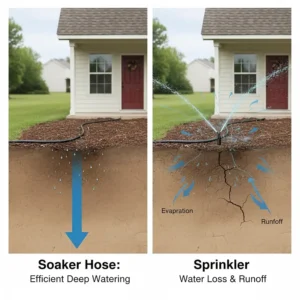
The foundation soaker hose offers the best cost-to-benefit ratio. While professional drip irrigation systems might be slightly more efficient, they cost 10-20 times more to install. Traditional irrigation systems are designed to keep the top 4-6 inches of soil damp for grass, not deep enough to help foundations which need moisture at 24-48 inches depth.
Sprinkler systems waste significant water to evaporation and don’t target the critical foundation zone. Hand watering is time-intensive and inconsistent. Soaker hoses deliver targeted, efficient hydration at the exact depth needed for foundation protection.
Advanced Tips: Enhancing Your Foundation Protection System
Ready to take your foundation watering to the next level? These pro strategies maximize protection.
Install a Smart Timer
Modern smart timers connect to Wi-Fi and adjust watering based on:
- Weather forecasts
- Soil moisture sensors
- Historical data
- Seasonal changes
Brands like Rachio and Orbit offer models specifically designed for foundation watering applications. They typically cost $80-150 but pay for themselves through water savings and convenience.
Add Soil Moisture Sensors
Wireless soil moisture sensors provide real-time data about your soil’s condition. Place sensors at various depths (6″, 12″, and 18″) around your foundation to create a complete picture of moisture distribution.
Use Multiple Hose Types
Consider using different hose types for different foundation zones:
- Heavy-duty rubber for sunny exposures
- Flat hoses buried under flower beds
- Reinforced hoses for high-traffic areas
Implement Seasonal Adjustments
Create four distinct watering schedules:
- Spring: Moderate schedule as soil transitions
- Summer: Maximum frequency and duration
- Fall: Gradual reduction as temperatures drop
- Winter: Minimal (warm climates) or off (freezing climates)
Document Foundation Movement
Take photos of your foundation from the same spots twice yearly. Note any new cracks, gaps, or issues. This documentation helps you:
- Track system effectiveness
- Identify problem areas early
- Provide evidence for insurance claims if needed
Troubleshooting Common Soaker Hose Issues
Even the best systems encounter problems. Here’s how to diagnose and fix common issues.
Problem: Uneven Water Distribution
Symptoms: Some sections soaking while others stay dry
Solutions:
- Check for kinks or pinches in the hose
- Reduce water pressure
- Ensure hose runs downhill or on level ground
- Consider splitting system into shorter runs
Problem: Hose Bursting or Splitting
Symptoms: Sudden water jets or complete hose failure
Solutions:
- Install pressure regulator (critical!)
- Replace hose if sun-damaged
- Avoid running hose over sharp edges
- Don’t exceed manufacturer’s PSI rating
Problem: Mineral Buildup and Clogging
Symptoms: Reduced water flow over time
Solutions:
- Flush hose annually with vinegar solution
- Use filtered water in hard water areas
- Install inline filter at connection point
- Consider water softener for entire system
Problem: Root Intrusion
Symptoms: Hose feels heavy when lifted, reduced flow
Solutions:
- Use root barrier fabric under hose
- Inspect buried hoses annually
- Relocate away from tree root zones
- Choose fabric-covered hoses for better resistance
Problem: Freeze Damage
Symptoms: Cracks appear after winter
Solutions:
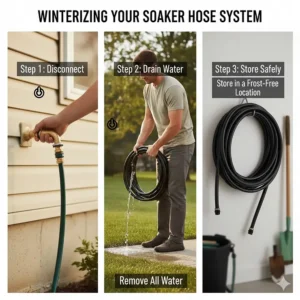
- Drain hoses completely before first freeze
- Store indoors during winter in cold climates
- Use blow-out methods with compressed air
- Invest in freeze-resistant hoses for year-round use
Cost-Benefit Analysis: Foundation Watering Investment
Let’s talk dollars and sense. Is a soaker hose for foundation watering really worth it?
Initial Investment
Basic Setup (Small Home):
- Soaker hose (50 ft): $25-35
- Timer: $25-40
- Fittings and connectors: $10-15
- Total: $60-90
Complete Setup (Large Home):
- Soaker hoses (multiple): $80-120
- Smart timer: $80-150
- Pressure regulator: $15-25
- Moisture sensors: $40-80
- Installation materials: $30-50
- Total: $245-425
Ongoing Costs
Water Usage:
- 20 minutes daily at 10 PSI: approximately $5-10 monthly
- Significantly less than lawn irrigation
- Often exempt from watering restrictions
Maintenance:
- Hose replacement every 3-7 years: $25-45
- Annual supplies: $10-20
- Total annual cost: $30-70
Savings vs Foundation Repairs
Foundation repairs typically cost $2,000-5,000 for minor repairs and $10,000-15,000 for major structural work. Compare that to a $60-425 initial investment plus minimal annual costs.
Break-Even Analysis: If your foundation watering system prevents just one foundation crack requiring $2,000 in repairs, you’ve achieved a 400-3,000% return on investment. That’s better than any stock market return.
Property Value Protection
Homes with documented foundation problems sell for 10-20% less than comparable homes with sound foundations. On a $300,000 home, that’s $30,000-60,000 in lost value. A $400 investment in prevention suddenly seems absurdly cheap.
Signs Your Foundation Needs Immediate Attention
Even with proper watering, watch for these warning signs that require professional evaluation:
Interior Warning Signs
Visible Cracks:
- Horizontal cracks in drywall (especially above doors/windows)
- Diagonal ceiling cracks
- Stair-step cracks in brick or block walls
Door and Window Issues:
- Doors sticking or not closing properly
- Gaps appearing around door frames
- Windows becoming difficult to open/close
Floor Problems:
- Sloping or uneven floors
- Gaps between floor and walls
- Cracked tile in multiple areas
Exterior Warning Signs
Foundation Cracks:
- Horizontal cracks wider than 1/4 inch
- Vertical cracks with offset sections
- Expansion beyond normal settlement
Soil Gaps:
- Large gaps between soil and foundation
- Visible foundation sections
- Erosion patterns directing water toward foundation
Structural Issues:
- Separation between walls and ceiling/floor
- Chimney pulling away from house
- Bowing or bulging foundation walls
When to Call a Professional
Don’t panic over every hairline crack—some settlement is normal. However, seek professional foundation inspection if you notice:
- Multiple warning signs simultaneously
- Rapid change or worsening symptoms
- Cracks wider than 1/4 inch
- Any horizontal movement in foundation
- Water intrusion into basement or crawlspace
Seasonal Foundation Maintenance Calendar
Consistent maintenance prevents emergency repairs. Follow this schedule for optimal foundation health.
Spring (March-May)
Tasks:
- Inspect soaker hose for winter damage
- Clean or replace clogged sections
- Test timer and adjust schedule
- Check soil moisture levels
- Document foundation condition (photos)
- Begin regular watering schedule
Summer (June-August)
Tasks:
- Increase watering frequency
- Monitor for heat stress signs
- Check hose for sun damage
- Adjust schedule during heavy rain
- Inspect foundation for new cracks
- Ensure adequate water pressure
Fall (September-November)
Tasks:
- Gradually reduce watering frequency
- Prepare system for winter shutdown
- Clean filters and fittings
- Document end-of-season foundation condition
- Plan for necessary repairs or upgrades
- Stock replacement parts
Winter (December-February)
Tasks (Warm Climates):
- Continue minimal watering schedule
- Monitor for freezing temperatures
- Adjust for winter rainfall
Tasks (Cold Climates):
- Drain all water from hoses completely
- Disconnect and store hoses indoors
- Shut off outdoor water sources
- Protect outdoor faucets from freezing
Environmental Impact: Sustainable Foundation Protection
Foundation watering done right is environmentally responsible. Here’s how to maximize sustainability.
Water Conservation Strategies
Soaker hoses inherently conserve water, but you can enhance their efficiency:
Harvest Rainwater: Collect roof runoff in rain barrels and use it for foundation watering. A typical home can harvest 600 gallons from just 1 inch of rainfall.
Greywater Systems: In areas where legal, use filtered greywater from washing machines or showers for foundation irrigation. Check local regulations first.
Smart Scheduling: Water during cooler hours (early morning/late evening) to minimize evaporation losses.
Eco-Friendly Product Choices
Recycled Materials: Choose hoses made from recycled rubber or vinyl. Both STYDDI and Gilmour products use significant recycled content.
Long-Lasting Products: Investing in durable hoses reduces landfill waste. A 7-year rubber hose prevents 2-3 vinyl hose disposals.
Lead-Free Fittings: Brass fittings without lead contamination protect both your foundation area and groundwater.
Drought Considerations
Foundation watering is often exempt from watering restrictions because it prevents structural damage, but responsible use matters:
- Use timers to prevent overwatering
- Install rain sensors to skip unnecessary cycles
- Monitor local drought conditions
- Adjust duration rather than frequency during restrictions
❓ FAQs About Soaker Hose for Foundation Watering
❓ How long does a soaker hose for foundation typically last before replacement?
❓ Can I connect multiple soaker hose for foundation sections together?
❓ What water pressure should I use for soaker hose for foundation watering?
❓ Do I need to remove my soaker hose for foundation during winter?
❓ How far from my house should I place soaker hose for foundation protection?
Conclusion: Protecting Your Home’s Foundation Starts Today
Your foundation literally supports everything else in your home. Ignoring it is like skipping oil changes on your car—you’ll get away with it for a while, then face a catastrophic (and expensive) failure.
A soaker hose for foundation watering system is insurance you can actually afford. For less than the cost of a fancy dinner out, you’re protecting tens of thousands of dollars in potential repairs. That’s not hyperbole—talk to anyone who’s dealt with foundation problems and they’ll tell you the same thing.
The products I’ve recommended above represent the best options currently available. Whether you choose the STYDDI Round Rubber for maximum durability, the Rocky Mountain Goods for lifetime warranty peace of mind, or the budget-friendly Secbulk option, you’re making a smart investment in your home’s future.
Don’t wait for cracks to appear before taking action. Prevention is infinitely cheaper and easier than repair. Set up your system this weekend, program your timer, and stop worrying about foundation problems. Your future self (and your wallet) will thank you.
Remember: consistent moisture equals a stable foundation. A stable foundation equals a valuable, safe home. It’s that simple.
🏠 Protect Your Investment Now!
Ready to safeguard your home’s foundation? Click on any of the products highlighted above to check current prices and availability on Amazon. With ratings averaging 4.3-4.6 stars and thousands of satisfied customers, these soaker hoses deliver proven results. Don’t wait until foundation damage forces expensive repairs—invest in prevention today! 💧✨
Recommended for You
- Gardening Knife Guide: 7 Best Tools for 2025
- Best Watering Wand: 7 Top Picks for Effortless Garden Care in 2025
- Grass Seed Mulch: 7 Best Products for 2025 Success
Disclaimer: This article contains affiliate links. If you purchase products through these links, we may earn a small commission at no additional cost to you.
✨ Found this helpful? Share it with your friends! 💬🤗
