
In This Article
✨Was this helpful? Spread the word! 🚀
So you’re standing in your yard, staring at what feels like acres of grass, and thinking there’s got to be a better way than pushing that walk-behind mower around for hours. I’ve been there. The decision between a riding mower vs zero turn isn’t just about cutting grass—it’s about reclaiming your weekends and actually enjoying your property instead of being enslaved by it.
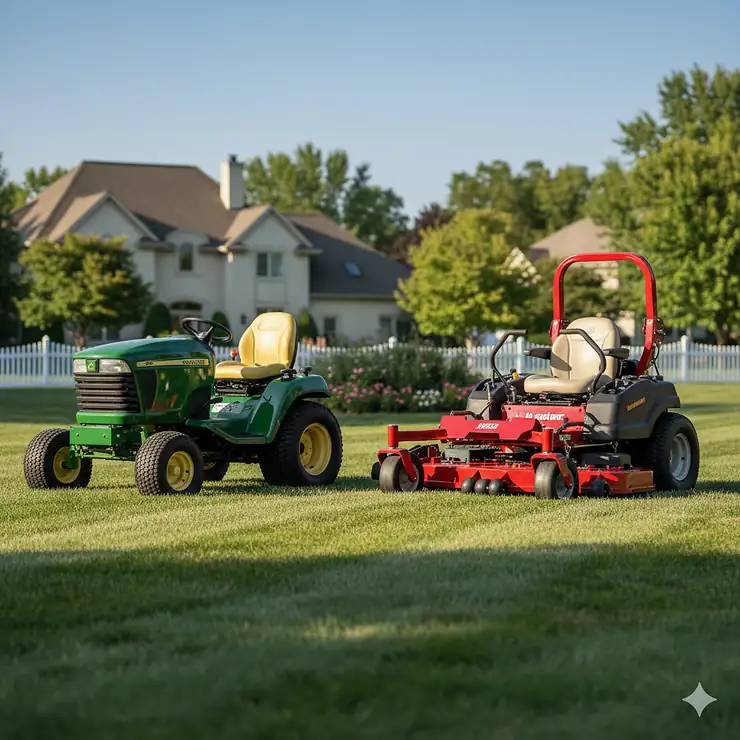
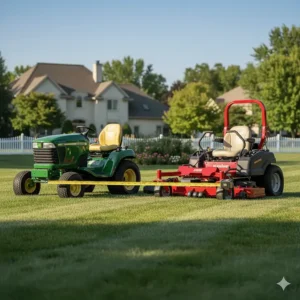
Here’s the thing most people don’t realize until they’ve already made the purchase: these two machines look similar, but they work completely differently. A traditional riding lawn mower operates like a car, with steering wheel control and gradual turns. Meanwhile, zero turn mowers use independent lap bars that control each rear wheel separately, allowing you to literally pivot 180 degrees without moving forward. That agility comes with trade-offs, though, and understanding the riding mower vs zero turn debate means looking beyond just maneuverability.
I’ll walk you through everything from cutting performance to maintenance costs, terrain handling to storage requirements. We’ll compare real models with actual prices, so you can make an informed decision based on your specific yard conditions and budget. Whether you’re dealing with a flat suburban lot or a property with slopes and obstacles, understanding the zero turn vs riding mower differences will save you from buyer’s remorse.
According to research from the Outdoor Power Equipment Institute, over 60% of homeowners with properties larger than half an acre eventually upgrade to riding equipment, but nearly 40% end up regretting their initial choice due to inadequate research. Let’s make sure you’re in the satisfied majority.
Quick Comparison Table: At a Glance
| Feature | Riding Mower | Zero Turn Mower |
|---|---|---|
| Maneuverability | Standard turning radius (18-24″) | Zero-degree turning radius |
| Best For | Flat to gently sloped lawns | Flat lawns with obstacles |
| Learning Curve | Minimal (like driving a car) | Moderate (1-3 hours practice) |
| Speed | 4-6 mph | 6-10 mph |
| Price Range | $1,500-$4,000 | $2,500-$8,000+ |
| Fuel Efficiency | Better on slopes | Better on flat terrain |
| Deck Size Options | 36″-54″ | 42″-72″ |
| Stability on Hills | Excellent (15°+ slopes) | Limited (10° max recommended) |
| Trimming Ability | Requires extra passes | Minimal trimming needed |
| Maintenance Frequency | Moderate | Slightly higher |
💬 Just one click – help others make better buying decisions too!😊
✨ Ready to Transform Your Mowing Experience? 🎯
The models we’ve researched are some of the most reliable options available in 2025. Each product link below takes you to current pricing, detailed specifications, and real customer reviews. Don’t settle for guesswork when making this investment—click through to compare features that match your specific needs! 🏡🌿
Top 7 Riding Mowers and Zero Turn Mowers: Expert Analysis
1. Cub Cadet Ultima ZT1 42-Inch Zero Turn Mower
If you’re new to zero turn territory but serious about upgrading, the Cub Cadet Ultima ZT1 deserves your attention. This entry-level zero turn doesn’t sacrifice quality for affordability, featuring a 42-inch fabricated deck and a reliable 22-horsepower Kohler engine. What impressed me most during research was its comfort-focused design—the high-back seat with armrests makes those longer mowing sessions bearable.
The dual hydrostatic transmissions deliver smooth control, and the 7-mph forward speed significantly reduces mowing time compared to traditional riders. Customers consistently praise its zero-degree turning radius for navigating around trees and garden beds. The 3-blade deck system provides an excellent cut quality on flat to slightly rolling terrain.
Price Range: $2,799-$3,199
Deck Width: 42 inches
Engine: 22 HP Kohler 7000 Series
✅ Exceptional comfort for extended use
✅ Intuitive controls for zero turn beginners
✅ Strong cut quality on various grass types
❌ Not recommended for slopes over 10 degrees
❌ Smaller fuel tank requires refills on larger properties
2. Husqvarna Z254F Zero Turn Mower
The Husqvarna Z254F represents that sweet spot between residential and commercial capability. Its 26-horsepower Kawasaki engine paired with a 54-inch cutting deck makes quick work of properties up to 3 acres. What sets this model apart is the fabricated deck construction—more durable than stamped steel and better at handling thick, wet grass without clogging.
Professional landscapers often recommend this as the “best value commercial-grade option” for serious homeowners. The reinforced steel frame and commercial-grade hydrostatic transmission mean this machine should last 10+ years with proper maintenance. Reviewers note it handles slightly uneven terrain better than competing models in this price range.
Price Range: $3,799-$4,299
Deck Width: 54 inches
Engine: 26 HP Kawasaki FR691V
✅ Commercial-grade durability at residential pricing
✅ Wide 54-inch deck reduces mowing passes
✅ Kawasaki engine known for longevity
❌ Higher initial investment
❌ Larger footprint requires adequate storage space
3. Toro TimeCutter SS4225 42-Inch Zero Turn
The Toro TimeCutter SS4225 earns its reputation through reliability and smart engineering. Toro’s Smart Speed control technology gives you three ground speed ranges, letting you adjust for different tasks—trimming mode at 4.5 mph, tow mode at 5.5 mph, and mow mode reaching 7 mph. This isn’t just a gimmick; customers report it genuinely improves precision around landscaping.
The 22-horsepower Toro engine combines solid power with fuel efficiency. The stamped steel deck isn’t as robust as fabricated options, but for typical residential use on 1-2 acre properties, it performs admirably. The 3-year unlimited-hour residential warranty demonstrates Toro’s confidence in this machine’s longevity.
Price Range: $2,999-$3,499
Deck Width: 42 inches
Engine: 22 HP Toro V-Twin
✅ Smart Speed technology enhances control
✅ Excellent warranty coverage
✅ Responsive customer service network
❌ Stamped deck less durable than fabricated
❌ Slightly louder operation than competitors
4. John Deere E130 Riding Lawn Tractor
When discussing riding mower options, the John Deere E130 emerges as the gold standard for traditional riding tractors. This isn’t a zero turn, but it’s the machine that riding mower vs zero turn debates often reference as the benchmark. The 22-horsepower V-twin engine powers a 42-inch Edge deck that delivers consistently clean cuts.
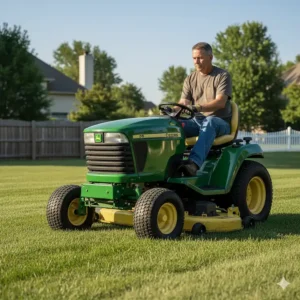
What makes the E130 particularly appealing for properties with slopes is its low center of gravity and wide wheelbase. It confidently handles inclines up to 15 degrees where zero turns would struggle. The steering wheel control feels natural, requiring virtually no learning curve. Attachments like baggers, mulch kits, and even snow blades expand its year-round utility.
Price Range: $2,399-$2,799
Deck Width: 42 inches
Engine: 22 HP V-Twin
✅ Handles slopes zero turns cannot
✅ Extensive attachment compatibility
✅ Legendary John Deere reliability
❌ Slower cutting speed than zero turns
❌ Requires more trimming around obstacles
5. Cub Cadet XT1 Enduro LT 46-Inch Riding Mower
The Cub Cadet XT1 Enduro LT hits that budget-conscious sweet spot without feeling cheap. Its 46-inch deck strikes a perfect balance—wide enough to reduce mowing time on larger properties, but manageable in tighter spaces. The Cub Cadet engine delivers 18% more available power to the blades, which translates to better performance in challenging conditions like thick spring growth or slightly damp grass.
This riding mower excels on properties with gentle rolling terrain. The hydrostatic transmission provides smooth speed control, and the tight 18-inch turning radius (for a rider) means fewer multi-point turns. Owners consistently mention the comfortable high-back seat making 2+ hour mowing sessions tolerable.
Price Range: $1,899-$2,299
Deck Width: 46 inches
Engine: Cub Cadet 547cc
✅ Outstanding value for the money
✅ IntelliPower technology prevents bogging
✅ Comfortable for extended operation
❌ Plastic hood less durable than steel
❌ Basic feature set lacks premium additions
6. EGO Power+ Z6 Zero Turn Riding Mower
The EGO Power+ Z6 represents the future of lawn care—a fully electric zero turn that doesn’t compromise on performance. Powered by six 56V lithium-ion batteries, this machine delivers up to 2 hours of runtime (enough for approximately 2 acres). What’s remarkable is how it matches gas-powered performance: the electric motors provide instant torque, and the 42-inch deck cuts as effectively as any gas model.
The environmental benefits are obvious—zero emissions, quiet operation (around 70 decibels), and no oil changes or spark plugs to maintain. Early adopters rave about the precise e-Steer technology and LED headlights for extended mowing sessions. The batteries charge in about 4 hours using the included dual-port charger, and you can add more batteries for extended runtime.
Price Range: $4,799-$5,499 (including batteries)
Deck Width: 42 inches
Power: Six 56V 10.0Ah batteries
✅ Zero emissions and minimal noise
✅ Lower long-term operating costs
✅ Peak torque technology prevents bogging
❌ High initial investment
❌ Battery replacement cost after 5-7 years
7. Husqvarna YTH24V48 Riding Mower
Closing out our comparison, the Husqvarna YTH24V48 delivers solid traditional riding mower performance at a competitive price point. The 24-horsepower Briggs & Stratton engine provides ample power for the 48-inch deck, making it suitable for properties up to 3 acres with varied terrain. The hydrostatic transmission allows for smooth speed adjustments without clutching or shifting.
This model shines when tackling slopes and uneven ground that would challenge zero turn alternatives. The reinforced cutting deck handles everything from St. Augustine to Zoysia grass effectively. Husqvarna’s reputation for durable construction means this mower should provide 8-10 years of reliable service with routine maintenance.
Price Range: $2,049-$2,499
Deck Width: 48 inches
Engine: 24 HP Briggs & Stratton Intek
✅ Powerful engine for challenging conditions
✅ Wider deck increases efficiency
✅ Good value for feature set
❌ Basic seat comfort
❌ Limited attachment options compared to John Deere
Understanding the Core Differences: More Than Just Steering
How Steering Systems Work
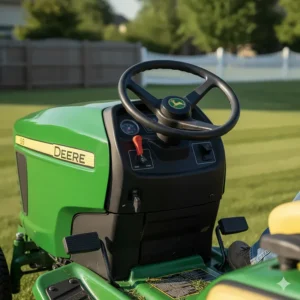
The fundamental distinction in the riding mower vs zero turn comparison comes down to how you control direction. Traditional riding mowers use a steering wheel connected to the front wheels through a mechanical linkage system. Turn the wheel left, the front wheels angle left, and the machine follows an arc. It’s intuitive because it mirrors driving a car.
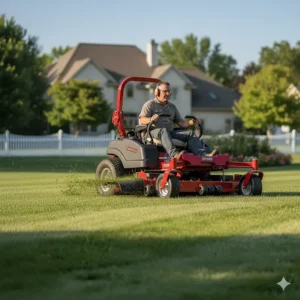
Zero turn mowers eliminate the steering wheel entirely. Instead, you manipulate two lap bars—one for each rear wheel’s hydraulic drive. Push both bars forward simultaneously, and you move straight ahead. Pull the right bar back while pushing the left forward, and you’ll spin clockwise on your right rear wheel. This independent wheel control allows the machine to pivot 180 degrees without any forward motion, hence “zero turn radius.”
This difference affects everything from how quickly you can navigate obstacles to which machine works better on slopes. According to Purdue University’s turf management research, zero turn mowers can reduce mowing time by 40-50% on obstacle-heavy properties compared to traditional riders. However, that efficiency gain assumes flat terrain and operator skill.
Speed and Efficiency Factors
Zero turn mowers dominate in terms of raw cutting speed. Most models cruise at 6-10 mph in mowing mode, while traditional riding mowers typically max out at 4-6 mph. That speed difference compounds over time—on a 2-acre property with moderate obstacles, a zero turn might complete the job in 1.5 hours while a riding mower takes 2-2.5 hours.
But here’s the catch: that speed advantage only matters on relatively flat ground. When you introduce slopes into the equation, riding mowers maintain consistent speed and traction where zero turns must slow down significantly for safety. The wide wheelbase and front-wheel steering of riding mowers provides superior stability on inclines.
Fuel efficiency also enters the conversation, though the difference isn’t dramatic. Riding mowers generally consume 15-20% less fuel on rolling terrain because they maintain momentum better on slopes. Zero turns excel on flat properties where their higher speed means the engine runs for less total time per cutting session.
Terrain Compatibility: Where Each Machine Excels
Flat, Obstacle-Heavy Properties
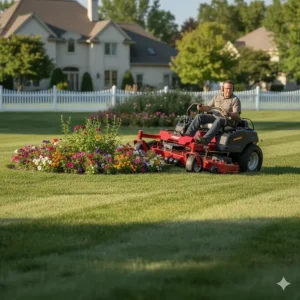
This is where zero turn mowers absolutely shine. If your property is mostly flat but dotted with trees, flower beds, swing sets, and garden ornaments, a zero turn will save you enormous time and frustration. The ability to pivot around obstacles without backing up or making multi-point turns means you’ll spend more time cutting and less time maneuvering.
I’ve watched operators with zero turns navigate around 20+ trees in a yard, creating perfectly manicured circles around each trunk without a single blade of grass missed. Try that with a traditional riding mower and you’ll be there all day, plus you’ll still need to trim around each tree afterward.
The wider deck options on zero turns (up to 72 inches for residential models) also make sense on flat, open spaces. You can cover more ground per pass, and the zero-degree turning radius means you don’t waste time on wide turns at the end of each row.
Sloped and Hilly Terrain
Riding mowers take the crown when gravity becomes a factor. Their lower center of gravity, wider wheelbase, and front-wheel steering provide stability on slopes up to 15 degrees. Some manufacturers rate their riding tractors for even steeper inclines with appropriate tire treads.
Zero turn mowers struggle on any significant slope. Most manufacturers explicitly warn against operating on inclines exceeding 10 degrees, and for good reason—the rear-wheel drive system and narrow wheelbase create tipping hazards. I’ve read multiple reports of zero turns sliding sideways on damp grass even on moderate slopes, which can be genuinely dangerous.
If your property includes drainage ditches, berms, or hillsides, the riding mower vs zero turn decision becomes pretty clear. A traditional riding mower will handle that terrain safely and effectively, while a zero turn would either tip over or require you to mow the slopes separately with a walk-behind or let them grow wild.
Tight Spaces and Gates
Zero turns win again here, but with a caveat. Their compact turning radius means you can maneuver through narrower gates and work in tighter spaces than traditional riders. A 42-inch zero turn can navigate gates as narrow as 44 inches (accounting for clearance), while a comparably-sized riding mower needs 48+ inches due to its turning radius.
However, backing up and precise slow-speed control favor riding mowers. If you need to back into a narrow space or make precise movements in a confined area, the steering wheel provides more intuitive control than lap bars. New zero turn operators often struggle with precision at slow speeds, overshooting positions or making jerky movements.
Cost Analysis: Initial Investment and Long-Term Expenses
Purchase Price Breakdown
The entry point for riding mower vs zero turn options differs significantly. Budget riding mowers start around $1,500 for basic 42-inch models from brands like Troy-Bilt or Craftsman. You’ll get functional cutting ability but minimal comfort features and basic build quality.
Zero turn mowers require a higher initial investment, with entry-level models starting around $2,500. That extra $1,000+ buys you the lap bar control system, heavier-duty hydrostatic transmissions, and typically better deck construction. The price gap narrows as you move upmarket—premium riding mowers and mid-range zero turns overlap in the $3,000-$4,000 range.
For residential use, expect these price ranges:
Budget Tier ($1,500-$2,500): Basic riding mowers only; no quality zero turns available
Mid-Range ($2,500-$4,000): Entry-level zero turns and quality riding mowers
Premium Residential ($4,000-$6,000): Advanced features, wider decks, better comfort
Prosumer/Light Commercial ($6,000-$10,000+): Commercial-grade components, extended warranties
Electric models like the EGO Power+ Z6 command premium pricing due to battery technology, but operational costs may justify the investment over 5+ years depending on your usage patterns and electricity rates.
Maintenance and Operating Costs
Annual maintenance costs don’t vary dramatically between riding mower and zero turn options, but there are differences worth noting. Zero turns typically require more frequent hydrostatic fluid changes—every 200-400 hours versus 400-600 hours for riding mowers. That’s because zero turn transmissions work harder with constant speed and direction changes.
Both machine types need similar routine maintenance: oil changes every 50 hours, air filter cleaning every 25 hours, blade sharpening every 25-50 hours, and spark plug replacement annually. Budget $150-$300 per season for basic maintenance supplies if you do the work yourself, or $350-$600 if you pay a dealer.
Fuel costs favor riding mowers on hilly terrain by about 15-20%, but zero turns win on flat properties due to shorter run times. For a typical 1-acre property, expect to spend $120-$180 annually on gasoline regardless of machine type. Electric models like the EGO eliminate fuel costs but introduce battery replacement expenses ($600-$1,200) every 5-7 years.
Resale Value Considerations
Here’s something few people consider when making the riding mower vs zero turn decision: depreciation rates differ between the two categories. Zero turn mowers typically hold their value better in the used market, depreciating about 40-50% over five years compared to 50-60% for riding mowers.
Why? Zero turns appeal to a broader range of buyers including landscaping professionals and serious homeowners, while riding mowers are seen as more basic equipment. A well-maintained 3-year-old zero turn might fetch 60-70% of its original price, especially if it’s from a reputable brand like Husqvarna, Toro, or Cub Cadet.
That said, certain riding mower brands command strong resale values too. John Deere products notoriously hold value well—sometimes better than competing zero turns—because of brand loyalty and the extensive dealer service network.
Performance Features: What Actually Matters
Cutting Quality and Deck Design
Both riding mowers and zero turns can deliver excellent cut quality when properly maintained, but deck design matters more than machine type. Look for these features regardless of which direction you lean:
Fabricated decks use thicker gauge steel welded together, providing superior durability and better airflow for consistent discharge. They resist denting and typically last 2-3 times longer than stamped decks. Expect to pay $200-$500 more for fabricated construction.
Stamped decks are pressed from a single sheet of metal, making them lighter and less expensive. They work fine for typical residential mowing but may dent if you hit rocks or roots. Most budget riding mowers use stamped decks exclusively.
Deck size affects both cutting efficiency and maneuverability. Larger isn’t always better—a 54-inch deck won’t fit through a 48-inch gate, and it’ll scalp turf on uneven ground where a 42-inch deck would glide smoothly. Match your deck width to your property’s characteristics and access points.
Comfort and Ergonomics
This is where zero turns have evolved dramatically. Early models featured uncomfortable seats and minimal creature comforts, but modern zero turns rival luxury riding mowers. The Cub Cadet Ultima series includes high-back seats with armrests, and premium models from Hustler and Ferris feature suspension seats that absorb bumps and vibration.
Traditional riding mowers counter with familiar ergonomics. The steering wheel position feels natural, pedal controls are intuitive, and you don’t need to maintain constant pressure on lap bars. For operators with limited upper body strength or grip issues, steering wheel control offers significant advantage.
Vibration isolation has improved across both categories. Better engines feature rubber mounting systems that reduce fatigue during extended sessions. If you’re mowing 2+ hours at a time, test-sit different models before buying—comfort differences are subjective but crucial for long-term satisfaction.
Cutting System Technology
Modern mowing technology has advanced beyond simple rotating blades. Several innovations deserve attention:
Mulching capability: Most current models offer mulching kits that finely chop clippings and return nutrients to your lawn. This works best when grass is dry and you’re not removing more than 1/3 of blade height.
Side discharge vs. bagging: Zero turns typically excel at side discharge due to their cutting speed and deck airflow. Bagging systems work on both machine types, but adding a bagger to a zero turn often impacts the weight distribution and handling.
Blade engagement systems: Electric PTO (power take-off) systems provide smoother engagement than mechanical clutches, reducing belt wear and improving blade life. Most modern mowers include electric PTO as standard equipment.
Making the Right Choice: Decision Framework
Property Size Considerations
The conventional wisdom suggests zero turns for properties over 1 acre, but that’s oversimplified. A more nuanced approach considers property characteristics beyond just square footage.
Under 0.5 acres: Either machine type works, but you’re probably better off with a traditional push or walk-behind mower unless you have mobility issues or truly hate mowing.
0.5-1.5 acres (flat): Zero turn makes sense if you have numerous obstacles. The time savings justify the investment.
0.5-1.5 acres (slopes): Riding mower is safer and more efficient unless the slopes are very gentle (under 5 degrees).
1.5-3 acres (flat): Zero turn with a 48-54 inch deck dramatically reduces mowing time. You’ll recoup the investment through time savings.
1.5-3 acres (varied terrain): Riding mower or carefully evaluate slope angles before choosing a zero turn.
Over 3 acres: Consider commercial-grade equipment regardless of type. Residential machines will work but may require more frequent maintenance.
Operator Experience Level
Your comfort with complex machinery matters more than most reviews acknowledge. If you’ve never operated anything beyond a push mower, a traditional riding mower’s learning curve is virtually nonexistent. You’ll be cutting grass competently within 15 minutes.
Zero turn mowers demand practice. Expect to spend 1-3 hours getting comfortable with lap bar controls, and even then, you’ll occasionally make mistakes—jerky movements, overshooting turns, or leaving uncut strips. Most operators become proficient within 5-10 hours of use, but that initial learning period can be frustrating.
Physical considerations also apply. Zero turn operation requires moderate upper body strength and grip stamina, as you’re constantly controlling those lap bars. Operators with arthritis or limited hand strength often find steering wheel control less taxing over extended sessions.
Budget Reality Check
Be honest about your total available budget, including maintenance reserves. A $2,500 zero turn becomes a $3,000+ investment when you factor in initial maintenance supplies, spare blades, and recommended first-season dealer service. Similarly, that $1,899 riding mower needs a mulch kit ($150), extra oil filters and fluids ($50), and potentially a bagger ($300) to match your needs.
Consider financing options carefully. Many dealers offer 0% APR for 36-48 months, which can make a higher-quality machine accessible. However, that’s only sensible if you’re certain you’ll keep the machine long enough to justify the premium features. Buying more machine than you need to impress neighbors rarely pays off in satisfaction.
The used market offers alternatives, but exercise caution. Hour meters can be reset, and hidden damage from tip-overs or impacts may not surface until you’ve already purchased. Buying used from a dealer with warranty coverage reduces risk compared to private party sales.
Maintenance Requirements: Keeping Your Investment Running
Routine Maintenance Tasks
Whether you choose a riding mower or zero turn, consistent maintenance determines longevity. Here’s what you’ll need to do:
Every 8-10 hours (or weekly during season):
- Check tire pressure (maintain 10-12 PSI for optimal traction)
- Clean grass buildup from under deck
- Inspect blades for damage or dullness
- Check oil level
Every 25 hours:
- Change or clean air filter
- Sharpen or replace blades
- Grease all fittings (zero turns have more grease points)
- Inspect belt condition
Every 50 hours:
- Change engine oil and filter
- Clean or replace spark plugs
- Check battery terminals and connections
- Inspect tire tread and sidewalls
Every 100-200 hours:
- Change hydrostatic transmission fluid (zero turns may need this more frequently)
- Replace fuel filter
- Clean cooling fins on engine
- Inspect spindle assemblies
Common Problems and Solutions
Zero turn mowers encounter specific issues related to their dual hydrostatic transmissions. Uneven wheel speed (one wheel spinning faster than the other) usually indicates transmission fluid issues or worn damper springs. This repair typically costs $200-$400 at a dealer, but experienced DIYers can handle it for $50-$100 in parts.
Riding mowers commonly develop steering problems—looseness in the wheel, wandering even when holding the wheel straight, or difficulty turning. These issues stem from worn tie rod ends or steering sector gears. Parts run $30-$80, and the repairs are straightforward for moderately skilled owners.
Both machine types can experience deck problems: uneven cutting (usually caused by blade imbalance or damaged spindles), excessive vibration (damaged blades or bent deck), or poor discharge (buildup of grass preventing proper airflow). Most deck issues are preventable through regular cleaning and blade maintenance.
Winterization and Storage
Proper off-season storage extends equipment life significantly. For both riding mowers and zero turns, follow these steps before storage:
- Fuel management: Either run the machine until the tank is empty, or fill it completely and add fuel stabilizer. Partial tanks encourage condensation and fuel degradation.
- Oil change: Old oil contains combustion byproducts and moisture that can corrode internal components. Change it before storage, not after.
- Battery care: Remove the battery and store it in a temperature-controlled location with periodic trickle charging. Alternatively, connect a battery maintainer to keep charge optimal.
- Deck preparation: Clean thoroughly, then spray the underside with cooking oil or silicone to prevent rust formation.
- Tire management: Inflate to maximum pressure to prevent flat spots. If possible, jack the machine slightly to remove weight from tires.
Zero turns require additional transmission care—check fluid levels and top off if needed. Some manufacturers recommend running the machine briefly every 4-6 weeks during storage to circulate fluids through the system.
Safety Considerations: Operating Responsibly
Zero Turn Safety Challenges
The maneuverability that makes zero turns efficient also introduces safety risks. The primary concern is slope operation—zero turns can slip sideways or tip over on inclines that riding mowers handle safely. Always mow across slopes (never up and down) and avoid wet grass on any incline.
The rear-wheel drive design also means less weight over the drive wheels, potentially causing loss of traction on slippery surfaces. This becomes particularly problematic in spring or fall when grass is frequently damp. Sudden direction changes at speed can cause the machine to slide unpredictably.
Modern zero turns include operator presence systems that stop blades immediately when you release the lap bars. Never defeat these safety features. Several fatalities occur annually when operators modify or bypass safety switches, then dismount with blades still engaged.
General Mowing Safety
Regardless of machine type, follow these essential safety practices:
Pre-operation inspection: Walk your property and remove debris—rocks, branches, toys, pet toys, and other objects can become dangerous projectiles when hit by blades spinning at 19,000+ RPM.
Proper footwear and clothing: Wear closed-toe shoes with good traction. Avoid loose clothing that could catch in moving parts. Safety glasses protect against debris thrown by blades.
Children and pets: Maintain a 75-foot clear zone around the mowing area. The Consumer Product Safety Commission reports over 200 lawn mower-related incidents involving children annually.
Slope awareness: If the slope makes you uncomfortable walking up it normally, don’t attempt to mow it with any riding equipment. Use a walk-behind mower with a dead-man control.
Refueling safety: Stop the engine and allow it to cool at least 5 minutes before refueling. Gasoline vapor can ignite on hot engine components.
Both riding mowers and zero turns feature roll-over protection systems (ROPS) on some models. These structures prevent crush injuries if the machine tips. Never remove or modify ROPS components.
Environmental Impact: Emissions and Alternatives
Gas-Powered Environmental Concerns
Traditional gas-powered mowers—both riding and zero turn varieties—contribute meaningfully to air pollution. According to the EPA, a gas lawn mower emits as much pollution per hour of operation as driving a modern car 45 miles. For a 2-acre property mowed weekly, that equals approximately 1,620 miles of automotive emissions per season.
Small engines lack the sophisticated emission controls found in modern vehicles. They produce disproportionate amounts of volatile organic compounds (VOCs) and nitrogen oxides (NOx), which contribute to ground-level ozone formation. Fuel spillage during refueling adds to environmental impact—the EPA estimates 17 million gallons of fuel are spilled annually during lawn equipment refueling.
Noise pollution also factors into environmental considerations. Gas-powered mowers typically produce 85-95 decibels at operator position, which can damage hearing during prolonged exposure without protection. This noise level disturbs neighbors and wildlife within several hundred feet.
Electric Mower Advantages
Electric riding mowers and zero turns like the EGO Power+ Z6 eliminate direct emissions and dramatically reduce noise. Operating at around 70 decibels, they’re quiet enough for conversation at normal volume while mowing. You can operate them early morning or late evening without disturbing neighbors.
The environmental benefit depends on your electricity source. In regions with high renewable energy penetration (Washington, Oregon, California), electric mowers offer genuine environmental advantages. In coal-heavy regions, the benefit is less clear but still positive due to the efficiency of power plants versus small engines.
Battery production carries environmental costs, primarily from lithium mining and manufacturing processes. However, lithium batteries are increasingly recyclable, and their environmental impact typically balances out within 2-3 years of normal use compared to gas engines.
Long-term operating costs favor electric models once you account for eliminated oil changes, spark plug replacements, and air filter changes. Factor in stable electricity prices versus fluctuating gasoline costs, and electric models can achieve lower per-hour operating costs within 3-4 years despite higher initial investment.
Frequently Asked Questions
❓ Which is better for beginners: riding mower vs zero turn?
❓ Can zero turn mowers handle hills safely?
❓ How much faster is a zero turn compared to riding mower?
❓ What's the average lifespan of riding mower vs zero turn?
❓ Are zero turn mowers worth the extra cost for 1 acre lots?
Conclusion: Making Your Final Decision
The riding mower vs zero turn debate doesn’t have a universal answer—it depends entirely on your specific property characteristics, physical capabilities, and budget constraints. I’ve walked you through the technical specifications, real-world pricing, and operational differences because informed decisions prevent expensive regrets.
If your property is flat with numerous obstacles—trees, garden beds, play equipment—a zero turn will transform your mowing experience. You’ll reclaim hours every season, and the precision around landscaping features eliminates tedious trimming. The learning curve is manageable, and modern models offer surprising comfort for extended sessions.
However, if you’re dealing with slopes exceeding 10 degrees, drainage ditches, or uneven terrain, a traditional riding mower provides the stability and control you need. The familiar steering wheel operation, lower entry cost, and attachment versatility make riding mowers the practical choice for varied properties. They won’t wow your neighbors with aggressive turns, but they’ll safely and effectively maintain your lawn for years.
For those prioritizing environmental responsibility, electric options like the EGO Power+ Z6 deliver impressive performance without emissions or noise pollution. The higher initial investment pays dividends through eliminated fuel and maintenance costs, plus you’re contributing to cleaner air quality in your community.
Ultimately, visit dealers to test both machine types on actual grass. Sit in the seats, manipulate the controls, and visualize operating them on your specific property. Take measurement of your gates, note your steepest slopes, and count your obstacles. Let your property characteristics drive the decision, not marketing claims or neighbor opinions.
🏆 Ready to Upgrade Your Mowing Game?
Stop wasting weekends on inefficient equipment! The models reviewed above represent the best value in their respective categories for 2025. Click through to check current pricing, read detailed specifications, and see what thousands of satisfied customers are saying. Your lawn deserves professional-quality results, and these machines deliver. Make this the year you actually enjoy your outdoor space! 🌿✨
Recommended for You
- Best Commercial Zero Turn Mower 2025: Top 7 Picks
- Best Electric Zero Turn Mower: 7 Powerful Picks 2025
- Riding Reel Mower: 7 Pro Models That Deliver Results
Disclaimer: This article contains affiliate links. If you purchase products through these links, we may earn a small commission at no additional cost to you.
✨ Found this helpful? Share it with your friends! 💬🤗
