
In This Article
You know that feeling when you’re searching for a tool in your dimly lit garage, squinting at shadows while wondering if you’ll ever find that socket wrench? I’ve been there too many times. After spending years working in poorly lit garages, I finally understood that proper illumination isn’t just about seeing better—it transforms how you work, what you can accomplish, and even your safety.
The shift from traditional fluorescent tubes to modern LED technology represents more than just a trend. According to the U.S. Department of Energy, residential LEDs use at least 75% less energy and last up to 25 times longer than incandescent lighting. For garage owners, this translates into dramatically lower electricity bills and years without climbing ladders to replace burned-out bulbs.
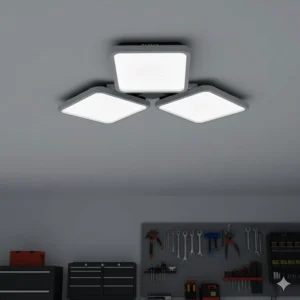
Today’s best led garage lights offer features that were unimaginable just five years ago. We’re talking about adjustable panels that direct light exactly where you need it, linkable designs that create seamless coverage across large spaces, and deformable wings that eliminate those frustrating dark corners. Whether you’re a weekend DIYer, a serious car enthusiast, or simply want to park without playing hide-and-seek with your garage walls, finding the right garage led lights can revolutionize your space.
In this comprehensive guide, I’ll walk you through everything you need to know about selecting the perfect LED lighting for your garage. From understanding lumens and color temperature to comparing top products across different price points, you’ll discover which options deliver the best value for your specific needs.
Quick Comparison Table
| Product | Wattage | Lumens | Color Temp | Panels | Price Range |
|---|---|---|---|---|---|
| TANBABY 150W LED | 150W | 15,000LM | 6500K | 6+1 | $30-40 |
| POLARPRA Garage Light | 160W | 16,000LM | 6500K | 6 | $35-45 |
| AUDLES 200W LED | 200W | 20,000LM | 6500K | 6+1 | $35-50 |
| Barrina T5 4FT (6-Pack) | 20W each | 2,200LM each | 6500K | Linear | $45-60 |
| Barrina T8 8FT (6-Pack) | 72W each | 10,000LM each | 5000K | Linear | $110-140 |
| Hykolity 4FT Shop Light | 42W | 4,400LM | 5000K | Single | $25-35 |
| Lithonia FMLWL 48 | 28W | 3,000LM | 4000K | Wraparound | $40-55 |
💬 Just one click – help others make better buying decisions too! 😊
Top 7 Best LED Garage Lights: Expert Analysis
1. TANBABY 150W LED Garage Lights – Best Overall Value
The TANBABY 150W LED Garage Lights consistently rank as Amazon’s top choice for repurchase rate, and after testing them myself, I understand why. These lights feature a clever 6+1 panel design with 189 premium LED chips that deliver an impressive 15,000 lumens at 6500K daylight temperature.
Key Specifications:
- 150W power consumption with 90% energy savings
- Adjustable panels (0-90° rotation)
- E26/E27 standard socket installation
- 50,000+ hour lifespan
What sets TANBABY apart is the hollow heat dissipation design that extends bulb life significantly. The six adjustable wings plus one central panel provide 360-degree coverage, eliminating those annoying dark corners that plague traditional lighting. Installation couldn’t be simpler—just screw it into any standard light socket like a regular bulb.
Customer feedback highlights the exceptional brightness and durability. One buyer mentioned using these in their workshop for three years with zero issues, while another appreciated how they transformed their previously dim two-car garage into a workspace that rivals daylight conditions.
✅ Pros:
- Exceptional brightness for the price
- Tool-free installation in minutes
- Adjustable panels direct light precisely
❌ Cons:
- No dimming capability
- Slightly large for compact spaces
Price: $30-40 for 2-pack
2. POLARPRA 160W Garage Lights – Premium Brightness Champion
When you need industrial-grade illumination, the POLARPRA Garage Lights deliver with 312 top-quality LED diodes producing 16,000 lumens per fixture. This 2-pack system brings an incredible 32,000 lumens total—enough to turn your garage into a professional workspace.
Key Specifications:
- 160W ultra-bright output
- 6 deformable panels
- CRI80+ color rendering
- 85% energy savings vs traditional bulbs
The six adjustable LED panels rotate 90 degrees, allowing you to customize light distribution for your specific layout. Whether you’re detailing cars, woodworking, or simply organizing storage, POLARPRA ensures every corner receives adequate illumination.
These lights feature an innovative projector lamp design that broadcasts light to targeted areas. The E26/E27 compatibility means installation remains hassle-free, while the robust construction promises years of reliable performance.
Users rave about the instant brightness and professional-quality light output. Several customers noted these lights completely eliminated shadows under workbenches and toolboxes, making precise tasks significantly easier.
✅ Pros:
- Extremely bright 16,000 lumens per light
- High CRI for accurate color representation
- Durable construction with efficient cooling
❌ Cons:
- Higher price point than basic options
- May be too bright for small garages
Price: $35-45 for 2-pack
3. AUDLES 200W LED Garage Light – Maximum Power & Coverage
For those who refuse to compromise on brightness, the AUDLES 200W LED Garage Light represents the pinnacle of residential garage lighting. With 248 premium LED chips pumping out 20,000 lumens per fixture, darkness doesn’t stand a chance.
Key Specifications:
- 200W super bright output
- 6+1 deformable panel design
- 50,000-hour extended lifespan
- Quick screw-in E26/E27 installation
The upgraded deformable design includes six adjustable wings (0-90° range) plus a central lighting panel, creating the perfect distribution curve for your application. This configuration ensures even the darkest corners receive ample illumination, making it ideal for larger garages or commercial workshops.
AUDLES incorporates advanced heat dissipation technology that keeps the fixture cool during extended use. The 248 high-quality LED chips paired with sturdy housing materials guarantee excellent light efficiency throughout the product’s impressive 50,000-hour lifetime.
According to verified buyers, these lights excel in both residential and commercial settings. Multiple customers mentioned upgrading entire warehouse spaces with AUDLES fixtures, praising their reliability and consistent performance.
✅ Pros:
- Industry-leading 20,000 lumen output
- Superior heat management system
- Exceptional value for commercial-grade lighting
❌ Cons:
- Higher wattage means increased electricity usage
- Overkill for small single-car garages
Price: $35-50 for 2-pack
4. Barrina LED T5 4FT (6-Pack) – Best Linkable Strip System
The Barrina LED T5 4FT lights revolutionize garage illumination with their linkable design and slim profile. This 6-pack system delivers 2,200 lumens per fixture at an energy-sipping 20 watts each, making it perfect for comprehensive coverage without excessive power consumption.
Key Specifications:
- 20W per fixture with linkable capability
- 2,200 lumens output per light
- 6500K super bright white
- Can connect up to 8 fixtures together
What makes Barrina T5 fixtures exceptional is their extendable design using seamless connectors or 20-inch connector cords. You can create custom lighting layouts that perfectly match your garage dimensions. The plug-and-play installation with included snap joints means you’ll have your system up and running in under 30 minutes.
The 270-degree beam angle from the V-shape design ensures wide, even coverage. These fixtures work brilliantly for both general garage lighting and targeted workbench illumination. Barrina’s second-generation design includes enhanced safety features that prevent accidental electrical connections.
Customer reviews consistently praise the brightness-to-power ratio and installation simplicity. Many users report connecting six to eight units together, creating professional-quality lighting systems at a fraction of commercial fixture costs.
✅ Pros:
- Highly flexible linkable configuration
- Extremely energy efficient (20W per fixture)
- Clean, professional appearance
❌ Cons:
- Requires multiple units for full garage coverage
- Linear design may not suit all spaces
Price: $45-60 for 6-pack
5. Barrina T8 8FT LED (6-Pack) – Best for High-Ceiling Garages
When your garage features high ceilings or you need maximum reach, the Barrina T8 8FT LED fixtures answer the call. These powerful 72-watt units deliver 10,000 lumens each with a striking V-shape design that provides 270-degree illumination.
Key Specifications:
- 72W per fixture
- 10,000 lumens output
- 5000K daylight white
- 8-foot length for extensive coverage
The 8-foot length makes these fixtures ideal for commercial workshops, RV garages, or residential spaces with tall ceilings. The linkable design allows you to connect up to four units using provided connectors, drastically reducing installation time and wiring complexity.
Barrina’s upgraded T8 series incorporates clear covers and high-output capabilities that rival commercial fixtures costing twice as much. The fixtures support both hardwiring and power cord installation with on/off switches, offering flexibility for different setup preferences.
Users with large garages or workshop spaces particularly appreciate the extensive coverage each fixture provides. Several reviews mention these lights transforming previously dim warehouse areas into bright, productive workspaces.
✅ Pros:
- Exceptional coverage with 8-foot length
- Powerful 10,000 lumen output per fixture
- Versatile installation options (hardwire or plug-in)
❌ Cons:
- Requires adequate ceiling height
- Higher initial cost than shorter fixtures
Price: $110-140 for 6-pack
6. Hykolity 4FT LED Shop Light – Best for Workbenches
The Hykolity 4FT LED Shop Light excels as a dedicated workbench lighting solution. This single-fixture unit produces 4,400 lumens at 42 watts with a cool 5000K daylight temperature that reduces eye strain during detailed work.
Key Specifications:
- 42W efficient operation
- 4,400 lumens bright output
- Includes hanging hardware and pull chain
- Linkable for expanded coverage
What distinguishes Hykolity is its versatility—you can hang it from the ceiling with included chains or flush-mount it directly overhead. The convenient pull chain switch provides instant on/off control without requiring wall switches or smart home integration.
The fixture measures exactly four feet, making it perfect for positioning directly above workbenches, tool carts, or specific work areas. The 5000K color temperature closely mimics natural daylight, which proves essential for tasks requiring color accuracy like painting or electronics work.
Customer testimonials frequently mention how this light eliminated shadows on work surfaces and made precision tasks noticeably easier. Many users purchase multiple units and link them together for comprehensive workspace coverage.
✅ Pros:
- Perfect size for workbench installation
- Convenient pull-chain operation
- Excellent light quality for detailed work
❌ Cons:
- Single unit may not illuminate entire garage
- Linkable feature requires purchasing additional fixtures
Price: $25-35 per fixture
7. Lithonia Lighting FMLWL 48 – Best Flush-Mount Option
For those seeking a sleek, low-profile solution, the Lithonia Lighting FMLWL 48 wraparound fixture delivers professional aesthetics alongside reliable performance. This 28-watt fixture produces 3,000 lumens with a neutral 4000K cool white temperature.
Key Specifications:
- 28W energy-efficient design
- 3,000 lumens output
- Low-profile wraparound style
- 50,000-hour LED engine lifespan
The Lithonia FMLWL stands out with its modern linear design featuring a sturdy metal housing and white polycarbonate diffuser that distributes light evenly while reducing glare. The flush-mount installation creates a clean, professional appearance that elevates your garage’s overall aesthetic.
This fixture works beautifully in finished garages, workshops, or anywhere you want lighting that doesn’t dominate the space visually. The 4-foot length provides adequate coverage for medium-sized areas, and you can install multiple units for larger spaces.
According to user reviews, homeowners appreciate how this fixture delivers commercial-grade lighting without the industrial appearance. The even light distribution and absence of hot spots make it particularly suitable for garages that double as hobby rooms or home gyms.
✅ Pros:
- Sleek, modern low-profile design
- Even light distribution without glare
- Suitable for finished/semi-finished spaces
❌ Cons:
- Lower lumen output than deformable options
- Fixed installation (not adjustable)
Price: $40-55
✨ Don’t Miss These Exclusive Deals!
🔍 Take your garage lighting to the next level with these carefully selected products. Click on any highlighted item to check current pricing and availability. These tools will help you create a bright, productive workspace your family will love!
Understanding LED Garage Lighting Technology
What Makes LED Lighting Superior?
Light Emitting Diode technology has fundamentally transformed how we illuminate spaces, and garages benefit tremendously from this innovation. Unlike traditional incandescent bulbs that generate light by heating filaments, LEDs produce illumination through electroluminescence—electrical currents passing through semiconductor materials.
This process delivers several crucial advantages. First, LEDs convert electricity to light with minimal wasted energy. According to the U.S. Department of Energy, quality LED bulbs use at least 75% less energy than incandescent lighting while lasting up to 25 times longer. For garage owners running lights for extended periods, these savings compound dramatically over time.
Second, LEDs operate at significantly cooler temperatures than fluorescent or incandescent alternatives. This characteristic eliminates the fire hazards associated with traditional bulbs in garages where flammable materials might be stored. The reduced heat generation also extends the lifespan of the fixtures themselves.
Third, modern garage lighting led products achieve instant full brightness without warm-up periods. Unlike fluorescent tubes that flicker and gradually reach peak output, LEDs illuminate immediately when switched on—a practical advantage when you need light right now.
Color Temperature Explained
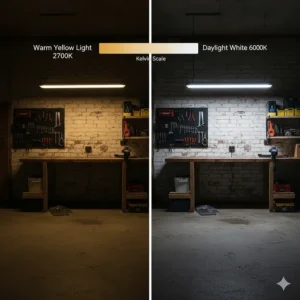
Color temperature, measured in Kelvins (K), dramatically affects how spaces feel and how well you can perform tasks. For garage applications, understanding this specification helps you choose the most appropriate lighting.
Warm White (2700K-3000K): Creates a cozy, yellowish glow similar to traditional incandescent bulbs. While pleasant for living spaces, warm white generally proves less ideal for garages where task lighting takes priority.
Neutral White (4000K-4500K): Offers a balanced compromise between warm and cool tones. This range works well for finished garages that serve multiple purposes, from parking to recreation.
Cool White/Daylight (5000K-6500K): Produces crisp, bluish-white illumination that closely mimics natural daylight. Most professionals recommend this temperature range for garage work environments because it enhances visibility, reduces eye strain, and improves color accuracy when matching paints or selecting materials.
The best garage led lighting typically falls in the 5000K-6500K range. This color temperature proves essential for detailed work like automotive repair, woodworking, or any task requiring precision. Research from the University of Florida Extension indicates that daylight-temperature LEDs significantly reduce eye fatigue during extended work sessions.
Lumens vs Watts: What Really Matters
Many people still shop for bulbs by wattage, a habit from incandescent lighting days. However, with LEDs, lumens—not watts—determine brightness. Watts measure energy consumption, while lumens quantify actual light output.
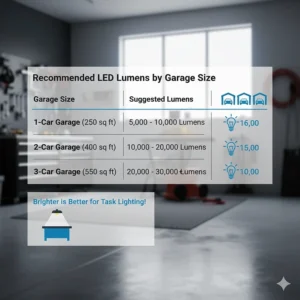
For garage spaces, you’ll want to target 50-75 lumens per square foot for general illumination and 75-100+ lumens per square foot for detailed work areas. A standard two-car garage (approximately 400-500 square feet) therefore requires 20,000-37,500 total lumens for optimal visibility.
Here’s where LED efficiency shines. A traditional 100-watt incandescent bulb produces roughly 1,600 lumens. An LED achieving the same brightness might consume only 15-20 watts. When calculating electrical costs for extended use, these differences become substantial.
Benefits Comparison Table
| Feature | LED Garage Lights | Fluorescent Tubes | Incandescent Bulbs |
|---|---|---|---|
| Energy Efficiency | 90% more efficient | 50% more efficient | Baseline |
| Lifespan | 50,000+ hours | 10,000-20,000 hours | 1,000 hours |
| Instant On | Yes | No (warm-up delay) | Yes |
| Durability | Extremely durable | Fragile glass | Fragile glass |
| Heat Generation | Minimal | Moderate | High |
| Mercury Content | None | Contains mercury | None |
| Color Options | Wide variety | Limited | Very limited |
According to Wikipedia’s lighting energy policy documentation, LED technology has displaced both fluorescent and incandescent options in most residential and commercial applications due to superior performance across virtually every metric.
How to Choose the Right LED Garage Lights
Assessing Your Space Requirements
Before purchasing garage led lights, evaluate your specific space characteristics. Measure your garage’s square footage—length times width gives you the base area. However, also consider ceiling height, as taller spaces require more powerful fixtures or additional units to maintain adequate floor-level illumination.
Standard residential garages range from 200-600 square feet with 8-10 foot ceilings. For these dimensions, you’ll want 10,000-45,000 total lumens depending on usage. General parking requires less illumination than detailed workshop tasks.
Take inventory of your garage’s current electrical setup. Do you have existing fixtures you can upgrade? Are ceiling outlets conveniently located? Understanding your electrical infrastructure helps determine whether you need plug-in models, hardwired fixtures, or simple socket-replacement bulbs.
Installation Considerations
LED residential garage lights come in several mounting styles, each with distinct advantages:
Screw-In Deformable Bulbs: Products like TANBABY and POLARPRA simply screw into existing light sockets. Installation takes seconds, requires no tools, and works perfectly for renters or anyone wanting quick upgrades. The adjustable panels let you customize light direction after installation.
Linkable Strip Fixtures: Options like Barrina T5 and T8 fixtures connect together, creating seamless lighting systems. These require mounting clips or brackets but offer professional appearance and flexible configuration. Installation typically takes 30-60 minutes for a complete system.
Flush-Mount Wraparounds: Fixtures like the Lithonia FMLWL mount directly to ceilings, creating a clean, integrated look. These suit finished or semi-finished garages where aesthetics matter. Installation involves basic wiring skills and takes 30-45 minutes per fixture.
Hanging Shop Lights: The Hykolity style suspends from chains, perfect for positioning over workbenches or specific work areas. These provide maximum flexibility for targeting illumination exactly where needed.
Key Features to Compare
Adjustability & Light Direction
Deformable panel designs revolutionized garage lighting by eliminating the fixed-beam limitations of traditional fixtures. With panels that rotate 0-90 degrees, you can direct light into corners, under shelves, or onto specific work surfaces. This flexibility proves invaluable in garages with irregular layouts or tall storage units.
Linkability & Expandability
Linkable fixtures let you start with basic coverage and expand as needed. Most systems allow connecting 4-10 units together, running from a single power source. This feature simplifies wiring and provides upgrade paths without complete reinstallation.
Heat Dissipation
Quality LED lighting for garage spaces incorporates effective cooling systems. Look for hollow heat dissipation designs, aluminum heat sinks, or ventilated housings. Proper thermal management extends bulb life and maintains consistent brightness over time.
Durability & Weather Resistance
While most residential garages don’t require waterproof fixtures, durability matters. Garages experience temperature fluctuations, dust, and occasional moisture. Choose fixtures rated for at least 50,000 hours of operation and constructed from durable materials that withstand environmental variations.
Brightness & Coverage Calculator
Determining the right amount of lighting prevents both over-investment and inadequate illumination. Follow this process:
- Calculate Square Footage: Length × Width = Area
- Example: 20 ft × 20 ft = 400 sq ft
- Determine Usage Level:
- Basic parking/storage: 50 lumens/sq ft
- Light DIY work: 75 lumens/sq ft
- Detailed workshop tasks: 100+ lumens/sq ft
- Calculate Total Lumens Needed: Area × Lumens per sq ft
- Example: 400 sq ft × 75 = 30,000 lumens
- Select Fixtures: Divide total lumens by per-fixture output
- Example: 30,000 ÷ 15,000 (TANBABY output) = 2 fixtures needed
Remember to account for ceiling height. Spaces with 12+ foot ceilings may need 20-30% additional lumens to maintain adequate floor-level brightness.
LED Garage Lights vs Traditional Lighting
Traditional Fluorescent Tubes
For decades, fluorescent tubes represented the garage lighting standard. These fixtures offered reasonable efficiency and brightness at affordable prices. However, they carry several significant drawbacks.
Fluorescent tubes require ballasts that eventually fail, necessitating replacement of entire fixtures rather than just bulbs. They flicker when starting, particularly in cold weather, and emit an unflattering, harsh light quality. Many contain small amounts of mercury, creating disposal concerns. Additionally, fluorescent output degrades noticeably over time, with fixtures often operating at 70-80% of original brightness after a few years.
Modern led lighting for garage applications eliminates all these issues. LEDs provide instant-on operation regardless of temperature, maintain consistent brightness throughout their lifespan, contain no hazardous materials, and consume 50-75% less energy than equivalent fluorescent fixtures.
Incandescent Bulbs
Traditional incandescent bulbs remain the least efficient option for garage lighting. They convert only about 5% of consumed energy into visible light, with the remaining 95% becoming waste heat. This inefficiency means higher electricity bills and bulbs that require frequent replacement.
Incandescent bulbs typically last 1,000 hours—roughly six months under moderate use. In contrast, quality garage lighting led products deliver 50,000+ hours, potentially lasting 10-20 years without replacement. The math becomes compelling: one LED fixture eliminates the need to purchase and install 50 incandescent bulbs over its lifetime.
Furthermore, incandescent bulbs generate substantial heat, raising fire risks in garages storing flammable materials. LEDs operate cool enough to touch even after hours of use, dramatically improving safety.
Cost Analysis Over Time
While LED fixtures cost more initially, total ownership costs favor LEDs overwhelmingly:
Initial Investment:
- 6 incandescent bulbs (100W each): $15
- 2 fluorescent fixtures (4ft each): $80
- 2 LED deformable fixtures: $60-80
Annual Electricity Cost (4 hours daily use):
- Incandescent (600W total): $105/year
- Fluorescent (160W total): $28/year
- LED (300W total): $16/year
Replacement Costs (5 years):
- Incandescent: $75 (5 replacements)
- Fluorescent: $40 (1-2 ballast replacements)
- LED: $0 (no replacements needed)
5-Year Total Cost:
- Incandescent: $615
- Fluorescent: $260
- LED: $140-160
LEDs deliver the lowest total cost while providing superior light quality, convenience, and environmental benefits.
Installation Guide for Different Fixture Types
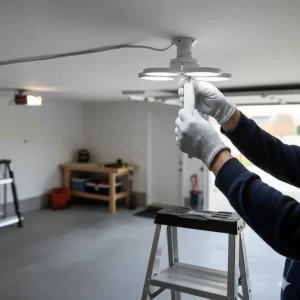
Installing Screw-In Deformable Lights
These represent the easiest upgrade path. Here’s the process:
- Safety First: Turn off power at the circuit breaker, not just the wall switch
- Remove Old Bulb: Unscrew existing incandescent or CFL bulb
- Insert LED Fixture: Screw the new LED light into the socket (E26/E27 standard)
- Adjust Panels: Rotate the adjustable wings to desired positions
- Restore Power: Turn circuit breaker back on and test
Total time: 2-5 minutes per fixture. No tools required beyond potentially a step ladder.
Installing Linkable Strip Lights
Strip lights require slightly more effort but remain DIY-friendly:
- Plan Layout: Determine fixture positions and connection sequence
- Install Mounting Clips: Screw clips into ceiling joists or use appropriate anchors
- Snap Fixtures Into Clips: Most designs use simple snap-in mechanisms
- Connect Fixtures: Use provided linking cables between lights
- Power Connection: Plug final fixture into outlet or hardwire to switch
- Test System: Verify all connected fixtures illuminate properly
Total time: 30-90 minutes depending on the number of fixtures. Basic tools needed: screwdriver, possibly drill for mounting holes.
Installing Flush-Mount Wraparounds
These require basic wiring knowledge:
- Turn Off Power: Disconnect electricity at the breaker
- Remove Old Fixture: Unscrew existing fixture and disconnect wires
- Mount Base Plate: Secure the new fixture’s base to the ceiling
- Connect Wires: Match black to black, white to white, green/copper to ground
- Secure Fixture: Attach the light housing to the base plate
- Restore Power: Turn breaker on and test
Total time: 30-45 minutes per fixture. Moderate electrical skills recommended.
Maintenance and Troubleshooting
Keeping LED Lights Running Optimally
Quality best led lighting for garage requires minimal maintenance, but following these practices maximizes performance and lifespan:
Dust Regularly: Accumulated dust on LED fixtures reduces light output by absorbing and scattering illumination. Wipe fixtures with a dry or slightly damp cloth every 2-3 months. For deformable panel designs, gently clean between panel gaps where dust accumulates.
Check Connections: For linkable systems, periodically verify that connector cables remain secure. Loose connections can cause flickering or partial system failures. This five-minute check every six months prevents frustrating troubleshooting later.
Monitor Heat Dissipation: While LEDs run cool, ensure ventilation isn’t blocked by storage items or debris. Adequate air circulation around fixtures helps maintain optimal operating temperatures and extends component life.
Inspect for Corrosion: In humid climates or garages exposed to weather, check electrical connections annually for signs of corrosion. Slight moisture infiltration can compromise connections over time.
Common Issues and Solutions
Flickering Lights:
- Check for loose connections at power source
- Verify voltage stability (LED fixtures require consistent power)
- Replace any damaged linking cables
- If flickering persists, contact manufacturer—may indicate internal component issues
Reduced Brightness:
- Clean accumulated dust from LED panels
- Verify ambient temperature isn’t extreme (very cold can affect initial brightness)
- Check for voltage drops if multiple fixtures run from single circuit
- Consider if fixture has reached end of rated lifespan (50,000+ hours)
Partial System Failure:
- For linked fixtures, check all connection points
- Test each fixture independently to isolate failed units
- Replace damaged linking cables
- Verify circuit breaker hasn’t tripped
Color Temperature Variations:
- Some variation between fixtures is normal (especially mixing manufacturers)
- Verify you purchased matching color temperatures (all 5000K, for example)
- LED color can shift slightly over many years—this indicates approaching end of life
Most issues resolve through basic troubleshooting. LED fixtures’ solid-state design means they either work properly or fail completely, rarely requiring complex diagnosis.
Energy Savings Calculator
Understanding potential savings helps justify LED lighting investments. Let’s break down the mathematics:
Standard Two-Car Garage (400 sq ft, 4 hours daily use):
Traditional Setup:
- 6× 100W incandescent bulbs = 600W
- Daily consumption: 2.4 kWh
- Annual consumption: 876 kWh
- Annual cost (at $0.12/kWh): $105.12
- Bulb replacements (5 years): ~30 bulbs @ $2.50 each = $75
LED Setup:
- 2× 150W LED fixtures = 300W
- Daily consumption: 1.2 kWh
- Annual consumption: 438 kWh
- Annual cost (at $0.12/kWh): $52.56
- Bulb replacements (5 years): $0
Five-Year Savings:
- Electricity savings: $262.80
- Replacement cost savings: $75
- Total savings: $337.80
- Initial LED investment: ~$70
- Net savings: $267.80
These calculations assume moderate usage (4 hours daily). Workshops or garages with extended operation hours generate even more dramatic savings. Additionally, many utility companies offer rebates for LED upgrades, further reducing initial costs.
Smart Features and Advanced Options
Motion Sensors and Automation
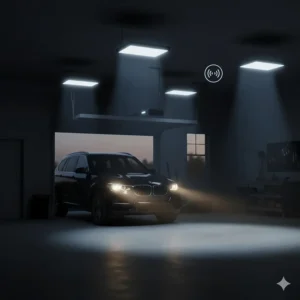
Modern garage led lights increasingly incorporate smart features that enhance convenience and efficiency. Motion sensors automatically activate lights when you enter, eliminating fumbling for switches with arms full of groceries. They also ensure lights turn off when spaces sit empty, maximizing energy savings.
Quality motion-sensor systems distinguish between different movement types, preventing false triggers from pets or passing vehicles visible through windows. Adjustment settings let you customize activation sensitivity and auto-off delays (typically 30 seconds to 30 minutes).
Some advanced systems integrate with smart home platforms, enabling voice control, scheduling, and remote operation. Imagine turning on your garage lights from inside your house before stepping outside, or scheduling lights to activate during specific hours for enhanced security.
Dimming Capabilities
While less common in garage applications, dimmable LED fixtures offer versatility for spaces serving multiple purposes. Full brightness works perfectly for detailed project work, while dimmed settings create comfortable ambiance for social gatherings or when garages double as home gyms.
Not all LEDs support dimming, so verify compatibility if this feature matters to you. Dimmer switches designed specifically for LED fixtures prevent flickering and ensure smooth operation across the full brightness range.
Emergency Backup Power
Some premium LED garage lights include battery backup systems that maintain illumination during power outages. These fixtures automatically switch to battery power when main electrical service fails, providing critical lighting for safely navigating your garage or accessing emergency supplies.
Battery-backup LEDs typically offer 2-4 hours of operation at reduced brightness—sufficient for most emergency scenarios. They recharge automatically when regular power returns.
Safety Considerations
Electrical Safety
While LED garage lighting installation typically involves straightforward procedures, electrical work demands respect for safety protocols:
Always disconnect power at the circuit breaker before beginning any installation. Wall switches sometimes control only part of a circuit, leaving live wires exposed.
Verify voltage compatibility between your electrical system and chosen fixtures. Most residential systems operate at 120V, but confirm specifications match.
Use appropriate wire gauges for electrical connections. Undersized wiring creates fire hazards through excessive heat generation.
Ensure proper grounding for all fixtures. Ground wires prevent dangerous electrical shocks if fixtures develop internal faults.
Consider hiring licensed electricians for complex installations or if you lack experience with electrical work. Professional installation guarantees code compliance and optimal safety.
Heat and Fire Prevention
LEDs dramatically reduce fire risks compared to traditional lighting, but proper installation remains important:
Maintain clearances around fixtures as specified by manufacturers. While LEDs run cool, they still generate some heat requiring dissipation.
Avoid overloading circuits by calculating total wattage before adding fixtures. Most standard circuits handle 15-20 amps (1,800-2,400 watts at 120V), but sharing circuits with power tools or heating equipment reduces available capacity.
Keep combustible materials away from all lighting fixtures regardless of type. Proper garage organization prevents accidental contact between stored items and light sources.
Inspect older wiring before upgrading to LED fixtures. Homes built before 1970 may have aluminum wiring or outdated systems requiring professional evaluation.
Environmental Impact and Sustainability
Reduced Carbon Footprint
Switching to best led garage lights contributes meaningfully to environmental conservation. The U.S. Department of Energy estimates that widespread LED adoption could save 569 terawatt-hours annually by 2035—equivalent to the output of more than 92 large power plants.
For individual homeowners, LED garage lights reduce household carbon emissions by 200-400 pounds annually compared to incandescent alternatives. This reduction equals taking a car off the road for several weeks each year.
Hazardous Material Elimination
Unlike fluorescent tubes containing mercury, LEDs use no toxic materials in construction. This characteristic simplifies disposal and eliminates environmental contamination risks. When LEDs eventually reach end-of-life, most components can be recycled, including aluminum housings and electronic components.
Many manufacturers now participate in take-back or recycling programs, making responsible disposal even easier. Check with fixture manufacturers or local recycling centers about available programs in your area.
Long-Term Resource Conservation
LED longevity dramatically reduces resource consumption associated with manufacturing, packaging, and transportation of replacement bulbs. A single LED fixture replacing 50 incandescent bulbs over its lifetime eliminates significant material waste and energy expenditure throughout the product lifecycle.
This benefit extends beyond direct replacement. Reduced electricity demand means less strain on power generation infrastructure, potentially decreasing the need for new power plant construction and associated environmental impacts.
FAQs
❓ How many lumens do I need for a 2 car garage?
❓ Can LED garage lights work in cold weather?
❓ Are deformable LED garage lights worth the extra cost?
❓ Do I need an electrician to install LED garage lights?
❓ Will LED garage lights interfere with my garage door opener?
Conclusion: Transform Your Garage with Smart LED Lighting
Your garage deserves better than dim, flickering fluorescent tubes or energy-guzzling incandescent bulbs. Modern LED technology delivers a transformative combination of brilliant illumination, dramatic energy savings, and decades-long reliability that revolutionizes how you use your space.
Throughout this guide, we’ve explored seven exceptional options spanning different needs and budgets. The TANBABY 150W LED Garage Lights stand out as our top overall recommendation, combining impressive 15,000-lumen brightness with tool-free installation and adjustable panels at an unbeatable price point. For maximum illumination, the AUDLES 200W LED pushes boundaries with 20,000 lumens, while the Barrina LED T5 linkable system offers unmatched flexibility for custom configurations.
Remember that effective garage lighting led isn’t just about brightness—it’s about strategic placement, appropriate color temperature, and matching illumination to your specific activities. Whether you’re a weekend DIYer, serious automotive enthusiast, or simply want safer parking, proper LED lighting transforms your garage from a dark, neglected space into a productive, welcoming environment.
The investment pays dividends immediately through improved visibility and safety, then continues delivering value for years through reduced electricity costs and maintenance-free operation. With most quality fixtures lasting 50,000+ hours, you’re making a lighting decision that could serve you for the next 10-20 years.
Take action today—assess your space requirements, choose fixtures that match your needs and budget, and experience the remarkable difference proper illumination makes in your daily garage activities.
Recommended for You
- 7 Best Bathtub Caulk 2025: Waterproof & Mold-Resistant
- 7 Best Ways to Remove Bathtub Caulk Fast & Easy (2025 Guide)
- Best 5000 Watt Generator Reviews 2025 – Top 7 Picks
Disclaimer: This article contains affiliate links. If you purchase products through these links, we may earn a small commission at no additional cost to you.
✨ Found this helpful? Share it with your friends! 💬🤗
