

In This Article
A moisture meter for wood flooring is a handheld tool that estimates the percentage of water inside wood boards and subfloor panels. Pin models read electrical resistance between two probes, while pinless models scan with an electromagnetic sensor pad. Installers use the numbers to confirm flooring and subfloor sit within manufacturer and National Wood Flooring Association (NWFA) tolerances before installation.

Wood is hygroscopic, which is a fancy way of saying it drinks from the air. Lay boards that are too wet over a subfloor that’s too dry (or the reverse) and the floor spends its first year negotiating the difference in public: cupped edges, open seams, a crown down the middle of the hallway. The fix costs a few hundred dollars of tooling. The failure can cost the price of the floor.
The difference between pin and pinless meters matters more than the logo on the case, because both infer water content indirectly from electrical behavior. This guide ranks seven real meters, translates their specs into jobsite meaning, and covers the craft around them: hardwood installation prep, the subfloor moisture testing tool question, humidity damage, and flooring warranty requirements.
One transparency note. I haven’t bench-tested these units. Everything below comes from manufacturer specifications, trade-press reporting and aggregated review themes. Prices are ranges, so check current pricing before you buy a wood moisture meter for flooring.
Quick Comparison: 7 Moisture Meters for Wood Flooring at a Glance
Short on time? This snapshot sorts the field by method, depth and budget. Retail numbers move weekly, so you’ll only see ranges.
| Meter | Method | Sensing Depth | Typical Price Range | Best For |
|---|---|---|---|---|
| Wagner Orion 950 | Pinless, dual depth | About ¼” and ¾” | $540-$650 | Pros who want EMC and job logs |
| Wagner Orion 910 | Pinless, deep | About ¾” | $390-$440 | Subfloor and thick-stock scanning |
| Delmhorst BD-2100 | Pin | 5/16″ pins (electrodes go deeper) | $350-$500 | Installers who prefer resistance readings |
| Lignomat mini-Ligno E/D | Pin | 3/16″ or 7/16″ pins | $100-$200 (family range) | Compact second opinion |
| Extech MO55A | Pin + pinless | Pinless to about 1″ | $120-$165 | DIYers who want both methods |
| Klein Tools ET140 | Pinless | ¾” | Under $60 | Fast scanning on a tight budget |
| General Tools MMD4E | Pin | Short contact pins | Under $60 | Cheap backup pin readings |
Looking at the comparison above, the Wagner Orion 950 is the all-in-one choice for professionals, while the Wagner Orion 910 is the sharper pick if subfloor scanning is your main chore. Budget buyers get the most flexibility from the Extech MO55A, and the Lignomat mini-Ligno E/D is the compact pin option I’d reach for first. The Klein Tools ET140 and General Tools MMD4E both sit under $60, but they work best as scanners and backups rather than paperwork-grade instruments.
💬 Just one click — help others make better buying decisions too!😊
Top 7 Moisture Meters for Wood Flooring: Expert Analysis
Here are the seven meters, ranked by how well they serve the widest range of flooring jobs. Every price is a range, so check current pricing before you buy.
1. Wagner Orion 950 — measures the wood and the room around it
The Wagner Orion 950 is the rare meter that checks the boards and the air they’ll live in. A built-in temperature and relative humidity sensor feeds an on-board equilibrium moisture content (EMC) calculator. You get a target number for that specific room instead of a vague “6%-9% is probably fine” guess.
Dual-depth pinless sensing (roughly ¼ inch and ¾ inch) means one tool can scan thin finished flooring and thicker subfloor panels. Bluetooth syncing to Wagner’s FloorSmart app logs readings by job, which is exactly the paper trail a warranty claim wants. The 7-year warranty and included on-demand calibrator (a quick on-site accuracy check) back up the premium positioning.
Based on the spec comparison, no other meter in this round-up links the reading, the ambient conditions and the documentation in one device. That’s a gift for installers and owners of expensive wide plank. It’s overkill for a single bedroom.
Trade-press and woodworking reviewers consistently praise easy species setup and dependable repeatability. Wagner’s own storefront shows high averages across the Orion line, though that’s a manufacturer-run review pool.
Pros:
- ✅ EMC calculator plus built-in temperature and humidity sensor
- ✅ Dual-depth pinless scanning leaves no marks
- ✅ App logging and 7-year warranty support documentation
Cons:
- ❌ Premium price is hard to justify for one project
- ❌ Feature depth means a longer learning curve
Price range: roughly $540-$650, which pays off if you test floors regularly.
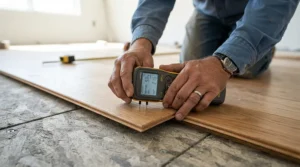
2. Wagner Orion 910 — deep scanning for subfloors and thick stock
The Wagner Orion 910 reads about ¾ inch (19 mm) into the material. Wagner positions it for stock roughly ¾ to 1½ inches thick, which makes it a natural subfloor scanner. It replaced the older MMC220, keeping the deep-depth IntelliSense sensing at a lower price.
Pinless means no pinholes. Because the sensor averages across a patch of material, you can sweep a plywood or OSB subfloor and watch the display drift instead of stabbing twenty separate holes. A backlit screen, rubber boot, foam-lined case, species booklet and the same 7-year warranty round out the kit.
Here’s what the spec sheet won’t tell you outright: that deep sensing window is a strength on subfloors and a mismatch for thin finished boards. A shallow or dual-depth Orion is the cleaner fit there. If your job is proving a subfloor is ready, this is the sharper tool. If you also grade flooring stock, budget for dual depth.
A verified-owner comment on a Wagner retailer page describes abandoning a pin meter that gave varying numbers on identical lumber. Independent review volume is modest, so the signal is positive but thin.
Pros:
- ✅ Deep pinless sensing suits plywood and OSB subfloors
- ✅ No pinholes and fast sweeps across large areas
- ✅ Same 7-year warranty and calibrator as pricier Orions
Cons:
- ❌ Deep window is a poor match for thin finished boards
- ❌ Costs several times more than entry pinless scanners
Price range: roughly $390-$440, fair for pros and steep for a weekend project.
3. Delmhorst BD-2100 — pin accuracy with a built-in calibration check
Resistance meters measure what wood does electrically between two pins, and the Delmhorst BD-2100 is a long-standing U.S.-made example. Its wood scale runs 6%-40%, which covers the single-digit territory flooring lives in. The 5/16-inch contact pins reach past surface effects, and a set-point alarm beeps when a reading crosses your limit.
It also averages up to 100 stored readings and includes a built-in calibration check. That’s handy because NWFA-style testing means roughly 20 readings per 1,000 square feet that you’ll average anyway.
Weigh the tradeoff. Pin readings suit board backs and subfloor panels, but they leave tiny holes. Species and temperature corrections come from charts in the manual rather than being built in, which is accurate if you’re disciplined and tedious if you’re not.
Review coverage is thinner than for Wagner. Trade-press and installer-oriented write-ups describe it as a durable, all-purpose contractor meter, so check recent owner reviews at the retailer.
Pros:
- ✅ Direct resistance readings on a 6%-40% wood scale
- ✅ Averaging memory and calibration check speed up testing
- ✅ Set-point alarm flags out-of-range readings
Cons:
- ❌ Manual species and temperature corrections
- ❌ One-year warranty is short versus Wagner’s seven
Price range: roughly $350-$500 depending on package, a good value for pin purists.
4. Lignomat mini-Ligno E/D — pocket-size pin meter low enough for floors
Lignomat built the Lignomat mini-Ligno E/D around a simple promise. The measuring range reaches down to 6% (low enough for hardwood floors) in a body small enough for a shirt pocket. Two pin lengths, 3/16 inch and 7/16 inch, let you switch between surface and slightly deeper readings.
Two wood-group settings correct the reading for broad species families. That’s coarser than a full species list but better than none. The 2-year warranty (lifetime on the display) and automatic shutoff add practicality. Lignomat notes readings grow less reliable above the fiber saturation point near 25%, which hardly matters when your target band is 6%-12%.
This one fits DIYers and small installers who want a trustworthy second opinion that costs far less than a professional pinless unit. For thick-stock core readings you’d step up to a mini-Ligno C model with a slide-hammer electrode, not this one.
Owner reviews on retailer listings describe it as accurate on hardwoods, sturdy and portable. Recurring nitpicks are that the pins don’t feel especially robust and that readings depend on wood temperature.
Pros:
- ✅ Pocket-size body with two pin depths included
- ✅ Range reaches 6%, low enough for flooring
- ✅ 2-year warranty and lifetime display coverage
Cons:
- ❌ Only two wood-group corrections
- ❌ Pins can feel delicate with rough use
Price range: roughly $100-$200 for the mini-Ligno family, a strong mid-value pin pick.
5. Extech MO55A — pin and pinless in one backlit body
If you can’t decide between pin and pinless, the Extech MO55A makes you stop deciding. It replaces the discontinued MO55 and pairs replaceable 8 mm pins with a pinless pad that reads up to about 1 inch deep, behind a backlit color LCD.
Pin mode covers 5%-50% on wood, wide enough for flooring. Pinless mode gives relative readings, a comparison tool rather than a calibrated percentage. In practice, you can scan a subfloor in pinless mode to spot hot zones, then confirm suspects with the pins. It runs on three AAA batteries and carries a 2-year warranty.
This is right for a DIYer who wants to follow cross-check habits without buying two meters. It isn’t a pro instrument, and the pinless number shouldn’t be compared directly to NWFA tolerance figures.
The most detailed independent review I found covered the earlier MO55. The writer found pin readings close to a pricier reference meter but noted the cone-shaped pins didn’t hold themselves in the wood, so steady pressure mattered. Treat that as guidance for the Extech MO55A, not proof.
Pros:
- ✅ Pin and pinless modes in a single meter
- ✅ Pin range of 5%-50% suits flooring work
- ✅ Replaceable pins and 2-year warranty
Cons:
- ❌ Pinless readings are relative, not true percentages
- ❌ Earlier-model review flagged pin stability issues
Price range: roughly $120-$165, which is good value for a first dual-mode meter.
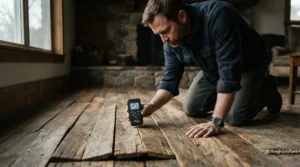
6. Klein Tools ET140 — fast no-hole scanning on a short budget
The Klein Tools ET140 is a pinless scanner with a ¾-inch sensing depth, a nine-LED bar graph, a 6.6-foot drop rating and a mode button for drywall, masonry, hardwood and softwood. Klein describes the output as relative moisture, with accuracy rated at ±4%.
Here’s the catch. That ±4% matches the entire NWFA tolerance window for strip flooring. Use this meter to hunt for wet spots and compare a leak zone with a dry zone, not to prove compliance.
For a homeowner mapping a dishwasher leak or checking a floor above a damp basement, it’s an easy first purchase. As the sole instrument on a documented install, it’s the wrong tool.
Home Depot’s listing carries a few hundred reviews, and Lowe’s summary calls feedback mixed. Buyers praise ease of use and quick leak-finding, while some report inconsistent results.
Pros:
- ✅ Non-marring pinless scanning to ¾ inch
- ✅ Nine-LED bar graph is easy to read
- ✅ Drop-rated body for rough jobsites
Cons:
- ❌ Relative readings, not calibrated percentages
- ❌ Only broad hardwood and softwood modes
Price range: under $60, excellent value as a scanner and weak value as your only meter.
7. General Tools MMD4E — the cheapest way to get true pin readings
The General Tools MMD4E is the bargain entry for resistance readings, with a backlit LCD, audible alerts and replaceable pins (the PIN3 set) in a roughly 4-ounce body. Retail listings quote about 3% accuracy at 0.1% resolution. The advertised wood range differs by listing (some say 5%-50%, others 8%-30%), so confirm against the manual before trusting numbers near the low end flooring cares about.
Pin meters show a direct number rather than a color band, so you can compare it with the plank tolerance. The cost is pinholes, so test the backs of boards or subfloor panels, not the finished face. Correction uses low, medium and high groups rather than a species list.
It’s ideal as a cheap backup for a pinless scanner or a first-time DIY check, and weak as a documentation instrument. Walmart’s listing showed a 4.5-star average from about 18 reviews at the time of research. That’s a small sample, so treat it as a soft signal.
Pros:
- ✅ Lowest price among the pin options here
- ✅ Backlit LCD with audible alerts
- ✅ Replacement pins are readily available
Cons:
- ❌ Advertised low-end range varies by listing
- ❌ Coarse wood-group correction only
Price range: under $60, excellent value as a backup.
Spec-by-Spec Comparison Table
| Meter | Method | Reading Notes | Warranty | Review Sentiment | Best For |
|---|---|---|---|---|---|
| Wagner Orion 950 | Pinless | 5%-32% wood, EMC calc, Bluetooth | 7 years | Strongly positive (trade press) | Pros and premium floors |
| Wagner Orion 910 | Pinless, deep | About ¾” depth, species settings | 7 years | Positive, small sample | Subfloor scanning |
| Delmhorst BD-2100 | Pin | 6%-40% wood, manual corrections | 1 year | Thin but respected | Documented pin checks |
| Lignomat mini-Ligno E/D | Pin | 6%-45%, two wood groups | 2 years (display lifetime) | Positive on accuracy | Compact second opinion |
| Extech MO55A | Pin + pinless | Pin 5%-50%, pinless relative | 2 years | Mixed to positive (MO55 coverage) | DIY cross-checks |
| Klein Tools ET140 | Pinless | Relative scale, ±4% | See listing | Mixed | Leak hunting |
| General Tools MMD4E | Pin | Range varies by listing, ~3% | 1 year | Small-sample positive | Budget backup |
The warranty column tells a quiet story. The Wagner Orion 950 and Wagner Orion 910 carry seven-year coverage, while the Delmhorst BD-2100 and General Tools MMD4E offer one year. If you plan to use a meter for a decade of jobs, that gap matters. Meanwhile the Klein Tools ET140‘s ±4% rating makes it a scanner, not a verifier.
Hardwood Installation Prep: A Moisture Routine You Can Actually Follow
Hardwood installation prep is mostly patience with a meter in your hand. This sequence follows the NWFA-based testing steps summarized by Hardwood Floors Magazine.
Before the Boards Arrive
- Set the environment. Run HVAC so the space sits at in-service conditions, typically 60-80°F and 30-50% relative humidity, for at least five days before delivery.
- Calculate your target. Use the room’s temperature and humidity to find the EMC. That’s the real finish line, not a generic number.
Readings That Count
- Test the subfloor. Take 20 readings per 1,000 square feet (or at least three per room) and average them. Note outliers, since a single high spot can signal a leak.
- Scan the flooring. Check roughly 40 boards per 1,000 square feet on arrival, and set aside boards that read unusually high or low.
- Compare tolerances. Strip flooring should land within about 4 percentage points of the subfloor, plank within about 2.
- Acclimate and retest. Stack boards with spacers for airflow, and retest until they match the target.
- Write it down. Record the date, time and readings for every test.
Confirm the meter is calibrated and set to the right species before step one. A perfect routine with a wrong setting just produces confident errors.
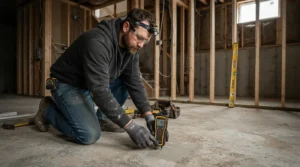
Real-World Scenarios: Matching the Meter to the Job
Three buyer profiles show how the same market splits into different right answers.
The Weekend DIYer
Picture a homeowner laying about 400 square feet of oak over plywood in a Midwest ranch, budget under $150, using the tool once. A Lignomat mini-Ligno E/D for true pin percentages or an Extech MO55A for both modes covers the job. Add a cheap humidity gauge, and the numbers are enough to follow acclimation advice.
The Working Installer
A contractor finishing several floors a month needs speed and documentation. The Wagner Orion 950 handles EMC, scanning and logs in one device. A frugal alternative pairs the Wagner Orion 910 for subfloors with a Delmhorst BD-2100 for pin confirmation.
The Leak Detective
A homeowner with seasonal gaps near a dishwasher doesn’t need lab precision. A Klein Tools ET140 maps wet and dry zones in minutes, and a General Tools MMD4E can confirm suspicious boards from the back side.
The pattern: pay for documentation when someone else’s money rides on the result, and pay for speed when you’re hunting problems.
✨ Ready to Gear Up Before the Boards Arrive?
🔍 Take your hardwood installation prep to the next level with these carefully selected meters. Click on any highlighted product name to check current pricing and availability. The right tool will help you build a floor that stays flat, tight and warranty-ready for years!
Problem and Solution: Five Moisture Headaches and How a Meter Helps
- Readings jump around. Check species and temperature settings, take more readings, and run the calibration check. A Delmhorst BD-2100 or Wagner Orion 950 makes that step quick.
- A pinless number looks strange. Metal fasteners or hidden hardware can skew a pinless reading, so confirm oddities with pins using a Lignomat mini-Ligno E/D.
- The subfloor reads high. Find the source (a leak, a damp crawlspace) and dry it before installing.
- Boards arrive at mixed readings. Isolate outliers, stack with spacers and retest.
- The slab is damp. A meter can’t settle that question. Move to relative humidity probes or calcium chloride testing, covered below.
How to Choose a Moisture Meter for Wood Flooring
Start with the job, not the brand: pick pin for verification and pinless for speed. Then check low-end range, species correction, sensing depth, calibration support and documentation tools.
- Decide pin, pinless or dual. Pinless scans quickly without marks, pin gives direct readings on board backs and subfloors, and dual covers both with compromises.
- Check the low end. Flooring lives in single digits to low teens, so look for a wood scale reaching 6% or lower.
- Demand species correction. Dense and light woods read differently, so choose a meter that corrects by species or at least by group.
- Match depth to thickness. Deep sensing suits subfloors, shallow suits thin boards, and dual handles both.
- Verify calibration support. On-demand calibrators and built-in checks keep numbers honest.
- Plan for documentation. Averaging memory or app logging helps when someone asks for proof.
- Divide price by use. A weekend job and a business are different math.
Pinless Moisture Meter vs Pin Meter: What the Difference Means on a Floor
A pinless moisture meter sends a low-frequency electrical signal through the material from surface pads. A pin meter measures resistance between two driven probes. Neither weighs water directly, and each brand converts signals with proprietary math, so numbers from different brands may not agree.
That last point has a practical rule: pick one meter family and use it for both subfloor and flooring. Subtracting a Brand A subfloor reading from a Brand B plank reading is apples versus oranges.
| Method | Strength | Weakness | Best For |
|---|---|---|---|
| Pinless moisture meter | Fast, no holes, scans many boards | Averages over a depth, needs right species setting | Wagner Orion 910, Klein Tools ET140 |
| Pin-type meter | Direct reading, clear percentage, ideal for board backs | Leaves pinholes, slower | Delmhorst BD-2100, Lignomat mini-Ligno E/D |
| Dual-mode meter | Scan then confirm | Pinless side is often relative only | Extech MO55A |
| Guessing by feel or seller’s word | Free | No data, no paper trail | Nobody |
| Oven-dry weighing | Direct measurement | Slow, destructive, impractical on site | Lab work |
As the table shows, the practical winners for most jobs are a pinless moisture meter for sweeping and a pin meter for confirming. The Wagner Orion 910 excels at the sweep, and the Delmhorst BD-2100 excels at the confirmation. Skipping measurement entirely is the only option with no upside.
Subfloor Moisture Testing Tool: Wood Subfloors vs Concrete Slabs
The right subfloor moisture testing tool depends on what’s under the boards.
Wood Subfloors
For plywood and OSB, a meter is the correct tool. A dry subfloor typically reads 12% or less, and some low-humidity regions run lower. Take your 20 readings per 1,000 square feet and average them. Any pinless moisture meter or pin meter in this round-up can do the job, though the Wagner Orion 910 is the most natural fit for panel sweeps.
Concrete Slabs
Concrete changes the rules. NWFA guidance favors in-situ relative humidity testing (ASTM F2170) or calcium chloride testing (ASTM F1869). Meters can help find problem areas, but ASTM F2659 doesn’t yet accept them as a final determination. Typical calcium chloride limits for direct glue-down wood flooring land around 3 pounds, though your manufacturer’s number rules.
The smart use of a meter on a slab is triage. Scan with a Klein Tools ET140 or Extech MO55A to find suspicious zones, then place proper RH probes where the scan points.
Humidity Damage: What Cupping, Gaps and Buckling Are Telling You
Humidity damage is slow, quiet and surprisingly readable. USDA Forest Service research explains that wood exchanges moisture with surrounding air depending on temperature, relative humidity and the wood’s current moisture. In other words, floors move because the room moves.
A cautionary example: a floor at 8% moisture exposed to 65% relative humidity can creep toward 12%. That swing is enough for visible dimensional change in many species.
Reading the Symptoms
- Gaps: Dry air shrinks planks, and many winter gaps close again when spring humidity returns.
- Cupping: Edges rise above the center, often when moisture is stronger below the boards than above.
- Buckling: Severe expansion lifts boards from the subfloor and may not fully reverse.
- Dry cupping: Extremely low indoor humidity can cup engineered floors, including one reported case at just 4.5% RH.
Using Your Meter as a Detective
Compare readings on affected boards against boards across the room. A gradient points toward the source. NWFA guidance says a cupped floor should stabilize before resanding, because sanding the symptom can set up a crown later. A Wagner Orion 950 with its ambient sensor is handy here, but a Klein Tools ET140 will find the wet corner too.
Flooring Warranty Requirements: Your Moisture Paper Trail
Flooring warranty requirements read like fine print because they are. Wagner’s overview of hardwood floor warranties notes that moisture damage is usually not covered unless the manufacturer guaranteed a specific moisture content. Warranties also lean on proper installation, correct humidity ranges and, sometimes, professional installers.
Warranty language I found for engineered products from Mohawk and Xulon spells out conditions such as 35-55% relative humidity, subfloor moisture at or below 12%, and limits on the gap between subfloor and flooring (4 points under 3 inches wide, 3 points above). Shaw’s hardwood residential warranty states that subfloor moisture damage isn’t covered. Another brand’s guide asks for written verification that the subfloor was inspected. Your manufacturer’s paperwork is the only version that counts.
Build the Paper Trail
- Record date, time and every reading, plus the meter model and species setting.
- Log calibration checks, which is where the Wagner Orion 950, Wagner Orion 910 and Delmhorst BD-2100 help.
- Keep humidity logs after install.
- File receipts, photos and installer documents together.
A meter doesn’t create a warranty, but it can prove you followed the conditions that keep one alive.
Features That Actually Matter (and Those That Don’t)
Features Worth Paying For
- Low-end range near 6%: Flooring lives there, which is why the Lignomat mini-Ligno E/D and Delmhorst BD-2100 fit the job.
- Species or wood-group correction: A reading with the wrong correction is a confident mistake.
- Calibration support: On-demand calibrators and built-in checks keep your numbers defensible.
- Sensing depth that fits your material: Deep, shallow or dual should match your boards.
- Warranty length: Seven years on Orions versus one year elsewhere is a real difference.
Features You Can Skip
- Fancy color screens: Backlit readability matters more than gradients.
- Huge 0-100% scales: Useful on drywall, irrelevant for hardwood.
- Bluetooth for a single floor: Helpful for pros, unnecessary for a one-time install.
- Accuracy claims worse than your tolerance: A ±4% rating, like the Klein Tools ET140‘s, can’t certify a 4-point window.
Long-Term Cost and Value: What Each Meter Really Costs per Floor
Divide the price by the floors you’ll test over five years. A cheap meter used once is expensive per use, and a premium one used weekly is cheap. Then add the failure cost: a cupped floor can cost more than every meter here combined.
| Meter | Upfront Tier | Ongoing Costs | Value Verdict |
|---|---|---|---|
| Wagner Orion 950 | $540-$650 | 9V battery, optional calibration certification | Pays off with frequent jobs |
| Wagner Orion 910 | $390-$440 | 9V battery, optional calibration certification | Best for subfloor-heavy work |
| Delmhorst BD-2100 | $350-$500 | Replacement pins, 9V battery | Strong for pin purists |
| Lignomat mini-Ligno E/D | $100-$200 | Replacement pins, 9V battery | Best mid-value pin |
| Extech MO55A | $120-$165 | Replacement pins, AAA batteries | Best dual-mode value |
| Klein Tools ET140 | Under $60 | 9V battery | Best leak-hunter per dollar |
| General Tools MMD4E | Under $60 | PIN3 replacement pins | Best backup per dollar |
Looking at the table, the long-term winners split by workload. Pros get the best return from the Wagner Orion 950, since the 7-year warranty spreads across hundreds of readings. One-floor homeowners are better served by the Extech MO55A or Lignomat mini-Ligno E/D. And everyone benefits from a sub-$60 backup like the General Tools MMD4E.
FAQ: Moisture Meter for Wood Flooring Questions
❓ Can a cheap moisture meter for wood flooring be accurate enough?
❓ Is a Wagner Orion 950 worth it for a one-time DIY install?
❓ Can a wood moisture meter for flooring test a concrete slab?
❓ How often should I calibrate a pinless moisture meter?
❓ Where do I find my flooring's moisture requirements?
Conclusion: Measure Twice, Nail Once
Moisture is the quiet reason hardwood floors fail, and a meter turns a guess into a record. For professionals, the Wagner Orion 950 is the most complete tool here, while the Wagner Orion 910 is the sharper choice for subfloor sweeps. Pin loyalists will find a durable workhorse in the Delmhorst BD-2100, and the Lignomat mini-Ligno E/D is the compact pin I’d reach for first on a budget. The Extech MO55A gives beginners both methods in one body, and the Klein Tools ET140 and General Tools MMD4E earn a spot as inexpensive scanners and backups.
Whatever you buy, the winning habit is the same: test the subfloor, test the boards, compare against the tolerances, acclimate, retest and write everything down. That routine protects against humidity damage and builds the paper trail flooring warranty requirements demand. Pick one meter family, set the right species, check calibration, and let the numbers decide when the boards go down.
✨ Don’t Wait for the Cupping to Start!
🔍 Choose the moisture meter for wood flooring that matches your job, then click any highlighted product name to check current pricing and availability. A few minutes with the right tool now can keep your floor flat, tight and worry-free for years!
Recommended for You
- Bosch Vs DeWalt Laser Measure: 7 Best Picks Ranked (2026)
- Stud Finder For Home Renovation: 7 Best Picks For 2026
- Level For Drywall Installation: 7 Proven Picks For 2026
Disclaimer: This article contains affiliate links. As an Amazon Associate, I earn from qualifying purchases. If you purchase products through these links, we may earn a small commission at no additional cost to you.
✨ Found this helpful? Share it with your friends! 💬🤗
