
In This Article
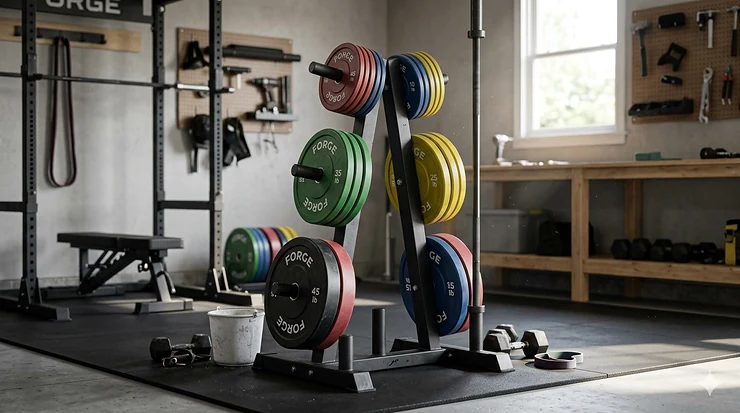
If you’ve ever stubbed your toe on a stray 45-pound plate at 5 AM, you know the pain—literally and figuratively. A cluttered garage gym isn’t just frustrating; it’s a safety hazard that kills your workout momentum before you even start. Research from gym safety experts indicates that improper equipment storage contributes to a significant percentage of home gym injuries—most of which are entirely preventable with organized storage solutions. The solution? A proper weight plate storage rack for garage gym that keeps your Olympic plates organized, accessible, and off the floor where they belong.
Here’s what most garage gym owners don’t realize: that pile of plates stacked against the wall isn’t just messy—it’s slowly damaging your equipment. Direct concrete contact wears down rubber coatings, metal plates develop rust in humid garages, and the constant bending to grab the right weight from the bottom of the stack adds unnecessary strain to your lower back. A quality storage rack solves all three problems while transforming your workout space from chaotic to professional.
The garage gym market has exploded since 2024, and with it came a flood of storage solutions ranging from budget-friendly wall mounts to heavy-duty commercial-grade trees that handle 1,000+ pounds. In this guide, I’ll walk you through seven real products currently available on Amazon, breaking down what works, what doesn’t, and exactly which rack matches your specific garage setup—whether you’re working with a cramped single-car space or a spacious two-car training facility.
Quick Comparison: Top Weight Plate Storage Racks at a Glance
| Product | Type | Capacity | Price Range | Best For |
|---|---|---|---|---|
| CAP Barbell Olympic Bumper Plate Tree | Freestanding | 660 lbs | $150-$200 | Mid-size collections with barbells |
| VEVOR Vertical Weight Plate Tree | Freestanding | 1,000 lbs | $120-$170 | Heavy users, mobile storage |
| SELEWARE 8-Peg Olympic Rack | Freestanding | 1,000 lbs | $180-$230 | Large plate collections |
| VEVOR Wall Mount (4-Pack) | Wall-mounted | 330 lbs total | $60-$90 | Space-saving, limited floor area |
| Kipika Weight Plate Tree | Freestanding | 1,000 lbs | $140-$190 | Versatile garage setups |
| Topeakmart Triangle Plate Rack | Freestanding | 882 lbs | $110-$150 | Budget-conscious buyers |
| EVERYMATE Wall Mount Plate Holder | Wall-mounted | 330 lbs | $50-$80 | Minimal footprint needs |
Looking at this comparison, the sweet spot for most garage gym owners falls in the $120-$200 range with 600-1,000 pound capacity. The VEVOR Vertical model delivers exceptional value with its wheeled mobility and 1,000-pound rating, while wall-mounted options like the VEVOR 4-Pack sacrifice some capacity for floor space preservation—a worthy trade in single-car garages where every square foot counts.
💬 Just one click — help others make better buying decisions too! 😊
Top 7 Weight Plate Storage Rack for Garage Gym: Expert Analysis
1. CAP Barbell Olympic Bumper Plate Tree Rack
The CAP Barbell Olympic Bumper Plate Tree Rack stands as one of the most reliable mid-capacity options for serious home gym owners. With 6 weight plate posts and 4 vertical barbell holders, this rack tackles the dual challenge of plate and bar storage in a single footprint.
The 660-pound total capacity breaks down to 110 pounds per post, which translates to real-world storage for most standard home gym plate collections—think pairs of 45s, 35s, 25s, and change plates without maxing out. The dimensions (51.18″ H x 23.62″ W x 25.59″ D) create a compact footprint that fits comfortably in the corner of a two-car garage without blocking vehicle access. What the spec sheet won’t tell you: those rubber end caps actually work. They protect your flooring from the 60+ pounds of steel frame weight and prevent the annoying sliding that cheaper racks suffer from during aggressive plate loading.
Customer feedback consistently highlights the powder-coated finish’s durability—users report minimal chipping even after 12+ months of daily use in humid garage environments. The barbell holders accommodate standard Olympic bars but run tall, so if you’re working with an 8-foot ceiling, measure twice before committing.
Pros:
✅ Dual functionality (plates + 4 barbells) maximizes space efficiency
✅ Powder-coated finish resists rust in typical garage humidity
✅ Rubber feet stay put without wall anchoring
Cons:
❌ Height (51″) limits use in garages with low ceilings
❌ Assembly requires two people for stability during setup
This rack suits intermediate to advanced lifters who’ve accumulated 400-600 pounds of plates and 2-4 barbells. Expect to invest around $150-$200, which delivers solid value when you factor in the 4-barbell storage eliminating the need for separate bar holders.
2. VEVOR Vertical Weight Plate Tree with Wheels
The VEVOR Vertical Weight Plate Tree separates itself from budget competitors through two features that matter in real garage training: genuine 1,000-pound capacity and locking caster wheels that actually lock. The vertical design stacks plates efficiently while keeping the footprint minimal—critical for garage gyms that double as parking spaces.
The heavy-gauge steel construction uses full-weld technology instead of bolt-together assembly, which eliminates the gradual loosening problem that plagues cheaper racks after 6-12 months of use. The black powder coating holds up remarkably well against the temperature swings and humidity that destroy lesser finishes. Those four swivel casters aren’t just for show—they transform this from a permanent fixture into mobile storage that you can roll against the wall when you need floor space for deadlifts or plyometrics.
Users consistently report the smooth-glide experience of loading and unloading plates, thanks to the precision-cut pegs that maintain consistent spacing. The rack handles both 2-inch Olympic plates and accommodates barbells in the integrated holders. What most reviews gloss over: the wheels elevate the rack slightly, which prevents the common problem of plates scraping against concrete during loading.
Pros:
✅ True 1,000-lb capacity supports serious plate collections
✅ Locking wheels enable storage flexibility
✅ Full-weld construction eliminates bolt maintenance
Cons:
❌ Larger footprint than wall-mount alternatives
❌ Wheels may scratch finished garage floors without protective mats
This rack targets the garage gym owner who’s accumulated 600-900 pounds of Olympic plates and values the ability to reconfigure their training space. The price range of $120-$170 positions it as exceptional value for the weight capacity delivered—you’re paying roughly 15-17 cents per pound of capacity versus 25-30 cents for comparable fixed-base options.
3. SELEWARE Olympic Weight Plate Tree Rack (8 Pegs)
The SELEWARE Olympic Weight Plate Tree Rack earns its premium positioning through sheer capacity and plate-protection features that cheaper alternatives skip. Eight dedicated weight plate posts handle massive plate collections, while the dual barbell holders prevent bar clutter—addressing both storage challenges garage gym owners actually face.
The 1,000-pound capacity isn’t marketing fluff; the unique trapezoidal base design distributes weight physics properly, preventing the dangerous tipping that occurs when cheap racks get loaded with 45s on one side. Each post features an inner plate washer and ball end cap—seemingly small details that prevent the chronic plate scratching issue. After loading and unloading hundreds of times, this design difference becomes obvious. Your bumper plates maintain their rubber coating instead of developing the worn spots that reduce resale value.
Customer feedback emphasizes the rack’s stability during aggressive loading—users report zero wobbling even when rapidly switching plates between sets. The matte black powder coating resists chips and scratches better than glossy finishes, maintaining professional appearance even after months of garage gym abuse. The compact footprint (34″ H x 37.8″ W x 30.3″ D) maximizes vertical storage without dominating floor space.
Pros:
✅ Eight pegs organize extensive plate collections systematically
✅ Trapezoidal base prevents tipping with uneven loading
✅ Ball end caps protect plate holes from wear
Cons:
❌ Higher price point than 4-6 peg alternatives
❌ Wider base requires more floor space commitment
This rack serves advanced lifters and small training groups who’ve accumulated 700-1,000 pounds of Olympic plates across multiple weight denominations. The $180-$230 range reflects the superior engineering—you’re investing in a storage solution that protects expensive bumper plates while organizing them for efficient access.
4. VEVOR Wall Mounted Weight Plate Holder (4-Pack)
The VEVOR Wall Mounted Weight Plate Holder solves the single biggest problem facing single-car garage gym owners: floor space scarcity. This 4-pack system mounts directly to studs, elevating plates vertically and reclaiming the square footage that freestanding racks consume.
Each holder supports 330 pounds through industrial-grade heavy-gauge steel construction and full-welding technology that creates seamless joints—no bolt loosening after repeated loading cycles. The 9-inch angled loading pins accommodate both 1-inch and 2-inch plates with the snug fit that prevents plates from sliding off during garage door vibrations or accidental bumps. What separates this from generic wall mounts: the 0.4-inch rubber padding on contact surfaces eliminates metal-on-plate friction that gradually wears through powder coating.
Installation requires basic tools and solid wood or concrete wall anchoring—the included heavy-duty expansion bolts handle the job when mounted to studs. Users report straightforward 3-step installation that takes roughly 15-20 minutes per holder. The upward angle (designed deliberately, not accidentally) prevents plates from creeping forward over time, addressing the common complaint with cheaper horizontal designs.
Pros:
✅ Maximizes floor space for actual training
✅ Rubber padding protects expensive bumper plates
✅ 330-lb per-holder capacity handles most home gym needs
Cons:
❌ Requires solid wall structure (studs or concrete)
❌ Permanent installation limits future reconfiguration
This solution targets space-constrained garage gym owners working with 200-600 pounds of plates who need every square foot for training. The $60-$90 range for the 4-pack delivers exceptional per-unit value—roughly $15-$22 per holder compared to $30-$50 for single-unit competitors.
5. Kipika Weight Plate Tree Rack
The Kipika Weight Plate Tree Rack distinguishes itself through base customization that addresses the mobility-versus-stability dilemma garage gym owners constantly navigate. You choose between the wheeled version (650-pound capacity, 4 lockable casters) or the fixed-feet variant (1,000-pound capacity, ultra-stable placement)—matching the rack configuration to your specific workflow.
The 8 stainless steel uprights feature polished finishes that create the smooth-glide loading experience that saves seconds during workout transitions. Those seconds compound across hundreds of plate changes annually, reducing workout friction. The commercial-grade construction uses industrial steel with the trapezoidal stability frame that prevents the tipping hazard cheaper triangular designs suffer from when loaded asymmetrically.
Customer reviews emphasize the rack’s ability to handle the heaviest Olympic plates without flexing—users loading multiple 45-pound plates per peg report zero bending or instability. The dual barbell holders integrate seamlessly, though they work best with standard 7-foot Olympic bars versus longer specialty bars. Assembly requires approximately 30 minutes with the included hardware and straightforward instructions.
Pros:
✅ Base option customization matches specific garage needs
✅ Stainless steel uprights resist rust in humid environments
✅ Commercial-grade construction supports heavy daily use
Cons:
❌ Wheeled version sacrifices 350 lbs capacity
❌ Premium features command higher price point
This rack serves the versatile garage gym owner who alternates between mobile training space needs and permanent storage configurations. The $140-$190 range reflects the quality engineering and base customization options—you’re paying for flexibility that cheaper fixed-design racks can’t deliver.
6. Topeakmart Triangle Olympic Plate Rack
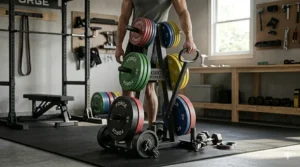
The Topeakmart Triangle Olympic Plate Rack delivers budget-friendly storage without sacrificing the capacity that matters. Six plate storage pegs accommodate 2.5 to 45-pound Olympic plates with an impressive 882-pound total capacity, while dual barbell holders prevent bar clutter—addressing both storage needs at an entry-level price point.
The powder-coated steel frame construction resists water and rust through the temperature extremes garage environments impose. The extra abrasion-resistant paint on weight plate pegs creates the smooth racking experience that prevents the catching and scraping issues cheaper racks develop after months of use. The triangular footprint (24.5″ W x 27″ D x 54.5″ H) optimizes floor space efficiency while maintaining stability under asymmetric loading.
Users consistently highlight the value proposition—receiving commercial-grade capacity at residential pricing. The rack handles serious plate collections without the wobbling or tipping that plague bargain-basement alternatives. Assembly straightforward with included hardware, though the powder coating benefits from careful handling during setup to prevent chips.
Pros:
✅ 882-lb capacity rivals premium alternatives
✅ Budget pricing ($110-$150) maximizes value
✅ Triangular design saves floor space
Cons:
❌ Taller height (54.5″) requires adequate ceiling clearance
❌ Powder coating vulnerable to chips during assembly
This rack targets budget-conscious lifters building their first serious plate collection or garage gym owners who’ve accumulated 500-800 pounds of weights without wanting to invest $200+ in storage. The $110-$150 range positions this as the best bang-for-buck option when floor space and capacity matter more than premium features.
7. EVERYMATE Wall Mount Weight Plate Holder
The EVERYMATE Wall Mount Weight Plate Holder strips weight storage down to the essentials: secure plate mounting that reclaims floor space without the feature bloat. This streamlined approach delivers exactly what minimal garage gyms need—reliable plate organization at the absolute lowest entry price.
The heavy-duty steel construction supports 330 pounds per holder through proper wall mounting to studs or concrete. The design philosophy emphasizes simplicity: mount to wall, load plates, start training. No assembly complications, no moving parts to maintain, no wheels to lock. The powder-coated finish resists basic garage environmental challenges, though it lacks the premium anti-chip properties of higher-tier options.
Users appreciate the straightforward installation process and the immediate floor space reclamation. The holder works best for gym owners with focused plate collections (200-300 pounds) versus those accumulating extensive weight sets. The basic design means plates slide on and off without the guided features that prevent scraping, so proper loading technique matters more here than with premium alternatives.
Pros:
✅ Entry-level pricing ($50-$80) minimizes investment
✅ Dead-simple installation and use
✅ Maximizes floor space in tight garages
Cons:
❌ No protective padding for plate preservation
❌ Basic finish lacks premium durability features
This holder serves the minimalist garage gym owner or beginners building their first plate collection without wanting to commit $150+ to storage infrastructure. The $50-$80 range delivers the absolute lowest cost per pound of storage capacity—you’re paying for function over features, which makes perfect sense for budget-focused setups.
How to Choose the Right Weight Plate Storage Rack for Your Garage Gym
Selecting the optimal weight plate storage rack for garage gym requires matching your current equipment reality to your space constraints—not buying based on aspirational plate collections you haven’t accumulated yet. Start by auditing what you actually own: count your plates by weight denomination, measure their total poundage, and assess how many barbells need storage. That number dictates your minimum capacity requirement, but smart buyers add 30-40% buffer for inevitable growth.
Space Assessment
Measure your available garage footprint before browsing products. Single-car garages (approximately 12′ x 22′) demand wall-mounted solutions or compact vertical trees with sub-30-inch footprints. Two-car setups (20′ x 22′) accommodate freestanding racks without compromising vehicle parking. Critical measurement: distance from your power rack or lifting platform to proposed storage location. Plates should sit within 6-8 feet of your primary training zone—farther distances create workout friction that gradually erodes training consistency.
Mobility Needs
Fixed-base racks excel when your garage dedicates permanent square footage to fitness. Wheeled options make sense for dual-purpose garages where you need to reconfigure space for vehicles, projects, or seasonal storage. The trade-off: wheeled racks typically sacrifice 200-350 pounds of capacity and cost $20-$40 more than fixed equivalents. Evaluate whether that mobility premium aligns with your actual usage patterns versus theoretical flexibility you’ll rarely utilize.
Construction Quality
Full-weld construction outlasts bolt-together assemblies by years in garage environments where temperature swings and humidity create expansion-contraction cycles that loosen fasteners. Powder-coated finishes resist rust better than painted alternatives—look for specifications mentioning “industrial” or “commercial-grade” powder coating. Stainless steel uprights command premiums but eliminate rust concerns entirely in coastal or humid climates where standard steel eventually corrodes regardless of coating quality.
Setting Up Your Garage Gym Storage System: A Practical Guide
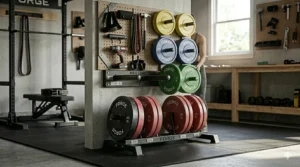
Proper storage rack installation determines whether your garage gym functions smoothly or creates daily frustration. Wall-mounted holders require solid anchoring to wood studs or concrete—drywall anchors fail catastrophically under 200+ pound plate loads. Use a stud finder to locate framing, then mark mounting points with a level to ensure horizontal alignment. The installation sequence matters: mount all holders before loading any plates, allowing you to verify stability without risking equipment damage.
Optimal Plate Organization
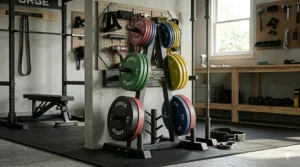
Arrange plates by weight with heaviest (45s) on bottom pegs and lightest (2.5-5 pounders) at top. This configuration creates natural stability while positioning frequently-used weights at comfortable loading heights (hip to shoulder level). Store matching pairs on the same peg—when you need 90 pounds, you grab two 45s from one location instead of hunting across multiple pegs. Label pegs if your rack stores multiple plate types (bumper, iron, competition) to maintain organization when rushing between sets.
Safety Spacing
Maintain 24-inch clearance around freestanding racks for safe loading access from all angles. Wall-mounted holders need 18-inch forward clearance minimum—less space creates the awkward body positioning that increases injury risk when handling heavy plates. Position storage racks away from garage door tracks and vehicle paths where bumps and vibrations could dislodge plates over time. According to SafetyCulture’s comprehensive gym safety guide, proper equipment spacing ranks among the top factors in preventing training-related injuries—a principle that applies equally to home garage gyms.
Climate Considerations
Unheated garages experience temperature extremes that affect equipment longevity. In humid climates, position racks away from exterior walls where condensation concentrates. Apply thin rubber mat beneath freestanding racks to prevent moisture wicking from concrete slabs. For wall-mounted systems in temperature-variable garages, annual bolt-tightening compensates for expansion-contraction cycles that gradually loosen hardware.
Common Mistakes When Buying Weight Plate Storage for Garage Gyms
The single biggest purchasing error garage gym owners make: buying capacity based on current plate weight instead of realistic growth projections. You own 300 pounds of plates today, so you purchase a 350-pound rack thinking the 50-pound buffer suffices. Twelve months later, you’ve added another pair of 45s and some 35s, and suddenly you’re either maxing out capacity or shopping for a second rack. Professional gym organizers consistently recommend the 130-150% rule: buy storage capacity equal to 1.3-1.5 times your current equipment weight. The smarter play: buy for 130-150% of current weight, which accommodates the natural plate accumulation that occurs as training advances.
Ignoring Ceiling Height
Freestanding racks range from 34 to 54 inches tall, and vertical barbell storage adds another 20-24 inches. Standard garage ceilings sit around 7-8 feet, but many homeowners install overhead storage that drops effective ceiling height to 6.5 feet. Measure from floor to lowest overhead obstruction, then compare against rack specifications including barbell holders. The mistake compounds when you realize clearance issues only after assembly—returning fully-assembled 80-pound racks creates logistics headaches most retailers charge restocking fees to resolve.
Prioritizing Price Over Weight Capacity
Budget racks rated for 300-400 pounds cost $30-$50 less than 600-800 pound alternatives. That savings evaporates when the cheaper rack maxes out 18 months into your lifting journey, forcing a replacement purchase. Worse: overloading undersized racks creates instability that damages plates, risks tipping accidents, and stresses welds until failure. The math favors buying proper capacity initially—amortized across 5-7 years of use, the $40 premium costs roughly $6 annually while preventing the $120+ replacement cycle.
Overlooking Assembly Requirements
Product descriptions rarely clarify that “some assembly required” translates to 45-90 minutes of work requiring two people and specific tools. Budget racks often include minimal hardware and vague instructions that assume mechanical familiarity most homeowners lack. Premium options provide comprehensive hardware kits and clear instruction manuals, but they still demand proper tools—impact drivers, socket sets, levels. Factor assembly reality into purchase decisions, particularly if you’re building a garage gym solo without experienced help available.
Vertical vs. Horizontal Weight Plate Storage: Which Design Works Best?
Vertical plate trees dominate garage gym setups because they optimize the scarcest resource: floor space. These designs stack plates upward across 6-8 pegs, creating compact footprints (typically 24-30 inches diameter) that fit corner spaces and against walls without blocking training zones. The physics work in your favor—gravity pulls plates downward onto pegs, creating inherent stability that horizontal racks lack. Loading and unloading flows naturally from top pegs down, matching the ergonomic movement patterns your body prefers.
Horizontal Rack Advantages
Horizontal plate storage shines in specific scenarios vertical designs can’t match. Extremely low ceiling garages (under 7 feet) physically can’t accommodate 50+ inch vertical racks with barbell storage. Horizontal racks also excel for plate collections dominated by heavy denominations—when you own ten pairs of 45s but minimal change plates, horizontal pegs allow spreading weight across more mounting points versus overloading vertical positions. The trade-off: horizontal racks demand 40-60 inch width allocations that consume premium wall space vertical options preserve.
Wall-Mounted Solutions
Wall-mounted holders represent the ultimate space optimization but impose permanent infrastructure changes. Drilling into studs creates holes that remain when you eventually move, potentially affecting home resale in markets where garage gyms aren’t standard. The installation commitment makes sense for long-term homeowners who’ve finalized their garage gym layout, but renters or frequent movers should favor portable options. Wall mounts also require solid structural anchoring—older homes with questionable wall framing may need reinforcement that adds $100-$300 in contractor costs.
Hybrid Approaches
Smart garage gym owners combine vertical freestanding racks for primary plate storage with supplementary wall-mounted holders for specialized equipment. Store your frequently-rotated training plates (45s, 35s, 25s) on the accessible vertical tree, while wall mounts organize change plates and specialty equipment you grab occasionally. This two-tier system prevents the common mistake of buying an oversized rack to handle every plate denomination when targeted solutions cost less and function better.
Cost Analysis: Budget vs. Premium Weight Storage Options
The price spread between budget and premium weight plate storage racks spans $50 to $230—a 360% difference that demands understanding what you’re actually paying for at each tier. Budget racks ($50-$110) deliver basic functionality: they hold plates off the floor and organize weights by denomination. Premium options ($180-$230) add engineered stability features, protective coatings, and capacities that accommodate serious training progression. The question isn’t whether premium racks are “better”—of course they are—but whether those improvements justify the investment for your specific situation.
Budget Tier Analysis ($50-$110)
Entry-level options like the EVERYMATE Wall Mount and Topeakmart Triangle Rack sacrifice refined engineering for functional adequacy. Expect thinner-gauge steel that flexes slightly under maximum loads, powder coatings that chip more readily, and assembly hardware that requires occasional retightening. These compromises matter less than most buyers assume—a budget rack properly maintained delivers 5-7 years of reliable service if you’re working with 300-600 pounds of plates. The math works when you calculate cost-per-year: a $90 rack lasting 6 years costs $15 annually. Compare that against storing plates on the floor where dropped weights damage concrete, plates get misplaced, and poor organization adds minutes to every workout.
The hidden cost consideration: budget racks often lack the plate-protection features that preserve expensive bumper plate value. If you’ve invested $1,200 in competition bumper plates, the $50 savings from choosing a basic rack becomes counterproductive when plate wear reduces their resale value by $200-$300. Conversely, if you’re running iron plates that cost $1-$2 per pound, budget storage makes perfect financial sense—iron handles abuse without the coating degradation bumpers suffer.
Mid-Range Sweet Spot ($120-$180)
This tier delivers 80% of premium features at 60% of premium pricing—the classic value optimization. The VEVOR Vertical Weight Plate Tree and Kipika Weight Plate Tree exemplify this positioning: commercial-grade capacity (1,000 pounds), full-weld construction that eliminates maintenance hassles, and protective features that preserve plate condition. You’re paying for engineering that addresses the common failures budget racks experience: instability under asymmetric loading, bolt loosening through repeated use, coating degradation in garage environments.
The value calculation shifts dramatically when you account for equipment longevity. Mid-range racks routinely deliver 10-15 years of service versus 5-7 years for budget alternatives. Amortized across that timeline, a $150 rack costs $10-$15 annually compared to $12-$18 for budget options requiring earlier replacement. The difference narrows to $2-$3 per year while delivering superior stability, capacity, and plate protection throughout that period.
Premium Investment ($180-$230)
Top-tier options like the SELEWARE 8-Peg Rack command premiums through capacity exceeding typical home gym needs (1,000+ pounds) and protective features that preserve plate investments. The target buyer: serious lifters who’ve accumulated extensive plate collections and view storage as infrastructure worth paying for once correctly. The engineering refinements at this level—trapezoidal base designs, ball-end protective caps, stainless steel uprights—deliver marginal improvements over mid-range alternatives but those margins matter when protecting $1,500-$2,000 plate collections.
Premium racks also maintain resale value substantially better than cheaper alternatives. When you eventually upgrade your garage gym or move, a well-maintained premium rack recovers 50-60% of purchase price versus 20-30% for budget options. Factor that residual value into true ownership cost and the premium tier’s lifetime expense approaches mid-range alternatives despite higher upfront investment.
Space-Saving Strategies for Single-Car Garage Gyms
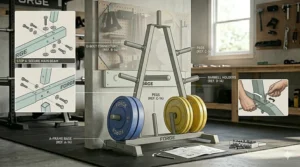
Single-car garages (typically 12′ x 22′) present unique challenges for weight plate organization because every square foot competes between vehicle parking and training equipment. The math gets tight fast: a standard compact car occupies roughly 15′ x 6′ when parked, leaving you with approximately 7′ x 12′ for your entire gym setup. Subtract space for a power rack (4′ x 4′), and you’re working with 3′ x 12′ for all remaining equipment including plate storage.
Wall-mounted solutions become non-negotiable in these constraints. The VEVOR or EVERYMATE wall mount holders reclaim floor space by utilizing vertical wall real estate your car never needs. Mount them 48-54 inches high on the wall behind your vehicle’s parking position—this height keeps plates accessible while you’re training but above bumper level when your car’s parked. Strategic placement along the garage’s back wall creates a storage gallery that holds 600-800 pounds of plates across 4-6 holders without consuming any floor footprint.
The alternative approach: mobile vertical trees with locking casters. Roll the VEVOR Vertical Weight Plate Tree against the wall when you need vehicle access, then wheel it to your training zone when working out. This adds 30-45 seconds to your setup routine but preserves the organizational advantages freestanding racks deliver. The key metric: measure your garage’s usable width with the car parked—you need minimum 30 inches of clearance for a vertical rack to fit comfortably without forcing you to squeeze between car and equipment.
Corner Optimization
Garage corners represent prime real estate for storage systems because they’re the least useful space for other purposes. Triangle-design racks like the Topeakmart Olympic Plate Rack nestle into corners with their angled footprints, maximizing capacity while minimizing intrusion into your training zone. Position the rack in the corner opposite your garage door—this keeps it away from the traffic flow when entering with your vehicle while maintaining easy access during workouts.
Bumper Plates vs. Iron Plates: Storage Implications
The plate type dominating your collection significantly influences optimal storage rack selection—a detail most buying guides completely ignore. Bumper plates measure 17.7 inches diameter regardless of weight (standardized for Olympic lifting), creating uniform stacking that works beautifully on vertical pegs. Iron plates vary dramatically in diameter: 45-pounders might measure 17 inches while 25-pound plates shrink to 10 inches. This size variation creates the frustrating scenario where mixing iron weights on single pegs becomes impossible—smaller plates slide past larger ones or get trapped behind them.
Bumper Plate Storage Advantages
Uniform diameter means you can load mixed weights on the same peg without the stacking chaos iron plates create. The rubber coating also provides natural grip that keeps plates stable on pegs versus the slippery metal-on-metal contact of iron weights. This stability matters more than you’d expect—how many times have you bumped your rack while grabbing plates, only to watch a domino effect as weights slide and crash? Bumper plates’ friction resistance prevents that cascade. The thickness trade-off: bumper 45s measure 3-4 inches thick versus 1.75 inches for iron equivalents, reducing how many plates fit per peg.
Iron Plate Considerations
Iron plate collections benefit from racks with multiple shorter pegs versus fewer longer pegs. The SELEWARE 8-Peg Rack excels here—eight individual storage posts let you dedicate specific pegs to specific weights, eliminating the mixed-diameter stacking problem entirely. Organize one peg for 45s, another for 35s, a third for 25s, and so forth. This denomination-specific approach creates the grab-and-go efficiency that mixed loading can never achieve. The durability advantage: iron plates handle abuse better than rubber coatings, so cheaper racks without protective padding work fine—you’re not preserving expensive bumper plate finishes.
Mixed Collections
Own both bumper and iron plates? Segregate them on separate storage systems or dedicate specific rack sections to each type. Store bumpers on your primary vertical tree positioned nearest your lifting platform—these are your working weights for squats, deadlifts, and Olympic movements where you need plates fast. Relegate iron plates to secondary wall-mounted holders for accessory work and less-frequently-used denominations. This two-tier organization prevents the frustration of hunting through mixed plate types when you need specific weights quickly between sets.
Long-Term Maintenance and Care for Your Weight Storage System
Quality weight racks require minimal maintenance but ignore them completely and even commercial-grade equipment degrades prematurely. Quarterly inspections prevent the gradual loosening that occurs as plates repeatedly load and unload from pegs—vibrations travel through metal frames, slowly backing out bolts that seemed tight during initial assembly. As highlighted in comprehensive gym maintenance guides, regular equipment inspections are the difference between safe, long-lasting gym equipment and costly accidents. Walk your rack with a socket set every 3 months, checking each connection point and retightening as needed. This 10-minute task extends rack lifespan by years while preventing the dangerous instability that develops when structural connections fail.
Coating Preservation
Powder-coated finishes resist garage environmental challenges but they’re not indestructible. Chips and scratches create entry points for rust in humid climates or coastal regions where salt air accelerates corrosion. Touch up damaged areas immediately using color-matched spray paint from hardware stores—even imperfect color matching beats exposed metal that spreads rust across the frame. For wall-mounted racks, annual inspection of mounting hardware matters more than frame condition—wall anchors and expansion bolts gradually work loose through repeated loading cycles, and a failed mount drops 300 pounds of plates with catastrophic consequences.
Peg Wear Patterns
Steel pegs develop wear grooves where plates repeatedly slide on and off at the same positions. Monitor wear progression during quarterly inspections—grooves deeper than 1/8 inch indicate peg replacement time before structural integrity compromises. Premium racks use replaceable pegs that unbolt for individual replacement versus forcing complete rack replacement when wear reaches critical levels. The cost difference: $15-$25 per replacement peg versus $150+ for new rack when cheaper designs fail.
Environmental Protection
Unheated garage temperatures swing 40-60 degrees seasonally in many climates, creating expansion-contraction cycles that stress welds and loosen bolts. Apply light machine oil to moving parts (caster wheels, swivel mechanisms) annually to prevent the seizing that occurs when metal components rust together. For wall-mounted systems, check that mounting bolts maintain consistent torque—temperature variations cause wall materials to shift slightly, potentially loosening connections over months. The five minutes spent verifying bolt tension prevents the catastrophic failure that drops hundreds of pounds of plates when walls shift.
FAQ: Your Weight Plate Storage Questions Answered
❓ How much weight can a standard garage gym weight plate rack hold?
❓ Can I install wall-mounted plate holders on drywall?
❓ What's the difference between Olympic and standard weight plate racks?
❓ How do I prevent my freestanding weight rack from tipping over?
❓ Should I choose a fixed or wheeled weight plate storage rack?
Conclusion: Building Your Ideal Garage Gym Storage Solution
Choosing the right weight plate storage rack for garage gym fundamentally transforms your training experience from chaotic equipment hunting to streamlined workout flow. The seven options detailed above span the spectrum from budget-conscious wall mounts to premium freestanding trees, ensuring solutions exist for every garage size, plate collection, and budget constraint. The key insight: match storage capacity to your actual needs plus 30-40% growth buffer, not the theoretical maximum plates you might someday accumulate.
For most garage gym owners working with 400-800 pounds of Olympic plates in a two-car space, the VEVOR Vertical Weight Plate Tree or SELEWARE 8-Peg Rack deliver optimal capacity-to-footprint ratios. Single-car garage trainers should seriously consider wall-mounted solutions like the VEVOR 4-Pack that reclaim floor space without sacrificing serious storage capacity. Budget-focused builders can’t beat the Topeakmart Triangle Rack’s 882-pound capacity at $110-$150, proving that smart equipment choices don’t require premium spending.
Beyond the storage rack itself, remember that organization quality compounds over years of training. The five minutes you spend today installing your rack properly—leveling, anchoring, positioning—pays dividends across thousands of workouts. Every effortless plate change, every eliminated equipment search, every prevented trip hazard adds up to hundreds of hours reclaimed for actual training versus garage gym management. That’s the real value proposition: buying back your time and mental energy for what matters—getting stronger.
Recommended for You
- 7 Best Tire Storage Rack for Garage Solutions in 2026
- 7 Best Motorcycle Gear Storage Solutions That Transform Your Space 2026
- 7 Best Motorcycle Lifts for Home Garage That’ll Transform Your Workshop (2026)
Disclaimer: This article contains affiliate links. As an Amazon Associate, I earn from qualifying purchases. If you purchase products through these links, we may earn a small commission at no additional cost to you.
✨ Found this helpful? Share it with your friends! 💬🤗
